




Abstract
As the use of realist approaches gains momentum, there is a growing interest in how systems approaches can complement realist thinking. In this article, we discuss how the epistemology of Soft Systems Methodology is compatible with realist approaches. Both Soft Systems Methodology and realist approaches emphasize the necessity to engage stakeholders; through models, the description of contingencies and exploring the intricacies of how complex programmes really work. We outline the key elements of realist approaches and Soft Systems Methodology, and report on two novel case studies. Drawing on our own experiences, we make the case that, used in conjunction with a realist approach, Soft Systems Methodology can provide a useful tool to a) map programme complexity, and b) develop and refine stakeholders programme theories, thus increasing the transparency, reliability, validity and accuracy of the theory building and refining process in realist approaches. We highlight Soft Systems Methodology as a novel companion to realist approaches and detail the first case studies of its use.
Background
As realist approaches gain momentum in the evaluation of complex social programmes and interventions, attention is turning to how other approaches can complement realist thinking. This article explores the benefits of using Soft Systems Methodology (SSM) within realist driven research. SSM is a constructivist endeavour that enables researchers to uncover real world complexity as experienced by stakeholders. We make the case that, when used in conjunction with a realist approach, SSM provides a useful tool to a) map programme complexity, and b) develop and refine stakeholders programme theories.
We provide an examination and critical discussion of the complementarity of both realist principles and soft systems approaches. Following this, we present two case studies and draw on both to illustrate our argument that SSM can help in mapping programme complexity (referred to as Advantage A) and developing and refining realist programme theories (referred to as Advantage B).
Realist approaches and Soft Systems Methodology
Realist approaches
Evaluation has previously been dominated by two views of how we understand the world we live in: positivism and interpretivism (Julnes and Mark, 1998). The two paradigms have opposed one another for many years (Julnes and Mark, 1998; Sorokin, 1957) and provide the researcher with a difficult choice, as described by Bhaskar: ‘Either a conceptually impoverished and deconceptualising empiricism, or a hermeneutics drained of causal import and impervious to empirical controls’ (1989: 12). Realism offers an approach for inquiry that neither rejects nor endorses the positions offered by the traditional positivist and interpretivist paradigms (Julnes and Mark, 1998; Pawson and Tilley, 1997). Realist approaches are embedded in realism: ‘a school of philosophy which asserts that both the material and the social worlds are “real” and can have real effects; and that it is possible to work towards a closer understanding of what causes change’ (Westhorp et al., 2011: 1). In realism, there is an underlying belief in a stratified nature of social reality, in that all human actions are embedded within a wider range of social processes (Pawson and Tilley, 1997). Even the most repetitive and commonplace actions are only understandable because they contain innate assumptions about a wider set of rules and institutions (Pawson and Tilley, 1997). Therefore, human action and reasoning is not linear and is understood in terms of its location within different layers of social reality. Causation is therefore viewed as generative, rather than successionist (Pawson and Tilley, 1997), meaning that outcomes of interest are generated by relevant mechanisms which are triggered by context (Wong et al., 2016). The underlying mechanisms that give rise to the event are the focus of the realist study (Dalkin et al., 2015; Westhorp et al., 2011; Wilson and McCormack, 2006).
Realist evaluation and realist syntheses are theory-driven methods (Greener and Mannion, 2009) that focus on explaining the mechanisms of action that underlie different complex programmes or interventions. An appreciation of the complex social reality inherent in the different programmes under investigation is required in order to seek the theories that explain why interventions are successful in some instances but not in others (Hewitt et al., 2012). In both realist evaluation and synthesis methods, the process begins with the development of a causal assertion represented as an initial programme theory representing conjectured Context–Mechanism–Outcome configurations (CMOC). Causal powers within objects, agents or structures under investigation are sought and often expressed in terms of CMOC (Pawson, 2006b). Complex and systematic understanding of causal powers, which takes into account the underlying constructs that connect two events, and the context in which that relationship occurs, is required (Pawson, 2006b).
The underpinning principles of the realist approach are well-documented (Greenhalgh et al., 2015; Pawson, 2006b, 2013; Pawson and Manzano-Santaella, 2012; Pawson and Tilley, 1997; Wong et al., 2013b), so too are the challenges of articulating and developing programme theories (Dalkin et al., 2015; Jagosh et al., 2013; Lacouture et al., 2015; Salter and Kothari, 2014). Therefore in this article, we highlight the possibilities offered by SSM principles as an adjunct tool in conducting realist inquiry.
Soft Systems Methodology
Originating in systems engineering, SSM is now tailored towards development of a better understanding of complex situations through participants’ learning (Hindle, 2011). SSM offers a complex and adaptive systems-based approach for understanding problems, and originates from a phenomenological philosophical position (Checkland, 1999).The system is not a formal structure but ‘more a conceptual dynamic amalgamation of interacting agents around an issue, situated within a context’ (Ribesse et al., 2015: 2). In SSM, the system maps created are set against perceptions of the real world by a process of comparison that initiate debate between stakeholders, often with different agendas and degrees of separation from the situation (Checkland and Scholes, 1992). As a result of this comparison, stakeholders gain a better understanding of a situation, and are engaged in a reflexive learning cycle leading to improvements. The process of SSM has been summarized by Von Bulow (1989: 35): The learning takes place through the iterative process of using system concepts to reflect upon and debate perceptions of the real world, taking action in the real world, and again reflecting on the happenings using systems concepts. The reflection and debate is structured by a number of systemic models. These are conceived as holistic ideal types of certain aspects of the problem situation rather than as accounts of it. It is taken as a given that no objective and complete account of a problem situation can be provided.
Thus, SSM operationalizes the co-construction of social reality maps with the greatest face validity for the system actors themselves. In order to ensure theoretical validity, Checkland (2000) suggests the researcher explores and questions the key structures, processes, people, issues expressed by stakeholders, and conflicts in the programme, as well as its broader social, cultural and political contexts (Checkland and Scholes, 1992).
Contemporary SSM is a flexible methodology (Hindle, 2011), and provides a framework to make explicit a variety of stakeholder perspectives separately and understand their implications. Particular perspectives are subjected to a structured and rigorous model development process using the mnemonic CATWOE (Checkland and Scholes, 1992).
Checkland and Holwell (1998) explain how, in SSM, complex situations are expressed in diagrammatic forms, to facilitate representing the complex nature of the real world. The starting point in an SSM map is a Transformation (T), that is, from a particular perspective, what is actually transformed from input to output. Once the transformation is identified, other key elements of the system can be uncovered. SSM is an iterative approach; different combinations of CATWOE can be configured, providing in depth understanding of a programme from a variety of perspectives.
Checkland (2000) suggests that developing the initial model should not be an exhaustive process. The SSM process is about cycles of discussion, deliberation and knowledge development as opposed to producing the ‘ideal’ solution first time. Following comparisons with real world and relevant data, the process can begin again; a new model is built which is a closer representation of the real world.
Using Soft Systems Methodology within a realist approach
It is beyond the scope of this article to discuss similarities and differences of realist and constructivist ontologies (Clark, 2008). However, we consider that there are enough commonalities to justify their juxtaposition as a productive endeavour to improve the quality of research inquiry.
SSM and realist approaches: Advantage A
Both approaches can be thought to be underpinned by complexity theory. Westhorp (2012) makes the case of the commonalities between complexity theory and realist approaches, for example, both approaches support the principle of emergence, that is, the belief that complex wholes or entities have specific properties or powers that are not reducible to the components that make up the whole (Checkland and Scholes, 1992; Elder-Vass, 2005). This is linked to a principle in complexity, of reality being comprised of open systems embedded in one another, in which change is generative, dependent on context and viewpoint, and evolves in time (Westhorp, 2012). Indeed, SSM is ‘oriented towards tackling complex situations through the experiential learning of a group of participants’ (Hindle, 2011: 32), so that learning takes place through the iterative process of using and refining system concepts. Furthermore, complex healthcare systems, which were the focus of both studies, make the identification of influential contextual factors even more difficult (Øvretveit, 2011). There is also a lack of practical instruction to understand Pawson and Tilley’s (1997: xiii) explanation of stratification as social programmes involving ‘the interplay of individuals and institution, and of structure and agency’. Thus, SSM might provide a way to manage and uncover the complexity of systems, particularly in the health care setting (Advantage A).
SSM and realist approaches: Advantage B
Realist approaches are a form of theory-driven evaluation which search for and refine explanations of programme effectiveness, however, several realist studies have been identified which lack this essential process (Pawson and Manzano-Santaella, 2012). Use of SSM may support inclusion of stakeholders from the outset of a research process; meaning that programme theory is considered and has expert input. As aforementioned, stakeholder engagement is important in both SSM and realist approaches. Whilst less emphasis may be placed on their learning, as in SSM, Pawson argues that interpersonal relationships between stakeholders embody the intervention (Pawson, 2006a), yet stakeholder engagement can be an afterthought in the research process. Use of SSM may engage stakeholders in a meaningful way from the outset of a research project, allowing them to develop and hone programme theory (Advantage B).
Thus, we suggest that using SSM within a realist approach has the potential to aid in some of the challenges inherent in the evaluation of complex interventions.
Epistemologically, both SSM and realist approaches engage in developing hypothetical descriptions that reveal the underlying mechanisms of everyday life, and refine them overtime, through an iterative process using both experimental and experiential data to refine and test the represented hypotheses (CATWOE maps in SSM, and as CMOCs in realist approaches).
Realist approaches are method-neutral (Marchal et al., 2012), therefore we suggest exploring the possibilities of combining other approaches, such as SSM, with realist methods should be encouraged. In the following section, we report on two illustrative case studies. We then draw on these case studies to identify how SSM was used to both map programme complexity, and develop and test initial programme theories.
Case studies
Case Study 1 is a realist evaluation of an Integrated Care Pathway (ICP) for people with palliative care needs in primary care (Dalkin, 2014; Dalkin et al., 2016), which was developed in line with UK national strategies on Advance Care Planning (ACP) and end of life care (NHS National End of Life Care Strategy, 2011). The ICP involved several ‘mini interventions’ such as the enhanced use of palliative care registers, ACP, anticipatory medication and the Liverpool Care Pathway (LCP). The ICP engaged many organizations and staff members, whom were engaged and met regularly through the formation of a palliative care partnership. The partnership included staff from NHS primary and secondary care, local hospices, social services, third sector organisations, government services, local audit and research group, ambulance trusts, and patient and public representatives.
Case Study 2 draws from a National Institute for Health Research funded realist synthesis of workforce development interventions, what works, how and under which contexts, to improve the skills and care standards of support workers in older people’s health and care services (Rycroft-Malone et al., 2014). As workforce development is complex, involving people, structures and organizations, the use of a realist approach was well suited to explain both the complex and contingent nature of programmes and interventions. Stakeholder engagement was embedded throughout the review process, which included patient and public involvement representatives, service providers, commissioners, and members from relevant organizations e.g. professional bodies and policy makers. In this case, stakeholder engagement was essential to explore the context of the review, to help refine the review questions, contribute to programme theory development, and to affirm or falsify the research team’s interpretation of the evidence (Rycroft-Malone et al., 2015).
In Case study 1 those who took part in the focus groups are referred to as (research) participants, in Case study 2, those who took part in the workshop are referred to as stakeholders. In both case studies, development of SSM maps led to a) mapping programme complexity (Advantage A), and b) realist theory development (and refinement, in case study 1) (Advantage B). In the following paragraphs, we draw on our case study examples to examine these two aspects in more detail.
Advantage A: Mapping programme complexity
In Case Study 1, a series of three focus groups with health care professionals were used to develop and refine programme theories (Dalkin, 2014). Participants were initially asked about the implementation of the ICP, the mini interventions within it, and any barriers to its use. Each mini intervention within the ICP was presented as a system embedded within the wider ICP system, itself embedded within the broader local health, social care and voluntary sector systems, themselves impacted on by wider local and national policy initiatives. Case Study 2, a realist evidence synthesis, investigated health care assistant workforce development in the care of older people. As such what works, for whom, why and in what circumstances was set within a range of organizational, professional and political contexts, with their impacts being contingent on a range of factors (i.e. personal, work-related, professional and organizational) (Rycroft-Malone et al., 2015; Williams et al., 2016).
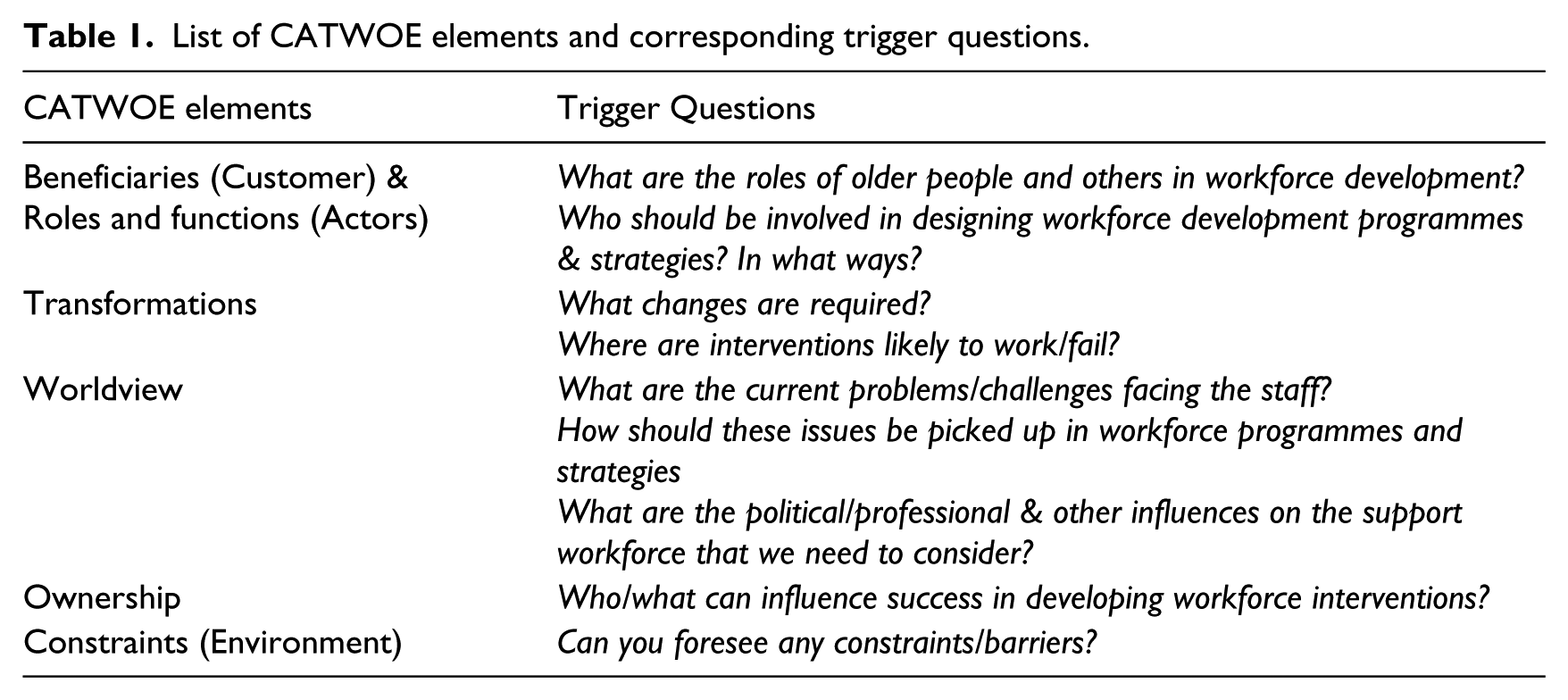
In Case Study 2, CATWOE components were used to structure deliberative conversations with stakeholders to surface their perspectives about healthcare assistant workforce development (see Table 1). The outputs from these discussions were then used to develop rich pictures that represented the complexity of a workforce development ‘system’ by linking the six CATWOE elements. Similarly, in Case Study 1, SSM maps were used for each mini intervention within the ICP; the map on ACP is provided as an example in Figure 1. This allowed the integration of knowledge from key stakeholders implementing the ICP and from the founder of the ICP, thus providing expert knowledge of how the systems within the ICP linked together allowing the programme to ‘work’. Thus Figure 1 maps out how ACP should work, providing many potential contexts, mechanisms and outcomes. SSM helped in drawing conceptual boundaries around the complex ICP system and the systems within it. It also concurrently acknowledged systems that impacted upon the ICP (such as social care systems), positively or negatively, therefore embracing the complexity of the ICP system as a whole.
List of CATWOE elements and corresponding trigger questions.
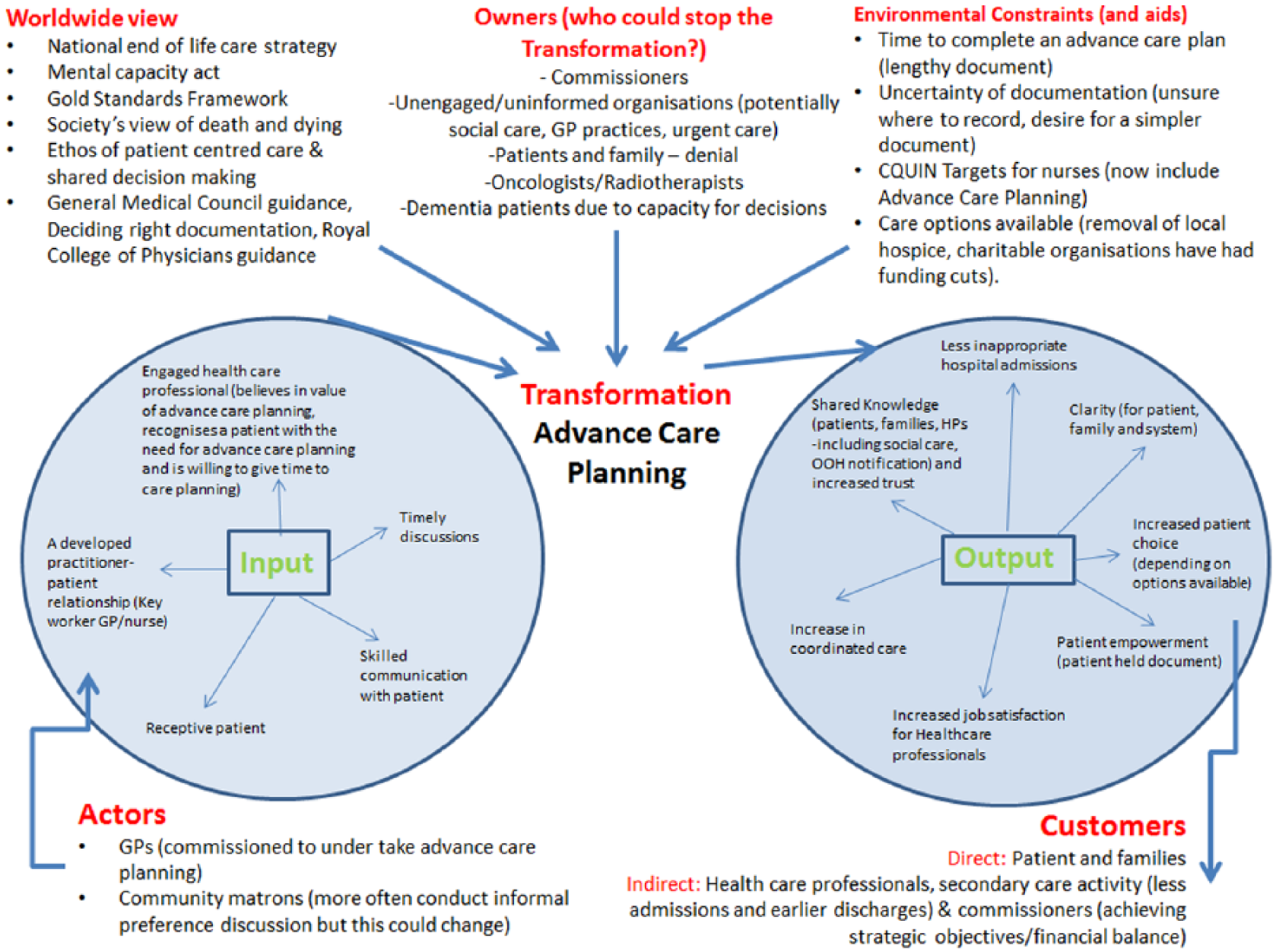
SSM map of ACP.
In Case Study 1 the CATWOE terminology was used with participants, whereas in Case Study 2 the elements were used as guidance to structure questions for deliberative conversations with stakeholders (see Table 1). Through use of these approaches, we illustrate how SSM maps allowed the participants, stakeholders and research teams to delve into the complexities of the different programme constituents using the CATWOE principles. For example, ‘transformations’ (some of which referred to underlying mechanisms) which occur through an ‘input’ (context and mechanisms, consisting of resources and reasoning), and produce an ‘output’ (reasoning and outcomes). SSM enabled the contextual intricacies to be made explicit, as the transformation is affected by ‘weltanschauung’, ‘owners’ and environmental constraints and aids (Box 1). Use of, and adaptation of the mnemonic enabled the participants, stakeholders and research teams to unpack relevant contexts, using multiple conceptualizations of context (weltanschauung, owners, constraints and aids), allowing for a more thorough examination of the various influences upon their practice. For example, in Case Study 1 a thorough examination of ACP led to the ‘owners’ circle in Figure 1 being expanded (in Focus Group 2; FG2) to include a primary health care alliance which governed the ICP. Using only the phrase ‘context’ may not have elicited ideas of ‘owners’ in participants. Thus as a result of FG2, the SSM maps were expanded in order to embrace the complexity of the ICP, further ideas were added, and CATWOE components were moved as knowledge grew (for example, from being listed under input, to worldwide view).
The CATWOE mnemonic (Checkland and Scholes, 1992).
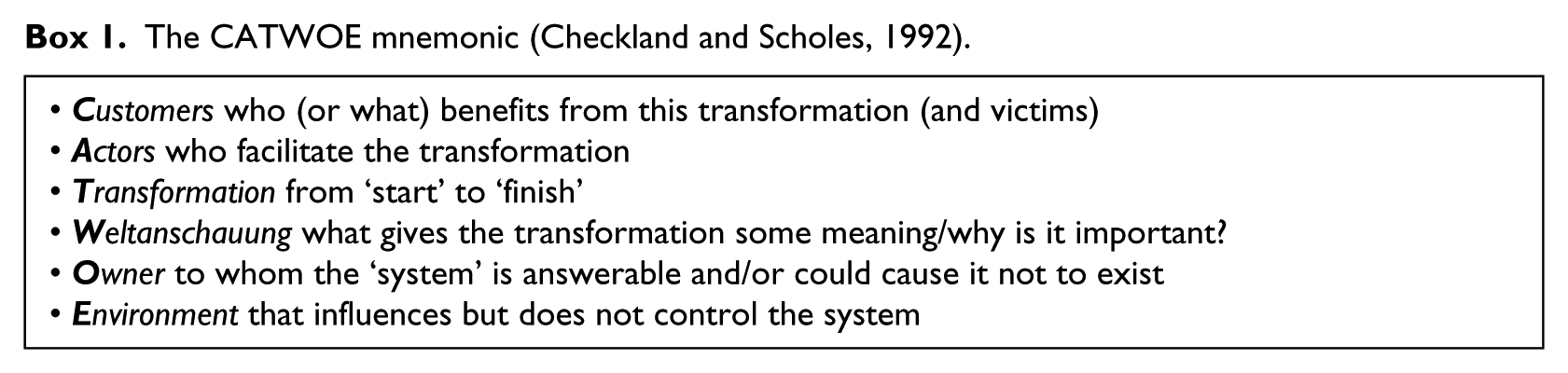
In Case Study 2, the CATWOE mnemonic enabled the stakeholders to engage in a structured thinking exercise about workforce development complexity, the beneficiaries of workforce development (the Customers – i.e. residents, recipients, services), the roles and functions of different people in workforce development (the Actors – e.g. the role of the organization versus the role of the individual participant in their development), eliciting the perceived change as a result of workforce development (Transformations – e.g. appropriate workforce development could/should lead to broader benefits beyond the health care assistant participant, including to residents, and to the organizations they work for), understanding beliefs about what is important in workforce development (Worldviews – e.g. patient stakeholders felt that development was important to improve standards, service lead stakeholders balanced this with issues of staff retention), leadership (Ownership – e.g. in different service contexts (private/public) ownership of both the problem and the solution was perceived to be a tension), and constraints on the system (Environment – e.g. typically resource (time, finance, capability) constraints, but these were viewed with differing levels of importance by the different stakeholders).
The use of SSM in both Case Study 1 and 2 allowed for exploration and mapping of the complexity of the programmes, in a transparent way, which engaged practitioners, participants and stakeholders.
Advantage B: Developing and testing realist programme theories
Transparent development and refinement of initial programme theories is a key premise of realist approaches. In Case Study 2, the focus was on developing initial programme theories with stakeholders, using SSM mapping within the research team. As part of the work to develop the initial programme theories, a stakeholder workshop was held, using SSM to illuminate how workforce development is understood and interpreted. This was similar to FG1 in Case Study 1, where the focus was making explicit the implementation chain of the ICP in order to develop SSM maps and subsequent initial programme theories.
In Case Study 2, the rich pictures developed from use of CATWOE guided deliberative conversations and were a source of evidence that informed initial programme theory development (see Table 1). Specifically, the elements of the rich pictures were used as concepts upon which to build our first attempts at developing the components of hypotheses, which then developed into initial programme theories. The rich pictures also contributed to identification of search terms in what is typically, within realist review, an iterative evidence search process. Similarly, in Case Study 1, the outputs of FG1 were made into SSM maps (Figure 1), on which programme theories were developed. Thus the rich SSM maps developed as a result of FG1 (Case Study 1) and the stakeholder workshop (Case Study 2) provided a transparent basis upon which complexity cognizant initial programme theories were developed.
In Case Study 1, SSM maps were used to not only develop programme theory with participants, but also to refine them through a further two focus groups (FG), thus allowing for cycles of discussion, deliberation and knowledge development (Checkland, 2000). FG2 allowed participants to explore and refine several programme theories, contrasting their experiences with the maps generated from FG1. This process helped in highlighting the key contexts and mechanisms which lead to intended outcomes and allowed the research project to capitalize on practitioners’ combined individual and organizational memory, experience and wisdom. FG participants confirmed, falsified, and refined emerging theories (Manzano, 2016) engaging in the teacher learner cycle, which aids in avoiding theory confirmation bias. SSM maps that were developed from FG2 were also used by the research team to explain locality data trends and themes from other aspects of the evaluation.
In the final focus group in Case Study 1, attention was devoted to participants explaining specific contingencies between the SSM concepts (for example, inputs, transformations, environmental constraints, as described above), which had previously been developed in FG2. This meant condensing the map through honed participant theory to find specific CMOCs relevant to ACP. Figure 2 displays the final refined SSM map/CMOC in relation to ACP: In a healthcare system focused on patient centred care and shared decision making (distal context), an engaged health care professional (proximal context) will use advance care planning forms (resource), leading to shared knowledge and increased trust between families, patients and health care professionals (reasoning), resulting in fewer inappropriate hospital admissions (outcome).

Expanded SSM map of ACP following FG3, with final CMOC underlined.
The other elements in Figure 2 (for example, other outputs or owners which are not underlined and therefore do not feature in the final CMOC) were not discounted but participants selected the elements that are underlined as essential in ACP. These omitted elements were developed to form alternative CMOCs within the study. All the key explanatory constructs were present in Figure 1 which was developed in FG1, however, these elements were not configured as a CMOC and not obvious as the most important aspects of ACP to the participants until FG3, after the process of deliberation had ensued through use of SSM.
Use of SSM in both Case Studies 1 and 2 allowed stakeholders and participants to provide data, learn from one another’s perspectives and develop (and refine in Case Study 1) SSM maps and transform these into initial programme theories. Furthermore, in Case Study 1 participants could describe contingencies within the ICP confidently whilst embracing complexity, as the visual presentation of SSM maps enabled FG discussions to be framed whilst considering several factors, due to presentation of CATWOE. This potentially generated further comments in a way that CMOC may not have, as they often do not aim to represent the whole system (ICP) as an SSM map does. Participants could see several factors in one domain, for example, several inputs, and discuss which was the most important for a particular transformation, thereby truly engaging in theory development.
Through SSM, the engagement of the participants and stakeholders who embodied the intervention enabled both the development and refining of realist theories. Use of SSM provided both stakeholders and participants with an opportunity to think about their practice and the issue/topic in a different way, which enabled the surfacing of prior assumptions and implicit considerations, therefore developing and refining stakeholder informed programme theory.
Discussion
In this article we make the case that, as part of a realist endeavour, SSM is a useful mapping tool which can uncover and explore programme complexity (Advantage A) and develop and refine stakeholder or participant realist programme theories (Advantage B). Other tools, such as traditional qualitative interviews or programme logic maps, also offer some advantages. However, the unique contribution of SSM to developing and refining realist programme theories is to combine stakeholder involvement (as could be achieved through qualitative interviews) and structured (CATWOE) programme mapping, which surfaces realist relevant information. To our knowledge, there are no other published examples of the use of SSM within a realist approach; our work signals the possibility and potential fruitfulness of this approach and demonstrates how it might build on the ‘how to’ for studies employing realist approaches.
Throughout this article, we have offered an insight into the practical application of using SSM within a realist approach. Systems thinking includes multiple stakeholder perspectives in order to co-construct relevant models (Ribesse et al., 2015). As they embody the intervention under study, stakeholders have inherent theories of how, why and what circumstances it ‘works’ (Pawson and Tilley, 1997). We found that SSM was useful in surfacing these implicit theories, which could then be refined through subsequent meetings and tested using primary or secondary data. Without SSM, the explicit role of stakeholders’ experiences in the co-construction of the explanatory endeavour would not have been as transparent, for both case studies. Our report therefore augments the face validity of the process, avoiding theory confirmation bias and ensuring that researchers’ endeavours reflect stakeholders’ complex practice realities. It is well established in realist approaches that all knowledge is partial and that mechanisms can operate outside of the consciousness of those involved in programmes (Pawson and Tilley, 1997), yet we suggest here that using SSM may facilitate their surfacing through full consideration of all aspects of the system and engagement of stakeholders and participants.
There are however, several limitations to the use of SSM with realist methods, and those methodologies in their own right. For example, The CATWOE elements may be exposed to critique in that labels such as owner and customer can lead to narrow focus. Additionally, identifying owners may not reflect the theory-practice reality of who owns the system (Bergvall-Kareborn et al., 2003). Emphasis was placed on the multiple nature of all the CATWOE elements in both case studies; it was made clear that, for example, there could be several ‘owners’ or ‘environmental constraints’ and participants were never limited to just providing one. In realist approaches, lack of clarity around defining context and mechanisms has raised dilemmas for the evaluator (Astbury and Leeuw, 2010; Jagosh et al., 2013; Marchal et al., 2012; Pedersen et al., 2012) although recent methodological guidelines and publications have come some way in overcoming this (Dalkin et al., 2015; Wong et al., 2013a, 2016). Whilst neither method is flawless, the use of both together can be complementary, but does have disadvantages, one being that creating SSM maps already adds to the labour intensive process of realist approaches.
Further work could integrate SSM and realist approaches further; in both of the case studies presented SSM was only one element of the study, as opposed to being utilized throughout. Use of SSM in other realist studies that focus on different levels of the system (specifically, meso, macro) might also contribute to understanding mechanisms outside of the traditional resource and reasoning sphere, building upon Westhorp’s work (forthcoming) on levels of mechanism abstraction.
Part of the definition of complex adaptive systems is that they are not cleanly bounded (Westhorp, 2012); yet for pragmatic reasons often linked to time and finances, researchers studying them have to draw clear cut boundaries (Cabrera et al., 2008). It is not possible to know just how important the features omitted from the system map may have been in producing the outcomes (Cilliers, 1998). In our work, engaging stakeholders through SSM was instrumental in embracing context whilst drawing boundaries in a transparent way that had most resonance with the world of practice. Using the rich pictures as part of SSM allowed a broad understanding of the programme to be generated before focusing back in on programme specifics to produce initial programme theories. This process also helped to gain a clear sense of the significance of individual agents within the programme, as well as their particular viewpoint. Using SSM as a vehicle enabled the stakeholders to explore several different facets of contexts and mechanisms (weltanschauung, owners, constraints and aids) which facilitated theory formulation as they highlighted how components interacted and impacted on one another.
Summary
This article has focused on SSM as a vehicle to embrace programme complexity whilst developing and refining programme theory. We suggest that SSM offers one way to make explicit the complex reality within which stakeholders make their decisions and thus overcome those complexity-related challenges. We suggest that this, in effect, increases the transparency, reliability, validity and accuracy of the theory building and refining process. Specifically, in our experiences, the use of SSM within a realist approach led to: mapping programme complexity, and developing and refining stakeholders programme theories. Our ambition for this article was to present SSM as a good bedfellow to realist approaches, which can add transparency and robustness, whilst concurrently providing a novel and creative way of active engagement with stakeholders.
Footnotes
Funding
This work was supported by NHS North of Tyne and Northumbria University via PhD funding [Case study 1]; and the National Institute Health Research (NIHR) Health Services and Delivery Research Programme [Case study 2; grant number 12/129/32].