



Abstract
Cash transfers are a widely adopted social policy initiative for addressing poverty and vulnerability. Cash transfers’ exponential growth in low- and middle-income countries provides a unique opportunity to advance our understanding of how they work to impact the social determinants of health. This article reports on a realist qualitative approach to developing an initial program theory about the role of cash transfers in tackling the social determinants of health. A set of 12 initial hypotheses regarding how cash transfers might work to address the social determinants of health were developed from the data. Cash transfer key mechanisms of change found in the study included political will and leadership and news media framing at the macro level, collaboration and intersectoral working at the meso level, and household motivation, empowerment, choice making, awareness raising and risk-taking behaviour at the micro level. This study has developed initial hypotheses that can be tested and refined in future studies using a realist approach.
Introduction
Over the past two decades, cash transfers (CTs) have become a popular social policy instrument in the fight against poverty in many low- and middle-income countries (World Bank, 2015). A feature of CTs since their inception has been their rigorous evaluation (Davis et al., 2016; Owusu-Addo et al., 2018a). As complex interventions, CTs are strongly influenced by context, meaning that the impacts that they may achieve are contingent upon factors such as the policy environment, socio-economic conditions, organisational readiness, availability of complementary and supply-side services and the behaviour of the target beneficiaries (Owusu-Addo et al., 2018a).
It has been argued that the traditional outcome-focused approaches are limited in their ability to evaluate large-scale, complex programs such as CTs as they often fail to explain how and why these do or do not work (Pawson, 2013). For instance, a systematic review which examined the impact of CTs on the social determinants of health (SDoH) and health inequalities in sub-Saharan Africa found that while there is strong evidence of CTs impact on SDoH, and moderate evidence of their impact on health outcomes, CTs’ mechanisms of change remain largely unclear (Owusu-Addo et al., 2018b). A subsequent review of the methodological approaches used to evaluate CTs found that the majority of the studies (95%) were outcome-focused, had mainly adopted experimental approaches and largely failed to explain how and why CTs work, for whom, and under what circumstances (Owusu-Addo et al., 2018a). It has been widely argued that it is insufficient to provide evidence that programs cause particular outcomes without identifying the mechanisms that link causes and their effects (Chen, 2005; Pawson, 2013). Pawson and Tilley (1997) succinctly put it this way: ‘programs work (have successful outcomes) only in so far as they introduce appropriate ideas and opportunities (mechanisms) to groups in the appropriate social and cultural conditions (contexts)’ (p. 57).
In evaluating complex interventions like CTs, a number of evaluation theorists and writers (e.g. Bamberger et al., 2016; Pawson, 2013) have argued that theory-based evaluation, particularly realist evaluation, is better at unpacking complex causality and the contextual factors that may influence the patterns of program outcomes. Realist evaluation holds that programs are complex interventions operating within open complex social systems, and that it is valuable and necessary to understand their nature and their mechanisms of change (Pawson, 2013).
The exponential growth in CTs and their ongoing evaluation provides a unique opportunity to advance our understanding of the way in which CTs work to impact health and health determinants. This article reports on a realist approach to developing an initial program theory about how CTs might work in tackling the SDoH as part of a larger realist evaluation focusing on the Ghana CT program.
Two questions guided the study reported in this article. First, what are the mechanisms through which CTs influence the SDoH? Second, which contextual factors determine whether intervention mechanisms result in intended outcomes? In this article, hypotheses are formalised regarding how CTs might work to tackle the SDoH for further testing and refinement in future stages of the work.
Overview of CTs
CTs are anti-poverty social protection programs which make direct cash payments to poor and vulnerable individuals or households either conditionally (CCTs) or unconditionally (UCTs) with the aim of breaking the intergenerational cycle of poverty. Generally, CTs seek to encourage increased demand for services through an ‘income effect’ and in the case of CCTs, through both an income effect and a ‘substitution effect’ (Baird et al., 2013). CCTs transfer money to households or individuals on condition that beneficiaries adopt prescribed behaviours including school enrolment and attendance, or utilisation of health services. UCTs provide a money transfer, but do not have any explicit conditions.
While there are marked differences in the objectives, design and implementation of CTs in low- and middle-income countries, they share common goals of reducing poverty and vulnerability (e.g. HIV) and fostering economic and social inclusion (Fiszbein and Schady, 2009; Owusu-Addo, 2016, 2018b; Owusu-Addo et al., 2016). The proliferation of CTs in low- and middle-income countries is justified on the grounds that social policy actions of this nature play a significant role in the fight against intergenerational poverty and health inequalities.
The Ghana CT program
Ghana’s CT program, the Livelihood Empowerment Against Poverty (LEAP), is focused upon combating extreme poverty and vulnerability (Ministry of Manpower, Youth and Employment, 2007). LEAP transfers cash to extremely poor households aimed at alleviating short-term poverty and encouraging human capital development. Aside from the cash payments, LEAP provides free health insurance to beneficiaries through a National Health Insurance Scheme (Ministry of Gender, Children and Social Protection, 2018). LEAP was introduced in 2008 and combines CCT and UCT elements.
Like all CTs, LEAP is premised on the principle that individuals and households can be empowered and trusted to make good use of resources available to them to improve their standard of living. The assumption here is that by providing regular direct cash payments to poor individuals or households, this may smooth income and consumption and enable households to meet their basic needs (e.g. food) when faced with shocks and stress without taking adverse risk-coping strategies like distress sales of assets or taking on debt (Jones et al., 2017).
The SDOH
The SDoH have been defined by the World Health Organization (WHO) as the conditions in which people are born, grow, work, live and age, and the wider set of forces and systems shaping the conditions of daily life. They include social policies, economic policies and systems, social norms and political systems (WHO, 2018). With the focus of CTs upon poverty reduction and human capital development, they have direct linkages to health and wellbeing by addressing the SDoH. For instance, Owusu-Addo et al.’s (2018b) systematic review found that CTs impact a broad range of SDoH including poverty, employment, education, social exclusion, nutrition and access to health services, but it was unclear why these outcomes were so varied. It is therefore important to understand how CTs work to influence the SDoH in order to contribute to better program design, targeting and implementation.
The realist approach
Given the complex nature of CTs, and the lack of evidence around the mechanisms by which they produce outcomes (Owusu-Addo et al., 2018a, 2018b), a realist approach was chosen for this study. Realist evaluation is underpinned by realist philosophy of science which holds that there is a world that can be known through human senses, cognitions, language and culture (Pawson, 2013). The key question that realist evaluation seeks to address is, ‘what works, for whom, under what circumstances, and how’ (Pawson, 2013: 15). Typically, realist evaluation aims to explain program effectiveness by way of exploring how different program mechanisms are triggered in particular contexts. This implies that programs work differently in different contexts; therefore, a CT program that works in one setting may fail in another setting as the ‘mechanisms’ needed for success are triggered in different degrees in different contexts.
Central to realist evaluation is the conception of causality as generative causation rather than successionist causation (regularity of events) (Pawson and Tilley, 1997: 67–68). Realist evaluation thus places emphasis on understanding how programs generate outcomes and how causal mechanisms are shaped by program contexts, suggesting that causation is local rather than general (Dalkin et al., 2015; Maxwell, 2004, 2012a, 2012b). The use of realist evaluation in this study is a departure from the dominant outcome-focused CT evaluations in order to uncover the interactions between program contexts and the ‘mechanisms’ that generate complex pattern of outcomes. Mechanisms as used here refer to a combination of resources offered by a social program and stakeholders’ reasoning in response (Pawson and Tilley, 1997). Put differently, ‘mechanisms’ are not the program activities or services, but the response they trigger from stakeholders and the resulting outcomes (Weiss, 1997).
In adopting a realist approach, the first stage is to develop an initial program theory about the program under investigation, and it is this theory that is at the focus of this article. Program theory should not be conflated with program logic in that while the function of the latter is to provide a logical sequence of program inputs, activities, outputs and outcomes, the former is much broader in scope as it provides an explanatory account of how a program works in diverse circumstances (Astbury and Leeuw, 2010). In order to understand the initial program theory, program theories are related back to formal theories (Wong et al., 2016). Formal theories are particularly useful in realist evaluation as they help analyse and conceptualise how change processes occur (Westhorp, 2013; Wong et al., 2016).
Methods
Study design
This study followed Maxwell’s (2012a) approach to realist qualitative research that focuses on generation of explanatory insights that are potentially transferable from one context to another (Maxwell, 2012a, 2016). This aim is achieved through the development and testing of an initial program theory regarding how an intervention is expected to work, specifically identification of underlying causal mechanisms triggered by CTs within particular contexts to produce their outcomes.
Data sources
The sources drawn upon in this study to develop the initial program theory included the following: evidence gleaned from a systematic review, analyses of LEAP program documents and interviews with key stakeholders. The documents uncovered in the systematic review provided initial ideas and insights about the contexts and outcomes of CTs. The information gleaned from the program documents was used to clarify the program aims and objectives, the context within which the program was designed and implemented, and how the program was expected to work and/or working.
Semi-structured interviews (N = 8) were conducted with CT policy makers, program managers and multi-lateral organisations who fund and provide technical support to the Ghana CT program (the United Nations Children’s Fund and The World Bank) to unearth assumptions about how the program might work in practice. These participants were selected purposefully as information rich cases (Patton, 2015) with the primary interest being relevance, rigour and diversity of perspectives rather than thematic saturation (Emmel, 2013; Pawson and Sridharan, 2009). A semi-structured interview guide informed by the systematic review and document analysis was used to conduct the interviews using the realist interviewing technique developed by Manzano (2016).
Data analysis
The program documents and interview transcripts were imported into NVivo 11 software for data analysis. The thematic framework approach developed by Ritchie et al. (2008) was used for the analysis through the application of a realist ‘lens’ to systematically identify context-mechanism-outcome configurations (CMOCs). Westhorp (2012, 2013) suggests that in evaluating large-scale complex interventions such as CTs, CMOCs should be developed to reflect the multiple systems within which the program operates. Berman’s (1978) social policy implementation model, which posits that policy implementation follows specific steps (i.e. policy translation into a program, program adoption and implementation by managers and program uptake by beneficiaries), was used to sort the CMOCs according to their relevance to macro-, meso- and micro-level systems.
Ethical approval for the study was granted by Monash University Human Research Ethics Committee (ID # 9153) and the Committee on Human Research, Publication and Ethics at the Kwame Nkrumah University of Science and Technology, Ghana (Ref. CHRPE/AP/275/17).
Results
In this section, propositions relating to how CTs work gleaned from the systematic review are first presented followed by the conjectured CMOCs developed from the findings of the interviews and the document analyses.
Insights from the systematic review
From the systematic review, it became clear that CTs are incentive-based interventions rooted in micro-economics with alignment to contingency management in behavioural psychology (Higgins, 2010). This was consistent with basic principles of economic theory which hold that well-informed individuals make rational decisions after weighing the pros and cons of different choices. The review showed that socio-economic factors including geographic location, inflation and household characteristics influenced CT outcomes. It was found that CTs result in complex patterns of both intended and unintended outcomes including school enrolment, attendance, absenteeism, health services utilisation, nutrition, poverty reduction and child labour. The CT intervention theory gleaned from the systematic review was that by incentivising ‘healthy’ behaviours that have social benefits among poor households and vulnerable individuals, CTs can tackle the SDoH to improve health equity and quality of life. Largely missing from the studies included in the review was CT mechanisms of change which was explored during the interviews.
Conjectured CMOCs
From the findings of the interviews and the program documents, a total of 12 CMOCs (Table 1) were identified in relation to how CTs might impact SDoH. While the systematic review provided insights into the CMOCs, we draw on the interviews and document review to provide evidence that supports each of the hypotheses. Supplementary Table S1 provides further details of the CMOCs and the supporting evidence. Supplementary Table S2 provides a summary of the program documents (N = 34) reviewed as part of the theory gleaning process. The CMOCs are discussed below.
CMO configurations.
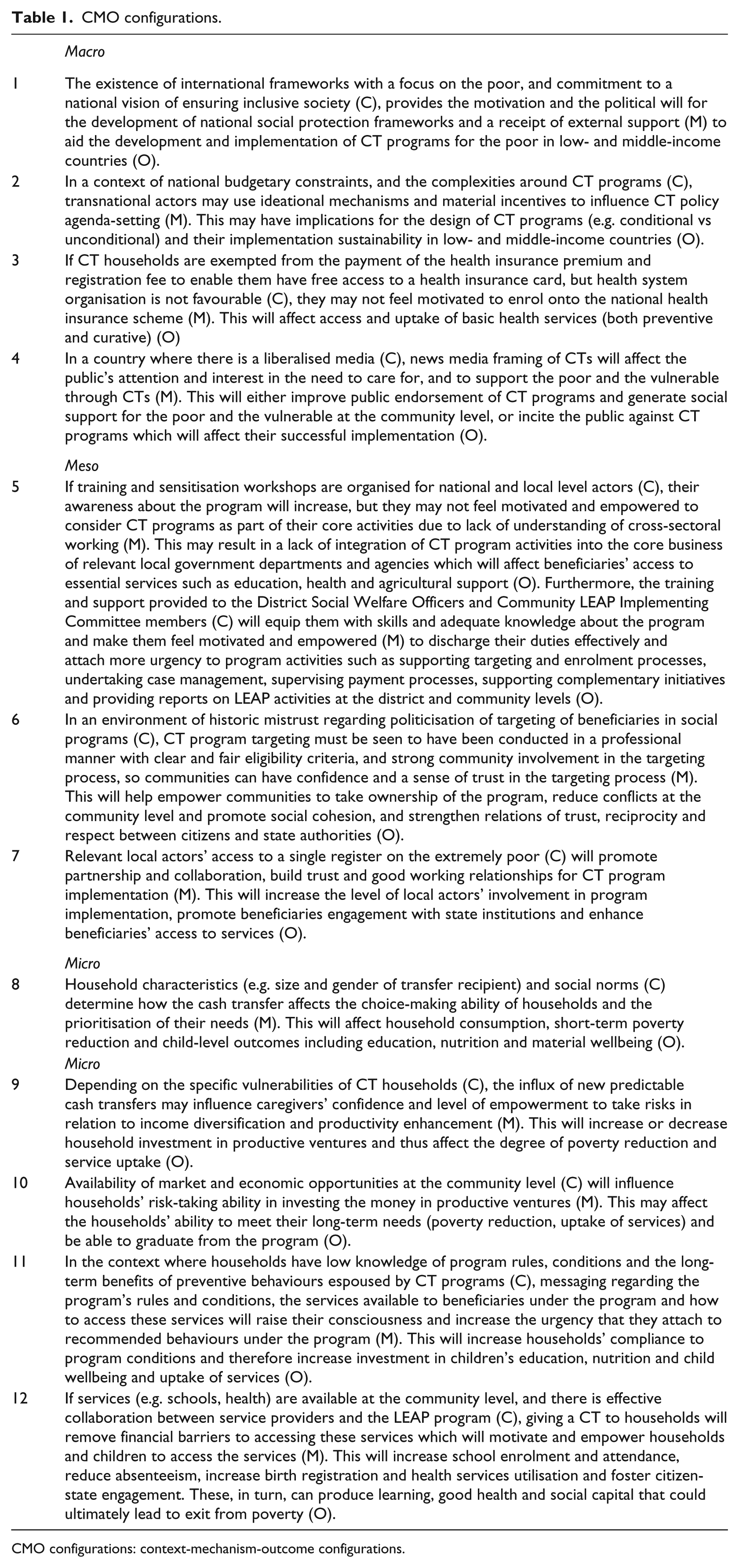
CMO configurations: context-mechanism-outcome configurations.
CT design and architecture
There was widespread agreement among policy makers and program managers that a clear vision of ensuring an inclusive society, and a strong political will and commitment are central to adoption of CTs as policy measures to address poverty and vulnerability. A policy maker remarked that Millennium Development Goal 1, which focused on poverty reduction, provided the impetus for the government to use CTs for the poor and vulnerable in society to achieve its vision of ensuring an inclusive society: In 2007, the then government … had what we call the Growth and Poverty Reduction Strategy document II [in line with the Millennium Development Goal 1] … The National Social Protection Strategy of 2007 also identified various key social protection interventions for the country. So the government actually had a clear plan and commitment to start the LEAP program. (Policy maker # 1)
The development of national social protection frameworks in line with Millennium Development Goal 1 provided the motivation for development partners, particularly the Word Bank, Department for International Development and the United Nations Children’s Fund, to support the Ghana government in the fight against poverty through CTs. Interviews with the policy makers further revealed that at the design stage, CTs were preferred over other alternatives such as food aid so as to inject new resources into extremely poor households to enable them access basic services. Our program theory suggests that international development agendas may influence the political will and policy agenda-setting of countries in adopting CTs to tackle poverty.
We hypothesise that the existence of international frameworks with a focus on the poor, and commitment to a national vision of ensuring inclusive society, provides the motivation and the political will for the development of national social protection frameworks and a receipt of external support to aid the development and implementation of CT programs for the poor in low- and middle-income countries.
The role of transnational actors
A common theme across the program documents, news articles and the interviews was the central role played by transnational actors in designing the program. A major factor which occasioned the involvement of transnational actors was national budgetary constraints as observed by a policy maker: Government funding is not always adequate so government started and the Development Partners followed. But this raises the question of sustainability because your country [Ghana] says they are now middle income … I can tell you from where I sit that if the development partners withdraw their support, it is going to be a challenge. (Policy maker #2)
The interviews indicated that while the development partners did not dictate to the Ghana government to consider CTs to tackle poverty and vulnerability, indirect strategies to get CTs onto government’s agenda were used including sponsoring government officials to attend workshops and seminars on CTs in countries where CTs have been implemented. Similarly, the development partners were members of the technical working group that proposed the design of a CT program in Ghana: The government with support from the Department for International Development and the United Nations Children’s Fund brought together technical experts to assist with drafting the social protection strategy. It was then that they [Development partners] supported study trips to Brazil and South Africa. They also gave us the technical assistance, which enabled the government to gather a number of experts from South Africa, Turkey and Kenya to initiate the process of developing the LEAP. (Policy maker #1)
The processes used by the development partners might have played a key role in shaping the architecture of the Ghana CT program. For instance, the Brazilian CT model is a CCT with strict enforcement of program conditions. A policy maker observed that the Brazilian model was considered at the design stage of the Ghana CT, but it was decided to implement ‘soft’ conditions in Ghana because of contextual issues in the country such as limited access to services: The conditions are soft because we are a bit worried that our target is not the people who receive the money [caregivers], our target is the poor child who is an orphan. If …, you make the conditions hard like in the Latin American countries like Brazil where if the household refuses, they deduct the amount … it can’t work in Ghana. (Policy maker #2)
The program theory here suggests that transnational actors may use ideational mechanisms and material resources to influence CT design. For instance, the exposure of government officials to countries already implementing CTs serves as an ideational influence which provides a platform for learning and may play a key role in shaping the design and architecture of CTs. This can result in political pressure to adopt CTs without adequate consideration of local stakeholders’ inputs into program design.
We hypothesise that in a context of national budgetary constraints, and the complexities around CT programs, transnational actors may use ideational mechanisms and material incentives to influence CT policy agenda-setting. This may have implications for the design of CT programs (e.g. conditional vs unconditional), their implementation and sustainability in low- and middle-income countries.
CTs and health insurance schemes
All participants indicated that a unique feature of Ghana’s CT program is its direct linkage to the country’s national health insurance scheme. It was reported that to improve program beneficiaries’ access to healthcare, the LEAP Program entered into a memorandum of understanding with the National Health Insurance Authority, an agency in the Ministry of Health, to register LEAP beneficiaries with the Scheme. Under the memorandum of understanding signed with the LEAP program, LEAP beneficiary households are exempted from the payment of the insurance premium: The National Health Insurance is a social protection intervention but citizens still make contributions to it … So there is an arrangement to make sure that those people [LEAP households] benefit from health care services without paying for premiums and registration. (Program Manager #1)
The participants held the view that automatic registration of program beneficiaries under the National Health Insurance Scheme would motivate program beneficiaries to acquire the health insurance cards to access health services: …. One of the hard pushes with support from donors [development partners] was to get National Health Insurance Authority to give automatic health insurance to LEAP beneficiaries. As soon as you are enrolled unto LEAP, the National Health Insurance Scheme is there enrolling you also without having to pay the premium. (Development partner #1)
The program theory here is that waiving the health insurance premium and registration fee for CT beneficiaries will ensure their access to healthcare. For this to occur, a conducive environment needs to be created to ensure beneficiaries’ physical access to the insurance card and health healthcare.
We hypothesise that if CT households are exempted from the payment of the health insurance premium and registration fee to enable them have free access to a health insurance card, but health system organisation is not favourable, they may not feel motivated to enrol onto the national health insurance scheme. This will affect access and uptake of basic health services (both preventive and curative).
The role of the media in CTs agenda
A review of program documents showed that the media was duly recognised with regard to their role in shaping the CT program: The Media, given their strategic role in public information, education and capacity-building, the media (print, electronic and audio-visual) shall be engaged. (Ministry of Gender, Children and Social Protection, 2015: 43)
This recognition of the role of the media was shared by all participants. Similarly, a review of news media reporting between 2007 and 2008, covering the period when the CT was announced by the government and begun implementation, showed that the media had already started providing coverage on the LEAP program. Some of the news headlines during this period were, LEAP to greater poverty: A plan to spend GH¢20 billion on the poor. (Kusoati, 2007) LEAP scheme is sustainable. (Osei, 2008). Giving money to the poor is not the answer. (Daily Graphic, 2008)
As captured by some of the news headlines, the announcement of the program was largely framed in the news as a political stratagem to buy votes, as it commenced implementation in an election year. In most of the news coverage, opposition leaders and some think-tanks questioned the relevance of the program and were sceptical about its sustainability. It was unclear, however, from the analysis of the initial media coverage whether the press endorsed the concept of CT as the way to tackle poverty and the root causes of poor health. The program theory here suggests that the media plays an important role in CTs, particularly in the areas of program awareness raising, accountability and transparency. News media framing changes over time and it is important to know how this might influence program implementation, accountability and public support for the program.
We hypothesise that in a country where there is a liberalised media, news media framing of CTs will affect the public’s attention and interest in the need to care for and to support the poor and the vulnerable through CTs. This will either improve public endorsement of CT programs and generate social support for the poor and the vulnerable at the community level, or incite the public against CT programs which will affect their successful implementation.
Training and sensitisation workshops
A common theme across the interviews with policy makers and program managers was the degree of program sensitisation of key decentralised government agencies that have a role to play in CT implementation. The policy makers noted that prior to the onset of LEAP, a series of sensitisation workshops were organised to raise awareness of the program among key sector ministries, departments and agencies, and civil society groups with the aim of eliciting their support and involvement: The workshop [LEAP sensitisation workshop], which was among other things, aimed at sensitising the participants to understand the concept and objectives of the scheme [LEAP], was attended by the Eastern Regional Minister, Mr Kwadwo Affram Asiedu, Municipal and District Chief Executives, the Presiding Members of the assemblies and officials of the Department of Social Welfare. (Daily Graphic, 2008)
As one policy maker puts it, ‘the idea of the sensitisation meetings was to orientate these stakeholders to consider LEAP as part of their agenda, and to mainstream it into their work schedules’. This aspect of the LEAP program theory is key as deepening the knowledge of sectors like education, health and agriculture, and providing them with the needed support may result in LEAP beneficiaries getting access to essential services provided by these sectors.
A similar theme from the interviews was the training of District Social Welfare Officers, and Community Implementation Committees who are directly responsible for the day-to-day implementation of the program at the local level. It was emphasised that because LEAP was a new program, there was the need to train these cadre of program staff to ensure the smooth implementation of the program.
While sensitisation workshops and training programs were organised for key implementing actors, a policy maker expressed misgivings that these did not appear to directly translate into concrete actions, particularly the mainstreaming of LEAP into the core business of decentralised departments. This was largely attributed to inadequate understanding of local actors about the decentralisation concept which calls for networking and collaboration across departments and programs: We do all these awareness creation and workshops but they don’t incorporate LEAP into their workplan … it is unfortunate but that is not the making of the program [LEAP]. Is the making of the decentralization system … very limited understanding of it. (Policy maker #1)
We hypothesise that if training and sensitisation workshops are organised for national and local level actors, their awareness about the program will increase, but they may not feel motivated and empowered to consider CT programs as part of their core activities due to lack of understanding of cross-sectoral working. This may result in a lack of integration of CT program activities into the core business of relevant local government departments and agencies which will affect beneficiaries’ access to essential services such as education, health and agricultural support. Furthermore, the training and support provided to the District Social Welfare Officers and Community Implementing Committee members will equip them with skills and adequate knowledge about the program and make them feel motivated and empowered to discharge their duties effectively and attach more urgency to program activities such as supporting targeting and enrolment processes, undertaking case management, supervising payment processes, supporting complementary initiatives and providing reports on LEAP at the district and community levels.
Targeting of program beneficiaries
CTs are not universal programs as they target the extremely poor and vulnerable population sub-groups. Therefore, the LEAP program Operations Manual and the National Social Protection Strategy and Policy documents lay emphasis on ensuring effective program targeting. Discussions with the program managers revealed that the processes for selecting program beneficiaries start from the national level and flow through to the regional, district, community and household levels. This entails geographic targeting using poverty maps from the Ghana Statistical Service, community-based selection processes and proxy means testing at the national level to select eligible beneficiaries: So when LEAP first started, it was community targeting and what that does is that you have things like you could have a chief decide that somebody should have the money and the other not have the money. So you will have issues where people would complain to their Member of Parliament and all of that, and it becomes like this is NPP, this is NDC [the two major political parties in the country]. But to me having this scientific method [proxy means test] kind of cleans that up a little bit. (Development partner #2)
There was a consensus among all participants that effective targeting was instrumental to the success of CT programs, particularly to avert politicisation of the program. Our program theory suggests that targeting is more likely to be effective and transparent when there is strong community involvement in the process. Community involvement in targeting is key to empowering communities to take ownership of the program and to provide support for the extremely poor and the vulnerable at the community level.
Another issue discussed by all participants was the need to have a single national register which collects data on households to enable the selection of the extremely poor onto the LEAP program. This was said to be a more efficient way of targeting the poor under the program as well as avoiding duplication of efforts across various social protection programs in the country. Our program theory here suggests that aside from effective targeting under the program, a single register which is available to decentralised departments and agencies will foster partnership and collaboration in terms of providing support to program beneficiaries.
We hypothesise that in an environment of historic mistrust regarding politicisation of targeting of beneficiaries in social programs, CT program targeting must be seen to have been conducted in a professional manner with clear and fair eligibility criteria, and strong community involvement in the targeting process, so communities can have confidence and a sense of trust in the targeting process. This will help empower communities to take ownership of the program, reduce conflicts at the community level and promote social cohesion, and strengthen relations of trust, reciprocity and respect between citizens and state authorities. We further hypothesise that relevant local actors’ access to a single register on the extremely poor will promote partnership and collaboration and build trust and good working relationships for CT program implementation. This will increase the level of local actors’ involvement in program implementation, promote beneficiaries engagement with state institutions and enhance beneficiaries’ access to services.
Household characteristics and vulnerability
The LEAP program provides social grants to households rather than individuals. This aspect of the program was seen by most participants to have implications for the specific mechanisms that may be triggered by the program. A researcher was particularly concerned about the effects of household size on program outcomes: There used to be this argument particularly at the design stage whether we should have a flat rate or whether we should vary it by the household size … This household size business sometimes is very tricky … So you give the money and then you watch how they use the money … depending on their needs. (Researcher/Evaluator #1)
All participants emphasised the role of household size in making decisions regarding how to use the cash grants. With the amount of CT given to households contingent on household size, two potential mechanisms that may be triggered are household choice making and prioritisation of needs. In instances where households do not prioritise human capital development, there may be little or no improvement in child-level outcomes such as education, nutrition and material wellbeing as anticipated by the program.
A program manager valued the LEAP program for its ability to instil confidence in beneficiary households. However, it was emphasised that the specific vulnerabilities faced by households may affect the confidence of caregivers in taking risks, for instance, by investing the money in productive ventures that could enhance the economic resources of the household: Yes, they are confident to take risk once they receive the cash. Because if you have the money and depending on your situation, you can rent a piece of land, it enhances your risk taking ability and then you are able to cope with certain demands from the family. (Program Manager #3)
The program theory here suggests that household characteristics and their specific vulnerabilities may influence household’s spending decisions upon receipt of a CT. This means that CT design, implementation and evaluation need to consider traditional family structures and practices.
We hypothesise that household characteristics and social norms determine how the CT affects the choice-making ability of households and the prioritisation of their needs. This will affect household consumption, short-term poverty reduction and child-level outcomes including education, nutrition and material wellbeing. Also, depending on the specific vulnerabilities of CT households, the influx of new predictable CTs may influence caregivers’ confidence and level of empowerment to take risks in relation to income diversification and productivity enhancement. This will increase or decrease household investment in productive ventures and thus affect the degree of poverty reduction and service uptake.
Opportunities for income diversification
A policy maker explained that: the word LEAP means more than the acronym for Livelihood Empowerment Against Poverty. We carefully chose the name to represent what we wanted the Program to achieve. That is, to get households leap out of poverty. So LEAP is kind of a conduit to access other opportunities at the community level like doing some small business … so you can get additional income. (Policy maker #1)
All participants acknowledged that the size of the LEAP transfer was small relative to the needs of the households. Program managers thus noted that caregivers are educated to invest the money in productive ventures in order to get additional income to supplement the cash grants. For this to occur, a participant observed that the local economic context matters: Are there opportunities at the community level for them … Like … sort of economic activities that they can engage in and multiply the money. What about market in terms of say trading? (Researcher, program design team member)
The program theory here suggests that while LEAP serves as a potential resource to foster livelihood diversification, the local economy may affect the risk-taking ability of households to engage in productive ventures. For instance, households may not want to invest the money in trading activities if the market opportunity at the community level is not encouraging for fear of losing the money.
We hypothesise that availability of market and economic opportunities at the community level will influence households’ risk-taking ability in investing the money in productive ventures. This may affect the households’ ability to meet their long-term needs and be able to graduate from the program.
Awareness of LEAP program conditions and rules
The LEAP program espouses particular behaviours that households are to engage in order to achieve human capital development and long-term poverty reduction. While program conditions are ‘soft’, the importance of households’ awareness of the co-responsibilities for receiving the cash grant was clearly articulated by participants: The District Social Welfare Officers provide all the necessary education to raise awareness. Because in the program there is what we call co-responsibility … For instance, it is the responsibility of the caregiver that when government brings the money to make sure that she doesn’t send the child to farm or engage in any form of worse child labour. So this education are all done at the point of payment. (Program Manager #4)
It was emphasised throughout the interviews that there is the need to create awareness about the program and its selection criteria at the community level as well as educating beneficiary households about the program conditions and rules. This way of thinking suggests that, if only people knew, they would be able to make better choices and be assertive in demanding services due them under the program. Awareness raising at the community level is a critical component of the program theory as it can strengthen program information flow and accountability, improve households’ access to services and bolster community cohesion and state–citizen relations.
We hypothesise that in the context where households have low knowledge of program rules, conditions and the long-term benefits of preventive behaviours espoused by CT programs, messaging regarding the program’s rules and conditions, the services available to beneficiaries under the program and how to access these services will raise their consciousness and increase the urgency that they attach to recommended behaviours under the program. This will increase households’ compliance to program conditions and therefore increase investment in children’s education, nutrition and child wellbeing and uptake of services.
LEAP as a conduit to build a network of social services around households
Across interviews, participants emphasised that LEAP is a means to an end, rather than an end in itself. A policy maker noted that ‘The aim of the CT was not to expand the existing social interventions, but actually to create access to these programs for the vulnerable and people who did not have access to these opportunities’ (Policy maker #2).
Within the framework of enhancing beneficiaries’ access to existing services was also the ‘need to build a network around the households’ (Program Manager #3) where professionals providing services closely monitored beneficiaries to better understand their needs and address them. The networking aspect of the program theory is important as it has been established by participants that the money given to the households is not enough and therefore, on its own cannot transform people’s life overnight. Therefore, a network promoting easy access to services will enable beneficiaries to have access to these. However, to foster networking of both services and professionals around beneficiaries, the services themselves must be available at the community level, and service providers must work collaboratively and be willing to deliver services that beneficiaries are entitled to. Furthermore, strong intersectoral engagement between health, education, agriculture and other agencies is required, to build synergies and identify leverage points for action under the program. This aspect of the program theory underscores the importance of supply-side services (e.g. schools) for the realisation of the long-term poverty reduction goal of CTs.
We postulate that if services are available at the community level, and there is effective collaboration between service providers and the LEAP program, giving a CT to households will remove financial barriers to accessing these services which will motivate and empower households and children to access the services. This will increase school enrolment and attendance and reduce absenteeism, increase birth registration and health services utilisation and foster citizen-state engagement. These, in turn, can produce learning, good health and social capital that could ultimately lead to exit from poverty.
Discussion
This study sought to develop an initial program theory that takes into account the context in which CTs work and postulates the mechanisms that they trigger to tackle the SDoH. The findings indicate that at the macro level, key mechanisms of political will and leadership, use of material incentives and ideational influences by transnational actors and news media framing shape the design and architecture of CTs. At the meso and micro levels, key mechanisms of collaboration and intersectoral working, and household motivation, empowerment, choice making, awareness raising and risk-taking behaviour, respectively, appear to be fundamentally important to both the implementation and outcomes of CTs. A range of contextual factors were identified across the macro (e.g. CT architecture), meso (e.g. targeting processes and collaborative working) and micro (e.g. availability of services like schools and health) levels that determine how and why these mechanisms may operate. Program outcomes that may result from the interplay of the contexts and mechanisms include short-term poverty reduction, household consumption, health (physical, mental and use of health services), educational participation, nutrition, child labour, social capital, savings and investment in productive ventures. In the long term, investments in both education and health-related human capital are expected to reduce the intergenerational cycle of poverty by improving beneficiaries’ chances of being employed.
From the interviews and review of program documents, the CT intervention theory gleaned from the systematic review was refined as follows: By incentivising ‘healthy’ behaviours that have social benefits among poor households and vulnerable individuals, CTs will empower households with additional resources allowing them to make choices to address their basic consumption and human capital development needs. This contributes to tackling the structural and intermediate determinants of health to improve health equity and quality of life. Households’ ability to make strategic choices is influenced by structural, local and individual factors.
Framing the CMOCs within existing formal theories
Merton (1968) argues that middle-range theory is essential to guide social enquiry. He explains that the aim of middle-range theory is to find concepts that are ‘sufficiently abstract to deal with different spheres of social behaviour and social structure, so that they transcend sheer description or empirical generalisation’ (Merton, 1968: 68). This kind of abstraction is relevant to realist evaluation in terms of looking for existing formal theories that could help understand and conceptualise CMOCs (Westhorp, 2012, 2013). Formal theories that can help understand the initial program theories include partnership synergy theory (Lasker et al., 2001), framing theory (Entman, 1993), capability theory (Sen, 1999), empowerment theory (Friedmann, 1992; Kabeer, 1999), self-determination theory (Ryan and Deci, 2000) and self-efficacy theory (Bandura, 1982).
The macro- and meso-level CMOCs (CMOCs 1-3, 5-7) can be understood through the lens of partnership synergy theory (Lasker et al., 2001). Partnership synergy theory posits that leveraging of resources and skills of various stakeholders enhances program design, implementation processes and realisation of outcomes. Building partnership and collaboration for CTs will mean the government first showing clear leadership and commitment to CTs, providing the relevant policy frameworks and fostering intersectoral working at the ministerial level. Building partnerships will also mean training key program partners about the program and nurturing trust and transparency among stakeholders to enhance their participation and embedding of CT activities into their work schedules.
Framing theory holds that the public’s perceptions are likely to be affected when news media messages are presented within particular frames (de Vreese, 2005; Entman, 1993). This theory can be applied to CMOCs 4 and 11 to explain how news media framing of CTs contributes to raising awareness among beneficiaries, shape public opinion about the program and contribute to agenda setting, with consequences for both implementation quality and accountability.
Sens’ (1999, 2002) capability theory which focuses on an agent’s capability to make ‘valued choices’ offers a valuable explanation of the operation and impact of CTs at the micro level. Sen (2002) states that capabilities are the freedoms that people have to attain the lifestyle that they value and posits that agents (e.g. the poor and the vulnerable) differ in their capacity to convert goods (in this case CT resources) into valuable achievements due to structural issues. Our findings indicate that at the household level, choice making, risk taking, needs prioritisation, empowerment and awareness raising are key CT mechanisms of change (CMOCs 8-12). In relation to Sen’s capability theory, these mechanisms represent the functioning construct, that is, the resources and attitudes people spontaneously recognise to be important. To realise the functionings, it is important to examine the structural (e.g. availability of schools, health facilities and markets) and personal (e.g. household characteristics) factors that may affect households’ ability to convert the resources offered by CTs into specific outcomes (Frediani, 2010).
Empowerment theory (Kabeer, 1999) posits that to bring about change (individual and collective), there is the need to increase the personal, interpersonal and political power of oppressed and marginalised groups. Empowerment mechanisms are incorporated into a number of the CMOCs (5, 9-10 and 12). Empowerment theory can explain how individuals and households are enabled by CTs to take action to improve their situation and how training equips local level staff to deliver the program and address communities’ needs and concerns. According to Kabeer (1999: 437), empowerment theory has two inter-related dimensions, namely, resources and agency. In relation to CTs, this highlights the role of the resources offered by the program to households and/or local level program implementers and how these resources enable choices and decision making (agency) under different conditions.
With motivation as the central mechanism in CMOCs 3 and 5, self-determination theory (Ryan and Deci, 2000) provides useful explanatory insights as it holds that intrinsic or extrinsic motivation to seek out novelty and challenges, and to extend and exercise one’s capacities, plays an essential role in determining the actions of individuals. Understanding the role of self-determination in CTs will entail identifying the contextual factors that facilitate or inhibit self-motivation among CT local staff and partners to support program implementation, on one hand and, on other hand, the adoption of beneficial practices by CT recipients. Self-determination theory could also inform investigation of how to maximise motivation and the impacts upon households if CTs are terminated or they are graduated from the program.
Relatedly, in CMOCs 6 and 9 where confidence and trust are key mechanisms, self-efficacy theory (Bandura, 1982) is highly relevant. Self-efficacy beliefs refer to one’s perceived ability to successfully perform certain behaviours, for instance, enrolling a child in school or investing in productive ventures (Bandura, 1997). In relation to CTs, self-efficacy theory means that if CTs serve as incentives to boost household and/or caregiver confidence, then they can trigger intrinsic motivation. Applying this theory to CTs will entail exploring the circumstances under which CTs promote households’ self-efficacy and how the program can be better designed to optimise this. Question of importance is how CTs be designed to make them more rewarding thereby promoting self-efficacy among orphan and vulnerable children so they would eschew child labour, and enrol and remain in school.
Trustworthiness
As argued by Maxwell (2017: 116), it is difficult for realist qualitative studies to be called ‘research’ if the trustworthiness of its inferences are substantially in question. In order to ensure rigour, this study adhered to the RAMESES II reporting standards for realist evaluations (Wong et al., 2016). The use of methodological triangulation (interviews, document analysis and literature review) also strengthened the credibility of the results. As a means of establishing transparency in the research process, a memo was kept at all stages to record hunches in relation to the data that were being collected and this was an aid in the development of the initial program theory. Additional strategies used to ensure trustworthiness and authenticity included verification of data and codes through meetings and member checking (e.g. seeking clarifications from participants during interviews).
Strengths and limitations
A strength of this study was the breadth of information sources used to develop the initial program theories. Aside from the literature and program document sources, interviewing policy makers who designed the program, program managers who implement the program and development partners who provide funding and technical support ensured rich insights on how CTs might work from multiple perspectives. Another strength is that besides contingency management and economic theories which have largely been used to understand CTs, a wider range of health promotion and behavioural theories were drawn upon to elucidate the CMOCs. A limitation of this study, however, is that Ghana’s CT is just one of the over 194 CT programs globally (World Bank, 2015). This therefore constrains the scope for identifying patterns across various CTs. Popper (2002) notes that a theory can be either verified or falsified, and that multiple testing and refinement of an initial theory result in a theory that has ‘proved its mettle’ (p. 10). The initial program theories identified in this study thus need to be examined within future research using other sources of evidence including CT program participants and program implementers to contribute to their testing, refinement and transferability.
Conclusion
To our knowledge, this study is the first to propose an initial program theory for a large-scale national CT program using the realist approach and a SDoH lens. Our overarching program theory suggests that while CTs have the potential to reduce poverty by empowering households through income transfer, and by enhancing access to services (e.g. education, health and nutrition), significant changes in intersectoral collaboration, household motivation, program awareness raising, risk-taking behaviour and choice-making ability may be required to optimise program impacts. This has implications for how CTs are designed and implemented, policy complementarity (i.e. making sure services such as schools are available) and engagement with sectors such as education, health and agriculture which provide the services required by program beneficiaries.
This article has theorised how CTs are expected to work in practice and is intended to demonstrate the value of theory-based approaches such as realist evaluation. We have shown that both theory development and realist evaluation are feasible and valuable for advancing knowledge about CTs mechanism of change. The tentative hypotheses developed rests on solid theoretical, epistemological and empirical foundations, and on a transparent research process. CTs continue to be on the agenda of most governments in low- and middle-income countries, and therefore it is important to continue to refine their design through an understanding of how they operate, for whom they provide benefits, and the circumstances under which these outcomes are achieved. It is hoped that the initial hypotheses and realist program theory developed in this article will be tested and refined in future evaluation of CTs using a realist approach to contribute to better program design, adaptation, implementation and outcomes.
Supplemental Material
Supplementary_Material_(1) – Supplemental material for Cash transfers and the social determinants of health: Towards an initial realist program theory
Supplemental material, Supplementary_Material_(1) for Cash transfers and the social determinants of health: Towards an initial realist program theory by Ebenezer Owusu-Addo, Andre M. N. Renzaho and Ben J. Smith in Evaluation
Footnotes
Funding
The author(s) disclosed receipt of the following financial support for the research, authorship and/or publication of this article: Ebenezer Owusu-Addo is funded through the Australian Government Research Training Program Award and Monash University’s Sir James McNeill Scholarship. At the time of the study, Professor Andre Renzaho was supported by an ARC Future Fellowship (FT110100345).
Supplemental material
Supplemental material is available for this article online.

References
Supplementary Material
Please find the following supplemental material available below.
For Open Access articles published under a Creative Commons License, all supplemental material carries the same license as the article it is associated with.
For non-Open Access articles published, all supplemental material carries a non-exclusive license, and permission requests for re-use of supplemental material or any part of supplemental material shall be sent directly to the copyright owner as specified in the copyright notice associated with the article.
