



Abstract
The aim of this study is to identify and validate the dimensions involved in the formation of the cognitive image of a rural tourist destination. The development of a positive tourist destination image has a significant motivating effect on consumer behaviours, such as satisfaction and loyalty, and represents a valuable instrument for the advancement of rural tourism. Given that effectively creating and managing a rural tourist destination image require knowledge of the factors that rural tourists value, this study sets out to identify and validate the dimensions of a cognitive rural tourist destination image. These are found to be the characteristics of the rural tourist destination, the characteristics of the service offer, the cultural offer, the nature-based activities offer and the offer of local products and gastronomy. This application has implications for entrepreneurial activities and decision making, and for public bodies working in rural tourism.
Introduction
Rural tourism is an increasingly important asset for the European economy (Buhalis and Deimezi, 2004) and a key factor in sustainable economic development. As an important alternative to the traditional tourism offer, it encourages diversification towards new destinations and helps redistribute demand to form sustainable rural tourist destinations (World Tourism Organization (WTO), 2007).
Yet, the particular characteristics of the rural environment and the sheer volume and diversity of participating agencies present difficulties for the development of rural tourism (Simpson, 2008). For example, tourists find it hard to recognise individually each rural tourism enterprise (Tinsley and Lynch, 2001). Furthermore, the wide variety of agents involved in the management of rural tourist destinations requires joint action (Cawley and Desmond, 2008) and shared resource management (Sharpley and Vass, 2006), which creates a high level of complexity. This complexity, when combined with the intense competition presently found in international tourism (Okumus and Hemmington, 1998), means that the continued survival of rural tourism enterprises is far from certain (Sharpley and Vass, 2006).
In order to facilitate the progress of rural tourism, then, a collective response is called for – one that achieves a good level of recognition for the tourist destination (Cawley and Desmond, 2008) and shared recognition for the enterprises operating within it. Such shared recognition can be achieved by developing the rural tourist destination image (RTDI).
Presenting a strong RTDI is vital because the image of a given destination has a major effect on tourist behaviour (Chen and Tsai, 2007; Kastenholz, 2010; McCartney et al., 2009), on preferences for that destination and on intention to visit (e.g.: Bigné et al., 2009). However, although destination image is widely addressed in the literature, its application in the rural tourism sector raises several new questions, as this sector has a number of characteristics that differentiate it from other types of tourism. Therefore, a very specific approach needs to be taken to identify the elements of tourist destination image (TDI) for this particular sector (Cánoves et al., 2004; Rodrigues et al., 2010).
Rural tourism is based on the premise of actively managing the unique resources of a rural destination (Cánoves et al., 2004; Hall, 2004), to achieve sustainable environmental, economic and social development (Hall, 2004; Simpson, 2008). When these unique resources are well managed, this creates an offer that is difficult for other types of tourism to match (García-Rosell et al., 2007), and this in turn can constitute the basis for developing a differentiation strategy in the marketplace and achieving an RTDI (Pike, 2009) that is appealing to tourists.
Despite the current interest in studying RTDI formation and the existence of several studies on the topic (e.g. Greaves and Skinner, 2010; Kastenholz, 2010; Royo-Vela, 2009), apart from the study by Chen and Kerstetter (1999), no previous literature has centred on determining and validating the dimensions that make up an RTDI measurement scale. Studying TDI demands that first, the formation of the cognitive image is considered, this being an antecedent to overall TDI (Crompton, 1979). The literature reveals some consensus on the cognitive component being an antecedent of the affective component, and on the fact that tourists’ evaluative responses stem from their knowledge of the rural tourist destination in question (San-Martín and Rodríguez-del-Bosque, 2008). This highlights the importance of creating and communicating a suitable cognitive image to the individual.
Specifically, then, the aim of this study is to identify and validate the dimensions involved in the formation of the cognitive RTDI. Given that the application of the TDI in the rural tourism sector is a new sphere of study, the present study responds to a gap in the literature by providing an insight into the formation of cognitive RTDI and the factors that rural tourists value most highly. This represents a significant step forward in the study of RTDI formation, and, as well as being of interest to the literature, it also has important implications for the professional sector, particularly at management level.
Literature review
Rural tourism
Rural tourism is based on the premise of sustainable tourism (Simpson, 2008). Different terminology is used according to the aim or type of activity (farm, green, adventure and ecotourism).Farm tourism indicates lodging on an arable, general crop or livestock farm. Farmers combine an accommodation service with the retailing of their produce, obtaining greater added value from renting their buildings. Green tourism, the more common term in northern and central Europe, basically refers to farm and rural tourism in their strictest sense. The aim is to get closer to the values of the rural world, such as its culture and heritage, contemplation of the countryside, tranquillity, physical and spiritual renewal, and the like. In contrast, ecotourism emphasises conservation of, and respect for, the environment (Lane, 2009; Ross and Wall, 1999).
This study adopts the generic concept of rural tourism advanced by Blanco-Herranz (1996: 27–28), namely, ‘The singular expression of the new forms of tourism, characterised by: being developed outside urban centres; occurring on a small scale; using – in a variety of ways – the natural, cultural, heritage and accommodation resources available, and the services belonging to the rural environment; and contributing to local development and to the diversity of tourism competitiveness’.
The origin and nature of rural tourism mean that it has its own particular characteristics that differentiate it from other forms of tourism. This issue constitutes a factor of increasing appeal in terms of tourism demand, with the volume of tourists seeking this type of tourism on the increase (Hall, 2004; Rodrigues et al., 2010; Stamou and Paraskevopoulos, 2006). Such tourists value ‘rurality’ as a differentiating element for their holidays and associate it with high quality and ‘unspoiled’ scenery, with peace, quiet, and, to some extent, solitude, and with the personal attention which rural tourism can offer their guests (Lane, 1994).
This means there is a need to develop greater knowledge of the formation of the RTDI. Developing a measurement model for the RTDI may reveal the existence of components common to other forms of tourism and other components specific to the rural tourism sector, which may contribute to developing differentiation strategies appropriate for the rural tourism sector. This would contribute to emphasising the features of this form of tourism, with the aim of promoting the development of the rural tourism sector.
Tourist destination image and its formation
There are many definitions of destination image proposed in the literature, although it is generally agreed that a sample of the image corresponds to an overall impression or a series of views of the individual of a given location (San-Martín and Rodríguez-del-Bosque, 2008).
Most studies (Baloglu and McCleary, 1999; Beerli and Martín, 2004; Crompton, 1979) tend to consider image to be a concept formed by the consumer’s reasoned and emotional interpretation as the consequence of two closely interrelated concepts: cognitive evaluations referring to an individual’s own knowledge and beliefs about the object, and affective appraisals related to the individual’s feelings towards the object. The TDI is formed by a cognitive and an affective component, whose interaction leads to the development of a third, conative component (Pike and Ryan, 2004). The combination of these two factors produces an overall, or compound, image related to the positive or negative evaluation of the product or brand (Figure 1).
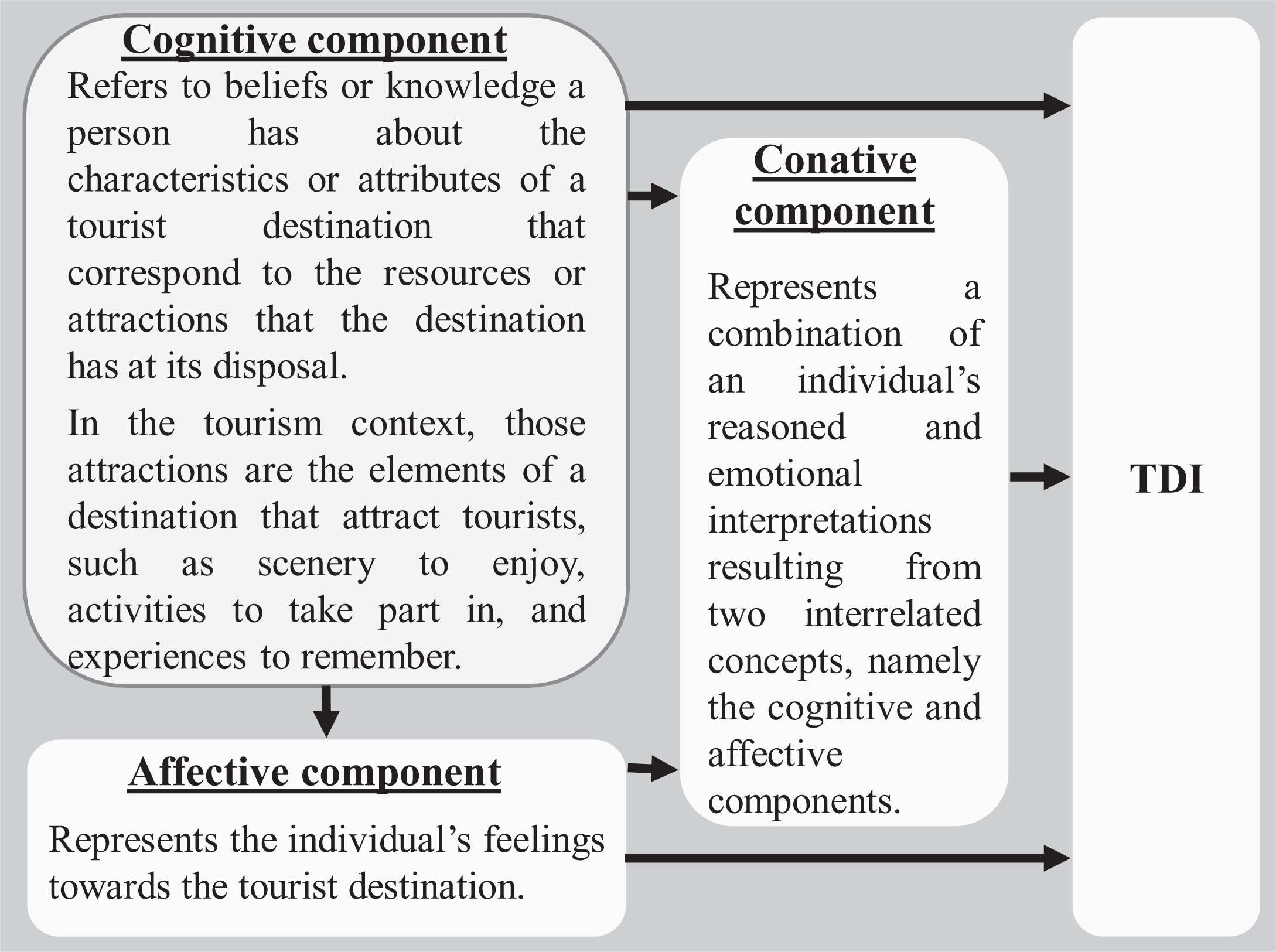
Literature review (components of tourist destination image).
The literature also reveals some consensus on the cognitive component being an antecedent of the affective component and on the evaluative consumer responses stemming from their knowledge of the product or service in question (San-Martín and Rodríguez-del-Bosque, 2008) (Figure 1). This explains the importance of creating and communicating a suitable cognitive image to the individual. As Goodall (1990) noted, knowing the factors influencing cognitive image would help identify target markets and decide which image should be promoted to which segment of the market.
Cognitive dimensions of TDI
The literature proposes a great variety of measurements for TDI. This is due to the fact that the cognitive TDI scales must be adapted to the various different tourism specialities (Gallarza et al., 2002; Lin et al., 2007). The exhaustive literature review conducted by Gallarza et al. (2002) shows that the cognitive TDI scales include different dimensions, depending on the particular type of tourism to which a given scale is applied. Table 1 outlines some of the content of the cognitive TDI image considered in different empirical applications.
Literature review (content of a cognitive tourist destination image)

Source: Adapted from Beerli and Martín (2004), Bui and Perez (2010), Bigné et al. (2009), Gallarza et al. (2002), Hui and Wan (2003) and San Martín (2005).
In relation to the scales, it is necessary to confirm that they offer adequate validity and reliability. The literature shows that only some studies consider this issue, such as Baloglu and McCleary (1999), Beerli and Martín (2004), Bigné et al. (2009), Chen and Tsai (2007), Chi and Qu (2008), Echtner and Ritchie (1993) and San-Martín anddríguez del Bosque (2008). Despite these efforts in the literature to develop a valid and reliable scale to measure the cognitive image of a destination within the sphere of rural tourism, there is still a significant gap. One exception is Chen and Kerstetter (1999), using a sample of international students, which identifies four dimensions: infrastructure, tourism, environment and leisure in nature and rural life. However, using a very particular sample could make the generalisation of the results to other populations questionable. Another exception is the study of Royo-Vela (2009), which provides an exploratory factor analysis that integrates cognitive and affective factors in the RTDI. However, the model is not validated and therefore its validity and reliability are not confirmed, thus raising questions as to the robustness of the results achieved. Hence, it is important to develop a measure of the cognitive image of a rural destination for tourists using a sample that reflects the diversity of individuals who visit a location and which confirms adequate validity and reliability of the model.
In short, the analysis of the TDI scales reveals two important factors: (1) a lack of homogeneity among the attributes defining individuals’ perceptions, due to the fact that cognitive TDI scales need to be adapted to each particular tourism speciality and (2) in several instances, the validity and reliability of the scales were not established, casting doubt on their psychometric properties. Hence, there is a need to ensure that each scale is adapted to each sphere of application (Lin et al., 2007) and that a suitable methodology is chosen to demonstrate the reliability and validity of the scales in question. The present study sets out to address precisely these issues, in the context of the rural tourism sector.
Cognitive dimensions of the RTDI
In order to determine the dimensions of the cognitive RTDI, some key points from the literature have been gathered that reveal contributing factors in the success of rural tourist destinations. These include the following:
Characteristics of the rural tourist destination itself: Not all areas are suitable for rural tourism development. Rural areas need to have a tourist attraction based on the beauty of the area (Li, 2008; Sharpley and Vass, 2006; Wang, 2008). Given the nature and origin of these rural tourist destinations, they are characterised as being little-visited places and are therefore very quiet (Lituchy and Rail, 2000) This feature is of great importance since one of the main motivations for rural tourists is precisely the quest for peace and quiet to promote rest and relaxation (Lane, 2009). Finally, enhancing tourist destinations favours their conservation – that is to say, sustainable development is a basic premise for the progress of rural tourism (Cánoves et al., 2004; Hall, 2004; Simpson, 2008).
Service offer: A range of services demanded by tourists during their stay in the rural tourist destination needs to be made available (Chen and Kerstetter, 1999; Hall, 2004; Huang, 2006; Royo-Vela, 2009). Although the supply of services demanded by rural tourists must consider common elements in all tourism offerings, such as price, quality and safety (Table 1), there are other elements of rural tourism-related services that need to be taken into account, such as developing a more personalised approach to tourists and providing a warmer reception (Cánoves et al., 2004).
Additional services related to the indigenous resources of the rural tourist destination: The existence of an attractive location is usually insufficient on its own, as the rural tourist also requires a complementary range of services, and it is these that make the operation of the rural tourist destination economically viable (García-Rosell et al., 2007). The development of this additional provision should be based on the resources of rural areas so as to achieve a perfect symbiosis between the tourist and the location. Usually, the market value of rural resources is enhanced through the development of clearly commercial activities. That said, it is important to remember that tourists will not want to lose contact with the authentically rural nature of the destination, nor with the local population (Cánoves et al., 2004). It is noted that some of the most common ways in which the value of rural resources is enhanced consist of the following: Activities that can be undertaken in the countryside (horse riding, fishing, hunting, hiking trekking, rafting, etc.) (Cánoves et al., 2004; Hernández et al., 2007; Rodrigues et al., 2010);
Cultural activities and visits to places of interest (Chen and Kerstetter, 1999; Huang, 2006; Royo-Vela, 2009): Culture-based activities constitute a major factor in attracting tourists (Kaufman and Scantlebury, 2007). In rural areas, these may include visiting monuments, ruins and other historical attractions, the creation of museums, and putting on shows based on the local culture. Examples of this approach, among many other applications that could be developed, include tourism products based on local festivals (Hernández et al., 2007), on the wine-making culture (Clemente et al., 2008; López-Guzmán and Sánchez-Cañizares, 2008) or on traditional mining operations now out of use (Ruíz and Hernández, 2007);
Offer based on local products and gastronomy: Tourist contact with the local culture can be managed through the development of trade and the gastronomy of the location. Local markets in a typical tourist destination, for example, are a major attraction (LeHew and Wesley, 2007). Partaking of the local gastronomy is also an attraction of great importance for the development of tourism (Boyne and Hall, 2004; Clemente et al., 2008). With the development of these activities, products typical of the area are offered, which leads to knowledge of the local culture for tourists, while fostering the development of social relationships with members of the local community.
In order to determine the dimensions of the RTDI, a review of specialised literature on rural tourism was carried out, as was a qualitative investigation (as referred to in the ‘Methodology’ section) which shows that the joint offer of rural tourist destinations can be summarised in six dimensions. Accordingly, the following hypothesis shapes the remainder of the study:
H1: The characteristics of the rural tourist destination, together with the characteristics of the service offer, the cultural offer, the nature-based activities offer, the supply of local products and gastronomy, are the dimensions through which the RTDI is formed.
Methodology
Qualitative study: adaptation and generation of list of items
Following the method proposed by Churchill (1979), the initial scale was developed. The field of application of this study makes an original contribution to the literature on RTDI, with particular characteristics that differentiate it from other applications previously undertaken in the literature; hence, a measurement instrument specifically for RTDI needed to be adapted and developed. The literature review made it possible to identify those dimensions that should be considered components of the RTDI scale, together with the content of each dimension.
The guidelines put forward by Creswell (1998: 123–125) and Denzin and Lincoln (2000: 649–651) were followed, together with the applications undertaken by the literature when the qualitative study was related to companies (Blankson and Cheng, 2005; Blankson et al., 2006). The present study began with an initial phase consisting of in-depth interviews with three experts with knowledge of the rural sector at national and international levels and then proceeded to a second phase devoted to 59 telephone interviews with rural tourism professionals.
With regard to the first phase, of the three sector experts, two represented the ‘hotel accommodation’ classification and the other represented the ‘non-hotel accommodation’ classification, but all three had knowledge of the rural sector at national and international levels. This field study was carried out in January 2008 and was undertaken by the lead researcher at the place of study of each of the experts interviewed.
For the second phase, the 59 telephone interviews were undertaken by a researcher experienced in conducting telephone surveys and were aimed at managers of rural tourism enterprises. This sample structure was chosen in light of the four quotas established (reflecting the particular combination of characteristics as follows: establishments from the ‘hotel accommodation’ classification, ‘non-hotel accommodation’ classification, higher category establishments and lower category establishments). In each of these four quotas, between 12 and 17 surveys were carried out.
The interviews were developed using a script based on the review of RTDI literature, and each one took approximately 25 min on average to complete. The questions posed were open-ended and derived, in addition to the review of RTDI literature, from the inherent characteristics of rural tourism enterprises (see the ‘In-depth interviews guide’ in Appendix 1).
The content from interviews was audio-recorded and registered for subsequent analysis (Denzin and Lincoln, 2000: 823). The data were in the form of protocols and means-end maps for individual respondents. Patterns of responses and observed similarities across individuals formed the results of this section of the study (Goodwin et al., 1997).
The results from this qualitative study were then used to develop the content for the scale measuring RTDI, showing that the joint offer of rural tourist destinations can be summarised in 17 items grouped into five dimensions (Table 2).
RTDI dimensions and items

RTDI: rural tourist destination image.
Quantitative study: research design
Sample used
In the quantitative study, a structured questionnaire was distributed to tourists who had enjoyed rural holidays in Andalusia, Spain. Results from this questionnaire reflected the perception of the cognitive image among rural tourists, as well as their socio-demographic characteristics. The interviews were carried out during a visit to the FERNANTUR rural tourism fair between 8 May 2008 and 11 May 2008. A total of 202 interviews were carried out, of which 3 were rejected for analysis as they were considered incomplete. On the assumption of simple random sampling and for a 95% confidence interval, assuming that these are estimates and the variance is maximised (p = q = 0.5), the sample error is ±7%.
Sampling was carried out using the convenience technique, after previously confirming that each interviewee fulfilled the two requirements of having recently carried out rural tourism in Andalusia and being over 18 years of age. Andalusia was chosen as the rural tourist destination because it is a region representative, both at national and at international levels, of tourism in general (Frías et al., 2008) and of rural tourism in particular (Polo and Frías, 2010), and therefore contributes to easily obtaining more generalised results. Given that the study focused on rural tourism, almost all were domestic rural tourists (Instituto Nacional de Estadística (INE), 2010), and thus, the questionnaire was written in Spanish only. That said, it should be borne in mind that the use of a convenience sample limits the scope of the results of the present study, and they should therefore be regarded as exploratory in nature (Luque, 1997: 203).
The profile of the respondents corresponded roughly to that of other studies undertaken in rural tourism (Frochot, 2005; Hernández et al., 2007; Kastenholz, 2010; Rodrigues et al., 2010). There was an almost equal number of females (54.80%) and males (45.20%). Most respondents were either under 29 years of age (41.20%) or between 30 and 44 years (32.20%) and were employed (53.80%). Virtually all the respondents had stayed in rural hotels and in ‘shared houses’, in equal proportion. The definition of rural hotels includes hotel establishments that are located in rural areas and that are designed in such a way as to be in harmony with their rural setting, while ‘shared houses’ refer to houses typical of the area that offer bed and breakfast and have communal areas (Polo and Frías, 2010).
Methodology applied
To measure the RTDI from the perspective of the tourist, a structured questionnaire was developed that encompassed the 17 items selected (Table 2).
Once the measurement scale was established, this scale could be validated and the reliability of each of the scales used could be measured.
A confirmatory factor analysis (CFA) was carried out in order to test whether the dimensions considered represent a joint offer by the rural tourist destinations. A CFA is a particular application of structural equation modelling (SEM). CFA is used to provide a confirmatory test of our measurement theory. A measurement theory specifies how measured variables logically and systematically represent constructs involved in a theoretical model. In other words, measurement theory specifies a series of relationships that suggest how measured variables represent a latent construct that is not measured directly. Measurement theory may then be combined with a structural theory to fully specify an SEM model (Hair et al., 2009: 663).
Since the chi-square test of multivariable normality of the variables observed was significant, it was appropriate to undertake the estimation using the maximum-likelihood method in combination with the bootstrap method (Yuan and Hayashi, 2003). Even using this technique, the chi-square value remains significant. This is because the chi-square indicator is sensitive to sample size. In this case, a valid reference is the value of the chi-square/degree of freedom ratio (normed chi-square) giving a value of 1.59, which falls within the recommended values.
Results: Dimensions underlying the cognitive rural TDI
Concerning the overall fit measurements of the model, the goodness-of-fit index (GFI) shows an acceptable value (0.92) and the root mean square error of approximation (RMSEA) value is lower than the maximum acceptable value (0.06). The incremental fit measurements Tucker–Lewis index (TLI) (0.94), comparative fit index (CFI) (0.96) and incremental fit index (IFI) (0.96) are also acceptable. The fit of the model is therefore acceptable.
The dimensions included in the cognitive RTDI scale reflect the composition of the scales when their validity and reliability can be confirmed (Devlin et al., 1993). To achieve this, the standardised charges, the individual reliability coefficient (R 2), the confidence interval and the significance of each one of the items included must be analysed (Table 3). The reliability indicators show a value greater or close to the minimum acceptable limit of 0.50 (Hair et al., 2009: 691–693). The next step is to verify the internal consistency of each one of the dimensions on the scale. Consistency can be measured with composite reliability and variance extracted. In both cases, the values obtained are acceptable, as they are close to or above the reference value of 0.70 for composite reliability and 0.50 in the case of variance extracted (Hair et al., 2009: 691–693), that is, with the exception of the characteristics of the supply of service dimension (0.46), which reveals a value of variance extracted close to the reference value. This dimension, showing a value lower than the recommended level, is not removed from the model, given that its removal does not significantly improve the overall fit of the model and can adversely affect the validity of the content (Bagozzi et al., 1979).
Validity and individual reliability

Finally, the confidence interval test was used to test discriminant validity between dimensions on the scale. According to this test, the value ‘1’ should not be found in the confidence interval of correlations between the different dimensions of the same level of analysis for discriminant validity to exist (Anderson and Gerbing, 1988). In addition, in order to establish the existence of adequate discriminant validity, the correlation between the two constructs may be checked to ensure that it does not exceed 0.80 (Bagozzi, 1994). The results are satisfactory for all cases (Table 4).
Indicators of discriminant validity

The results obtained lead to the conclusion that the set of dimensions proposed to measure the cognitive RTDI is valid, given that it allows the existence of adequate validity and reliability to be confirmed, and provides empirical support for the hypothesis proposed.
Discussion and managerial implications
Given the complexity and diversity of factors involved in the development of rural tourist destinations, it is of interest to make inroads in the study of RTDI formation. One initial step in this direction is the study of cognitive RTDI formation. In the present study, the dimensions that comprise the cognitive RTDI are identified and validated, thus making it possible to develop appropriate strategies for the development of rural tourism – a further aim of this study.
It is seen that the dimensions identified in this study have been adapted to the rural tourism sector, which means that their content differs from the content of the dimensions applied in other forms of tourism (e.g. Gallarza et al., 2002). It demonstrates that, ideally, the rural tourism sector should employ differentiation strategies based on the rural resources compared to that of other tourism specialties. Hence, it is made clear that this sector has specific identity traits that tourists greatly value, which other specialist tourist markets cannot offer.
The results achieved in this study also have implications for those practitioners in the sector who wish to have a better understanding of the factors that make up the RTDI. The following implications are of particular note for both private and public players operating in the rural tourism sector:
Implications for the private rural tourism sector: Considering the makeup of the TDI from the tourists’ perspective, it is quite clear that this sector has specific traits that tourists greatly value, which other specialist tourism markets cannot offer. It is extremely useful for private rural tourism enterprises to have an insight into those elements of the rural tourism offer that rural tourists value most highly, which differentiate the rural offer from that of other specialist tourism markets. This knowledge can be used specifically for the implementation of actions that are market-oriented (Boyne and Hall, 2004; Glover and Prideaux, 2009; Molina and Esteban, 2006; Rodrigues et al., 2010; Singh et al., 2007).
More specifically, it should be borne in mind that when a tourism enterprise carries out market-related activities (such as new product development, promotion and sales promotion), its offer will increase in value from the tourist’s perspective if it takes into account (a) the particular characteristics of the rural tourist destination, such as the beauty of the natural setting, peace and quiet, and the state of conservation of these attributes; (b) the elements of safety, quality and price of the tourism services delivered, together with the warm welcome given to tourists and the personalisation of tourist services; and (c) the complementary offer of the rural tourist destination, in terms of culture (such as monuments, museums, concerts and theatre), those activities pertaining to the natural environment (e.g. mountain sports, water sports and adventure activities) and activities related to local products and gastronomy (which promote the cultural and leisure aspects of the destination, in the form of fairs, competitions, courses and tasting sessions, for instance).
Implications for agencies responsible for the development of economically disadvantaged rural areas: The aim of many government agencies is to encourage the development of economically disadvantaged rural areas through the development of rural tourism. To achieve this goal, the European Union (EU) has put into operation ambitious strategic plans involving high levels of investment geared towards the achievement of sustainable development and social well-being in rural areas (Barke, 2004). However, nowadays European policy on the development of rural areas is moving away from a protectionist focus and towards a focus based on the market and global competition (Ward and Lowe, 2004).
This new scenario reveals how important it is for the sector to adopt actions that respond to the current situation within the tourism market. Therefore, a key area for decision making among public bodies involved in the rural tourism sector is that of policies and actions aimed at creating greater competitive capacity and a higher level of appeal for the market in each rural area in which they operate. The adoption of a market perspective is essential for the development of an offer that is geared to the market (Baláz and Williams, 2005; Glover and Prideaux, 2009). The present study offers precisely this market perspective, identifying those elements of the rural tourist destination offer that the market values most, and that contribute to differentiating these destinations from the offer represented by other tourism specialities.
With this knowledge, public entities will be able to invest their resources in such a way as to achieve maximum impact on the development of each rural area, stimulating their competitiveness and helping to achieve differentiation in the marketplace. In this sense, public entities have a key role to play in guiding those involved in rural tourism, helping them to recognise that in order to increase competitiveness in the market, they need to work together to create a shared, consistent RTDI, rather than each firm conveying its offer individually.
The basis for this shared approach is to identify (a) the unique characteristics of the rural tourist destination; (b) the features and benefits of the services offered by the destination; and (c) the features of the overall range of activities related to culture, nature, local products and gastronomy that the destination can offer. Once these features have been identified, a profile for the overall offer of the rural tourist destination can be jointly created and presented to the market. Similarly, knowledge of the elements that make up the RTDI scale validated in the present study constitutes an invaluable tool with which public bodies can evaluate the design of the overall offer of each rural tourist destination and thus identify any possible areas that are not being appropriately presented to the market or where increased effort is required.
The insights offered by the present study therefore represent an impetus to public bodies to make every effort to conserve and improve those resources on which a greater appeal of the tourist offer is based. This impetus also extends to taking action with regard to service providers, aimed at ensuring that they deliver an offer that is in line with the characteristics that the market is asking for. It also relates to designing an offer that integrates and celebrates the cultural and natural resources of the rural tourist destination and other resources such as gastronomy and local products, including activities that allow the tourist to interact with these local rural resources.
Conclusion
Since the scope of the study is new to the literature, it was necessary to identify the particular elements of rural tourism that make up the cognitive TDI. To achieve this, a literature review was conducted and a qualitative study undertaken, from which the factors were identified out of which tourists form the cognitive RTDI. The results demonstrated the existence of five dimensions: first dimension referring to the characteristics of the rural environment, second dimension referring to the offer of services demanded by the rural tourist and the other three dimensions relating to the appreciation of the resources of the rural environment that fosters contact with, and a better understanding of, ‘rural life’ (from the cultural offer, activities in the natural environment and the supply of local products, emphasising the gastronomy). These dimensions were then validated by means of a confirmatory factorial analysis. Acceptable values were found for the overall fit of the model, the validity and reliability of each dimension and the correlations. Therefore, the validity of the scale was established.
Limitations and future direction
As with any empirical study, this article presents some limitations, which in turn help to identify future lines of research. First, this study is primarily focused on the development of a cognitive RTDI – a necessary first step in developing a better understanding of the formation of an RTDI. That said, it would be interesting to go one step further in this new application and develop a model that includes the affective components of the RTDI, so as to ultimately achieve a comprehensive model of the image.
Second, while the empirical study was conducted in a leading tourist destination for rural tourism (Polo and Frías, 2010), which contributes to the generalisability of the results achieved, further empirical studies in other geographical areas are necessary to help corroborate the adequacy of the scale developed in this study.
Third, an area of interest for further study is the relationship between factors making up the rural tourist destination offer and the tourist’s behaviour (concerning the choice of destination and their degree of satisfaction with, and loyalty to, the chosen destination). Another area of interest is the study of the effect of the RTDI on the achievement of outcomes by the rural tourist destination.
Footnotes
Acknowledgement
Study carried out thanks to financing received from research project “Internet, ComercializaciónTurística y Desarrollo en Andalucía” by the Junta de Andalucía (Spain).
Appendix 1
In-depth interviews guide
| Topic 1: RTDI in general Please indicate the elements you believe the tourist takes into consideration when forming the RTDI |
| Topic 2: Characteristics of the rural tourist destination Please outline the characteristics of the rural tourist destination that the tourist takes into account when forming the RTDI (e.g. beauty of resources, diversity of resources or general atmosphere of the rural tourist destination) |
| Topic 3: Characteristics of the service offer Could you identify the characteristics of the service offer of the rural tourist destination that the tourist takes into account when forming the RTDI? (e.g. personalised service of staff, service quality level or price levels of the businesses providing services) |
| Topic 4: Cultural offer Could you identify the characteristics of the cultural offer of the rural tourist destination that the tourist takes into account when forming the RTDI? (e.g. offer of monuments, museums or cultural activities) |
| Topic 5: Offer of activities in nature Could you identify those characteristics of the rural tourist destination’s offer of activities in nature that the tourist takes into account when forming the RTDI? (e.g. mountain or water sports, or adventure activities) |
| Topic 6: Local products and gastronomy offer Could you identify the characteristics of the local products and gastronomy offer of the rural tourist destination that the tourist takes into account when forming the RTDI? (e.g. offer of local products or local gastronomy) |

RTDI: rural tourist destination image.