




Abstract
The Internet has impacted the tourism sector and tourists substantially. Yet, very little information is known about how tourism organisations are using the second generation of the Internet, Web 2.0, and its various social media platforms in relation to their marketing activities. This article explores ways in which events, as an integral part of the tourism sector, are using Web 2.0 tools to build their online brand communities. While the qualitative analysis highlights benefits for events, it also identifies the risks and challenges that events face in using Web 2.0. These include the capacity to resource this aspect of marketing and the ability to protect their brand from the advent of counter- and alter-brand communities when online brand community building activities are not fully effective.
Introduction
The Internet has impacted the tourism sector and tourists substantially. Tourists use the Internet to plan their vacations (Tierney, 2000); communicate with suppliers, friends and family while on vacation (Akehurst, 2009); memorialise their vacations with photos on websites and blogs (Carson, 2008); and recommend their vacation experiences to others via a range of social media platforms (Prideaux and Coghlan, 2010). A number of studies have explored the influence of the Internet on tourism marketing, such as that of Pan et al. (2007) with regard to travel blogs; Kepler (2000), Vermeulen and Seegersa (2009) and Yea et al. (2009) on industry-based software and Beldona et al. (2005) on consumer motivations for using online technologies related to tourism. Very little information is known, however, about how tourism organisations are using the second generation of the Internet, or Web 2.0, in their relation to branding activities.
Web 2.0 and its various platforms provide the perfect toolset for organisations to collaborate with consumers and create specific value, or linking value, out of their relationship with them (Cova and Cova, 2002). In this context, the power of the crowd is accentuated (Cova and White, 2010). With the advent of Facebook, YouTube, MySpace, Flickr, LinkedIn and Twitter, there are a myriad of opportunities for organisations to develop online brand communities. However, Schmallegger and Carson (2008: 106) state that while ‘ … [tourism] practitioners need to be aware of how consumers are interacting with the Web 2.0 environment’ they also emphasise that research is needed to inform tourism practitioners as to ‘how the associated applications can be employed to assist in business functions’.
This article seeks to address this gap in knowledge and specifically focusses on the use of Web 2.0 for brand community building activities in the events tourism sector. The focus is on the practices or the linked and implicit ways of understanding, saying and doing things (Schau et al., 2009) that events are using to develop their online brand communities and how they are managing the opportunities, challenges and risks that Web 2.0 presents for them.
As events have become an integral part of the tourism industry (Getz, 2000), they are a particularly fertile area in which to examine the notion of brand community for a number of reasons. First, most events, be they festivals, cultural events, business or sports events, are aimed at building some form of community, whether this be in the traditional sense (Mayfield and Crompton, 1995) as we know it or in the marketing sense of a community around a set of brand values (Ouwersloot and Odekerken-Schröder, 2008). Second, because events are limited in duration (Jago, 1998) and more likely to be held periodically, rather than on a continuous basis, the challenges for sustaining brand communities are possibly accentuated as compared with market offerings that are available on a continuing basis. Finally, as the franchise model is not uncommon in the event sector (Hede and Kellett, 2011), event owners are keen to develop their brand’s equity to enhance the market value of their asset and building the strength of an online brand community is one way to achieve this.
This article proceeds with an overview of the brand community literature, as well as details of our method, which involved a multiple case study design of 13 events. We then present and discuss our findings, highlighting the challenges of using Web 2.0. In our conclusion, we acknowledge the limitations of the research, make managerial recommendations and suggest avenues for further research on this topic.
Brand communities and online brand communities
Brand building and relationship building are two of the key implications of virtual communities for tourism organisations (Wang et al., 2002). Brand communities, as specialised, non-geographically bound communities, where members or admirers of the brand have a structured set of social relationships, are characterised by a shared consciousness, common rituals and traditions and a sense of moral responsibility for the group (Muñiz and O’Guinn, 2001). Online communities around brands have become spaces where organisations and consumers share information about brands. In this sense, online brand communities have potential to enhance consumer loyalty and develop awareness of the brand beyond a bounded geographical location.
Brand communities provide opportunities for members to network and support each other and to learn about the brand (Brown et al., 2003) and to co-create value (Vargo and Lusch, 2004). While Belk (2010) notes differences among cultures in relation to sharing, the phenomenon of sharing of opinions and information online to a wide audience in the western world is almost staggering. Indeed, Kozinets (1999) pointed out that the idea that giving things away has potential to build networks and value emerged in the very early stages of the digital economy.
Cova and White (2010) suggest that the most important resource in online, as well as offline, gatherings is the crowd. Customers, therefore, are central to brand communities (McAlexander et al., 2002). Communications in online brand communities eventuate between customers, between customers and the brand and among the community (Muñiz and O’Guinn, 2001). In online brand communities, the face of the customer or the organisation behind the brand is no longer anonymous, as communication among members, whether they are customers or employees of the brand, is open. In addition, there is greater fluidity in the role that employees play in online brand communities; their relationship with customers is less hierarchical as they share the power with customers (Muñiz and O’Guinn, 2001).
Hence, online brand communities are a means of empowering consumers. Cova and Pace (2006) suggest that customer re-empowerment is facilitated in online brand communities. They provide the examples of Ducati, Mercedes Benz and Harley-Davidson when these brands have evolved into a shared piece of cultural property, rather than merely owned by the corporation, and the relationship between the community members is dialectical (Holt, 2002). Füller et al. (2008) found that because of their devotion to the brand and expertise in the use of the market offering, online brand community members were motivated to solve problems and co-create new and revised market offerings that were beneficial to users and organisations.
Benefits and risks
The benefits of strong brand communities are, therefore, considered to be substantial for both organisations and consumers. Brands that have strong brand communities experience high levels of consumer loyalty and are able to better withstand competition and consumer defection intentions (Schau et al., 2009). Madupu and Cooley (2010) proposed that brand communities create sustainable brand loyalty, oppositional brand loyalty and moral brand recommendation intentions. Woisetschläger et al. (2008) found that identification, satisfaction and degree of influence are key factors impacting the efficacy of online brand communities, with more active members tending to evaluate the brand more favourably.
Just as there are benefits to be gained via online brand community activities, there are also risks for organisations. Schmallegger and Carson (2008) suggest that what is different about many Web 2.0-based platforms is that their content is relatively unstructured and that content development is not always managed by host organisations. However, some organisations may encounter unexpected problems when developing their online brand communities because consumers become the creators of content (Muñiz and Schau, 2005). Cova and White (2010), for example, documented that alter- and counter-brand (or alternative or opposing) communities can emerge and highlight the difficulty in controlling collective actors, which the Internet has spontaneously helped to foster and nurture.
With what is known about the benefits of online brand communities, and the known risks associated them, organisations adopting online branding strategies are best placed to leverage their benefits when they approach their development in a strategic manner. Schau et al. (2009) identify four aggregate themes across the practices of nine online brand community members, namely, social networking, impression management, community engagement and brand use. They suggest that opportunities for social networking in brand communities eventuate from a range of emergent participatory actions, namely, welcoming, empathising and governing. They concluded that the social networking activities of community members, who were devotees of the brands, create, enhance and sustain the ties among brand community members.
Adoption of social media platforms in tourism and events
The rise of virtual communities has been phenomenal. In addition, the scope of virtual communities is varied and complex. ‘Virtual communities vary in the scope of their content from fairly simple lists of resources to complex cyber environments offering net-citizens information and the opportunity to socialize with likeminded individuals’ (Litvin et al., 2008: 464). In their review of research on e-tourism over the last 20 years, Buhalis and Law (2008: 623) stated that ‘virtual communities are gradually becoming incredibly influential in tourism as consumers increasingly trust their peers, rather than marketing messages’. Hence, tourism organisations are in need of understanding virtual communities and are engaging with them to do this.
Tourism organisations are using a range of social media platforms, not unlike other organisations, to develop virtual communities. Popular blogospheres include TripAdvisor and Travelocity (Noone et al., 2011). A number of studies have examined the role of travel blogs on consumer decision making (see, for example, Carson, 2008; Keng and Ting, 2009; Pan et al., 2007; Schmallegger and Carson, 2008; Thevenot, 2007; Zehrer et al., 2011). Zehrer et al. (2011) examined the influence of consumer evaluations of tourism products and services on the perceptions that other virtual community members form of those same tourism products and services. They concluded that virtual community members found it useful when negative blog postings were countered by a subsequent positive blog. ‘On the other hand, a positive posting that is countered by a negative posting should be considered less desirable’ (Zehrer et al., 2011: 112). Hence, they highlight the importance of managing online communications that may impact the brand’s value in the marketplace.
While as blogospheres, TripAdvisor and Travelocity, for example, focus on information search, social media platforms such as Facebook, YouTube, MySpace, Flickr and Twitter, which are widely used by tourism organisations, create a dialogue among brand community members. The common feature of these social media platforms is that they encourage discussion, feedback, voting, comments and sharing of information from all interested parties (Noone et al., 2011). Thevenot (2007), however, cautioned that the travel and tourism industry today needs to recognise that while social media platforms have the potential to create positive impacts, they can also create negative ones. Thevenot argued that social media platforms offer tourists increased power and institutions/marketers decreased powers if organisations do not manage online communications appropriately. In addition, the return on investment from the use of social media platforms has been questioned (Weinberg and Pehlivan, 2011).
A cursory review of a range of event websites indicates that Web 2.0 platforms have been adopted by event organisations to build their online brand communities via social networking activities. For example, the 2012 London Olympic Games Organising Committee has been using Facebook since July 2005; the Sydney Convention and Exhibition Centre created a blog in March 2011 and the FIFA World Cup Soccer, with its Club House, states that this concept places members at the ‘heart of the game’ (http://www.fifa.com/theclub/myprofile/index.htmx), as it enables members to create networks, create fantasy teams and avatars. The dearth of academic research on this topic, however, does not appear to reflect what has emerged in the event sector. We suggest therefore that this is fertile ground in which to explore the development of online brand communities.
Method
Our research is focussed on one of the four aggregate themes that Schau et al. (2009) found to be apparent in online brand communities – social networking opportunities. We were particularly interested in the practices that event organisations use to develop their online brand communities and to explore the challenges and risks associated with developing online brand communities around their events. Schau et al. (2009) examined the practices that members of nine brand communities, including those in relation to cars, television programmes, electronic devices, adopted. Their work is focussed on the entire online brand communities, but our study is focussed on the practices that event organisations have adopted. Hence, our study is industry-specific and offers a different perspective to their study. By delving into a context that has not yet been explored, we aim to gather new information about online brand communities.
Data were collected in 2011 via an interpretive case method drawing on in-depth interviews with those responsible for the marketing of 13 events. Multiple case studies can be difficult to organise, however, they assist to develop a snapshot of reality (Carson, 2008; Healy and Perry, 2000). The 13 events were purposively selected for our study so as to include a cross-section of cultural, community, sporting and business events and festivals. Events included in this study range from those that were delivered at least once each year to biannual events which are often the case in the events sector. The study also included events that were privately owned, not-for-profit events and those owned by government instrumentalities. While this small number of events cannot be said to represent the entire event sector, it was thought that a sample of events with these profiles would provide a more comprehensive picture of the real world rather than if a completely random sample of events was included in the study. Table 1 provides details of the events included in our study.
Event profiles, brand community strategy and platforms used
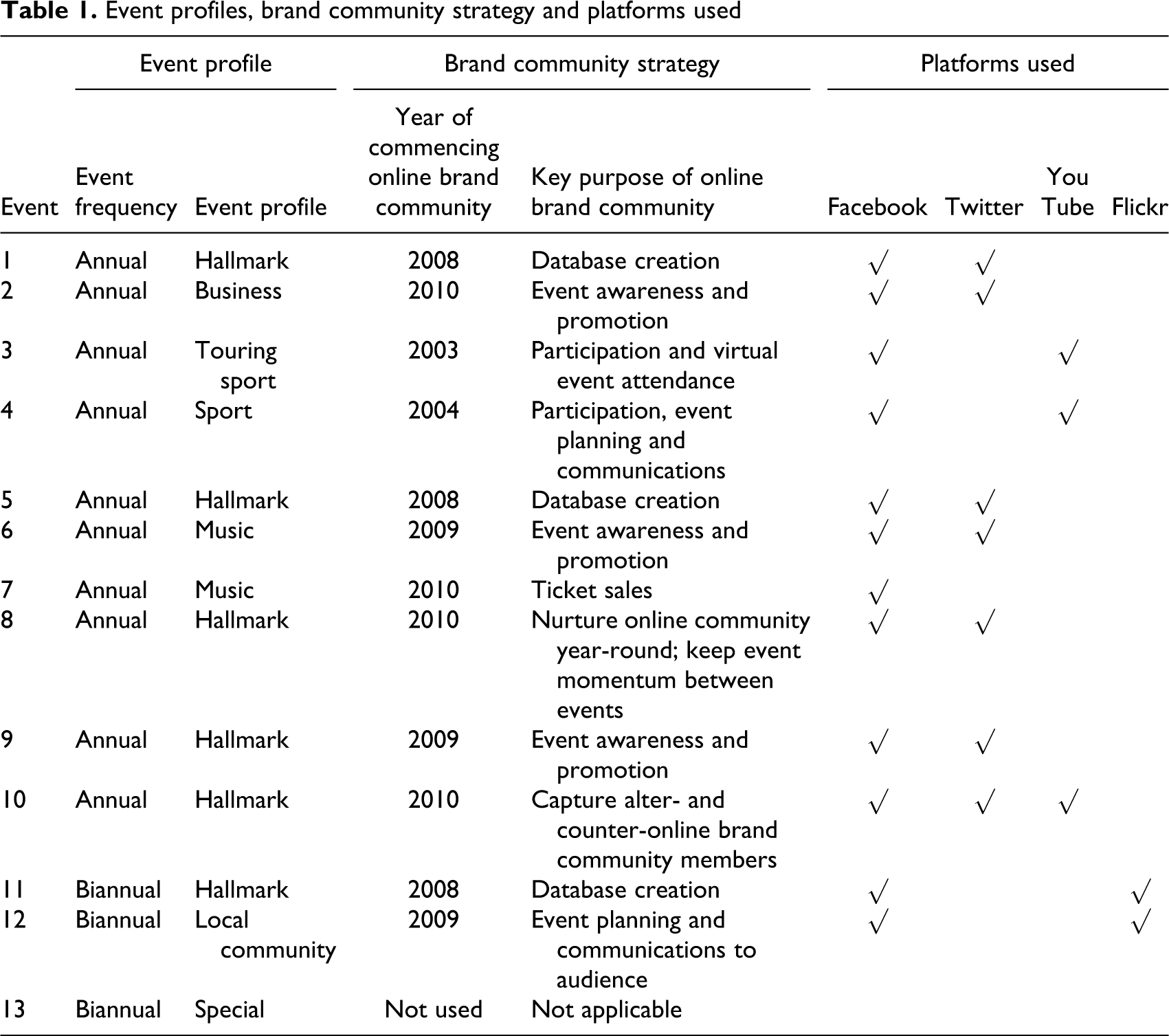
All the informants in this study had a central role in the delivery of each of the events. Six of the 13 events were hallmark events (Events number 1, 5, 8, 9, 10 and 11, see Table 1). These event organisations were typically larger and more complex in their structure with access to financial and human resources. As such, the responsibility for social media rested within the marketing departments of those organisations. All of the informants from these organisations was a coordinator of the social media strategy as part of his or her broader role in marketing of the event. For the remaining seven events, the organisations were typically smaller and had access to less financial and human resources. In these event organisations, the informants who participated in this study were responsible for multiple tasks in the strategic development, planning, marketing and implementation of their events. As such, informants from these event organisations tended to be executive level personnel and one of their responsibilities was to coordinate social media as part of their broader role.
Prior to commencing the data collection, we developed an interview protocol. To do so, we reviewed the literature regarding the way in which event organisations have been using social media for marketing activities, and particularly in relation to branding. Further, we familiarised ourselves with the way event organisations internationally and event organisations within this study were using the various Web 2.0 platforms. We therefore developed an informed understanding of which platforms were commonly being used by events globally, and then drilled down to the specifics of the platforms being used by each event organisation in this study.
The interview protocol provided informants with a background to the research and its aims and objectives. It invited informants to describe their event in terms of its history and brand and to share their professional background and current role within the event. It also sought informants’ perspectives regarding the extent to which the event had adopted Web 2.0 platforms and the resulting organisational practices to build the event’s online brand community. Finally, informants were asked to indicate how the outcomes of their practices were evaluated. This protocol provided a framework for the interviews. Before each interview, we examined each event’s website in case there were particular aspects about their practices that we felt we should be aware of. This enabled us to focus the interviews on actual practice, to be more conversant with the participants about their online brand community building practice and to probe the interviewees on specific aspects related to their online brand community practices.
We recorded the interviews with the consent of the interviewees and then transcribed the recordings for later analysis. We also took notes during the interviews, and in most cases, both authors conducted the interviews. Once all the transcripts were available and verified by the research participants, the data were analysed within each case and then across-case (see Eisenhardt and Graebner, 2007; Miles and Huberman, 1984; Yin, 1984) using content analysis, hence reducing, organising and displaying the data. Our coding focussed on the Web 2.0 tools and their use for welcoming, empathising and governing online brand community members and how these were perceived to create, enhance and sustain ties among brand community members. When this process was completed, the data were then reordered to identify the salient issues relating to the primary research question.
Findings and discussion
Overview of the use of Web 2.0 platforms
Across our sample, all but one event, which is held biannually and is a hallmark event, indicated that they were using various social media platforms to communicate with consumers. Facebook and Twitter were the most commonly used platforms, a finding which reflects the incidence of the adoption of social media platforms more generally (Kaplan and Haenlein, 2010). YouTube was also used, but to a lesser extent than Facebook and Twitter. Three events had created their own YouTube channel posting visual content, particularly during and after the events, to create and maintain interest in the event brand. Flickr was not widely used, but when it was used this tended to be for those events that were visual- or content-rich, such as arts and music events. For example, one of our informants representing an arts festival, viewed Flickr as a tool for festival attendees to post some of the most ‘beautiful images’ from the festival which she noted the organisation would not have had the time to create, and recognised the value-adding capacity of user-generated content.
One of the events in our study had commenced using social media as a marketing tool in 2003. Three events in our study commenced using social media, specifically Facebook, in 2008, and the remaining events commenced their use of social media after 2008. Four of these events had only implemented social media activities for marketing their events within 12 months prior to this research. The norm seems to be that events first use Facebook and Twitter, but later they may venture into using a YouTube channel.
Figure 1 visually presents an indication of how the events in our study are using Facebook, Twitter, YouTube, LinkedIn and Flickr across the pre-stage, during stage and post-stage of their events for brand-building activities. As can be seen from Figure 1, the different platforms are used in different stages of an event’s delivery. The event website is used continually. However, the use of social media platforms increases closer to the event. Facebook is used most frequently immediately pre-event, while Twitter is used most frequently when the event is being held. The platforms used most frequently change somewhat post-event, with YouTube and Flickr used to create and sustain event legacy.

Indication of platforms used, purpose through event stages.
Practices of adoption
We found that the practices of adoption were mostly unstructured and reactive, reflected in the generally limited planning being made in relation to the frequency and types of posts by the events that are being made rather than a deliberate attempt to be flexible and responsive to members’ needs. However, we also found an unstructured yet proactive approach as well as an approach that was structured and proactive, among the events. These latter two approaches provide insights into how social media platforms and associated online communications among the event organisations and consumers are being used to strategically build brand communities.
Unstructured and proactive
Our informant from an action-sports programme of events, for example, indicated that they are using Facebook and Twitter in an unstructured manner to allow the event to be proactive in its approach to the content and frequency of brand community communications. To some extent, this likely reflects the organisation’s creative and innovative culture and the sport it represents. This event was an early adopter of social media, in 2003, and this may go some way to explain how comfortable the organisation feels with using social media and the success that it is currently experiencing. For example, our informant said: … I guess it has been a long journey. We’ve started to see the real success in our work in the last 12 months, with the recent announcement, increased participation funding … so it was a pleasure to see that all the hard work has been recognised.
Social media communications from this event respond to what is happening around the event and in the sport in a concise manner and in a way that consumers want to hear and absorb the information about the sporting event. For example, our informant said: Our audience is highly active, so they’re not going to sit down for half an hour on a Saturday morning and watch the event. They prefer to see short snippets and updates … the way that they consume is short, distinct, more informative.
In addition, our informant indicated that his organisation is of the view that there are very few rules with regard to what can be said in these media. He explained: That’s the beauty of it. It’s open to everyone to have comments. Obviously we might start a large majority of it [conversation], but what we hope it is not a one-way conversation … we’ve got the capacity to moderate … but if someone is prepared to have a contrary conversation, then that’s fine. We don’t want to shoot down anyone for their own opinions.
In this way, this event welcomes communications from the brand community members, stimulating discussion among members and thus maintaining the brand community (Schau et al., 2009). In this instance, member contributions, such as comments and photos, are valued in their own right and the organisation is not judgmental about members’ opinions. As can be seen from the preceding quote from this informant, it is uncommon that members’ posts are edited by the event organisation. Unlike one event in our sample that has not adopted social media for their marketing communications strategies, this sports-based event does not see user-generated content as a potential risk to the brand’s integrity. Indeed, this sports-based event perceives open communications from their brand community members to be a means of enhancing the brand, communicating its values and enabling them to create the brand through their communications and problem solving. For example, our informant explained: There is no set schedule for many of our events. They are organised by the online community and advertised in the online community: so they [consumers] set the agenda.
This supports the finding of Füller et al. (2008) that online brand community members are recognised for their creativity and capacity to solve problems and innovate the brand to which they are dedicated.
Highly structured and proactive
In contrast to this unstructured approach, some of the events in our sample were using a very structured approach to their social media strategies. This is consistent with general approaches to engaging in social media (traditional and structured vs emergent) as noted by Berthon et al. (2005).
One sports event, an annual international hallmark event developed and applied a model of social media communications to each day of the program, thus adopting a structured approach. This sports event had one of the largest online brand communities. In our sample, which was developed following three years of experience using social media, includes a specific number of posts each day with a specific purpose. For example, one post includes the details of the day’s schedule and another is focussed on the merchandise that can be purchased at the event. The remaining posts are flexible with regard to their content. They may be about the celebrities attending the event, the athlete or attendee fashions at the event, the outcome of the day’s completed competition or the cultural entertainment at the event. During the year, this sports event has comparatively limited posts. However, because it is an international event and part of a world circuit of related events, it leverages off its other international counterparts to maintain awareness of the event during the year. However, in the 2 months preceding this event, a social media consultant works on the social media platforms in a full-time capacity to build the brand community. This resourcing arrangement reflects the peaks and troughs associated with events more generally (Hanlon and Cuskelly, 2002).
Similarly, a music event, which only commenced using social media platforms for the first time in 2011, developed a schedule of social media marketing communications that included weekly activities in the 4 months preceding the event. The purpose of the strategy was to raise awareness of the event and to motivate brand community members to purchase their tickets in advance. While our analysis of the interview data suggests that a number of our research informants viewed their social media marketing communications as an appendix to their marketing communications, the approach adopted in the case of the music event is that social media marketing communications and related brand community building activities were integrated. Activities included a weekly competition for brand community members to win a ticket to the forthcoming festival and a range of offline brand community activities, held in a number of strategically selected venues, which were linked with the online brand community activities. From our informant’s perspective, this approach was successful in building the database and building the online brand community. Our informant said online brand community members who helped to expand the online brand community were rewarded for their contributions. For example, as one friend tagged 10 other friends, they helped to build the database: ‘the first person to do that and prove it, won tickets to the events’. This supports Kozinets’ (1999) assertion that the simple marketing rule which was emerging very early in the digital economy was that networks are created and developed when things are given away. However, our informant also added that it was sometimes more effective not to have the same information posted to all marketing communication platforms: We’ve got the PR team who do media releases … but … not all of those things [that are on Facebook] are worthy of going public, you know in the paper.
Another event in our study used an exclusive offline social event as part of its launch of its official online brand community. As this event is a hallmark event, anchored in the host destination, many of the event’s brand community members were able to attend the social event. Hence, to some extent, the online brand community here is not entirely boundaryless as Muñiz and McGuinn (2001) suggest is the case for online brand communities. The social event also served as a way of welcoming brand community members into the official brand community, which Shau et al. (2009) suggest is integral to successful online brand communities. Hence, as McAlexander et al. (2002) might suggest, the use of offline brand community events with online activities have the potential to capitalise on the most important resource in online, as well as offline, gatherings: the crowd.
Challenges associated with developing online brand communities
We identified four key challenges for events in relation to their potential to develop their online brand communities: the pulsating nature of events; limitations in expertise and knowledge of events which impact social media activities; the resourcing of online brand community activities using social media and the risk of alter-brand communities emerging when online brand community activities using social media are not effective.
The nature of events
The pulsating nature of events (Hanlon and Cuskelly, 2002) presents an inherent challenge for events in relation to the management of their online brand communities. With much of the event workforce casualised, a tendency for events to use volunteers, and a substantial need for staff to multi-task, all but one of our informants indicated that resourcing was problematic. They suggested that it is difficult to find the resourcing to welcome, empathise and govern their online brand communities so that they are successfully created, enhanced and sustained. As one of our informants said: I just find it so time-consuming … I’d have a lot more to say about it and use it better if I had more time to work it out … From now and until the end of the event, I am hoping that I spend no time on Facebook and Twitter because of my time … I’m running the finance you know. I am doing lots of things.
Limited expertise and knowledge
Our informants also raised the issue of needing to have the expertise to manage online brand communities using social media. As one informant offered: … it can’t just be anybody on Facebook and Twitter. It’s not a matter of just getting an ‘intern’. You have to have a really strong understanding of public relations and media management … it’s not a job for somebody who doesn’t have that kind of communication background.
Resourcing
There is a common perception that brand-building strategies that use social media platforms are cost-free (e.g. Weinberg and Pehlivan, 2011). Most of the social media platforms, such as Facebook, Twitter, LinkedIn and Flickr, which were those that were most commonly used by the events in our study, are free to use, but as noted previously, the expertise to develop the brand community building strategies and the time required to implement them are not free. Most informants recognised that a specific skill set was required. However, unlike other marketing activities used to build the brand, very few informants in this study reported that they allocated specific budgets to the use of social media or had hired in specific expertise for this purpose. One informant explained: … we are using resources that already exist within the team [to implement social media activities]… ideally you need someone across all platforms twenty-four seven. But we don’t have the resources for that.
Another informant noted: ‘… we just integrate [social media strategies] in… you just tack social media onto the normal tasks’. As noted by Weinberg and Pehlivan (2011), often there is little evidence of a return on investment from social media spending. In the case of respondents in this study, evaluation and measurement of return on investment was limited even though there are some sophisticated tools emerging for this purpose. Hence, the reasoning and justification to invest more funds in brand-building activities using social media activities, potentially at the expense of other business activities, could not always be provided.
Emergence of alter-brand communities
The risk of non-official brand communities, or those brand communities that an organisation does not manage which Cova and White (2010) refer to as alter- or counter-brand communities, motivated at least three of our events to initiate their online brand community activities. Alter- or counter-brand communities were considered to be major challenges resulting from the advent of Web 2.0 for the events. One of our informants, from a major hallmark event, set out to activate the event’s online brand community when they realised that a series of alter-brand communities had emerged on Facebook. She explained: … what really encouraged us to use Facebook and jump right into this [Web 2.0] was a quick audit of what was happening out there in this space. We discovered that there were websites with over 7000 members using our event name.
Similarly, another informant from a local community event explained that counter- or alter-brands were of concern to their event. The main task ahead was to convert members of one of these alter-brands to the official brand community to avoid the brand’s value being undermined and devalued.
Conclusions and further research
As Schmallegger and Carson (2008: 106) suggest, tourism practitioners need to be aware of how consumers are interacting with the Web 2.0 environment and how Web 2.0 platforms assist in business functions. Our research explored the use of social media and social media platforms for online brand community building in the events sector. Our qualitative study of a wide range of different types of events provides insights into the ‘state of play’ for events with regard to their online brand community activities and use of Web 2.0 platforms in Australia in 2011.
While the sample size is relatively small, the content of our interviews indicated that we were nearing saturation with regard to our findings. We were aware that additional interviews would likely not add value to our findings. Hence, we suggest that the sample size is not a major limitation of this study, but we acknowledge that generalising our findings beyond the scope of the events in our study should be approached with caution. We hope that this exploratory study, the first of its kind on the use of Web 2.0 platforms within the field of events in Australia, sheds light on the topic and opens a pathway for further research in Australia and overseas.
For example, it would be useful to undertake further research on this topic outside Australia to explore whether the findings of this study pertain to other countries. Once this is established, a broader study that includes event brand community members and their views on how events are using Web 2.0 to build the brand communities and create value would be beneficial from both a theoretical and practical viewpoint. Questions that could drive future research include the following: Are the opportunities, challenges and risks associated with building online event brand communities universal across the globe? Can generic models of brand-building activities in a Web 2.0 context be developed for events? How effective are event brand communities in adding value for brand community members?
This study leads us to make the following conclusions. First, integrating offline and online brand community building activities has potential to have a synergistic effect on the utility of the value of the brand community for events. That is, event organisations can no longer afford to understand online brand community building activities as separate to, or different from, traditional brand-building activities. Indeed, one should drive the other, and vice versa. Second, effective brand community building activities have the capacity to minimise seepage of brand equity via alter-brand communities. In other words, when organisations leverage online brand communities to stimulate live event attendance and/or live event engagement and leverage live event attendance to stimulate virtual engagement, the value of the brand is enhanced, and the likelihood of counter-brands emerging is minimised. Third, events need to manage their online brand-building activities in a strategic manner to ensure that they are able to overcome the unique challenges associated with being a pulsating organisation. This is an important factor that is unique for the event sector. Event organisations must consider what information is important, which platform is most appropriate and when information dissemination is most appropriate for each platform. Such strategies will allow event organisations to use Web 2.0 platforms as tools to continue regular conversations about events despite their intermittent delivery cycles.
The events sector is an important component of tourism (Getz, 2005) as event attendance is often the impetus for many tourists to take a vacation (Nicholson and Pearce, 2000). Hence, it is important that research is undertaken on marketing in relation to events as an independent market offering as well as when they are integrated into the complex systems that drive tourism. Furthermore, as Schultz (2011) notes the use of social media is not a commercial aberration; it is revolutionary and has impacted the world as we know it. Thus, the need to gain information as to how social media is impacting event marketing is not only important for events to have, but it is also critical to their viability and to the tourism sector more widely.
Footnotes
Funding
This research received no specific grant from any funding agency in the public, commercial or not-for-profit sectors.