




Abstract
This article explores whether a destination brand image exists in Western Australia’s (WA) South-West region, and whether local and international visitors hold different perceptions of it. A questionnaire using a non-probability convenience sampling method was self-administered to students from a university in WA. From the 228 useable survey responses collected, differences were observed between the perceptions of local and international visitors. In-group approval played a significantly higher role in influencing destination choice for international visitors. Five factors were derived from the brand image of WA’s South-West region. The article highlights the need for researchers and practitioners to identify both the most salient and the least salient aspects of a destination in order to address what drives and inhibits destination choice. Examining perceptual differences between local and international visitors will help to identify the differential impacts of cultural perceptions on satisfaction and repeat visitation to the destination.
Introduction
Tourism scholars have challenged the practice of tourism practitioners in adopting concepts and frameworks directly from other disciplinary areas without considering the research implications (Aramberri, 2001; Murphy et al., 2007; Quadri-Felitti and Fiore, 2012). One example of this practice lies in the area of destination branding (Henderson, 2000). The literature related to branding is traditionally associated with consumer goods and becomes a more difficult and complex process when extended to countries and destinations (e.g. Bosnjak, 2010; Hankinson, 2004). This is because countries and destinations have long histories and associations (Morgan et al., 2003) and are part of past and contemporary societies that are never static (Henderson, 2007). Additionally, limited budgets, lack of overall product control and political pressures have hampered the development of destination branding (Morgan et al., 2003). In instances when the construct has been examined, the focus has been on international destinations that have proven to be financially more lucrative than domestic ones (e.g. Hudson and Ritchie, 2002; Mechinda et al., 2009; Soliman, 2011). In such studies, it is widely acknowledged that a destination brand can provide potential tourists with pre-trip information that enables them to: (1) identify a destination, (2) compare and differentiate it from other destinations, (3) create expectations about the experience offered by the destination, (4) consolidate and (5) reinforce their perceptions of the destination after their travel experience (Bosnjak, 2010; Ritchie and Ritchie, 1998).
Despite its advantages, the literature is limited for several reasons. First, according to Pike (2009), the earliest journal article explicitly concerned with destination branding only appeared in 1998. This suggests that the research area is in its infancy stage, requiring more work in its development and validation. Second, there seems to be some inconsistencies as to how destination image is conceptualized and operationalized (Martin and Rodriguez del Bosque, 2008
Clearly, the need to understand and manage positive and negative perceptions that impact on a destination’s brand image is crucial to attracting tourist arrivals. A good start in this direction would be to identify specific attributes associated with a destination’s attractiveness and risk that can help shape its image (Hankinson, 2004; Jenkins, 1999). By identifying these specific attributes, destinations may be able to target distinct market segments with specific strategies.
The overall objective of this article is to explore the brand image of Western Australia's (WA) South-West region that showcases its wineries, food, natural scenery, arts, culture and history. According to Tourism Western Australia (2012), local and international visitors to the destination accounted for 1,630,000 and 129,000 overnight arrivals, respectively, between June 2010 and June 2011. This contributed AU$8.1 billion and AU$89 million in tourism receipts, respectively, over the same period, highlighting the importance of visitors to the destination. Thus, the specific objectives of this study are to determine: whether a brand image exists for WA’s South-West region; if so, whether visitors associate specific positive and negative brand attributes with the destination; whether differentiating destination brand attributes are perceived by local and international visitors; if so, whether this is influenced by significant others.
This article is organized in four sections. First, constructs central to the article are introduced and their relationships identified. Next, methodology outlining the sample, instrumentation and data collection is detailed. Then, results of the analysis are introduced and discussed. Finally, the limitations and implications are identified.
Relevant literature and hypotheses
Destination brands
From a tourist’s perspective, a destination brand is defined as ‘perceptions about a place as reflected by the associations held in tourist memory’ (Cai, 2002: 273). From a marketer’s perspective, a destination brand is defined as the ‘set of marketing activities that: (1) support the creation of a name, symbol, logo, word mark or other graphic that readily identifies and differentiates a destination; that (2) consistently convey the expectation of a memorable travel experience that is uniquely associated with the destination; that (3) serve to consolidate and reinforce the emotional connection between the visitor and the destination; and that (4) reduce consumer search costs and perceived risk. Collectively, these activities serve to create a destination image that positively influences consumer destination choice’ (Blain et al., 2005: 337).
Brands have social, emotional and identity value to users (Bosnjak, 2010; Morgan et al., 2003). By identifying a brand’s perceived utility, desirability and quality (Kotler and Gertner, 2002), consumers connect with its functional, emotional or self-expressive benefits (Bosnjak, 2010; Morgan et al., 2003). When consumers make brand choices about destinations, they are making lifestyle statements since they are not only buying into an image but also into an emotional relationship (Urdde, 1999). Destination brands communicate, reflect and reinforce the associations and group memberships that consumers have in society (Morgan et al., 2003). Clarke (2000) has observed that consumers use their trips as expressive devices to communicate messages about themselves to peers and observers. Thus, returning travellers share with friends and family their souvenirs, photographs, videos and postcards, logo-emblazoned merchandise and luggage tags to proclaim that they have ‘been there and done that’ (Morgan et al., 2003).
Destination’s brand image
Since Hunt’s (1975) pioneering research examined the role of image in tourism development, studies on destination brand image have become a dominant area in tourism research (Hosany et al., 2006). Destination brand image is defined as an attitudinal concept consisting of the ‘sum of beliefs, ideas and impressions that a person holds of a destination’ (Crompton 1979: 18). More recently, Murphy et al. (2000: 44) have defined destination image as ‘a sum of associations and pieces of information connected to a destination, which would include multiple components of the destination and personal perception’. These definitions, which suggest that multiattributes come together to form a composite of destination image are grounded in multiattribute theory that evolves from expectancy-value theory. According to expectancy-value theory, ‘an individual’s attitude towards an object is a function of his beliefs about the object and the evaluative aspects of those beliefs’ (Fishbein, 1967: 395). Thus, when a tourist formulates beliefs about a destination, a number of salient (non-salient) attributes about the destination are identified, and the beliefs of the expected value (non-value) that these attributes deliver will determine the tourist’s attitude towards the destination (Fishbein, 1967).
An increasing number of scholars support the notion that a destination’s brand image is a multidimensional construct comprising cognitive and affective components (e.g. Bosnjak, 2010; Lawson and Band-Bovy, 1977). The cognitive component refers to beliefs and perceptions about the physical attributes of a destination, while the affective component refers to feelings and emotions towards the attributes and the surrounding environments (Mechinda et al., 2009; Qu et al., 2011). A common consensus in these studies is that affective evaluation depends on the cognitive evaluation of objects and that the affective responses are formed as a function of the cognitive responses (Baloglu and McCleary, 1999). This observation is consistent with expectancy-value theory, which postulates that when an individual formulates beliefs about an object and a number of salient (non-salient) features about the object are identified, beliefs of how these features provide (restrict) value will determine the person’s attitude towards the object (Fishbein, 1967).
Thus, consistent with expectancy-value and multiattribute theory, we focus on the cognitive components of a destination’s brand image, which include beliefs and perceptions about the destination’s attributes. Specifically, we examine positive perceptions related to the attractiveness of a destination and negative perceptions associated with the risks of a destination. The affective component in the brand image construct, which impacts on attitude towards the destination, is considered in a later stage of the study, not reported in this article.
Positive perceptions about a destination refer to the perceived attractiveness or salient aspects of a destination. A destination’s perceived attractiveness is defined as a cognitive evaluation as to whether the destination can meet specific holiday criteria (Hu and Ritchie, 1993; Um et al., 2006). Perceived attractiveness is viewed from two perspectives. From a supply-related perspective, perceived attractiveness is the perceived ability of a destination to provide unique experiences and deliver individual benefits (Mayo and Jarvis, 1981). These include historical sites, spectacular scenery, services and facilities (Hu and Ritchie, 1993; Um et al., 2006) that provide relaxing and entertaining experiences for visitors (Bruwer and Alant, 2004). Such experiences cannot otherwise be obtained from tourists’ homes, resulting in the destination’s appeal (Mayo and Jarvis, 1981). From a demand-related perspective, perceived attractiveness represents a tourist’s beliefs, opinions and perceptions about the ability of the destination to satisfy their specific holiday needs (Hu and Ritchie, 1993; Sparks, 2007).
How tourists view a destination’s attractiveness is dependent on personal characteristics such as culture, age, marital status, travel experiences and purpose of visit (Bowie and Chang, 2005; Chen and Tsai, 2007; Deslandes, 2003; Kozak et al., 2007), making perceived attractiveness a situation-specific construct. For instance, the perceived attractiveness of a destination’s attributes such as its scenery may be appreciated by leisure travellers, while its meeting facilities may be appreciated by business travellers, depending upon the context in which the judgment is made (Hu and Ritchie, 1993). Tourists with travel experience and who are familiar with a destination enjoy the ‘security and comfort qualities of the tourist experience’ (Tasci and Knutson, 2004: 88). In fact, Elliot et al. (2011) have observed that tourists who have greater familiarity with a destination will have more positive perceptions of the destination’s products and services. Thus, it can be argued that local visitors who have more experience and familiarity with a destination will greater appreciate the positive attributes of the destination than international visitors. Subsequently:
Negative perceptions about a destination refer to the perceived risk or non-salient aspects associated with a destination. Perceived risk such as bad weather, poorly organized events and safety threats (Kozak et al., 2007) can distort perceptions of the destination (Formica, 2002) and influence decisions as to whether the costs incurred outweigh the benefits received at the destination. Perceived risk was first introduced to marketing research by Bauer (1960: 24), who observed that ‘consumer behavior involves risk in the sense that any action of a consumer will produce consequences which he cannot anticipate with anything approximating certainty and some of which are likely to be unpleasant’. Perceived risk refers to a belief or evaluation that influences the consumer even if the perceived risk does not exist in reality (Deslandes, 2003; Formica, 2002; Reichel et al., 2007). Thus, according to Sweeney et al. (1999: 81), perceived risk in consumer behaviour is defined as the ‘subjective expectation of a loss’ that is context specific.
While marketing literature identifies several types of contexts that may present as risks, this article focuses on perceived financial risk that is commonly associated with purchase intentions (Aqueveque, 2006). Perceived financial risk is conceptualized as the monetary loss incurred when a purchase needs to be repaired, replaced or the purchase price refunded (Horton, 1976). Laroche et al. (2004) have examined perceived financial risk associated with purchasing products and services. The authors have concluded that there is higher financial risk of services due to their intangible nature. Thus, it is likely that the intangibility of the destination experience will create greater perceptions of financial risk associated with the destination.
Individuals may view risk differently due to their geographical and cultural differences (Aqueveque, 2006; Law, 2006) and travel experiences (Kozak et al., 2007). For instance, some tourists may avoid risk (Aqueveque, 2006), while others may use risk as part of excitement in tourism (Lepp and Gibson, 2003). Generally, however, if a similar travel destination is offered at a lower price, then arguably, most people will choose the one with less financial risk. This has prompted Pizam and Mansfield (1996: 1) to observe that ‘most tourists will not spend their hard earned money to go to a destination where their safety and well-being may be in jeopardy’. Carneiro and Crompton (2010: 455) have suggested that people ‘perceiving greater risk are more likely to search for information about destinations’. Conversely, it can be argued that local visitors who have more experience and familiarity with a destination will perceive less financial risk about the destination than international visitors. Subsequently:
Significant others
The influence of significant others on decision-making is widely acknowledged in psychology (e.g. Fishbein and Ajzen, 1975), behavioural sciences (Weber et al., 1998), marketing (e.g. Lee, 2000) and tourism marketing (e.g. Lee, 2009). Bagozzi (1992) has observed that decision-makers experience social pressure from family, friends and colleagues while deciding to perform or not to perform a behaviour. The opinions of significant others or social norms (Fishbein, 1967) can impact on an individual’s decisions and affect how individuals think about themselves. In his study of national cultures, Hofstede (1991) has identified collectivistic and individualistic communities or cultures. Collectivists refers to people who ‘from birth onwards are integrated into strong, cohesive in-groups, which throughout people’s lifetime continue to protect them in exchange for unquestioning loyalty’ (Hofstede, 1991: 51). In contrast, individualists are people who embrace self-concept, free will and freedom and develop a greater sense of autonomy and personal achievement. According to Hofstede (1991), Singapore, Malaysia, Thailand, Indonesia, China and Hong Kong are collectivistic cultures (i.e. ranked low between 20 and 26 for individualism), whereas Australia is an individualistic culture (i.e. ranked high at 90 for individualism).
Subjective norms are high, particularly in collectivistic cultures, where the opinions of others play an important role in shaping consumers’ perceptions of themselves (Lee, 2000; Lee and Green, 1991). This is because people from collectivistic cultures tend to be less risk-seeking in their social choices than people from individualistic cultures (Weber et al., 1998). This has been attributed to cushion theory, which suggests members of socially collectivistic cultures have a heightened sensitivity to social approval and are keen to avoid social embarrassment in order to maintain their social image (Weber and Hsee, 2000; Weber et al., 1998). Since collectivists are vulnerable to in-group influences and loyal to in-group norms, they are expected to accept social norms that are prevalent within their in-group (Yoo and Donthu, 2002). Thus, it can be argued that when associating with a destination brand, people from collectivistic cultures will feel more pressure to conform to in-group norms. Subsequently:
Methodology
The sample constituted university students who participated in a study between August 2007 and March 2008. The study utilized a 10-min self-administered pen and paper questionnaire with a non-probability, convenience sampling approach. The questionnaire was administered to selected undergraduates and postgraduates in the early stages of their degrees at a university in WA. A map illustrating WA South-West region and its associated towns accompanied the questionnaire. The region is 300 km from Perth, the capital of WA and covers popular towns such as Margaret River, Bunbury, Busselton, Dunsborough, Albany and Pemberton. Wine, food, natural scenery, arts, culture and history are amongst the destination’s most popular attractions. A screening question was used to eliminate respondents who had not visited the region previously. Respondents who completed the questionnaire were given the incentive to enter a lucky draw, which offered wine from Margaret River, music and coffee vouchers as prizes.
A total of 378 questionnaires were distributed to the convenience sample. Of this, 150 respondents were screened out, as they had not visited WA’s South-West region previously. The remaining 228 respondents who had visited the region and completed the entire self-administered pen and paper questionnaire were deemed as valid and useful. This represented a 60% response rate, which is acceptable for pen and paper surveys (Sekaran, 2003). From the sample, 124 respondents (54%) were local visitors, while 104 respondents (46%) were international visitors, giving a fairly even representation of both groups of visitors. The majority of international visitors were from Singapore, Malaysia, Thailand, Indonesia, China and Hong Kong, all South East Asian countries with collectivistic cultures (Hofstede, 1991).
The use of international students to represent an international sample profile was justified for the following reasons. First, respondents in the international sample had been in Australia for less than 18 months, had only resided in the metropolitan city of Perth and even so, had limited experience with the city. Second, WA’s South-West region is a 3-h drive from Perth and presents a totally different experience from the city. Finally, the majority of the international sample had visited the destination only once before. These assumptions were made to qualify them as international visitors to the destination.
The questionnaire as can be seen in Table 1 included the following seven sections.
Initial questions: Respondents were asked to identify the towns within WA’s South-West region that they had visited previously, frequency of their visits, time and duration of their most recent visit and travel companions. These questions were used to understand tourist travel patterns.
Perceived attractiveness: Respondents were required to rate their perceived attractiveness of WA’s South-West region on their last previous visit. Sixteen attributes that identified the perceived attractiveness of the destination were selected from Chen and Tsai’s (2007) and Buhalis’ (2000) perceived attractiveness scale for their reliability (α = 0.75 and α = 0.85, respectively) and adapted to fit the research context. Each attribute utilized a 7-point scale, ranging from strongly disagree (1) to strongly agree (7).
Perceived financial risk:
Significant others: Respondents were required to rate how their decision to visit WA’s South-West region on their last previous visit was perceived by significant others. Four statements were selected from Deslandes (2003) and Sweeney and Soutar (2001) for their reliability (α = 0.96 and α = 0.85, respectively) and adapted to fit the research context. Each statement utilized a 7-point scale, ranging from strongly disagree (1) to strongly agree (7).
Satisfaction: Respondents were asked to rate their satisfaction with WA’s South-West region on their last previous visit. Seven items relevant to the satisfaction literature (Deslandes, 2003; Oliver, 1997) and chosen for their reliability (α = 0.90) were adapted to fit the research context. Each statement utilized a 7-point scale, ranging from strongly disagree (1) to strongly agree (7).
Revisit intention: Respondents were required to rate their intention to revisit WA’s South-West region. Four items were selected from Deslandes (2003) for their reliability (α = 0.92) and adapted to fit the research context. Each item utilized a semantic 7-point scale, ranging from unlikely/impossible/improbable/uncertain (1) to likely/possible/probable/certain (7).
Demographics:
Initial scale items.

WA: Western Australia.
Results and analysis
First, sample profiles were examined with descriptive analysis, as can be seen in Table 2. The local sample had more female (64%) than male (36%) respondents, with an average age of 22.7 years. The majority of respondents (87.1%) had visited the destination at least twice, with 60.5% who had done so in the last 11 months. The average length of the most recent trip to the destination was 4.8 days. A large proportion of respondents (45.2%) had travelled to the destination with friends. Importantly, average satisfaction with the most recent trip was 5.7 of 7, with a majority (86.3%) expressing higher intention to visit the destination again.
Previous experience with destination.

*Mean based on 1 = 1 = strongly disagree, 7 = strongly agree.
Similar to the local sample, the average age of the international sample was 22.9 years. However, the international sample had an equal representation of female (51%) and male (49%) respondents. Unlike the local sample, the majority of respondents (53.8%) had visited the destination only once, with 67.3% who had done so in the last 11 months. This was attributed to the fact that the international sample had resided in WA for less than 18 months. The average length of the most recent trip to the destination was 3.3 days, lower than the local sample. According to Tourism Western Australia (2012), an average 27% of intrastate visitors have cited visiting friends and relatives as the purpose of their visit to WA’s South-West region over the last 3 years. This may account for their longer duration of stay at the destination. Again, the majority of respondents (66.3%) had travelled to the destination with friends. Average satisfaction with the most recent trip was 5.5 of 7, with a majority (76.9%) expressing higher intention to visit the destination again.
Then, independent group t tests examined the 19 items (16 measuring perceived attractiveness and three measuring perceived risk) as can be seen in Table 3. As expected, local visitors had significantly higher appreciation for the food and beverage outlets, clean beaches and unique landscapes than international visitors. It is likely that local visitors had more experience and familiarity with the destination (Elliot et al., 2011). On the other hand, international visitors demonstrated significantly higher appreciation for the availability of public transport and parking facilities than local visitors. Possibly, their inexperience with the destination may have heightened their need for such functional facilities. Since local visitors had significantly higher perceptions of some of the destination’s attributes than international visitors, there was some support for H1. As expected, international visitors also held significantly higher perceptions of the financial risks associated with the destination than local visitors, supporting H2. As the majority of international visitors had visited the destination only once previously, their inexperience may have contributed to higher concerns associated with the financial aspects of their visit.
Differences in destination brand image for local and international visitors.

As expected and can be seen in Table 4, significant others exerted a significantly higher influence on international visitors than local visitors, supporting H3. Since international visitors were from Asian collectivistic cultures and the majority had travelled to the destination with friends, it could be surmised that peer pressure and in-group approval of their destination choice were crucial to the social image of these international visitors.
Differences in the influence of significant others on local and international visitors.

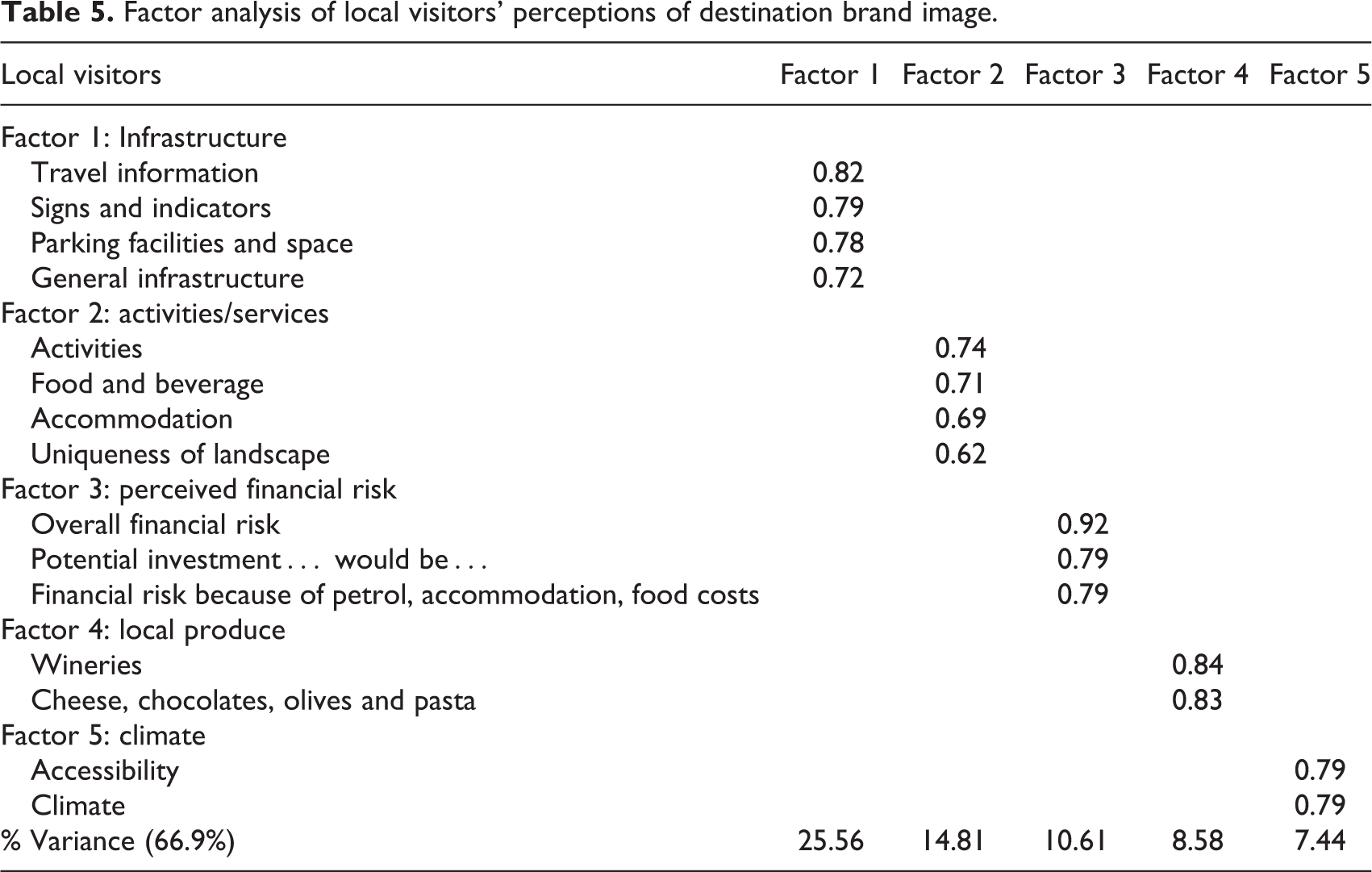
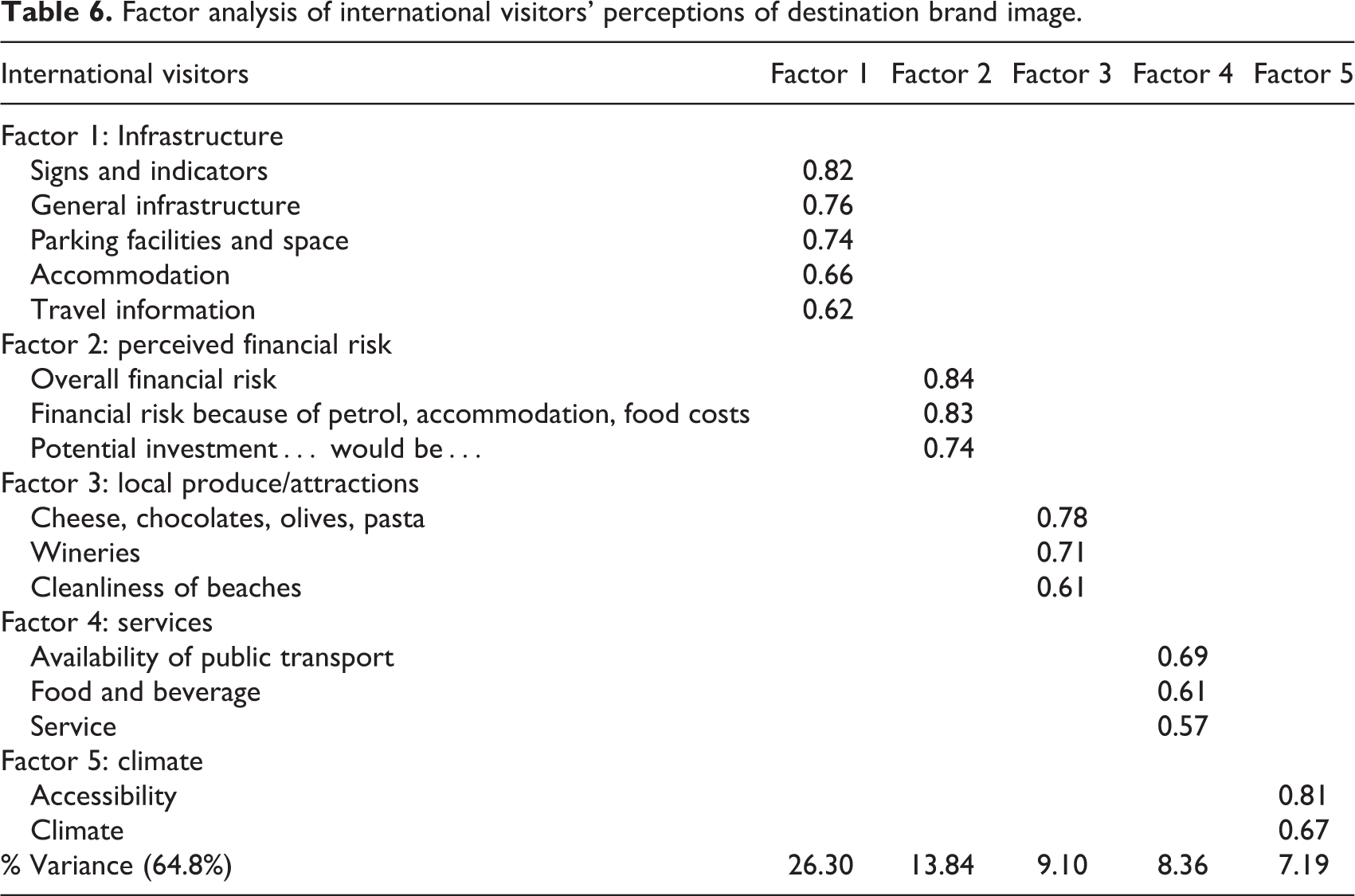
Next, exploratory factor analysis examined the 19 items for perceived attractiveness and perceived risk to establish whether different factor structures existed for the local and international samples. Items that cross-loaded with one another or had communalities that were less than 0.4 were eliminated (Hair et al., 2010). This process was iteratively conducted until there was minimal overlapping among factors, suggesting that all factors were independently structured.
As can be seen in Tables 5 and 6, the final factor analysis using a VARIMAX rotation identified a 5-factor solution that explained 66.9 and 64.8% of the variance extracted for the local and international samples, respectively. Fifteen items were retained for the local sample and 16 items for the international sample. As expected, there were some similarities and differences in the factors identified by the local and international samples. In both samples, infrastructure, perceived financial risk and climate were consistently identifiable dimensions of destination image. Additionally, the local sample identified activities/services and local produce, whereas the international sample identified services and local produce/attractions. The results from Tables 5 and 6 are visually represented in Figures 1 and 2.
Factor analysis of local visitors’ perceptions of destination brand image.
Factor analysis of international visitors’ perceptions of destination brand image.
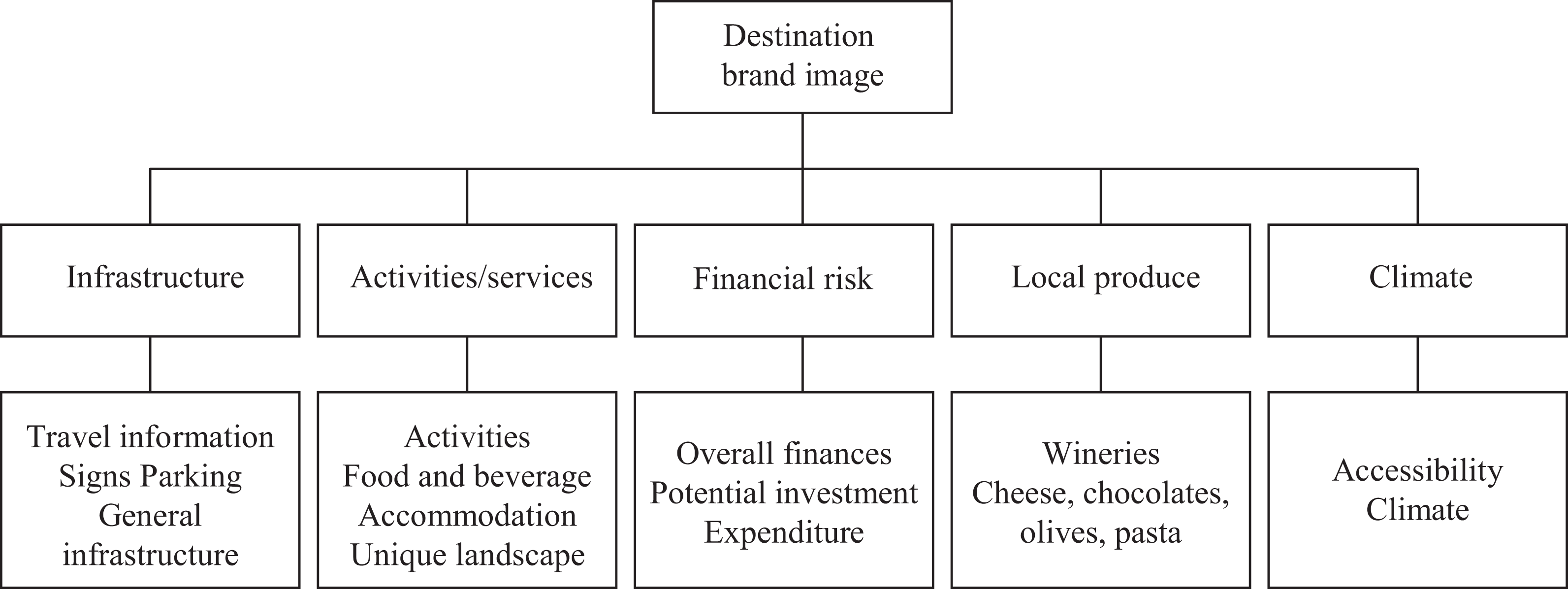
Destination brand image dimensions for local visitors.
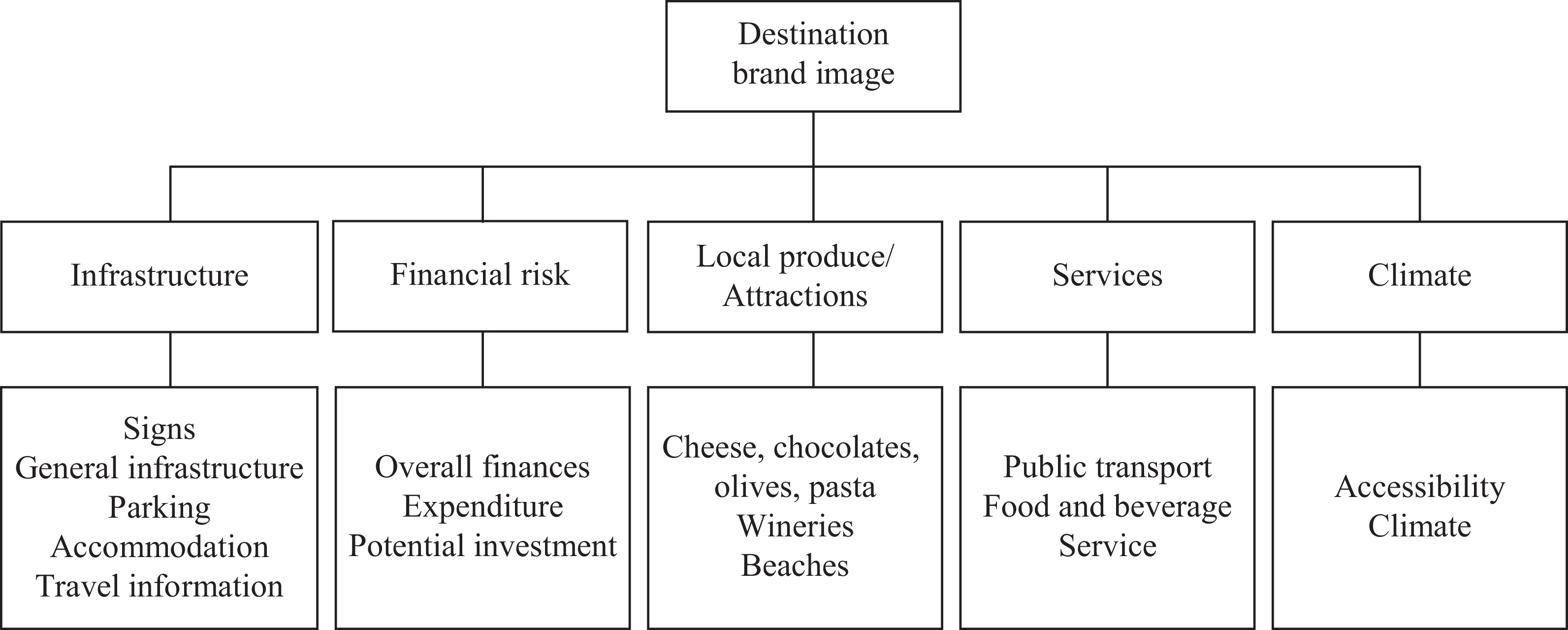
Destination brand image dimensions for international visitors.
Clearly, both the international and local samples were similar in their perceptions of the sound Infrastructure and good climate offered by the destination. Also, both samples were mindful of the perceived financial risk associated with purchasing a holiday to the destination. However, although financial risk was perceived to be low by both samples, international visitors ranked this perceived threat to be higher than local visitors due to their inexperience with the destination.
Being more familiar with the destination, the local sample demonstrated greater appreciation for the activities/services available, holding higher perceptions of food and beverage as well as the unique landscapes at the destination. Finally, while the provision of services resonated with international visitors, these were focused on more functional aspects of service such as public transport and general service.
Discussion
This key objective of this article was twofold. First, it is to examine the brand image of WA’s South-West region. Second, it is to establish whether positive and negative attributes associated with the destination differed between local and international samples. As reported in the preceding section most of the hypotheses are supported.
As a summary, it appears that WA’s South-West region has a destination brand image that is consistently shared by local and international visitors. Both samples have similar perceptions of the general infrastructure, signs, travel information and good climate at the destination. Similarly, both samples identify experiencing local products such as wines, cheese, chocolates, olives and pasta from cottage industries as a dimension of destination brand image. These attributes may well offer a distinct competitive advantage for the destination (Bosnjak, 2010), since they depict what visitors connect with most. This suggests to researchers and marketing managers that advertising campaigns about the destination are effectively communicating its brand image to local and international visitors. For example, more initiatives should be built around seasonal festivals that can attract more traffic of tourists to these places. Some good events that can be considered include chilli festivals, dairy making classes and even wines and cheese appreciation classes. These could be made aware to tourists through local and international agencies and could attract critical masses if they are made annual events.
However, there are aspects of WA’s South-West region destination brand image that are not shared by local and international visitors. Each sample had different perceptions of the financial risk and services provided by the destination. International visitors perceived higher financial risk and perceived services in terms of the functional aspects of public transport and general services, whereas local visitors perceived lower financial risk and perceived services in terms of the food and beverage and accommodation facilities available. It appears that for local visitors, the services dimension is tapping a more proactive aspect that involves active participation since the local sample also cites activities in this dimension. Possibly, local visitors perceive the destination as offering opportunities for engaging in activities, eating, drinking and experiencing the unique landscapes. This suggests to marketing managers that local public relations campaigns that target intrastate visitors should continue to highlight these attributes. On the other hand, it appears that for international visitors, the services dimension is tapping the functional aspects of public amenities. This suggests to destination managers that they should maintain servicing of their infrastructure to make the travel experience as seamless as possible for first-time visitors. Information can be filtered through websites and pamphlets made available in agencies offshore as well as domestic tourist offices and airports.
Limitations and future directions
The questionnaire used a convenience sampling method, which limited its generalization of all visitors to the destination. The sample size constituted 228 university students with an average age of 23 years. Similar studies have utilized respondents under the age of 30 years, which controlled for the extraneous effects of life stage and class (e.g. Lepp and Gibson, 2008). However, there is a need to address people in other life stages, particularly the growing number of baby boomers who engage in leisure travel (Sellick, 2004). Furthermore, an international student sample was utilized to represent the perceptions and behavioural intentions of international visitors. This was justified since the international sample had been in WA for less than 18 months, resided in the metropolitan city of Perth and had only visited WA’s South-West region once. However, the next stage of the research will utilize data samples from international tourists to ensure generalizability across populations. Finally, this stage of the study has only focused on the cognitive component of brand image, which impacts on perceptions of a destination. The affective component of brand image, which impacts on attitude towards the destination will be addressed in the second stage of the study.
Studies on brands have been traditionally associated with consumer goods (e.g. Aaker, 1996), which embody a logo (Cai, 2002), values and personality (Morgan and Prichard, 2002). In recent years, tourism scholars have developed frameworks that examine the relationship between a destination’s brand image and self-image (e.g. Ekinci, 2003; Murphy et al., 2007). Findings from this article suggest that this relationship may also be influenced by significant others as travel companions, particularly, in cultures where in-group approval on lifestyle choices is high. It may be plausible to extend Ekinci’s (2003) framework by introducing the significant others construct and examining for its effect on destination brand image and self-image.
While only financial risk was examined in this article, the perceived risk construct requires further investigation. The multidimensional nature of the construct needs to be examined for its other dimensions of potential performance, social, psychological, physical and convenience loss. Since perceived risk is context specific, it may be interesting to explore how an individual perceives risk in different contexts and how different individuals perceive risk in the same context (Quintal et al., 2010).
How positive and negative aspects of a destination’s brand image relate to each other in a decision-making model requires more consideration. A tenable framework for this purpose could be Ajzen’s (1985, 1991) theory of planned behaviour (TPB) that considers subjective norms, attitude, perceived behavioural control, intention and behaviour. By introducing into this framework, the perceived attractiveness and perceived risk constructs that shape a destination’s brand image, scholars will be able to explore how such perceptions may interact with and impact on the TPB constructs and influence destination choice. This could help international destination managers to develop distinct strategies and programs when communicating with local and international visitors as well as first time and repeat visitors. For instance, when promoting a destination’s best attributes such as its primitiveness and adventure activities, it may also be pertinent to provide assurances of its tranquility and support facilities (Lepp and Gibson, 2008). This may help to allay concerns from first-time visitors about the risks associated with the destination.
Clearly, more comparative studies between collectivistic and individualistic cultures need to be conducted to evaluate the differential impacts perceptions of a destination and significant others have on destination choice. For instance, it is likely that perceived social risk will interact more strongly with social norms in the decision-making of people from collectivistic cultures. While other studies have found a perception of similar behaviour based on nationality, there is also evidence that subcultural differences in tourist behaviour within countries exist (e.g. McCleary et al., 2007). It would be interesting to examine subcultures in multicultural societies such as Australia, Canada and the United States of America for their influence on travel and lifestyle choices.
It is likely that familiarity with a destination will create more positive perceptions of a destination’s products and services (Elliot et al., 2011). Since a receptive host community can make a significant contribution towards a destination’s appeal, it is imperative for the destination to seek stakeholder consensus through a publicly driven process rather than a private expert-driven process based on market forces (Ritchie and Crouch, 2000). Sharing the destination’s vision and maintaining regular communication with stakeholders are necessary to foster community ownership, pride and support.
In conclusion, this article highlights the need for researchers and practitioners to identify not just the most salient but the least salient aspects of a destination in order to address what drives and inhibits destination choice. Examining perceptual differences between local and international visitors will help to identify the differential impacts of cultural perceptions on satisfaction and repeat visitation to the destination.
Footnotes
Funding
This research received no specific grant from any funding agency in the public, commercial or not-for-profit sectors.