




Abstract
The study analyzes the relationship between tourism satisfaction, cognitive and affective country image, destination image, and post-visit intentions. The proposed research model is tested with a survey on a sample of 542 international tourists intercepted in two Italian airports at the end of their journey. Results suggest that general country and destination images are able to mediate the effect of tourism satisfaction on post-visit behavioral intentions. Moreover, empirical findings show that a high-quality tourism experience is able to not only affect intention to return and willingness to recommend the country as a tourism destination but also induce more positive intentions toward the products made in the sojourn country. On the basis of results, the study concludes with discussion of managerial and research implications.
Keywords
The influence of country image on consumer behavior is recognized as one of the most relevant research streams in the international marketing literature (Roth and Diamantopoulos, 2009). Results from this large body of knowledge seem to provide reliable support to the notion that country image—defined as ‘the total of all descriptive, inferential and informational beliefs one has about a particular country’ (Martin and Eroglu, 1993: 193)—can be considered as an extrinsic cue which can be used by consumers to draw inferences in making consumption evaluations (Eroglu and Machleit, 1989; Kotler and Gertner, 2002; Okechuku, 1994).
From a theoretical point of view, the effect of country image on consumer behavior has been explored in two main research areas, namely, product–country image (PCI), which deals with the effects of country image on buyers’ behavior toward products associated with various origins (Bertoli and Resciniti, 2013; Bilkey and Nes, 1982; Papadopoulos, 2004; Roth and Diamantopoulos, 2009a) and tourism destination image (TDI), which refers to the ‘perceptions held by potential visitors about an area’ (Hunt, 1975: 1) and it includes functional characteristics, concerning the beliefs related to directly observable or measurable features (e.g. sceneries, attractions, and facitities), and psychological characteristics, concerning the more intangible ones (e.g. friendliness and atmosphere) (Echtner and Ritchie, 1993). Starting from the 1970s, research on TDI has resulted in more than 200 published articles (Elliot et al., 2011). According to a review from Gallarza et al. (2002), the most investigated topics include the conceptualization and measurement of destination image (Echtner and Ritchie, 1993; Hunt, 1975), the influence of image on travelers’ choice (Pearce, 1982; Woodside and Lysonski, 1989), its formation (Baloglu and McCleary, 1999; Gartner, 1993), and destination image management policies (Echtner and Ritchie, 2003).
The image of a destination has also been considered as a significant antecedent of tourism satisfaction and post-visit behavior. As stated by Chen and Tsai (2007), tourists use the perceived image of a destination as a parameter to form expectations before the visit and compare them with results of the travel experience. As a consequence, a positive destination image will increase the propensity to make a positive evaluation of the sojourn and will enhance intentions to return and recommend the destination. Similar findings were reported by Bigné et al. (2001)—whose research found that destination image is a direct antecedent of perceived quality, satisfaction, intention to return, and positive word of mouth—and Chen and Tsai (2007), whose study concluded that the image of the destination directly influences both attribute and overall satisfaction and that such two components, in turn, have a direct and positive impact on destination loyalty.
Although the above-mentioned research seem to provide reliable support to the relationship among tourism satisfaction, destination image, and post-visit behavior, there still remain some gaps that call for further research. First, in tourism research, destination image has always been considered as an antecedent of tourism satisfaction while no research so far has investigated the opposite path. Although previous contributions focusing on the image modification due to actual destination experience (Hallberg, 2005) and on the image differences between travelers who have visited/not visited a destination (Papadopoulos and Heslop, 1986) revealed that results of the travel experience have a significant influence on the perception of a place, so far the reverse relationship has never been empirically investigated.
Second, in establishing the sequence image—satisfaction—post-visit intentions research has focused only on the attributes of the image specifically related to the dimension of tourism. However, as recognized in previous research, the image of a country is a more complex construct, ‘consisting of generalized images created not only by representative products but also by the degree of economic and political maturity, historical events and relationships, culture and traditions, and the degree of technological virtuosity and industrialization’ (Roth and Diamantopoulos, 2009: 727). Even if literature recognizes that general attributes of a country’s image play a significant role in influencing product and destination perceptions (Baloglu and McCleary, 1999; Elliot et al., 2011; Papadopoulos et al., 1988), no research so far has investigated the effect of tourism experience on the evaluation of the general image of a country.
Finally, research evaluating the relationship between service quality, satisfaction, and tourism behavior has centered on the destination loyalty and positive word of mouth as the dependent variables (Bigné et al., 2001; Chen and Tsai, 2007; Chi and Qu, 2008), while the potential effect on behavioral intentions toward the products made in the sojourn country has never been explicitly considered. Such relationship has been posted by Kleppe and Mossberg (2005)—albeit without adopting an empirical approach—and Hallberg (2005), who found that international travel experiences lead to changes in consumers’ attitudes toward products associated to the sojourn country. In a more recent work, Elliot et al. (2011) reported that components of general country image (affective and cognitive) are able to affect both product attitudes and destination beliefs and that such beliefs, in turn, play a significant role in influencing product and destination receptivity. Similarly, Lee and Lockshin (2012) found that the image of a country as a tourism destination is able to influence consumers’ perception of products ‘made in’ the destination. However, although such studies contributed to shed some light on the existence of a ‘cross’ effect between country image, destination image, and attitudes toward the products made in the sojourn country, at present it could be argued that the overall understanding of such a relationship remains still unclear.
Arising from the above-mentioned research gaps, this study aims to provide additional evidence on the effect of tourism experience on tourist’ perception of general country image, destination image, and post-visit intentions by investigating: (a) the impact of tourism satisfaction on tourists’ evaluation of cognitive and affective components of general country image and on their perception of the image of the country as a tourism destination (destination image); (b) the relationship between cognitive and affective components of general country image and destination image; and (c) the influence of general country image and destination image on post-visit behavioral intentions toward the country as a travel destination and toward its national products.
Since tourism satisfaction plays a crucial role in affecting a destination’s competitiveness, it is essential to gain a better understanding of potential outcomes of the tourists’ experience. As a consequence, major findings from this study have significant managerial implication for both public and private tourism practitioners and for national companies that aim to improve their international marketing strategies. Moreover, since some of the relationships tested in this study are analyzed for the first time, results are willing to advance theory in the fields of country images and tourism satisfaction.
The next section presents the research model and the theoretical background underlying the hypotheses investigated in this study. The subsequent section describes a survey conducted in two Italian international airports (Naples and Rome) on a sample of 542 international tourists intercepted at the end of their journey in the country. Finally, the article concludes with discussion of contribution to literature in the field and of the related managerial implications and it provides suggestions for further research.
Theoretical background and hypotheses
From the theoretical point of view, the research model proposed in this study integrates common issues drawing from the two streams of research, namely TDI and PCI, which have dealt more extensively with the effect of country image on consumer behavior (Elliot et al., 2011; Hallberg, 2005; Papadopoulos and Heslop, 1986). Moreover, the model builds on studies dealing with the influence of travel experience on country image formation (Echtner and Ritchie, 1993; Gartner and Hunt, 1987) and with the relationship between country image and post-visit behavior (Bigné et al., 2001; Mansfeld, 1992). The structure of the model is pictorially represented in Figure 1.
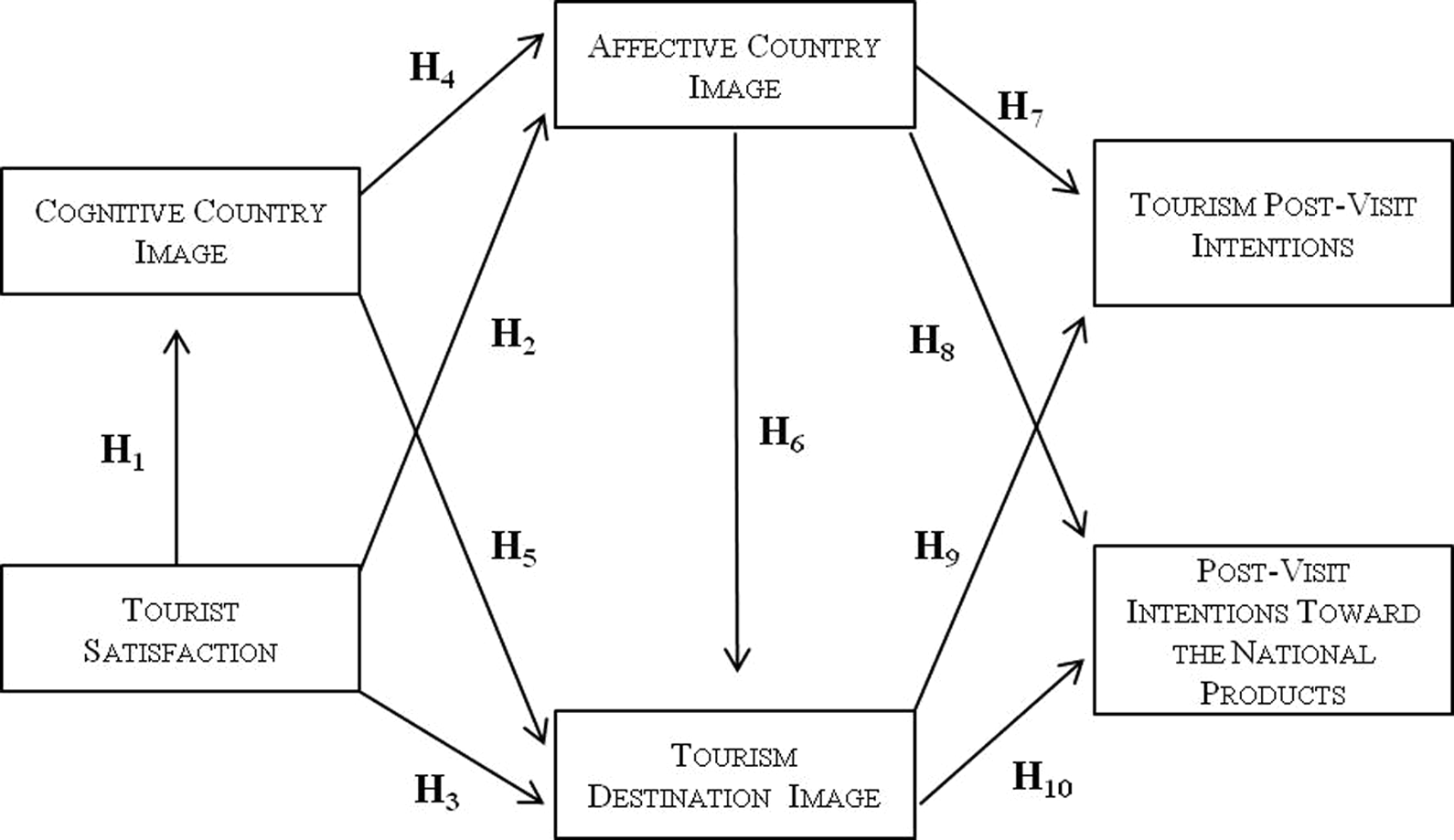
Research framework and hypothesized relationships.
The main hypothesis is that perceived results of tourism experience have a positive influence on the general components of country image (cognitive and affective) and on destination image and that such images, in turn, are able to predict post-visit intentions toward the country as a tourism destination and toward its national products. Moreover, we also hypothesized a positive and direct relationship between tourism satisfaction and post-visit behavioral intentions.
As a consequence, the following constructs were included in the model:
tourism satisfaction: it is defined as ‘the extent of overall pleasure or contentment felt by the visitor, resulting from the ability of the trip experience to fulfill the visitor’s desire, expectations and needs in relation to the trip’ (Chen and Tsai, 2007: 1116);
general country image: it is defined as ‘a generic construct consisting of generalized images created not only by representative products but also by the degree of economic and political maturity, historical events and relationships, culture and traditions, and the degree of technological virtuosity and industrialization’ (Roth and Diamantopoulos, 2009: 727) and identified through the cognitive components (cognitive country image) and the affective components (affective country image) (Allred et al., 1999; Elliot et al., 2011; Roth and Diamantopoulos, 2009);
destination image: according to the bulk of tourism research, in this study destination image was defined through a functional and attribute-based approach (Bigné et al., 2001; Echtner and Ritchie, 2003; Elliot et al., 2011; Gallarza et al., 2002). Therefore, this construct included ‘tourists’ judgments related to tangible and measurable features of the country as a tourism destination, formed as a result of the sojourn experience’;
post-visit behavioral intentions: they were evaluated both in terms of intention to return and positive word of mouth toward the country as a tourism destination and in terms of intention to buy and positive word of mouth toward its national products.
In the following sections, we illustrate the research hypotheses and the related theoretical assumptions.
Influence of tourism satisfaction on general country image and on destination image
Whereas the influence of familiarity on perception of country image and product evaluation has been extensively investigated in PCI literature (Han, 1989; Johansson, 1989; Jaffe and Nebenzahl, 2001; Knight and Calantone, 2000), there are very few studies dealing with the effect of tourism experience on the perception of a country’s image (Jaffe and Nebenzahl, 2001). Research on this topic have examined the image differences between travelers who have visited a destination (visitors) and those who did not (Chon, 1991; Fakeye and Crompton, 1991; Hu and Ritchie, 1993). Moreover, previous studies in the tourism field have investigated image modifications due to actual destination experience (overt behavior) through a longitudinal approach aiming to compare pre- and post-trip evaluations. For example, Pearce (1982) compared tourists’ images of two Mediterranean countries across a pre- and post-visit stage and found that travelers changed some of their perceptions after visiting them. Papadopoulos and Heslop (1986) analyzed the possible effect of the international travel experience on visitors’ post-travel attitudes and found that, under certain circumstances, international travel can lead to positive attitudes toward the sojourn country and its products. A significant relationship between travel experience and country image was also found by Beerli and Martin (2004), whose research supported the notion that the tourist’s level of experience of vacation travel has a positive and significant effect on cognitive and affective images of the destination. Finally, Hallberg (2005) analyzed the effect of travel experience on the cognitive and affective attitudes toward the sojourn country and found a positive correlation with post-visit consumption behavior (i.e. information seeking, frequency of purchasing, etc.) toward the products made in the destination.
General results from these studies showed that when individuals visit a place the image that they form after the visit tends to be more realistic and complex and that such an image is able to affect perceptions and attitudes toward the country. However, so far there are no studies aiming to explicitly investigate how perceived tourism satisfaction is able to influence evaluation of country image. Moreover, research on this topic did not clarify how international travel experiences affect the evaluations of the general country image and of the specific image of the country as a tourism destination.
Following the above, in our study we therefore hypothesized that:
Influence of general country image on destination image
Previous research on PCI and TDI provided reliable support to the notion that country image is a multidimensional construct made of different components. In PCI literature, a number of authors operationalized country image through a cognitive component, which includes consumers’ beliefs about a particular country, an affective component, which describes the country’s emotional value to the consumer, and a conative component, which captures consumers’ behavioral intentions toward the sourcing country (Laroche et al., 2005; Papadopoulos et al., 1990; Parameswaran and Pisharodi, 1994). Although based on more limited empirical evidence, research on TDI reported very similar patterns. As stated by Baloglu and McCleary (1999) and Beerli and Martin (2004), destination image can be considered as the consequence of two closely interrelated components, namely, the perceptive/cognitive evaluations, which identify the individual’s own knowledge about the destination, and affective appraisals, which include the individual’s feelings toward the destination.
Similarly, in recent years both PCI and TDI literatures supported the existence of a ‘hierarchical relationship’ between the components of the general image of a country and between the general country image and the specific images related to a country’s product and tourism offerings, with the prior being a significant antecedent of the latter. In PCI studies, Papadopoulos et al. (1988) proposed different scales for the measurement of country image and product beliefs and identified a direct causal relationship between the two constructs. Such a relationship was confirmed in subsequent studies, which reported a direct effect of the general country image on product beliefs (e.g. Knight and Calantone, 2000; Laroche et al., 2005). Comparable findings were provided by tourism research, which showed reliable consensus about the cognitive component of country image being an antecedent of the affective component (Baloglu and McCleary, 1999; Beerli and Martin, 2004; Kim and Yoon, 2003; Nadeau et al., 2008; Russel and Pratt, 1980) and about the role of affective and cognitive components in shaping the overall perception of a tourism destination (Baloglu and McCleary, 1999; Beerli and Martin, 2004; Elliot et al., 2011).
Given the above, in this study, we assumed that perceptions of the different components of the country image as a result of the travel experience are arranged hierarchically in the consumers’ mind, with the general cognitive component being an antecedent of the affective component and the country’s overall image being an antecedent of the ‘specific’ image of the country as a tourism destination.
We therefore hypothesized that:
Influence of general country image and destination image on post-visit behavioral intentions
The notion that components of country image are able to affect consumption intentions constitutes a fundamental principle in both PCI and TDI literatures. Results in the context of PCI seemed to suggest that affective components of country image played a more significant role in influencing consumers’ evaluation of local products than cognitive components (Laroche et al., 2005; Parameswaran and Pisharodi, 1994; Roth and Diamantopoulos, 2009). Such an assumption was also consistent with various studies in other disciplines such as advertising or retailing, which showed that emotions can lead to much stronger reactions than pure cognitions (Donovan and Rossiter, 1982; Schoefer and Diamantopoulos, 2008). Similarly, in TDI research, destination image was found in a number of studies to be a direct antecedent of intention to return and willingness to recommend the destination (Bigné et al., 2001; Court and Lupton, 1997; Park and Njite, 2010). In spite of the consistent similarities in results, only a few studies have investigated whether any cross effects exist; that is, whether components of general country image are able to influence travel choices and, vice versa, whether image of a country as a tourism destination is able to affect consumption attitudes toward products made therein.
However, results from this limited body of research seem to provide a significant support to this relationship, even if the nature and role of country image remain fragmented. For example, Papadopoulos and Heslop (1986) compared Canadians who had traveled to a country with those who had not and found that the two groups differed in how they evaluated that country’s products, but they did not investigate the effect on attitudes toward the destination. On the other hand, the link between general country image and destination attitudes was explored by Nadeau et al. (2008), but they did not include product measures in their study. The only research aiming to provide a clear picture about the potential interactions between country, destination, and product images was the one conducted by Elliot et al. (2011). Their empirical results showed that affective country image exerts a positive influence on both product receptivity and destination receptivity. This result was consistent with previous studies reporting that while the cognitive component of the country image is able to affect consumers’ evaluations of national products and/or destination features, it’s the affective component to drive the behavioral intentions (Gartner, 1993; Laroche et al., 2005).
In addition, the study provided evidence of a direct effect from product belief to product receptivity and from destination beliefs to destination receptivity and found a crossover effect from product beliefs to destination receptivity but not the other way around. However, results from their study could be affected by the specific target countries (Japan and United States) and by the specific sample involved in their survey (consumers attending a major travel show in South Korea). As a consequence, the authors suggested that ‘different sample and target country combinations may produce different results’ (Elliot et al., 2011: 11).
Following the above, in this study, we tested the hypothesis that affective perception of general country image and destination image resulting from the travel experience are able to influence tourists’ post-visit behavioral intentions toward the country as a tourism destination—in terms of intention to visit the country again and of positive word of mouth—and that the two constructs lead to more positive intentions toward the country’s products, in terms of both willingness to purchase and positive word of mouth.
We therefore propose that:
Influence of tourism satisfaction on post-visit behavioral intentions
Perceived satisfaction has been recognized as a significant antecedent of post-visit behavioral intentions. Tourism research provided reliable support to the notion that satisfaction with a destination is able to influence intention to return and positive word of mouth (Bignè et al. 2001; Chen and Tsai, 2007; Chi and Qu, 2008; Hosany and Prayag, 2013). However, the relationship between tourism satisfaction and attitudes toward the products of the sojourn country has not received the same attention, with only two studies that have focused on this issue empirically: Hallberg (2005), whose research showed that travelers to a country increase their information search for its products but did not investigate the connection with tourism satisfaction from the visit, and Papadopoulos and Heslop (1986), who simply found that people who had traveled to a country evaluated its products differently from those who had not.
Based on the above, in this study we hypothesized a positive relationship between tourist satisfaction and post-visit intentions toward the country as a tourism destination and toward its national products.
Therefore:
Methodology and results
In order to test the proposed model, a survey was conducted in two international airports (Naples and Rome) on a sample of foreign tourists intercepted in the international departure area before leaving Italy. Interviews were made over 3 weeks during April/May 2012, and respondents were identified via random systematic sample by trained graduate students supervised by two of the coauthors. According to the sampling procedure, interviewers were located in the international departure terminals of the two airports, and each interviewer was assigned with a random and systematic sequence of check-in numbers. For each selected check-in number, the last tourist waiting in the queue was approached and invited to participate in the survey. A preliminary question served to exclude Italian citizens and to select respondents who had visited Italy for leisure purposes. Interviews were conducted with a face-to-face method.
The research instrument was a structured questionnaire and organized in the following three sections: (i) tourist experience, place image, and post-visit intentions; (ii) attitudes and familiarity toward the Italian products; and (iii) general demographic information. The questionnaire was preliminarily tested on a small sample (32 respondents) intercepted at international airport of Naples and minor changes to the measurement scales were made in the measures according to results. At the end of the survey, 542 questionnaires were coded for data analysis. The sample demographics (Table 1) indicated that respondents were both male (51.2%) and female (48.8%). The largest proportion of the respondents were aged between 35–44 years (34.9%) and 25–34 years (27.7%). The most represented countries included England (22.2%), United States (12.8%), France (10%), Germany (8.4%), Spain (7.8%), and Russia (5.2%). In terms of destination familiarity, a significant portion of respondents (36.9%) was in Italy for the first time, 26.2% had visited the country once in the past, while only 8.4% had been to Italy more than five times. In terms of consumption of products behavior, 53.7% of respondents reported that country of origin is ‘very important’ in their consumption choices and 38.9% reported ‘somewhat important’.” Almost 80% of respondents (79.7%) had already bought or tried Italian products in the past.
Demographic and behavioral characteristics of the sample.

Model constructs were measured on the basis of scales adapted from similar studies in the field of tourist satisfaction, PCI and TDI (Table 2). Namely, tourist satisfaction was assessed through 5 items based on a 8-point Likert-type scale built on the basis of measures provided by Baker and Crompton (2000) and Bigné et al. (2001). In line with earlier studies in both marketing (e.g. Oliver, 1980) and tourism (e.g. Bignè et al. 2001; Tse and Wilton 1988), the construct of satisfaction was operationalized as the overall evaluation of the tourism experience instead of analyzing the individual components of the construct.
Model measures and validity check.
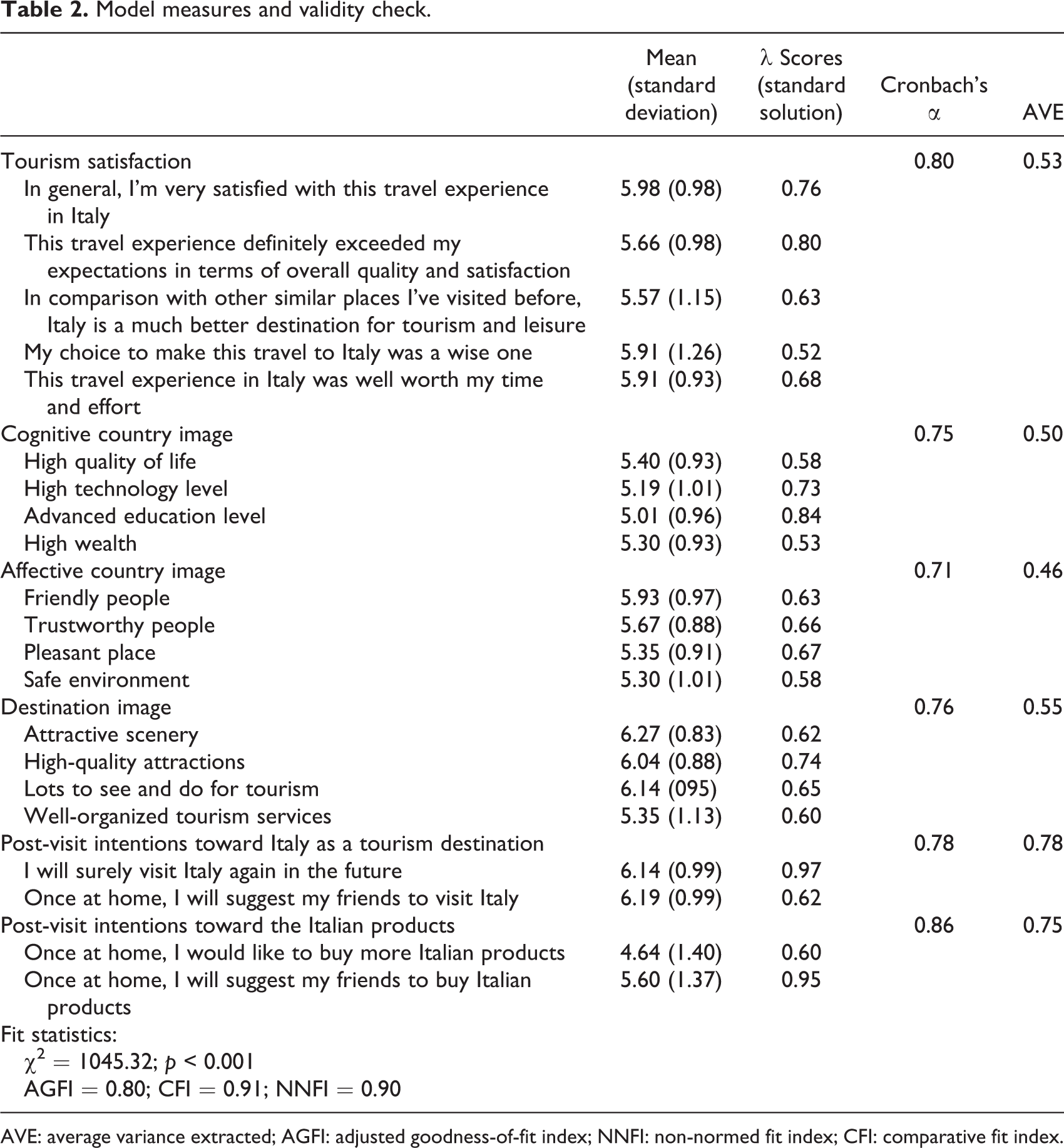
AVE: average variance extracted; AGFI: adjusted goodness-of-fit index; NNFI: non-normed fit index; CFI: comparative fit index.
Cognitive and affective components of general country image were measured with a total of eight items on the basis of contributions provided by Papadopoulos et al. (1988) and Elliot et al. (2011). Destination image was measured through four items based on research conducted by Elliot et al. (2011). On the basis of previous similar contributions (e.g. Bignè et al. 2001; Chen and Tsai, 2007; Gallarza et al., 2002), items were selected on the basis of two rules. First, the measurement scale employed functional and attribute-based components of the destination image (e.g. perception of services, attractions, etc.), while psychological adjectives were not considered. Second, since the study asked respondents to provide an overall impression of Italy as a tourism destination as a result of the travel experience, the measurement scale included only the more universal attributes, ignoring those that corresponded to the idiosyncrasies of a particular location (e.g. beaches, mountains, etc.).
Finally, post-visit behavioral intentions toward Italy as a tourism destination and toward the Italian products were measured through four items provided by Cronin et al. (2000), Bigné et al. (2001), and Elliot et al. (2011). Similar to the majority of research in the fields of PCI and TDI, and in the attempt of making findings more generalizable, this study adopted ‘global-level’ measures of post-visit behavioral intentions and did not consider specific tourism destinations and national products or brands (e.g., Heslop et al. 2004; Pike, 2002).
According to Anderson and Gerbing (1988), a two-stage approach was followed in which the measurement model was first confirmed and then tested. In the first stage, a confirmatory factor analysis (CFA) was conducted on exogenous and endogenous variables to assess the reliability and validity of the multi-item scales. Results provided adequate support to measurement choice (Table 1). Although the χ 2 value was significant (χ 2 = 1045.32; p < 0.001), comparative fit index (CFI = 0.91) and non-normed fit index (NNFI = 0.90) indicated satisfactory model fit. Moreover, all the estimated pattern coefficients of each item on their posited latent construct factors were close or above 0.60, indicating sufficient convergent validity (Table 3). Cronbach’s α ranged from 0.71 to 0.86, suggesting that all the latent measures were acceptably reliable. Finally, with the exception of affective country image, for all the measures the average variance extracted reached the suggested value of 0.50 (Bagozzi and Yi, 1988; Fornell and Larker, 1981). On the basis of the above findings, it was concluded that constructs were sufficiently reliable and valid.
Standardized coefficients and fit statistics.
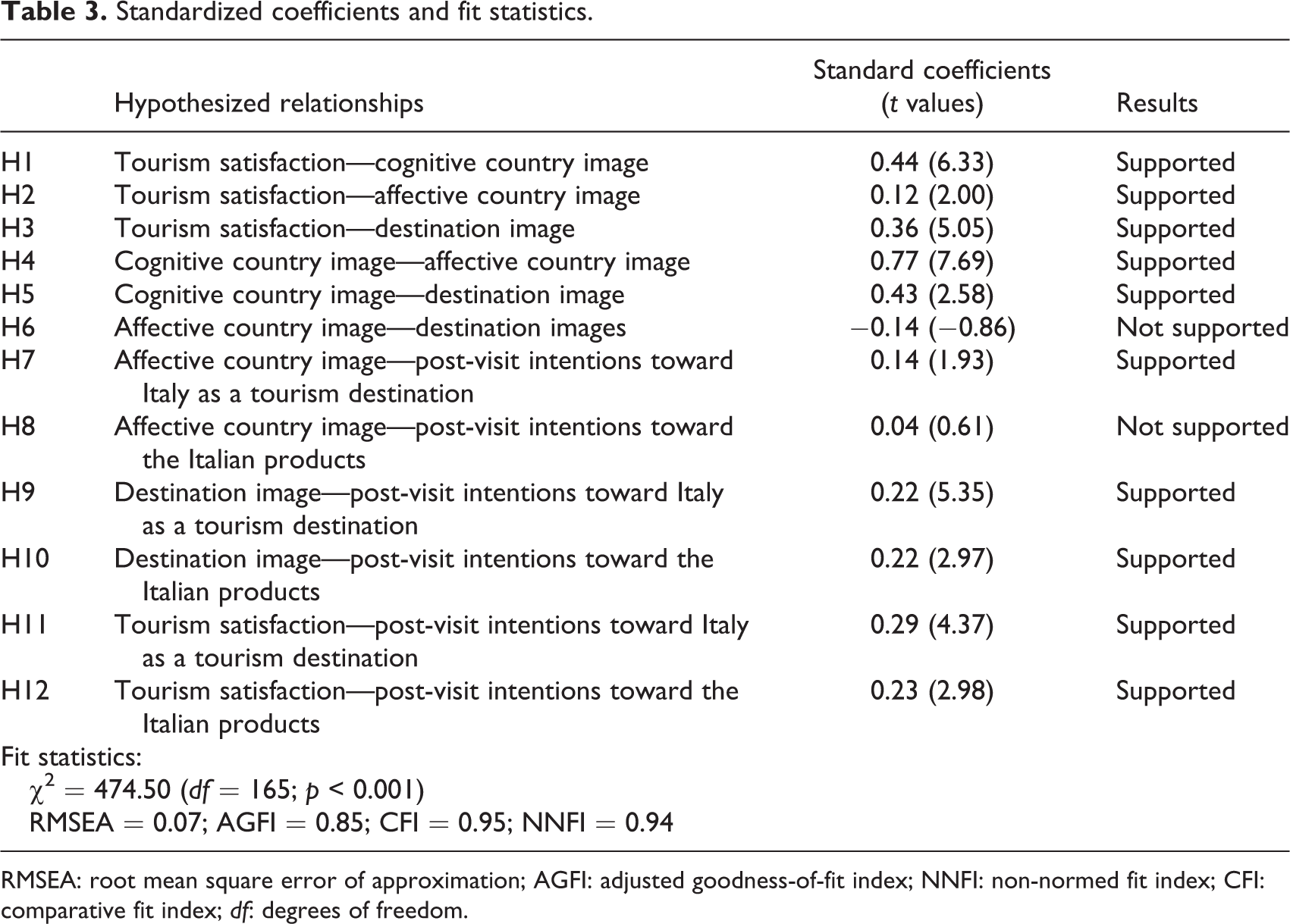
RMSEA: root mean square error of approximation; AGFI: adjusted goodness-of-fit index; NNFI: non-normed fit index; CFI: comparative fit index; df: degrees of freedom.
After confirming the measurement model, the structural model was then tested with maximum likelihood simultaneous estimation procedure. To avoid model misspecification, familiarity toward the country as a tourism destination was included as the control variable. With the exception of χ 2 the main indices showed that data fit the structural model reasonably well, namely, adjusted goodness-of-fit index = 0.85, CFI = 0.95, and NNFI = 0.94. As shown in Table 3, all the paths were in the hypothesized direction of the proposed model. Namely, tourism satisfaction played a significant role in influencing post-visit perceptions of general country image and destination image; that is, empirical findings reported that a higher level of tourism satisfaction was strongly related to the improvement of cognitive country image (maximum likelihood estimate = 0.44 and t value = 6.33), affective country image (0.12 and 2.00), and destination image (0.36 and 5.05), providing support to H1, H2, and H3, respectively.
Consistent with the expectations, parameter estimates from path analysis showed a significant causal relationship between components of general country image and specific image of the country as a tourism destination. Specifically, tourists’ perception of cognitive country image had a positive influence on both affective country image (0.77, 7.69) and on destination image (0.43, 2.58), confirming H4 and H5. In contrast, H6 was rejected as the affective country image did not affect post-travel destination image (−0.14, n.s.). This result was consistent with the findings from Elliot et al. (2011).
As for the relationship between components of country image and post-visit behavioral intentions, the overall pattern of results provided almost full confirmation to all the hypothesized relationships. Namely, a positive perception of destination image and affective country image as a result of the travel experience strongly influenced post-visit intentions toward Italy as a tourism destination, in terms of both intention to return and positive word of mouth (0.22, 5.35; 0.14, 1.93), providing support to H7 and H9. Interestingly, the improvement of destination image was strongly related to the post-visit intention to buy and recommend Italian products (0.22, 2.97), while the same pattern was not found for the affective country image (0.04, n.s.). Such findings supported H10 but not H8. Finally, a higher level of tourism satisfaction was found to play a significant role in affecting post-visit intentions not only by increasing intention to visit again and positive word of mouth toward the country (0.29, 4.37)—as demonstrated by previous research (Bignè et al., 2001; Chen and Tsai, 2007; Chi and Qu, 2008)—but also, and most interestingly, by increasing the positive word of mouth and desire to buy the products made in the sojourn country (0.23; 2.98). Such results provided support to H11 and H12.
Conclusion and implications
The relationship between tourism and country image is of relevant interest both in place marketing literature and for public and private practitioners. The ability of a country to provide high-quality tourism experiences may lead to significant improvements in perceived country image that, in turn, is able to affect post-visit intentions. Arising from the current findings provided by research on tourism satisfaction, PCI and TDI, this study proposed and tested a theoretical framework aiming to investigate: (a) the influence of tourism satisfaction on cognitive and affective components of general country image and on specific image of the country as a tourism destination; (b) the existence of a hierarchical relationship between cognitive and affective components of country image and destination image; (c) the subsistence of a cross effect between post-visit intentional behaviors toward the country as a tourism destination (expected loyalty and word of mouth) and consumption intentions toward products made in the sojourn country; and (d) the direct effect of tourism satisfaction on post-visit behavioral intentions. Results from the survey conducted on a sample of international tourists intercepted at the end of their journey in Italy provided support to almost all the hypothesized relationships. Such results suggested that general country and destination images are able to mediate the effect of tourism satisfaction on post-visit behavioral intentions. Moreover, our study supported the notion that a highly satisfactory tourism experience is able to not only affect intention to return and willingness to recommend the country as a tourism destination—as reported in previous research (Bignè et al, 2001; Chen and Tsai, 2007)—but induce more positive intentions toward the products made in the sojourn country. In this way, the existence of a significant interaction between tourism and product images was confirmed. On the other end, the lack of support for the hypothesized influence of affective country image on destination image was consistent with previous research on both PCI (Klein et al., 1998) and TDI (Elliot et al., 2011), and it suggested that tourists at the end of the travel experience form their impressions about the sojourn country only on the basis of functional attributes, while the affective appraisals provide the ‘magnetism’ necessary to stimulate their post-visit desired interaction only in the tourism realm.
Following the above, the research model and results presented in this study were able to suggest several theoretical and managerial implications. From the research point of view, this study contributed to literature on tourism and place image at least in four directions. First, it was one of the few empirical research to provide a comprehensive framework aiming to investigate the relationship between tourism satisfaction, country image, and post-visit intentions. Previous research on this topic have investigated the image differences between travelers who have visited a destination and those who did not (Fakeye and Crompton, 1991; Milman and Pizam, 1995) or image modifications due to actual destination experience (Pearce, 1982; Papadopoulos and Heslop, 1986; Hallberg, 2005), but none of them had explicitly assessed how the results of the tourism experience affect the relationship between the components of country image and post-visit consumption intentions. Second, to our knowledge this was the first study to consider country image as a consequence rather than an antecedent of tourism satisfaction. In this way, the proposed model was the first to capture the mediating role of general country image and destination image resulting from the travel experience on the relationship between tourism satisfaction and post-visit intentions. Third, the proposed framework investigated the role of cognitive and affective components of the general country image in addition to the specific components of destination image. Although general attributes of the country image are recognized to play a significant role in influencing product and destination evaluation (Baloglu and McCleary, 1999; Elliot et al., 2011; Papadopoulos et al., 1988), no research so far had analyzed the influence of the tourism experience on the perception of the general country image. Fourth, this study was one of the few to empirically test the relationship between destination image and international tourists’ post-visit behavioral intentions toward the products made in the sojourn country. So far there is still lack of studies aiming to fully clarify how perception of a country as a tourism destination affects intention to buy its national products. As noted in previous studies, ‘there have been virtually no systematic studies to combine the two streams and examine jointly their corresponding perspectives on the role of place image in consumer behavior’ (Elliot et al., 2011: 520–521). Finally, a perhaps most interestingly, while results from this study confirmed the existence of a significant interaction between tourism satisfaction, expected loyalty, and positive word of mouth toward the country as a tourism destination—as stated in previous research (Bignè et al., 2001; Chen and Tsai, 2007; Hosany and Prayag, 2013)—the present study was the first to empirically test and find a positive relationship between tourism satisfaction and post-visit behavioral intentions toward the products made in the sojourn country.
From the managerial point of view, results from this study were able to identify a potentially innovative area of collaboration between national governments and companies for the development of integrated marketing strategies aiming to connect the general country image to the destination image and product image. For example, local companies with a strong image linkage with the country of origin could target the most relevant international tourism markets in their country selection strategies in order to take advantage of the positive perception of the general country image and destination image of Italy. Moreover, they could integrate components of TDI in advertising strategies toward such countries. At the other end, national governments could incorporate the image of products in their ‘nation brand’ advertising campaigns, with the aim of promoting the country and attracting international tourists. Finally, the significant influence of tourism satisfaction on the perception of country and destination image and on related post-visit behavioral intentions toward the national products provides greater consideration to the role of tourism satisfaction not only as a measure of tourism performance but also as an instrument for the promotion of products made in the destination.
Limitations and directions for future research
While this article was one of the few to examine the link between tourism satisfaction, country image, and post-visit attitudes, it also has a few limitations which, in conjunction with the findings, serve to suggest directions for further research. First, this was a single country study. Because different contexts were not considered, the validity of the results was limited to the country under investigation. Second, the proposed model did not incorporate familiarity toward the country as a tourism destination. Therefore, the results may differ between tourists who have already visited the country one or more times in the past and first-time visitors. Also, familiarity with the national products was not considered. As a consequence, a further study could analyze the moderating role of product and destination familiarity in the relationship between tourism satisfaction, country image perception, and post-visit intentions. Third, the model did not assess tourists’ heterogeneity with respect to demographic and psychographic variables. As these variables were found to affect both the relationship between country image and product attitudes (Chao and Rajendran, 1993; Gurhan-Canli and Maheswaran, 2000) and destination image formation (Baloglu, 1999), they might be the object of subsequent investigation. Finally, another possible area of enquiry is attitude changes over time. For example, a follow-up study could assess tourists’ post-travel consumption behavior in order to assess whether a positive tourism experience is able to produce long-term effects. Results from such research could provide additional insights into how national companies and policy makers can collaborate in marketing strategies aiming to provide more concrete exposure of products/brands and tourism destinations in connection with consumers’ international travel.
Footnotes
Funding
The author(s) received no financial support for the research, authorship, and/or publication of this article.