




Abstract
Entrepreneurial marketing is used to understand new venture creation in the vacation tourism sector through a case study of private art museum in Tasmania that has become a tourist destination of major international significance. The Museum of Old and New Art (MONA) has emerged as a major driver of tourism in the region. Interrogation of the arts and cultural tourism literature sets up a key research proposition – in arts and cultural tourism, the unique artistic tastes of the entrepreneur often trump customer needs and preferences by shaping the visitor’s experience through creative artistic innovation. The findings support our proposition, with additional grounding through the impact of the owner/manager and associated entrepreneurial marketing and effectuation impacts.
More than a million people have reached this hard-to-reach showplace (MONA) … Curators from New York and Paris have marvelled … ‘The museum is born of risk, just like David’s early life of gambling’ said Leigh Carmichael. (cited in Perlez, 2015: A8)
EM, as the nexus of an entrepreneurial and marketing orientation, is the proactive, risk accepting pursuit of attractive marketing opportunities through value creating innovation (Miles and Arnold, 1991; Morris et al., 2002). An early study of EM practices by Miles and Arnold (1991: 61) found that ‘environmental dynamics may result in market-driven organizations potentially augmenting their current marketing-oriented business philosophy with the salient components of an entrepreneurial orientation’. These components of an entrepreneurial orientation such as proactively leveraging innovation in risky environments are done by organizations in the pursuit of competitive advantage to create Schumpeterian rent (see Covin and Miles 1999; Darroch et al., 2005; Miles et al., 2003). Likewise, Miles and Darroch (2006) suggest that the EM processes such as opportunity-driven innovation that leverages resources to create new value offering enable firms to better recognize and exploit opportunities to generate these innovation-based Schumperterian rents and EM disrupts existing markets to create new markets (Darroch and Miles, 2011).
A case study methodology is used to explore how the MONA in Hobart, Tasmania, has leveraged EM to become one of the avant-garde cultural attractions (Lehman et al., 2014). MONA is a privately owned museum – unusual in the museum sector – that has successfully leveraged EM and its position as a highly innovative art museum on an international scale to become the most popular tourist destination in Tasmania (Tourism Tasmania, 2014). Indeed, MONA is making an international impact, having recently been named on the Lonely Planet’s List of 500 Best Places in the World as the world’s best modern art gallery, ahead of New York’s Museum of Modern Art and London’s Tate Modern (Delaney, 2015). Its collection is solely dictated by the taste of its founder David Walsh. Interestingly, in geographically isolated Tasmania, visitation to MONA had exceeded 1 million in its first 4 years (Frost, 2014). Tourism marketing in Tasmania has the same problems with accessibility and accommodation perceptions as what Buultjens et al. (2011: 329) note about the Northern Territory in Australia: Effective marketing is even more important for remote destinations since these destinations have extra challenges to overcome such as accessibility and tourists’ perceptions of inferior infrastructure.
This article contributes to an understanding of EM in the vacation marketing and tourism sector by exploring the practices of a start-up art museum as a case study: an entity that has had a significant impact on the local cultural tourism landscape (Lehman and Reiser, 2014). EM with its foundation of opportunity-seeking innovation generating effectuation logic is utilized to explore the new venture creation process and assesses the role played by the founder in creating the new arts venture.
This article draws on theory in the EM literature focusing on Morrish et al.’s (2010) notion that EM is both customer and entrepreneur centric and that marketing strategy and tactics are shaped by both the needs of the customer and the entrepreneur to better understand new tourism venture creation. This proposition helps frame how EM is employed in a vacation marketing context.
This article focuses on the rationale for utilizing EM and effectuation to help explain venture creation within the tourism marketing sector, following a case study research (CSR) methodology (Woodside, 2010). The research proposition is then developed, followed by the presentation and analysis of the research findings. The article then synthesizes the findings via a discussion section and sets out an agenda for future theory and practice of new venture creation in the tourism sector.
Entrepreneurial marketing
One of the main components of EM is effectuation logic, particularly during venture creation and start-up (Sarasvathy and Venkataraman, 2011). Effectuation involves trial and error decision-making and is often the result of a creative process by the entrepreneur (Read et al., 2009); moving beyond the impact of the entrepreneur’s personality to incorporate values and expertise, thereby shaping the organizational structure, strategy and tactics (Sarasvathy, 2008).
Causal decision-making is more effective in a business stage of more certainty. By contrast, effectual decision-making is more effective during uncertainty and centres on the entrepreneurs’ means to create new end markets and offerings. EM as a theoretical framework is employed to help better understand how a new venture’s founders identify and create opportunities in the cultural tourism sector. EM is shaped by high levels of intrinsic motivation that is conducive to creativity (Amabile, 1983). EM competencies such as curiosity, opportunity recognition and risk-taking synergistically combine to give the organization competitive advantage in less certain environments (Carson et al., 1995; Shaw, 1999). EM depends largely on the preferences and competencies of the owner/manager and the subsequent effectual outcomes of their realization in practice. This is a particularly significant point in relation to new tourism ventures, where there is a high level of entrepreneurial behaviour (Bosworth and Farrell, 2011; Komppula, 2014). There is also a growing body of work that applies EM to the arts and cultural tourism (e.g., Fillis, 2004, 2009; Gökbulut Özdemir, 2013; Kirchner et al., 2013; Nytch, 2013).
Similarly, there is an increasing number of contributions to the literature on EM generally related to tourism ventures (e.g., Ahmad and Saber, 2015; Kurgun et al., 2011; Mattsson and Praesto, 2005). There has also been work done on entrepreneurial individuals and how their activities impact tourism regions. For example, Bosworth and Farrell (2011) have investigated the role of individual owner/managers in small tourism businesses as drivers of entrepreneurial behaviour in their area. Similarly, Komppula (2014) studied the influence of entrepreneurial individuals on the competiveness of a tourism destination. However, in the vacation marketing and tourism literature there is little consideration given to the circumstances surrounding the creation of a new cultural tourism venture or the role of the entrepreneurial individual in shaping that venture. It seems, then, that utilizing the concepts of EM and effectuation to provide insight is timely, given the need noted above to better understand the process of establishment and development of new tourism ventures.
EM acknowledges that both effectual and causal logic are required for organizations, and that these logics dominate decision-making based on the context and stage of the firm. This role of EM and effectuation as a critical component of strategy is supported by Webb et al. (2011: 545, emphasis added) who note that: Marketing activities strongly influence a firm’s entrepreneurship process. As such, marketing activities represent a set of means that facilitate firms’ ability to exploit opportunities and satisfy customer needs. As a set of means, however, marketing activities may also be the focus of a firm’s entrepreneurship? More specifically, firms can recognize and exploit opportunities to more efficiently or effectively serve customer need through the innovation of marketing activities.
Methodology
The decision to use MONA and its owner/manager as a single case study to apply effectuation and EM theory to a new context is supported by the literature. First, a case study allows an in-depth understanding of the phenomena of interest (Eisenhardt, 1989; Yin, 2009). A single case study analysis does not reveal meaningful generalization; however, it can develop a deep understanding of the phenomena of interest in exploratory research such as the present study. In addition, comparisons can be made with findings from other case studies. CSR methodology allows the data to be triangulated so that the reliability of the findings can be confirmed (Denzin, 2006). In theory testing, extreme examples are often the most effective to use, and MONA is certainly a corner solution. There are also a number of field studies, including several single case qualitative case studies (e.g. Harting, 2004; Sarasvathy and Kotha, 2001) that support this methodological position.
Case studies normally contain much more qualitative rather than quantitative data. Concerns about generalizability, or external validity, from case study findings have been expressed because of their small sample size, but Tsang (2013) believes that they have a stronger ability to make theoretical generalizations than quantitative approaches. This concern could also apply to qualitative research in general, but this has not impeded the advances made in making the insights form the particular more generalizable. Measures of validity and reliability are more often related to quantitative research, with qualitative research able to call on other approaches to ensure rigour. It is possible, for example, for the analysis of a single case study to make use of transferability and comparability criteria (Chreim et al., 2007).
A combination of primary and secondary data sources were utilized, including participant observation (site visits, event attendance, etc.), interviews with key staff (managerial, curatorial and marketing), analysis of corporate publications, media statements and data from social media and other websites. Semi-structured interviews were carried out with a range of staff from MONA. Table 1 sets out each interviewee’s role in the organization (and assigned them a code for purposes of clarity). In several cases, respondents were reinterviewed after sufficient time had elapsed in order to evaluate MONA’s progress. The interview questions asked in the series of interviews centred on the role of entrepreneurial marketing and the effectuation process in starting the new venture. These drew on the key conceptual areas identified and discussed in the review of the literature and the data relating to David Walsh and the creation of MONA: particularly in respect to the impact of Walsh’s decision making and personal brand on the development of MONA from its initial conception.
Interviewee role in the MONA organization.

MONA: Museum of Old and New Art.
Conceptual framework and proposition
This article adapts Morrish et al.’s (2010) contention that in EM the entrepreneur and customer are core actors, EM firms are both customer- and entrepreneur-centric and leverage marketing strategy and tactics shaped by both the needs of the customer and the entrepreneur. However, in arts and cultural tourism, the unique artistic tastes of the entrepreneur often trump customer needs and preferences shaping the visitor’s experience through creative artistic innovation.
Data analysis
Analysis of the data was carried out with the assistance of the qualitative data analysis software package NVivo 10.0. Interview transcripts, field notes and text versions of the various secondary data sources were imported into the software. In line with Miles and Huberman (1994), the data analysis commenced with a preliminary set of ‘codes’ based on the conceptual framework, the interview schedule and the key factors apparent from the literature review. After Robson and Hedges (1993), a process of revisiting the data was then adopted, with the data being continually re-examined and re-evaluated. The research team both independently and collectively triangulated the findings to ensure rigour throughout the analysis process (Boyatzis, 1998). The researchers were then able to refine and revise the codes as the analysis progressed, with two major areas and a number of themes becoming apparent. These form the basis of the following section.
Findings
As noted above, analysis of the data identified a number of themes (see Table 2) that provide insight into how EM and effectuation operate in the case of MONA as a new vacation marketing venture. These themes can be classified by those that are internal and those that impact customers. Internal forces within MONA include (1) motivation for new venture creation, (2) owner/manager ambition, (3) branding through effectuation and (4) developing and implementation of the required EM competencies. These that are classified as MONA’s influence on its consumer include (1) immersive visitor experience and (2) the impact of EM and effectuation. These themes have determined the structure of the following sections.
Themes apparent from the analysis.

MONA: Museum of Old and New Art; EM: entrepreneurial marketing.
Internal forces within MONA
Motivations for new venture creation
MONA is a privately owned museum entirely funded by David Walsh. Despite not having direct access to government funding (Walsh’s primary source of income – gambling is a tax-free activity under the Australian Tax Code allowing Walsh to build tremendous wealth without the normal burden of paying income tax, see www.ato.gov.au), it has built up a significant international collection of art and uses a free-entry pricing policy for Tasmanians as a stakeholder relationship management strategy. The combination of a world-class art museum provided for ‘free’ to the state’s residents has resulted in MONA’s significance as a Australian tourism destination has made Walsh and MONA very popular with the state’s politicians and residents (Perlez, 2015).
David Walsh comes from a working-class background in Hobart. Originally studying science at the University of Tasmania, he dropped out to focus on developing a mathematical gambling model. In an interview for the German art magazine Kunstforum International, he described himself as ‘a “misfit” internally focused and a professional gambler’ (cited in Lohrey, 2011).
Walsh’s portfolio of business interests under the MONA brand include a high-quality wine (Moorilla – the first ‘product’ in the portfolio), a boutique beer brand (Moo Brew), a series of art and music festivals (MONA Festival Of Music and Art (FOMA) and Dark MONA FOMA – the latter a winter festival) and a suite of luxury boutique hotel apartments (The Pavilions), all located on his Berriedale (suburban Hobart) property. Along with his partners, Walsh purchased the vineyard Moorilla Estate near Hobart in 1995. Walsh subsequently leveraged the Moorilla Estate due to its scenic location close to Hobart. The museum component of MONA costed Australian $80 million to build, with an estimated annual running cost of Australian$7 million. Most of the gallery space is underground and is invisible to visitors as they arrive. This is part of Walsh’s philosophy for visitors not to see what they are getting until they enter the space as they discover the museum gradually. Navigation around the signage-free museum is either done by hand-held interactive Global Positioning System devices, which provide information on the artworks (and has been effectually leveraged and sold to museums around the world). Whilst museum visitors are clearly important, Walsh’s tastes and preferences alone have shaped the design and realization of MONA. Significantly, he has also demonstrated an ability to transform and revitalize existing products (e.g. the winery and vineyard), constantly leveraging his resources and using networks (Shaw, 1999). This suggests that, whilst Walsh may dislike traditional marketing, he has become a master of EM and leveraging even the development of priority technologies like the museum navigation devices into profitable new revenue streams (Perlez, 2015).
In essence, MONA is being very effectively marketed, not using traditional practices but exploiting EM with innovative new media and public relations, having a controversial spokesperson in Walsh, and offering unique art and cultural products shaped by him rather than those demanded by an audience. The marketing communications messages utilized involve sensual imagery, avant-garde references and deliberately obscure and provocative statements. Further, the products themselves are high quality, individualistic and tailored to a niche. With respect to branding, the link to the pursuit of hedonistic experiences is also clear (O’Shaughnessy and O’Shaughnessy, 2002). There is no doubt the MONA brand has been shaped as a luxury brand for the art market: we see ourselves … more as … the Louis Vuitton/Moet Hennessey product where they have anything from Kenzo to Donna Karan to Louis Vuitton bags under this one arching brand and it’s a luxury brand. So MONA is going to be our overarching corporate brand … represent[ing] the international message that we have … and the art is what’s going to give us that credibility … (Interviewee 4)
Interviewee 1 encapsulates the essence of the creation of MONA when he describes how ‘worldwide this is an experiment that isn’t tried very often, where one person can actually put forward their own personal views’. David Walsh has been quoted as saying that, if nobody comes to MONA, then he will close it, and it will become his very expensive lounge room (Clark, 2009). This is the ultimate EM perspective. Interviewee 1 explains Walsh’s ethos: David enjoys a risk, enjoys pushing boundaries … I think he likes to test and see what directions might be possible. He acknowledges that not everything always goes as planned … any new enterprise has its risks but he enjoys that and he knows that the outcomes and the benefits are usually positive …. We want to get people caught up in the mood of it and well David’s really interested in … the idea that music and art these experiences can really change peoples’ lives … So we’re not just trying to entertain people we really want to get people on board and think about themselves in different ways.
Owner/manager ambition
David Walsh’s ambitious philosophy can be summed up when he states: I want to target the world, but I want to target a very small percentage that might be interested in this subversive, adult kind of Disneyland … [They] might come from New York or Hobart, and if they come from New York, they’ll justify the long trip and fairly large expense because the specific experience might have something to say to them. (cited in Strickland, 2009: 38) I’ve got a soapbox that I want to stand on. I’ve got some things to say. I’m the kind of person who would scream obscenities into the wind in Hyde Park if I was English, but I’m not English. (cited in Schwartzkoff, 2009: 12) … I always think I really love the process, I really love doing this stuff, I always want to do things that are beyond what I can normally comprehend as you know a normal lifetime activity, so I feel its grand and scary. (ABC Local Radio, 2009)
Branding through effectuation
The Berriedale site, with its associated ‘products’, itself reflects the tangibilising of David Walsh’s essence and brand identity: here the experience has got to be a genuine one and it has to be one where we don’t lose track of the fact that this is one man’s dream and I see that as a core message. This is what has to inform the entire site, this is [what] one man wants and it’s almost a portrait of him, this little 3 hectare site is a portrait of David Walsh, of his likes or his dislikes, of the ideas that influence him, of architecture, the food, the wine, his whole life experience … (Interviewee 1) we’re not going to do something here that isn’t true to what David is actually genuinely interested in, and that’s very, very important that we stay true to that. As soon as we start doing stuff here that is just away from David. David is the brand. As soon as we start doing that the whole place losses its purpose, the museum ceases to have any relevance, it becomes a jumble sale of bits and pieces. We’re certainly not in the profit at the moment so one could argue we’re subsidising a lot of what we do. None of this even if we sold out in The Pavilions or restaurant, we sold all our wine and beer … we’re not going to make a profit, so in the old fashion sense we’re not marketing to profit, it’s not pure capitalism. There’s no way any of this lot is going to pay for that museum, ever. (Interviewee 1)
Developing and implementation of required EM competencies
EM permeates the organizational culture of MONA and influences the style management found throughout the organization. Interviewee 2 gives some insight into how the necessary competencies help develop a management style, in part shaped as a result of working for and with Walsh: … I work a lot … out of intuition, which I’ve always done just with my own interactions with people and I’m not saying that that’s necessarily the right way of approaching it and I’ve only just become a manager of stuff in a very minimal level. But there is a bit of that happening and it’s just going to be purely trial and error on my behalf and I think my management style will be something that I develop as a personal style other than something that I read out of a textbook … And that is the thing that I think is unique about MONA is that David has an uncanny knack of bringing together … it’s very disparate groups of people from various backgrounds and they make something very unique. He doesn’t say he can’t do that because to me you can’t curate an exhibition because you don’t have any curatorial experience or you haven’t got a degree in it. He’ll just say we’ll you’re good at doing that, here you go and do that and he does that … we don’t have particular roles we have to tick the box with, so a job description’s purely a marketing tool. (Interviewee 2)
MONA’s influence on its consumer
Immersive visitor experience
Along with an array of associated cultural products, the distinctive visitor experience provided by MONA is reinforced by its geographical location, which is unique and unusual for an art museum. The choice of location is inspired both by Walsh’s background in the area and the fact that he could have chosen any location for the new venture. A few months before the MONA museum opened, interviewee 2 discussed MONA’s distinctiveness in terms of being more than just a museum, raising expectations from the wider industry and the public more generally: I think they’re quite excited by the possibilities of MONA. I think a lot of people do have high expectations of what we’re going to do. I think some people may also be waiting for us to fall flat on our face but I think there is a level of anticipation and excitement purely because it’s an unusual thing for Australian landscape as far as museums galleries go. Internationally I think we also have consistently found an engagement with what we’re doing as … I think a lot of people see what we’re doing is very liberating and very freeing of the ideas that you have to do things in a particular way if you are seen as a museum. We definitely don’t have a target market. We intentionally don’t have a target market because it’s the kind of stuff we’re doing … The only way that this festival can be fun and effective and vibrant is by not having a target market, reaching outside the usual suspects and roping in the general public and that’s what makes it exciting because then there’s the sense of discovery … I don’t believe that there is art for certain people. I think everybody has the potential to enjoy just about anything. So it’s a just a matter of how you present it to them.
Impact of EM and effectuation
One of Walsh’s strengths is his ability to exploit his competencies in shaping his personal brand (Shepherd, 2005). His own reputation and identity as both an individual and owner/manager of the venture merge into one with the identity of MONA. This influences how customers and other interested parties view him and the organization (Wei, 2002). Similarly, it is also closely related to the image created and presented by Walsh in terms of how outsiders view MONA (Whetten et al., 1992). Whilst interpretation of MONA’s corporate image is partly uncontrollable (Gray and Balmer, 1998), it is shaped by Walsh leveraging his imagination, creativity and flair through the strategic use of MONA’s resources and competencies. Although formal strategic processes are adopted by Walsh and his team in order to promote MONA, these are supported by word-of-mouth communication, networking and other informal mechanisms. The Internet and social media is also carefully used to generate wider awareness of its products and services. So the identity, reputation and image of MONA are created by Walsh, who can be viewed as forward looking, ambitious, opportunity-focused, creative, innovative and a risk-taker. These EM characteristics enable Walsh to project these factors onto his staff and, ultimately on to the values that MONA communicates. The impact of Walsh’s creativity is shaped by factors relating to his ability to influence the direction of the business: … This is very much one man’s collection … he has his own ideas, some of them he’ll express through the way he has the artworks arranged, some of it you’ll glean as viewer simply because you’ll see what sort of artworks he’s buying … David’s incredibly democratic and he always gives everybody a turn, he always listens but until he has made those ideas his own I think they’re fairly meaningless to a project so we’re continually having to take a step back rather than impose things upon him … It means that it’s entirely David’s call … He can really do what he wants. (Interviewee 1) we’re not constrained by bureaucracy thanks to David’s way of conducting business. We can act quickly, he has the liberty to spend money as he wishes but because of that it comes down to personal decisions … (Interviewee 1)
Walsh’s interest in art and intuitive EM capabilities allow him to construct novel perspectives on familiar phenomena (Murphy, 1997). This enables him to use his perceptual competencies to addressing environmental complexity, ambiguity and uncertainty (Henry, 2001). This has implications for the communication and impact of Walsh’s decision-making style: … it has caused some issues that there is just a verbal understanding and we do need to make it a far more rigid structure or that goals need to be actually defined in far more tangible ways. (Interviewee 2)
Interviewee 4 believes that David Walsh prefers a flat management structure. However, although this may be true on the levels beneath him, Walsh’s overarching approach always dictates decision-making shape and direction. … we are not market driven, we’re not going to produce a product because we have done market research and we think the market place would prefer a different sort of beer or want to listen to a different sort of music. Everything, everything goes past David … and ultimately … if he doesn’t like it he will chuck it out or bring back his own idea to the table, it’s very, very personal … (Interviewee 1)
Discussion and conclusions
This article has used a case study approach to investigate the operation of effectuation and EM in a new venture in the tourism sector. Our analysis was guided by one proposition, with evidence found to support it. The findings indicate the support for an entrepreneur-centric organizational focus. As we illustrate in Figure 1, the flow of influence between the entrepreneur (Walsh), the organization (MONA) and the consumer (tourist) indicates a much lesser role for the consumer.
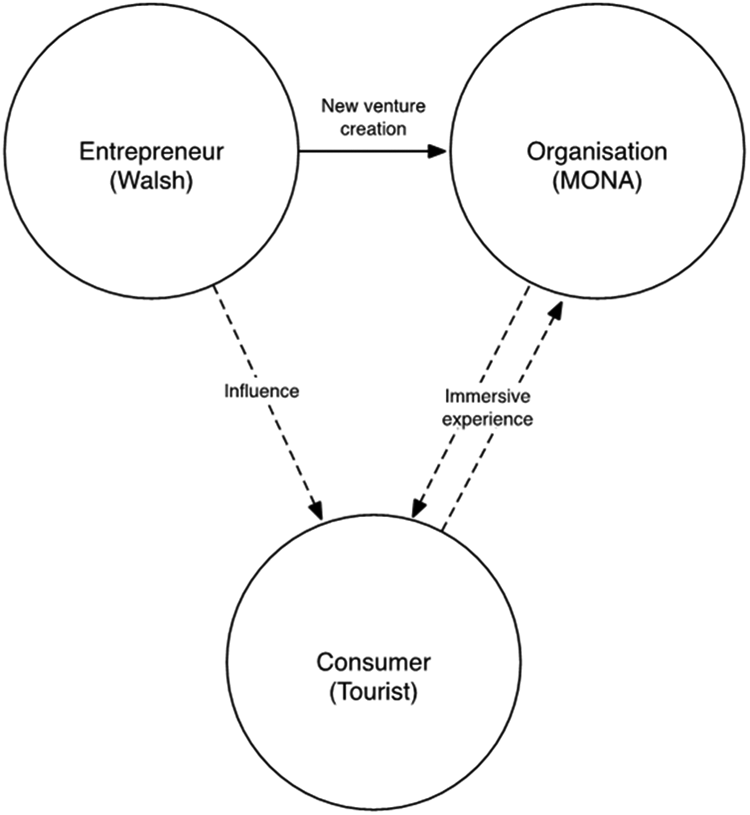
Flows of influence between the entrepreneur, their organization and the consumer.
Certainly, MONA is an extreme case of EM, with a very wealthy, creative and eccentric entrepreneur driving it. Underpinning the research is an investigation of the degree of fit of conventional marketing in an innovative organization. Results suggest also that serendipity has a role to play. These factors combine to create a market for the product, rather than the pursuit of market following activities. The research uncovers the passion of an individual pursuing opportunities in order to launch a new venture using entrepreneurial marketing efforts (Hills et al., 2010). It demonstrates the innovative use of an organization’s resources (Shaw, 1999) in offering an end product unique from the mainstream. It also shows how the personality and motivation of the key decision-maker shapes effective EM through a personalized management style and influences the consumer (tourist) by force of personality. As can be seen in Figure 1, the entrepreneur is not a faceless manager, but creates the public perception of the organization. Whilst Walsh is not an enigma as an entrepreneur, he has demonstrated that EM can be an effective marketing strategy in the tourism and vacation marketing sectors, particularly for sophisticated and upmarket segments. His values and tastes shape what MONA is and the entire MONA visitor experience, and that is unique in tourism and vacation marketing.
Additional research on the impact of EM in the vacation marketing and tourism sector is required, where it is clear creative solutions to opportunities are needed instead of repetitive, linear, rational responses that have failed to produce innovative outcomes (Alsos et al., 2014). Further research also needs to be conducted into market creation activities in which truly innovative products and new customers can result from creative thinking. EM helps in understanding the role of the owner/manager from different perspectives; for example, the owner/manager can be thought of as a brand in the same way a firm’s products have been used as the brand’s icon. The reputation of a successful owner/manager can be as strong as that of the business itself. This can also be viewed from a self-branding or self-marketing perspective (Shepherd, 2005). Although MONA as an art museum has its own identity, as do the MONA ‘umbrella’ products, it has been argued that these have been largely shaped by Walsh’s EM approach and effectual logic. Any marketing techniques utilized by MONA staff are also influenced by EM and effectuation rather than as a response to the demands of the patrons and customers. The impact of EM appears to have blurred the distinction between MONA and David Walsh, and in fact, have commodified David Walsh as a brand (Lair et al., 2005). Importantly, Walsh demonstrates the importance and advantage of developing an individual style of EM that leverages experimentation, inventiveness and his self-centredness in the marketplace.
This research has shown that the drive and ambition of an innovative owner/manager can cut through these obstacles in order to develop a new venture. Many vacation marketers have an intuitive inclination to exploit their competencies in imagination, vision and non-standard solution finding, but others will need encouragement to step away from long-held beliefs. Many in the latter category have the potential to develop their businesses further, but they need to step out of their comfort zones in order to realize their full potential. Those tourism firms with entrepreneurial flair will always be inclined to take risks (see Ross, 2003), but others can be encouraged to move from being reactive. Innovative tourism firms may have a unique product and are shaped by equally innovative owner/managers who can exploit their own brands and identities in the marketplace in order to create new customers and, hence, new demand.
Footnotes
Declaration of conflicting interests
The author(s) declared no potential conflicts of interest with respect to the research, authorship, and/or publication of this article.
Funding
The author(s) received no financial support for the research, authorship, and/or publication of this article.