



Abstract
Characterized as involving ‘Japanese traditionalism elements’, Ryokan-style accommodation includes full food and beverage service, futons and spas (hot springs), and emphasizes local traditional food. Although these Japanese traditional hotels are famous for their excellent service, traditions, and are a unique accommodation experience for overseas visitors, research into the Ryokan market segment remains limited. The aim of the current study is to provide a better understanding of the decision-making of that market segment of travelers from Korea that use Ryokan-style hotels. The data were collected (N = 328) from Korean visitors to Japan during February and March of 2015. Segmentation of tourists by selection attributes resulted in three clusters: ‘personal service seekers’ (36.9%), ‘physical environment seekers’ (21.1%), and ‘spa & gourmet, systematic service and reputation seekers’ (42.0%). There were statistically significant differences between the three clusters with respect to the characteristics of Korean tourists. The implications of this study are discussed relative to possible future Ryokan marketing strategies and to future research on this accommodation type.
Introduction
Ryokan are Japanese traditional accommodation facilities with a history that can be traced back over 1000 years (Lee and Lim, 2011). However, partly due to the poor accessibility of the destinations that used them extensively, and the desire to provide ‘Western-style’ hotels for the new inbound tourists (Funck and Cooper, 2013), this accommodation style developed slowly after the construction of more extensive travel facilities at the end of the Edo period (essentially bridges over the major rivers and the first railways; Fitzpatrick, 2006; Kang et al., 2004). Today, the advantages of successful Japanese traditional inns (ubiquitous onsen, traditional costumes, food, and quality service) has meant that Ryokan have increased their popularity among tourists, at least for those on honeymoon trips or package tours organized by companies (Guichard-Anguis, 2007). Staying in a Ryokan is an accommodation experience that involves three kinds of activities: sleeping on a futon on the floor (Tatami mat), bathing in hot springs, and dining in Japanese traditional costumes. Together, these services contribute to an exotic customized experience that impresses many customers (Guichard-Anguis, 2007; Lee and Lim, 2011). However, although Ryokan are thus a unique accommodation form, little research has been carried out on their attractiveness to international tourists.
In 2015, the Korea National Tourism Survey (Ministry of Culture, Sports and Tourism, 2016) noted that the number of Korean outbound tourists travelling to Japan in the previous 5 years had been 4,002,052 in 2014, 2,456,165 (2013), 2,044,249 (2012), and 1,658,073 in 2011, and that the country ranked second after China as a tourism destination for Koreans. For Japan, Koreans ranked first among Chinese, Hong Kong, and Taiwan visitors in the same 5 years (Japan National Tourism Organization, 2016). Therefore, Japan is an important tourism destination to Korean tourists, and at the same time, Korea is an important tourism market to Japan. The main motivations for Koreans to visit Japan are for the natural environment (22.4%), relaxation (14.3%), gourmet food (12.9%), and a spa experience (4.5%).
The Japanese Ryokan & Hotel Association (2016) put the number of registered Ryokan at 2775 in 2016. Being registered means that the quality of facilities, such as the number of rooms, size of rooms, the toilet and shower room, quality of the hot water (onsen), attractiveness of the lobby, the food, hygiene, and safety in these Ryokans, is warranted to be beyond the general standard in the Ryokan industry. However, all Ryokan do not have the same facilities/services. Individual Ryokan differentiate themselves from their competitors by raising service levels. Although there is no classification such as the star ranking system in hotels in Japan, different classes of Ryokan can be determined by their size. Among these 2775 enterprises, large-scale Ryokan (the number of rooms is more than 100), middle-size Ryokan (the number of rooms ranges from 31 to 99), and small-scale Ryokan (the number of rooms is less than 30) make up 15%, 51%, and 34% of Japanese Ryokans, respectively. While every Ryokan does not have the full range of facilities, at least in the middle and large-scale Ryokans, excellent facilities/services relating to natural landscapes, relaxation, gourmet food, and spa can be experienced. And these make up nearly 70% of all Ryokans (Japan Tourism Agency, 2016). It is the authors’ firm belief that a study that is designed to increase our knowledge of the importance of each of these service attributes as perceived by tourists would help Japanese authorities and the industry to develop effective market segment management strategies for all Ryokan. Such strategies would further help Ryokan to maintain their existing customers and provide an opportunity for them to promote these excellent traditional Japanese inns much more widely internationally.
In previous studies relating to tourism segmentation, researchers have demonstrated that the tourist market is not homogeneous (Pizam and Milman, 1993). Therefore, a range of variables must be used to distinguish groups of people from one to another (Pizam et al., 1997). Social researchers use several variables (such as personal values, attributes, benefits, motivation, and loyalty) to explain tourist behavior (Kamamura and Novak, 1992; Li and Cai, 2012). Among these variables, selection attributes have proved to be valid for segmenting hospitality-based contexts (Konu et al., 2011; Yuksel and Yuksel, 2002). For example, Yuksel and Yuksel (2002), focusing on tourists’ dining experiences, identified five distinct selection segments and demonstrated various service dimensions that affect customer satisfaction in a restaurant setting. Similarly, Konu, Laukkanen, and Komppula (2011) segmented Finnish ski resort visitors into six groups based on ski destination choice attributes. Pesonen, Laukkannen, and Komppula (2011) segmented tourists based on the benefits they seek from a tourism destination. Their study identified four distinct groups, namely nature enthusiasts, outdoor types, sightseers, and cultural tourists. But, despite the expressed importance of using segmentation as a marketing tool (Cahill, 2006; de Pelsmacker et al., 2010; Middleton and Clarke, 2001; Wedel and Kamakura, 2002), the examination of market segments based on selection attributes, especially for Ryokan tourists, has attracted surprisingly little attention from tourism and hospitality scholars.
To fill this gap, the present study is based in the previous market segmentation literature but then builds on this to examine the specific selection attributes as evinced by Korean inbound tourists to Japan. Segmentation of markets is generally based on various variables such as demographic, geographic, psychological, and/or personal benefit choice criteria (Bowen, 1998; Cahill, 2006; Dong et al., 2013; Know et al., 2011; Pesonen et al., 2011). Among these criteria, many tourism and hospitality studies have strengthened validity using the variable of selection choice attributes (e.g., Jang et al., 2002; Park and Yoon, 2009; Pesonen et al., 2011). In a hotel or a motel context, segmentation has concentrated on dividing customers into homogeneous groups using choice attributes (Chen et al., 2013; Guillet and Kucukusta, 2016; Khoo-Lattimore and Prayag, 2015). Therefore, this study also attempted to segment Korean Ryokan customers by choice attributes.
Since researchers agree that a Ryokan is an extension of a general hotel (Chen et al., 2011; Lee and Lim, 2011), the selection attributes of Ryokan should be a combination of the quality of general hotel facilities and service, and the unique characteristics of Ryokan. As the previous literature indicates, the selection attributes of Japanese Ryokan can be generally categorized as: (1) personal service, (2) physical environment, (3) systematic service, (4) spa & gourmet, and (5) reputation (Albayrak and Caber, 2015; Baker and Cameron, 1996; Chen and Rothschild, 2010; Chu and Choi, 2000; Kim and Perdue, 2013; Masiero et al., 2015; McCleary et al., 1993; Roman and Martin, 2016; Ryu et al., 2011; Wilensky and Buttle, 1988). As such, segmenting Ryokan tourists by selection attributes would help our understanding of the varying influences of specific market segments, allow cataloging of the unique benefits sought by each segment, and establish the different marketing strategies required by a segment (Woo, 1998).
Therefore, the current study aimed to provide tourism marketers with insights into the travel behavior of tourists from Korea to Japan, which should help in establishing appropriate marketing strategies for Ryokan. Accordingly, there were three objectives for this study: (1) to explore the multistructure of Ryokan selection attributes using factor analysis; (2) to segment the Ryokan tourist market based on the attributes of this accommodation type using cluster analysis; and (3) to explore the differences between segments with respect to a range of behavioral variables and demographic characteristics.
Literature review
Selection attributes of Japanese Ryokan
Ryokan are one of the least-known types of accommodation in the international lodging industry and the definition of Ryokan is still vague in the academic literature. Nonetheless, based on its functions and characteristics, it would be reasonable to describe a Ryokan as a Japanese traditional hotel with spa/hot spring facilities (Lee and Lim, 2011). Hospitality researchers have indicated that Ryokan are a form of accommodation where customers can enjoy spas/hot springs while having access to lodgings, food and beverage, and a range of other hotel/inn services (Chen et al., 2011). However, they should be differentiated from general hotels/inns because while they offer the same services/tourism products as a general inn/hotel, they also include Japanese traditional services (e.g., spa, sleeping on futons, bathing in hot springs, and dining in Japanese traditional costumes).
The evidence from several sources suggests that the characteristics of Ryokan include various ‘traditional elements’. In guest rooms, the flooring is tatami mats, and guests should take off their shoes before stepping onto these, there are paper-thin sliding doors, and guests usually sleep on futons on the floor. Bathing in natural mineral springs is also included where possible, and guests are offered full-service accommodation (Kang et al., 2004). Additionally, the meals in a Ryokan consist of traditional Japanese cuisine such as kaiseki (light meals served with a tea ceremony, and usually containing several small, varied dishes). Guests staying in these hotels can also experience being served by staff or the owner wearing a kimono during dining (Lee and Lim, 2011). Thus, the unique characteristics of a Ryokan can be described as: (1) one-on-one full service, which means the Japan-styled Ryokan delivers service directly to a specific individual, a situation rarely seen in a Western-style hotel (e.g., preparing a meal in the room and attending during eating, or laying out the coverings for customers); (2) the inclusion internally in the hotel, and even in each room, of spas and hot springs; (3) food made from local resources; and (4) various high-quality Japanese traditional dishes, luxurious foods/sashimi, and the use of local specialties and fresh ingredients.
As previous studies show, it is the specific services and facilities offered by a hotel that lead customers to choose one over another (Lewis, 1983). Atkinson (1988) suggests that cleanliness, safety, and security of the accommodation are the top attributes for customers in choosing a hotel. Baker and Cameron (1996), however, state that the physical environment is also an important choice attribute for customers. Customers are more likely to spend their time and money in a pleasantly serviced environment. Wilensky and Buttle (1988) also state that factors such as personal service and physical attractiveness are highly appreciated by hotel customers. Chen and Rothschild (2010) explored the impact of various facility attributes on hotel room rates in Taiwan and found that location, LED TVs, and conference facilities have a significant influence, while Román and Martín (2016) divided hotel attributes into affective (e.g., friendliness from staff/area security), cognitive (e.g., price, food quality), and sensory (e.g., noise level, hotel room views) categories. Finally, Masiero L, Heo CY, and Bing P (2015) explored hotel choice based on specific attributes such as room views, specific hotel floors, smartphone services, and cancellation policy.
After an extensive review of the literature, we settled on five service attributes of Ryokan that may attract customers (Albayrak and Caber, 2015; Chen and Rothschild, 2010; Chu and Choi, 2000; Kim and Perdue, 2013; Masiero et al., 2015; McCleary et al., 1993; Roman and Martin, 2016; Wilensky and Buttle, 1988). These factors are personal services, the internal physical environment of the facility, systematic delivery of services, spas & gourmet foods, and the reputation of the hotel. These attributes contribute to the understanding of the choices made by customers and are vital factors in influencing their satisfaction and their intention to visit Japanese Ryokan.
Tourism market segmentation
Market segmentation, the process of dividing a market into distinct and homogeneous groups of people with similar needs and wants who will respond similar to unique product offerings and marketing mixes, has been extensively discussed in the tourism and hospitality literature (Plog, 1987; Vanhove, 1995; Weber, 1995). This is because customers have various needs and desires in relation to tourism products; therefore, it is difficult to satisfy their requirements using a mass marketing and management approach (Dibb, 1998). Thus, segmentation has proved helpful in identifying groups with similar characteristics and means that specialized travel offers may be the most effective way to fulfill target markets’ unique needs and desires (Kara et al., 1997). Through market segmentation tourist resources are more effectively and efficiently used to increase a company’s sales and profits (Reid, 1983).
A very large number of studies have used different descriptors and discriminating variables to segment a market; some of which include attributes for vacations (Crask, 1981), benefits sought by travelers (Gitelson and Kerstetter, 1990; Loker-Murphy and Perdue, 1992), motivations for travel (Cha et al., 1995; Madrigal and Kahle, 1994), behavioral characteristics (Formica and Uysal, 1998), and product bundles (Oh et al., 1995). For instance, Konu, Laukkanen, and Komppula (2011) segmented Finnish ski resort visitors by ski destination choice attributes. They identified six different segments (passive tourists, crosscountry skiers, want-it-all, all-but-downhill skiing, sports seekers, and relaxation seekers) using a factor-cluster method. Yuksel and Yuksel (2002) also investigated tourist dining experiences by grouping these into different segments. Their study distinguished five different clusters: value seekers, service seekers, adventurous food seekers, atmosphere seekers, and healthy food seekers. Additionally, Callan (1996) used segments to identify UK leisure travelers and business traveler ratings of the importance of hotel attributes, while Griffin, Shea, and Weaver (1996) examined the discrimination patterns of business travelers visiting midpriced and luxury hotels. And finally, Lee, Lee, Bernhard, and Yoon (2006) segmented the casino gambling market in Korea using a cluster analysis that yielded four clusters (challenge/winning seekers, only winning seekers, light gambling seekers, and multipurpose seekers).
However, little effort has been made to explore Ryokan segmentation. The only research related to this topic is the study by Kang et al. (2004). They analyzed the effect of service quality on customer satisfaction and behavioral intentions. In their study, the service quality perceived by customers of Ryokan was divided into eight dimensions (accessibility, physical aspect, assurance, responsiveness, contact performance, encounter performance, creativeness, and unexpected benefits). Although this study was carried out to explore service quality, these factors cannot, however, fully reflect the characteristics of Japanese Ryokan. As aforementioned, Ryokan services, such as one-on-one service, spa and hot springs, food made from local resources, and various F&B with high quality, are not included in such measurements (Kang et al., 2004), nor is the effect of size. Thus, studies on the development of proper measurements that can accurately reflect the characteristics of Ryokan are urgently needed for establishing market segmentation strategies (Kang et al., 2004; Lee and Lim, 2011). From previous research, segmentation based on choice attributes or the benefits sought by customers has been found to predict behavior better than others that are more descriptive. When a customer seeks a specific tourism attribute, that attribute will play a significant role in influencing his/her choice (MacKenzie, 1986). Understanding the behavior and size of the different segments will thus provide a good understanding of the likely results of a promotion strategy across a variety of segments.
Methods
Data collection and sample characteristics
The present study was designed to promote a better understanding of why Korean tourists travel to specific destinations to stay in Ryokan. A nonprobability convenience sampling technique was used to collect the data. These data were obtained from potential Korean travelers during the period February 21 to March 8, 2015, by asking a screening question designed to select suitable participants. This question asked whether potential respondents had stayed in a Japanese Ryokan within the last 12 months. The research assistants explained the purpose of the study and defined Ryokan, distributed the questionnaires, and helped participants complete them. The follow-up questionnaire survey was conducted in a city restaurant, a department store, and a university in Busan, Korea, a city geographically close to Japan. The questionnaire took around 15 min to complete per person. To increase response and usable rates, completeness was checked immediately. Through this process, 350 questionnaires were collected. After excluding unusable questionnaires, 323 responses were retained for analysis.
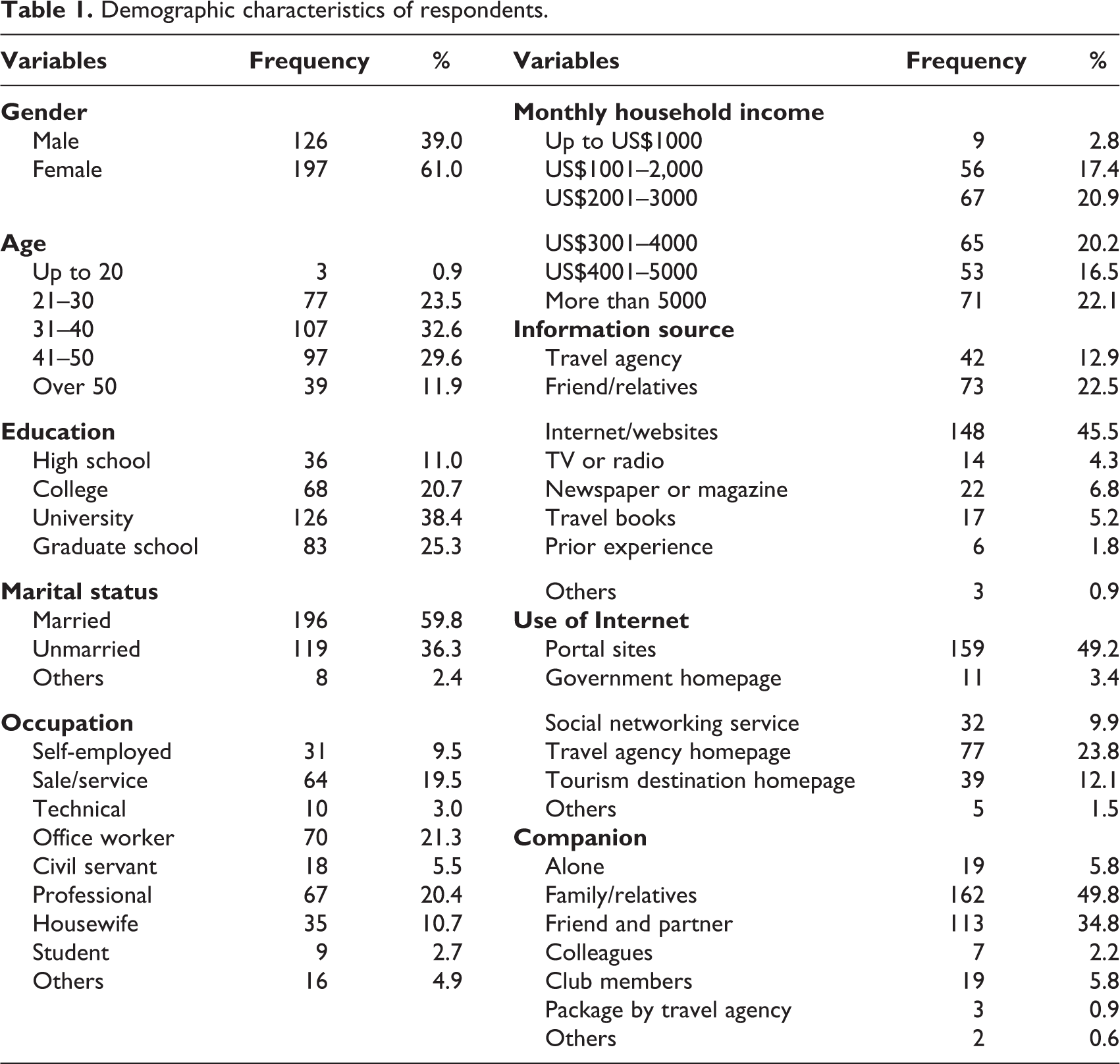
The sociodemographic characteristics of Korean Ryokan travelers are seen in Table 1. Among the respondents, 39.0% were male, and 61.0% were female, and more than half were married (59.8%). Most respondents were office workers (21.3%), or held professional positions (20.4%), or sales/service positions (19.5%). Students made up the smallest portion of the respondents (2.7%). Most respondents indicated that they have a degree higher than college (83.7%), and most were aged 21–50 years (85.7%). Almost 58.8% earned more than US$3000 a month, while 20.2% earned less than US$2000. As for gaining information about their proposed travel behavior, many of them (45.5%) use Internet/websites, followed by friend/relatives (22.5%), and travel agencies (12.9%). Nearly half of them visited portal sites (49.2%), followed by travel agency homepages (23.8%), and tourism destination homepages (12.1%). Additionally, Ryokan tourists seldom traveled alone (5.8%), most of them accompany family or other relatives (49.8%), and friends (or partners, 34.8%).
Demographic characteristics of respondents.
Measurement
The survey included three parts (a description of Ryokan travel, questions on the attributes of Ryokan, and questions on the required behavioral and demographic information), where the latter were for classificatory and profiling purposes. The questionnaire was slightly modified and improved after a pretest with experts in hospitality, tourism managers, and Ryokan practitioners. Specifically, copies of the questionnaires were sent to a sample of these people with a view to increasing the content validity and the clarity of the questions. The initial version of the questionnaire was in English, which was then translated into Korean using a blind translation–back-translation method. To enhance face validity, the translated questionnaires were carefully reviewed by academics in hospitality management.
The assessment of Ryokan selection attributes was formulated based on a comprehensive review of the literature (Albayrak and Caber, 2015; Chen and Rothschild, 2010; Chu and Choi, 2000; Kang et al., 2004; Kim and Perdue, 2013; Masiero et al., 2015; Lee and Lim, 2011; Parasuraman et al., 1985; Roman and Martin, 2016). To evaluate personal service, six items were adapted (employees are trustful, employees treat guests in a friendly manner, employees have professional knowledge of service, employees of Ryokan are willing to serve customers, employees of the Ryokan understand the needs of guests, and employees appear neat and tidy) to measure the internal and external physical environment; five items were used (the atmosphere and equipment are comfortable and appropriate for purpose of stay; the rooms are quiet and the facilities are clean; rooms, facilities are safe; the Ryokan has excellent facilities, attractive decoration, furniture, bed, and pillows and beautiful surroundings). To evaluate systematic services, four items were utilized (the procedure for checking in/out is fast, the reservation system of the Ryokan is easy and convenient, the service that is reserved by guests can be guaranteed, and complaints from customers can be dealt in a fast and accurate way). Finally, three items were selected to evaluate the reputation of Ryokan (reputation of Ryokan, fame of Ryokan, and convenient and accessible hotel location). In addition, six items were developed to measure those attributes that are unique (the Ryokan has one-on-one full service; the Ryokan has excellent spa and hot spring facilities; the dishes using local food items seem attractive; the Ryokan has a variety of F & B options; the F & B in Ryokan is high quality; and beautiful surroundings). In the questionnaire, the respondents were asked to rate the importance of these 24 Ryokan attribute statements. A 7-point Likert-type scale, ranging from not at all important (1) to very important (7), was provided to the respondents for grading purposes.
Data analysis
An exploratory factor analysis (EFA) using principal component analysis and the Varimax rotation method was carried out to determine the underlying dimensions of the attributes of Ryokan. EFA has been widely used in tourism segmentation research (Cha et al., 1995; Johns and Gyimothy, 2002; Shoemaker, 1994) and helps to identify the constructs that underlie variables. A cluster analysis was employed to classify Ryokan tourists into mutually exclusive groups based on the Ward method, using a K-means clustering procedure. Multivariate statistics were used to examine significant differences between clusters. A Duncan multiple range (DMR) test was then employed to examine any differences between clusters with respect to each factor. The results of the DMR test show that statistically significant differences were found between clusters, supporting the contention that this represents an appropriate categorization. Then, discriminant analysis was used to identify the Ryokan selection attribute with the strongest influence. Lastly, a χ2 test was employed to profile the clusters demographically in relation to Ryokan-based tourist behavior.
Results
The first run analysis produced five factors with eigenvalues higher than 1.0, accounting for 68.87% of the total variance. However, four items (employees are trustful; employees appear neat and tidy; the Ryokan has excellent facilities; and Ryokan have attractive decoration, furniture, bed, and pillows) were deleted from the analysis due to low factor loadings. Then, a new factor analysis was carried out. This second analysis extracted five factors accounting for 71.81% of the total variance (see Table 2). The value of the Kaiser–Meyer–Olkin Measure of sampling adequacy was 0.900, and Bartlett’s test of sphericity was significant (p < 0.001), demonstrating the usefulness of the EFA model (George and Mallery, 2001).
Exploratory factor analysis of Ryokan selection attributes of international tourists.

The first dimension, labeled ‘personal service’, included four items (employees treat guests in a friendly manner, employees have professional knowledge of service, employees of the Ryokan are always willing to serve customers, and employees understand the specific needs of guests). This factor captured 43.5% of the variance. The second dimension, ‘physical environment’, which refers to the ambience in Ryokans including good feeling and atmosphere, cleanliness of facilities/rooms, and the safety perception of Ryokan, involved three items (the atmosphere and equipment are comfortable and quiet, rooms and facilities are clean, and rooms and facilities are safe). This factor explained 11.9% of the variance. The third dimension, labeled ‘systematic service’, consisted of four items (the procedure for checking in/out is fast, the reservation system is easy and convenient, services that are reserved by guests can be guaranteed, and the Ryokan resolves guest complaints and compensates quickly and accurately). The fourth dimension, ‘Spa & gourmet’, included six items and explained 5.9% of the variance (the Ryokan provides one-on-one full service, the Ryokan has excellent spa and hot spring facilities, dishes made with local food seem attractive, the Ryokan has a variety of food and beverage services, F&B in the Ryokan is high quality, and the Ryokan is beautifully set among nature for sightseeing). The final dimension, ‘reputation’, was measured by three items (the overall reputation of Ryokan, the fame of the specific Ryokan, convenience, and accessibility), and captured 5.1% of the total variance.
Cronbach’s alpha scores ranged from 0.79 to 0.87 and were higher than the suggested cut-off point of 0.7, making them significant (Nunnally, 1978). The factor loading of all 20 items was higher than the suggested value of 0.50 (Hair et al., 1998). These results indicate that five extracted factors are statistically vigorous and appropriately summarized the data.
A cluster analysis was used to categorize respondents into mutually exclusive groups based on the Ward method, using the K-means clustering procedure. The results suggest that a three-cluster solution appeared to be appropriate (see Table 3). Specifically, the results of analysis of variance (ANOVA) tests revealed that all five dimensions contributed to segmenting the three Ryokan tourist clusters (p < 0.001). In addition, a DMR test was used to examine any differences with respect to each of the factors. The results of the DMR test demonstrated that statistically significant differences were found between clusters; named for which characteristic had the highest mean score (i.e., the personal service seeker, the physical environment seeker, and the spa/reputation/systematic service seeker).
Results of cluster analysis.

Note: H (high), M (medium) and L (low) groups are based on the average mean provided by the DMR-test (Duncan Multiple Range test: p < 0.05).
***p < 0.001.
To validate the results of the Ryokan selection attributes, a discriminant analysis was performed with the three cluster groups and five attribute dimensions. Since discriminant analysis helps determine which variables discriminate between/among the clusters, the classification matrices are calculated to explain the degree to which respondents are correctly classified in their clusters (Huberty and Lowman, 1997). The results of the discriminant analysis are shown in Tables 4 and 5. Two canonical discriminant functions were evaluated on five Ryokan selection attributes (see Table 4). For the split half samples, 96.2% of the analysis sample and 97.5% of the hold sample were correctly classified by the discriminant function (see Table 5). The validity of discriminant functions was demonstrated since the rates of correctly classified were twice as high as the Maximum Chance Criterion (Cmax), in both the analysis sample (Cmax = 39.7%) and the hold-out sample (Cmax = 44.6%). In addition, the resulting discriminant functions were subjected to a χ2 test to determine their significance. The χ2 statistic indicated that the functions were statistically significant (p < 0.001). A Wilkes’s lambda test and a univariate F test were conducted to determine the significance of each of the selection factors of the Ryokan attributes. The results suggest that all the dimensions make a statistically significant contribution to the discriminant function.
Results of discriminant analysis.

***p < 0.001.
Classification information.

Note: Analysis sample: Cmax (55.3%); hold-out sample: Cmax (40.0%).
aPercent of cases correctly classified: 96.2%.
bPercent of cases correctly classified: 97.5%.
Standardized structure coefficients were used to interpret the discriminant function. In principle, standard coefficients represent the relative contribution of the associated variable to the function. As seen in Table 6, the construct ‘systematic service’ in function 1 was the highest discriminant factor. These results enhance our confidence in the reliability and validity of the clusters.
Standardized discriminant coefficient.

To further identify the profile of the three clusters, each cluster was crosstabulated with external variables, such as the tourists’ socioeconomic characteristics and behavioral characteristics. The results of the χ2 tests indicate that there were statistically significant differences among the three clusters with respect to the characteristics of Korean tourists that stay at Japanese Ryokan (see Table 7 ).
Differences of demographic characteristics by χ2.

*p < 0.10; **p < 0.05.
Cluster 1: Personal service seekers (36.9%)
Compared to other segments, the personal service seekers valued the unique service given by Ryokan. Their main purposes for visiting Japanese Ryokan are to enjoy the high-quality service that is the characteristic of this hotel style. As for the demographic characteristics, this cluster is relatively old (more individuals aged 41 or over), and relatively rich (earning from US$3000 to more than 5000 monthly). Therefore, in the cluster, generation X, Y, and baby boomers are gathered together (see Table 8). Kotler and Keller (2015) note that baby boomers are those who were born between 1946 and 1964 (currently about 50- to 70-years old), generation X refers to the people who were born between 1965 and 1976 (currently 40- to 50-years old), and generation Y are the people who were born between 1977 and 1994 (currently 20- to 40-years old). There are more holding professional jobs (31% of the sample) in this cluster. It is also noticeable that personal service seekers rely predominantly on information from Internet/websites followed by tourism destination homepages and prefer to travel with family members and relatives.
The characteristics of Korean international tourists based on Ryokan selection attributes.

Cluster 2: Physical environment seekers (42.0%)
This cluster is composed of individuals who view physical elements as important factors influencing their choice of Ryokan. Physical environment seekers are the largest segment among the three groups that primarily visit Ryokan for their clean and neat environment. Compared with other groups, they are generally young people between 20- and 40-years old (72.8% of sample), working as office workers (30.8%), or sales/service people (21.5%). Thus, they are more likely to be generation Y, who are relatively young. Many of them have relatively low salaries (27.7% of the sample earned under US$2000 per month). As with the personal service seekers, they acquire Ryokan information through Internet/websites and use social network site (SNS, 15.2%) more than other groups. In addition, they prefer traveling with their partners.
Cluster 3: Spa/reputation/systematic service seekers (42.0%)
Individuals in this cluster are likely to visit Ryokan due to their spa facilities, efficiency of systematic service, and reputation. This group of people seems older than the other two (48.8% of the sample were more than 41-years old). Therefore, they are both generation X and baby boomers. They are employed as civil servants (5.3%), are self-hired (9.8%), or are housewives (17.3%), and had a middle level of monthly income (39.4% of sample ranging from USD2000 to 4000). They gather travel information mainly from the Internet, newspapers/magazines, and the homepages of travel agencies. Finally, they like to travel alone, or with other colleagues and club members.
Discussion and conclusions
The aims of this study were to segment Korean international tourists traveling to Japanese Ryokan and to develop market strategies based on the study results. Thus, both theoretical and practical implications can be provided. To the best of our knowledge, this is the first study that has produced five dimensions of Ryokan selection attributes. Although the dimensions of personal service, systemic service, and reputation are correspondent with the dimensions in a general hotel, the physical environment, and spa & gourmet factors were demonstrated to be valid indices that well reflect the unique characteristics of Ryokan. Specifically, Ryokan-style hotel service that includes the contexts of one-on-one service, spas, hot springs, and high-quality local food are seldom found in a Western-style hotel, even in Japan. By introducing these items, the appropriate measurement tools were first constructed and examined in our study. Therefore, the Ryokan-related dimensions (i.e., physical environment, and spa & gourmet) should be included in future studies, because these identified factors can be utilized to assess the motivations of international travelers more thoroughly, and can contribute to deepening our understanding of the motives of that segment of international travelers that stay at Japanese Ryokan. Second, this study is the first to divide the Korean tourist into three clusters based on selection attributes. Moreover, the preferences in selection attributes by Korean tourists were also made clear using ANOVA: Specifically, the first cluster (personal service seeker) placed considerable value on hotel employees’ manner and the speed of service delivery.
While, compared to the first cluster, the second cluster (physical environment seeker) pays more attention to the environment, such as cleanliness of the rooms and personal safety in the facilities. The third cluster (spa/reputation/systematic service seeker), however, focuses on their reputation relating to the provision of the services of spa and gourmet food, one-on-one service, hot springs, and local food; as well as the overall systematic operation of the hotel, such as check-in/out procedures, reservation systems, and customer complaint management. These results point to the possibility of marketing strategies being developed by the better understanding of the segmentation of Ryokan tourists and the nature of the target customers. Third, based on our discriminant analysis tool, the study results indicate that systematic service was the most discriminatory dimension in the five-selection attribute dimension. Thus, the importance of systematic service was first identified in our study. Also, we determined that strategies paying attention to the quality of service such as check-in/out procedures, reservation systems, and fast resolution of guest complaints should be developed first. In such a way, market differentiation could be achieved for Korean tourists, and higher customer satisfaction could be obtained.
Our study also has some practical implications: First, the unique characteristic of Japanese Ryokan is that they provide ‘one to one’ service for customers. This means those special services that are difficult to find in a typical hotel or motel. In this segmentation, human services such as friendly hospitality and attentive care and attitude toward customers are important factors directly related to customer satisfaction. Providing professional services based on a thorough understanding of the services they perform in response to customer needs through the personal intimacy and kindness unique to Japanese people will help to secure successful customers in the future. This segmentation emphasizes spreading information by word of mouth, and it is thus necessary to strive for meticulous 1:1 service, so that customers who have experienced Ryokan service in Japan will be able to communicate positively to their friends, relatives, and other potential guests. In addition, this segmentation includes many professionals such as professors, lawyers, and doctors, so if a Ryokan can provide a high level of human services for these customers and satisfy them, this will greatly contribute to the upgrading of its customers in the future.
Second, the ‘physical environment seekers’ comprised around 21.1% of all respondents. In this group, there were more males than females, and more young people between 20- and 40-years old. They typically had bachelor’s degrees, and worked as service people or were self-hired, or were students, and had a relatively low family monthly income. Compared to other groups, more of them were single, intended to travel with their partners, and to obtain travel information from a travel agency. Like most youngsters, they also exchange information on SNS. This group emphasized the importance of environmental services among hotel properties. Therefore, it is necessary for the industry to emphasize the luxurious, quiet and comfortable atmosphere unique to Ryokan in Japan, and the cleanliness of their facilities. This form of Japanese traditional style accommodation is a mysterious and attractive factor for customers who have not experienced a room or atmosphere that is completely different from a ‘Western’-style hotel or motel. This group of respondents contained a larger proportion of youths and university students in their 20s than did other segments. However, such groups usually cannot experience luxurious Japanese Ryokan due to the price problem. Therefore, Ryokan managers in Japan need to resolve cost and price issues if they wish to extend their market into this age group. For example, enjoying and relaxing in Japanese hot springs with quiet, clean facilities, and a luxurious atmosphere with friends or lovers without staying overnight will be helpful in developing a new market for young people in their 20s. In addition, since this group has a high frequency of using SNS, it is easy to make information such as photos and images that relate to cleanliness, quietness, and the mysterious atmosphere of Ryokan in Japan available to the public, and thus develop and secure a new market targeting friends and loved ones.
Third, ‘Spa & gourmet, systematic service and reputation seekers’ made up of 42.0% of the total sample. Compared to other groups, this cluster included more females, more individuals who were over 40-years old, and more housewives and civil servants. More people with household monthly incomes ranging from US$3000 to 4000 were also found in this group. In addition, this group searches for travel information in print, such as newspapers, magazines, and travel books. Also, they would like to obtain information through the Internet via government homepages and travel agency homepages. When traveling abroad, they tend to choose colleagues and club members as their companions.
This third group emphasizes spa & gourmet food, systematic service, and the reputation found among Ryokan properties in Japan, suggesting that it will form a most important segment of the market in the future. It is important to emphasize that this is an opportunity to experience the unique food culture of Japan by offering various food and meals made with fresh ingredients from a local area, and conveying health-related messages such as skin and beauty in relation to Japanese hot springs. Usually, Ryokan in Japan have a long history based on hot springs and personal services. The price is often expensive, but this group of respondents included numerous middle-aged people and housewives, who do not care or worry greatly about the costs involved.
Therefore, based on the traditions and reputation of Ryokan in Japan, operators should package hot springs and meals together. Strategies that emphasize the management of skin and beauty for housewives through hot springs, and health through diet and meals made from fresh and healthy ingredients for middle-aged people in their 40 s and 50 s will be helpful. Furthermore, as this group uses travel-related newspapers, magazines, and travel brochures, so operators should send information by means of these traditional promotional materials so that they can help to form a large-scale segment such as company colleagues or club members in the future. Meanwhile, this is a group who also love to maintain a relationship with others. By participating in activities such as eating local foods, and enjoying spa and hot springs together, they expect to gain memorable experiences and good communication. To target this segment, related advertisements should appear in professional travel books/magazines, as well as in specialized Internet forums. Ryokan products containing such elements as ‘union’ and ‘harmony’ would be effective marketing strategies.
Finally, it is also necessary to assess the framework of service by considering the characteristics of both Korean and Japanese culture. Koreans highly value traditional manners in their culture. Thus, they evaluate a hotel highly if employees are polite to customers. This can be applied to Ryokan when they provide personal service. Strong relationships will be formed between employees and customers when the service is provided with expertise. Therefore, Korean customers are satisfied when employees can promptly meet their requirements with positive attitude and passion. Meanwhile, the Japanese are famous for excellent service and good manners. In this sense, developing Japanese fine service by considering the Korean traditional elements (e.g., good manner, passion, and courtesy) would help turn Korean tourists into loyal customers. Meanwhile, day packages should be planned to enlarge market shares by attracting the tourists who wish to have a budget trip, or who have a busy schedule. Instead of spending money on staying overnight, food and spa experience should be made a major attraction, and packed into a day-trip program. Therefore, an hourly operated room system (e.g., room just for purpose of resting), good perceptions on the food (e.g., a video showing the excellence of food ingredients, open kitchen with a chef explaining the special cooking method) should be strengthened.
Until this study, Ryokan selection attributes had not been clearly identified. By employing both qualitative and quantitative techniques, the present study generated the underlying factors relating to these attributes. A thorough EFA verified that the five dimensions of selection attributes (personal service, physical environment, systematic service, reputation, and spa & gourmet facilities) had an acceptable level of reliability and validity. The results also support the notion that using selection attributes based on segmentation is a good approach in the context of studying Japanese Ryokan. Three distinct groups that represent different types and levels of Ryokan selection attributes were identified. Therefore, the segmentation of the market presented in this study is helpful in explaining why different individuals choose Japanese Ryokan hotels.
However, there are several limitations that provide directions for future studies that should be addressed. First, this study has local limitations. While Busan is the closest geographical area to Japan and has a lot of interchanges with Japanese cities such as like Fukuoka and Beppu/Oita, in the future, efforts should be made to secure the reliability and generality of the survey results by expanding the survey target nationwide to both countries. Second, this study was designed to be appropriate to a Ryokan hotel setting. Therefore, any application of the selection attributes used here to other settings, and other cultural backgrounds without modification, should be carried out with special care. Third, other variables such as the influence of psychological factors were not considered in this study. Finally, continuous or even longitudinal studies should be carried out to pinpoint the characteristics of Ryokan tourists more accurately. Thus, some other variables (e.g., personal values, motivation, benefit, satisfaction, and loyalty) should be further explored in future research.
Footnotes
Declaration of conflicting interests
The author(s) declared no potential conflicts of interest with respect to the research, authorship, and/or publication of this article.
Funding
The author(s) disclosed receipt of the following financial support for the research, authorship, and/or publication of this article: This work was supported by the Dong-A University research fund.