



Abstract
Tourist marketers rely heavily on using visual stimuli in their advertising to attract attention and improve awareness and interest of their experience. This study used eye-tracking and self-reported recall methods to investigate online tourism advertisement effectiveness based on the hierarchy of effects model. A within-subjects experimental design (n = 30) was used to examine mock advertisements (stimuli) containing various combinations of image, text and product price. Results show that the advertisement containing both image and price was least effective, while the stimuli with text and price were most effective in capturing the respondent’s attention. Advertising consisting of image, text and price generated the best recall. There were significant differences in results based on gender, task and experience.
Introduction
Capturing and holding a customer’s attention with marketing material is critical to business success (Davenport and Beck, 2001), especially in the information-overloaded online environment where consumers want relevant information quickly and easily (Morgan et al., 2000). This is particularly true for tourism, which sells intangible travel experiences and needs to capture and maintain a customer’s interest and convey information on which they can base their decision. The image and text in tourism advertisements provide important ways for consumers to search for information (Djafarova and Andersen, 2008; Evrim, 2010), and to promote destination image and enable virtual experience (Tussyadiah and Fesenmaier, 2009).
Previous research highlighted advertising design features, including colour, animation and orientation, in creating awareness and recall (Hernández-Méndez and Munoz-Leiva, 2015; Kuisma et al., 2010) and also found that customers may be confused by moving stimuli (Lee and Lee, 2004) and avoid pop-up advertising and online website banners (termed “banner blindness”). This implies that increasing the visual attraction of an online advertisement may counter-intuitively reduce its effectiveness (Benway, 1998). Surprisingly, while there is research on the effectiveness of tourism website advertising (Hernández-Méndez and Munoz-Leiva, 2015), not so much has been done so far on the specifics of Chinese online tourism advertisements which adopt a different design format from that used in other countries (Li, 2010).
This study examines tourists’ visual attention to Chinese online tourism advertisements using eye-tracking and self-report recall methods to examine the effect of image, text and price. Different from tourism advertisements in other countries which are presented in various forms, advertisements in the Chinese online tourism domain (e.g. Qunar.com) typically appear with a combination of image, text and price in a format similar to that shown in Figure 1. In this study, these three components of an advertisement were systematically varied to create seven experimental stimuli with each respondent viewing all seven. The effect of gender, task and experience with online tourism websites on visual attention and memory was also tested in this study.

Stimuli examples.
This study addresses four literature gaps as follows: First of all, this study provides insights into the effect of tourism advertisements from the point of view of visual attention and memory based on the hierarchy of effects model. Attention is regarded as the antecedent of consumers’ processing of advertisements (e.g. Aaker et al., 1992; Kahneman, 1973) and memory (recall) has been widely used to test consumers’ cognition (Barry and Howard, 1990). These two stages are evaluated in the context of Chinese online tourism advertising. Secondly, instead of focusing on the influence that properties like colour and animation (e.g. Li, 2010), types of advertising media and exposure rates (e.g. Li and Zhang, 2007) have on tourists’ attention and perception, this study examines the components (image, text and price), which comprise most tourism advertisements in China, including online travel agents, blog posts or travel brochures. Thirdly, as attention and memory have been found to vary with viewers’ background, gender and experience (e.g. Hernández-Méndez and Munoz-Leiva, 2015), by including these aspects, this study helps further understand group differences in the online tourism environment. Finally, this study also contributes to the methodological literature of tourism and marketing by combining eye-tracking technique and self-reported recall method instead of just self-report methods such as questionnaires and interviews.
The hierarchy of effects model
The hierarchy of effects model assumes that consumers’ responses to advertising are ordered: Consumers experience a series of step-up mental stages, from “unawareness” of the advertised products to actions (Yoo et al., 2004; Lavidge and Steiner, 1961). It has been widely applied to measure the effect of advertising (Barry and Howard, 1990; Weilbacher, 2003) since it can not only evoke consumers’ responses to advertisements, but also provide predictions and information for advertising optimization (Barry, 2002). Three main processes (cognition, affect and conation) of this model have been identified (e.g., Barry and Howard, 1990; Ray, 1973). This model starts from cognitive information processing (e.g. Aaker et al., 1992; Krugman, 1966; Kuisma et al., 2010), which refers to “a system of beliefs structured into some kind of semantic network” and has aroused widespread discussion in terms of its operationalization because of the consistent criticism about the hierarchy of effects model (Barry and Howard, 1990; Ray, 1973). This study will introduce Barry and Howard’s (1990) finding about the operationalization of cognition, making recall as the key variable for consumers’ cognition towards online tourism advertising.
The hierarchy of effects model presumes attention is the first phase and antecedent in a hierarchic order for actual information processing (e.g. Aaker et al., 1992; Kahneman, 1973; Kuisma et al., 2010). Visual attention refers to applying cognitive resources to relevant information in a visual environment and is required to deal with the information richness of the online environment (Carrasco, 2011). In general, more attention paid to stimuli indicates greater relevance to the consumer’s needs and results in better recall (Wedel and Pieters, 2012) and a higher likelihood of purchase (Krajbich et al., 2010). Therefore, investigating and understanding how potential tourists view online advertisements is paramount for both practitioners and academics, but most studies focus on ads’ properties such as website location (Posner, 1980), features (Corbetta et al., 1990) and clutter (Calder et al., 2009) while ignoring advertisements’ components like image, text, price, and so on. A strong connection has been found between visual attention and eye movements (e.g. Orquin and Loose, 2013; Posner, 1980), such that eye tracker can capture and record viewers’ real-time reactions to stimulus efficiently (Duchowski, 2002). Thus, attention to different advertisements may be considered as a measure of viewers’ interest when exposed to them.
Memory plays an important role in consumers’ advertising perception process – only the selected information is attended to and passed on for further interpretation (Kuisma et al., 2010). It is a key variable in understanding behavioural responses in decision-making (Yoo, 2007) and predicting subsequent destination choices (Kuisma et al., 2010), although limited attention has been paid to its study in the context of tourism. Previous studies have discussed the effect of gender and task relevance (Pagendarm and Schaumburg, 2001) on memory but not experience. Here, the effectiveness of different combinations of advertisement content on memory is investigated through the use of a recall test.
The hierarchical model assumes a positive link between the attention paid to advertisements and the consequent memory of them (Kuisma et al., 2010; Pashler, 1998), which is a useful starting point for this article; better memory score can be achieved if consumers pay more attention to advertisements. Pavlou and Stewart (2000) proposed that theoretical models varied in different advertising environments, so this study attempts to examine the effects of tourism advertising on the Chinese online environment within the framework of the hierarchy of effects model.
Advertising components: Image, text and price
Chinese online tourism advertisements typically consist of three main components: image, text and price, which is a design format distinctive from tourism advertisements in other countries. Images deliver information efficiently (Zimbardo, 1992), while texts have significant roles in consumers’ attention capture (Pieters and Wedel, 2004) and in evoking cognition (e.g. Stern, 1996). Extant research has focused on people’s perception and recall of pictorial stimuli and words, but with little consensus on their effect. Some research has found that images tend to yield superior attention and are better recalled than texts (Childers and Houston, 1984; Lewis et al., 2013), while other studies indicate consumers allocate more attention to texts (Hernández-Méndez and Munoz-Leiva, 2015; Rayner et al., 2001). Limited research has been conducted on consumers’ perceptions of images and texts in tourism advertisements and further research needs to discuss tourists’ allocation of their visual attention when viewing different advertisements.
Price included in an advertisement serves as informational content (Resnik and Stern, 1977) and helps to shape perceptions of quality (Fruchter, 2009), but has received less research interest compared to the effect of images and texts. Tourism is an experiential product and is subject to significant pre-purchase evaluations (Gaur and Fischer, 2005; Rao and Monroe, 1988), and prices signal important information used in these evaluations (Nelson, 1974). Price has complex influences on tourists’ service expectation and decision-making process as a budget constraint (Chen and Tsai, 2007; Lepp et al., 2011) and provides subjective quality signals (Rao and Monroe, 1988; Sigurdsson et al., 2010). There is, however, contention between destination brand marketers and travel trade intermediaries about whether to include a price in tourism advertisements. Destination marketers are reluctant to include a price in their advertisements to avoid lowering consumers’ brand perception by low prices (Rao and Monroe, 1988), while intermediaries like online travel websites tend to compete on price to increase demands (Xu et al., 2014). Therefore, the inclusion of a price in tourism advertisements is controversial and insufficient attention has been devoted to its effect on consumers’ perception and memory in conjunction with images and texts.
Effect of gender, task and experience
The three attributes of gender, task and experience will be introduced to this research to investigate the influence these participant characteristics have on the effect of tourism advertisements within the framework of the hierarchy of effects model. Gender has a key role in consumers’ evaluative judgements of stimuli (Holbrook, 1986), especially when examining images and texts (Wolin and Korgaonkar, 2003). Gender has an effect on visual attention (Mahzari and Ahmadzadeh, 2013) and information processing (Krugman, 1966) which should be taken into account when designing optimal advertising (Shaouf et al., 2016). Gender is also considered a determinant in moderating tourists’ behaviour and segmenting tourism markets (McGehee et al., 2007). Research indicates a website is more influential in reducing the risk of travel and in facilitating intention to travel for women than men (Garbarino and Strahlievitz, 2004). Although researchers consider gender as a key variable in tourism, the role of gender in tourists’ advertising evaluation process is not well studied.
Consumers’ objectives in the tasks they undertake can affect attention (Sternberg et al., 2008) and memory (Pagendarm and Schaumburg, 2001), and a consumer’s information processing and cognitive capacity (Gilbert et al., 1988) is affected differently according to the different difficulty of tasks (Gwizdka, 2010). Online tourism websites may promote several services that are important parts of a trip such as transport, accommodation and food (Camacho et al., 2001), but which may be task irrelevant and distract tourists’ attention in their current information search task. However, few studies have investigated task specificity and its impact on tourists’ perception towards tourism advertisements, further research about a task’s moderating role on attention is still needed (Bang and Wojdynski, 2016).
Online advertising viewers can develop a capacity to filter out advertisements that seek to attract attention (Drèze and Hussher, 2003) based on their past browsing experience (Benway, 1998). Experienced users concentrate and are more efficient when processing websites’ information (Drèze and Hussher, 2003), while new users are easily distracted by non-essential information such as banner advertisements (ThorbjØrnsen et al., 2002). This is one of the between-group factors that will be studied in this research.
Method
This study uses eye-tracking and self-report recall tests. In eye-tracking studies, a fixation refers to when a participant’ eye pauses on a specific area of interest (AOI) for more than a certain amount of time (here 200 ms) and is taken as a measure of viewers’ interest in that specific area of the stimulus (Rayner et al., 2001; Scott, Green and Fairley, 2015). Other measures such as dwell time and fixation count reflect different facets and amounts of visual attention (Hutton and Nolte, 2011); dwell time refers to fixation duration in some studies; dwell time and fixation count indicate the dominant AOI (Wedel and Pieters, 2012).
Pretesting and stimuli
Online tourism advertisements for destination tourism products were selected from three well-known Chinese online travel agencies (Qunar, Ctrip and Mafengwo) (Jiang and Liang, 2014; Wu, 2013; Yu and Zhang, 2016) and then used in a 2 (image vs. no image) × 2 (text vs. no text) × 2 (price vs. no price) experimental design (see Figure 1 and Table 1). Qunar is regarded as a typical example of Chinese vertical search tourism websites (Yu and Zhang, 2016), Ctrip is a representative in terms of its popularity and leading position in tourism e-business (Jiang and Liang, 2014), and Mafengwo is a tourism website specializing in travel guides which attracts millions of users (Wu, 2013). In order to develop the final advertisements used for testing, 10 advertisements were chosen for each type. A convenience sample of 10 tourists and 3 tourism experts (Wang and Sparks, 2016) rated all 70 advertisements on a five-point scale to examine whether the advertising stimuli used were typical in Chinese online environment (Li, 2010); the stimuli rated the highest in each type were chosen for the main study.
The stimuli for eye-tracking experiment.
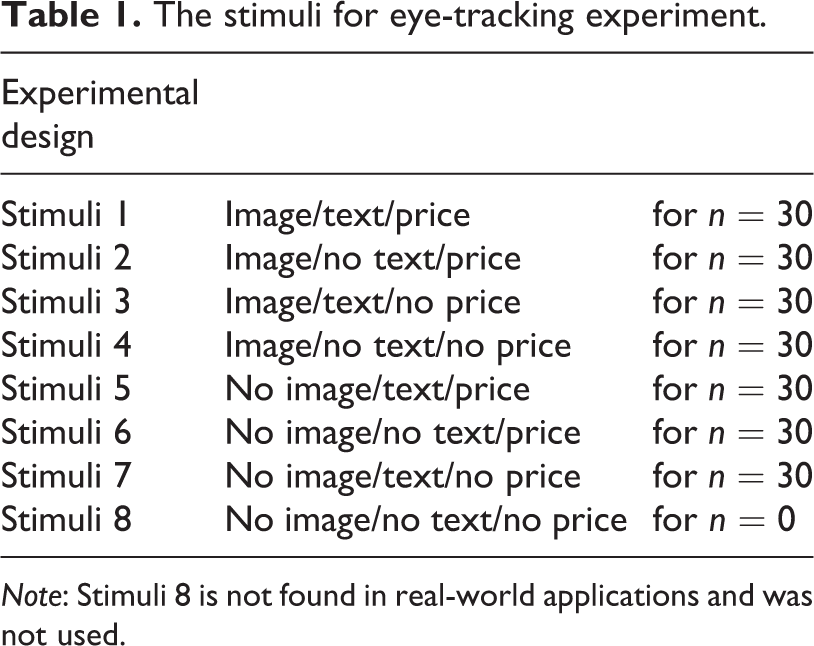
Note: Stimuli 8 is not found in real-world applications and was not used.
Main study
A random sample of 30 university students (15 males and 15 females with a mean age of 23.17 years) from a Chinese university participated in this study. Informed consent was obtained from all the participants. All participants had experience using online tourism websites and with travel (average of 1.47 domestic and/or international trips per year). This sample size is typical of eye-tracking studies, but the external validity is low and so results are not intended to be representative (Miellet et al., 2010; Pan et al., 2013).
An EyeLink 1000 eye tracker was used for collecting eye-tracking data. This has a screen resolution of 1280 × 1024 pixels on which the stimuli were controlled by a procedure written using E-Prime 2.0 software. Before the eye-tracking experiment, participants were divided into two groups depending on their task assignments. One group was given an information collection task and instructed to assume they were going to travel next week and view the stimuli to collect the information they needed. They were told that if they answered questions about advertisements accurately after the eye-tracking experiment, they would be rewarded the rough equivalent of AUD$2 for each question. The second group was allowed to view the stimuli without instruction. In addition, participants were categorized into two experience level groups based on the frequency of use of travel websites (“rarely” 1; “sometimes” 2; “whenever I travel” 3). Those reporting a three (n = 12) were considered expert users (Hernández-Méndez and Munoz-Leiva, 2015). The rest were deemed to new users. Participants viewed seven stimuli randomized over the each sample for 20 s. The eye movement data were analysed using dwell time and fixation count. These data were collected for each advertisement as a whole. Only fixations longer than 200 ms were used for analysis (Manor and Gordon, 2003).
A post-exposure recall test was then conducted. Participants were requested to indicate whether they had seen the stimuli by checking different levels of certainty from I am sure I have seen it (score 4) to I am sure I have not seen it (score 1) (Hou et al., 2013; Kuisma et al., 2010) for each advertisement. Respondent demographics were obtained through a self-administered questionnaire after the recall test.
Results
The means for dwell time, fixation count and recall of all advertisements are respectively 10.439 s (SD = 3.798), 40.957 (SD = 12.113) and 2.752 (SD = 0.936). SPSS 22 was used to compute analysis of variance (ANOVA) with significant effects reported at p < 0.05. All these variables (dwell time, fixation count and recall) passed the Shapiro–Wilk test for a small sample and the results of the ANOVA showed significant differences for dwell time (F = 7.949, p = 0.000), fixation count (F = 8.898, p = 0.000) and memory (F = 4.765, p = 0.000). All eye-tracking measures were consistent in indicating stimuli 5 (no image/text/price) received the most attention while stimuli 2 (image/no text/price) ranked last (Figure 2). Stimuli 2 (image/no text/price) had the least dwell time (M = 8.205 s) and fixation count (M = 32.433). Stimuli 5 (no image/text/price) attracted the highest dwell time (M = 12.789 s) and fixation count (M = 51.067). The four stimuli containing an image had a lower dwell time and fixation count compared to three stimuli that did not contain an image. Among the stimuli containing an image, those containing texts received more attention as measured by both indicators. Importantly, areas of interest within these stimuli based on which evaluation was made differed, with text parts attracting more attention and interest from participants (see Figure 3).

Visual attention for seven stimuli.

Heat map examples.
As shown in Figure 4, stimuli 1 (image/text/price) was highest (M = 3.467) on recall results, while stimuli 6 (no image/no text/price) was the lowest (M = 2.400). The stimuli containing both image and text (e.g. stimuli 1 (image/text/price) and stimuli 3 (image/text/no price)) received higher average recall results while those stimuli (e.g. stimuli 2 (image/no text/price) and stimuli 6 (no image/no text/price)) without text had lower average recall scores.

Recall test result for seven stimuli.
Effect of gender, task and experience
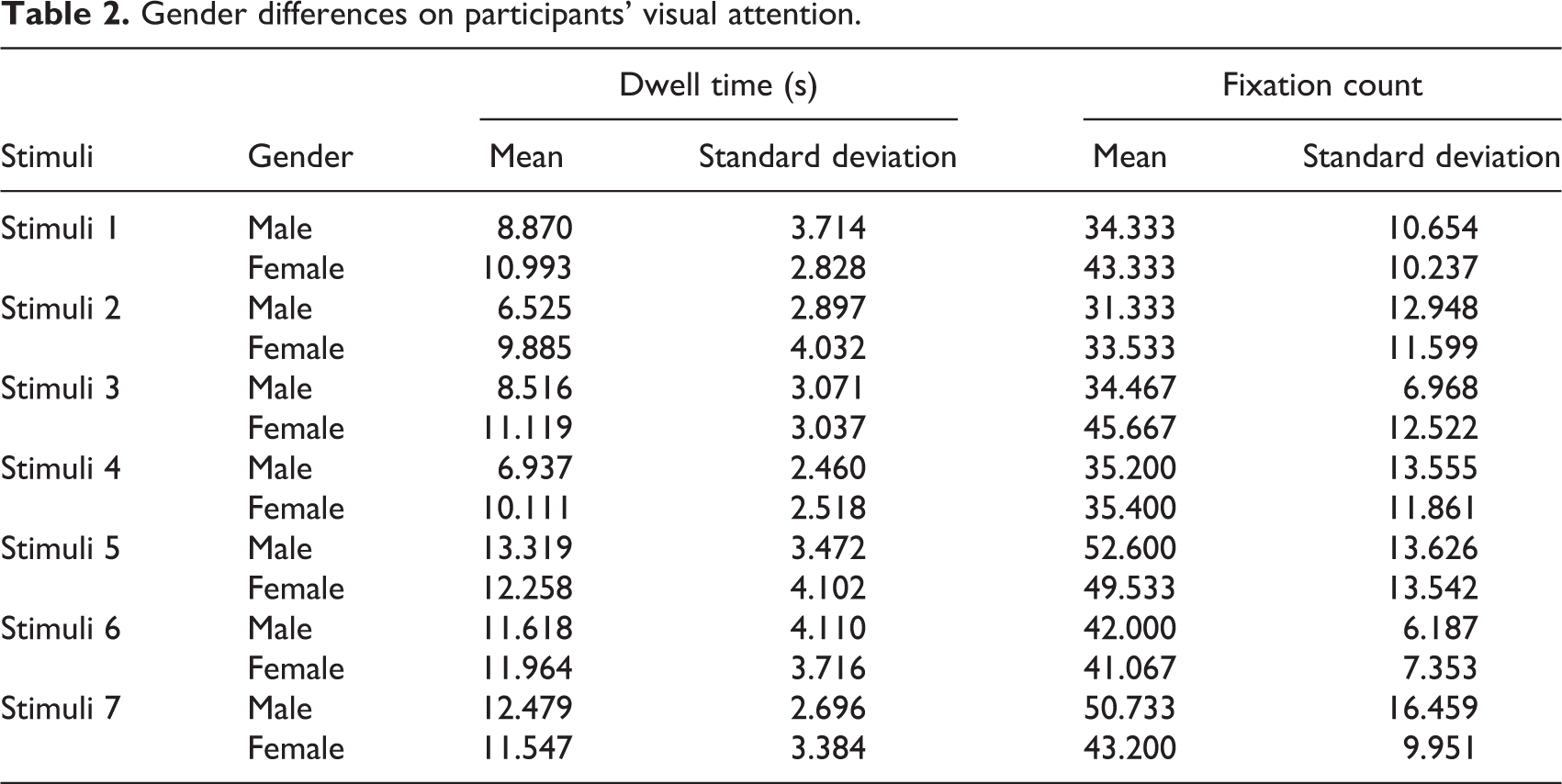
Significant differences between gender, task and experience groups on eye movement and recall measures were examined using an ANOVA test. There was a significant interaction effect between gender and stimuli in terms of dwell time (F = 2.421, Sig. = 0.028) and fixation count (F = 2.481, Sig. = 0.025), but no significant result was obtained for recall test results (F = 0.623, Sig. = 0.712). Stimuli 2 (image/no text/price) had the shortest dwell time for both gender groups (male 6.525 s; female 9.885 s) and stimuli 5 (no image/text/price) had the longest dwell time (male 13.319 s; female 12.258 s) as shown in Table 2. The fixation count for both male and female respondents was lowest for stimuli 2 (image/no text/price; male 31.333, female 33.533), while the highest fixation count for both male and female was found for stimuli 5 (no image/text/price; male 52.600, female 49.533). Males’ dwell time and fixation count for the four stimuli containing images were lower than females’, perhaps suggesting males were more interested in tourism advertisements without images.
Gender differences on participants’ visual attention.
Significant main effects of task and stimuli on dwell time (F = 2.181, Sig. = 0.046), fixation count (F = 2.387, Sig. = 0.029) and memory (F = 2.238, Sig. = 0.041) were obtained. Participants given the information collection task devoted more attention to all the stimuli (see Figure 5(a)). Stimuli 5 (no image/text/price) recorded the longest dwell time (M task = 15.129 s, M no task = 10.448 s) and highest fixation count (M task = 59.600, M no task = 42.533). Stimuli 4 (image/no text/no price) produced the shortest dwell time (M = 9.252 s) and lowest fixation count (M = 37.600) for participants with an information collection task, while stimuli 2 (image/no text/price) (M dwell time = 6.678, M fixation count = 24.800) received the least attention for the group without a task. Stimuli containing no image attracted more attention from both task and non-task groups than those stimuli with images; among those stimuli containing images, stimuli 1(image/text/price) and stimuli 3 (image/text/no price) which have both texts and images attracted more attention than the two containing no text, reflecting on higher dwell time and fixation count. The group with the information collection task scored better on the recall test (see Figure 5(b)), participants received the best memory score on stimuli 1 (image/text/price) (M task = 3.533, M no task = 3.400); the poorest memory result for the group with task was for stimuli 6 (M = 2.400) while stimuli 2 (image/no text/price) for free viewers (M = 2.067). The participants with an information collection task had better recall for the stimuli containing images, while the no task group showed higher recall scores on those stimuli containing texts than on stimuli without texts.

Task differences on participants’ visual attention and memory.
A significant main effect between experience and stimuli was found for dwell time (F = 2.178, Sig. = 0.047), fixation count (F = 2.248, Sig. = 0.040) and memory (F = 2.268, Sig. = 0.039). The expert users had higher dwell time and fixation count than new users (see Figure 6(a)). The highest dwell times (M expert user = 15.692 s, M new user = 11.107 s) and fixation counts (M expert user = 60.909, M new user = 45.368) were found for stimuli 5 (no image/text/price), while stimuli 2 (image/no text/price) received the least attention (dwell time: M expert user = 9.298 s, M new user = 7.572 s; fixation count: M expert user = 35.000, M new user = 30.947). The significant difference found for the effect experience has on memory showed both experience groups recalled stimuli 1 (image/text/price) best (M expert user = 3.917, M new user = 3.167), while stimuli 6 (no image/no text/price) scored the least for expert users (M = 2.727) and stimuli 5 (no image/text/price) for new users (M = 2.053) (see Figure 6(b)). Expert users obtained higher recall scores on the stimuli containing text, while new users remembered the stimuli comprising images better.

Experience differences on participants’ visual attention and memory.
Discussion and conclusion
In this study, seven stimuli in a typical advertising format were tested with eye-tracking and recall measures to determine the differences in viewer attention and memory. The effects of gender, task and experience were also included. The study yielded four main contributions. First, visual attention paid to tourism advertisements varied, depending on various combinations of components (image, text and price); advertisements containing both text and price received greater attention, while the advertisement containing image and price but no text scored poorly on both attention and recall. Advertisements containing image, text and price scored best on recall. Second, gender had a significant effect, with males attending to and recalling tourism advertisements without images better. Third, attention and memory were influenced by task relevance; the group given an information collection task devoted more attention and generated better recall. Fourth, tourists’ experience with tourism websites had a significant impact on their attention to and memory of tourism advertisements. Expert users scored higher on both attention and memory for advertisements containing text, while new users scored better for advertisements with images. Although the hierarchy of effects model is conceptually useful in elaborating the effectiveness of advertising, there is a lack of literature explaining the quality of information processing and memory (Janiszewski, 1993; Kuisma et al., 2010; Ryu et al., 2007). This study found that there is a gap between attention and memory created by pre-attentive behaviour, and that consumers’ ability, motivation and opportunities (e.g. gender, task and experience) have a key role in moderating the quality of attention and memory in hierarchic models (Kuisma et al., 2010; Pritchard and Morgan, 1996).
Effect of different tourism advertisements on attention and memory
Of the seven stimuli, stimuli 2 containing image and price only scored lowest on attention capture and recall. Stimuli 5 containing text and price and stimuli 1 containing destination image, text and price held the most attention and had the best recall effect, respectively. These results are inconsistent with prior research findings that indicate images tend to have shorter fixation times and yield superior attention. These results indicate that online tourism advertisements containing destination images perform poorly on attention capture as measured by lower dwell time and fixation count, perhaps because images require great cognitive efforts to process and create greater images (Hahn et al., 2016; Lee et al., 2010; Unnava and Burnkrant, 1991). Including a destination image in an advertisement therefore evokes better recall effect than verbal information (Babin et al., 1992) since photographic images take greater mental effort and stimulate mental imagery processing (Miller and Stoica, 2003; Paivio, 1991; Unnava and Burnkrant, 1991). Destination images in Chinese online tourism advertisements hinder the attention capture but can be regarded as good factors for evoking tourists’ memory.
Interestingly, the tourism advertisements with text and no destination image attracted tourists’ attention in a shorter time. The text is usually the first entry point in a text–picture hybrid scene; the text is decoded in more fixations than the picture since the former has a higher density of verbal information on which viewers can rely to determine meaning and make decisions (Liu et al., 2011; Rayner et al., 2001). In the tourism domain, providing text information about experiences or destinations may reduce perceived risks (Djafarova and Anderson, 2008). Text introduction of a tourism product is a valuable content for both visual selection and recall result. Although price had been considered to reflect service quality and reduce risk in travel choice (Chen and Tsai, 2007; Lepp et al., 2011; Xu et al., 2014), there was no significant difference in attention capture and recall effect detected due to adding price into online tourism advertisements. Although the market competition leads to higher price sensitivity (Narasimhan et al., 1996) and low-price competition has been a vicious phenomenon in domestic tourism marketing, this study suggests that highlighting low price is not particularly effective because there is no significant difference detected on tourism consumers’ attention and memory when there is price added to the online tourism advertisements. All these findings can be theoretically explained by the fact that tourism is an intangible product and driven by information, and that tourists’ behaviour is open to outside influences like advertisements (Pritchard and Morgan, 1995), especially the visual representation on which the marketing of tourism products depends (Morgan et al., 2000). Furthermore, these findings also suggest an unexpected gap between attention and memory in the hierarchy of effects model – lower attention being accompanied by higher recall effect. There is no clear relationship between eye fixations and memory, and viewers can remember visual objects without fixating on them (Brockmole and Henderson, 2005; Williams, et al., 2005). Although viewers have not intentionally looked at advertisements, they may have pre-attentive processes (Kuisma et al., 2010; Ryu et al., 2007; Tavassoli, 2008) and have stored these advertisements unconsciously in memory (Brockmole and Henderson, 2005; Williams et al., 2005). There is no strict hierarchy in the way consumers follow advertisement processing (Pieters and Wedel, 2004); rather the quality of attention and exposure effects should be taken into account when considering evaluating an advertisement’ effect based on the hierarchy of effects model in Chinese online tourism environment.
Interaction effect of gender, task and experience on attention and memory
The attention to different online tourism advertisements varied depending on the interaction effect between gender and stimuli. Males showed lower interest in tourism advertisements containing destination images than females. This finding supports the literature about gender’s moderating role in tourists’ behaviour (McGehee et al., 2007) and attention to web advertising (Goodrich, 2014; Park et al., 2015), and suggests that males prefer less imagery processing. As a product of gendered societies, tourism and related behaviour are moderated by gender in their construction, presentation and consumption (Pritchard and Morgan, 2000; Rao, 1995).
Consistent with previous research, this study found that tourists with an information collection task had higher attention and recall than those with a free-viewing task. Those in the task group appeared to be more concentrated on information collection (Hong et al., 2007; Lang, 2000; Reeves and Nass, 2000), while the free viewers were less so (Bang and Wojdynski, 2016). Both task and non-task groups paid more attention to the advertisement containing text and price. The task group paid the least attention to advertisements containing images only, while their counterpart paid the least attention to advertisements comprising image and price. This finding demonstrates that an online tourism advertisement containing text and price performs best. Respondents given a task demonstrated poor attention to advertisements containing destination images, while free viewers paid less attention to advertisements consisting of destination image and product price. The participants with the tourism information collection task fixed on the advertisements containing text for a longer time, which showed that the tourism introduction text was the component they cared most about. In contrast to the advertisement free viewers disliked (stimuli 2 (image/no text/price)), participants with an information collection task disliked stimuli 4 (image/no text/no price) most because it had no price content. So the task group regarded the text as the most important component and also cared about the price in tourism advertisements because they needed to check the text to confirm their search results (Hughes et al., 2010), and cared more about the services of tourism products and information for decision-making, while free viewers only valued the text introduction of products. Customers with information search tasks did not like advertisements that contain destination image only, while the non-task group disliked most the advertisement which had image and price only. The participants showed significant differences in recall. Both groups better remembered the tourism advertisement consisting of image, text and price, while the price-only stimuli received the lowest recall score for the task group and the advertisement consisting of image and price was lowest for the non-task group. The information collection task group had better recall of the advertisements containing destination images, while their counterpart favoured the online tourism advertisements containing texts. Thus, an online tourism advertisement consisting of image and price should be avoided for free viewers regarding visual attention and memory; an advertisement containing image only or one appearing with price only should not be directed towards information collection tourists. These findings can be explained by the notion that consumers’ motivation and intention to process advertisements affects the amount and quality of attention (Kuisma et al., 2010; Yantis, 1998). The online environment is cognitively oriented (Cho, 1999; Kuisma et al., 2010) and consumers usually treat advertisements as low involvement if the advertisements they view are irrelevant to their current information search and processing (Kuisma et al., 2010). Previous studies indicated that consumers’ visual attention is driven by stimuli with a bottom-up model (Kuisma et al., 2010), while consumers direct their cognitive effort to focus their attention on task-relevant stimuli and suppress task-irrelevant information in a top-down model (Vidnyánsky and Sohn, 2004). Thus there is no wonder participants with task devoted more attention to the text and price which helped them to retrieve and perceive the tourism product efficiently and had better recall results.
Attention and memory also varied in relation to the interaction between experience and the different stimuli. Compared to new users, expert users had a higher dwell time, fixation count and better recall for each stimulus. These findings are consistent with previous research proving that expert users are efficient in processing information (Drèze and Hussher, 2003). Both expert users and new users paid more attention to the advertisement containing text and price, and least to the one consisting of image and price. And similarly for both groups, the online tourism advertisements with no destination image obtained higher dwell time and fixation account. The best recall stimuli for both groups were for a combination of destination image, text and price, while the lowest recall was recorded for the price information–only advertisement for the task group and the advertisement containing text and price for the free viewers. Price had a limited impact on tourists’ memory towards online tourism advertisements. Furthermore, the expert users had better recall results on the tourism advertisements containing text introductions for tourism products and the new users had better memory for the advertisements containing destination images. This suggests that expert users remember text introductions about tourism products well, while new users show positive cognitions in imagery images of tourism destinations. This cognition is moderated by their experience of usage and expert users showed higher quality of processing. Marketing segmentation is usually regarded as the essence of marketing (Chisnall, 1994; Pritchard and Morgan, 1996). Easily understood demographics (e.g. gender), motivations and ability are widely used to maximize market demand by distinguishing different groups of consumers’ taste in advertisements (Pritchard and Morgan, 1996). The evaluation of between-group factors such as gender, task relevance and usage experience helps identify differences in consumers’ cognition of online tourism advertisements.
Implications
Theoretical implications
This study extends research on the cognitive processing of tourism advertising, providing insights regarding visual attention and recall results for online tourism advertisements containing different combinations of image, text and price. This is important since consumers face a great number of marketing messages and consumers ignore irrelevant stimuli (Kastner and Pinsk, 2004). This study finds that texts in online tourism advertisements capture attention, with advertisements containing text and price receiving more attention. Further research might examine the components of tourism advertisements with deeper insights, like the impact that emotion arousal and risk-reduction advertisements have on destination choices. Also, a more precise distinction between image and text needs to be found by examining two types of image–text relationships: text extending the image and text elaborating the image (Molina-Plaza and Alousque, 2015). Furthermore, there is a gap identified between attention and memory: Although the advertisement containing image, text and price could not capture participants’ attention effectively in these seven stimuli, it received the best recall result. This result can be explained by the notion that viewers can remember an advertisement without fixing on it; they can process the advertisement pre-attentively leaving an implicit memory trace. This article proposes that consumers’ advertisement processing did not follow the strict hierarchy of effects model and so there is a theoretical need for re-evaluating this model in Chinese online tourism environment.
Notably, group differences (gender, task and experience) show significant influence on tourists’ attention and memory, revealing different group preferences for online tourism advertisements’ components. These findings may provide a basis for better marketing segmentation and innovatively supplement the research on the role gender, task and experience play in moderating tourists’ information process of advertisements which is beneficial to segmenting the market in tourism and other fields. Furthermore, this finding will contribute to the study of gender, task and experience and potentially highlight the need for future investigation of attention capture and memory result on the basis of group differences.
Another significant contribution of this study is the innovative research design, using the eye movement technique and recall measures. It supplements the existing literature that primarily examines participants’ subjective opinion, with the objective observations of eye tracker. Eye tracker records users’ real-time reactions to stimuli, while conventional methods like interviews, questionnaires depend on users’ willingness and competency to describe their feelings which may be biased (Guo et al., 2016). This study revealed eye tracking’s important insights into tourists’ visual selection and provided valuable triangulation among eye movements, recall test and self-reports. Eye-tracking technique can be applied to various areas in the context of tourism, like emotion arousal, risk perception and reduction. Memory measures can also be widely used in assessing the effectiveness of tourism materials like posters and supplementing valuable triangulation for eye tracking.
Practical implications
The findings of this study strengthen the design of advertisements to capture consumers’ visual attention and memory. Making contributions to Chinese-targeted marketing is important since Chinese domestic tourism marketing is growing rapidly and many destinations in China are favoured by tourists (Li, Huang and Christianson et al., 2016). This study indicates that tourism advertisements containing text and price receive most attention from tourists and those comprised destination image, text introduction of tourism products and price generate the best memory result. A typical online tourism advertisement that contains just image and price is the least effective regarding both tourists’ visual attention and recall.
This research provides other suggestions for developing effective online tourism advertisements. Gender should be taken into consideration and advertisers should deliver fewer advertisements containing destination images for males since males dislike online tourism advertisements consisting of destination images in contrast to females.
In addition, advertisers should customize tourism advertisements for tourists at different stages of the decision-making process. The results suggest advertisers should avoid tourism advertisements consisting of image when targeting information collection viewers and those containing image and price for free viewers regarding attention capture, and advertisers should direct advertisements containing price only towards information collection tourists and advertisements comprising image only towards those only browsing to have better recall.
Online tourism advertisers need to optimize their advertisements for consumers with different levels of experience using online tourism websites. Advertisers need to increase the amount of text when targeting expert users. Advertisements consisting of image, text and price create better recall. Furthermore, expert users remembered online tourism advertisements better than new users, while new users showed better recall on advertisements containing destination images.
Limitation
This research does have limitations. First, although this study has shown there are differences of gender, task and experience when users view different online tourism advertisements, the difficulties of involving eye-tracking (e.g. the eye tracker this study used required participants to complete this experiment in a university lab which made it difficult to recruit participants with different occupations, ages and education background, so participants were all university students) and recall test data (e.g., some participants refused to participate because of the time commitment needed) limit insight into these differences. A more diverse sample of participants is needed.
Secondly, reading on a screen as required for eye-tracking studies introduces artificial conditions and the spontaneity of reading, making the experimental environment distinct from the daily reading environment and having biased impact on the results. Future studies may wish to use newly developed eye-tracking glasses that allow studies to be conducted in a normal environment. The eye tracker (EyeLink 1000) used in this study recorded the movements of participants’ right eyes, which reduced the accuracy of the experiment when compared to two-eye eye trackers.
Thirdly, although the sample size of this study is sufficient to produce statistically reliable results, it limits the use of more comprehensive and cross-correlated analysis methods (e.g. Structural Equation Model (SEM)). Future research may seek to increase sample sizes. Future research of other factors such as goal strength, stimuli position and nationality is also needed to improve online advertising effectiveness.
Finally, it may be useful to try different measures of attention and recall in future studies and also elaborate the relationship between attention and memory.
Footnotes
Declaration of conflicting interests
The author(s) declared no potential conflicts of interest with respect to the research, authorship, and/or publication of this article.
Funding
The author(s) disclosed receipt of the following financial support for the research, authorship, and/or publication of this article: This research received specific grant from the National Natural Science Foundation of China (41671137; 41501158).