



Abstract
The current exploratory study conceptualizes botanic park personality and explores its effects on visitor attitude and behavioural intentions. To achieve this, a renowned botanic park in Western Australia was selected. Pen-and-paper and online surveys were self-administered to 481 local and international respondents in two main studies. Two botanic park personality attributes were identified, namely, ‘excitement’ and ‘competence’, which aligned with the destination personality literature. These attributes impacted on attitude as well as subsequent intentions to visit and recommend the botanic park for local and international respondents. Findings offer researchers a platform to advance further studies on botanic park personality that may be extended to other nature-based tourism attractions. The identified and distinctive botanic park personality attributes help to guide practitioners in shaping the positioning and differentiation strategy to attract visitors and enhance the park’s financial sustainability.
Introduction
Botanic parks play a vital role in contemporary society, serving as “part of the green lung” of a place (Razak et al., 2016, p. 478). The authors observe that parks enhance the quality of life by increasing the degree of enjoyment and satisfaction experienced in daily life. At parks, visitors fulfil their own goals of self-identity and social bonding (Lee and Shen, 2013), finding balance in their psychological, physical and economic well-being (Razak et al., 2016). In Australia, nature-based tourism, which includes visiting botanic parks, annually contributes $23 billion to the country’s economy (Tourism and Transport Forum, 2013).
The management of botanic parks with sweeping, manicured stroll gardens traditionally fell to government conservation bodies. However, this management model is in decline due to overburdened governments and limited resources (Phau et al., 2013). There is increased pressure on botanic parks to be self-sustaining by seeking their own sources of income through the commercialization of garden visiting (Connell, 2004). Thus, world-class botanic parks such as London’s Kew Gardens (http://www.kew.org/full-ticket-prices), Singapore Gardens by the Bay (https://ticketing.gardensbythebay.com.sg/SelectTicket.aspx) and Copenhagen’s Tivoli Gardens (http://www.tivoligardens.com/en/praktisk/priser) charge entry fees of £15 (US$20), S$30 (US$22) and Danish Kroner100 (US$15), respectively, in order to recuperate some of their operating costs. Consequently, individuals who seek to indulge in the zen-like surrounds that botanic parks offer are expected to pay for these benefits.
Since self-sustaining botanic parks are essentially destinations that compete for the tourism dollar, branding strategies are of paramount importance (Liu et al., 2016). Brand personality is considered as a critical branding strategy for effective positioning and differentiation (Chen and Phou, 2013; Murphy et al., 2007). While early studies on product personality were conducted in the 1950s (e.g. Martineau, 1957), the first studies on destination personality only emerged in the 2000s (Usakli and Baloglu, 2011). According to these authors, destination personality acts as a viable metaphor for building destination brands, understanding tourist perceptions of destinations and crafting an identity for them.
The outcomes of destination personality highlight its importance in branding strategy. For marketers, distinctive and attractive destination personality leverages the perceived image of a destination and positively influences tourist choice behaviour (Ekinci and Hosany, 2006). For tourists, positive destination personality reduces search costs and perceived risk (Blain et al., 2005) as well as increases intentions to return and remain loyal (Ekinci and Hosany, 2006; Farhat and Khan, 2011; Xie and Lee, 2013). For governments, positively sustained destination personality increases repeat visitation and voluntary promotion by loyal visitors that impact on the community’s economic development (Phau et al., 2013).
To date, tourism research has focused on the personality of destinations (e.g. Chen and Phou, 2013; Kaplan et al., 2010; Pereira et al., 2014). There is a dearth of studies that examine the personality of botanic parks. Thus, it is important to develop botanic park personality strategy for its effective positioning and differentiation, which has the potential to shape visitor attitude and subsequent intentions to visit and recommend to others. This differentiation will help in giving parks a ‘competitive edge in order to survive in the long run’ (Kinnunen and Haahti, 2015: 252). Such a strategy can assist in improving the long-term financial sustainability of botanic parks (Phau et al., 2013).
Currently, a common understanding of the critical personality attributes that attract visitors to botanic parks does not exist. Identifying these attributes will facilitate researchers to better predict visitor behaviour towards botanic parks. In turn, this enhanced understanding can aid managers and marketers to develop effective positioning, differentiation and communication strategy for their botanic parks. Consequently, given the under-researched area of botanic park personality, the current study is exploratory in nature. Specifically, it sets out to conceptualize and operationalize botanic park personality and examines its impact on visitor attitude as well as subsequent intentions to visit and to recommend to others.
Literature review
Brand personality
Personality research has been a cornerstone of psychology since the early 20th century (Monte, 1995). The word ‘person’ is derived from the Latin ‘persona’ which refers to the masks people wear according to their roles in theatre (Soysal, 2008). Personality has been used to explain all distinctive and unique behaviours of individuals (Akin, 2011). Brand personality results from the transfer of the personality concept from individual psychology to the marketing context (Pitt et al., 2007). Aaker and Fournier (1995) argued that a brand can function as a character, partner and person. This enables consumers to ascribe personality characteristics to the brand. A widely accepted definition of brand personality is provided by Aaker (1997: 347) who asserted that it is ‘the set of human characteristics associated with a brand’. Azoulay and Kapferer (2003: 151) summarized the definition as ‘the set of human personality traits that are both applicable to and relevant for brands’. Similarly, Sweeney and Brandon (2006: 645) observed that it is ‘the set of human personality traits that correspond to the interpersonal domain of human personality and are relevant to describing the brand as a relationship partner’.
From the domains of both psychology and marketing, researchers have attempted to operationalize the personality construct. In psychology, Norman’s (1963) Big Five Scale, extended by John (1989) as well as McCrae and John (1992), has been cited in operationalizing the personality attributes of individuals (e.g. Hill, 2016; Robinson et al., 2015) and of countries (e.g. Carlos et al., 2014; Rojas-Méndez et al., 2015). The Big Five identifies five dimensions, namely, ‘extraversion’, ‘emotional stability’, ‘agreeableness’, ‘conscientiousness’ and ‘culture’. In consumer behaviour, Aaker’s (1997) Brand Personality Scale (BPS) has been widely used in operationalizing the personality attributes of consumer products (e.g. Klink and Athaide, 2012; Maehle and Shneor, 2010). The BPS also identifies five dimensions, namely, ‘sincerity’, ‘excitement’, ‘competence’, ‘sophistication’ and ‘ruggedness’ which encompass 15 personality traits.
Destination personality
In their seminal study of destination personality, Ekinci and Hosany (2006) conceptualized the construct as the set of human characteristics associated with a destination and observed that tourists ascribe and attribute personality characteristics to destinations. Guthrie (1997: 51) referred to this attribution process as anthropomorphism which he defined as ‘the transmission of human characteristics to non-human things and events’. Consequently, due to the human trait-like features of destination personality, tourists are believed to form strong emotional relationships with specific destinations (Ekinci and Hosany, 2006; Hosany et al., 2006; Usakli and Baloglu, 2011).
Aaker’s (1997) BPS has been commonly cited in destination studies. For instance, building on the BPS, Hosany, Ekinci and Uysal (2006) distinguished the relationship between destination image and destination personality. Forristal and Lehto (2009) drew on the BPS to examine whether native species of plants shared analogous personalities with their destinations. Adopting the BPS, Chen and Phou (2013) assessed whether destination image and brand personality impacted on visitor loyalty. Liu et al. (2016) adapted the BPS to evaluate perceptions of tourism real estate agencies.
Such destination studies that have adopted the BPS reported varied findings. For instance, Usakli and Baloglu’s (2011) study of visitors in Las Vegas identified five dimensions of brand personality, namely, ‘vibrancy’, sophistication, competence, sincerity and ‘modernity’. Although the first four of these factors are consistent with the BPS, the fifth factor, namely, modernity is specifically relevant to Las Vegas. Ha (2016) explored the application of brand personality to the service environments of web-based travel agencies across three BPS dimensions, namely, sincerity, excitement and competence. The author justified the selection of these dimensions on the basis of their theoretical consistency with three Big Five Scale dimensions, namely, ‘agreeableness’, ‘extraversion’ and ‘conscientiousness’, whereas the other two BPS dimensions, namely, sophistication and ruggedness are not consistent with the Big Five Scale (Sung and Kim, 2010). Glinska and Gorbaniuk (2016) highlighted that when determining the personality of cities, local governments more frequently adopt two BPS dimensions, namely, excitement and sincerity and less frequently, competence. The authors observed that other dimensions directly related to functional attributes, and relevant to establishing city personalities, namely, ‘safety’, ‘attractiveness’ and ‘innovativeness’, are beyond the scope of the BPS. The majority of these BPS-related studies suggest that the excitement, competence and sincerity dimensions appear to be most relevant, whereas the ruggedness dimension appears to be least relevant in destination personality studies.
Given the varied findings and limitations of the BPS, some researchers have been motivated to develop their own destination personality scales. For instance, Kumar and Nayak (2014) introduced the Destination Personality Scale (DPS) to encompass a range of personality traits of a destination. The DPS comprises six dimensions, namely, ‘courteousness’, vibrancy, ‘conformity’, ‘creativity’, ‘viciousness’ and ‘tranquillity’. Pereira, Correia and Schutz’s (2015) investigation of Algarve as a tourist/golf destination identified three key dimensions, namely, ‘enjoyableness’, ‘distinctiveness’ and ‘friendliness’. These unpacked into relational traits which included ‘reliability’, ‘hospitality’, ‘uniqueness’ and attractiveness.
Botanic park personality
Contemporary large-scale participation in country house and garden visiting initially emerged from the elite and affluent classes in 16th-century Northern Europe (Towner, 1996). Gradually, a dichotomy ensued between owners who operated parks simply to share their love of nature and those who did so as commercial enterprises to generate income (Connell, 2005). Today, it is commonly acknowledged that gardens cannot be financially viable without visitors to support their maintenance (Phau et al., 2013).
A review of the nature-based tourism literature suggests that no research on botanic park personality currently exists. However, it is noteworthy to point out that Eastern cultures, religions and philosophies such as Taoism are ecocentric in viewing humans as an integral part of nature (Packer et al., 2014). From this perspective, individuals exist in harmony with nature (Chan, 2001). Thus, an Eastern worldview is generally anthropomorphic, ascribing human characteristics to nature (Sofield and Li, 2007). This process opens an individual to psychological interpretation of functional and symbolic facets (Pereira et al., 2014). On the one hand, functional benefits entail problem-solving capability (Kim et al., 2011). For instance, an individual may visit a botanic park because they identify with the functional benefit of relaxing and energizing themselves. On the other hand, symbolic benefits (Keller, 1993) are abstract qualities (Kim et al., 2011) that capture soft associations or the emotional side (Biel, 1997). In this instance, an individual may visit a botanic park for a specific park bench or garden that evokes the symbolic benefit of recapturing cherished memories of time spent there with loved ones.
In spite of recent tourism interest in the personality construct, three key research gaps exist. Scant research has focused on park branding and none exists in exploring personality as a competitive strategy to position and differentiate (Kinnunen and Haahti, 2015) botanic parks. Bhatti and Church (2000: 184) called attention to the plight of botanic park research when they observed that ‘the contemporary garden has largely been ignored in social science generally and leisure studies in particular’. This prompted Connell (2004) to highlight that research on garden visiting is limited in quantity and scale. Where such research exists, it is focused on managing demand (e.g. Benfield, 2001), organizing festivals (e.g. Ryan and Bates, 1995) and identifying visitor motivation (e.g. Ballantyne et al., 2008; Tipples and Gibbons, 1992). Building on the collective understanding of destination branding and personality and how this impacts on visitor behaviour, it is opportune for the current study to focus on branding botanic parks through the use of brand personality strategy.
A paucity of research has considered the park visitor perspective despite the importance of garden visiting as a tourism activity (Connell, 2004). The author observes that botanic gardens such as Kew Gardens and Wisley are significant generators of visitors for the UK’s tourism attractions sector. Similarly, in Australia, nature-based experiences are identified as key attractions for both local and international visitors and are widely depicted in Australia’s tourism communication campaigns that instigate visitation (Packer et al., 2014). The current study offers a platform for developing knowledge in terms of visitor cognition of personality attributes, affect and conative behaviour towards botanic parks. The study’s key contribution lies in identifying the botanic park’s personality attributes that shape visitor attitude and behavioural intention, followed by a critical analysis of the implications for the sector.
Finally, visitors differ in their approach to nature and botanic park based on their own worldviews. This stems from their own culture, prior knowledge, expectations, perceptions and previous experiences (Ballantyne et al., 2011; Falk and Dierking, 2000). It is imperative to understand botanic park visitors from their diverse standpoints (Ballantyne, et al, 2014). Gaining insight into who park visitors are, how they perceive of park personality attributes and behave towards parks empowers owners, managers and marketers as to how they conceptualize this nature-based attraction as well as strategize positioning, differentiation and communication initiatives to develop the sector. The current study explores local and international visitor perspectives of botanic parks that provide vital input into the design of park experiences for different cultural visitor segments (Packer et al., 2014).
To address these gaps, the current exploratory study sets out with three objectives. First, it conceptualizes and operationalizes personality by identifying a set of personality attributes relevant to botanic parks that may be used as a starting point for research in the area. Second, it explores how these personality attributes impact on attitude as well as subsequent intentions to visit and recommend the botanic parks. Finally, it examines how visitor perceptions, attitude and intentions vary between local and international visitors to botanic parks for their implications to park owners, managers and marketers.
Research model and hypotheses
In conceptualizing botanic park personality, the current study adapts several key definitions. First, it adapts Wyse Jackson and Sutherland’s (2013) definition by conceptualizing a botanic park as: a protected natural green area, with manicured landscaped gardens, which houses documented collections of living plants and/or preserved plant accessions for research, education, conservation, sustainable use, display, tourism, recreation, production of marketable plant-based products and services for improving human well-being. These benefits are made accessible to visitors for a fee.
In operationalizing the botanic park personality, two underpinning theories were introduced to assess the construct’s explanatory power in a decision-making conceptual model. Due to the exploratory nature of the current study, these two fundamental theories were simply utilized to test whether the operationalized botanic park personality dimensions would demonstrate some predictive ability by explaining attitude as well as subsequent intentions to visit and recommend to others. The two underpinning theories are attitude theory and the hierarchy of effects model. Each theory is explained for its relevance to the hypothesis in the conceptual model, as shown in Figure 1.
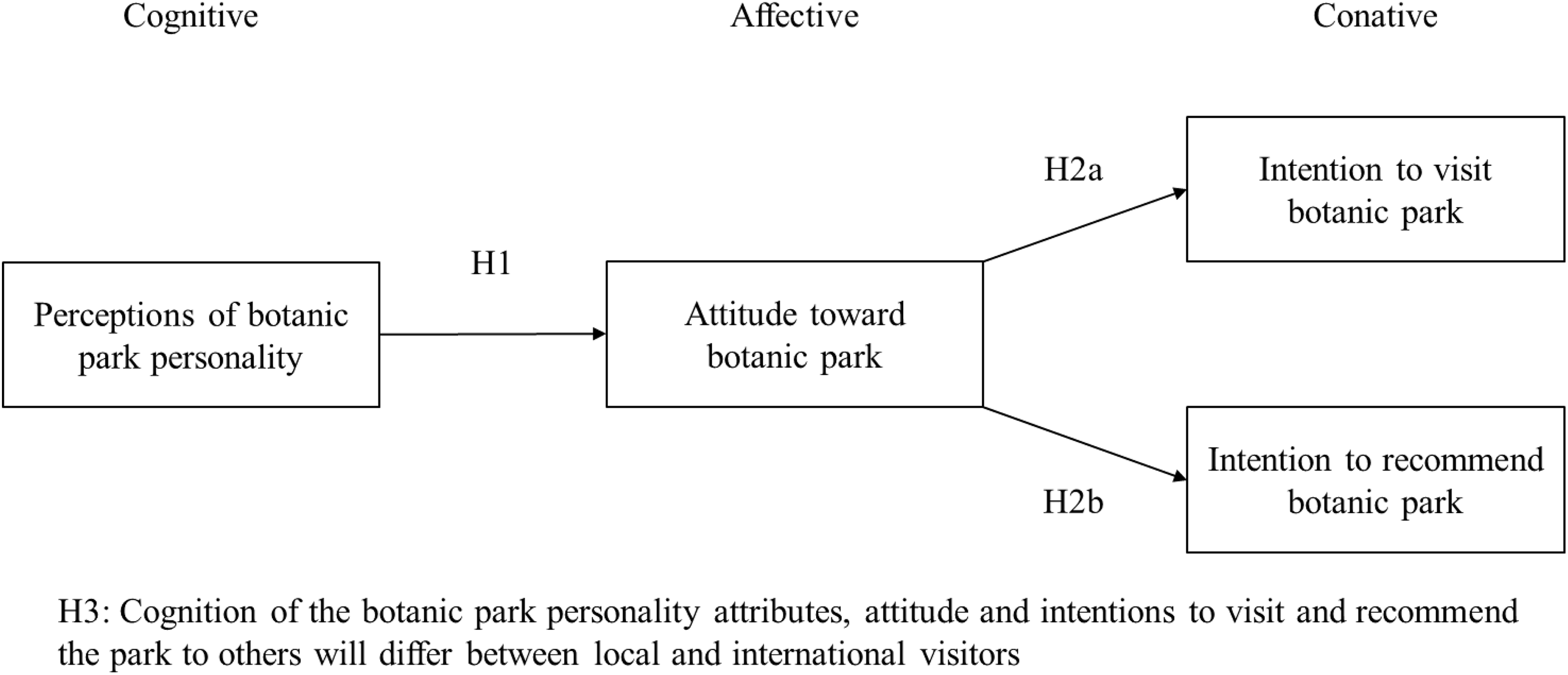
Conceptual model.
In attitude theory, Fishbein and Ajzen (1975) suggested that individual evaluative responses are thoughts that develop into attitude towards an object. Petty, Cacioppo and Schumann (1983) highlighted the distinction between the two constructs. Cognition refers to thought processes that are conscious (unconscious), whereas attitude refers to psychological predispositions to act with some degree of favour (disfavour) towards the object. How consumers mentally process and perceive of a brand shapes the formation of brand attitude (Karson and Fisher, 2005). Consumers with more positive brand cognition will demonstrate more favourable attitude towards the brand’s products (Miller et al., 2009). For instance, Chen and Phou’s (2013) study of Angkor Wat in Cambodia highlighted that affirming perceptions of the destination’s personality attributes favourably impacted on satisfaction with the destination. Consequently:
In the hierarchy of effects model, the belief–attitude–intention hierarchy proposes that if an individual holds a strong belief about an object, an attitude towards the object will be developed. Stronger positive attitude towards the object will generate a higher intention towards it (Lavidge and Steiner, 1961). Thus, visitors with a favourable attitude towards a nature-based activity (O’Neill, Riscinto-Kozub and Van Hyfte, 2010) are likely to have a positive intention towards pursuing the activity. For instance, Apostolopoulou and Papadimitriou (2014) examined tourists in Greece and observed that their evaluations of the destination’s excitement and sincerity personality impacted on their intention to (re)visit the destination. Similarly, Xie and Lee (2013) investigated tourists in Beijing and concluded that their evaluations of the destination’s excitement, competence and sophistication personality predicted their intentions to recommend the destination to others and pay more to enjoy it. Consequently:
The literature on nature-based tourism has considered the differing perceptions, attitude and intentions of visitors from domestic and international markets. For instance, Ballantyne et al. (2014) considered the diverse expectations, preferences and perceptions between Chinese and Western visitors at five key heritage sites in China. The authors identified differences in perceptions of the visitor experience. Further, Packer, Ballantyne and Hughes (2014) compared Chinese and Australian visitors for their attitude towards nature. The authors reported that Chinese visitors held a more anthropocentric view of nature and demonstrated more connection with it compared to Australian visitors. Consequently:
Methodology
Research site
The current exploratory study was carried out at a botanic park located 35 km south-east of metropolitan Perth in Western Australia. The 59-ha botanic park and bushland was selected for three reasons. First, it is known among park lovers for its cultural heritage and diverse range of exotic and native species of plants. In 2012, the International Camellia Society recognized the botanic park under its Camellia Gardens of Excellence programme. Second, it is an exclusive site for visitors to and within Western Australia, attracting 110,000 visitors annually. These visitors are drawn to the park’s manicured gardens and landscaped outer walls and terraces where they can interact with its natural and built surrounds. Finally, it charges an entry fee for visitors to indulge in its zen-like surrounds. Each year, the botanic park presents two botanical shows which generate its highest visitor attendance and income. These include its tulip show in spring and its chilli show in summer. The tulip show features about 140,000 tulips in bloom, in addition to a stunning array of camellias and tea roses, all flourishing among a native backdrop of eucalyptus, marri and blackbut trees. The show attracts 56,000 visitors over 8 weeks and costs A$15 (US$11) for entry. The chilli show showcases diverse offerings that include chilli beer, wine and chocolate from over 100 exhibitors. The show attracts 17,000 visitors over one weekend and costs A$20 (US$15) for entry.
Participants and procedures
To collect data for the current study, pen-and-paper and online surveys were self-administered to the population in metropolitan Western Australia in two main studies between March and July 2015. A convenience sampling approach intercepted respondents for the pen-and-paper survey at the botanic park. Postgraduate students from a large Western Australian university who undertook a research unit were trained to collect the data. An online panel and snowballing through Facebook approached respondents for the online survey.
Study One targeted the local population between March and April 2015. Local respondents were qualified as consumers who reported Australia to be their country of residence. A quota was set for 300 surveys and 241 surveys were usable. Study Two targeted the international population, mainly from China, Indonesia and Malaysia, the key tourism source markets for Australia, between June and July 2015. International respondents were qualified as consumers who reported their country of residence to be other than Australia. Again, 300 surveys were set as the quota, resulting in 240 usable surveys. In both studies, consumers within the 21–44 age group were selected as this was identified as the target market of interest by the botanic park.
The self-administered survey comprised three sections. In the first section, respondents were requested for details about their prior visits to the botanic park. The second section showed respondents a real-life stimulus, namely, an advertisement of the botanic park, and their reactions to the stimulus were recorded with scales that measured their perceptions of the botanic park personality traits, attitude, as well as intentions to visit and recommend to others. This stimulus was previously used by the botanic park in its communication campaigns. The final section recorded demographic information from respondents. The survey instrument can be seen in the Appendix.
Measures
A review of the relevant literature identified a list of destination personality attributes from Aaker’s (1997) five-dimensional BPS which encompassed 15 personality traits. Then, two focus groups, each comprising 15 postgraduate students from a large university in Western Australia were invited to rate the degree to which they perceived each of the 15 personality traits accurately described the botanic park. These were rated on a seven-point Likert-type scale, ranging from 1 for strongly disagree to 7 for strongly agree. A cut-off point with a mean rating of 4 or above was used to select the most relevant traits. Four items from the BPS, namely, ‘daring’, ‘up-to-date’, ‘tough’ and ‘upper class’ were deemed to have less relevance to the park and were substituted with ‘exciting’, ‘contemporary’, ‘rugged’ and ‘glamorous’, respectively.
Attitude was measured with four items, whereas intentions to visit and recommend to others were measured with three items each. These were selected from existing scales (see Bagozzi et al., 2003) for their reliability (≥ 0.70) (Hair et al., 2010) and relevance to the context. The brand personality traits and intention items were measured with a seven-point Likert-type scale, ranging from 1 for strongly disagree to 7 for strongly agree. Attitude was measured with a semantic bipolar scale.
Data analysis
The data analysis was conducted in five stages. Initially, descriptive analysis with SPSS 22 was used to establish sample profiles of local and international respondents. A second stage utilized exploratory factor analysis with SPSS 22 to identify underlying personality dimensions for the botanic park. Confirmatory factor analysis with AMOS 22 was performed in the third stage to assess whether the scale items represented and fitted the personality dimensions in the measurement models for the botanic park. The fourth stage adopted correlation analysis and independent sample t tests with SPSS 22 to distinguish personality perceptions, attitudinal and behavioural differences between local and international respondents for the botanic park. Finally, structural equation modelling with AMOS 22 assessed construct reliability and examined the relationships that the personality dimensions had with attitude and subsequent intentions towards the botanic park.
The second and third stages of the data analyses were conducted with split samples from the two main studies. Split samples are justified in reducing the outcome of spurious results (Hansen, 2000). Further, split samples provide important information about the stability of the scale (Albright and Park, 2009). Consequently, studies One (N = 241) and Two (N = 240) were each split into two. The first halves of both studies One (N = 120) and Two (N = 120) were merged to derive a cross-section of the local and international populations for exploratory factor analysis. Since the existing literature carries no studies on botanic park personality and its dimensions, it was imperative to determine the factor structures of a botanic park with exploratory factor analysis (Hair et al., 2010).
Next, the second halves of both studies One (N = 121) and Two (N = 120) were merged to obtain a cross-section of the local and international populations, this time, for confirmatory factor analysis. There is some likelihood that the first split sample used to identify a measure in exploratory factor analysis may include ‘unstable, chance factors with reliable covariation among items’ (Fazal-e-Hasan et al., 2017: 205). Thus, introducing the second split sample to validate the results removes the likelihood of ‘systematically assigning reliability to chance results’ since this split sample does not hold any influence in selecting the initial scale items (Fazal-e-Hasan et al., 2017: 205). Having identified the factor structures of botanic park personality with exploratory factor analysis, it was necessary to validate them with confirmatory factor analysis (Hair et al., 2010).
Finally, the fourth and fifth stages of the data analyses that incorporated correlation analysis, independent sample t tests and structural equation modelling utilized the full local (N = 241) and international (N = 240) samples.
Results
Sample profile – Local versus international visitors
As shown in Table 1, the local sample approximately corresponded to the ratio of females to males (1:0.99) in Australia (Australian Bureau of Statistics, 2014). There was a fairly equal balance of respondents who were single (44.8%) and in a relationship (43.6%) in the local sample, although married respondents constituted the majority in the international sample (40%). Students (36.9%) and professionals (25.7%) comprised the largest groups in the local sample, whereas students (34.6%) and technician/trades workers (14.6%) were the largest groups in the international sample. The income of the local sample reflected the average annual income of A$59,103 in Australia (Australian Bureau of Statistics, 2015). International respondents roughly followed visitor arrivals from Western Australia’s tourism source markets of China (5%), Indonesia (3%) and Malaysia (10%) (Tourism Research Australia, 2016). A higher percentage of respondents from the international sample had visited the botanic park previously (68.4%) than compared with the local sample.
Sample profiles.

Dimensionality, reliability and validity
Exploratory factor analysis was conducted using the principal component method with Oblimin rotation to examine the personality dimensions of the botanic park. As suggested by Hair et al. (2010), eigenvalues greater than 1 and factor loadings greater than 0.50 indicated significance. Consequently, items with low factor loading (≤0.50), high cross loading (≥0.40) or low communality (≤0.40) were eliminated until a stable factor structure was obtained.
This resulted in a three-factor model with 12 items, as shown in Table 2. The factor solution accounted for over 60% of the total variance extracted, the Kaiser-Meyer-Olkin (KMO) Test for Sampling Adequacy was 0.85 and Bartlett’s Test of Sphericity was 957.47 (p ≤ 0.001), suggesting underlying factors in the data. Factors were labelled based on the characteristics of the items underlying each factor. The first factor with six items was named excitement, the second factor with three items, sincerity and the third factor with three items, competence. All factors had communalities ranging from 0.49 to 0.69 and acceptable reliability coefficients (Cronbach’s α), with excitement at 0.86, sincerity at 0.58 and competence at 0.63.
Exploratory factor analysis.
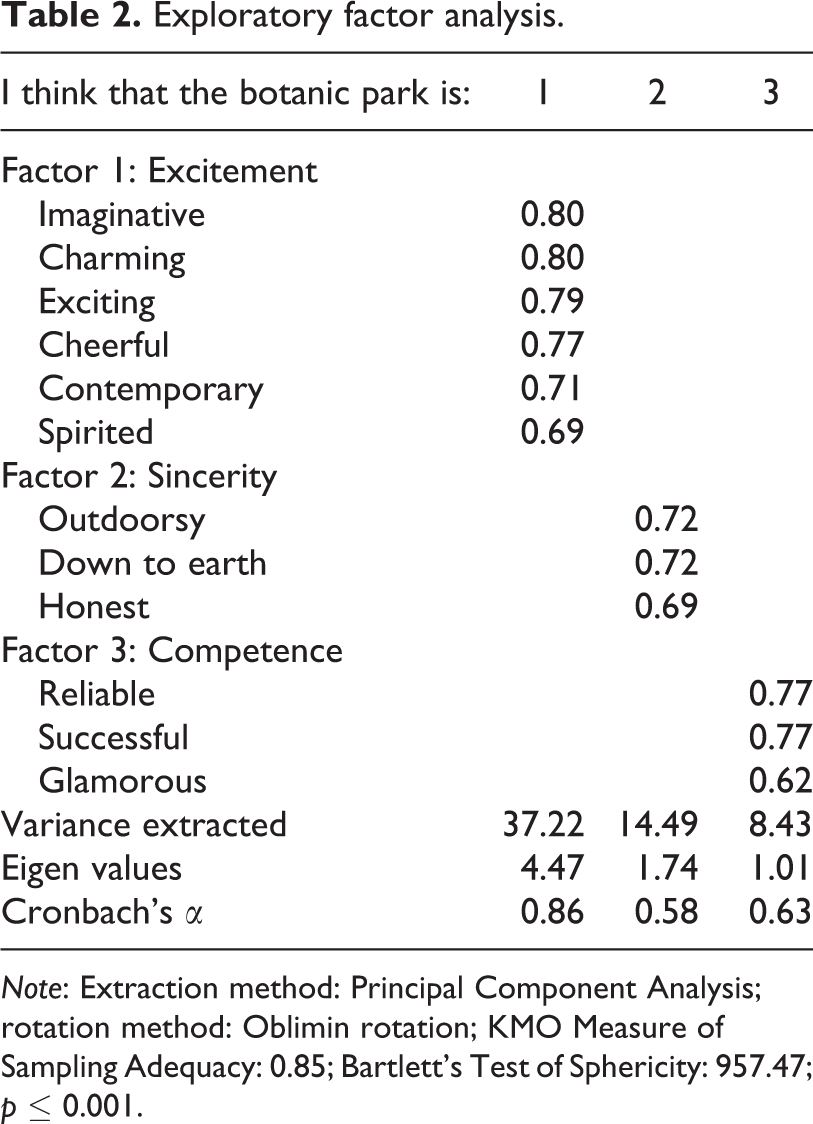
Note: Extraction method: Principal Component Analysis; rotation method: Oblimin rotation; KMO Measure of Sampling Adequacy: 0.85; Bartlett’s Test of Sphericity: 957.47; p ≤ 0.001.
Following the two-step approach suggested by Anderson and Gerbing (1988), confirmatory factor analysis using one-factor congeneric models and the maximum likelihood estimation method was conducted for each botanic park personality factor to assess its validity and reliability. As proposed by Jöreskog and Sörbom (1999) and Hair et al. (2010), the model adequacy was evaluated using the fit indices (χ2/df ≤ 3.0; p ≥ 0.05; root mean square error of approximation [RMSEA] ≤ 0.08; goodness-of-fit index [GFI] ≥ 0.90; comparative fit index [CFI] ≥ 0.90; normative fit index [NFI] ≥ 0.90) and a preliminary analysis was performed. To ensure increased reliability and decreased measurement error, the standardized factor loadings were consulted for both constructs. One item from the six-item excitement factor, namely, ‘charming’ and all items from the three-item ‘honest’ factor, namely, ‘outdoorsy’, ‘down to earth’ and honest hovered around the minimum criterion of 0.50 (Hair et al., 2010) and were eliminated. Confirmatory factor analysis was performed again and the GFIs addressed all criteria, as shown in Table 3. Then, the resultant eight scale items representing the two botanic park personality factors were introduced into a full measurement model and subjected to structural equation modelling. The process ensured that no further improvement to the model was required and there was no significant misfit (Jöreskog and Sörbom, 1999). The full measurement model addressed all goodness-of-fit requirements and was deemed acceptable (χ2 = 20.61, df = 19, p ≥ 0.36; RMSEA = 0.02, GFI = 0.99, CFI = 0.96, NFI = 0.98).
Confirmatory factor analysis.

χ2: chi-square; df: degrees of freedom; RMSEA: root mean square error of approximation; CFI: comparative fit index; NFI: normative fit index; GFI: goodness-of-fit index.
As shown in Table 4, construct reliabilities estimated with the standardized factor loadings and error variances for excitement and competence were 0.82 and 0.68, respectively, with excitement exceeding the critical value of 0.70 (Anderson and Gerbing, 1988; Hair et al., 2010). The average variance scores extracted for both constructs were 0.47 and 0.42, respectively, with excitement close to the suggested value of 0.50 (Anderson and Gerbing, 1988; Hair et al., 2010). These fit indices indicated the measurement model for excitement had acceptable convergent validity. Although the standardized factor loadings and average variance scores extracted for competence did not meet the suggested statistical criteria, the factor was retained for its semantic contribution to the botanic park personality measure (e.g. Ha, 2016; Hosany et al., 2007; Usakli and Baloglu, 2011). Further, discriminant validity was assessed by comparing the average variance extracted scores with the squared structural path coefficient between the two constructs (Fornell and Larcker, 1981). Both constructs met the test of discriminant validity since the variance extracted estimate from each construct (0.42-0.47) exceeded the squared path coefficient between both constructs (0.36), implying that each construct was statistically different from the other. This suggested that the botanic park personality measurement model was reliable and meaningful, and it was now possible to test the predictive ability of the two-dimensional botanic park personality construct on attitude and subsequent intentions to visit and recommend to others.
Means, reliabilities, average variance extracted and correlations.

Note: Squared correlations in parentheses.
M: mean; SD: standard deviation; CR: construct reliability; AVE: average variance extracted.
Hypotheses testing
Finally, a maximum likelihood estimation method using path analysis was conducted to test the predicted relationships in the structural models for local and international respondents. As suggested by Anderson and Gerbing (1988) and Hair et al. (2010), the structural models were deemed acceptable when they addressed the GFIs (χ2/df ≤ 3.0; p ≤ 0.05; RMSEA ≤ 0.08; GFI ≥ 0.90; CFI ≥ 0.90; NFI ≥ 0.90).
Although the GFI did not exceed the critical level of 0.90, the structural model was deemed acceptable because it met the other goodness-of-fit criteria, as shown in Table 5. The excitement and competence personality of the botanic park had significant and positive effects on local respondents’ attitude towards it (β = 0.34; p = 0.01; β = 0.29; p = 0.05) respectively, supporting H1 for the local sample. Similarly, the excitement personality of the botanic park produced a significant and positive effect on international respondents’ attitude towards it (β = 0.83; p = 0.01). However, no significant effect was observed for the competence personality of the botanic park on international respondents’ attitude towards it, partially supporting H1 for the international sample. For both local and international respondents, their attitude towards the botanic park had significant and positive effects on their intentions to visit (β = 0.48; p = 0.001; β = 0.83; p = 0.001) and recommend to others (β = 0.61; p = 0.001; β = 0.92; p = 0.001), respectively, supporting H2a and H2b.
Path analysis.
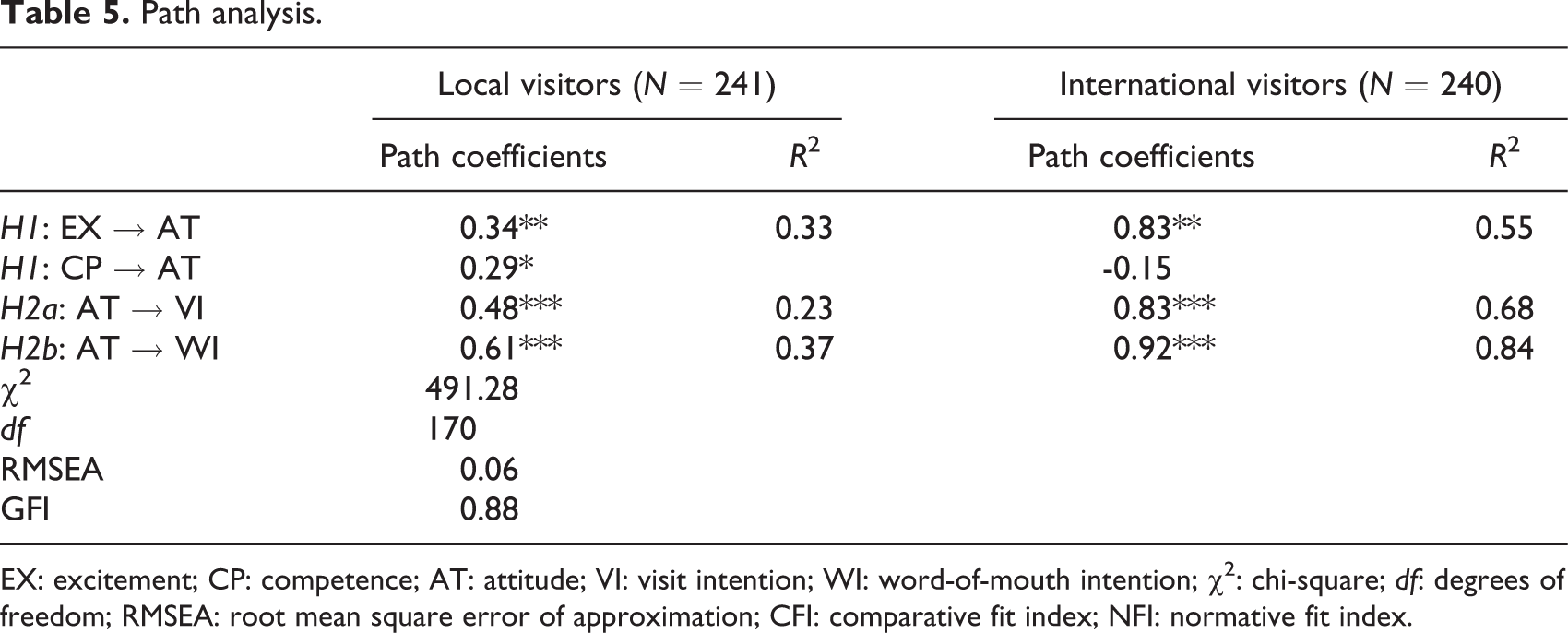
EX: excitement; CP: competence; AT: attitude; VI: visit intention; WI: word-of-mouth intention; χ2: chi-square; df: degrees of freedom; RMSEA: root mean square error of approximation; CFI: comparative fit index; NFI: normative fit index.
Independent sample t tests were conducted to establish personality perceptions, attitudinal and behavioural differences between local and international respondents. As shown in Table 6, local and international respondents demonstrated significantly different perceptions of the botanic park’s competence personality, attitude, as well as intentions to visit and recommend to others (p = 0.05), supporting H3. However, no significant differences existed for the botanic park’s excitement personality between local and international respondents. With the exception of attitude towards the botanic park, international visitors demonstrated higher responses for the botanic park’s excitement (t = 4.81) and competence (t = 5.06) personality as well as intentions to visit (t = 4.81) and recommend to others (t = 5.23).
Independent sample t tests.
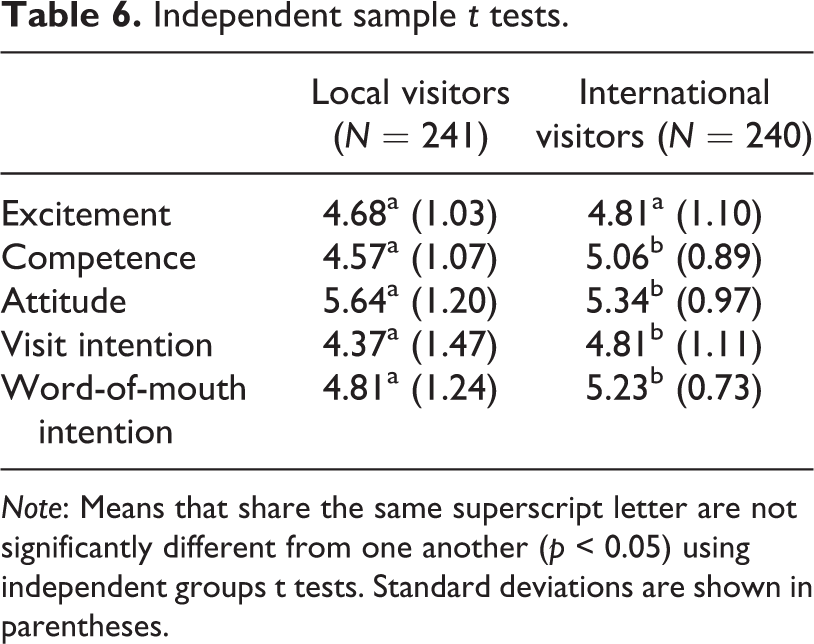
Note: Means that share the same superscript letter are not significantly different from one another (p < 0.05) using independent groups t tests. Standard deviations are shown in parentheses.
Discussion
The current study explored the conceptualization and operationalization of personality in the context of botanic parks. Aaker’s (1997) BPS was adapted to tap into the unique dimensionality of a botanic park in Western Australia. Two distinct personality attributes, derived from the BPS, were identified for the botanic park, namely, excitement and competence. These attributes are consistent with those reported in destination personality studies conducted by Glinska and Gorbaniuk (2016), Ha (2016) and Usakli and Baloglu (2011). The two-dimensional botanic park personality construct was examined for its impacts on visitor attitude as well as subsequent intentions to visit and recommend the botanic park. The majority of the hypotheses were supported across the local and international samples.
International respondents held significantly higher perceptions of the botanic park’s excitement and competent personality compared to local respondents. This suggests that international respondents tend to rely more on the botanic park’s personality attributes to develop their attitude towards it. However, both local and international respondents’ perceptions of the botanic park’s excitement personality had significant and positive impacts on their attitude towards it. Clearly, the influential excitement personality attribute needs to be highlighted in the botanic park’s domestic and international communications campaigns to influence the affect towards it.
Local respondents demonstrated significantly higher attitude towards the botanic park, although intentions to visit and recommend to others were significantly higher among international respondents. Findings indicate that the majority of local respondents have visited the botanic park previously. Local familiarity coupled with pride in engaging in pro-environmental behaviour (Bissing-Olson, Fielding, & Iyer, 2016) may be contributing to their higher affect towards the botanic park. However, both local and international respondents’’ attitude towards the botanic park had significant and positive impacts on their intentions to visit and recommend to others. The results support destination branding literature that favourable attitude impacts on loyalty behaviour (e.g. Apostolopoulou and Papadimitriou, 2014; Chen and Phou, 2013; Xie and Lee, 2013).
The current study’s findings suggest that Aaker’s (1997) BPS may be used as an initial theoretical underpinning for a measure that is specifically relevant to botanic parks. The two personality attributes that are identified, namely, excitement and competence offer a starting point for tapping into the dimensionality of botanic parks. The excitement dimension encompasses personality traits of being ‘imaginative,’ exciting and ‘spirited.’ Pan and Ryan (2007) observed that it is the allure of discovery and challenge which attracts visitors to forest parks in New Zealand in a bid to gain mastery of their abilities. The competence dimension depicts personality traits of being ‘reliable’, ‘successful’ and glamorous. Evidently, the innovative and consistent integration of natural and built aspects entice visitors to botanic parks in their efforts to stay in touch with topical issues such as land conservation and agribusiness (De Lacy, 1994).
Theoretically, the results also indicate that the two-dimensional botanic park personality construct has explanatory power to account for attitude and subsequent intentions to visit and recommend to others in the hierarchy of effects model (Lavidge and Steiner, 1961). The high R2s that explain attitude for local (R2 = 34) and international (R2 = 34) respondents lend support to this observation. Moreover, the higher attitude that local visitors demonstrate towards botanic parks suggest that affinity with these botanic parks can be developed over time. This signals to park managers the continued need to design family-oriented programmes (McDowall, 2010). Such programmes create initial connections with younger visitors, which are sustained into their adulthood and family life.
Some parks have already recognized this affiliation, successfully implementing engaging excitement and contemporary competence initiatives which integrate children and families into their natural environments. Since 2012, Singapore Gardens by the Bay has showcased a contemporary children’s garden, providing interactive play delights, water play features and educational programmes that engage pre-primary, primary and secondary schoolchildren in a lush natural setting. Its success has been phenomenal, with visitors to Singapore Gardens by the Bay reaching 6.4 million in 2014 and projections of 8 million in 2015, compared with New York Botanic Gardens and London’s Kew Gardens, where the numbers hover around 1 to 2 million visitors (Mohandas, 2015).
Razak, Othman and Nazir (2016) observed that successful parks are measured by the visitors they attract from the positive benefits they offer. International visitors from China, Indonesia and Malaysia demonstrate favourable attitude and intentions towards botanic parks. These tourism source markets, particularly, China are crucial to Australia. China is expected to be Australia’s biggest market and is predicted to contribute between $4.6 and $6.3 billion to the national economy by 2020 (Tourism Research Australia, 2012). Botanic park marketers should consider consolidating their branding with contemporary competence and engaging excitement practices to encourage their affinity with international visitors. Strategic product placements of iconic botanic parks in films have the potential to interest and generate international visitors. For instance, films such as ‘Home Alone 2’ and ‘Sex and the City’ centred around Central Park in New York City, can increase awareness in visiting the destination (Quintal and Phau, 2014). A highlight of Central Park is its lake that is managed by the Department of Environmental Conservation, which invites visitors to learn about its varied freshwater fish (New York State, 2015). This suggests the need for botanic parks to be proactive in creating contemporary and engaging brand personalities that resonate with and entice visitors.
The current study has broader implications for nature-based tourism that encompasses non-damaging, non-degrading tourist activity in relatively undisturbed natural areas (Orams, 1995). Nature-based experiences are commonly cited as main attractions for local and international tourists (Tourism and Transport Forum, 2007). However, given stiff competition for the tourist dollar in this sector and an uncertain economic future predicted for visitor attractions in general (Milman, 2001; Mintel, 2002; Swarbrooke, 2001), it is opportune to extend the current study’s approach to the nature-based tourism sector. The use of positioning and differentiation with identified personality attributes offers a competitive branding strategy that the more sophisticated nature-based visitor attractions may adopt to nurture their markets (Connell, 2004).
Limitations and future directions
There are several limitations to the current study. The personality traits identified in the botanic park personality scale comprised a small list of 15 items. While these traits were derived from Aaker’s (1997) BPS, which has been utilized in numerous studies and the study was an exploratory one, a more exhaustive list of personality traits needs to be considered. These will form a basis for developing a personality measure that adequately represents the unique dimensions of botanic parks. Further, the study focused on one botanic park in Western Australia, limiting generalizations nationally and internationally. Again, while the study is exploratory, the need to consider other botanic parks should be a priority on the research agenda. Finally, the sample size of 481 respondents is relatively small, again impacting on the generalizability of the findings. Future research will require larger sample sizes across various botanic parks, and the countries in which they are located.
In summary, the current study explored and identified a two-dimensional personality measure that has the potential to represent botanic parks. These two personality attributes demonstrated the explanatory power to predict visitor attitude as well as subsequent intentions to visit and recommend the botanic parks. Findings offer researchers a platform to advance further studies on botanic park personality that may be extended to other nature-based tourism attractions. The identified and distinctive botanic park personality attributes help to guide practitioners in shaping the positioning and differentiation strategy to attract visitors and enhance the park’s financial sustainability.
Footnotes
Appendix
The following questions ask about your PAST EXPERIENCE with the [botanic park].
The following statements relate to different CHARACTERISTICS that represent the [botanic park].
The following statements ask about your ATTITUDE towards the [botanic park].
The following statements relate to your INTENTIONS towards the [botanic park] in the future.
Declaration of conflicting interests
The author(s) declared no potential conflicts of interest with respect to the research, authorship, and/or publication of this article.
Funding
The author(s) received no financial support for the research, authorship, and/or publication of this article.