




Abstract
The following research addresses the growing concern that the historic tourism city of Charleston, South Carolina, may be reaching a tourism saturation point, with the city considering the implementation of a moratorium on hotel development. This research, employing a qualitative approach, solicited and analyzed the viewpoints of a panel of hotel industry leaders from across the city to determine their views regarding the potential governmental intervention, seeking to answer the question ‘how will we know when “enough is enough?” ‘The hoteliers’ views are of significant importance to those managing, marketing, and governing Charleston, or any other destination concerned they may be reaching saturation.
Introduction
Myriad tourism articles provide cautionary tales for destinations concerned with the impact of unbridled tourism growth upon their community. Perhaps the most impactful authors exploring the issue have been Richard Butler (1980), who adapted marketing’s product life cycle to create his ‘tourism area life cycle’ (TALC), and Stanley Plog (2001), who applied his psychographic tourist continuum to explore the issue ‘Why destinations rise and fall in popularity’. Somewhat less known, but also impactful, has been the work of George Doxey. Doxey (1976: 26) presented his ‘Index for Tourism Irritation’ in the article ‘When enough’s enough: The natives are restless in Old Niagara’, which considered the issue of destination maturation in the Ontario resort community of Niagara-on-the-Lake (NOTL). Doxey’s ‘Irridex’ suggests that destinations, as they are discovered and grow, progress along a path that leads through sequential periods of euphoria, apathy, irritation, and ultimately antagonism—when residents ‘see the tourist as the harbinger of all that is bad…destroying all that is fine’ and ‘mutual politeness’ gives way to an antagonistic view toward visitors and the local tourism industry. Doxey (1976) expressed concern that NOTL was rapidly approaching a stage of antagonism and hoped his paper would serve as warning that further tourism development should be checked. Significant early research that applied and extended these seminal models include work by Agarwal (1997) and Smith (1991), who respectively studied the maturation of resort and beach communities; Perdue et al.’s (1990) study of mountain community tourism development; Snepenger et al.’s (1998) modeling of the maturation trajectory of a historic tourist city’s downtown; and Mitchell’s (1998) update of Doxey’s (1976) work, again studying developmental tourism issues faced by NOTL. What each of the original models, as well as these adaptions, have in common is an innate sense of pessimism—viewing tourism development as a ‘devil’s bargain’ (Rothman, 1998), with initial tourism success leading to growth, ultimately followed by an unhealthy future and inevitable decline.
With their conglomeration of large numbers of people, both residents and guests, in a small geographic area, cities face significant management and policy issues as these relate to tourism development vis-à-vis their maintenance of residents’ quality of life and economic welfare. In Le Pelley and Laws’ (2003: 76) case study of Canterbury, which considered both Doxey’s (1976) and Butler’s (1980) models, the authors determined the English city’s historic city center was ‘approaching the zenith of its life cycle, where the presence of visitors is beginning to drive local people away’. The key underlying concept that leads to such irritation is that of ‘carrying capacity (Cole, 2012)’, that is, the number of tourists a destination, or in the case of Canterbury, a city center, can absorb before residents and/or visitors experience a deterioration in attractiveness. From a residents’ perspective, such deterioration, as many authors have noted, is a function of Social Exchange Theory, which explains that the host community will support tourism development as long as residents perceive its potential benefits exceed its costs (Mantecón and Huete, 2011). Maintenance of such a positive balance is critical to the success of tourism in the community, for, as noted by Zamani-Farahani and Henderson (2014: 355), ‘resident attitudes play a significant role in creating a welcoming environment for tourists and tourism in general’ and is a key factor in determining guest satisfaction and repeat visitation.
Ma and Hassink (2013) recently introduced evolutionary economic geography (EEG) concepts to help understand destination modeling, with a specific emphasis upon the TALC. While noting the model’s shortcomings, the authors’ study of Gold Coast, Australia, generally supported the TALC concept, noting that the model provides an effective foundation for understanding a tourism community’s development trajectory. Ma and Hassink (2013) noted, however, as a moderating variable, the ‘coevolutionary interplay’ between the public and private sectors; with growth induced by the entrepreneurial efforts of hospitality industry members checked by local government strategies and initiatives introduced for the purpose of controlling undesired change. Similarly, Sanz-Ibáñez and Clavé (2014), also employing EEG concepts, called for government intervention to avoid progress that may result in undesired change. An additional example of research that is respectful of the predictive nature of the destination models yet calling for government intervention when necessary was penned by Brenner and Priestly (2014: 282), who warned: Destinations have two options: to react when changes occur, an option that may include irreversible negative impacts; or to develop plans and instruments that evaluate the initial situation, anticipate the future and select a number of actions that take advantage of the opportunities that the area offers. [W]hile the tourism development models may make communities leery, they should not dissuade them from exploring tourism’s potential. Instead, they should serve as warning to do tourism well. For tourism should not be viewed as an apocalyptic choice. When carefully and caringly planned, managed, marketed, and controlled, rather than a ‘devil’s bargain’ tourism development can provide a viable path to a prosperous and attractive future…and a happy ending.
Study setting
Charleston, South Carolina, a historic city with a population of 135,000 residents (metro area = 650,000), is enjoying—some would say suffering—a dramatic tourism boon, likely attributable to the recent numerous tourism accolades bestowed upon the city. Among these are multiple-year ‘Best city in the USA’ designations by both Condé Nast Traveler and Travel + Leisure magazines; capped in 2016 by Travel + Leisure readers having voted Charleston ‘Best city in the world’. The city’s success is reflected in its tourism metrics. Visitor arrivals have increased from 4 million in 2008 to last year’s (2016) 5.4 million (Pan and Patience, 2016). Airport volume has doubled since 2010, creating the need for a recently completed major expansion (Wise, 2017). And, most germane to the research that follows, the number of hotel rooms, both within the city’s historic district and across the metro area, as reflected graphically in Figure 1, has increased significantly in recent years to accommodate the growth in demand (Barrett and Lindsey, 2016).
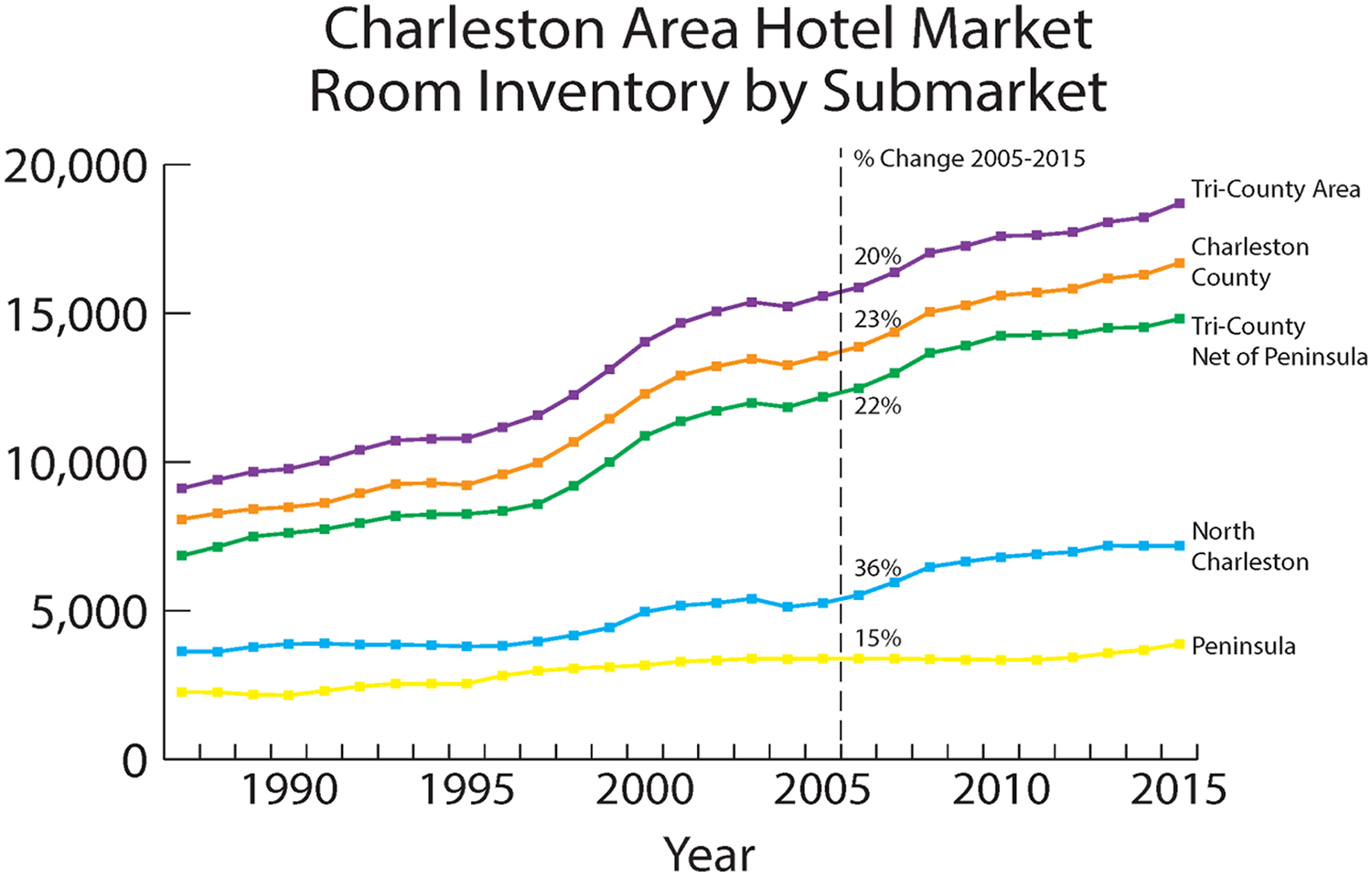
Charleston lodging data. Source: Smith Travel Research data, compiled by College of Charleston Office of Tourism Analysis (Barrett and Lindsey, 2016). Notes: The proposed hotel moratorium would affect only the Peninsula, that is, the city’s historic district. It is also noteworthy, that the College of Charleston Office of Tourism Analysis (unpublished) has found that 90% of visitors who stay in lodging outside of the historic district visit the historic district during their stay, thus adding to the traffic, parking and general congestion issues encountered by residents of the City.
Unsurprisingly, the city’s tourism growth—as the destination maturation models predict—has generated considerable public angst related to crowding, traffic, and general livability issues. At the heart of the community’s discontent is the issue of hotel growth, as many see this as the precursor and enabler of all other tourism-related maladies. Appended, from the local daily newspaper, please see a recent editorial, opinion column, and two passionate letters to the editor, each representative of a stream of such commentaries and reflective of a vocal anti-hotel development attitude among city residents…at least among those publicly expressing their views (see Appendix 1).
It is interesting to note that Charleston’s most recent mayor, Joe Riley, who served as the city’s leader for 40 years (1975–2016), based his initial election campaign on a platform that called for revitalizing a then struggling downtown by investing public funds to facilitate the building of the city’s first major modern hotel; originally an Omni, today the 440-room Belmond Charleston Place Hotel. Once opened, the hotel catalyzed the city’s economic revival and the tourism growth that followed (Stock, 2006). Contrast this, four decades later, with the platform of the city’s current mayor, John Tecklenburg, whose 2016 campaign, cognizant of increasing community concern, included a pledge to halt hotel development in the city’s historic district. To date, various versions of the Mayor’s moratorium bills have failed to be enacted by City Council, but it is expected that future attempts with compromise proposals will follow. As perhaps could or should have been expected, the moratorium threat has spurred an unprecedented number of zoning applications by property owners and hotel developers hoping to have their projects preapproved in the event the city’s lodging development window closes (see Figure 2).

Charleston historic sistrict lodging growth per year, including proposed hotels with zoning requests pending. Source: Smith Travel Research data, compiled by College of Charleston Office of Tourism Analysis (Barrett and Lindsey, 2016).
The research that follows was conducted to learn the views of the key stakeholder group, Charleston hoteliers, regarding the proposed moratorium. In addition, and more broadly, we also sought to add to the destination maturation model literature. As cautioned by Litvin (2010), these models are much better looking retrospectively at ‘what went wrong’ than they are helpful in determining where on the curve a destination currently resides, and thus are difficult to rely upon when determining proactive planning, development, and destination marketing strategies. Their universal shortcoming, Litvin (2010) further noted, is their lack of key indicators for when saturation is near. To address this lacuna and answer our questions regarding the proposed moratorium, a panel of Charleston hoteliers, those most directly impacted by such potential legislation, was interviewed. Discussed during the interview sessions were issues related to the city’s hotel growth, how close the hoteliers felt the city was to reaching a point of lodging saturation, and their views regarding government intervention in the product-development decision-making process…with the goal of learning how we might ‘know’ when intervention, limiting hotel growth, was necessary in order to avoid decline. What we found, as discussed below, was that our interviewees, critical stakeholders at the center of the current hotel development controversy, were generally insular in their views; with most opinions regarding the current state and future of the city based upon a highly introspective business perspective, while expressing only minimal broader concern regarding the general health of the city.
Research method
Twenty-five hoteliers were interviewed for this study. Their hotels were well-distributed across the geographic area. Ten represented properties within Charleston’s historic district. The remaining 15 were evenly spread across the city’s suburban areas. The responsibilities and positions of those who agreed to be interviewed were diverse. Participants included, among other titles, hotel owners, general managers, multiple directors of sales/marketing, and a vice president of revenue. Their industry experience spanned from 6 to 43 years. Property size ranged from 12 to over 400 rooms; and interviewees represented both national chain and independent properties. While the interview panel represented a convenience sample, predominantly predicated upon personal relationships and ‘snowballed’ recommendations, the goal, which we feel was accomplished, was to include a broad and representative sample of the city’s hotels and hoteliers.
The panel provided a base of responses that were deemed to be dependable, credible, confirmable, and transferable—those traits necessary, per Lincoln and Guba (1985), to allow understanding of the issues and conclusions to be drawn. In addition, we felt the 25 interviews yielded ‘theory-saturation’, the point at which responses noticeably coalesce, signaling, per Mason (1996), that sufficient data had been collected. Finally, we noted that the quantity of interviews conducted fell comfortably within the 15–30 range suggested as appropriate by Ritchie and Goeldner (1994).
At the start of each interview, participants were provided a standard university Institutional Review Board waiver that described the study, explained participant rights, and included our commitment to quote their responses anonymously. While all but two participants indicated no objection to our identifying them as study participants, we subsequently concluded it would be more appropriate to provide only their general descriptions. These are reflected in Table 1.
Descriptive list of interview subjects.

The interviews were conducted primarily using open-ended verbal queries, with all responses audio-recorded, supplemented by notes scribed during the interview. The interview sessions, generally conducted at the participant’s place of work, were semi-structured with follow-up questions employed to provide ‘rich accounts of subjectivity’ (Baker et al., 2012) and generally lasted 20–30 minutes. Following each session, review responses were summarized and coded in vivo by the interviewer to identify opinions and key response patterns among the participants. The interviewer’s coding was subsequently reviewed and reconciled as necessary in conjunction with the other author.
Findings
Before the oral inquiry began, to determine the interviewee’s overall view regarding the city’s current tourism environment, written questions related to the aforementioned Plog (2001) and Doxey (1976) models were asked. The first enquiry provided participants a graphic continuum that ranged from 1 to 10 and asked where they would place Charleston. At one end of the graph (value = 1) were Myrtle Beach and Disney, places that Plog (2001) has specifically used as examples of psychocentric destinations. At the other end (value = 10), were Africa and Asia, destinations Plog (2001) has used as representative of allocentric destinations. The mean Charleston classification by the 25 participants was 5.8; solidly in the mid-centric category, reflecting a collective viewpoint that the city is not overly ‘touristy’ and that the current stage of tourism development is comfortable. This was followed by a query related to Doxey’s (1976) Irritation Index. Each hotelier was asked to indicate which of the following descriptions best describes Charleston. The response options provided, which neither mentioned Doxey nor the stage name, were crafted to mirror the four stages of Doxey’s (1976) model. Charleston has a good deal of growth potential. We can still add a good number of hotels and remain a healthy destination. (Doxey’s stage of Euphoria. Four of twenty-five interviewees selected this option; 16%) Charleston is close to the point where we have all the hotels we can handle and remain a healthy destination. (Doxey’s stage of Apathy. Fourteen selected this option; 56%.) Charleston has reached a point where we can no longer build additional hotels and remain a healthy destination. (Doxey’s stage of Irritation. Seven selected this response; 28%.) Charleston has passed the saturation point. Too many hotels have been built and the destination is no longer healthy. (Doxey’s stage of Antagonism. Zero selected this option; 0%.)
Given the response distribution to our ‘Doxey’ question, consistent with the responses to our ‘Plog’ enquiry, one can conclude that the city’s hoteliers feel the city, as a tourism destination, is currently healthy; with, however, a slim majority (those selecting ‘Doxey’ response ‘b’) cognizant that a saturation threshold may be approaching. As a follow-up question, those who had selected ‘Doxey’ response option ‘a’ or ‘b’, that is, those who indicated there is still room for growth, were asked: ‘How will we know when we reach the point where it is unhealthy to continue to build additional hotels?’ The seven participants who selected option ‘c’, suggesting they felt the city had already reached its hotel saturation point, were asked: ‘Why do you feel we have reached the saturation point?’ Very few interviewees, in their extended responses, addressed either the resident quality of life or visitor satisfaction issues at the heart of the destination maturation models. Rather, almost all focused on the classic hotel metrics of occupancy and average daily rate (ADR). For example, one owner indicated the city should be concerned when occupancies fall by 5% versus the prior year. A general manager indicated that it would be time to stop building when existing properties are unable to ‘hit their budget’. Another general manager responded: ‘I don’t know…when people stop coming’. And still another, an owner, clearly not overly concerned with the current growth rate replied: ‘We do not have an answer to the question because we have not hit that point’. It was interesting to note that those few participants who provided non-hotel-metric responses came from hoteliers who, during the interview, made a point of mentioning they lived downtown; and as residents themselves, did not like the crowding, the traffic, and so on. But again, such responses were rare. Most of the 25 hoteliers interviewed looked at the issue of hotel saturation, and the indicators that would suggest such a situation could be nearing, through the myopic perspective of their property’s financial performance.
Participants were then asked specifically their view regarding the potential hotel moratorium. Responses were split. Based upon our coding, we noted that 11 (44%) interviewees responded negatively to the question: ‘Do you believe the city has an obligation to impose a limit on the number of rooms in the city?’ A slight majority of the hoteliers (14 participants, 56%) were supportive in principle, albeit very reluctantly, as most hedged their response, qualifying their answer to indicate that such a measure was an extreme response to a problem that did not currently exist.
The next question asked how a moratorium reconciled with the property rights of owners. A healthy minority (11 participants, 44%) indicated, generally as a last resort, that the government had the right to do so, despite their concern regarding the loss of rights by owners. A historic district innkeeper commented that it would be permissible, but only if current projects were allowed to continue—a view that helps explain the rush of proposals recently submitted to the city’s Planning Department. Said another, the Sales Manager of a large downtown hotel: ‘The city has to have structure and rules and limits…to keep the balance, make the place attractive to please the residents’. Eight interviewees (32%), however, held the opposite opinion, arguing that property rights are sacrosanct and not something that can or should be ‘trampled upon’ by government. Representative of this view was the comment by an executive with a hotel development group who noted: ‘What ends up happening is that rules get changed midstream, which is not fair. We have zoning rules in place. Once set, these should not be changed’. Per another high-level executive with a local hotel group: ‘If it was not profitable or valuable, we would not build. It is our property and our right to do with it as we wish’. The remaining six (24%) hoteliers were generally undecided on the issue.
A related question asked: ‘Will the free market work, or not work, to find an appropriate balance, instead of having government decide?’ Again, responses were split, with 13 (52%) hoteliers indicating their belief that the free market can be counted upon to do the right thing versus 9 (36%) who had less faith in the market economy to choose the correct path. The remaining three (9%) hoteliers were noncommittal. Interesting comments in favor of letting the market decide included: ‘The free market is only thing that works’; ‘Government regulations put handcuffs on industry’; and ‘The market always finds a balance’. Conversely, those with a less conservative/libertarian bent argued: ‘Big corporations are going to keep coming until someone says no’; ‘The power of the people is powerful’; and ‘The only way we can have affordable housing part of the mix is to have government making the rules’. With but a few exceptions, those hoteliers who felt a moratorium would violate the property rights of owners also believed the free market could be trusted to solve problems.
The next question looked at the macro issue of tourism development in the city, asking: ‘An argument can be made that hotels are displacing too many retailers, other employment sites and residences—development that is not healthy for the community. How do you respond as a hotelier?’ A majority (15 participants, 60%) indicated they did not believe hotels were at fault. A representative comment from a suburban hotel GM: ‘Tourists visit the city and want to shop and eat, all of which puts money into the municipal pocket’. Similarly, paraphrasing an innkeeper from the historic district: ‘Just because a developer comes in and buys a building to convert to a hotel does not mean the city is losing retail. Retail is easy to relocate’. Said an AGM from a hotel just outside the downtown area: Charleston, being named over and over again the best destination in the world has dramatically helped the economy of the city and generated significant employment. We have more restaurants, more shopping, and a better city as a result of our tourism growth.
A final question asked interviewees: ‘Mayor Riley often stated, “People like to visit places people like to live.” Are the number of hotels in the city in danger of making Charleston a less attractive place to visit?’ Of the 25 hoteliers interviewed, 19 (76%) disagreed with the statement, while 6 (24%) felt the city was indeed losing its charm. Those expressing concern did so with passion. An interesting comment from the GM of a large historic district property: If there is a hotel on every corner, it takes away from the charm and uniqueness of the city. With the growth of tourism, we are becoming like San Francisco, a dirty city, and people are not going to come.
At the conclusion of the interview, participants were asked to read a short paragraph. They were told this had been taken from the City of Charleston Tourism Management Plan and were asked their reaction. The paragraph read: The dramatic increase in tourism-related activity over the past few years has provoked expressions of alarm by residents concerned with maintaining the amenities and quality of life for which the city is known. Moreover, there is general recognition that the city is not equipped adequately to serve and manage growing numbers of visitors.
We then informed the interviewees that the above passage was taken verbatim, not from Charleston’s recently crafted 2016 Tourism Management Plan, but rather from the city’s original, and first in the nation, 1978 Tourism Management Plan…when Charleston’s visitor arrivals approximated 500,000—less than 10% of today’s number. Our interviewees found it interesting and generally surprising, how very little, other than the sheer numbers, seems to have changed in 40 years.
Discussion
As is evident by the tone of the appended articles, letters, and so on from the local newspaper and by the actions of the city’s new Mayor, Charleston and its residents are concerned regarding the growth of tourism, and more specifically the proliferation of hotels, in the city. From the initial set of questions asked our interviewees, based upon Plog’s model and Doxey’s Irritation Index, we learned, however, that the city’s hoteliers are considerably more positive about the state of their city; considering the current situation to be generally healthy and as a result are generally not supportive of the idea of a hotel moratorium. We also learned the foundation of these views was somewhat insular, based heavily upon their own internal operating results. While we have no doubt the interviewed hoteliers care about their community, it appears, if they are filling their rooms and commanding a high ADR, they see little reason for concern. It was an interesting coincidence that while writing this article, an article in the local press reported on a forum hosted by the Charleston Chamber of Commerce to discuss the issue of tourism growth reported the following (Munday 2017): “Everybody asks if we are getting saturated,” Gresham [a local hotel management company executive] said, referring to the growing concern that too many hotels are built in Charleston. He responded by pointing out that Charleston’s hotel occupancy remains 6 percent to 7 percent above the national average, despite the increasing inventory, and room prices continue to rise.
It is important to note that with few exceptions, hotels are amenities and not attractors. Certainly, hotels such as this year’s Travel + Leisure’s two top scoring US resort hotels, The Lodge at Glendorn, in Bradford, PA, and The Willcox, in Aiken, SC, induce visits to their host communities. But these are exceptional cases. Charleston has many wonderful hotels, but it is safe to say that guests do not visit Charleston specifically to stay in these. Rather, it is the historic charm, the beaches, the food, and the city’s other fortunate attributes, what Judd and Fainstein (1999) call ‘place luck’, that attract the city’s five million visitors. Hoteliers, we believe, appreciate this, and as such, must also appreciate that the warnings of the destination maturation models should be heeded, with the concerns of the city’s residents listened to and seriously considered to avoid reaching a point of saturation. Charleston, as was the general view of the hoteliers interviewed, may not be nearing a danger point, but eventually there may well be a time when indeed ‘enough will be enough’. That said, while such concern was evident in 1978 per the original Tourism Management Plan, the subsequent 10-fold increase in visitor arrivals has not brought the city to a predicted stage of decline. But will another million or two visitors and adding enough hotels to accommodate their demand, be the ‘tipping point?’ If not, how about when the city reaches 10 million visitors, and so on? Awareness of these issues, and recognizing that they extend beyond their hotel’s current performance metrics, was not particularly evident in our interviews. But they should be; and we hope over time the warnings are acknowledged and respected. The current success of Charleston hoteliers is impressive, as is the fact that developers see a healthy future that justifies their continued significant investment in the community. But it is also healthy that concerned residents and government officials continue to raise relevant and pertinent issues, hopefully avoiding a decline, if in fact a point of saturation is on the horizon.
Litvin’s (2010) commentary, cited at the beginning of this article, states that the decline predicted by the maturation models can be averted with clear foresight and good management. Hoteliers can add value to the process and should participate in the planning, control, and decision-making needed to avoid a downturn and the loss of attributes that make their city both an attractive place to live and to visit. A moratorium in Charleston may not be necessary today, but as the discussion of government intervention progresses, it is important that hoteliers and others in the tourism industry, including the CVBs whose marketing efforts help fuel the growth, be involved with the debate—while hopefully being objective and outward looking as they work with the city to find and maintain an appropriate balance.
Tangentially, the politics behind the hoteliers’ views regarding the issue of government control proved interesting. While most participants appreciated that at times it is the government’s responsibility to control growth, they also expressed significant discomfort with actions that restrict the rights of property owners; preferring free market forces be allowed to work. It is interesting how this view would seem to be in direct conflict with most hoteliers’ business self-interest; as a legislated disruption of free market forces through a hotel moratorium would keep newer properties from entering the market and diluting the incumbents’ competitive advantage.
A final takeaway is the need for strong government committed to doing what is best for the community. Charleston residents have been concerned for 40 years that too much tourism growth would hurt the community. It certainly seems, under Mayor Riley’s leadership, that smart growth was accomplished. He arguably found a healthy balance between the concerns of residents and the profit-motivated business desires of the tourism/hospitality industry. But if the city is nearing, or when the city eventually reaches, its saturation point, it will take strong and committed governmental leadership to make decisions their hospitality business community likely will not enthusiastically support. We hope the work we have presented herein helps decision makers, both in Charleston and in other tourism destinations, understand some of the ‘coevolutionary interplay’ (Ma and Hassink 2013) challenges they likely will face as they consider tourism development policy that addresses and reconciles the desires of all stakeholders; providing economic vibrancy for providers, a high quality of life for residents, and an attractive product for visitors.
Before concluding, it is interesting to provide a parallel between Doxey’s (1976) earlier work and the current study. When Doxey commented on NOTL, the destination attracted approximately 250,000 annual visitors. When Litvin (2010) revisited NOTL, its annual visitor count had grown to 2.5 million visitors, a growth rate virtually parallel to that of Charleston’s. Litvin (2010: 160) commented: My guess, were Doxey to visit NOTL today, is he would again provide the same concerned warning that while the community is doing fine that the prospect of further growth should be of serious concern and that for the good of the town such growth should be restrained, perhaps halted, before ‘antagonism’ sets in and diminishes the community’s livability.
Limitations, future research, and conclusion
While the 25 in-depth interviews conducted for this research provided what we believe to be a comprehensive view of the attitudes and opinions of the city’s hoteliers, it is the nature of qualitative research that extrapolation to the broader industry community invites a degree of healthy skepticism. As such, a quantitative follow-up study, with the findings herein reduced to survey questions distributed to a wider sample of lodging industry representatives across the city, as well as in other destinations, would be of value. Further, though ‘resident attitude toward tourism’ studies in numerous destinations have been conducted through the years, we were unable to find one that specifically addressed the issue of hotel saturation. Extension of the current work with residents would therefore be informative. Finally, as noted, a shortcoming of destination maturation models is their weakness in helping communities to know where they are ‘along the curve’ and how close they may be to reaching a danger point. We had hoped our hotelier participants would provide incremental answers to this question, suggesting measures that would serve as indicators of saturation and/or decline. Little insight as to the warning signs, however, emerged. But learning that hoteliers are not as concerned as the broader public is itself a significant outcome, suggesting to governments and other stakeholders that while it is important to get the input and feedback of the industry, their views are likely to be highly insular, and thus the need to balance these with those of its residents when creating policy.
As a concluding comment, we note that the issue of destination maturation and developmental balance has been well-studied. We are pleased to have added to the discussion by providing and analyzing the views of Charleston hoteliers at a time when the city’s residents have concerns regarding the dramatic growth in the city’s tourism and as the local government weighs its options and measures its political will to harness its growth. We sincerely thank the members of the Charleston hotel community who so generously provided their time to assist with this research. We are delighted with their success and with the success of the community. There is no doubt that Charleston has benefitted greatly from its newfound tourism fame. But there is also little doubt that the city must closely monitor future development, not letting this special place become, as would be described by McMahon (2010) ‘Anywhere USA’.
Footnotes
Declaration of conflicting interests
The author(s) declared no potential conflicts of interest with respect to the research, authorship, and/or publication of this article.
Funding
The author(s) received no financial support for the research, authorship, and/or publication of this article.
Appendix 1
The following newspaper editorial, opinion column, and two letters to the editor, one from a downtown Charleston resident and the other from a suburban area, each reflect a growing public sentiment related to the growth of hotels in the city.