



Abstract
With the development of information technology, online travel agency has become an important information and communication source in the hospitality industry. The previous studies assessing the online hotel decision-making behaviours, however, mainly focused on behavioural intentions as well as identifying factors that directly influence the transactional behaviours, which rely on a static approach rather than employing the holistic viewpoints. Thus, this research adopted the choice-set model as a theoretical lens to explore online hotel booking behaviours by using multiple methods (i.e. observation and survey methods). The findings of this research shed light on the dynamic patterns of online hotel decision-making process and identify important factors (i.e. internal and external information sources) across sequential stages of the choice-set model. Therefore, this research provides useful implications to online hospitality marketers.
Keywords
Introduction
Understanding consumers’ decision-making behaviours for travel products has become a critical issue not only for academics but also for practitioners (Yavas and Babakus, 2003). The constant development of information technology, in particular, has evolved the way travel services are purchased (Llach et al., 2013). For example, the advent of an online travel agency (OTA) has contributed substantially to reducing information asymmetry between consumers and service providers by offering not only useful and up-to-date information but also price transparency (Toh et al., 2011). Indeed, OTA sales in the Asia Pacific region have largely grown by 43% in 2015 to reach US$79 billion. Sales in North America and Western Europe recorded 11% and 9% growth, respectively, in the focal years (Skift, 2016).
In this vein, a number of researchers in the field of hospitality have examined the online hotel booking behaviours in three different aspects: (1) channel characteristics (Amaro and Duarte, 2013); (2) online information characteristics such as content and types of information offered to consumers (Steinbauer and Werthner, 2007); and (3) consumer characteristics such as demographics, brand knowledge, familiarity and loyalty (Law, 2009). Most studies, however, focused mainly on behavioural intentions that rely on a static approach rather than employing holistic viewpoints. That is, rather than analysing consumers’ perceptions using a survey method based upon recall of past service experiences, it is essential to understand the entire online booking process by analysing actual behavioural data.
To address this gap, this study adopted a choice-set model as a theoretical lens to investigate online purchasing behaviour which is an important task in travel planning (Park et al., 2011). The choice-set model explains the sequential steps of the decision-making process along with rational (or utilitarian) decision makers (Mansfeld, 1992). That is, consumers go through the consecutive steps comprising multiple decision sets (i.e. awareness set, consideration set and action set) to make a final decision, being influenced by internal (i.e. personal experiences and knowledge) and external factors (i.e. information obtained from external sources during the process to accomplish the task) (Sirakaya and Woodside, 2005).
The choice-set model has been mostly applied to understand the traveller’s destination choices based on a statement: ‘It is now a truism of marketing that brand awareness is a necessary precondition for choice’ (Nedungadi, 1990: 264). Nevertheless, the authors of this research argue that it may not always be applicable in the online hotel decision-making process along with the advancement of OTAs.
Although consumers have limited knowledge about hotels in specific destinations, they can easily search for relevant information about available hotels and seek out alternatives using online travel sources such as search engines and intelligent agents (Peterson and Merino, 2003). As a result, the online hotel decision-making behaviour is a dynamic process that encompasses various strategies (Decrop and Snelders, 2005).
To date, however, there is a limited research analysing the actual consumer choices, and such studies have restrictions to accomplish a comprehensive theoretical approach to explaining the online hotel booking process (Chiang and Jang, 2007). In this vein, Lockyer (2005) stated that the traditional choice-set model mainly focused on proposing typology rather than assessing the process, and thus, the acceptance and rejection process is not described exhaustively. Therefore, the focus of this research is to shed light on consumers’ online travel purchasing behaviours and to identify factors that affect each stage of the sequential process using multiple methods (observation and survey methods), enabling researchers to estimate perceptual and behavioural aspects, respectively.
Literature review
Choice-set model in hospitality and tourism research
Various theories and conceptual models have been proposed to explain travel decision-making behaviours, yet there is no unifying theory to fully account for the process (Hung and Petrick, 2012; Sirakaya and Woodside, 2005). Among these models, one theoretical framework, the choice-set model, frequently has been used to understand a destination choice (Decrop, 2000; Sirakaya and Woodside, 2005). Consumer purchasing behaviour of travel products is a complex process that requires an extensive decision-making strategy due to high cost and involvement (Sirakaya and Woodside, 2005). In this circumstance, the choice-set model that explains how individuals make purchase decisions when confronting a wide range of alternatives is a suitable approach to explaining high-risk purchasing behaviours (Crompton and Ankomah, 1993; Jones and Chen, 2011; Teare, 1998).
The choice-set model is derived from information-processing theory, which suggests that travellers go through a sequence of stages when deciding on a final choice for purchase (Hung and Petrick, 2012; Salisbury and Feinberg, 2012). In particular, a traveller follows a three-stage, consecutive and funnel-like procedure comprising an awareness set, consideration set and a final choice (Crompton and Ankomah, 1993; Jansen and Schuster, 2011; Sirakaya and Woodside, 2005).
The first stage is an awareness set, referring to all products that people have beliefs and experiences/knowledge about. The number of such products in an awareness set (e.g. accommodations) would be vast; hence, the second stage (i.e. consideration set) becomes critical. The following stage is the consideration set, which includes the products that a traveller is considering for purchase within some period of time (Crompton, 1992). This stage consists of an initial consideration set and a late consideration set; the latter contains a smaller number of alternatives. A traveller then makes an active effort in the information search to make a final decision. Due to the hierarchical notion of the choice-set model, this theory has been applied to explain information search behaviours (Vermeulen and Seegers, 2009), travel planning (Mutinda and Mayaka, 2012) and destination image formation (Baloglu and McCleary, 1999).
Importantly, it can be argued that consumers do not always show homogenous sequential steps to reach their final decisions. Solomon et al. (2006) suggested that under a certain condition (e.g. a low-risk purchase), consumers are not constantly engaged in a high level of information search nor rigorous evaluation of alternatives but use simple decision rules to make a decision. Also, when consumers possess low ability and motivation, they are likely to rely on heuristic cues (Yoon et al., 2009).
Similarly, Payne et al. (1993) stated that under a certain circumstance, a consumer is likely to conduct non-compensatory strategy which avoids trade-offs among values and typically reduces demands for informational processing. Moreover, when consumers are engaged in routine purchase (Snepenger and Snepenger, 1993) or have high brand loyalty (Petrick et al., 2007), they tend not to behave in the manner the choice-set model suggested.
Similarly, the typical choice-set model focusing on typology rather than process lacks understandings of the acceptance and rejection process in an inclusive way (Lockyer, 2005). To address this gap, we seek to investigate the types/patterns of online travel decision process and the influential factors on developing each set of the choice-set model using multiple methods that enable researchers to obtain actual behavioural as well as cognitive understandings.
Online decision-making process for hospitality products
A number of researchers in hospitality have endeavoured to identify factors affecting the online hotel decisions from three main perspectives, including (1) channel characteristics, (2) website features (i.e. types and contents of information on the websites) and (3) individual characteristics (see Amaro and Duarte, 2013; Dolnicar and Otter, 2003; Peng et al., 2013).
A number of theoretical lenses have been used to understand the usage experiences of online sources. Based upon theory of planned behaviour, consumers’ decision-making is influenced by attitudes engendered from their beliefs of online information sources (Shim et al., 2001), such as security and/or trust of the online service providers (e.g. OTAs, online destination marketers and hoteliers) (Kim et al., 2005). The technology adoption model, which suggests two key elements such as ease of use and usefulness, is another well-recognized theory to explain the usage of new technology in the online travel booking process (Morosan and Jeong, 2008). Usability of channels such as navigation, convenience, time saving, easy-to-price comparisons and appearance is the crucial driver of online purchasing decisions (Morosan and Jeong, 2008).
Another stream of studies is related to website features especially related to the types and contents of information on websites (Peng et al., 2013). Consumers are more likely to purchase travel products on websites that offer sufficient information, enabling them to evaluate the quality of the products (Dolnicar and Otter, 2003). Indeed, people generally accompany two different phases to fulfil when searching for information: utilitarian and hedonic considerations (Dhar and Wertenbroch, 2000). These phases play independent roles as consumers evaluate and form attitudes towards products, and, in turn, they enable consumers to distinguish between alternatives according to utilitarian and hedonic features (Mano and Oliver, 1993).
In this vein, the information environment is organized by two formats of information presentation: verbal and pictorial information (Childers and Houston, 1984). Textual information basically helps to meet utilitarian information needs, whereas pictorial information allows for realizing hedonic needs (Lee and Tussyadiah, 2010). That is, a verbal source enables consumers to have detailed information about the advantages and disadvantages of the products and, in turn, decides the final choice maximizing the utility. On the other hand, visual information facilitates capturing consumers’ attentions and processing information (in a relatively quick way). Accordingly, those two formats of information influence online hotel choice in interactive ways (Pan et al., 2013).
Lastly, there have been many studies assessing the influences of individual characteristics on online purchasing behaviours for hospitality products, such as demographics, product knowledge, online experiences, personality and shopping orientations (Amaro and Duarte, 2013; Park et al., 2011). Among them, personal experiences (or familiarity) and knowledge reflecting individual differences have been concerned as main determinants of the online decision-making process (Kim and Kim, 2004). Product familiarity induces a high level of confidence and guides consumers’ attention towards specific brands. Knowledge on travel products influences the degree to which people are involved in the information search process and the specific content of information individuals look for online (Lehto et al., 2006; Lin and Chen, 2006; Park and Kim, 2010).
It is important to note that although a substantial amount of research has been analysed to understand the online travel decision-making process, those studies mainly emphasize the likelihood to purchase the products instead of investigating the actual behaviours. The general recognition of consumer studies pointed out the discrepancy between consumer intentions and actual choices (March and Woodside, 2005). More importantly, it is critical to assess heterogeneous roles of factors that have different influences on different stages of the sequential process until reaching a final choice (Um and Crompton, 1992).
Methodology
Data collection
This research employed multiple methods – observation and survey approaches. Observation method allows researchers to obtain actual online behavioural data, and the survey method enables us to gain cognitive responses during the online hotel decision-making process (e.g. Hausman, 2000). Multi-method research refers to ‘a study in which the researcher collects, analyses and mixes multiple forms of either qualitative or quantitative data’ (Creswell, 2011). The main benefits of the multi-method design are strengthening the findings through triangulation and complementing the weaknesses of the single research method.
The observation method has been used as a common method in behavioural psychology, which entails the observation of a subject’s online information searching behaviours (Zechmeister et al., 2009). An approach, observation without intervention, has been applied, which obtains how subjects naturally behave in a given setting. This method verifies external validity that allows researchers to observe the flow of behaviours in its own setting studies (Olshavsky and Granbois, 1979). Along with the nature of choice-set model as a theoretical lens in this research, observation method is suitable to investigate consumer behaviours in the entire stages of decision-making process.
More specifically, the subjects were asked to book an accommodation in Paris using an online travel website, http://www.booking.com, as one of the main travel products (Morosan and Jeong, 2008). The reason why http://www.booking.com was selected in this study is that it is one of the largest global OTAs (Economist, 2017), offering over 1 million hotels and accommodations in 227 countries ranging from small independents to five-star luxury hotels globally (Booking.com, 2016). Also, from the user perspective, it is a user-friendly OTA website so that travellers can easily access and engage in searching for hotel information via a familiar technology and that these advantages lead the company to acquiring the largest market share in Europe (King, 2014).
Paris was selected as a destination in this research, because the place has a wide range of properties, which meets the needs of different travellers. According to Paris Tourist Bureau, there are 1564 approved hotels offering 81,431 rooms in Paris (Paris Tourist Office, 2012) as well as other types of accommodations, such as apartment rentals and bed and breakfast (Convention and Visitors Bureau, 2013). The variety of accommodation implies that consumers need to consider huge amount information and alternatives that make it as an ideal test ground to address the purposes of this research.
The subjects were invited from two universities located in South East of England and London through campus-wide flyers, inviting students and staff. As a result, the total number of subjects who participated in the data collection was 44. A researcher individually contacted each subject and conducted in the places of the respondents’ preferences to ensure the setting is convenient for them and similar to their daily lives. Each participant was given a brief introduction about the research objectives with a guideline to complete the entire data-collection procedures so that all the data were collected under a consistent setting. As a first step, the subjects were asked to fill out the survey questions about demographic characteristics, Internet usage and past travel experiences. Then, each respondent was asked to plan an imaginary week-long holiday during the winter to visit Paris. They were instructed to make a hotel decision for the trip via http://www.booking.com. All the hotels in their budget ranged from low end to luxury hotels and would be of low occupancy due to the advanced reservation. Meanwhile to maximize the observation accuracy, the screen capturing software (i.e. videotaping), CamStudio[A: Please provide version or software developer details for CamStudio and ReCal.], was used to record the entire behavioural processes of the participants.
During the study, it was critical to discern ‘consideration set’. As such, the respondents were instructed to form an initial consideration set (e.g. Crompton and Ankomah, 1993) by adding the hotels, which they were interested in and willing to search more information about, into ‘the wish list’ on http://booking.com. Once the respondents compared the hotels included in the ‘wish list’ and reduced the alternatives into smaller numbers, the remaining hotels were regarded as the ‘late consideration set’ (or evoked set) following the definition proposed by Crompton (1992). These activities helped researchers notice the consideration sets and investigate online information search behaviours across different stages of choice-set models (Pan and Fesenmaier, 2006). During the duration of the study, a researcher sat in certain distance without any intervention.
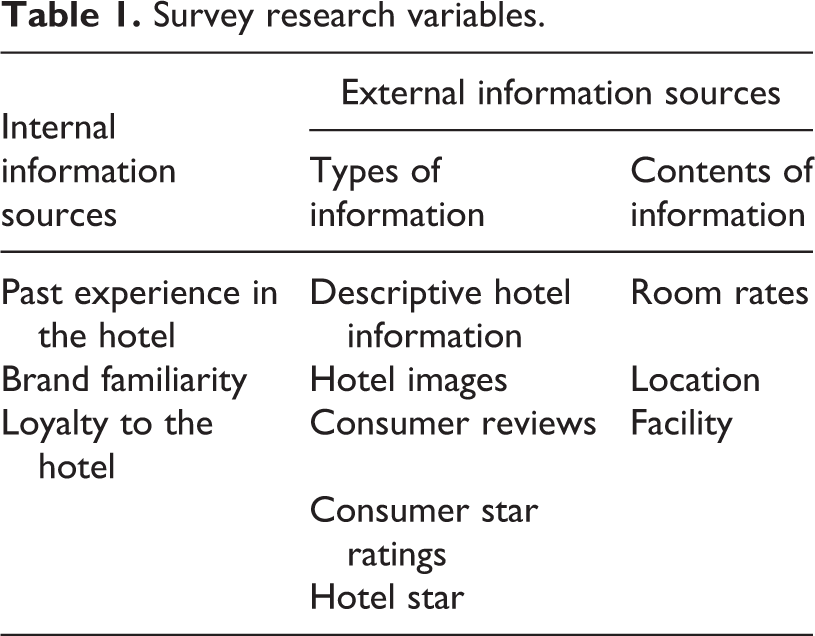
In fact, video recording of booking behaviours is sufficient to obtain behavioural data, but somewhat limited in measuring the relative influences of information acquired during the decision-making process. Next, the subjects were requested to fill out a survey to indicate their online experiences right after finishing the given task study. Specifically, the respondents were asked using a five-point Likert-type scale to indicate the perceived influences of past experience visiting Paris, hotel brand familiarity and loyalty (Gursoy and McCleary, 2004) and all types of the information exposed on http://booking.com, such as (1) the types of information: hotel description, hotel images, consumer reviews, consumer and hotel ratings; and (2) the contents of information: facility, price and location of the hotels (Park and Kim, 2010; Park et al., 2013) (see Table 1). Appendix 1 shows more detailed information about the survey questionnaire.
Survey research variables.
Data analysis
A series of data analysis were conducted to assess two forms of data collected from the observation and the survey methods. To analyse data from the observation study, a general decision-making protocol was developed for every subject based upon the video data files, including time spent, behaviours and description of the behaviours (Hodkinson et al., 2000) (see Table 2).
An example of protocol analysis.
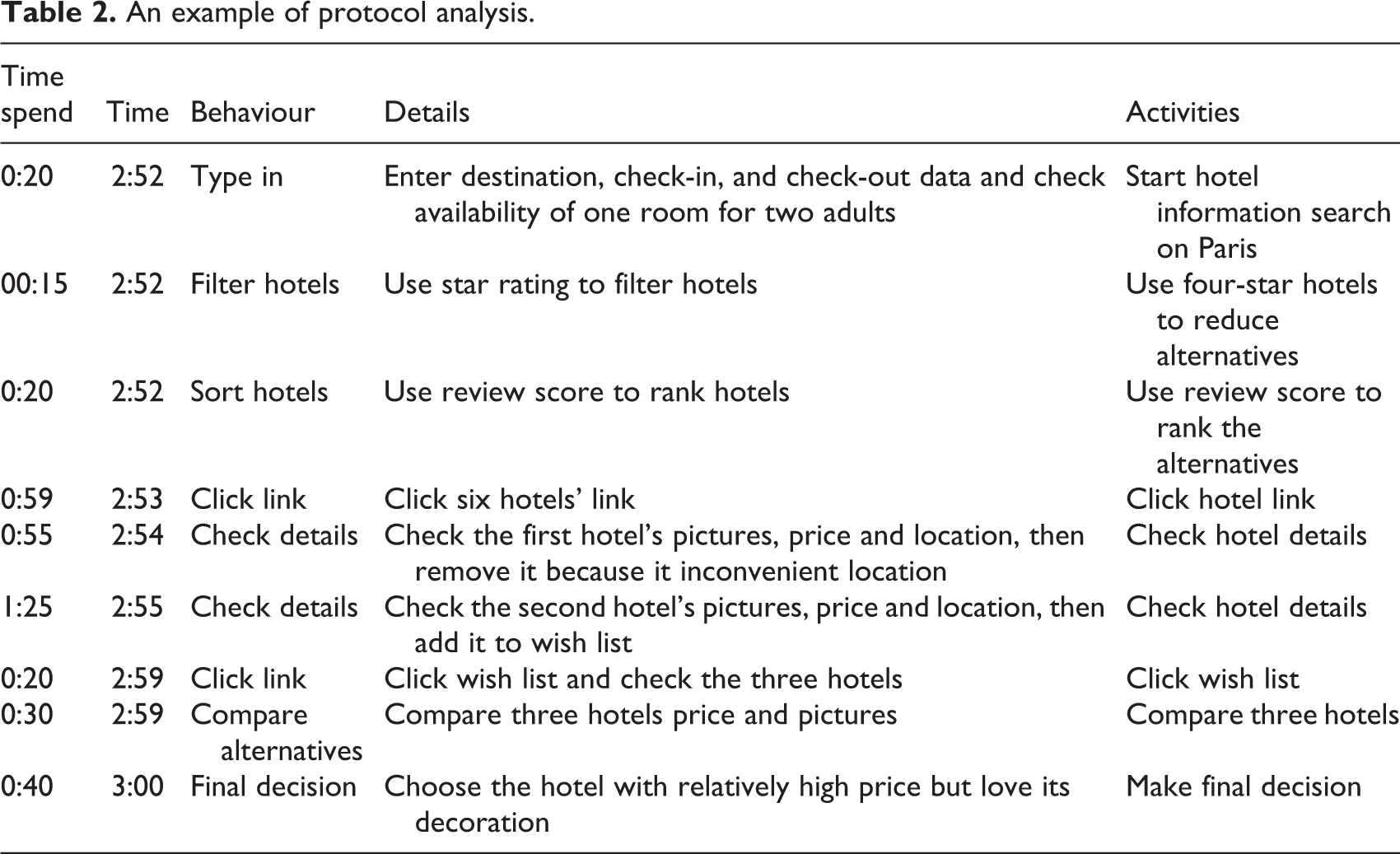
The protocol approach includes various advantages allowing researchers to gain details of the rules in consumer behaviour. That is, the protocol method is beneficial in developing a model of processes gone through by consumers in making a choice (Bettman, 1977) so as to express decision nets that specify the particular rules to be applied in judging alternatives.
The online decision-making graph of each subject was, then, generated from the protocols. The decision-making graph facilitated the researchers to comprehend the structures of online booking behaviours by the types and the orders of external information sources researched by each traveller across the phases of the hierarchical decision-making process. In particular, we focused on three key aspects of online behaviours by analysing the mouse-clicks and cursor movements (Berger et al., 2012): (1) the types of filter function to reduce number of alternatives, (2) the types of sort functions to arrange the lists of the hotels and (3) the types and contents of information consumers emphasized. The mouse–cursor movements infer the user’s intent on the websites and can be used to evaluate interface design, since in over 75% of chances, a mouse saccade moves to a meaningful region and the eye gaze is very close to the mouse cursor (Chen et al., 2001).
Two researchers performed separate coding of the same video clips independently, which was followed by cross-comparisons so as to ensure inter-coder reliability of the outcomes. Then, the researchers independently attempted to identify typologies of the online decision-making process, whereby the subjects who showed similar patterns of choice-set behaviours were classified, and the attributes taken into account in forming each stage of the process were illuminated. As a final step of the analysis, the researchers repeated the above in order to recognize the subjects’ inclusive decision-making styles, and the types and contents of information the subjects considered. In addition to understanding the actual behaviours, data obtained from questionnaires were analysed to identify the extent to which internal and external information sources have influences on forming the sequential stages of online booking behaviours.
Results
Respondent profile
Fifty-six percentage of subjects were female, and the average age was 30.35 with 10.46 of standard deviation. The respondents in the current study were highly educated: 27.3% with undergraduate and 72.7% with postgraduate level degrees. Approximately, half of the subjects have stayed in hotels located in Paris. In terms of online booking experience, the participants indicated moderate levels of online experiences.
Categorization of online hotel decision-making patterns
The results of this study revealed three different patterns of the online hotel decision-making process, namely, arbitrary decision makers (group 1), standard decision makers (group 2) and comprehensive decision makers (group 3). More specifically, eight respondents (18%) were categorized as arbitrary decision makers who directly reached the final decision from the total available set (see Figure 1). About 66% of the respondents were classified as standard decision makers who went through the total and consideration set to reach the final hotel decision (see Figure 2). The last group comprised 16% of participants (7), who appeared to use a more sophisticated process in decision-making (using initial and later consideration sets), was classified as comprehensive decision makers (see Figure 3). That is, usage of ‘wish list’ function reflecting the formation of consideration sets on the choice-set model was considered to discern the travellers between arbitrary and standard decision makers. Among those who used the ‘wish list’ function, the subjects repeatedly accessing ‘wish list’ for the multiple formation of consideration sets were regarded as comprehensive decision makers. To test the objectivity, reproducibility and reliability of the quantification of online purchasing classifications, an inter-coder reliability was performed. The result was 0.82 using the online software ReCal, which is over cut-off points (Krippendorff, 1980).
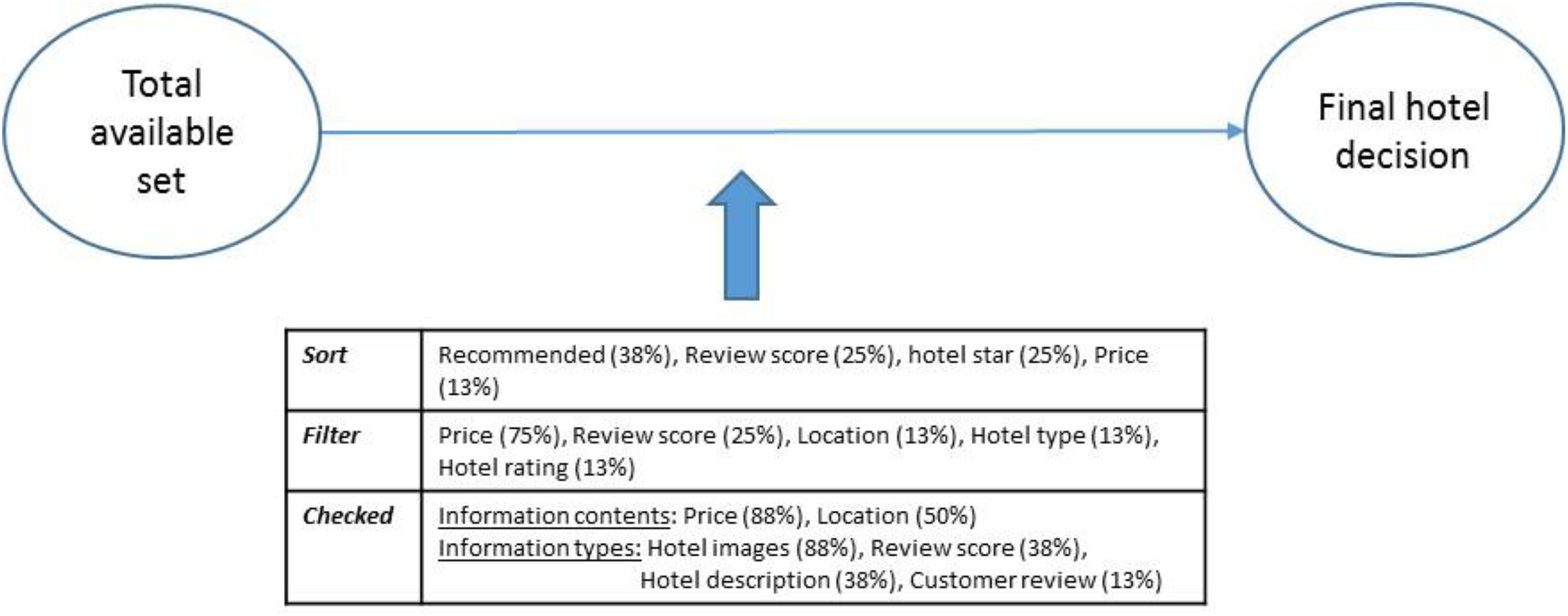
Online decision-making process of arbitrary decision makers (group 1).
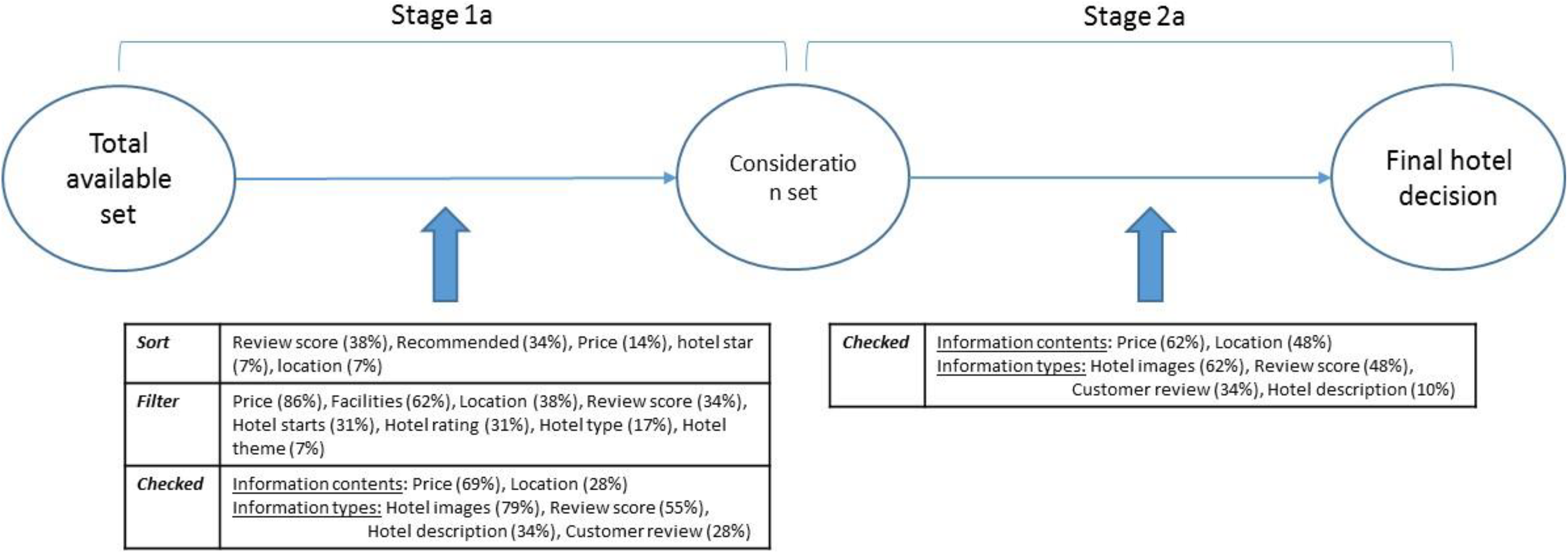
Online decision-making process of standard decision makers (group 2).

Online decision-making process of comprehensive decision makers (group 3).
Given the classification of online travel decision-making behaviours, individual factors such as demographic, prior knowledge, the Internet usage and online booking experiences were compared to understand the different natures of those online travel groups classified (see Table 2). The travellers in group 1 (the arbitrary decision maker) were likely to be male and younger with lower annual incomes than ones in group 2 (the standard decision maker) and group 3 (the comprehensive decision maker). The arbitrary decision makers were likely to possess higher levels of knowledge about the travel destination and online booking experiences than the standard decision makers and the comprehensive decision makers in the same lines with Park and Stoel (2005). With regard to the length of time spent in the online booking process, as expected, the comprehensive decision makers spent more time (17 min on average) than the standard decision makers (8 min and 37 s on average) and the arbitrary decision makers (4 min and 54 s on average). These findings imply that the different patterns of online booking behaviours across the groups reflect the individual differences in demographics as well as the personal knowledge and online channel experiences that are consistent argument with previous tourism studies (e.g. Park et al., 2011) (see Table 3).
Profiles of the respondents.

SD: standard deviation.
Understanding online hotel booking behaviours
Arbitrary decision makers (group 1)
The analyses of the navigation graphs of eight participants suggested that all the travellers in this group used either a ‘sort’ or ‘filter’ function to reduce the number of hotel choices to consider. In terms of the sort function, the travellers sorted the hotels using mostly the ‘recommendations’, which was given by the OTA (38%). For the usage of the filter function, 75% of respondents used ‘price’, followed by review scores (25%), location, hotel type and star rating (13%) as a criterion. This suggests that online travellers, who belong to the cohort of arbitrary decision makers, were concerned largely about prices of travel products during their decision-making. It was also in line with the findings from the analysis of mouse movements. When the participants searched for hotel information in detail, the majority of them paid significant attention to price information (88.0%). Also, consistent with the notion of a heuristic decision maker, they were more likely to focus on hotel images (i.e. heuristic cue; 88.0%) than textual types of information (i.e. rational cue; 38.0%; see Figure 1).
The results of the survey analysis reveal the extent to which individual factors (i.e. past experience in staying in the hotel, brand familiarity and loyalty) and information on the websites (i.e. the type and content of information) influence the online decision process. Personal characteristics such as past experiences, brand familiarity and loyalty did not seem to be important as much as information-related factors, for instance, consumer reviews, review scores and hotel images. Consistent with the findings of the observation method, the online travellers responded that information content about room rates was more influential than hotel location to make the final decision.
Standard decision makers (group 2)
The online booking process for standard decision makers consisted of two different stages: (1) from total set to consideration set (i.e. stage 1a) and (2) from consideration set to final decision (stage 2a; see Figure 2). The results showed that all the 29 respondents used either sort or filter functions to initially dispose the hotels by their preferences. During the process of forming a consideration set, the majority of the standard decision makers (86%) used the filter function by price, which was similar to the arbitrary decision makers. However, the travellers did not actively exploit sort functions: for example, only around 38% of people sorted the hotel by the consumer review scores. When it comes to investigating specific content and type of information concerned, the standard decision makers were more involved in information about price (69%) and hotel images (79%) than hotel location (28%) and hotel descriptions (34%) when forming the consideration set.
Given the establishment of a consideration set (i.e. hotels included in a ‘wish list’), the information search process to make a final decision was analysed. Online travellers were likely to search for additional information by comparing specific attributes relevant to the hotels rather than using other sorting and filtering functions. Similar to the formation of a consideration set, the subjects paid considerable attention to hotel price (62%) and visual types of information (62%).
While the individual factors, such as past experience, brand familiarity and loyalty, were not notably important when deciding hotels online (on average below 3.0), the elements related to information acquired from the OTA were essential in passing through stages of the choice-set model. In terms of the types of information, consumer review scores were perceived as the most important source, followed by hotel images and descriptive (textual) information about hotels in stage 1a.
On the other hand, the information search behaviours in stage 2a showed the different patterns with ones shown in stage 1a. For example, while the consumer star ratings were perceived as a key factor in forming a consideration set (stage 1a), the information became the second least important in the process of making a final decision. In the same vein, the consumer reviews placed one of the least important factors in developing a consideration set, whereas it was regarded as the most influential factor at the phase of making a final choice. With regard to information contents, the travellers indicated that hotel location was more important than room price in stage 1a, but in stage 2a, room price was more important than hotel location.
Comprehensive decision makers (group 3)
Interestingly, the comprehensive decision makers showed quite different information search behaviours with the standard decision makers in forming consideration sets (i.e. initial and late sets; see Figure 3). Specifically, when developing the initial consideration sets, the travellers in the group of comprehensive decision makers actively used sorting tools using categories such as ‘review scores’ (86%) and ‘recommendations’ by the online agency (14%), while it was not common in other decision-making types. Besides, over 85% of the travellers disposed the lists of hotels based upon facilities (mainly the existence of Wi-Fi), which was not observed in other two groups. This finding implies that the comprehensive decision makers were more likely to deliberate the types of services on offer, whereas other types of decision makers were largely concerned with room prices.
It is revealed that most comprehensive decision makers checked information about both price and location in forming initial (stage 1b) and late consideration (stage 2b) sets (see Figure 2). Interestingly, however, when it comes to a final choice, the travellers showed different decision-making behaviours. About 71% of them considered ‘consumer reviews’ to make a final hotel decision (stage 3b), while it was the least concerned in stages 1b and 2b.
The survey results show that as Um and Crompton (1992) suggested, while individual factors were somewhat notable in organizing the consideration set, these factors were not substantially important when deciding a final choice. All the comprehensive decision makers indicated ‘review ratings’ as the most important factor in stages 1b and 2b, followed by ‘hotel images’ and ‘descriptive information about hotels’. As expected, the different patterns of information search used to make a final choice were identified; for example, consumer reviews were recognized as the most influential source, which was the least important factor in the formation of a consideration set. In terms of information contents, the comprehensive decision makers perceived that hotel location is more important than room price in both constructing a consideration set and selecting the final choice.
Discussion and conclusion
OTAs play a critical role in distribution of travel products by building an effective link between service providers and consumers (Pan et al., 2011). OTAs enable travellers to search information, share their experiences and purchase travel products via a uniformed platform. For travel service providers, OTAs facilitate the ability to reach potential customers across the globe at an unprecedented scale. As a result, an OTA becomes one of the most dominant intermediaries in the tourism market. While past research has significantly enhanced an understanding of online hotel purchasing behaviours, most of these studies assessed behavioural intentions relying on a static approach (Chiang and Jang, 2007). To address this gap, the current research observed actual decision-making behaviours of travellers through an entire process, allowing for them to elucidate their dynamics in online hotel booking behaviours with a choice-set model as an underlying theory. Also, pre- and post-survey methods allowed us to understand cognitive behaviours by identifying the influential factors on each stage of the sequential decision process.
To the best of our knowledge, this is the first empirical research that employed a behavioural theory as well as used multiple methods to shed light on aspects of behaviours and perceptions in the online hotel booking process. Therefore, this study helps to advance the understanding on how consumers make hotel purchasing decisions online by providing several theoretical contributions.
First, this research identified three distinctive patterns of the online hotel decision-making process by looking into Internet information search behaviours: arbitrary, standard and comprehensive decision-making. Our findings also suggested that consumers from different groups exhibited different demographics, Internet experiences and levels of prior knowledge of the destination. These results broadly place in line the current study with previous hospitality research (e.g. Amaro and Duarte, 2010; Park et al., 2011), suggesting that the way a traveller behaves online reflects the different natures of traveller characteristics.
Second, our results suggested that the factors affecting formation of each stage of the online decision process were heterogeneous. For example, use of the filter function of price, facility and location was commonly observed among travellers during the process of forming consideration set(s). When it comes to final decision making, price- and location-related information were the most sought after for all groups of travellers. These findings are in line with the concept of the adaptive decision maker suggested by Payne et al., (1993); that is, people apply a comprehensive decision-making strategy when the size of the alternative set (i.e. the consideration set) is enough for them to estimate through their information-processing capacity (Einhorn and Hogarth, 1981). Interestingly, the information search and acquisition behaviours also varied across different stages of the choice-set model. For example, review score and hotel images were the most sought-after type of information by all travellers during the process of consideration set(s) formation. For the final decision-making, however, the information need varied across the different types of travellers. These findings address the dynamics of online travel decision-making behaviours.
Another important finding is that the internal information sources (e.g. past experience, knowledge or brand loyalty) did not seem to be important as much as information-related (external) factors. Peterson and Merino (2003) suggested that as intelligent agents become more sophisticated and their use increases, the importance of brand-level information (or brand knowledge) is likely to decline.
Regarding practical implications, these findings can be important for OTAs in the following ways. As Chiang and Jang (2007) suggested, a deeper insight into travel product choice from online dynamics is greatly important and useful to service providers, particularly for OTAs. For example, OTAs could provide a tailor-made approach in the development of interface design for different types of travellers. For arbitrary decision maker types (who could be identified by the demographics provided), streamlined online interfaces could be made to suit their fast-paced decision-making nature, while more tools, such as a wish list or comparison feature, could be provided or made to appear more prominent on online interfaces to aid comprehensive decision makers form their consideration sets more efficiently.
Also, our findings would enable OTAs provide better and more targeted information to customers. OTAs could make review-related information more prominent in interfaces for comprehensive decision maker types and in certain phases of the decision process to aid their decision-making. As a result, the typology this study proposed could be used for online tourism managers when executing a customized marketing strategy by understanding the heterogeneous information needs.
This study makes an important contribution but does have some limitations that future studies could be addressed. Using observation study, explicating actual behaviours rather than intention is one of the unique merits of this study, but it does pose some drawbacks. The issue is that the subjects of this research are either students or staffs working for higher education institutions. Future research extending the scope as well as the size of the sample is recommended to enhance the generalizability of the findings.
Footnotes
Declaration of conflicting interests
The author(s) declared no potential conflicts of interest with respect to the research, authorship, and/or publication of this article.
Funding
The author(s) received no financial support for the research, authorship, and/or publication of this article.
