




Abstract
Below-cost tours (BCTs) have long been considered a serious issue in the travel industry, yet they have rarely been discussed from a tour guides’ perspective. Today’s tour guides are mostly freelancers, hired by tour operators to lead tour groups. While previous studies cover the management and behaviors of tour guides, there is little insight into personal perceptions of their work. To better understand BCTs, this study provides an intimate look at the phenomenon through the use of semi-structured interviews from tour guides and employment of nonparticipant observation on their experiences. The structural problems of the travel industry and impacts of BCTs on tour guide performance are explored and highlighted. Framed in the agency theory, the managerial implications and solutions to the BCT problems are discussed and recommended.
Introduction
A below-cost tour (BCT) is a company-organized tour which sets the consumer price below the cost to run the tour. In order to make profits, companies typically try to coerce tourists to buy optional tours or extra commodities. BCTs have long been considered a serious issue in the travel industry. Particularly in countries and regions like China, East Asia, and Southeast Asia, they have been criticized as not just a major problem in itself but also as a main generator of other problems in the travel industry. The public tends to have a ‘shoot the messenger’ attitude toward BCT problems, placing most of the blame on the tour guides rather than the companies themselves.
Today’s tour guides often find themselves in a conflicting role when leading BCTs. As freelancers, BCT tour guides typically have to add several company-sponsored ‘tourists shops’ and optional excursions to the trip in order to generate a sufficient amount of commission. If tour guides feel too guilty to coerce tourists, they will most likely receive no remuneration or even become financially deficit in choosing to work the tour. In the case that tourists are unwilling to spend, some tour guides may display negative emotions which can affect the perceived quality of their service performance (Van Dijk et al., 2009), further leading to conflict with their tour group. While tour guides have increasingly become the most maligned people in the public view (Mason, 2016), there has been little previous study of BCTs from their perspective.
Previous studies have made efforts to look for solutions to BCT-related problems, but they focus mainly on criticizing tour guides and management (e.g. Jia, 2004; Kong et al., 2009; Mak et al., 2011; Zhang et al., 2009; etc.). Few studies have been conducted that examine the roles and impacts of figures higher on the control chain, namely local tourism authorities and BCT travel agencies (Hu and Wall, 2013). Local tourism authorities are governmental organizations in China which are supposed to play the important roles in tourism management of planning and coordinating and the development of the tourism industry; establishing and organizing the implementation of tourism market development strategies; organizing the surveying, planning, development, and protection of tourism resources; normalizing the order of the tourist market, and supervising and managing the service quality and maintaining legal rights and interests of tourism consumers and operators.
In most BCT cases, public media and societal attitudes tend to focus on sympathizing with the associated tourists. Tourists in turn blame their dissatisfaction on their tour guides’ inferior service. There are relatively few stories from the perspective of tour guides who are, instead, criticized by other key BCT players (i.e. the government, tour operators, tourists, the public, and public media). Consequently, little is reported in tourism literature about what really concerns Chinese tour guides when encountering BCTs. This study is designed to address that gap by employing qualitative approaches to investigating the tour guides’ viewpoints of the phenomenon of BCTs, the relationships between tour operators and tour guides in the context of BCTs, tour guides’ perceptions about leading BCTs, and the role of tourism law and regulations in tackling BCT problems. Given that tour operators and freelance tour guides have what could be defined as an agency relationship, the discussion of this study is framed within the agency theory.
Literature review
Below-cost tours
BCTs are described as unhealthy business practices in the travel industry, in which organizing travel agencies advertise BCTs in order to attract tourists (Mak et al., 2011). Tourism literature has discussed the BCT issue and other related travel service problems from different perspectives. Such issues include the professionalism of tour guides (King et al., 2006; Tao and Lu, 2005; Zhao, 2003), tour guide training and monitoring (e.g. Ap and Wong, 2001), tour guide management (Hu and Wall, 2013), and the immaturity of the tourism market in Mainland China as well as an excessive consumer demand for cheap tours (e.g. Mak et al., 2011). Few studies have ever investigated or discussed the BCT issue from the perspective of tour guides. For instance, previous studies have mainly emphasized the importance of tour guide management. Huang and Weiler (2010) stressed that tour guide quality assurance in China might be constrained by an overreliance on government and an absence of industry-driven mechanisms such as monitoring negative behaviors, enforcement of good practices, and rewarding of excellence. To cope with the BCT problem, Hu and Wall (2013) suggest that appropriate tour guide management should serve as the primary strategy and last defense for ensuring quality guiding performance. Ap and Wong (2001) found that, in Hong Kong, ineffective tour guide training and monitoring resulted in lack of tour guide professionalism. Kong et al. (2009) stressed the importance of tour guide management with respect to guides’ educational attainments, professional skills, and career development.
China’s tourism law came into effect in 2013, aiming to regulate the industry while laying out rules for growth. The law addresses acceptable business practices and ways to protect the rights and interests of tourists. China’s tourism law and travel service regulations articulate that travel agencies organizing BCTs and providing unhealthy business practices will be severely penalized, and tour guides who are tipped off by tourists for organizing involuntary optional tours or shopping will be fined and fired (CNTA, 2017). Though tourism authorities are determined to tackle the BCT issues, the problems related to BCTs have never been eradicated (e.g. Baijiahao, 2018; Beijing Youth Newspaper, 2018; Renminwang, 2018; Xinjingbao, 2018), indicating that the measures taken by tourism authorities so far have seemingly not been very effective.
With the continuous growth of the online travel market, tour operators involved in selling holidays packages have seen their sales drop significantly in recent years. Cutthroat competition and a lack of tour product innovation results in these operators turning to BCTs to keep customers (Hu and Wall, 2013). Given the non-sustainable nature of BCTs, BCT tour operators mainly rely on exploiting freelance tour guides. Policy makers and tourism management lay particular stress on how to regulate, supervise, and monitor tour guides’ performances to fulfill other various stakeholders’ expectations (Huang and Weiler, 2010), but relatively little is done in comparison on laying down policy designed to protect tour guides (Hu and Wall, 2013). When a BCT incident occurs, public media usually focuses on the ill-treatment of tourists by their guides, failing to discuss or criticize the tour operators who organized the BCT.
Previous studies suggested that the BCT problem may be solved by improving tour guide management, training, and education (e.g. Hu and Wall, 2013; Mak et al., 2011). Hu and Wall (2013) argue that insufficient and inappropriate guide management results in low professionalism and commitment of guides, while encouraging widespread unethical business practices. These in turn further undermine tour guiding services. One essential problem concerning tour guide management is the diminution or deprivation of guiding service fee, something which directly affects their income and indirectly affects their standard of performance (Mak et al., 2011). Because little previous insight has been given and tour guides are a major yet easily overlooked group impacted by BCTs, it is important that a comprehensive investigation of the BCT issues should primarily include their perspective.
The purpose of this study is to examine the BCT problems from the perspective of Chinese tour guides. Based on a comprehensive qualitative approach, the results of this study would be useful to tourism authorities who endeavor to solve BCT-related problems. This study will also contribute to the body of knowledge of tour guide management, as related to the BCT practice.
Principal–agency theory
Given the fact that the relationship between tour operators and freelance tour guides is a type of agency relationship, this study is framed in the principal–agency theory. Principal–agency theory is also called agency theory, a term from organizational economics (Eisenhardt, 1989; Wright et al., 2001). This theory is premised on the observation that some individuals (principals) attempt to have their agendas carried out by other individuals (agents). Principals delegate to agents in order to carry out a task more efficiently (Eisenhardt, 1989; Wright et al., 2001). The reason for delegating to agents is perhaps because the agent possesses greater expertise or specialized knowledge about the task to be carried out (Aerni, 2006), or relating to burden sharing and diffusing direct accountability (Hamman et al., 2010).
The central problems addressed by agency theory are the divergence of goals or attitudes between a principal and an agent (Eisenhardt, 1989). Such problems are compounded when it is difficult for a principal to monitor an agent’s performance (Bergen et al., 1992). As a result, information asymmetry may occur whereby an agent withholds information from a principal, allowing ‘self-interested activities to go undetected’ (Mason et al., 2006: 59). Likewise, information asymmetry can also occur when a principal keeps information from an agent.
In the travel business, freelance tour guides are hired by tour operators to deliver a service to their customers in the operator’s place. Therefore, the relationship between the tour operator and the freelance tour guides is an agency relationship. Agency problems may arise when the interests or attitudes between the two groups diverge. However, few studies have applied agency theory in exploring the relationship between tour operators and tour guides. In Dong et al.’s (2002) study, agency theory was used to analyze problems primarily from the employer’s perspective and focuses on management responses required to optimize performance outcomes for the tour operator. In a recent tourism study, Lamont et al., (2018) examine potential impacts of utilizing volunteer guides from the perspective of tour customers, and empirically deploy stakeholder–agency theory in the context of tour guiding. With respect to the BCT phenomenon, no attempt has yet been made to apply the agency theory in solving its problems.
Research methods
The researcher employed semi-structured interviews and nonparticipant observations to form a basic picture of BCTs in China and the structural issues which concern it. While the semi-structured interviews focus on a few tour guides and through a limited number of questions, the nonparticipant observation aspect of the study is a supplementary way to cross-validate the interview data and to capture a multidimensional view of the BCT phenomenon.
Semi-structured interview is a very popular qualitative approach. However, using interviews alone can be fraught with drawbacks. Walford (2007: 147) cautions that ‘interviews alone are an insufficient form of data to study social life’. What people say in an interview will be influenced, to some degree, by the questions they are asked (Hammersley and Gomm, 2008). Interviewees will only give what they are prepared to reveal about their perceptions of events and opinions (Alshenqeeti, 2014). To remedy the drawbacks, Alshenqeeti (2014) suggests that observational techniques be used as a supplement, which would give researchers another way to investigate participants’ internal beliefs and external behaviors.
According to DeWalt and DeWalt (2002), ‘the goal for design of research using observation as a method is to develop a holistic understanding of the phenomena under study that is as objective and accurate as possible’ (p. 92). This BCT study uses nonparticipant observation, specifically observing subjects, events, and activities without actively participating in them, as a way for direct understanding of the BCT phenomenon in its natural setting. According to Liu and Maitlis (2010), the observation process is a three-stage funnel, beginning with broad-scope descriptive observations to get an overview of the setting, then to focused observation of a narrower portion of the activities, and finally to selected observation to investigate relations among selected elements of the greatest interest. Observation should end when theoretical saturation, the point when further observations add little or no insight to a researchers’ understanding, is reached.
To collect participants for semi-structured interviews, the researcher reached out to contacts he knew who were currently working as tour guides in China. These contacts then further recommended a network of similar tour guides. As a result, nine tour guides were obtained for the interview. The group included both senior and junior tour guides, from several different cities in China. The interviews were conducted on February 2018 through a WeChat voice or video call. WeChat, also called Weixin, is an all-in-one social communications app for text, audio, and video calls commonly used in China. The researcher asked four questions to the interviewees: (1) What do you know about BCTs? (2) Why do travel agencies organize BCTs? (3) What do you think of the tour guides who were involved and got caught in leading BCTs? (4) How do you think of the role of the government (and tourism law) in tackling the BCT problems? A typical interview lasted for 20–30 min. All the interviews were tape-recorded and later transcribed.
Nonparticipant observation took place largely through a virtual community of tour guides who are located in Chongqing, China’s largest municipality. The community was accessed through the social media platform WeChat. It should be noted that there are numerous tour guide social media platforms being set up across the country mainly for the purpose of exchanging travel information and career opportunities between tour guides. The groups are private and only tour guides are allowed to join, as enforced by an invitation-only policy. Due to the nature of the social platform WeChat, each virtual community can only accept up to 500 members. The researcher gained access in October 2017 through a contact who is a member of the virtual community, and was able to join the virtual community without publicly announcing the primary purpose of the observation. The observation lasted until June 2018 when all the needed information was collected; this was also the time when an announcement was made in the virtual community platform, requesting that only tour guides can stay in the community and the others should leave. The researcher observed all the communications and activities taking place in the virtual community during that time period. The researcher would save the BCT-related content in WeChat’s ‘favorites’ folder, for further editing and data analysis.
Results of the interviews and observations were analyzed via thematic analysis. Thematic analysis is a method of pattern recognition within the data, where emerging themes become the categories for analysis (Fereday and Muir-Cochrane, 2006). According to Boyatzis (1998), a theme is ‘a pattern in the information that at minimum describes and organizes the possible observations and at maximum interprets aspects of the phenomenon’ (p. 161). In this study, thematic analysis was used to identify BCT-related themes that tour guides were commonly concerned with. The technique used is consistent with the six phases of thematic analysis defined by Braun and Clarke (2006) which are familiarizing the data, generating initial codes, searching for themes, reviewing themes, defining and naming themes, and producing the report (Braun and Clarke, 2006).
Presented in the following section are the findings from the semi-structured interviews and nonparticipant observation.
Results
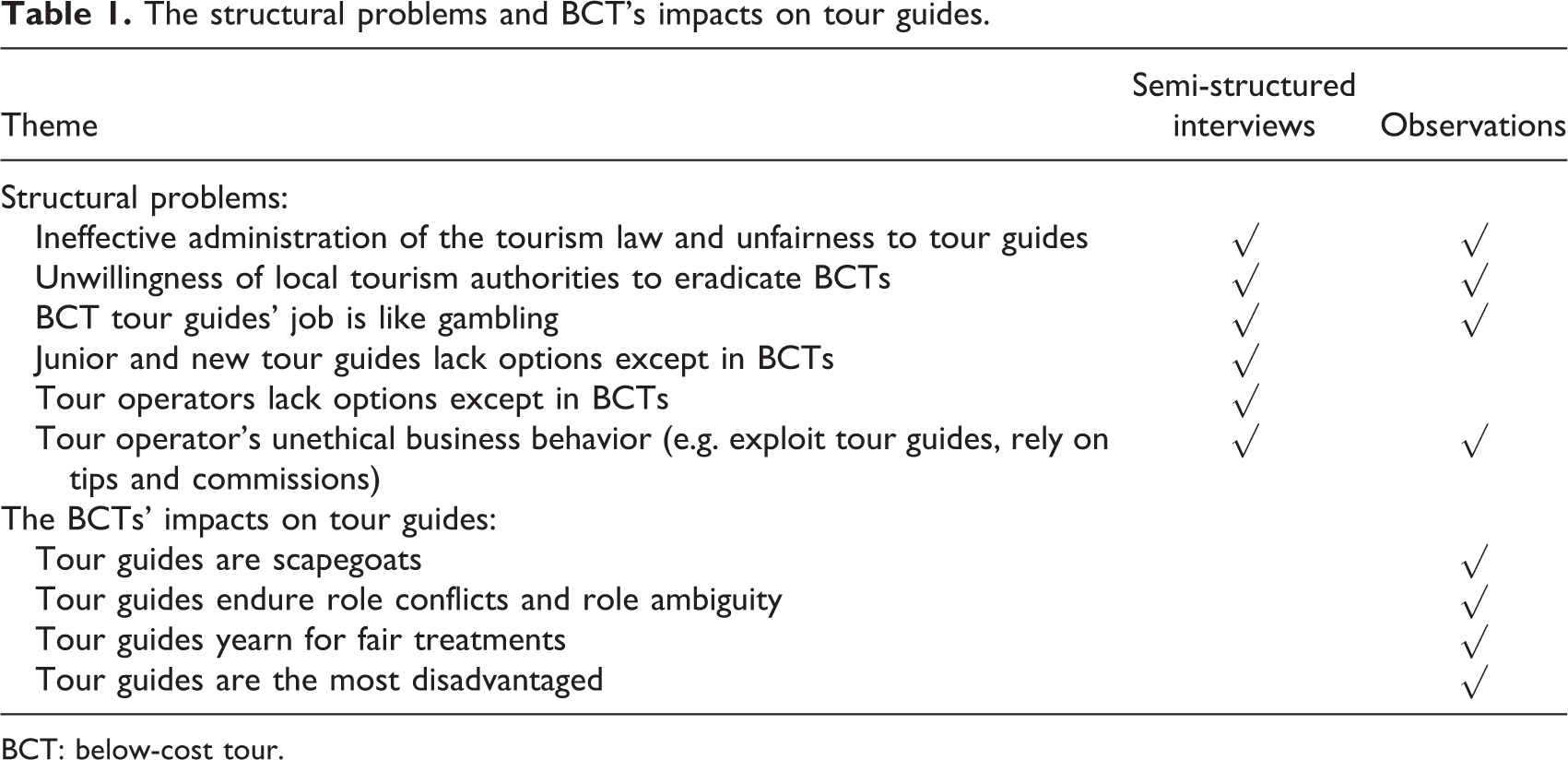
The themes resulting from the data analysis are summarized and displayed in Table 1. As shown in Table 1, a total of 10 themes are identified, which are classified into two categories—the structural problems of the travel industry (6 themes) and BCT’s impacts on tour guides (4 themes).
The structural problems and BCT’s impacts on tour guides.
BCT: below-cost tour.
Themes identified from the semi-structured interviews
Theme 1: Ineffective administration of the tourism law and unfairness to tour guides
With regard to tourism law, the interviewees feel that a major negative impact is the blurring of lines between tips and commissions, both of which are a main source of income for today’s freelance tour guides. As a result, freelancing tour guides believe the law denounces them of receiving tips or commissions. They believe this is unfair as the law only prohibits tour guides from receiving tips while other workers of the industry, including rickshaw drivers and unlicensed informal tour guides, could receive tips. One senior tour guide interviewee made the following points about the law: Compared with the previously stipulated ‘travel service management regulations’, the tourism law did not make it explicit as to whether tour guides can or cannot accept tips. We understand tourists have their rights to choose giving or not giving tips to tour guides. But because of the indistinct statement in the law, it becomes illegal for tour guides to accept tips of commissions even though we actually live on them. What the law should have stated is that tour guides accept tips as tokens of appreciation but it is up to tourists’ willingness to give or not to give.
Theme 2: Unwillingness of local tourism authorities to eradicate BCTs
In regard to measures taken by local tourism authorities in coping with BCT problems, the interviewees responded that authorities were passive toward and reluctant to eradicate BCTs. Typically, tourism authorities or affiliated monitoring centers for tourism quality would take actions only when a BCT problem was tipped off. One interviewee commented: [Local tourism authority or quality assurance department] should know all the tricks made by the travel agencies about fake tour contracts or disguised tourist shops, but what really concern the local tourism authorities is that, with the eradication of BCTs, the number of tourists to their provinces will decline, and fewer people will come, which in turn will affect all the tourism businesses. And the BCT tourists will visit other provinces instead.
Theme 3: BCT tour guides’ job is like gambling
Interviewees tended to be sympathetic to tour guides caught by tourism authorities for leading BCTs. While the interviewees expressed that it was certainly wrong for a tour guide to coerce tourists into unplanned expenses and the punishment for such guides was appropriate, interviewees also did not blame the guides but were rather sympathetic to them for lacking the experience to navigate a BCT with their customers. The interviewees commented that people involved in BCTs were taking a gamble, where success or failure depends on their ‘luckiness and skill’. At the same time, coercing of tourists was still condemned by the interviewees. The following comments made by one interviewee were very common among the other interviewees: Tour guides must understand that our work is like gambling—you may win or lose in the game, relying on both skills and luckiness. For a tour guide, if you agree to gamble, you’ll have to accept the ‘gamble is gamble’ rule—play the game the way it is played and should never coerce tourists even if you lose the game. You’ll deserve the punishment if you violate the rule.
Theme 4: Junior and new tour guides lack options except in BCTs
Interviewees’ attitudes toward BCTs are ambiguous. On the one hand, they despise BCTs—a practice which has brought lots of pressure and troubles to tour guides. On the other hand, BCTs offer more job opportunities, especially for new and junior tour guides who otherwise would not have any. As one interviewee remarked, I myself would never lead a BCT. BCT for tour guides means to lick blood on the tip of a knife. However, I understand and sympathize the new and junior tour guides who choose to take BCTs. They need this job to make a living or support their family, and no BCT means no income for them.
Theme 5: Tour operators lack options except in BCTs
The interviewees commented that today’s tour operators have a hard time acquiring tourists. With the rapid expansion of the online travel market, today’s tourists prefer to take advantage of easily available online travel services for travel plans, and have become much less dependent on land-based tour operators. The advantage of land-based tour operators over online services is that the former has much larger local networks and closer ties with local guides and tourist shopping stores. In order to survive the market competition and make profits, some tour operators choose to sell BCTs, and make profits by exploiting tour guides. Here is one of the interviewees’ experiences: Facing the fierce competition in the travel market, the traditional or offline tour operators find it hard to compete for and attract tourists to buy their tour products today. What they can rely on are two approaches—bulk purchase and price reduction. Once they even count the commissions and tour guides’ tips into cost accounting, BCTs and unethical business behaviors are bound to occur and the involved tour guides are to be exploited.
Theme 6: Tour operators’ unethical business behavior
According to the interviewees, BCTs are prevalent in China’s domestic, and even outbound, travel markets, and BCT tour groups are traded like commodities by tour operators. However, no matter how BCT tours are organized or ‘traded’, they will always be executed by operator-hired tour guides. They are the ones who will ultimately be responsible for covering the costs generated by tour operators who organized the BCTs. Moreover, tour guides receive no guiding service fees from their employer and have to make an income from selling optional tours and adding shopping activities. In the case that tourists refuse optional tours and shopping activities, the tour guides have to pay all uncovered costs from their own pockets. Tour guides involved in BCTs usually do not know whether they will make money until the end of the trip. As one interviewee commented, Many of the local tour operators rely on exploiting tour guides’ services. In running BCTs, the tour operators only serve as a shell company—i.e. buy a tour from an organizing tour operator and ‘sell’ it to a tour guide. The tour guide will have to prepay various kinds of fees amounting to about CNY 20,000–30,000 for an outbound tour. When taking a below-cost tour group, the tour guide will receive no travel allowance, and even no work contract from the tour operator.
The nonparticipant observation
Four themes similar to the ones found above regarding structural problems of BCTs were noted from nonparticipant observation. Four additional themes about the impacts made by BCTs on tour guides were identified (see Table 1).
The four structural problems are ‘lack of law enforcement’, ‘unwillingness of local tourism authorities to eradicate BCTs’, ‘the gambling mind-set in the travel industry’, and ‘tour operators’ unethical business behavior’. Examples of the tour guides’ narratives are in Table 2. The findings from the nonparticipant observation show that tour guides have no confidence in measures taken by the government, in regard to either the monitoring of the implementation of the tourism law or regulations, or the effectiveness of the measures taken by the tourism authorities. The tour guides think that the travel market in China is unorganized and chaotic, as all the participants in the industry seem to be gambling. Tricks and irrational BCT transactions are used to get around government-imposed regulations and restrictions, but there is always a risk of being caught.
Observed themes about the structural problems.

BCT: below-cost tour.
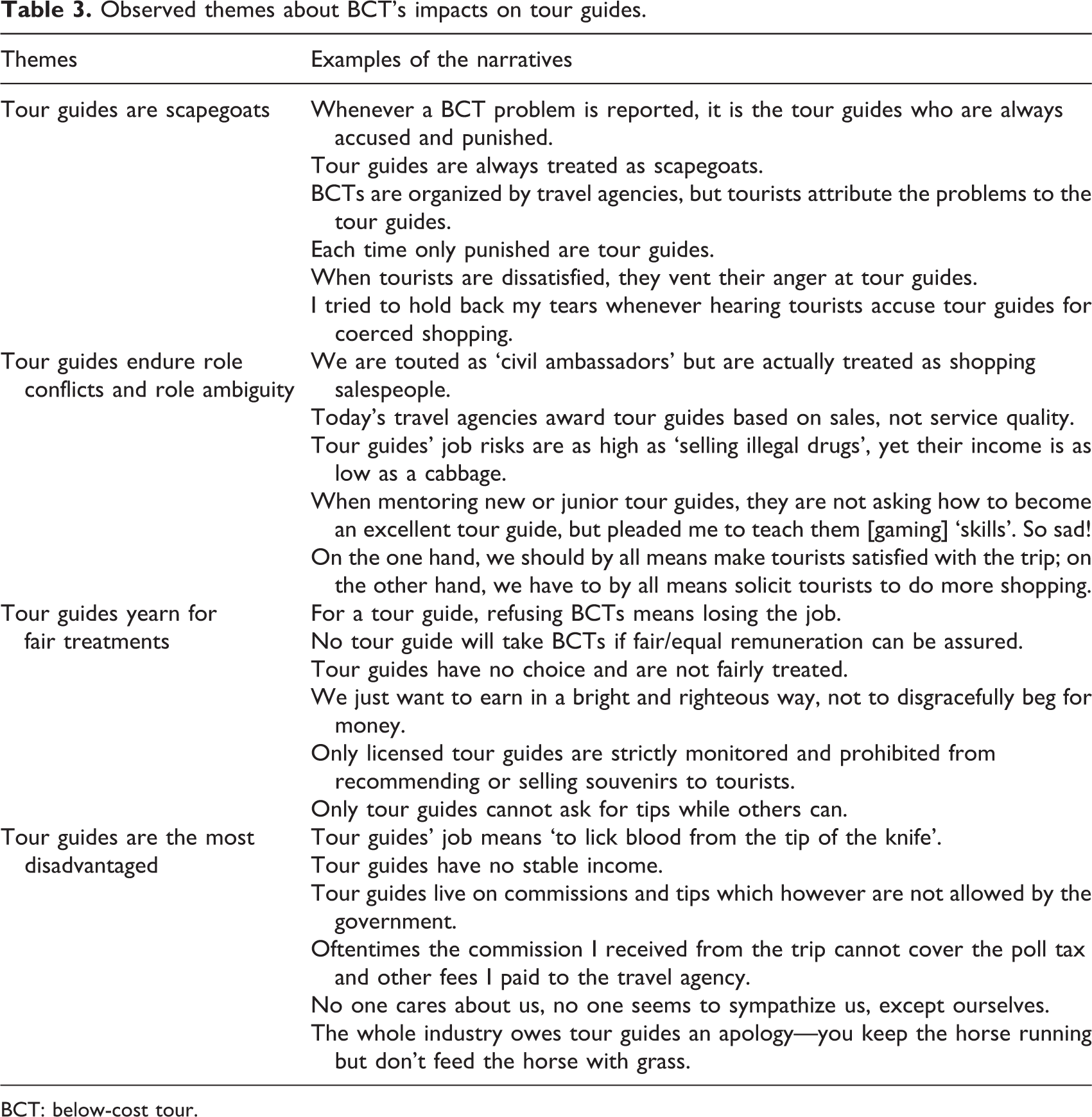
The four themes regarding the impacts on tour guides are ‘tour guides are scapegoats’, ‘tour guides endure role conflicts and role ambiguity’, ‘tour guides yearn for fair treatments’, and ‘tour guides are the most disadvantaged’. Examples of tour guides’ comments associated with each theme are listed in Table 3. The researcher observed that the tour guides felt wronged for being unfairly treated as the scapegoats of BCT-related problems—they struggle with dual roles—being a professional tour guide but also ‘salesperson’. They seem pessimistic about their working conditions and career, and consider themselves the disadvantaged group in the travel industry.
Observed themes about BCT’s impacts on tour guides.
BCT: below-cost tour.
Discussion
With regard to BCT problems, different stakeholders, including tourism authorities, tour operators, tour customers, and the public media, tend to blame the tour guides for leading the tours and providing inferior services. Previous studies stress the importance of tour guide management, yet, little is known about how tour guides themselves think about BCT problems and the measures taken in tackling these problems. Previous studies have reported that tour guide performance is correlated to their customers’ satisfaction levels (Hsu, 2000; Mossberg, 1995). In order to find solutions to BCT issues and improve tour guide performance, it is important to first understand BCT tour guides’ perceptions of their work.
The structural problems
The most common comments made by BCT tour guides are related to the lack of law enforcement in the industry and the ineffective management of local tourism authorities. Although regulations do exist that are designed to combat BCT issues, it is the implementation and monitoring of these regulations that will create a real-world impact. According to the tour guides, China’s tourism authorities are making efforts to eradicate BCTs, but these efforts have not been effective. Since the BCT phenomenon is in essence a price reduction strategy, a common business practice, that has been adopted by tour operators to attract tourists (Zhang et al., 2009), tourism law should focus not on eradicating all BCTs but rather on prohibiting unethical business behaviors and inferior tour guide services.
In the eyes of the tour guides, local governments have an ambiguous and passive attitude when dealing with BCT-related issues which makes their efforts less effective. The province of Yunnan, considered to have the most serious BCT issues, is one such example. Though local tourism authorities swore to eradicate BCTs, there was also a concern that strict measures could scare away tour operators, who organize BCTs, from visiting the province. In other words, what the local governments are really concerned about are not BCTs, but the shrinking travel market that could be caused by the eradication of BCTs (CCTV, 2018).
Because of the ineffective or lack of law enforcement and monitoring, BCT tour operators in China act like gamblers in running BCTs, always taking the risk of being discovered and punished. For instance, a company pretends to offer an ‘incentive tour’ to its customers for free. The offer is in reality a BCT, a hoax designed to coerce customers into purchasing optional tours and expensive, but often fake, commodities on the trip. Even though it is a requirement by some local tourism authorities for tour operators to establish a minimum protection price for tour groups (e.g. Mak et al., 2011), BCT tour operators, according to the tour guides, have found a way to evade local tourism authorities’ inspections by fabricating travel information or prices in tour contracts. As a result, even inspection by tourism authorities cannot prevent their below-cost deals with their customers. Consequently, while BCTs still exist everywhere, they go ‘unnoticed’ by tourism authorities.
Many travel companies in China lack innovation and are still living on traditional tour package products, resulting in fierce competition in the travel market. In order to win in travel business, tour operators choose to operate BCTs by transferring the operating costs to freelance tour guides, and it is usually the new and junior tour guides who are hired to lead BCTs as they do not have sufficient tour guiding opportunities. As a result, it seems that BCT tour operators and junior tour guides form a type of symbiotic relationship in the BCT business, either actively or passively. This symbiotic relationship makes BCT tour operators able to stay afloat in the travel market by organizing BCTs and transferring operating costs to junior tour guides, who in turn hope for more job opportunities and a chance to make money in the BCT business.
What makes BCT a profitable business is the unethical business practice prevailing among BCT tour operators. They take advantage of the lack of law enforcement and ineffective management of local tourism authorities, exploit tour guides, cheat tour customers, use false contracts, coerce optional tours and shopping activities, and collude with tourist shops to sell high-price fake or low-quality commodities to their customers.
BCTs’ impacts on tour guides
What commonly concerned tour guides were the negative impacts made on them by BCTs. The tour guides complained of the unfair treatments and harsh working conditions they encountered. They witnessed the continuous decline of the social status of tour guiding as a profession, as well as the devaluing of their career—from what was once seen as a highly admirable ‘civil ambassador’ to a dishonored freelance ‘salesperson’ whose income is now merely relying on tips and commissions.
Tour guides feel that they are disrespected by the government and tourism organizations as the law and regulations do not seem to be able to protect their interests. For instance, as a measure to eradicate BCTs, tour guides are now under the close surveillance of tourism management organizations, which makes them feel that tourism authorities do not trust them or value their profession. According to the tour guides, tourism authorities in some provinces send staff to closely inspect tour guides’ performances by sitting in their tour buses to make sure that tour guides did not recommend or sell commodities to their customers.
When being hired by BCT operators, tour guides often encounter the frustration of role conflict and ambiguity. They struggle between two roles—providing professional tour guiding services versus an unfriendly salesperson forcing customers to buy optional tours or commodities. When a conflict between a tour guide and a tour customer occurs during a BCT, the government, the public, the public media, and the tourists tend to blame the tour guide who led the BCT, not the tour operator who organized the BCT. Tour guides often feel that they are the scapegoat of the BCT issues and are a disadvantaged group disregarded by the government and society.
Framing the BCT issues in the agency theory
In the context of BCTs, a tour operator organizes a tour whose customers either do not need to pay for the trip or pay only a nominal amount. The tour operator hires freelance tour guides to provide tour guiding service to the customers, and at the same time transfers all the travel costs to the tour guides. In addition, the tour guides need to pay the tour operator the ‘capitation’ or ‘poll tax’. This indicates that, unlike the other agency relationships, the agency relationship between the BCT tour operator and the tour guide is unusual and abnormal. To solve the BCT problem, efforts are needed by tourism authorities to regulate and normalize the agency relationship between tour operators and tour guides. For example, a tour operator should be required to sign a contract with a freelance tour guide when hiring him or her to lead a tour and must pay the tour guide a service fee based on the criteria regulated and monitored by the tourism authorities. Regarding BCTs, tourism authorities should also be aware that some tour operators may offer BCTs as a strategy in order to compete for or sustain the market shares which should be plausible as long as the agency relationships are normal. Given this, there may exist two types of BCTs—ethical (i.e. a real incentive or promotional tour offered by a tour operator or a company) and unethical (which involves abnormal agency relationships). To tackle the BCT issues, tourism authorities should focus on the unethical BCTs, not all BCTs.
Agency problems arise when (1) the objectives of the principal and agent are different and (2) asymmetric information exists that makes it difficult for the principal to monitor the agent’s actions (Jensen and Meckling, 1976). According to Dong et al. (2002), the agency problem in the Chinese travel industry is a lack of goal alignment—with the agent’s short-term focus on maximizing pay and the principal’s long-term focus on reputation leading to repeat and referral business. In this study, however, the lack of goal alignment is reflected by tour operators’ short-term focus on maximizing revenue and tour guides’ long-term focus on trying to earn a steady income and stable life, indicating that the agency relationship between BCT tour operators and tour guides is unusual. In the context of BCTs, information asymmetry occurs. Most likely this is due to BCT tour operators withholding information from tour guides, not tour guides withholding information from tour operators, a symptom of BCT tour operators’ gambling mind-set toward the BCT businesses. For instance, some tour guides complain on social media that they did not know whether the tour they were leading was a BCT or a regular tour until arriving at the destination and being told by the step-on local tour agent. Agency theory typically examines agency issues from the principal’s perspective. In the context of BCTs, it seems that the main problem stems from tour operators, and tourism authorities should focus more on the unethical business practices of BCT tour operators in tackling the BCT problems.
As outlined in agency theory, a principal monitors its agents’ behavior through traditional and economic mechanisms for discouraging agents to act self-interestedly (Jensen and Meckling, 1976). In the situation of BCTs, tour guides need to prepay all the costs before leading a tour. BCT tour operators will withhold the tour guides’ prepayment if tour guides fail to coerce tourists to buy optional tours or commodities. In other words, BCT tour operators tend to exploit tour guides and place guides at a disadvantage. Hence it is important for China’s tourism authorities to take effective measures to ensure tour guides’ basic interests such as remunerations, which will be helpful in preventing tour guides from leading BCTs or providing inferior services.
What tour guides expect is the assurance of fair remuneration and treatment. Tour guides in China are not allowed to be self-employed (Hu and Wall, 2013). Most of today’s tour guides are freelancers, not permanent employees belonging to a travel company. In order to become a licensed tour guide, freelancers need to register in their local city’s Tour Guide Management Center—an institution intended to ‘manage’ not ‘hire’ tour guides. In order to earn money and live a stable life, many guides do not have a choice in declining or accepting BCTs. It is important for the tourism authorities to effectively monitor tour operators to pay guides a legitimate service fees and guarantee their working rights and legal benefits.
According to the agency theory, a tour operator hires a tour guide because the tour guide possesses tour guiding expertise and knowledge. In the context of BCTs, however, tour guides’ expertise and knowledge are not really important; what is important in the eyes of tour operators is tour guide’s ‘selling’ skill. Tour guides are expected to be ‘skillful’ at coaxing tourists to purchase fake commodities and participate in optional tours. The experience of tour guides in BCTs is not valued by tour operators. BCT tour operators tend to hire new and junior freelance tour guides to lead BCTs as these are the people who do not have enough tour guiding job opportunities. As a result, a loose management of freelance tour guides is a challenge in tackling the BCT problem as BCT tour operators can always easily find tour guides to lead BCT tours. One solution to this challenge is for tourism authorities to empower and strengthen the function of the tour guides’ association. By joining professional and well-established tour guiding associations, freelance tour guides’ common interests can be better protected by themselves, which will also be conducive to constructing a healthy agency relationship between tour operators and tour guides.
Conclusion
This study discusses BCT issues from the perspective of the tour guides via an approach framed in agency theory. Based on the findings, this study argues that tackling the BCT problem is not simply about eradicating the practice itself or criticizing inferior service from tour guides, but more about the ineffectiveness of the tourism authorities in the implementation of the tourism law and the monitoring of tour operators’ unethical business behaviors. Tour guides are often the scapegoats of the anti-BCT movement while also being the most disadvantaged group in the business. Most BCT tour guides have no choice or bargaining power in the industry, often struggling with role conflicts and unfair treatment. A popular sentiment among this group is feeling neglected by the government. Many say that the government should at least provide a minimum remuneration for tour guides who find themselves trapped in a BCT scheme. To tackle the BCT problems, authorities should take actions to prevent tour operators from collecting unfair fees, such as poll taxes, quality assurance fees, advances payments, and so on, from tour guides.
It should be noted that BCT issues are an occurrence not just in Mainland China, but also in neighboring receiving tourist destinations such as Hong Kong, Macau, and Thailand. Early studies on BCTs recommended solutions that require joint efforts by the governing groups of Mainland China and those of the receiving destinations (Mak et al., 2011). However, nearly a decade later, problems associated with BCTs still continue to occur in all previously affected regions, with no suggestion of any successful joint efforts being made to address them. This researcher echoes the comments of Mak et al. (2011) that BCT problems originated in Mainland China, and should be primarily solved within Mainland China.
The scope of this study is an exploration of problems found in BCTs through the perspective of tour guides working for such companies. A more holistic picture of all problems and challenges of these tours may be garnered through the analysis of other perspectives. These include many high-stake yet little-observed roles such as those of policy makers, tour operators, and customers. Some limitations that should be acknowledged and considered when interpreting the results and applying the implications of this study are as follows. (1) Only nine tour guides were interviewed and such a relatively small sample size may not be representative of BCT tour guides’ viewpoints. (2) All the attitudes observed are based on tour guide experiences from the municipality of Chongqing, which may not be representative of every city’s BCT issues. To more accurately generalize the findings, it is recommended that future research include a wider range of demographic profiles for tour guides and include more cities of interest. This current study has limiting elements which may not create a complete picture of BCT issues. Future studies with a wider range of major stakeholders, a larger sample size, and multiple cities are recommended.
Footnotes
Declaration of conflicting interests
The author(s) declared no potential conflicts of interest with respect to the research, authorship, and/or publication of this article.
Funding
The author(s) received no financial support for the research, authorship, and/or publication of this article.
