




Abstract
Consumer citizenship behavior is widely considered to be vital to business success. However, the role of resource uniqueness and service quality in encouraging citizenship behavior in tourism settings has not been well understood. Grounded on a framework integrating the Stimulus-Organism-Response Model and Social Exchange Theory, this study examines whether tourism resource uniqueness and service quality affect tourists’ citizenship behaviors (i.e., word-of-mouth recommendations and providing feedback) through the mediating effect of tourist emotion (i.e., positive and negative emotions). A total of 321 samples collected from three types of scenic spots in China were analyzed using structural equation modeling and Bootstrapping procedures. Results suggest that both tourism resource uniqueness and service quality positively predict positive emotion and negatively influence negative emotion, which is further positively and negatively associated with word-of-mouth recommendation and providing feedback, respectively. Moreover, both positive emotion and negative emotion mediate the effects of tourism resource uniqueness and service quality on tourists’ citizenship behaviors. Findings provide evidence that both resource uniqueness and service quality are critical to understand tourists’ citizenship behavior, and offer important marketing implications for destinations to manage tourist emotional experiences.
Keywords
Introduction
Service companies are facing continuous challenges to create and sustain their competitive advantage in local and global markets. As a new stream of research, the service-dominant logic focused on customers as organizational partial employees participating in value co-creation activities with service companies altruistically and voluntarily (Assiouras et al., 2019; Vargo and Lusch, 2004). These voluntary and discretionary behaviors such as recommendation, helping customers, and providing feedback, known as customer citizenship behaviors (CCB), are not required for the successful production and/or service delivery but help the service companies overall (Groth, 2005). It has been found that CCB contributes to desirable employee outcomes (Revilla-Camacho et al., 2015; Yi et al., 2011) and service outcomes (Mandl and Hogreve, 2020).
The active participation of tourists has a pivotal role in creating memorable experiences which are fundamental to attract and retain tourists (Su and Huang, 2011b). Therefore, tourists should not be considered as mere recipients, but as operant resources (partial employees) (Liu and Tsaur, 2014), since they may exhibit voluntarily extra-role behaviors, also called tourist citizenship behavior (TCB) by Liu and Tsaur (2014), such as providing feedback and making recommendations during or after the tour according to their own experience (Hosany et al., 2016b; Prayag et al., 2015; Su and, Hsu 2013; Su et al., 2014a). While a growing number of studies have examined CCB in the retail service context, TCB are underexplored within the context of tourism service delivery to date, which leads to a need for more work on the TCB and its antecedents (Liu and Tsaur, 2014).
This study seeks to narrow the gap in the travel research literature by focusing on the antecedents of TCB. Specifically, the present study examines tourists’ perceived tourism resource uniqueness, service quality, and positive and negative emotions in tourism service delivery as antecedents of TCB. Although previous studies have investigated the influence of service quality on different types of TCB with the mediation of tourists’ satisfaction and trust (Hosany et al., 2016b; Kim and Kim, 2018; Prayag et al., 2013; Su et al., 2014a, 2016; Su and Huang, 2011a), many competitive tourism destinations are not always able to attract new tourists from improving service quality (Su and Huang, 2011b), which suggests that there may be other vital determinants. Consumer behavior literature has suggested that product uniqueness is fundamental to desired behavioral outcomes of consumers (Lee et al., 2011). This is because consumers like to pursue original products to meet their unique needs (Ma et al., 2014). However, prior studies have failed to give sufficient consideration to the behavioral effect of tourism resource uniqueness. Following this view, one purpose of this study, therefore, is to investigate the influence of tourism resource uniqueness and service quality on TCB.
Extant studies have argued that positive emotional responses during a tour such as satisfaction and pleasure (Hosany and Gilbert, 2010), play a vital role in creating memorable experiences for tourists (Mehran and Olya, 2020; Tung and Ritchie, 2011). More recent studies suggest that tourists’ emotions have an extensive impact on their travel experience (Hosany et al., 2016a, 2016b; Prayag et al., 2015; Yan et al., 2018). To the best of the authors’ knowledge, however, little attention has been paid to the resource antecedents and citizenship outcomes of emotional response in the context of tourism consumption. Furthermore, negative emotions of tourists have received less attention than positive emotions in the existing literature. This study intends to advance our understanding of tourists’ emotions literature by examining the role of two types of emotions in the relationship between tourism resource uniqueness and service quality, and TCB.
Grounded on the Stimulus-Organism-Response model and Social Exchange Theory, this study aimed to address the following research questions: do positive and negative emotions affect TCB? Do tourism resource uniqueness and service quality trigger tourists’ positive and negative emotions? And do positive and negative emotions mediate the effect of tourism resource uniqueness and service quality on TCB? We contribute to the literature on tourists’ emotions and TCB by answering these questions. First, we extend the CCB to the TCB by exploring the mechanism through which tourism resource uniqueness and service quality influence TCB. Second, we offer a better understanding of tourists’ emotions through distinguishing tourists’ positive and negative emotional responses, which provides a useful supplement for the existing literature overlooking negative tourists’ emotions. Third, we contribute to the literature on consumer emotion by investigating the antecedents of positive and negative emotions from the perspective of tourism product attributes, i.e. tourism resource uniqueness.
Theoretical background
Customer and tourist citizenship behavior
Citizenship behavior, originally conceptualized to measure employees’ extra-role behavior, is held to be vital to the survival of an organization (Organ, 1988). Given the fact that citizenship behavior research has almost exclusively focused on employees rather than on consumers, Groth (2005) extended and applied the organizational citizenship behavior framework to the consumer domain, and further conceptualized CCB as ‘voluntary and self-directed customer behavior that helps the enterprise as a whole, but is not a must for the success of manufacturing and service delivery’. Numerous studies have confirmed the effectiveness of CCB on increased service quality and business performance (Groth, 2005; Lin et al., 2017; Rosenbaum and Massiah, 2007).
For so many years, CCB has been investigated in different retail settings. However, retail customers are external members of the organization, whereas tourists are institutional and formal members of the tour. Existing CCB research neglects these dynamic features of the social exchange during prolonged service encounters (Liu and Tsaur, 2014), which calls for more work on TCB due to its unique service context. Liu and Tsaur (2014) extended the concept of CCB to TCB, and defined it as discretionary and altruistic behaviors demonstrated by tourists during group package tours that sustain effective functioning of the tour. Recently, Mehran and Olya (2020) examined the effects of overall image, perceived quality, and alternative attractiveness on tourists’ intention to recommend (one typical TCB). To the best of our knowledge, very little is known about the role of tourism resource and service attribution in predicting TCB (Liu and Tsaur, 2014). This study, therefore, adopts the definition of TCB from Liu and Tsaur (2014) due to a similar research context, and seeks to examine whether and how tourism resource uniqueness and service quality affect TCB.
Some multiple-dimensional models have been identified and validated the factor structure of CCB such as the three-dimensional model (Groth, 2005), the five-dimensional model (Rosenbaum and Massiah, 2007), and the eight-dimensional model (Bove et al., 2009). The three-dimensional model, i.e. recommendation, providing feedback to the organization, and helping other customers, is most widely used in the marketing literature (Bartikowski and Walsh 2011; Yi et al., 2013). CCB can be categorized into two parts: CCB toward other customers and toward the firm (Bartikowski and Walsh 2011; Yi et al., 2013). To capture TCB toward the destination, this study focused on two types of TCB, i.e. word-of-mouth recommendation and providing feedback. They are the most accurate dimensions to evaluate CCB toward the firm, and are widely adopted in the existing literature (Bove et al., 2009; Groth, 2005; Rosenbaum and Massiah, 2007; Yi et al., 2011, 2013). Specifically, word-of-mouth recommendation refers to the fact that a tourist recommends a tourism resource or destination to other tourists; providing feedback is that tourists participate in offering relevant suggestions to motivate and support tourism service providers (Groth, 2005; Liu and Tsaur, 2014).
Uniqueness and service quality in the context of tourism consumption
Uniqueness refers to the extent to which a consumer perceives a product’s novelty and originality compared to other similar products (Sundar et al., 2014). Previous studies have indicated that product uniqueness significantly predicts consumers’ purchasing intentions (Berger and Heath, 2007; Rubera et al., 2011). Thus, product or service uniqueness is commonly used by businesses to distinguish competitors’ similar products or services (Ma et al., 2013; Sundar et al., 2014). With the increasing homogeneity of tourism resources, more recent evidence indicates that in the context of tourism consumption, the uniqueness of tourism resources has a significant impact on tourists’ loyalty (Hikmah et al., 2018). What is not yet clear is the impact of tourism resources uniqueness on tourist emotional and citizenship behavioral responses.
Perceived service quality is viewed as the degree and direction of the discrepancy between consumers’ expectations and perceptions of the performance of firms providing the services (Parasuraman et al., 1988). Several studies have found that perceived service quality has an essential effect on consumer behavioral intention (Dal-Won et al., 2017; Liu et al., 2016). Offering a high quality of service is widely recognized as a vital factor in the success of online and offline firms in the travel and tourism industry (Fick, 1991; Ho and Lee, 2007). Service quality has been identified as a contributing factor for expected tourist behavior through tourist satisfaction (Kuo et al., 2011), tourist trust (Setó-Pamies, 2012) and tourist emotion (Su and Huang, 2011a). So far, however, there has been little discussion about the relationship among service quality, negative emotion and CCB in a tourism consumption context.
Tourist emotion
Faced by increasingly fierce competition, tourism destination marketers are striving to create high-quality emotional experiences for tourists. Thus, researchers have shown an increased interest in measuring tourists’ emotions and examining their antecedents and outcomes. Firstly, several attempts have been made to measure customer emotion by adjusting individual emotion scales such as the Discrete Emotion Scale (Izard, 1977), the Pleasure, Arousal and Dominance Scale (PAD) (Mehrabian and Russell, 1974), the Eight Primary Emotions Scale (Plutchik, 1980), and the Positive Affect and Negative Affect Scales (PANAS) (Watson et al., 1988). However, existing emotion scales suffer limitations because of failing to take into account tourists’ and destinations’ specific characteristics (Hosany and Gilbert, 2010), which requires a specific focus on measuring tourists’ emotion. Hosany and Gilbert (2010) and Hosany et al. (2016a), therefore, developed the Destination Emotion Scale (DES) including three dimensions, i.e. Joy, Love and Positive surprise. Although the DES provides a valuable insight into evaluating tourists’ positive emotions and their behavioral effects, it is insufficient to capture tourists’ complete emotional responses since it ignores the measures of negative emotional experience of a tour. Prior influential emotion scales were composed of both positive and negative emotion items (Izard, 1977; Plutchik, 1980; Watson et al., 1988). Actually, feeling positive emotion does not preclude the occurrence of negative emotion (Babin et al., 1998; Izard, 1977). Furthermore, negative emotional responses occurred more frequently than positive ones and the two types of emotions have asymmetric effects on customer satisfactions and loyalty (Rychalski and Hudson, 2017). Due to this limitation, recent studies on tourism consumption integrated items of the DES (Hosany and Gilbert, 2010) and negative emotions to evaluate tourists’ emotions such as Prayag et al. (2013) and Hosany et al. (2016b). Thus, this study aims to examine the antecedents and outcomes of both positive and negative emotions.
Secondly, regarding the antecedents of customer emotions in the hospitality and tourism literature, customer justice perception (Yi and Gong, 2008), perceived service fairness and service satisfaction (Ebrahimi et al., 2016; Su and Hsu, 2013), other customers’ passion and aesthetic scenery (Kim et al., 2019), overall perceived value (Bonnefoy-Claudet and Ghantous, 2013), and overall image, perceived quality and alternative attractiveness (Mehran and Olya, 2020), have been found to elicit tourists’ or hotel guests’ positive emotions such as joy, excitement, and peacefulness. However, little is known about the effect of tourism resource uniqueness on tourists’ positive emotion. Except for Yi and Gong (2008), the antecedents of negative emotions are underexplored.
Thirdly, numerous studies on the outcomes of tourist or traveler emotion have reported the positive relationship between emotional responses and desired behavioral intention (Ebrahimi et al., 2016; Kim et al., 2019; Ryu and Jang, 2016; Song and Qu, 2017; Su and Hsu, 2013; Su et al., 2016; Yan et al., 2018). Supporting previous findings that customers’ positive emotions contribute to the CCB in the context of an executive-MBA program (Yi and Gong, 2008), Kim et al. (2019) found that customers’ excitement has direct and indirect (via customer-to-customer interaction) impacts on CCB in the sport industry. Yet, to date, we know little about this effect in a tourism service delivery context, and even less attention has been paid to the undesirable impact of tourist negative emotion on TCB.
Conceptual model and hypotheses
Conceptual model
The Stimulus-Organism-Response (SOR) model (Mehrabian and Russell, 1974), which proposes that the relationship between environmental stimuli (S) and approach or avoidance behavioral responses (R) is mediated by customers’ emotional responses (O), served as a guiding framework for developing the research model of this study. Previous studies mainly examined the effects of physical environment factors such as decoration layout on consumer emotions or behavioral intentions. Recent studies have found that human-related environmental factors such as customer-employee interaction have a similar impact (Tsaur et al., 2015). This model has been widely applied to theorize the effect of environmental stimuli on customer emotional and behavioral responses (Jang and Namkung, 2009; Ryu and Jang, 2016). And it has also been applied in tourism research. A growing body of studies has investigated the influence of environmental stimuli (i.e., service quality and service fairness, perceived mobility, social presence, and system and service quality, and festivalscapes) on the experience of tourists, that enable their loyal behaviors such as revisiting and word-of-mouth recommendation (Chen et al., 2019; Hew et al., 2018; Su et al., 2016). In line with these studies, this study viewed tourism resource uniqueness and service quality as two types of environmental stimuli and explored their effects on tourists’ emotional and behavioral responses.
Social exchange theory (SET) emphasizes that the exchange parties reward their value based on the principle of reciprocity (Homans, 1958), which has been applied to explain why some consumers demonstrate citizenship behaviors (Garba et al., 2018; Yi and Gong, 2008). According to SET, when customers obtain beneficial behavior from an organization, they will not only feel grateful to it but turn their positive emotion into pro-organizational actions, i.e. contributing to it by implementing citizenship behaviors. In the service context of the tourism industry, Liu and Tsaur (2014) and Tung et al. (2017) used SET to explain citizenship behavior in the tourism industry.
Drawing on the SOR model and SET, this study develops a framework as shown in Figure 1, which demonstrates that the tourism resource uniqueness and service quality predict TCB (i.e., word-of-mouth recommendation and information feedback) through the mediation of tourist positive and negative emotions.
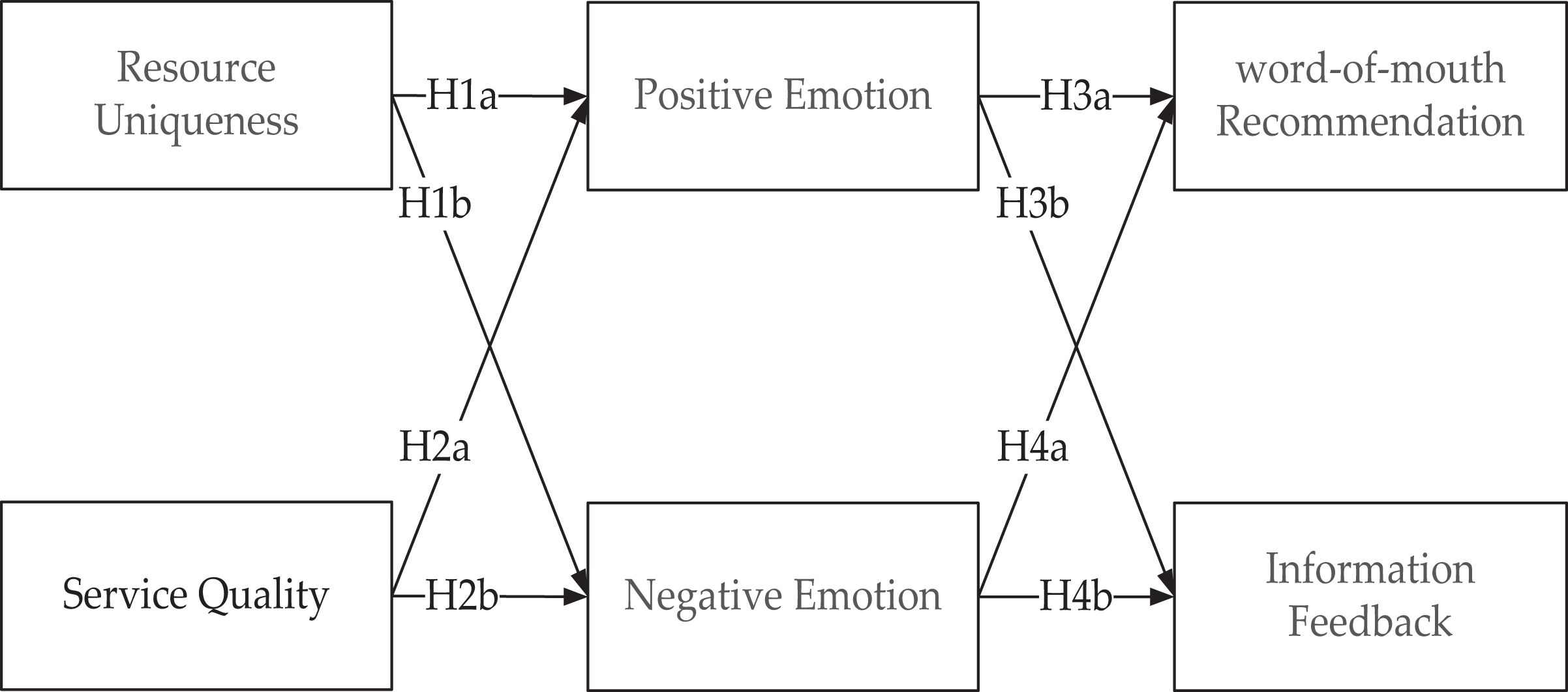
Theoretical framework.
Tourism resource uniqueness and tourist emotion
The theory of uniqueness holds that an individual has unique needs. Consumers with high unique needs prefer to buy novel and different products to highlight the differences between themselves and others (Snyder and Fromkin, 1977). They are more concerned about scarce and innovative products (Lynn, 1992) and like to pursue products with unique designs (Bloch, 1995). Consumers can acquire self-image and social image by purchasing and using unique products, which makes them build up confidence and experience positive emotion (Derbaix and Vanhamme, 2003). Also, according to the SOR model, external environment elements will act as stimuli to affect consumers’ emotions and behaviors (Kisang and Han, 2011; Lee et al., 2011; Ryu and Jang, 2016). Positive emotion has been well established to be associated with events that facilitate the fulfilment of an individual’s objectives. Conversely, negative emotion is associated with events that hinder the fulfilment of objectives (Lazarus, 1991). In other word, products with no uniqueness are more likely to cause consumers’ negative emotions (Lee et al., 2011). With increasing homogenization of resources and services provided by scenic spots, tourists favor destinations which offer impressive emotional experience by providing unique tourism resources and high quality service.
Service quality and tourist emotion
The interaction between customers and service personnel has been confirmed to affect customers’ emotional responses (Tsaur et al., 2015). Several studies have examined the relationships between service cognitive factors and tourists’ behavioral intentions and found that service quality has a positive impact on tourists’ positive emotions and a negative impact on tourists’ negative emotions among Chinese tourists in rural (Su and Huang, 2011b), historical and cultural (Su and Hsu, 2013), and leisure (Su et al., 2016) tourism destinations. Collectively, these studies outline a critical role of high-quality service quality for eliciting tourists’ psychological satisfaction and positive emotions.
Tourist emotion and tourist citizenship behavior
The interaction between consumers and organizations is a form of social exchange. When consumers get benefits from an organization, they will take certain actions to reward the organization (Homans, 1958). Tourists will, therefore, consider their emotional experience during their travel as a kind of gain or loss, and thus make corresponding behavioral responses (Razzak and Yousaf, 2017). If tourists have positive emotions about something, they tend to make positive decisions; on the contrary, if tourists feel negative emotions, they are more likely to make negative decisions. Spector and Fox (2003) indicated that positive emotions encourage people to take positive actions to cater to their emotional state. Lee et al. (2008) also found that positive emotions have a positive effect on consumers’ recommendation and repurchase intentions, while negative emotions have a negative effect. Similarly, Yi and Gong (2008) showed that positive emotions of consumers promote their citizenship behavior.
Tourist emotional response includes not only positive emotions such as happiness, joy, and delight, but also negative emotions such as fear, anger and boredom. When they enjoy themselves in a tourism destination, they will have a positive emotional experience, which will promote and motivate them to behave positively. However, when they have a negative emotion, positive behavior will be disturbed and destroyed. Su and Huang (2011a) found that tourists’ emotions will have an impact on their revisiting tendency and word-of-mouth recommendation. A recent study by Su et al. (2014b) confirmed this conclusion in the hotel service industry. Therefore, we expect that tourist emotion predicts TCB.
The mediating effect of tourist emotion
The SOR model considers that the external consumption environment can influence consumers’ emotional response, which in turn leads to approach or avoidance behavior responses (Mehrabian and Russell, 1974). Existing studies have shown that physical environmental factors such as unique decoration style and spatial layout (Kisang and Han, 2011) and human-related factors such as dress etiquette and body language (Ryu and Jang, 2016; Tsaur et al., 2015) can be used as stimuli. For example, Jang and Namkung (2009) applied the SOR model to understand the relationship among perceived quality (i.e., product, atmosphere, and service)—customer emotion—behavioral intention in the restaurant service context. Tsaur et al. (2015) demonstrated the mediating role of positive emotions in the relationship between the aesthetic labor of service personnel and customer behavior intention based on the SOR model. Similar to the context of this study, Lee et al. (2011) viewed high-technology product attribute as an environmental stimulus, and found that product innovativeness of technology and visual appeal contribute to consumers’ approach–avoidance behavior through cognitive (attitude) and affective states (pleasure). Su et al. (2016) also found the mediating effect of tourists’ emotions in the relationship between service quality, service fairness and word-of-mouth recommendation. Therefore, based on the SOR model, this study considers tourism resource uniqueness and service quality to be external stimuli which influence tourists’ positive and negative emotions, which, in turn, predicts their behavioral intentions.
It should be noted that there are so many hypotheses of mediation effect that they are not marked in the conceptual model.
Method
Sample and procedure
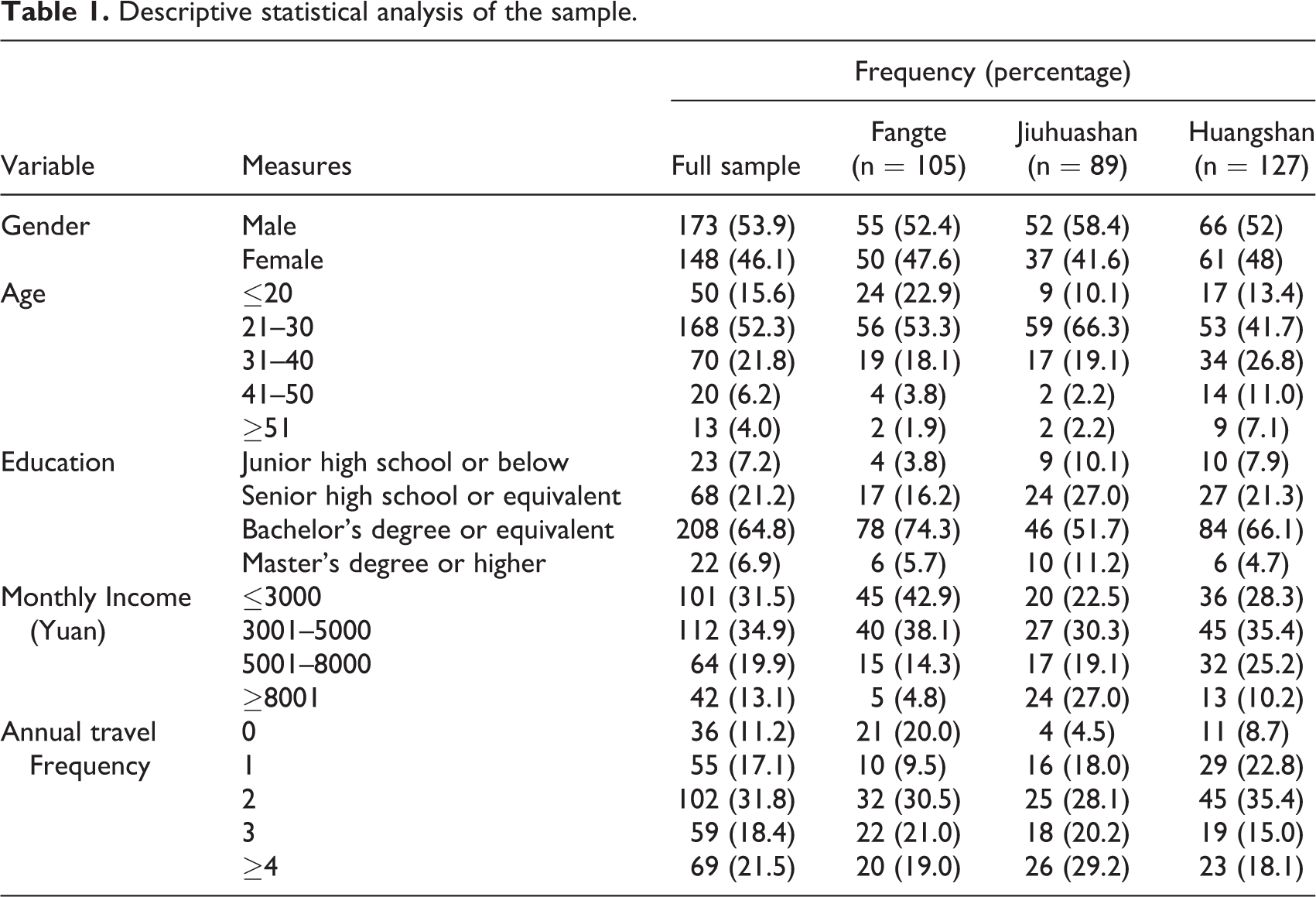
Like many similar studies (Bove et al., 2009; Chan et al., 2017; Garba et al., 2018), this study used paper-and-pencil surveys to collect data. Considering the fact that the emotional experiences of tourists and their effects on behavioral intention may vary according to different types of destinations (Mehran and Olya, 2020), we chose three different types of China’s five-star tourism destinations to provide greater variability and range, i.e. Wuhu Fangte Amusement Park (China’s largest fourth generation theme park located in Wuhu Huaqiang tourist city in Anhui Province), Mount Jiuhua (a World Geopark characterized by Buddhist culture and natural scenery and one of China’s four Buddhist mountains located in Chizhou, Anhui Province) and Mount Huangshan (known as the first Wonder Mountain located in Huangshan, Anhui province, which is a World Cultural and Natural heritage site, a World Geopark, and the only mountain scenery among China’s top 10 scenic spots.). Before sending out the paper questionnaire, we built three investigation teams of three research assistants each for the three targeted destinations and trained them. One team was assigned to each targeted tourism destination. During the field investigation, participants were randomly selected at each site. They were asked to fill in the questionnaire with the guidance and assistance from a team member during their rest time. A total of 367 questionnaires were collected from the three destinations, and 321 valid questionnaires were retained. Table 1 reports the demographic information for the sample. Also, for all observed variables, the absolute values of Skewness (ranging from −0.822 to 0.952) and Kurtosis (ranging from −0.805 to 0.985), except for gender with a Kurtosis value of −1.988, are less than 1.0, and the Q-Q plots appear as a diagonal line. These findings confirm the normality of data. Table 1 shows the demographic characteristics of the full sample and of each of the three groups in this study.
Descriptive statistical analysis of the sample.
Measures
All constructs in this study were adopted from previous studies. All measures were contextually adjusted to assess tourism resource uniqueness, tourism service quality, tourist emotion (i.e., positive and negative emotion), and TCB (i.e., word-of-mouth recommendation and providing feedback). All ratings use 5-point Likert scale responses, ranging from 1 (‘strongly disagree’) to 5 (‘strongly agree’).
A four-item scale adapted from Sundar et al. (2014) was used to measure tourism resource uniqueness (TRU). We adapted four items from Parasuraman et al. (1988) to assess tourism service quality (TSQ) and chose items that were modified to ensure their appropriateness for the context of tourism service. TCB was measured through Groth’s (2005) CCB scale. Specifically, we utilized four items to assess word-of-mouth recommendation (WMR), and providing feedback (PFB) was measured with three items. In this study, tourist emotion was assessed with both positive and negative emotion. When measuring tourists’ emotions, Prayag et al. (2013) and Hosany et al. (2016b) measured positive emotion with many far more items than negative emotion. Similar to Prayag et al. (2013) and Hosany et al. (2016b), eight items (i.e. joy, delight, enjoyment, happy, comfortable, amazement, exited, and surprise) were identified from the DES (Hosany and Gilbert, 2010) to measure tourist positive emotion (TPE). To get a scale better fitting in the present context, five items (i.e. fear, anger, disgust, nervous, and regret), widely used in the PANAS (Watson et al., 1988), the Valence-Arousal emotional space (Cai and Lin, 2011), and the Wheel of emotion (Plutchik, 1980), were chosen and modified to measure tourist negative emotion (TNE).
Five frequently used demographic and social measures, including gender, age, education, income, and annual travel frequency, were considered as control variables, which may influence TCB. A summary of the measures is shown in Table 2.
Results of confirmatory factor analysis.

Results
Common method bias test
The potential common method bias caused by self-reported data, which were collected from a single source at one point in time was tested before data analysis. In this study, we used a confirmatory factor analysis approach to compare the fit indices of the single-factor model and those of the hypothesized six-factor measurement model using AMOS (Cai et al., 2018). Results showed that the fit indices of the hypothesized measurement model (χ2/df = 1.641, GFI = 0.901, TLI = 0.966, CFI = 0.971, SRMR = 0.036, RMSEA = 0.045) were considerably better than those of the single-factor model (χ2/df = 8.908, GFI = 0.534, TLI = 0.578, CFI = 0.610, SRMR = 0.108, RMSEA = 0.157), indicating that the common method bias was not serious in the dataset of this study.
Reliability and validity evaluation
This study uses SPSS17.0 to evaluate the reliability of all constructs. The Cronbach’s α of resource uniqueness, service quality, positive emotion, negative emotion, word-of-mouth recommendation and providing feedback were 0.850, 0.921, 0.937, 0.876, 0.898 and 0.894 respectively, which were higher than the recommended value of 0.7, indicating satisfactory reliability. Furthermore, confirmatory Factor Analysis (CFA) was applied to test the measurement model using maximum likelihood estimation (AMOS). The results of the confirmatory factor analysis for the measurement model are presented in Table 2. The standardized factor loadings range from 0.609 to 0.934, higher than the benchmark value of 0.5. The Average Variance Extracted (AVE) scores range from 0.583 to 0.763, larger than the recommended value of 0.5. Composite Reliabilities (CR) range from 0.856 to 0.935, higher than the recommended value of 0.7, indicating good convergence validity (Fornell and Larcker, 1981; Ziegel, 1998).
In this study, the correlation between two constructs and the corresponding AVE score was compared to assess discriminate validity. The results in Table 3 suggest that the correlations among constructs were lower than the corresponding square roots of AVE, indicating the good discriminate validity (Fornell and Larcker, 1981).
Correlation coefficients and the squared roots of AVE.
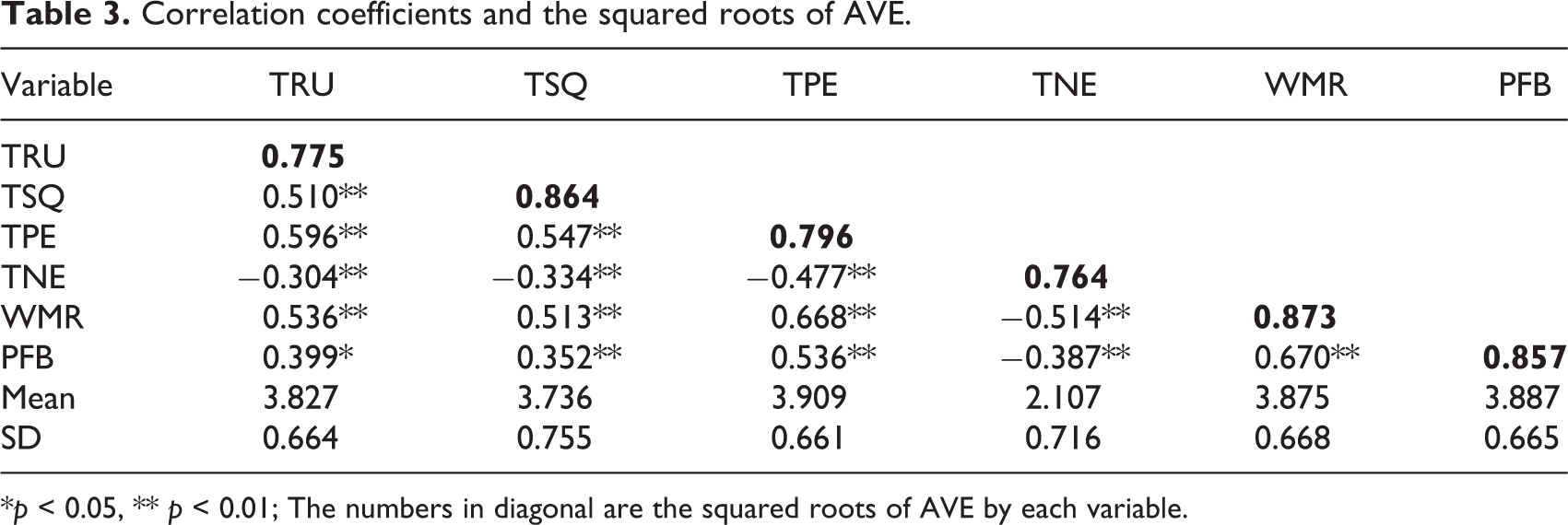
*p < 0.05, ** p < 0.01; The numbers in diagonal are the squared roots of AVE by each variable.
Structural model and hypotheses testing
Mplus7.4 was employed to test hypotheses. The fit indices are acceptable: χ2/df = 2.287, TLI = 0.926, CFI = 0.934, SRMR = 0.064, RMSEA = 0.066, indicating that the structural model fits data of this study well (Bentler, 1990). The results of the structural model test are reported in Figure 2.
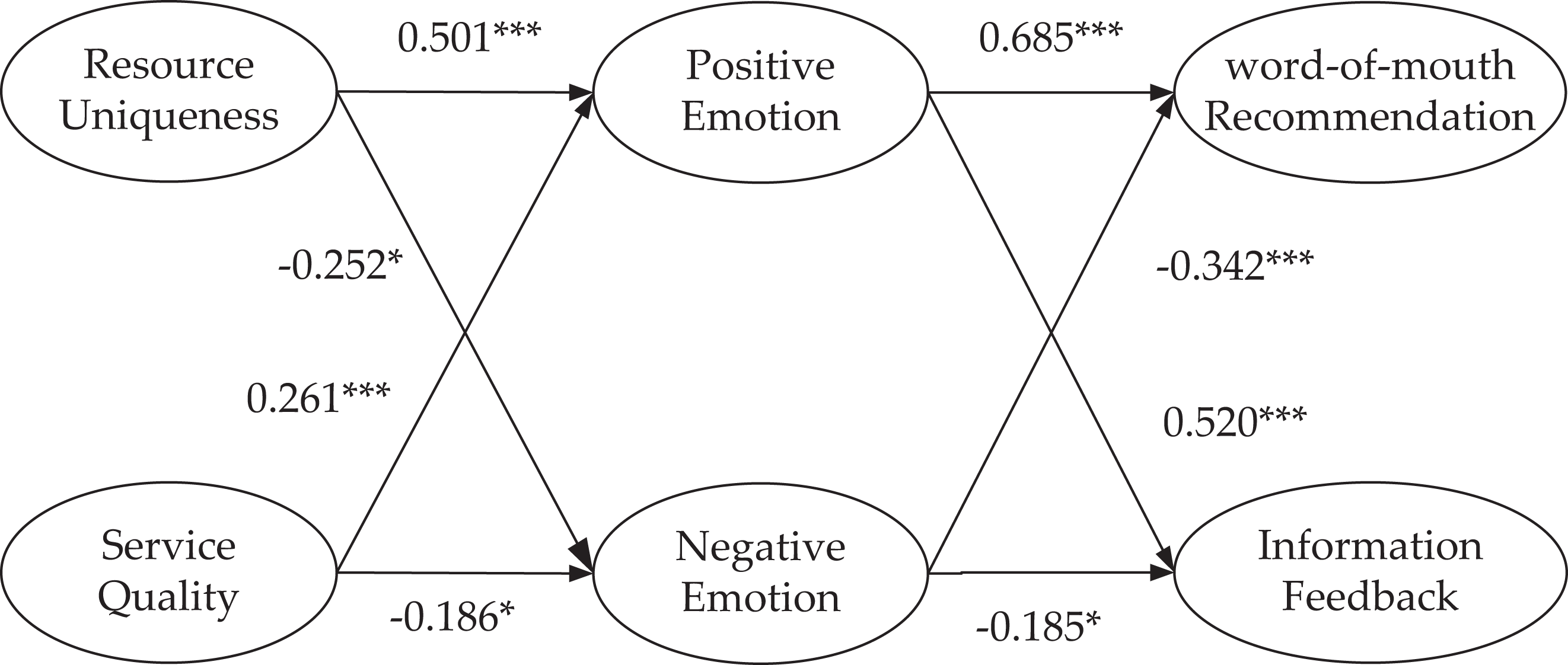
Results of the structural model.
The path coefficients of uniqueness and service quality on positive emotion are respectively 0.501 (p < 0.001) and 0.261 (p < 0.001), and −0.252 (p < 0.05) and −0.186 (p < 0.05) on negative emotion, which shows that resource uniqueness and service quality have significant positive effects on the positive emotion of tourists, while both have significant negative effects on the negative emotion, which supporting H1a, H1b, H2a, and H2b. Positive emotion is associated with word-of-mouth recommendation (β = 0.685, p < 0.001) and providing feedback (β = 0.520, p < 0.001), thus providing support for H3a and H3b. Negative emotion is also found to be correlated to word-of-mouth recommendation (β = −0.342, p < 0.001) and providing feedback (β = −0.185, p < 0.05), suggesting that H4a and H4b are supported.
Mediation effect testing
To further test the mediating effect of tourism resource uniqueness and service quality on TCB through positive and negative emotion, this study used the bias-corrected bootstrap method, with 2000 samples at 95% confidence intervals to examine the mediation effect (Preacher and Hayes, 2004). The results shown in Table 4 indicate that the indirect effect of resource uniqueness on word-of-mouth recommendation is significant through positive and negative emotions, because the 95% confidence intervals are [0.252, 0.464] and [0.027, 0.180], excluding zero; the indirect effect of resource uniqueness on providing feedback is significant through positive and negative emotions, because the 95% confidence intervals are [0.184, 0.375] and [0.011, 0.117], excluding zero. Also, both positive and negative emotion significantly mediate the relationship between service quality and word-of-mouth recommendation, because the 95% confidence intervals are [0.114, 0.278] and [0.026, 0.129], excluding zero; Also, a significant indirect effect of service quality on providing feedback through positive and negative emotions is found, because the 95% confidence intervals are [0.087, 0.216] and [0.013, 0.082], excluding zero. These findings show that all mediation hypotheses are strongly supported, suggesting that tourists’ positive and negative emotions have a significant effect on the relationship between tourism resource uniqueness and service quality, and TCB.
Results of the mediating effects.

Note: TRU = tourism resource uniqueness, TSQ = tourist service quality, TPE = tourist positive emotion, TNE = tourist negative emotion, WMR = word-of-mouth recommendation, PFB = providing feedback.
Evaluation of SOR and SET
This study applied the Stimulus-Organism-Response model and Social Exchange Theory to develop the research model. The SOR model assumes that tourists’ perception of tourism resource uniqueness and service quality influences their citizenship behavior through triggering positive and negative emotional responses. The results confirmed the mediation role of both tourists’ positive and negative emotions in the relationships between resource uniqueness and service quality, and word-of-mouth recommendation and providing feedback (Table 4). Hence, the results of this study confirmed the SOR. Regarding the SET, the results of the structural equation model demonstrated significant effects of positive and negative emotions on two kinds of TCB, i.e. word-of-mouth recommendation and providing feedback. Therefore, the SET is supported by evidence of this study.
Conclusion and implications
Research findings
The purpose of this study was to reveal how tourism resource uniqueness and service quality can encourage TCB in the Chinese context. Specifically, we utilized the SOR and SET to develop a conceptual framework in which tourism resource uniqueness and service quality influence TCB through tourists’ emotions, namely, positive and negative emotion. Results show that tourism resource uniqueness and service quality can positively affect tourists’ positive emotions and negatively influence tourists’ negative emotions. Also, tourists’ positive and negative emotions mediate the relationship between uniqueness and service quality, and TCB. Thus, the findings strongly support the claim that tourism resource uniqueness and service quality can encourage TCB by improving positive emotions and reducing negative ones.
Theoretical implications
This study makes theoretical contributions to previous literature in three ways. Firstly, it contributes to the literature on TCB. Groth (2005) introduced CCB from the perspective of employees within organizations to customers outside organizations. Several studies investigated CCB in marketing literature with the focus on individual customers in offline (Bove et al., 2009; Yi et al., 2013) and online contexts (Anaza, 2014; Zhu et al., 2016). However, little is known about citizenship behavior in a tourism service context (Liu and Tsaur, 2014). This study expands CCB to the context of tourism consumption by investigating how TCB is encouraged among tourists in China and enhances our understanding of TCB by finding that tourism resource uniqueness and service quality motivate TCB through inducing tourist positive and negative emotional responses.
Secondly, this study investigates the role of both positive and negative emotions in creating TCB, thus highlighting the critical role of tourist emotional experiences. Previous studies focused on the impact of tourist satisfaction, trust and commitment on behavior intentions (Prayag et al., 2013, 2015; Su et al. 2014a), but neglect the role of tourists’ emotional experiences on TCB. As a response to the call for exploring the situational antecedents of TCB (Liu and Tsaur, 2014), this study advances our understanding by confirming the effect of tourist emotional responses on TCB, namely, intention to recommend and providing feedback. Aside from the effect of positive emotion, we further highlighted the importance of negative emotion in predicting tourist behavior, namely, TCB in this study, and thus fill a gap in the tourist behavior literature which mainly focuses on positive emotion (Hew et al., 2018; Lee et al., 2011; Tsaur et al., 2015) and offer support for recent exceptions (Hosany et al., 2016b; Su et al., 2016).
Thirdly, the current study offers insights into the antecedents of tourists’ emotions. How to stimulate tourists’ emotions has always been a hot topic for researchers given the vital role of emotions in tourists’ evaluation of tourism experiences. Previous studies have paid attention to the impact of cognitive service factors (Su et al., 2016; Wu and Li, 2017), tourist behavior factors (Su and Huang, 2011a), scenic image factors (Hongwei et al., 2017; Prayag et al., 2013), and social responsibility factors of destinations (Su and Swanson, 2017) on tourist emotions, but they have not examined the role of tourism resource uniqueness in eliciting tourist emotions. In another service context, several studies have shown that the product attributes (e.g., uniqueness, attractiveness, creativity, and usefulness) significantly affect the emotional responses of consumers (Derbaix and Vanhamme, 2003; Lee et al., 2011; Sundar et al., 2014), but few studies are concerned about the impact of tourism resource uniqueness on tourist emotions. This study explores the impact of tourism resource uniqueness on tourists’ positive and negative emotions, thus making up for the lack of research on the antecedents of tourist emotions.
Practical implications
This study has practical implications for organizations in the tourism industry to attract and retain tourists in an increasingly competitive environment. Firstly, tourist emotion is proved to be an important factor affecting TCB, that is to say, with such a rapid development of tourism today, tourism operators should pay attention to the stimulation of tourist emotion if they want tourists to voluntarily engage in beneficial citizenship behaviors toward enterprises. Secondly, for tourists, positive emotion will prompt them to voluntarily engage in positive behavior, while negative emotion may encourage tourists to give a bad evaluation of tourism destinations, and then cause the loss of tourists through word-of-mouth recommendation. Therefore, concerning operators of tourism destinations, it should be recognized that positive and negative emotions of tourists will have completely different impacts. In this regard, operators should try to stimulate tourists’ positive emotions and avoid their negative emotions. Thirdly, since tourism resources uniqueness and service quality can arouse positive emotional responses, destination operators should focus on transmitting the clues of unique tourism resources to tourists in destination advertising campaigns. Also, they must pay attention to providing personalized, friendly, fast and safe on-site services to all tourists in a fair way. Finally, because homogenous tourism resources and low-quality personnel service elicit negative emotions, destination managers need to effectively prevent and manage negative emotions. For example, they can develop unique tourism resources with local and cultural characteristics, and apply for and protect national or world geological, cultural or intangible cultural heritage. Meanwhile, they should emphasize the importance of training field service staffs and tourist guides, and use various techniques to track service quality such as complaint solicitation, service blueprinting, and critical incident technique (Su et al., 2016). If a service failure or complaint occurs, they need to take timely service recovery measures to smooth tourists’ negative emotion caused by poor service.
Limitations
This study explores the impact of tourism resource uniqueness and service quality on TCB and the important role of tourists’ emotions. There are still some limitations to the research process. Firstly, tourists will inevitably experience a variety of different activities during their trip, so their experience will be interwoven with a variety of emotions. However, the cross-sectional data used in this study cannot accurately reflect the dynamic relationship between tourist emotions and variables. Secondly, although this study takes into consideration different impacts of different types of scenic spots, the sample is not widely representative if the questionnaire is only issued for scenic spots in Anhui Province. Moreover, there may exist an interviewer bias, because young research assistants tend to select participants closer to their age group (Table 1 indicates a low proportion of participants over 41 years old and lowly educated), which may challenge the results. Hence, future research is expected to collect more diverse samples to enhance the universality and reliability of research findings. Thirdly, like most extent literature, this study used structural equation modeling and bootstrapping procedures to test hypothesis. Actually, tourists’ behavioral intentions such as TCB in this study are determined by external antecedents and their complex interactions (Mehran and Olya, 2020). Future studies will benefit from identifying sufficient configurations in predicting TCB using qualitative comparative analysis (Ragin, 2008).
Footnotes
Authors’ note
Lin Liu and Tingting Cui share the first authorship.
Acknowledgements
The authors are very grateful to the reviewers for their valuable suggestions, especially for a reviewer’s help in correcting grammatical errors.
Declaration of conflicting interests
The author(s) declared no potential conflicts of interest with respect to the research, authorship, and/or publication of this article.
Funding
The author(s) disclosed receipt of the following financial support for the research, authorship, and/or publication of this article: This research was funded by the National Natural Science Foundation of China (11705002), the Humanities and Social Sciences research projects of the Chinese Ministry of Education (18YJCZH102), the Humanity and Social Science Major Foundation of Education Committee of Anhui province (SK2019ZD07), the Open Fund of Key Laboratory of Anhui Higher Education Institutes (CS2020-ZD01), and the Natural Science Foundation of Anhui Province (1908085MG238 and 1908085QG301).
