




Abstract
This study aimed to develop the destination consumption-customer attitude model to explain tourist travel satisfaction and revisit intention with the moderating effect of religious involvement. Data were collected using a survey questionnaire. Respondents of 392 tourists who visited four major Buddhist monasteries in Taiwan have been analysed, and research hypotheses were assessed by employing partial linear square structural equation modelling (PLS-SEM). The findings revealed that destination consumption has positive and significant effects on rational attitude and emotional attitude toward revisiting a destination, which further facilitates travel satisfaction and revisit intention. Furthermore, this study supported the moderating role of religious involvement on the influence of national and emotional attitude and travel satisfaction on revisit intention. The results emphasized that symbolic experiential and functional consumption of a certain religious destination will significantly influence the rational and emotional attitudes toward revisiting the same destination. These results suggested that destination marketer should design a tourist’s destination consumption based on not only functional factors but also symbolic factors (such as self-concept, lifestyle, and destination) and experiential factors (such as entertainment, joy, pleasure, escape). Since the issues of destination consumption were still subject to further validation, this study provided an important reference for destination marketing to develop marketing strategies. The results were also valuable to provide as a theoretical base for further empirical validation.
Keywords
Introduction
As one of the very early forms of tourism, religious tourism has emerged as the fastest-growing part of the industry (Apleni et al., 2017). It is estimated that religious tourist sites attract more than 300 million tourists and are worth around US$300 billion per year (Gabor, 2016). In fact, the question of how to attract tourists to visit and revisit religious sight-seeing spots has become a critical issue because it serves as a driver for cultural activities, social interactions, financial incomes, and transportation planning (Chen and Chen, 2010). Millions of people are travelling to sacred places at any point in time. However, not all tourists are pilgrims. Kim et al. (2020) argued that ‘religious tourism in sacred sites has been facilitated simultaneously by tourists from being religious and non-religious, who exhibit distinct behavioural patterns’. Therefore, more recent studies of religious tourism have evolved into considerations of secularity (Nilsson and Tesfahuney, 2016). Some scholars then observed the distinct motivations between pilgrims (who seek for spirituality, contemplation, and tranquillity) and tourists (who seek for fun, joy, playfulness, and entertainment). Kim et al. (2020) further clarified that religious tourists’ perceptions can be understood through their motivations, behaviours, and beliefs and some of them even choose religious destinations for seeking new experiences (such as nature, sports), with a very low religious motivation. As the case of Humanistic Buddhism, a modern philosophy practised by Buddhist groups originating from Chinese Buddhism, which places special emphasis on integrating Buddhist practices into everyday life, is now prevalent in Taiwan (Chia, 2015). However, Terzidou et al. (2018) argued that religious tourists’ motivations or attitudes maybe more complex. Piety may be characterized as the core motivation for pilgrims, whereas tourists are motivated by the prospect of cultural, natural, and infrastructural encounters (Damari and Mansfeld, 2016). Therefore, the first aim of this study is to investigate the relationship between tourists’ destination consumption, travel attitudes, and the influence of those on travel satisfaction and revisit intention using the tourists of four famous Monasteries in Taiwan.
Previous studies tended to evaluate travel motivation through cognitive evaluation (Chiu et al., 2016), where tangible attributes serve as the main drivers for tourist destination consumption. Agapito et al. (2013) addressed the issues of destination positioning analysis from the perspective of cognition, affect, and conation. Cognition is the sum of awareness, knowledge beliefs focusing on physical attributes (San Martín and Del Bosque, 2008). Affect represents the feelings toward an object, such as pleasant/ unpleasant, relaxing/ distressing, arousing/sleepy, and exciting/gloomy (Jalilvand et al., 2012). Conation is the intent or acing components (Kim et al., 2013). Pike and Ryan (2004) argued that previous studies on destination positioning tended to focus on the cognitive perception of different attributes, such as suitable accommodation, good value for money, a comfortable drive from home, natural scenic beauty, and good restaurant; with relatively little attention on affective (or emotional) perception. Buddhism has sometimes been claimed to be over-commercialized especially for the case of Shaolin Monastery (Hung et al., 2017). Thus, a balance between pilgrims and religious tourists should be evaluated. It seems that pilgrims are more likely to visit holy places, while religious tourists tend to enjoy their leisure through various kinds of heritage sites, cultural events, and infrastructure, and less emotionally or spiritually connected at religious philosophies (Damari and Mansfeld, 2016). Kim et al. (2020) argued that detailed studies are needed on the perception of subjects of religious tourists and pilgrims. Scholars have argued that religious tourists visiting sacred sites may visit to achieve spirituality, religious goals, and aspiration (Nilsson and Tesfahuney, 2016), while non-religious tourists may be motivated by the prospect of both cultural, natural and general sight-seeing encounters (Olsen and Wilkinson, 2016). Therefore, understanding the distinguish of religious and non-religious motives can allow a better targeting and attracting and effective communication with the tourists (Drule et al., 2012). Following the comments from Kim et al. (2020) and other scholars, this study’s second aim is to propose that in addition to the emphasized religious cognitive perception, the emotional aspect and affective process of experiences should be considered.
Finally, involvement is an important construct in the marketing and consumer behaviour field and can be defined as the perceived importance and interest toward the acquisition, consumption, and disposition of a good, service, or event (Gross and Brown, 2008). It plays a critical role in predicting purchasing behaviour, information searching, developing brand loyalty, and product identification (Campos et al., 2017). Involvement is usually measured by three dimensions: the perceived importance/pleasure, the degree in which individual express their-self, and the extent to which individual’s social network revolve around (Jin et al., 2019). Most researchers have categorized involvement as enduring and situational involvement (Calvo-Porral et al., 2018). Situational involvement is temporary and influenced by a change in a particular time, whereas enduring involvement refers to the general relevance or feeling of a good, service, or event in a long period of time. In tourism, religious involvement refers to the level of involvement in places of religious tourism and can be both situational (for non-religious tourists) and enduring (for religious tourists). As the world has become more and more inauthentic, religious tourism has grown rapidly, and religious involvement can play a significant role for tourists to evaluate the attributes of religious destinations (Griffin and Raj, 2018). Sharpley and Sundaram (2005) proposed that tourist religious involvement may moderate the influence of attitude on travel satisfaction and revisit intention. However, not many studies have identified the relationship between religious involvement, attitude with travel satisfaction and revisit intention. In the visiting of religious destination, the moderating roles of religious involvement become so important that under higher religious involvement, the influence of rational and emotional attitudes and satisfaction on revisit intention can be accelerated, while under lower religious involvement, the above influence routes may not be activated. However, the moderating role of religious involvement are still being neglected until now.
This study intends to fill this research gap and contribute to the tourism literature, specifically the religious tourism literature. The objective of this study is to provide a comprehensive model of religious destination consumption on tourist attitude, satisfaction, and revisit intention. The moderating effects of religious involvement on the influence of customer attitude on travel satisfaction and revisit intention are also explained.
Literature review and hypothesis development
Religious tourists’ motivation on religious destination
In a comprehensive review of the literature on religious tourism, Kim et al. (2020) concluded that religious destinations may have all tourist types ranging from the sacred to the profane who exhibit multiple motivations. A previous study in Taiwan illustrated that approximately 25% of the tourists have a real profound of beliefs, whereas 40% of them have little sense of devotion (Shuo et al., 2009). Fleischer (2000) concluded that pilgrims are most likely to visit holy places, while tourists enjoy their leisure through different activities.
Researchers have proposed the issues of how tourist identities can be referred as a critical factor for understanding religious tourism. Religious and non-religious tourist have exhibited distinct perception patterns. Religious tourists are affiliated with religious beliefs, motivations, and purposes based on spirituality, faith, and piety (Wang et al., 2016), while non-religious tourists are likely to recognize religious sites as a temple or monastery with religion, culture and society-embedded (Fleischer, 2000). This study used both religious and non-religious tourist as the respondents and conducted an empirical survey to understand the relationships between tourists’ destination consumption, travel attitudes, and their influence on travel satisfaction and revisit intention using the tourists of four famous monasteries in Taiwan.
Destination consumption
According to Chen et al. (2016), tourists discover benefits while travelling and then create destination consumption, which consists of symbolic, experiential, and functional consumption. Symbolic consumption focuses on ‘the use of products as a mechanism of creation, development, and preservation of individuals’ images’ (Edson and Bettman, 2005: 8). Individuals can acquire, create, preserve, and present their identity through consumption (Sun et al., 2014). Tourists tend to apply self-congruence (match between destination image and self-image), lifestyle congruence (match between destination experience and individuals’ lifestyles), and destination brand identification (brand integrates into value and tourists’ self-concept. In the tourism context, symbolic consumption means that tourists tend to visit or choose destinations and perform related activities that reflect individuals’ religious practices (Moran et al., 2018). On the other hand, experiential consumption focuses on the subjective evaluation of experiential quality (Chen and Chen, 2010). Experiential consumption is derived from the ability of tourist destinations to elicit appropriate experiences, feelings, and emotions in customers (Chang et al., 2014). Tourism experiential consumption is measured by different approaches such as hedonism and refreshment (Kim et al., 2012); local culture, variety of activities, hospitality, hypsography, place attachment, and superstructure (Kim, 2014); or joy, love, and positive surprise (Li et al., 2015). Finally, functional consumption focuses on the attributes provided in the tourism objects (Campbell, 1987). As described by Sop and Kozak (2019), functional consumption explains why consumers tend to consume certain goods or services, and focuses on matching the utilitarian value of a destination’s functional attributes with tourists’ ideal type of performance. Most previous studies have identified functional consumption based on the service quality of the destination (Nam et al., 2011).
Customer attitude
Customer attitude has been extensively studied in the literature. In expectancy-value theory, Ajzen and Fishbein (2008) explained that attitudes are formed, developed, and modified based on the consumption and evaluation of beliefs and values. Li et al. (2018) further described tourist attitudes as the psychosocial tendencies expressed by the positive or negative evaluations of tourists when engaged in certain tourism activities. In an attempt to measure attitudes, Farley and Stasson (2003) adopted a two-dimensional conceptual framework of consumer attitudes: the rational dimension derived from the functions or attributes of the tourist destination while the emotional dimension resulted from the sensations derived from the experience visiting tourist destination. The theory of reasoned action (Ajzen and Fishbein, 1975) argued that a consumer’s actual behaviour toward a religious destination could be predicted by the strength of his/her intention to pursue the behaviour, the attitudes (toward a religious destination), and the subjective norm regarding the destination.
Travel satisfaction
Suh and Youjae (2006) described tourists’ satisfaction as an important factor in the destination marketing success because it influences the tourists’ choice of the destination, consumption of products and services, and intention to revisit the tourist place. Tourism researchers have continuously studied the concept of tourist satisfaction, as it is one of the most crucial factors in evaluating a destination’s performance and affects potential tourists’ destination selection (Milman and Tasci, 2017). Kozak (2001) summarized various approaches regarding satisfaction, including expectation-performance, importance-performance, disconfirmation approach, and performance-only approach. In the context of tourism, travel satisfaction with a destination can be identified as a gap analysis between pre-travel expectation and post-travel experience (Haque and Momen, 2017). It is in line with the concept of expectation-disconfirmation model by Oliver (1980), which explained that individuals tend to compare the actual performance with their expectations. In other words, if tourists feel that the actual performance or attributes in the tourist place better than their expectation, it will lead to positive disconfirmation. Positive disconfirmation means tourists have high satisfaction toward the tourist place and more willing to visit that place again in the future. On the contrary, when the actual condition is worse than the expectation, tourists will feel dissatisfied. This study employs travel satisfaction as the positive disconfirmation of the tourists because of the actual condition and attributes of tourist destination is higher than their expectation.
Destination revisit intention
Destination revisit intention is considered as tourists’ desire to visit the same destination for the second time (Chang et al., 2014). Han and Kim (2010) defined that revisit intention refers to ‘an individual’s readiness or willingness to make a repeat visit to the same destination’. Tourists’ destination revisit intention is vital to tourism organizers, since these tourists bring many benefits, one of which is that attracting repeat tourists costs less than attracting first-time tourists (Osti et al., 2012). Moreover, repeat tourists tend to recommend certain tourist destinations to others through positive word-of-mouth and are more likely to stay longer than first-time tourists (Carranza et al., 2018). Furthermore, tourists’ intention to revisit a tourist destination can be influenced by the performance of the staff or related service activities at the destination, which can be achieved through promotional efforts and the introduction of new attractions (Wu et al., 2014). In this study, revisit intention is referred as the tourists’ willingness to visit again at the same tourist place.
Religious involvement
A religion is established by the collective spiritual experiences of a group of people through the system of practices and beliefs. Religious involvement is mentioned as the frequency of participation in an organized religion. Derezotes (1995) defined religious involvement as a system of beliefs, rituals, and behaviours, usually shared by individuals within an institutionalized structure. Allport (1966) as one of the major contributors of religion study has explained two components of religious involvement: extrinsic and intrinsic. Extrinsic religious involvement includes instrumental and utilitarian values that individuals derive from religion for their own uses, such as security, social relationship, status, and so on. On the other hand, individuals with intrinsic religious involvement find their master motivation in religion and strive to transcend self-centrered needs (Hunt and King, 1971). Religious involvement later is considered as the development of an individual’s involvement in organized religion as well as the salience of religion to the individual’s everyday life, as indicated by behavioural or perceptual measures such as perceived essentials of religion (Agorastos et al., 2014). In more detail, Ellison (1991) explained that there are several aspects of religious involvement, including denominational ties, social integration, divine relations, and existential certainty which encourage tourists or pilgrims to travel.
Hypothesis development
Functional consumption can be considered as a pivotal driver in tourists’ overall rational attitude to a specific destination (Jani and Han, 2011). Thus, the service provider should offer functional or utilitarian values to help tourists develop feelings of trustworthiness. Specifically, tourism service, facility quality, accommodation, food, and transportation can determine whether or not the tourist destinations put efforts to provide the promised functional consumption. Functional consumption can improve the cognitive value of a religious destination, which further facilitates rational attitudes (Wu et al., 2014). Experiential consumption is critical essential factor to promote hedonic attitudes. Previous studies have emphasized the importance of aesthetic experience because it can invoke feelings of arousal, such as joy, pleasure, delight, and escape (Wei and Tasci, 2019). It can also reduce any discrepancy between tourist expectation and performance, helping to construct value, trust, and rational attitude toward the religious place (Haque and Momen, 2017). For example, playfulness can support visiting some religious locations, because, instead of highlighting the religious aspect, it can improve and enrich tourist beliefs in the destination (Kim, 2014). Symbolic consumption is one of the important factors to facilitate rational attitude toward revisit intention. Sirgy et al. (2018) proposed an integrative model of self-congruity and tourist attitude and behaviour, whereby the higher the self-congruity level between a destination image and the potential tourist’s self-concept, the more likely that the tourist would have a positive cognitive attitude to a destination (Ekinci et al., 2013; Sop and Kozak, 2019). Tangsupwattana and Liu (2017) also contended that symbolic consumption would promote tourists’ rational attitudes to religious destinations. In the moment to promote a religious place, it is possible that improving the perceived experiential consumption, symbolic consumption, and functional consumption can nurture the trust and the image of the place. Based on the above explanation, this study proposes that:
Hypothesis H1a: Symbolic Consumption has a positive effect on rational attitude.
Hypothesis H1b: Experiential Consumption has a positive effect on rational attitude.
Hypothesis H1c: Functional Consumption has a positive effect on rational attitude.
Previous studies in marketing have proposed hedonic and utilitarian values as two of the most important factors facilitating tourist satisfaction and behaviour (Wei and Tasci, 2019). Wu et al. (2014) concluded that the more experiential value that tourists gain, the more satisfied they will be with the destination. Destination experience is a significant determinant of tourist outcome, especially tourist satisfaction (Wu and Ai, 2016). Moreover, according to identity theory (Stets and Burke, 2000) and theory of communities of practice (Wenger, 1998), symbolic consumption composed of destination identification, self-congruence, and lifestyle congruence may represent a vital driver of travel satisfaction. Following Agorastos et al. (2014), the desire to be seen as a part of a group is an important antecedent of feeling satisfied with the chosen religious destination. Tourists who possess specific feelings or preferences regarding religious practices may enjoy the interactions with other tourists and may learn more about that specific community. This learning will be internalized if tourists consider that this is appropriate for their self-identity, self-congruence, and lifestyle congruence; otherwise, they may not absorb the information (Chen et al., 2016). Nam et al. (2011) argued that functional consumption based on functional attributes, such as service quality of the tourist destination, will promote travel satisfaction. Tourists who committed to learning more about the religious destination, the customs, the rituals, and so forth, may choose a religious destination that lets them pursue this goal. Moreover, sometimes the tourists may feel interested in having some knowledge before their travel experience transforming this knowledge as a part of their self-identity or their own self-aspects, allowing them to have a higher level of travel satisfaction. Based on the above explanation, this study proposes that:
Hypothesis H2a: Symbolic Consumption has a positive effect on travel satisfaction.
Hypothesis H2b: Experiential Consumption has a positive effect on travel satisfaction.
Hypothesis H2c: Functional Consumption has a positive effect on travel satisfaction
Tourists choose a religious destination based on symbolic meanings and relation to their self-congruence, self-identity, and self-concept (Sun et al., 2014). These symbolic meanings may reinforce their emotional attitudes toward religious places (Ekinci et al., 2013). For example, Sirgy et al. (2018) found that self-congruence and self-identity may enhance the perceived values that tourists would experience during their visit. Therefore, if tourists identify themselves with the religious activities of certain destination, this identification may further enhance the development of emotional attitudes, creating a sense of belonging (Ekinci et al., 2013). Moreover, this identification may build up some affective image toward the destination (Chen et al., 2016). Religious tourism encompasses the identification of a specific community that may possess the same beliefs and culture, developing higher levels of experiential and spiritual values. On the other hand, functional consumption may increase the utilitarian value that tourists experience during their visit (Wu and Ai, 2016). Functional consumption is also vital for developing a desirable emotional attitude; for example, some tourists may have specific requirements regarding the food, facilities, bible and so forth, which may help them enjoy and develop an affective image of the destination (Lee et al., 2011). Based on the above explanation, this study proposes that:
Hypothesis H3a: Symbolic Consumption has a positive effect on emotional attitude.
Hypothesis H3b: Experiential Consumption has a positive effect on emotional attitude.
Hypothesis H3c: Functional Consumption has a positive effect on emotional attitude.
Aliman et al. (2014) found that destination consumption is one of the most crucial antecedents of tourist satisfaction in Langkawi Island, Malaysia. Stylos et al. (2017) further proposed that the association between functional consumption of destination and revisit intention is positive and statistically significant. They confirmed that when tourists have a more favourable rational attitude toward a tourist location, the possibility that they may decide to revisit the same place will be higher. Furthermore, Hallmann et al. (2013) used service quality, physiography, tourist management, facilities, hospitality, and costs as different attributes to approach the cognitive value that tourists may have toward a destination. More precisely, in their study, cognitive evaluation of destination attributes was identified as the most influential predictor of revisit intention. In addition, religious destinations that produce positive cognitive evaluation in the minds of tourists can increase tourist satisfaction, and therefore facilitate higher levels of destination revisit intention (Haque and Momen, 2017). These studies argue that positive cognitive evaluation will increase tourist travel satisfaction and revisit intention by reducing any potential risk and uncertainty perception related to a religious destination. Based on the above explanation, this study proposes that:
Hypothesis H4: Rational Attitude has a positive effect on travel satisfaction (a) and revisit intention (b).
Experiential and emotional states, such as feelings of well-being, excitement, and happiness, are conceptually expressive of tourists’ experiential perception which can be used as a predictor of travel satisfaction (Muskat et al., 2019). When tourists have experiences related to attributes or functional matters at tourist places, such as quality of the site, arrangement of the site, or the services of the organizers, then they will feel satisfied (Wu et al., 2014). According to Chua et al. (2014), when tourists perceive a high level of experiential value, such as excellent service or aesthetic decoration, they tend to have favourable behaviour intention, such as intention to revisit. In the context of tourism, experience of fantasy, playfulness, and enjoyment in the tourist location will influence tourists’ attitudes and encourage them to revisit the same place (Lee et al., 2011). According to Wu et al. (2014), tourist intention to revisit the same destination is influenced by the feelings of satisfaction and positive experience that tourists garnered during their travelling. Moreover, Eaude (2009) concluded that, in general, tourists’ experiential value could help individuals avoid individualistic behaviour and develop more introspective behaviour, which creates greater satisfaction and a good memory that may generate a willingness to revisit the same destination. Apleni et al. (2017) argued that religious activities related to perceptions, mediation, and wisdom are some of the determinants of overall satisfaction and future behaviour intention. Milman and Tasci (2017) argued that tourists’ rational and emotional attitude to revisit will influence their revisit intention for a theme park destination. Based on the above explanation, this study proposes that:
Hypothesis H5: Emotional Attitude has a positive effect on travel satisfaction (a) and revisit intention (b).
Tourist satisfaction and revisit intention have been widely studied in the literature as the outcome variables of a destination visit. Sirgy et al. (2011) explained that tourists who feel satisfied with experiences during travelling will create positive effects or less negative effects on their life satisfaction. The higher the travel satisfaction, the higher will be the intention to revisit the destination (Wu et al., 2014); tourists who feel satisfied and happy with their travelling will intend to visit the same place again. According to bottom-up spillover theory, tourists experience both positive and negative feelings in relating to their travel experience to the destination and tourist satisfaction can be derived from a summation of the positive and pleasant travel experiences (Huang et al., 2019). Researchers further clarified that with those travel experiences, tourists will feel satisfied and more likely to revisit the destination (Vada et al., 2019). Similarly, Stylos et al. (2017) explained that tourists who feel satisfied with experiences they gain when travelling are likely to return to the same destination. Based on the above explanation, this study proposes that:
Hypothesis H6: Travel satisfaction has a positive effect on revisit intention.
According to Davis et al. (2017), product involvement can be related to an individual’s perception of the importance of an explicit product category. Moreover, high customer involvement will lead to a strong interest in seeking information related to the product and high repurchase intention (Rauyruen and Miller, 2007). Chen and Tsai (2008) argued that high levels of product involvement can increase the possibility that customer attitudes will lead to higher levels of loyalty, and increase the possibility that satisfaction will lead to greater loyalty. Applying this finding to the religious tourism field, this study argues that religious involvement may moderate the associations between rational attitude, emotional attitude, and travel satisfaction on revisit intention (Sharpley and Sundaram, 2005). More precisely, religious involvement has been proved to increase travel satisfaction and strengthen these associations (Suh and Youjae, 2006). As religious involvement increases, tourists may be willing to search for more information regarding the religious destination (Blackwell, 2007). When there is low religious involvement, tourists may not possess sufficient information for judgement, which might affect their attitude to the religious destination. Furthermore, religious involvement may increase the perception of an image of the religious destination, and thus intensifying travel satisfaction and revisit intention in religious spots. Based on the above explanation, this study proposes that:
Hypothesis H7a: Religious involvement has a moderating effect on the relationship between rational attitude and revisit intention.
Hypothesis H7b: Religious involvement has a moderating effect on the relationship between travel satisfaction and revisit intention.
Hypothesis H7c: Religious involvement has a moderating effect on the relationship between emotional attitude and revisit intention.
Based on the results of the literature review, this study developed a research framework, as shown in Figure 1.
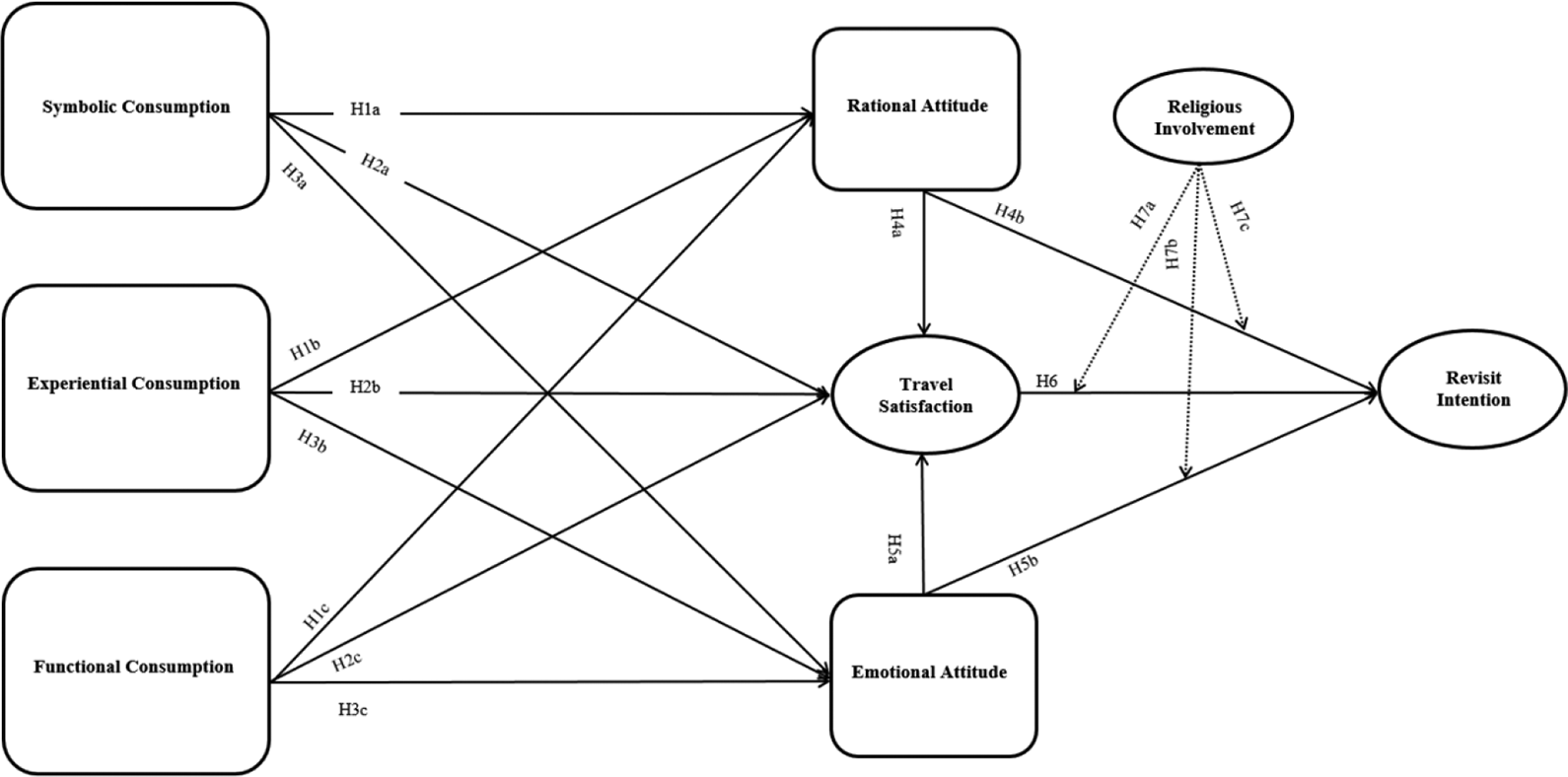
Research framework.
Methodology
To test the hypotheses, eight research constructs and respondent demographic information were operationalized from the literature review. All items were measured by a seven-point Likert scale, from 1 = strongly disagree to 7 = strongly agree. The symbolic consumption construct was measured using six items from Ekinci et al. (2013) and Gazley and Watling (2015). The experiential consumption construct was measured by four items adapted from Grappi and Montanari (2011). The functional consumption construct was measured by four items adapted from Chen and Myagmarsuren (2010). The rational attitude construct consisted of 10 items from Stylos et al. (2017) and Sweeney and Soutar (2001), while emotional attitude consisted of 11 items from Matheson et al. (2014) and Stylos et al. (2017). Four items of tourist satisfaction (Wu et al., 2014) and four items of revisit intention (Stylos et al., 2017) were used to measure tourist satisfaction and revisit intention, respectively. Finally, religious involvement was measured by seven items from Ellison (1991).
There are approximated 2300 Buddhist monasteries in Taiwan. Among them, there are four of the most famous monasteries in Taiwan with millions of followers and have international recognitions. Fo Guang Shan, located in Kaohsiung and founded by Venerable Master Hsing Yun, is the largest Buddhist monastery in Taiwan, with a tourist size of more than 10 million per year. Chung Tai Chan Monastery, located in Nantou County and founded by Venerable Master Wei Chueh, is another important Buddhist organization in Taiwan, with its renowned architecture for its integration of Chinese and Western Engineering methods and Buddhist artefact exhibition. Dharma Drum Mountain, located in Taipei and founded by Chan Master Sheng-Yen, is a famous international Buddhist spiritual, cultural and educational foundation in Taiwan, with the goal of improving the world and establishing a ‘pure land on the Earth’ through Buddhist education. Tzu Chi, located in Hualien and founded by Venerable Master Cheng Yen, a Taiwanese Buddhist nun, is considered as another greatest monastery in Taiwan, with more than 10 million members worldwide throughout more than 50 countries.
Using a convenience sampling method, international tourists visiting one of the above four monasteries were invited to participate in the study. Respondents have been advised that their participation was voluntary and free of charge, and their answers would be kept confidential. Respondents were asked to complete the self-administered questionnaire in about 10 minutes on-site, usually when they were waiting to see the next attraction spot or taking a rest after visiting an attraction spot. Totally, 115 questionnaires were distributed to each of the four monasteries. Eventually, we received 428 questionnaire responses, but only 392 were usable. The characteristics of the respondents are shown in Table 1.
Demographic and descriptive information of sample for this research.

Results and findings
Evaluation of the measurement model
Based on Hair et al. (2011), in order to measure the reliability, validity and justify the goodness of fit of the measurement model, the results of this study have to fit through five main criteria. The first criterion is the average variance extracted (AVE) that accessing the convergent validity of the construct. In this study, the AVE of the constructs ranged from 0.703 to 0.926, which are greater than 0.5 to demonstrates satisfactory reliability and convergent validity of the research constructs. Secondly, the composite reliability (CR) ranged from 0.805 to 0.963, which is much greater than 0.6 to confirm that the variables shared by the respective indicators is strong. Thirdly, the Cronbach alpha’s coefficient ranged from 0.779 to 0.979, which is greater than 0.7 and confirms the internal consistency of the research construct. The next criterion is the coefficient of determination (R2) that measures the amount of explained variance of each endogenous latent. Schroer and Hertel (2009) argued that R2 should be considered to be in three levels, such as substantial (greater than 0.672), moderate (0.33), and weak (less than 0.19). As shown in Table 2, R2 for the four latent variables are as following: 0.450 for rational attitude which is considered moderate, 0.553 for emotional attitude, 0.682 for travel satisfaction and 0.528 for revisit intention which are considered substantial. Finally, GoF is 0.80, which is considered as robust (Hair et al., 2016). Based on the above results, it is concluded that the reliability and convergent validity of the research model are appropriate, which enabled the authors to proceed with an evaluation of the structural model.
Correlations among the research constructs.

Furthermore, in order to measure the discriminant validity of each latent construct, this study applied the Fornell-Larcker test (1981), stated that if the square root of the AVE is greater than the coefficients between that latent construct and other latent constructs in the measurement model, then the model satisfies the criteria of discriminant validity. As shown in Table 2, the square roots of AVE as shown in the diagonal are significantly higher than the person correlation coefficients as shown below the AVE diagonal. Therefore, the discriminant validity of the research constructs is confirmed.
Evaluation of the structural model: Hypothesis testing
Using a sample of 392 participants, a non-parametric bootstrapping procedure was performed with PLS-SEM with 5,000 sub-samples to obtain the statistical significance of each path coefficient for hypothesis testing A total of 17 hypotheses are accepted.
Destination consumptions (particularly symbolic consumption, experimental consumption, and functional consumption) are shown to have a positive and significant influence on rational attitude, with β = 0.731, t-value = 22.746, β = 0.240, t-value = 4.012, β = 0.512, t-value = 15.117 respectively, thus supporting H1a, H1b and H1c. The results also showed the positive and significant relationship between destination consumption and travel satisfaction (β = 0.316, t-value = 14.699, β = 0.059, t-value = 12.741, and β = 0.2161, t-value = 6.884 respectively), and this supports H2a, H2b, and H2c. Similarly, three hypotheses which state the relationship of symbolic consumption, experiential consumption, and functional consumption with emotional attitude (β = 0.680, t-value = 19.574, β = 0.257, t-value = 3.450, and β = 0.213, t-value = 7.211) also receive positive support. Tourists judge the destination using a different set of beliefs about themselves, particularly religious tourists who tend to have more sense of ‘identification’; thus symbolic consumption may reinforce their emotional attitudes toward the religious places (Ekinci et al., 2013).
Furthermore, rational attitude is found to be positive and significantly related to travel satisfaction (β = 0.059, t-value = 2.241, p-value < 0.05) and revisit intention (β = 0.159, t-value = 2.241, p-value < 0.05), which supports H4a and H4b. Emotional attitude is also found to be positive and significantly related to travel satisfaction (β = 0.782, t-value = 13.031, p-value < 0.05) and revisit intention (β = 0.215, t-value = 12.364, p-value < 0.05), which supports H5a and H5b. Finally, travel satisfaction is proved to have a positive and significant impact on revisit intention (β = 0.598, t-value = 7.503, p-value < 0.05).
Lastly, the moderating effect of religious involvement on the relationship between rational attitude and revisit intention is significant at β = 0.023, t-value = 3.059, which supports H7a; this means that when there is religious involvement in the trip, the effect of rational attitude and destination revisit intention will be accentuated. Similarly, the other two moderating effects of religious involvement on the relationship between travel satisfaction and revisit intention (H7b), and between emotional satisfaction and revisit intention (H7c) also received positive support (β = 0.133, t-value = 7.105, and β = 0.103, t-value = 6.148).
Discussion and conclusion
Conclusion
The major purpose of this study is to provide a comprehensive model of destination assumptions on customer attitude, satisfaction, and revisit intention for religious tourist destinations. The moderating effects of religious involvement on the influence of customer attitude on travel satisfaction and revisit intention are also evaluated.
This study contributes to religious tourism literature by proposing a comprehensive model of symbolic consumption, experiential consumption, functional consumption, rational attitude, emotional attitude, customer satisfaction, and revisit intention toward religious tourism. The results of the PLS-SEM model demonstrate that there is a positive and significant relationship between all the patterns. First, symbolic consumptions, experiential consumption, and functional consumption are identified as three elements of destination consumptions as the major factors to influence rational and emotional attitudes and travel satisfaction. The symbolic consumptions theory (Hirschman, 1981) stated that we can use symbolic meaning of a product or service to represent the tangible functions, which can dominate consumption. The experiential consumption model (Holbrook and Hirschman, 1982) stated that sensory experiences such as aesthetic, sensual, pleasure, fantasy or fun will influence our decision making. Thus, these two elements are served as the augment of functional consumption to facilitate satisfaction. This study further identifies self-congruence theory, self-identity theory, and self-concept theory to explain the influence of symbolic, experiential and functional consumption on rational and emotional attitude, which based on the theory of reasoned action further facilitate travel satisfaction. Particularly, symbolic consumption is confirmed as a vital influence on travel satisfaction and a significant predictor of travel satisfaction and revisit intention. Furthermore, experiential consumers guiding by the emotions and feelings, will further enhance the experiential and spiritual values of the destination. Similarly, functional consumption which is referred as the main core service dimension of a destination is important in displaying different emotions of tourists to create their experiential value and enhance their satisfaction.
This study also confirms the effects of both rational and emotional perspectives on travel satisfaction and revisit intention which confirms the cognitive-affective-conative model of destination image (Agapito et al., 2013). Our result agrees that when tourists develop a favourable cognitive image of a destination and perceive a high level of utilitarian value and rational trust, it is likely that this will increase their satisfaction, and also likely that they will revisit the destination in the near future (Stylos et al., 2017). Similarly, when tourists perceive the high quality of the destination, excellent service, or experience enjoyment and playfulness, it is more likely that their emotional attitudes will be encouraged and they will revisit the same destination (Milman and Oren, 2018; Muskat et al., 2019). This situation is particularly true for religious tourists whose motivations are mostly spirituality, religious goals and aspiration (Singh, 2006).
Moreover, based on involvement theory, this study explains the role of involvement that under high involvement, the influence of rational attitude, emotional attitude and travel satisfaction on revisit intention will be much higher than low involvement (Huang and Pearce, 2019). In other words, tourists who perceive a positive attitude and a high level of satisfaction with higher involvement of religion will tend to revisit the religious location. This suggestion is a new contribution to the literature on religious involvement and tourism. Destination consumption, rational attitude and emotional attitude can be considered as stable constructs that may build up long-term memory. However, travel satisfaction and revisit intention are changeable constructs that vary according to each tourist’s personal experience. When there is a high religious involvement, tourists will possess sufficient information to evaluate and make behavioural decisions (Suh and Youjae, 2006).
Managerial implications
This study confirms the importance of all three destination consumptions (symbolic, experiential, and functional consumption) in developing attitudes, satisfaction, and revisit intention toward religious destinations. Destination managers should understand that tourists make a judgement not only on the basis of functional factors and the experiential quality but also on the ability of the destination to enact the tourists’ self-concept, lifestyle and destination identities. Neglecting any of these factors will bring about critical issues in tourist satisfaction and post-visit behaviours. Hence, it is important to offer high-quality facilities and attractions; create memorable destination experiences; and match destination’s symbolic meanings to those of tourists. Destination managers should develop strategies to understand potential tourists and offer a matched destination experience by monitoring travel groups and their network, encouraging them to express their opinions or participating in comments sessions. Furthermore, destination marketers can use stories, cultural design and image, and souvenir products associated with the destination identities to create positive attitudes of tourists. In this case, the importance of tour guides, and the knowledge and skills of the destination staffs should be concentrated and emphasized. During the whole trip, tourists can then easily understand and immerse themselves in the stories told by the tour guides or destination staff, and easily reflect and associate this experience with themselves, thus enhancing the tourists’ symbolic consumption.
The study also has some practical implications for religious destination marketers. Since the empirical results show that symbolic consumption is the most critical predictor at religious destinations to enhance tourist attitudes, improve tourist satisfactions, and influence their behaviour intention, destination marketers should differentiate their destinations based on their symbolic meanings, especially spiritual cultures and religious identity. Religious destination marketers can design target marketing and positioning strategies of religious destination, to highlight the unique and distinctive attributes to promote tourist satisfaction. Moreover, this study emphasizes that tourists value both tangible and intangible characteristics; therefore, promoting religious and cultural benefits and feelings of escape; and the development of exceptional functional quality, such as destination attractions, amenities, and service quality, would help attract new tourists. In the concept of religious tourism, emotional dimension that attracts from religious experiences plays a critical role in travel intention and revisit intention. Therefore, marketers should offer facilities and activities to fulfil the needs of the tourists, particularly to support the strong, deeply-held, personal beliefs and/or embodied performance related to the everyday religious practice that relates to the sacred. Furthermore, as mentioned, tourists who travel to religious destinations can be both religious and non-religious tourist with a wide range of behaviour patterns. Thus, it is important for destination marketers to distinguish their perceptions, motivations, and expectations and provide integrated facilities and services (Griffin and Raj, 2018). Particularly as Taiwan is highly diversified in terms of religious practices, including Buddhism, Taoism, Christianity, Catholicism, Islam, Hinduism, and so on, Taiwan has become a famous religious destination in the world. It is important for destination marketers to acknowledge the symbolic consumption as the major antecedent of tourist attitude and satisfaction. Thus, marketing strategy on promoting symbolic meanings must be carefully designed for the target tourists. Furthermore, since repeat tourists may focus on deeper understanding and connection of faith, cultural, or leisure, destination marketers should design products and services by creating appealing market communication to enhance tourists’ consumption and experience and then attract the repeat visited tourists.
Moreover, this study confirms that with high religious involvement, the influence of rational/emotional attitudes and travel satisfaction on destination revisit intention can be amplified, because highly religious tourists may be more energetic in collecting information, communicating, and completing pre-travel research. Marketers may need to see individuals’ religious involvement as a primary factor in designing religious tourism courses and to fulfil customer needs. Finally, it is noticeable that religious destinations now become general tourist attractions. While religious tourists seek for a sense of purification, repentance, sensation, self-identification, and spiritual renewal, general tourists look for culture, relaxation, nature, and new experiences. Religious destination managers need to distinguish those differences to create and enhance their experiences.
Limitation and future research
This study has some limitations which are also opportunities for future research. First, following Kim et al. (2020), this study recognized that religious tourists can be categorized as sacred tourists and profane (Olsen and Wilkinson, 2016), believers and non-believers (Wang et al., 2016), or pious (Terzidou et al., 2018). It is suggested that religious tourists are affiliated with religious beliefs based on spirituality, faith, and piety, while non-religious tourists tend to pay more attention to religion, culture, architecture, and leisure. Further research can collect more empirical data to verify the differences of motivations and activities toward religious tourism. Second, a major limitation of this research is that the survey was conducted in Taiwan, which can not generalize the samples to other countries. Moreover, the destination used in this study is Buddhist temples, in which results can’t be applied to other religions. Convenient sampling might be another problem because results can’t represent all sample sizes. Sample size is 392 which is also a small number. Future researchers can conduct a survey with a larger size and apply for other religions or in other destination contexts. To enhance a better understand of religious consumption, future studies also can investigate the social influence factors such as families and friends, online communications, to have a more comprehensive view on this matter.
Footnotes
Declaration of conflicting interests
The author(s) declared no potential conflicts of interest with respect to the research, authorship, and/or publication of this article.
Funding
The author(s) received no financial support for the research, authorship, and/or publication of this article.

Appendix 1
Reliability test and internal consistency.

| Construct | Average Variance Extracted | Composite Reliability | Cronbach’s Alpha | Coefficient of Determination |
|---|---|---|---|---|
| Symbolic Consumption | 0.909 | 0.805 | 0.958 | – |
| Experiential consumption | 0.903 | 0.959 | 0.959 | – |
| Functional consumption | 0.703 | 0.886 | 0.812 | – |
| Rational attitude | 0.778 | 0.966 | 0.966 | 0.450 |
| Emotional Attitude | 0.926 | 0.816 | 0.979 | 0.553 |
| Travel satisfaction | 0.869 | 0.871 | 0.866 | 0.682 |
| Revisit intention | 0.885 | 0.829 | 0.826 | 0.528 |
| Religious involvement | 0.899 | 0.879 | 0.779 | – |