



Abstract
The purpose of this study is to explore how publications on social media related to hotel experience influence key customer purchasing behaviour variables, thereby extending research concerning guests’ decision-making processes by demonstrating empirically that attachment is a mediating variable between engagement and booking intention. The study also aims to identify the type of online publications focused on hotel experiential dimensions that offers the best results in terms of users’ affective responses. Based on a panel survey of 1279 potential hotel guests conducted in January 2021, a multi-group model shows that interactions with social media content improve brand attachment and booking intention. In addition, the experiential dimensions have a moderating effect. Publications that refer to localization produce better outcomes than those produced by guest mentions and ambience. These results suggest guidance for hotel managers regarding communication strategies for social media based on experience cues, interaction and the establishment of emotional bonds with potential customers.
Introduction
The concept of customer experience plays a crucial role in the provision and promotion of service in the hotel industry (Manthiou et al., 2016) and represents the core of tourism (Ruiz-Alba et al., 2019) since it is the result of a unique combination of responses to various dimensions of the physical and human environment (Khan et al., 2019). The advertising contents of a hotel are more closely related to tangible aspects such as the characteristics of the rooms in the hotel or its prices, which have an impact on the rational response of the consumer; however, such advertising occasionally fails to stimulate the emotional aspect of the experience (Cai and Hobson, 2004). Since experiences related to tourism have a strong hedonic component (Li et al., 2015), it is important to improve this type of content in the communications of the brand. Therefore, the content of social media posts related to customer experience can produce beneficial results for hotels (Abuhashesh et al., 2019). Moreover, searching and sharing shopping experiences online represents a notable transformation of purchasing behaviour (Moliner-Velázquez et al., 2021). The increased use of social networks as promotional tools by companies has led to a significant change in the paradigm of marketing communications (Casaló et al., 2007; Ferrer-Rosell et al., 2020; Llopis-Amorós et al., 2019; Rosenbaum et al., 2021). Furthermore, social media has changed the way in which trips are planned and subsequently shared with other users (Kumar and Goh, 2021). Thus, social media are becoming more influential in tourist's decision-making and have a significant impact on the formation of their expectations of both the destination and the hotel (González-Porras et al., 2021; Szymkowiak and Gaczek, 2021). Social media platforms make it easy for tourists to digitize and share emotions and experiences before, during and after their trips (Zhou et al., 2020), and interacting with social media platforms allows consumers to “experience” hotels or destinations prior to visiting them physically (Molinillo et al., 2018).
Previous research has focused on understanding experience in the tourism sector in general, but less attention has been devoted to experience in hotels, although hotels are one of the central services that provide tourism experiences (Gómez-Suárez and Veloso, 2020; Khan et al., 2019). Different opinions have been expressed concerning the definition, background, variables, measurement and impact of customer experiences. This lack of consensus makes it difficult to design effective experiences (Cetin and Dincer, 2014). Although different definitions coexist, there is a certain degree of consensus regarding the subjective and personal nature of the concept, which arises as a response to stimuli pertaining to the hotel during a customer's journey201720212009 1] (Brakus et al., 2009; García et al., 2018; Khan and Rahman, 2017). However, according to Khan and Rahman (2017), hotel brands can be distinguished from other brands according to the context in which the hotel is experienced. Accordingly, resorting to a more general definition and concept that does not focus on the idiosyncratic and unique aspects of the hotel experience with respect to other types of brands would not be suitable for reflecting and measuring this concept. A correct understanding of the experiences evoked by hotel brands is important to provide new perspectives concerning brand management and insights for hoteliers (Khan and Rahman, 2017).
Despite the relevance of this issue, a literature review reveals not only a lack of consensus regarding the dimensions that constitute experience in the hospitality environment but also a gap relating to what type of experiential message posted online could be most effective. Given the absence of empirical studies, the main contribution of this paper is that it investigates how hotel customer experience impacts users’ affective reactions. This issue could be key to elucidating the origin of potential differences across dimensions. Moreover, this research provides valuable insights for hotel managers.
Therefore, the objectives of the present research are twofold. First, it aims to examine the impact of content published on social networks on customer purchasing behaviour in the hotel industry through a model that explains the direct and indirect influences of interaction with content (engagement) on brand attachment and booking intention. Second, based on the dimensions of the hotel experience, the study identifies what type of content generates the best results. No previous research has analysed reactions to messages from an experiential perspective. Thus, this study focuses on content of an experiential nature, incorporating informational or social aspects of the message that are essential for consumers who are seeking information regarding a future stay in a hotel.
Background
Social media platforms represent an ideal “place” to share opinions (Pérez-Aranda et al., 2017), which, in many cases, helps other users with their purchasing decisions (Atwood and Morosan, 2015; Madhusanka et al., 2020). Therefore, social networks have become the most effective advertising media to both attract new audiences and to generate brand awareness in the hotel sector (Anaya et al., 2020). Being a fan of a certain brand in a particular social network implies greater purchase intention, even if the behaviour is passive (not interacting) (Beukeboom et al., 2015; Leung, 2019). In this sense, social networks are effective in conveying experiences during a stay via descriptions, videos, and images (Tran, 2020). In addition, they allow companies to interact with consumers before, during and after their stays and even to co-create personalized products/services by paying attention to consumers’ suggestions and comments (Liu and Jo, 2020; Yost et al., 2021).
The message strategy, which is among the most influential factors of communication strategy, refers to the ideal characteristics of marketing communication (Molina et al., 2020). In the context of social networks, diverse categories of message content generate different visiting intentions from fans (Leung et al., 2017).
More specifically, during the pre-stay phase, the social network is mainly used to search for information about destinations, activities, dates, attractions, transport options, selection of accommodations and meals (Liu et al., 2020). Hotels should also be concerned about all the impressions that they produce. The information that consumers obtain through the social network may be the first point of contact between the guest and the hotel (Hu and Olivieri, 2020). Hence, the contents of publications should be used to reinforce the hotel's image and to describe it in a way that generates attachment to the brand by including relevant information (Phelan et al., 2013) such as specific and unique services and a description of the hotel or its environment.
Regarding user response, online engagement can be understood as electronic word-of-mouth (eWOM) since this is a way of expressing and recommending the brand (Hernández-Maestro, 2020). Thus, users’ interaction with the content of the publication is an indicator of the degree of users’ participation with the brand as well as the quality of the communication (Su et al., 2015) and can help customers feel more connected to the brand (Santos et al., 2022; Yost et al., 2021).
In general, social media behaviour can be passive or active (Yesiloglu et al., 2021). Passive users limit their activity to browsing and viewing content and taking advantage of relevant information, but they do not contribute to the activities proposed by the social network (Su et al., 2015). In contrast, active behaviour assumes that the user interacts with posts in a more energetic and proactive way (Gálvez-Rodríguez et al., 2020). Depending on the degree of involvement of the interaction, the dissemination of word-of-mouth (WOM) communication by the user of a social network occurs via three types of actions: likes, comments and shared content (Eslami et al., 2021; Kim and Yang, 2017). Each of these actions implies more active participation of users and, therefore, a higher level of involvement on their part. “Likes” allow users to express their positive feelings towards the content shared by the brand (Vaiciukynaite and Gatautis, 2018). This behaviour can be interpreted as an “affective” response but represents the least degree of commitment and cognitive effort since a simple click is sufficient (Kim and Yang, 2017). Comments allow users to express their opinions and feelings, which takes more effort and represents a medium level of involvement. In terms of sharing behaviour, users distribute content published by the brand by sharing it on their profiles, which represents the highest level of involvement (Vaiciukynaite and Gatautis, 2018). When a user comments on a post, it appears in the user's news feed for a limited time as new posts from other users cause the content to disappear quickly. However, when users share a publication on their wall, it not only appears in their news feed but also remains on their profile, which implies that this publication is part of the presentation or content published by the user (Kim and Yang, 2017).
Regarding the type of content of the message, the most frequent academic classification is based on the distinction between sales/marketing messages and conversational messages (Leung, 2019; Loo, 2020; Su et al., 2015). However, building a typology focused on this type of distinction when observing any social network is a complicated task, while distinguishing the purpose of the message from the point of view of the text itself is less complex (Vaiciukynaite and Gatautis, 2018). Based upon the aim of the publication, these authors identified informative, social, entertainment and remunerative messages by analysing the effect of the type of message content in publications in a particular social network, Facebook, especially with regard to metrics. Nevertheless, the nature of the data in their study, which was observational, did not allow examination beyond the descriptive analyses of the metrics and did not include the measurement of users’ attachment or intention. Moreover, the research did not take into account the effect of different types of publications based on experiential content.
Past studies identified part of the content of the experiential message based on sensory aspects, that is, how users will experience sight, sound, taste, touch, and smell (Ashley and Tuten, 2015; Tafesse and Wien, 2017). However, this experiential content must refer to the full experience; it should not only appeal to the senses but also define the experience in a more complete way and, therefore, focus on the effect that the stimulation of the senses has on the experience itself. In this way, a greater link between the understanding of the experience through its dimensions and the possible response of the client to this stimulus may be established, thus increasing the client's likelihood of making a hotel reservation.
Regarding the development of hypotheses, the first involves the relationship between online engagement and purchase intention. Behavioural intention describes the probability of an individual being involved in a particular activity (Ajzen, 1991; Ruiz-Equihua et al., 2021). For the design of this research, we did not use the theory of planned behaviour proposed by Ajzen (1991). However, this theory was useful with respect to the task of justifying the selection of the booking intention variable since intention is a precursor to actual behaviour. Therefore, by measuring behavioural intention, we should be able to predict the actions in which a visitor is likely to engage (Wong et al., 2020). Thus, it is necessary to understand behaviour intentions in order to know what psychological factors affect visit intention in the hotel context (Tajeddini et al., 2021). Alhidari et al. (2015) and Kudeshia and Kumar (2017) showed that social media engagement might have positive effects on purchase intention. In fact, customers’ purchase intention increases after following a page on a social network (Beukeboom et al., 2015) or when the number of “likes” is high (Phua and Ahn, 2016). Based on this, the following hypothesis is proposed:
H1: Engagement has a direct positive effect on booking intention.
When social media users interact with the brand, they develop strong emotional bonds towards the brand. That is, customer engagement improves brand attachment (Ming-way et al., 2020). According to Vernuccio et al. (2015) engagement positively influences brand love, which is understood by some authors such as Moussa (2015) to constitute a form of attachment, thus highlighting the fact that consumers tend to develop more intense emotional bonds with brands via consumer interaction with and participation in the official account of the brand on social networks. In addition, in the context of social networks, César Machado et al. (2019) demonstrated that such engagement had a positive and significant impact on brand love. Thus, the following hypothesis is proposed:
H2. Engagement has a positive and significant effect on attachment to a hotel.
About the relationship between attachment and booking intention and considering that behavioral intention is the most direct and definitive purchase predictor (Ajzen, 1991; Lee and Lee, 2015), previous research in the field of marketing has shown that brand attachment plays a crucial role in consumer behavioural intentions (Japutra et al., 2014; Yen et al., 2018), being a key antecedent of current and future purchase (Esch et al., 2006).
Referring specifically to the tourism industry, place attachment could shape tourist behaviours such as intentions to revisit and recommend to others (Reihani, 2019; Stylidis et al., 2020). Within the hospitality context, Tiamiyu et al. (2020) showed that indeed the feeling of attachment towards Airbnb influences the booking intention. According to these authors, if individuals develop attachment to a company, their intention to reserve with this company is expected to be higher (Tiamiyu et al., 2020).
Hence, the following hypothesis is proposed:
H3: Attachment to a hotel has a direct effect on booking intention.
Additionally, the moderating effect of the different types of dimensions must be considered. The hospitality sector generates the most specific characteristics of services, such as intangibility, inseparability, heterogeneity, and a perishable nature (Kwok and Yu, 2016), as well as specific characteristics of its offer. This feature leads Khan and Rahman (2017: 281) to define the brand experience in hotels as “a set of feelings, sensations, thoughts and behavioural responses toward hotel brand-related stimuli that are integral to the hotel brand's location, ambience, staff competence, website and social media presence and guest-to-guest interaction”. This research is based on an adaptation of the dimensions suggested by these authors.
Location is a fundamental element in the global evaluation process of clients towards a hotel (Khan et al., 2019). In fact, it is considered one of the main attributes that affect selection and satisfaction with hotels (Yang et al., 2018) because it generates greater loyalty towards the hotel brand than guests’ interactions (Khan et al., 2019). Moreover, this type of publication seems to have the greatest impact on the customer experience since it provides more information that is tangible to users (Gómez-Suárez and Veloso, 2020). Customers can previously access the hotel's location through tools such as Google Maps or images on social networks. As such, they are usually aware of information regarding and are accepting of a hotel's location prior to their visit (Wong et al., 2020). Therefore, it can be expected that content focused on location is more effective than the other dimensions since it represents an important competitive advantage to be emphasized in communication with potential customers (Israeli et al., 2000). For members of Gen Z, location is one of the most important attributes when choosing a hotel and is specifically more important than other such attributes, such as communication or the atmosphere/facilities of the hotel Wiastuti et al. (2020). In the field of advertising, it has been shown that the type of message affects the processing of user information (Rodriguez-Molina et al., 2015) and influences the number of likes, comments and shares the message receives (De Vries et al., 2012; Vaiciukynaite et al., 2017). Therefore, it is to be expected that publications that provide information concerning the most relevant and tangible dimension of the customer experience in the hotel are more effective than other publications with respect to improving user behaviour. Hence, the following hypothesis related to the moderation effect of the experiential dimension is presented:
H4: The different content of messages on social networks (different CX dimensions) provides different levels of responses in users, with the location generating the greatest booking intention.
Considering all the above, the conceptual proposal is presented in Figure 1.

Conceptual framework.
Methodology
The data were obtained in Spain, which has very high domestic and foreign tourism movements but has experienced a decrease in tourist activity of more than 20% (Moreno-Luna et al., 2021). Residents in Spain made 101.5 million trips in 2020; 95.0% had Spain as their main destination and 5.0% were abroad (INE, 2021). Therefore, the study focuses on a representative sample of potential Spanish hotel guests.
A two-phase study was conducted that included a pilot study and a main study. Before the main survey was launched, as part of the pilot study, 264 potential guests recruited through publications on social networks were pretested with a survey through Google Forms. The participants were exposed to the four publications from a fictitious hotel (each per dimension), and they interacted with the content. Previous interaction with the post was controlled; that is, both publications had the same number of likes, comments, and shares. The results of this first phase allowed us to discard publications related to staff competence, which presented less interaction. Therefore, the rest of the study was conducted with the other three dimensions. The pretest results showed that the scales were valid and reliable and that the relationships between the main constructs were statistically significant.
The dimensions proposed by Khan and Rahman (2017) were employed because they are considered to be the best with respect to evaluating the characteristics of a hotel experience. Regarding these dimensions, we employed the following:
Location: According to Khan and Rahman (2017: 274), this dimension is defined in terms of the degree to which a hotel's location engages an individual's senses. In this study, this dimension refers to posts related to the location of the hotel, including sunsets and sunrises near the hotel, local views, surroundings, and proximity to areas of interest that cause the hotel experience to be memorable. Ambience: This dimension is defined in terms of the extent to which the environment impresses the senses of guests, as noted by Khan and Rahman (2017: 274). In this research, this dimensions refers to content that is related to the architecture and decoration of a hotel and the resulting stimulation of the senses.
Guest mention: This dimension refers to “the degree to which the presence of other guests affects another guest” according to Khan and Rahman (2017: 274). This dimension has been modified most heavily to adapt it to the context of this study. Thus in the context of social media, this dimension refers to content that is generated by guests who share their experience with the hotel during their stay on their social media accounts, which is then shared by the hotel; alternatively, it can refer to situations in which the hotel mentions a guest and shares a photo of the guest as part of a post. Three constructs including 10 items were answered on a Likert-type scale including five positions ranging from 1 (strongly disagree) to 5 (strongly agree). The engagement scale was adapted from Gruen et al. (2006) and Leung et al. (2017). The attachment scale was adapted from the study by Gómez-Suárez and Veloso (2020) based on Jiménez and Voss (2014). The booking intention scale was based on Chiang and Jang (2007), Kim and Johnson (2016), Leung et al. (2017) and Blasco-Lopez et al. (2019).
The main survey was conducted in January 2021. The survey was launched using the panel of a well-known market research company, Toluna (https://esus.toluna.com/#/), which assisted in the process. Two sample selection variables were included: being a member of a social network and having stayed in a hotel establishment in the last three years. The sample was representative in terms of gender and age since quotas were preassigned to the two variables, so there was no bias in the sample in relation to these variables.
Three groups of participants were randomly assigned to each publication (approximately 400 per dimension). The panellists were exposed to the information in the most realistic way possible, as if it were a publication from any social network. The same questionnaire was developed with three different beginnings depending on the content of each publication, each based on different experiential content. First, the respondents viewed the post (see Appendix A) Then, they answered questions related to this publication in the rest of the questionnaire. In addition, control variables were included to verify that the content related to each dimension was correct, that is, that users perceived the dimension referred to in the publication in each questionnaire. The results of the crossed frequencies in the subsequent contingency tables allowed us to assert that each dimension was related to the appropriate dimension (statistically significant chi-square at 1%). At the end of the data collection process (3 days), there were 1279 responses (424 for location, 434 for ambience and 421 for guest mention). There were no missing data for the target variables.
The average age of the respondents was 44.01 years (standard deviation of 19.96). A total of 62.7% of the sample had completed university studies. Regarding the use of social networks, the screening variable was being a member of a social network. The percentages regarding the respondents’ frequency of use were as follows: 92% of the participants used Facebook, 59.6% used Instagram, and 51.9% were regular Twitter users. The analyses were performed using the statistical programs SPSS and Amos 26.0.
Results
The descriptive analyses and ANOVA for each item relating to the experience dimensions are shown in Table 1.
Descriptive results.

Note: *** significant at 99%; ** significant at 95%; * significant at 10%. From 1 to 5.
The results of the Principal Component Analyses (PCA) with varimax rotation verified that three constructs (engagement, attachment and booking intention) accounted for 81% of the accumulated variance. The Kaiser-Meyer-Olkin measure of sampling adequacy was .938 (close to 1.0). This analysis also showed that the model did not present common variance bias since there was no single factor (Podsakoff et al., 2003). The three constructs presented a reliable and consistent scale with Cronbach's alpha values ranging between .8 and .9, higher than the critical value of .7 (Nunnally and Bernstein, 1994).
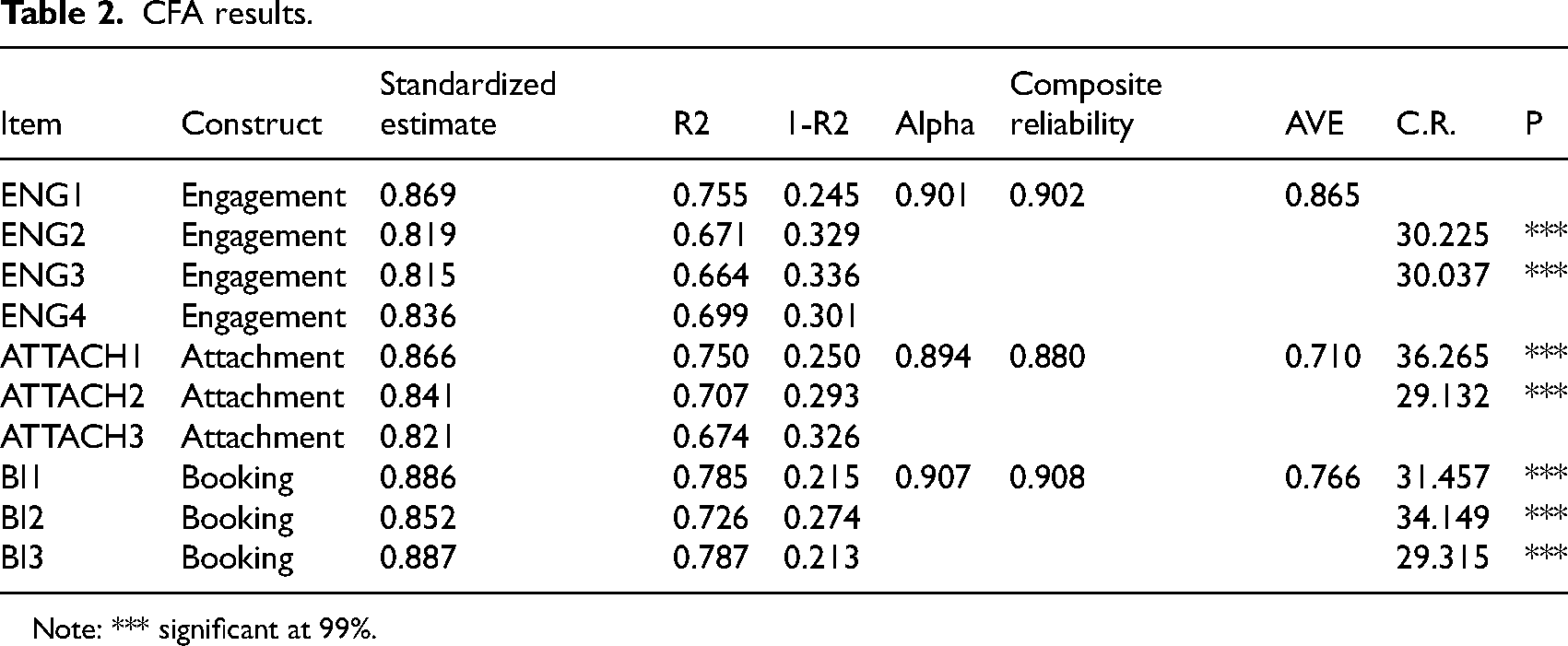
The test for multivariate normality showed that this requirement was not fulfilled (multivariate critical ratio = 78.86 > 1.96). Since the sample was large enough, the structural model was estimated using asymptotic distribution-free estimations instead of maximum likelihood. CFA was performed to confirm the validity of the proposed scales. Considering the significance of the global contrast sensitivity to the sample size with caution (Hair et al., 2006), the goodness of fit indicators showed an adequate fit (CMIN/DF = 1.898; CFI = 0.964; AGFI = 0.951; NFI = 0.929; TLI = 0.944; RMSEA = 0.027). The proposed scales complied with the psychometric properties (Table 2). Coefficients greater than .6 were obtained and were above .8 in all cases. The internal consistency was evaluated through the composite reliability (CR), with a minimum threshold of .7 (Anderson and Gerbing, 1988; Hair et al., 2006). The average variance extracted (AVE) indexes were higher than .7 in all cases, surpassing the critical value of .5 (Fornell and Larcker, 1981; Hair et al., 2006). Therefore, convergent validity was assessed.
CFA results.
Note: *** significant at 99%.
To check the discriminant validity, the AVE was compared with the squared correlation between constructs; the former must be higher (Fornell and Larcker, 1981). Therefore, because the AVE values (main diagonal) were higher than the square inter-construct correlations for each construct, discriminant validity was also confirmed in the estimated CFA model (Table 3).
Discriminant validity.

The hypothesized model was tested using SEM (Table 4). The model fit was good (CMIN/DF = 1.616; CFI = 0.976; GFI = 0.983; AGFI = 0.958; NFI = 0.941; TLI = 962; RMSEA = 0.022). This model confirms three of the proposed hypotheses: (H1) engagement had a positive significant effect on booking intention (0.436) and (H2) a positive significant effect on attachment (0.879). (H3) Attachment had a positive and significant effect on booking intention (0.456). The standardized indirect effect of engagement through attachment was 0.409.
SEM results.

Note: *** significant at 99%.
Then, a multi-group SEM (MGSEM) was conducted. The analysis of invariance was conducted by means of the AMOS 26 program by imposing restrictions to verify whether these restrictions improved or worsened the fit of the model. Since multi-group CFA showed metric invariance, MGSEM was carried out. The unconstrained model fit (model 1) was acceptable (χ2/DF = 2.132; TLI = 0.986; CFI = 0.991; RMSEA = 0.030) (Hair et al., 2006). In addition, there was metric invariance. In accordance with the values set by Chen (2007), changes in the goodness-of-fit indexes did not exceed the recommended values (Δ χ2/DF < 3; Δ TLI < 0.01; ΔCFI < 0.01; ΔRMSEA < 0.015 (Δ χ2/DF = −0.167; ΔTLI = 0.002; ΔCFI = 0.001; ΔRMSEA = −0.003). Therefore, the structure was invariant across the publications, so the different results were not a consequence of the structure but rather of the differences in the object of measurement. Figure 2 shows the results of the standardized coefficients for each type of publication. All the relationships are statistically different since the critical ratio for differences as formulated by Byrne (2010) is higher than ±1.96. H4 is verified since the total effect of the estimate is higher for location (0.905), followed by guest mention (0.881) and ambience (0.812). Therefore, H4 is confirmed.

Final model MGSEM. Note: *** significant at 99%
Conclusions
Theoretical implications
This pioneering study demonstrates how users receive communication from hotels through a social network based on publications specifically focused on the dimensions of customer experience adapted to the hotel context. The results of our research demonstrate that engagement with social networks helps ensure hotel brand attachment, thus resulting in greater booking intention. Moreover, the study offers a comparison of the effect of a preliminary set of dimensions based on hotel customer experience on consumers’ brand engagement and the variables mentioned above. The results of the research highlight the fact that when users are willing to interact with posted content, attachment and booking intention increase. To investigate this phenomenon, the participants in the study were exposed to different stimuli based on a hotel post on social networks. The participants were then asked to indicate whether they would be willing to like, share or comment on the post in question as well as to indicate whether their intention to book at the hotel changed after seeing the post. It seems, therefore, that such engagement behaviour with the brand can be a process of self-expansion, which can lead to a closer brand attachment and thus to a reduction in psychological distance from the brand, in this case the hotel, which should in turn strengthen attachment to the hotel (Jahn and Kunz, 2014)
In this way, it can be said that a priori, it is sufficient to have an intention to interact with the content, even if this intention does not ultimately materialize in the form of real interaction, because according to Ajzen (1991) such an intention is the greatest precursor of future behaviour. In addition, according to Jahn and Kunz (2014) both passive participation (following a brand in networks, and/or reading the brand's contents) and active participation (likes, shares and comments) have an impact on attachment, although the effects of active participation on brand attachment are notably higher.
One of the main objectives of social networks is to achieve a high engagement ratio. Nevertheless, the academic literature has focused on understanding how to design publications that are capable of fostering this engagement without taking into account messages based on possible customer experiences in the hotel. For this reason, the present study provides relevant information on what type of experiential content can be more effective on hotels’ social networks. In addition, the importance of generating engagement is demonstrated, and its indirect impact on booking intention through attachment is tested.
This study shows that the experiential content of the social network message has an impact on the responses of potential tourists; that is, “what to say” has different levels of users’ response. Experience not only causes greater popularity or visibility but also leads directly to a greater affective connection with the brand and, indirectly, to a change in future behaviour, increasing booking intention. To our knowledge, no previous study has verified the type of relationship between tourists and hotel brands beyond social engagement behaviour by focusing on the effect of further affective interactions with the hotel brand.
Thus, engagement with publications on social networks supports the formation of attachment to the hotel as well as the establishment of affective bonds, which translate into an increase in the intention to book.
In line with previous research developed in the offline context (Prodanova et al., 2020) and specifically in the hotel sector, our results confirm that engagement with content on social networks that is based on experience encourages the establishment of emotional links and thus improves booking intention. The relationship between engagement and booking intention is both direct and indirect through attachment. Engagement implies greater purchase intention. For this reason, hotel managers must pay attention to the design of publications that can connect emotionally with users to transform engagement into a greater reservation intention. Advancing current knowledge concerning brand attachment, this study found empirical support for the notion that people may develop emotional bonds by interacting with the content published by hotels on social networks. Positive experiences with brands support the creation of memories and feelings of connection, which ultimately contribute to the development of emotional ties (Reihani, 2019). Therefore, because experience is a precursor of the feeling of attachment to the brand (Bıçakcıoğlu et al., 2016), this study empirically tested whether this relationship is also reproduced in the online environment.
Our results confirm that the content of the message has an effect on engagement (Vaiciukynaite and Gatautis, 2018). However, the results also reveal that the responses of potential visitors to a hotel might differ depending on the way in which publications related to the dimensions of customer experience are presented, thereby facilitating the establishment of an attachment to the hotel brand to a greater or lesser degree. Since attachment is a direct precursor of consumer behavioural intention (Kil et al., 2012; Rodríguez-Torrico et al., 2020), the inclusion of the experiential dimensions within the publication establishes an affective link. Hence, our proposal expands the classification of message content in the social media literature by including specific mentions of the experience dimensions within hotels. An especially interesting finding is the importance of the location dimension when communicating with users through the social network since publications that focus on this dimension obtain better ratings than those that focus on ambience or mentions of other guests.
Practical implications
This research provides insightful implications for social media hotel managers to improve their potential customers’ booking intentions. Given that hotels prioritize consumer entertainment content on social media that aims to describe the experiences provided by the hotel over other communication tools, this study highlights the underuse of a communication instrument that can help reinforce the image of the brand and offers useful information so that potential guests are more open to making reservations. We do not mean that all content should be experiential or that hotels should avoid publishing other types of content but that in times of high demand, they have a useful instrument to improve brand perception. The results of this research highlight the importance of generating engagement both with respect to improving guests’ intention to book at the hotel and to improving their attachment. Precisely for this reason, hotel managers must design their social media posts carefully to ensure that in addition to communicating the intended experience, these posts encourage the user to interact with the content, whether they are presently enjoying a stay at the hotel, planning their trip or have recently finished a stay at the hotel. One way of encouraging user interaction is the use of contests. For example, users could be asked to share a photo of their favourite beach, tourist attraction or aspect of the hotel they liked the most, with the winner of the contest being the post that receives the most likes. In this way, a greater reach can be achieved and interactions among new followers can be made more likely, since users may share their publications with their friends and acquaintances to become winners.
In addition, hotel-specific hashtags can be used to foster a sense of community, and guests can be encouraged to share their experiences using the hotel's hashtag. These hashtags can also be placed in specific locations within the hotel, such as elevators or photographable corners, to encourage guests to share their experiences.
In addition, to facilitate greater interaction and encourage the establishment of affective bonds, it would be interesting to create dialogues with users who participate by responding to their comments, asking questions both in the publication itself and in the responses to comments and encouraging them to include other users, for example, by asking them to “mention the person with whom you would enjoy these views”. Images are as or more important than the text in regard to generating emotions and sensations. Therefore, special attention must be paid to the pictures (or videos) that constitute the experiential message to ensure that they describe this dimension well. For example, the photos that clients have published during their stay at the hotel can be shared. Alternatively, images of the most attractive and emblematic locations within the hotel, details of the architecture or photographs of locations where future guests can take their own photos can be shown and shared on social networks. Entertainment or the quality of service might improve the link to the consumer site in the online purchasing process (Prodanova et al., 2020). Therefore, hotels should publish content based on the hotel's experience dimensions, reflecting aspects such as entertainment around the hotel based on its location or encouraging guests to assess the quality of the hotel service on their social networks, for instance, through contests that promote guest mentions.
In addition, regarding the specific type of message, hotel community managers can segment content when conducting advertising campaigns on social networks. To achieve greater engagement and improve the relationship with the hotel, they can highlight the location because it has been proven that this dimension helps to generate better results. To accomplish this task, such managers can refer in the post to the restaurants that are located closest to the hotel as well as points of interest or the distance to the main tourist attractions, supermarkets and shops. This strategy emphasizes the value of the hotel and provides practical information that is more important than emotional factors in promoting these values (Cheung et al., 2022). In addition, agreements could be reached with nearby establishments to create publications regarding the hotel and vice versa.
Limitations and future research
The variables of this study have a strong attitudinal component, so future research could focus on studying the actual behaviour of hotel customers through experiments. An experiment of a mixed type (between-within groups) would serve to verify the combined effect of each of the dimensions with another treatment. For instance, the inclusion of images that are congruent or not congruent with the text, the reinforcement of comments by the hotel or possible reactions from other users could be future variables to include. In this study, only posts that were related to three of the dimensions proposed by Khan and Rahman (2017) were included. It would be interesting for future research to include all the proposed dimensions or even a dimension related to safety, since the COVID-19 pandemic has undoubtedly modified the priorities of consumers who were looking for a hotel during the most severe periods of the pandemic. It would therefore be interesting to investigate whether these patterns continue now that the pandemic situation has been normalized. Future studies could determine whether there is any other moderating variable in this relationship, such as age. The younger generations are more used to interacting on social networks and therefore have a greater propensity to use the network as an element of communication (Bravo et al., 2020; Lee et al., 2021). The potential greater engagement of this segment could have a greater impact on booking intention compared to older users.
The sample in this study included only tourists of Spanish nationality; therefore, to generalize the results, the model could be replicated by incorporating tourists of different nationalities. Likewise, it would be interesting to test whether these relationships are maintained or, on the contrary, if there are geographical, economic, or cultural factors that may condition these relationships.
The design of the publications was made by simulating post content in a generic network. Future research could test whether these relationships also occur in specific social networks such as Facebook, Instagram or Twitter or even conduct a comparative study between several social networks. The reference hotel was also fictitious. Future studies could be based on experience with real hotel brands.
Finally, since risk is a predictor of visit intention (Yu et al., 2021), COVID-19 might have an effect on the risk perceived by potential customers (Liu et al., 2021). Although hotels have tried to reduce the risk associated with the effects of the pandemic and adopted measures to guarantee the safety of their clients, this exogenous factor might influence the response of potential tourists. In other words, the risk associated with the pandemic may produce lower reservation intention (Wachyuni and Kusumaningrum, 2020). This effect occurs largely in customer segments with greater psychological risk and may be included in future estimations.
Footnotes
Acknowledgements
This study was conducted under the framework of the Research UAM Group TECHNOCONS “Consumer Behaviour and Technology”. The authors would like to give special thanks to Dra. Yagüe and Dra. Díaz-Martin, from Universidad Autónoma de Madrid, for their valuable advice, and continuous support. The authors also appreciate assistance from Natacha Lerma, Ana Ocheda and Fernando Virviescas (Toluna) for their assistance in the data collection stage.
Declaration of conflicting interests
The author(s) declared no potential conflicts of interest with respect to the research, authorship, and/or publication of this article.
Funding
The author(s) disclosed receipt of the following financial support for the research, authorship, and/or publication of this article: The research was supported by the multi-year agreement signed by the Government of Madrid and the Autonomous University of Madrid, UAM (Line #3).

Appendix A
Post 1: location
Post 2: ambience
Post 3: guest mention