



Abstract
This article examines the cultural dimensions of synthetic ‘body fat replicas’, anatomically modelled objects used in educational and medical settings to train subjects in particular affective responses to fat/ness. Specifically, I focus on theorizing the phenomenological experience of embodied engagements with such models, and exploring the manner in which the replicas are designed to participate in the shaping of emotional orientations toward one’s own body and those of others. Appealing to the work of contemporary social and cultural theorists, I consider how the capacity of objects to act as nexuses for the commingling of abstract and concrete, psychological and material, inner space and outer life, and meaning and affect situates these lumps of polyvinyl chloride as valuable aids to elucidating the cultural polyvalence of ‘fat’. This article is oriented around the application of a selection of insightful theoretical work, drawn from the multidisciplinary field of science and technology studies, as well as from sociological research on medicine and the body. I argue that, by moving toward an understanding of fat/ness as a phenomenon comprised, in Annemarie Mol’s terminology, of ‘multiple enactments’, we can better understand how ‘fat’ has come to embody particular sets of meanings and emotions in the context of a contemporary medicalized transnational culture.
Encountering ‘Fat’: An Introduction
The globular masses of deep yellow hue, delicate ribbons of vibrant red twisting and coursing through their interior, appear strangely juxtaposed against the austere background of the white page upon which they appear. Accompanied by cryptic alphanumeric codes in stark, black typeface, the entities present a curious facade to the viewer, and, if considered apart from both text and context, confound attempts to ascertain origin or artifactuality, scale or dimension, composition or content. The objects sit before the viewer’s gaze enigmatically – testifying, perhaps, to the ambiguity of phenomena apart from the intelligibility imparted through acts of framing.
Adjacent to the images, we read: Grossly dramatic replicas of human fat molded with the same techniques used to create Life/form® food replicas. A shocking but strongly motivating attention-getter. Made of soft, pliable, long-lasting vinyl plastic, the replicas have a profound, memorable effect when passed around among the audience. (Nasco, 2011)
Nestled among a collection of the more than 65,000 products manufactured and/or distributed under the auspices of this company, these objects are first and foremost material goods, commodities primarily intended for purchase and use by educational, healthcare and agricultural institutions. They exist as part of Nasco’s series of ‘Life/form® replicas’, an array of anatomically modelled objects which includes several different configurations of this synthetic ‘fat’ made from pliable, translucent yellow vinyl. The ‘fat’ range includes 1lb and 5lb versions (Figure 1), as well as a more elaborate 20lb ‘body fat vest’ (Figure 2), designed to be worn with the stated aim of ‘understand[ing] the physical changes that occur with weight gain’ (Nasco, 2011). These ‘replicas’ – a heavily laden word in itself – are claimed by the manufacturer to be of the same weight/volume ratio as real human fat tissue. Their creators’ aspiration to realism is enhanced by the inclusion of simulated red ‘blood vessels’ running through the yellow models. They are, in the simplest of terms, ‘fake fat’.
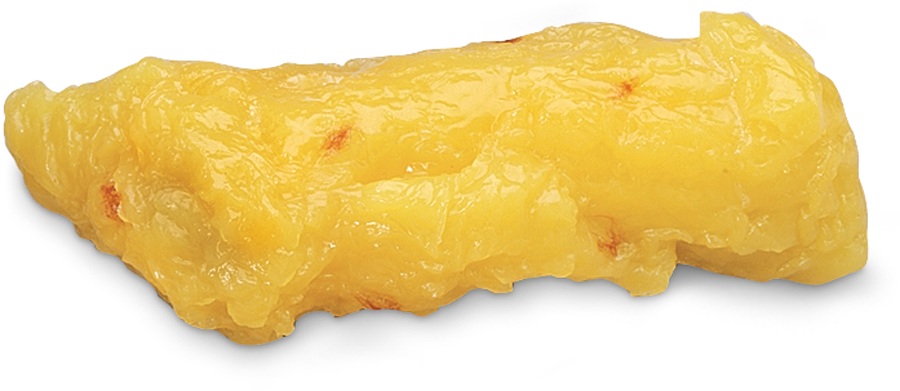
5lb fat replica.

Nasco’s ‘body fat vest’.
That these fat replicas might be approached as worthy of scholarly inquiry testifies to the growing recognition that such objects are, in Lévi-Strauss’s pithy phrase, ‘good to think with’ (1964) – that they present unique and fecund avenues for understanding worlds, both internal and external. Sherry Turkle, a noted scholar of science and technology studies (STS), takes this conviction one step further, explaining: We find it familiar to consider objects as useful or aesthetic, as necessities or vain indulgences. We are on less familiar ground when we consider objects as companions to our emotional lives or as provocations to thought. The notion of evocative objects brings together these two less familiar ideas, underscoring the inseparability of thought and feeling in our relationship to things. (2007: 5, italics added)
Studying Fat/ness
‘Of all the parasites that affect humanity’, penned English undertaker William Banting (1797–1878) in his now-famous Letter on Corpulence: I do not know of, nor can I imagine, any more distressing than that of Obesity…. The word ‘parasite’ has been much commented upon, as inappropriate to any but a living creeping thing (of course I use the word in a figurative sense, as a burden to the flesh), but if fat is not an insidious creeping enemy, I do not know what is. (1869, italics in original)
The fat body as a social object has, over the last two decades in particular, begun to gain the attention of scholars working within a variety of disciplinary contexts. The pioneering work of these academics has laid a foundation for comprehensive research into the construction of ‘fatness’ and the ‘fat body’, gradually coalescing into an area of scholarly inquiry that has come to be known as ‘critical fat studies’. The field, which now includes edited anthologies (Rothblum and Solovay, 2009; Tomrley and Naylor, 2009), university course offerings and dedicated conferences, has embraced the efforts of academics from disciplines as diverse as history (Gilman, 2004, 2008), sociology (Monaghan, 2008, 2010), anthropology (Kulick and Meneley, 2005), psychology (Escalera, 2009), philosophy (Heyes, 2006; Murray, 2008), political studies (Oliver, 2006), geography (Colls, 2007; Evans, 2006), education (Gard and Wright, 2005) and communication studies (LeBesco, 2004), as well as work by researchers who identify more explicitly with ‘fat activism’ (Cooper, 1998; Wann, 1998). Collectively, these scholars and authors have produced an ever-growing corpus of illuminating analyses which, while not uniformly unproblematic, shed much light upon the constitution of ‘normate’ and ‘deviant’ bodies, and the places and roles of fat bodies within broader social, cultural, economic and political contexts and dynamics.
As fat studies has expanded and diversified as a field of inquiry, so have the possibilities for understanding fat bodies. Early work, while considering fat-related phenomena like experiences of discrimination (Solovay, 2000), media and diet-industry influences on body image (Poulton, 1997), and historical shifts in body-size preferences (Schwartz, 1986), too commonly stopped short of meaningfully interrogating the ways in which subjects, fat-identified and otherwise, inhabit and experience a world of constitutive affective relations with fat/ness. With the ‘affective turn’ witnessed of late in the social sciences and humanities (Clough and Halley, 2007), and particularly its salience in body-studies (Blackman and Venn, 2010), thoughtful engagement of the nexus of fat and affect seems merited. The significance of this new orientation in scholarship has been articulated cogently by Michael Hardt: A focus on affects certainly does draw attention to the body and emotions, but it also introduces an important shift. The challenge of the perspective of the affects resides primarily in the syntheses that it requires. This is, in the first place, because affects refer equally to the body and the mind; and, in the second, because they involve both reason and the passions. Affects require us, as the term suggests, to enter the realm of causality, but they offer a complex view of causality because the affects belong simultaneously to both sides of the causal relationship. They illuminate, in other words, both our power to affect the world around us and our power to be affected by it, along with the relationship between these two powers. (in Clough and Halley, 2007: ix)
An alternative method by which fat embodiment might be approached, and one that would ground the study of the same in a consideration of the generation and transmission of affect, might be to examine the ways in which fat itself – as a type of bodily tissue – is given a social existence and imbued with a set of emotional-cultural meanings through its various materializations within the social world. A few scholars have already made inroads into addressing these dimensions of fatness (most notably, Colls, 2007; see also, Evans and Colls, 2009), thinking about the processes through which fat emerges as ‘matter that matters’. Further, the relationship between fat bodies and fat tissue, mutually constituted and interpreted as they are, is undoubtedly a complex one. Yet, there are evident linkages, perhaps most visible in the ease with which the specificities of ‘fat’ as a dietary component, a bodily tissue, a corporeal form and an identity category become elided into a composite cultural discourse, heavily laden with moral implications and imperatives, social status considerations, and oftentimes ardent emotional associations and affective responses.
It is with the goal of elucidating this nexus that I have chosen to consider Nasco’s body-fat replicas as particularly meaningful and ‘feeling-ful’ cultural artifacts. As a sociological researcher, I am interested in the ways that objects in the world participate in the constitution of subjects, as well as how they come to possess ‘social lives’ of their own. With the emergence of the internet as a primary vehicle for product promotion and sales, the Nasco fat replicas are laid open to both general notice and critical attention in ways that would have previously been much less likely; in this guise at least, they possess a dimension of ‘virtual’ accessibility. In studying these objects, I am intrigued by how the intended uses of fat replicas imbue them with specific affective effects, and how rethinking the trajectories of both meaning and feeling – or, more accurately, meaning-feeling, as fundamentally conjoint phenomena – might lead to new and different ways of thinking about fat embodiment. In my research, I have turned to the work of theorists occupying diverse disciplinary locations to explore the ‘affective lives’ of these objects – creating, by design, a theoretical bricolage in the service of what might be termed a ‘cubist’ approach, one that brings together multiple viewpoints to more fully illuminate the whole. The unitary thread within this project lies, however, in my commitment to a phenomenologically oriented sensitivity toward the lived experience of embodiment.
These synthetic ‘replicas’ of human fat tissue, I argue, act as material-semiotic nodes in and through which a multiplicity of circulating discourses and emotions about ‘fat’ intersect and coalesce into tangible entities within the lifeworld. Utilized – by design – to train embodied subjects in a particular affective response to fat/ness, these objects exist within a broader system of knowledge and power that exerts ‘torque’ (Bowker and Star, 2000) on subjects’ understanding of their own and others’ bodies.
Amenable to multiple positionings, this ‘fake fat’ has been adopted into both personal efforts to remake the body-self and biopolitical projects framed as matters of public health concern. These models can thus be understood as boundary objects that participate in the constitution of fat/ness as a site in which experiences (real and simulated) of particular embodiments, affective orientations toward bodies and practices, authorized knowledges, institutional/ized authority, economic interests and transnational political agendas meet and commingle. By shifting away from an overly simplistic reading of cultural ‘lipophobia’ or anti-fat sentiments as a coordinated conspiracy and toward an understanding of fat/ness as a phenomenon comprised, in Annemarie Mol’s terminology, of ‘multiple enactments’ (2002), we can more clearly understand how ‘fat’ has come to embody particular sets of meanings and emotions within a contemporary transnational culture deeply impacted by the hegemony of western bourgeois constructions of bodies and selves.
Discursive Frames: The Language of Fat
The rhetorical and lexical choices made by the authors of the Nasco catalogue text bring the replicas and the person encountering them together into a particular affective relationship. The use of a descriptor like ‘grossly’, with a spectrum of denotations that encompasses meanings of unrefinement, vulgarity, disgust and offensiveness, suggest that the ‘proper’ or ‘authorized’ attitude to be taken toward these objects is one of repulsion. The variety of impact language used (such as ‘shocking’, ‘memorable effect’ and ‘strongly motivating’) creates an expectation that the sensory encounter with a fat replica should be intense and that the object should transform, in particular ways, the individual who encounters and engages with it.
Indeed, the primary ‘educational’ purpose of the models is evidently not the acquisition of knowledge about the physiological functions of fat tissue; neither the replicas nor their descriptions convey information about, for example, the role of body fat as an endocrine organ or a nutrient reservoir. Rather, they serve as a tool of affective education of the subject towards fat – with the further implication that this will, in turn, assist in the training of the will regarding certain behaviours (specifically, consumption choices and physical activity) which broader cultural discourses link with body fat acquisition and loss. Indeed, the visual pairing of the body-fat vest with a ‘weight management’ guidebook in the catalogue listing confirms the models’ implicit behavioural mandate and establishes them as instruments of what have been termed ‘biopedagogies’ (Wright and Harwood, 2009).
Notably, the descriptions for these models do not explicitly articulate a view of body fat as pathological. Interestingly, such an assertion is made with respect to the company’s ‘muscle replicas’: ‘Motivates patients to exercise regularly, since America’s number one health problem is obesity’ (Nasco, 2011). But why, then, not frame the fat replicas with similar – albeit medically dubious – claims? We might perhaps understand this ‘omission’ as a presupposition that the reader of the catalogue description and potential purchaser of the product has already been socialized into a particular set of cultural beliefs around fatness, weight loss and health – thus making the articulation of an explicit link unnecessary. As critical scholars of medicine and the body have observed, fatness has long been pathologized in western medical discourse and practice, and, in recent years, has increasingly been framed in both professional and lay healthcare contexts as a definitive ‘disease’ in its own right, even in the complete absence of ‘dis-ease’ on the part of the individual deemed afflicted (Jutel, 2006). Indeed, so deeply entrenched is the discursive distancing of ‘fat’ from ‘health’, that even much of the literature that attempts a critical examination of the cultural meaning of fat reproduces the assumption that the acquisition of a physical (and, often psychological) state of ‘good health’ need necessarily involve the loss of bodily fat, whether intentionally or not (Orbach, 1978).
Objectivizing Fat/ness: Knowing What to See, Seeing What is Known
These replicas, then, are situated as pedagogical objects, acting as vehicles of transmission for social norms, values and orientations regarding bodies and behaviours. They teach not through words and quantified data, but via the sensual, affective encounters they facilitate. But what it is that they address – ‘fat’, and, implicitly, ‘fatness’ – are far from self-evident phenomena.
This ‘fake fat’ exists within a broader tradition of anatomical modelling which seeks to make externally manifest to the senses the ‘inner space’ of bodies. Like the more commonly encountered anatomical models of bones, vascular systems, muscle groups and individual organs, the fat replicas facilitate an experience of relating to the body vicariously as a collection of discrete components. Further, these parts are delineated and delimited through model-makers’ and requisitioners’ culturally informed boundary impositions on the body – for example, in the representation of ‘the brain’ as a collection of tissues localized within, at most, the supraclavical region, rather than as disseminated throughout the entire nervous-system network.
This practice of anatomization (in the literal sense!) is an outgrowth of analytical tendencies in western societies, particularly dominant since the scientific revolution. How bodies are experienced is largely a consequence of the culturally specific ways in which embodied subjects are constituted in and through discourse. As Foucault (1973) has demonstrated in the context of western medical practice, bodies and conditions have been perceived differently in various historical periods. How a holistic life form – an integrated matrix of physicality and consciousness – comes to be understood as characterized (or not) by certain qualities presupposes a ‘regime of seeing’ in which those very attributes are able to enter into the field of vision as recognizable and meaningful phenomena. Embedded within a particular sociocultural context, one is taught – at least implicitly – not simply ‘how to see’ but also what is visible.
That ‘fatness’ as a significant and quantifiable quality of bodies should exist as a perceptible entity within the contemporary épistème attests to its cultural life as a meaning-laden phenomenon within the sphere of western modernity. More specifically, it gestures toward the centrality of normalization of body-subjects as both value (the articulation of characteristics that subjects should possess) and practice (the institution of methods and procedures to prompt conformity with the norm). Foucault, famously, has interrogated the processes by which ab/normality of bodies and behaviours has come to be instituted via the exercise of power through disciplinary formations such as psychiatry (1965) and the carceral system (1975). Indeed, as Mike Featherstone has emphasized, bodies ‘are not stable pre-formed entities’, but are always ‘processual, indeterminate and multiple’ (2010: 205); this also holds true for the corporeal ‘components’ that we identify within bodies’ shifting collection of matter and meaning. Fat – like madness or delinquency – also has a genealogy, a trajectory through which it has come to exist as a naturalized phenomenon in the present-day social world.
Cultural historians have traced the roots of the modern emphasis on medical normalization of pathologized ‘fat’ bodies back to at least the mid 19th century (Gilman, 2008; Schwartz, 1986) – a period during which we encounter Banting defending to his readers his heterodox designation of body fat as parasitical in order to justify his weight loss promotion venture. However, the underlying order of thought and vision which permits fat to ‘be seen’ – and, only then, to be objectivized as a medical and moral concern – precedes this, with roots stretching back through centuries of western thought. Such an order, though largely naturalized and thus occluded to those who inhabit it, is ultimately grounded in conceptions of subjectivity that understand the materiality of the body to be expressive of particular conditions of the self. By no means confined only to the realm of medicine, this foundation depends on multiple strands of discourse and representation that circulate widely and transverse and permeate many spheres of life.
As the body-self is a phenomenon in historically and culturally situated flux, we may locate Nasco’s fat replicas within a contemporary moment in which the objectivization of bodily conditions presents itself as a vehicle for reconceptualizing self-identity and embodied personhood. Anthropologist Joseph Dumit has explored the theme of ‘objective self-fashioning’ in the context of brain imaging and mental illness, considering the place of these visualization technologies in the constitution of the ‘afflicted’ subject (Downey and Dumit, 1997: 83–102; Dumit, 2003). In Dumit’s examples, positron emission tomography (PET) images of brain activity, produced in medical and research settings, become sites of an objectivized self-definitional process for patients, in which mental states are ‘made visible’ as externalized forms. While Dumit’s focus on the imaging of the brain physiology of psychiatric conditions places his work in particularly close proximity to prevailing neurally oriented scientized cultural conceptions of selfhood, a similar process is, arguably, at work with respect to fatness and the fat replicas. Given a cultural context in which the fat body is understood as reflective of an individual’s character (at least inasmuch as the conventional association of fatness with moralized dietary patterns and habits of limited physical exertion provides a compelling interpretive frame), the objectivization that occurs via the replicas presents the ‘condition’ of fatness as a clear and observable manifestation of some dimension of the inner self.
In this regard, the work of Dumit’s fellow anthropologist, Janelle S. Taylor (2005), is particularly illuminating when read in tandem with the former’s perspectives on self-fashioning. She has proposed the study of bodies as ‘contingent configurations’ via the examination of what she terms ‘surfacing the body interior’ – that is, through attending to ‘the range of practices and processes that both materialize bodily surfaces as significant sites within broader orders, and surface that which lies hidden beneath them’ (2005: 742). Likewise, through the act of human–object engagement within a particular regime of visualization and knowledge, the fat models not only make seeable a certain type of subcutaneous cellular tissue normally concealed within the circumscription of the skin, but make it possible for fat/ness to be engaged with on an empirical level as a pathologized state of the body-subject.
Acquiring Bodies, Engaging the World
Drawing upon Bruno Latour’s work on ‘body talk’ (2004), we might well describe the encounter of subjects with these replicas in terms of ‘acquiring a body’ through a training to be affected – and thus, effected, or continually remade with new capacities and receptivities – by the encounter. This model of comprehending bodies and experiences, maintains Latour, renders the perennial mind-versus-body and language-versus-world dilemmas of western philosophy moot, for the ostensible gap itself evaporates, as the Cartesian knowing subject is replaced by the corporate-body-as-dynamic-trajectory formed via the interface between the individual and the world (2004: 206).
Extrapolating from Latour’s example of the perfumer (or le nez – the Nose – in colloquial French), carefully trained to discern and differentiate scents through the use of odour kits which themselves ‘become part and parcel of what it is to have a body’ (2004: 207), we may seek the ‘articulate subject’ produced through the encounter with the fabricated fat tissue. Through visual and tactile interaction with these models, subjects learn to attend to the materiality of bodies – their own and those of others – through the identification of particular bodily tissues as ‘fat’, and thus to develop a sensitivity toward body-selves as divisible into discrete biophysical components. What may initially appear to a subject to be arbitrary lines drawn through a unified body become the sites at which meaning penetrates materiality. Even in the absence of discourses which explicitly position fat/ness as affectively fraught, this very ‘training’ in relating to bodies as comprising differentiated tissues is itself a fundamental precursor to the specific orientation toward fat which the replicas’ makers and marketers seek to achieve.
Further, following Latour’s logic, the fat-aware body-subject transcends the boundaries of the biological corpus and comes into being in the engagement with the fat replicas. Fat may thus be conceptualized as a ‘proposition’, to employ Latour’s phrasing, articulated through – and thus dependent upon – such encounters (2004: 212). Neither a simple ‘given’ in the world nor a wholly subjective imposition upon independently existing phenomena, fat is thus brought into being relationally. If, following Dumit, we allow that the replicas facilitate the objectivization of the fat/not-fat body-self, we must acknowledge that they also, in Latourian terms, participate in the construction of a somatized selfhood, all the while transgressing and negating the very subject–object division.
Abject Tissues and Purified Subjects
In this relational ‘production of fat’ through the direct, sensual engagement with these replicas, the ‘trainee’ is encouraged to establish a psychological association between these synthetic lumps of gelatinous petrochemical substances and the living tissues of his or her own body (as well as those of others’ bodies), and to transpose the affective associations cultivated around the former onto the latter.
However, it is important here to observe that the replication of body fat enacted through these objects takes a mimetic form, creating a ‘verisimilar’ entity that nevertheless will not be completely confused with its natural prototype. The very detectable artificiality – whether through visual, tactile or even olfactory engagement – of the model’s fabricated fat reinforces the sense of ‘unnaturalness’ of fat tissue, fashioning it as something present within the body-self, yet not fully of it, and therefore existing in an ambiguous state.
In this respect, Julia Kristeva’s concept of abjection is valuable in comprehending the affective response to the fat replicas promised by the manufacturer. According to Kristeva (1982), entities which transgress the psycho-cultural boundaries between subject and object, particularly those which appear simultaneously part of the living body-subject and yet not, inhabit a ‘space of abjection’ and generate an uncanny unease for those who encounter them. From this perspective, which seeks to yoke Mary Douglas’s ‘matter out of place’ (1966) to Lacanian theory, the psychic repulsion experienced with regard to the ambivalent and fetishized object prompts efforts to ‘cast it out’ from the self, in order to more firmly establish oneself as fully within the symbolic order. This process, fraught with anxiety, places the subject, even if unknowingly, directly in touch with the contested boundary zone of the self and the other, and tends thereby to generate feelings of disgust toward the object, which haunts the perception of a stable, vital selfhood. That the association of such disgust with a given entity is not a natural given, but rather a cultural effect, is convincingly argued by Sarah Ahmed (2004), who, drawing on Elizabeth Grosz’s influential work on ‘volatile bodies’ (1994), identifies the locus of abjection in attempts to maintain a given order of things, and specifically situates the feared ‘stickiness’ of the boundary-defying object that will not leave us in peace as ‘an effect of the histories of contact between bodies, objects, and signs’ (Ahmed, 2004: 90). What we experience as abject, in other words, is a consequence of how we order our world and ourselves, and where we collectively opt to delineate the two.
Inasmuch as engaging with a fat replica emulates and evokes, to a certain extent, the sensation of seeing and handling an actual ‘disembodied’ body part – a bilious, spongy mass, replete with a tangle of sanguineous capillaries – it is liable to generate a reaction of repulsion. But because of the associative link fostered between the replicas and the actual tissues of one’s own and others’ body, this affectual response easily becomes transposed onto the differentiated components of the body-self, making bodily fat/ness appear as the threatening ‘other’ which must be eliminated to resolve the tension. As the ‘fat vest’ perhaps illustrates the most vividly, fat is envisioned (and described) as something ‘excess’, like a theatrical ‘fat suit’ (Meltzer, 2006), which can and ought to be removed from the ‘real’ not-fat body – an excess to be vicariously experienced via the vest, only so as to be loathed and actively shunned. (That the ‘fat vest’ is modelled in Nasco’s catalogue by a quite ordinary-looking young, thin, white male could even be read as a symbolic gesture toward intensifying the presentation of fat as an improper ‘imposition’ upon the otherwise-unmarked universal subject.)
The framing of bodily fat as abject becomes clearer if we contrast the so-called ‘empathy belly’ – a weighted vest used to simulate the physical experience of pregnancy – with the ‘fat’ garment. While both are intended to simulate bodily stresses and discomforts claimed to be associated with the respective states of pregnancy and fatness – the ‘Empathy Belly’ website, 1 for example, notes fatigue, irritability, frequent urination and shortness of breath as among the ‘medically accurate’ effects of pregnancy generated by wearing the prosthetic belly – as its moniker suggests, the use of the empathy belly is directed toward generating a different sort of emotional response to the situation of the pregnant woman. Whether the belly is worn to generate appreciation of a pregnant partner’s physical limitations, or to deter young people from courting early reproduction through its simulation of the daily challenges for which the expectant parent must be prepared, it is obvious that the intent is not to generate an intrinsic loathing or rejection of the pregnant body or its foetal contents, but, rather, to instil a respectful regard, or even reverence, for the maternal ‘work’ of childbearing. (The proviso, of course, being that the specific maternal body in question is deemed to be of suitable race, class, marital status and weight, lest it be rendered an uncontrolled body for ‘irresponsibly’ enacting the process of conception and childbearing.) The generation of empathic concern for the pregnant figure via the belly is, quite evidently, distinct from the psycho-emotional rupture between the normate body and adipose tissue which is fostered by the fat vest.
The impression that the fat replicas reference a liminal or defiling phenomenon is enhanced by their formal divergence from the prototypical medical model. Unlike most three-dimensional models which represent anatomy as comprising clearly bounded and precisely separated physical parts, and are usually made of hard, smooth, solid substances, these replicas depict tissue which appears to have been torn away, perhaps violently, from the surrounding bodily matter, and further depict it as pliant and irregular. Thus the replicas invoke the dual meaning of ‘disordered’ in reference to bodies and fat, both as ‘pathological’ and as ‘out of place’ or ‘out of control’.
Authorizing Meaning and Politicizing Fat
An example of an attempt to capitalize upon the abjection and fetishization of fat via the replicas – and one well within the evident intentions of the products’ creators – is that of an enterprising individual marketing these replicas directly to the general public as part of a weight-loss plan trademarked as the ‘My Pet Fat’ programme. 2 The purchaser is encouraged to place the models inside his or her refrigerator to discourage ‘overeating’ by appealing to the affective linkages established among the replicas, body fat and behavioural mandates. The cultural ‘imperative of health’, the logic of normalization and the cultivation of fat-oriented abjection together form a coherent rationale for the otherwise-inexplicable action of placing a chunk of inedible vinyl inside one’s fridge.
The individual who purchases a Nasco fat replica in hopes of aiding his or her own body-modification efforts is, however, an exceptional consumer. Indeed, the marketing of these models primarily to educators and health professionals points to the ways in which channels of expertise and authority operate with respect to the constitution of fat/ness as a social entity imbued with complex sets of meanings and moral implications.
The emergence of western allopathic clinical medicine in its ‘modern’ form, a transformation which Foucault (1980) locates in 18th-century Europe, produced a particular logic of health and bodies which continues to shape ideas and practices in contemporary times. Specifically, according to Foucault’s periodization, this historical era witnessed the rise of biopolitical strategies for the management of subjects on the level of populations; this approach was conditional on accumulating quantified knowledge about, and establishing norms for, the members who compose collectivities (Foucault, 1984). This shift set in motion an incremental process of professionalization of the ‘care’ of the fat body – usually defined, somewhat ironically, as striving to effect its disappearance, via its transformation into a normate bourgeois body. The result has been the thorough medicalization of fat embodiment, to the point that today even popular cultural discourses on fat/ness most often utilize the taxonomy of allopathic pathology, speaking of particular bodies as ‘overweight’ or ‘obese’, or otherwise judging the ‘fitness’ or ‘health’ of specific body weights and tissue configurations, often based merely on casual observation.
Given their positioning as health-oriented ‘teaching aids’, the body fat replicas are framed as manifestations of an expert anatomical knowledge, the cultivation of which is dependent upon an experience of the interior tissues of bodies. Since this variety of engagement with real bodily tissues remains occult to most persons aside from surgeons and pathologists (a medical privilege, in fact, which has long been carefully guarded and juridically secured), the models are outgrowths of a social order and a cultural logic which positions certain individuals, using specific means of inquiry, as generators and custodians of ‘body knowledge’. Also, as the target market for these replicas is health educators and institutions, who are entrusted with transmitting ‘authorized’ perspectives and knowledge about bodies, even the ‘first-hand’ experience of interacting with the models is likely to be mediated and managed by those trained and entrusted to police health in accordance with the prevailing biomedical paradigm. Indeed, the multinational pharmaceutical giant, Roche, has recently distributed similar fat replicas as promotional items for the prescription weight-loss drug, Xenical (orlistat) – not to potential consumers of the drug, but to conference audiences composed of those medical practitioners and researchers now commonly referred to as ‘obesity professionals’ (Cooper, 2010a).
Further, the models and the institutional contexts in which they circulate exist within a complex system of economic and governmental power relations. The pricing of the replicas – approximately US$80 for the 5lb model (Nasco, 2011) – tends to limit the likelihood of private ownership (or at least impose a socioeconomic class barrier thereto) and to reaffirm their status as institutionally mediated sites of engagement with fat/ness. The price also gestures toward the profit potential existent within a socioeconomic system predicated upon the valuation of ‘bio-optimized’ body-subjects. While the medicalized language of epidemiology often renders concern over fat/ness apparently altruistic and apolitical, the accelerating claims of a transnational ‘obesity epidemic’ are deeply interlaced with broader economic and political priorities.
The extent to which actual state power is exercised in the constitution of fat/ness within this biopolitical regime is societally specific, and, yet, increasingly globally pervasive. As Christine Halse has written, ‘controlling one’s weight is constituted as the ethical responsibility to society of a virtuous (bio) citizen’ (2009: 54), and, thus, the formation of fat-conscious (and, even more so, fat-concerned) subjects is a project in which governments have established a stake. While the most vocal state-sanctioned frenzy over fat has tended to emanate from the United States – where an ongoing government-sponsored ‘obesity-prevention campaign’ depicts crude models of fat body parts discarded on the ground and tossed into refuse bins (US Department of Health and Human Services/Ad Council, 2010) – other nations have recently begun to take up anti-fat projects as well. In fact, fat replicas have been pressed into service by the National Health Service in the United Kingdom, as part of an ‘Obesity Tool Kit’ which is being distributed to physicians (Herefordshire Council, 2008). In providing practitioners with a means of re-presenting fat/ness to patients in a way that fosters particular affective relations with the latter’s own bodies, the state deploys a technique of governmentality to produce self-policing body-subjects. In constituting a populace for whose members fat/ness is pervasively imbued with specific varieties of affect, the exercise of power in a manner which penetrates into the body’s very tissues is also facilitated.
Re-affecting Fat: Orientations of Resistance
If we understand the fat replicas as existing in the world as evocative objects, around and through which both meanings and affects are produced, it is equally clear that this process does not take place in a vacuum. The stories that these objects tell us about ourselves and about those with whom we dwell in the lifeworld are continually animated and guided by the circulating discourses and vested power relations in which we exist. As Turkle has breviloquently stated, ‘objects function to bring society within the self’ (2007: 310).
Is there, then, any possibility for engaging with these replicas in a manner that challenges the social norms and cultural meanings which they transmit? The phenomenological description, provided at the very outset of this article, of the encounter with these models is intentionally evasive and equivocal for this very reason. Are these replicas really such that they must inevitably host a displaced experience of fat as unpleasant, as discordant, as repulsive? Or do they, as rich material-semiotic sites, offer a more expansive range of possibilities for interpretation and engagement?
Having considered the ways in which the generation of particular semio-affective responses is the corollary of the replicas’ embeddedness within a specific set of historical relations and meanings, perhaps they might yet also be used to ‘feel fat/ness’ differently. As Le’a Kent has written: ‘Because the process of fat abjection is so central to ideas of proper selfhood in our culture, fat-affirmative representation often must create new modes of self and new ways of seeing and being in the body’ (2001: 137). Acknowledging, of course, that to follow the dominant interpretive route fostered by a particular social, cultural and political environment is the path of least resistance, might there be value in seeking to interpret and feel ‘against the grain’ in this case? As Ahmed has pointed out in her text Queer Phenomenology, ‘what matters is shaped by the directions taken that allow things to appear in a certain way’ (2006: 165). This is not to remove the materiality of the object (whether a fat replica or the fat tissue/body it references) from the equation – a position Latour has objurgated – but, rather, to call attention to the effects of the positioning of embodied beings with respect to the configuration of objects and, thus, to the constitution of ourselves. Indeed, the body, as Janelle Taylor has indicated, ‘is not so much a thing as an-ing’ (2005: 745) – a dynamic entity always in formation and reformation through relational practices.
Indeed, a few attempts to imbue these objects with new affective meanings have been undertaken by fat-acceptance advocates. In her influential book, Fat!So? Because You Don’t Have to Apologize for Your Size (1998), high-profile American fat activist Marilyn Wann devotes a brief section to her own purchase of a small fat replica from an online catalogue which she then re-purposes as an object of amusement, with the humorous explanation that fat tissue which ‘disappears’ as a result of weight loss has really just gone ‘on vacation’ (1998: 26). Wann’s explanation, and the accompanying snapshots of this ‘little lost pound o’ fat’ on its ‘visits’ to exotic tourist locales, not only reframes fat as non-threatening – and even joyfully agential in its own right – but also coyly exposes one of the facts rarely acknowledged by the weight-loss industry: that lost fat, like the vacationing traveller, most often returns. In this case, writes Wann, the pounds of fat ‘come home, right back to where they belong, your hips and thighs’ (1998: 26). The reader’s body becomes, in this rendering, the proper, even welcoming, abode of the ‘wandering’ fat, rather than a fortress which must be continually guarded against the surreptitious return of undesirable tissues.
Charlotte Cooper, a British doctoral student and well-known fat-rights author, has more recently blogged about the Xenical promotional fat replica (which she terms the ‘Xenical fat mountain’, for its montiform configuration), encountered at an obesity conference by her fat-studies colleague, Rachel Colls (Cooper, 2010a). Cooper engages the fat replica as demonstrative of a characteristic mode of medicalized engagement with fat bodies as dehumanized entities composed of abject tissues; she utilizes the model as an exemplar of the ways in which the obesity industry ‘others’ fat and, by extension, fat bodies, and casts them as intrinsically ‘disgusting’ and in need of medical ‘fixes’.
I would argue that Cooper’s ‘fat mountain’ blog posts, when considered beside Wann’s ‘lost pound o’ fat’ account, provides a second, interrelated and complementary reorienting of affective responses to fat. Whereas Wann repositions the fat replica primarily as a source of mirth (in a way subtly designed to move the reader toward the acceptance of fat), Cooper mobilizes her readership’s latent anger and frustration over the pervasive medicalization of fat bodies and subjects, by using her blog as a vehicle for Colls’ call for readers’ examples of other ‘anti-obesity marketing junk’ – to which she devotes a later post (Cooper, 2010b). In inviting exposure and ridicule of the ways in which powerful medical interests use such items to reduce fat subjects into isolated and pathologized physical parts, Cooper is offering a public forum in which these replicas and other obesity-treatment promotional items can be transformed from objects that seek to problematize fat bodies, into ones that explicitly interrogate and even discredit those very same attempts. In so doing, the fat subject may take up the role of an active producer of new ‘felt meanings’ in relation to the object and rework the mandated othering of affective relations with his or her own body.
Granted, of course, such fat replicas are not the sole objects involved in the emergence of existing orientations toward fat/ness; yet, they nevertheless participate in a cumulative affective formation. If, rather than collaborating, one chooses to reconstitute engagement as an intervention into the dominant order, drawing upon alternative cultural narratives – aesthetic appreciation of the replicas as sense-engaging artifacts; scientific visualization of bodies as wondrous; ‘unruly’ bodies as resistance against compulsory homogenization; and the like – the signifying chain becomes unsettled, even ruptured. When individuals join together – even if spatially apart – in consciously reorienting themselves, the dominant evocations of objects change, dividing and recombining to form new tissues of affective experience.
Footnotes
Acknowledgements
I would like to thank Bernard Lightman and Natasha Myers (York University), and three anonymous referees for their feedback and comments on earlier drafts of this article. I would also like to acknowledge the Social Sciences and Humanities Research Council of Canada for their assistance in funding my research.