



Abstract
This photo-essay highlights the ways in which medicine features in the Occupied Palestinian Territories (OPT) and uses it to reflect on the nature of ethical obligation set out by Judith Butler in her work on state-achieved precarity. Although medical infrastructure of even the most basic type is tragically lacking and in some areas shockingly absent in the OPT, it is the particular way in which medicine comes to be needed that we focus on. Leaving aside the rhetoric that has claimed authority over what can or cannot be said of the Occupation, we focus on its geo-technological arrangements. By placing photos and case studies of medical obstruction within an analysis of the Occupation, we forge an encounter between reader and the Occupation to raise questions about the use of medicine in this context and the manner in which conventional ethics can give legitimacy to this use. On the basis of what we show through visual and textual documentary material, we propose ethics be understood as inherent to the geo-technological arrangements that make life possible or, as in this case, undermine, obstruct or deliberately take life. Hence the ethical obligation that Butler calls upon is reiterated in ways that encompass the everyday features of occupation including those active in the emergence of medicine as a tactic of war.
The precarity of life imposes an obligation upon us. We have to ask about the conditions under which it becomes possible to apprehend a life or set of lives as precarious, and those that make it less possible, or indeed impossible. (Butler, 2008: 2)
In this article we seek to illuminate how medicine – a practice in which the precariousness of life is most specifically engaged – can become, by way of its proximity to such precariousness, a technique of combat. As we do so, we want to reflect on the obligation this poses in light of Judith Butler’s claim. For Butler, the ontology of the body is, she states, a social ontology, by which we understand that its existence is achieved through the work of social and political forces (2009: 3). And it is on the basis of the contribution of the social and political that, Butler explains, the conditions may be created that maximize the precarious nature of some lives while minimizing it for others (2009: 2). In order to give emphasis to such conditions and hence the very political nature of bodily ontology that is foremost in her concerns, Butler proposes the term ‘precarity’ in place of ‘precarious’ which, she says, is a more existential concept: ‘it is the differential allocation of precarity that, in my view, forms the point of departure for both a rethinking of bodily ontology and for progressive or left politics’ (2008: 3). Central to this rethinking is the manner in which norms constitute what is recognized as a valued human life and those lives which come to hold little or no value and may be made to perish. The political achievement of precarity turns our attention to the role of the state and how, because precarity is an achievement of the state, a paradox is constituted. As Butler explains, those at risk have ‘no other option than to appeal to the state for protection, but the state is precisely that from which they require protection’ (2008: 26). It is this paradox that obliges us – that is, those who through a differential process are not subjected to such violence – to act and it is in the form taken by this paradox, according to Butler, that we may find guidance on how to do so.
We begin this article with an acknowledgement of the important political, theoretical and ethical analytic provided by Butler for our inquiry into the deployment of medicine in the Occupied Palestinian Territories (OPT). At the same time, we also want to signal from the outset that we wish to supplement her approach. Without wanting to underplay the significance of how the state of Israel acquires a certain legitimacy such that it is able to maintain and advance the Occupation, as Butler has revealed in various spectacularly incisive critiques of the language of Occupation (2003, 2004, 2008, 2011), the arrangements by which medicine emerges as an extraordinary tactic of war – the antithesis of what we might expect – lead us to ask whether the notion of epistemic violence is sufficient ground on which to conceive of ethics. In what follows we focus on the Occupation as an activity that achieves a condition of precarity through the geopolitical compartmentalization, that is, the fragmentation and enclosure of the OPT into the divided areas of the West Bank, East Jerusalem, and the Gaza Strip and, most particularly, in the day-to-day arrangements that enact this compartmentalization. It is in our endeavours to map some of the medical-militaristic terrain of the Occupation that we review the nature of precarity and, associatively, the ethical obligation it brings.

The Wall.
In order to illustrate the work of the Occupation in the maximizing of Palestinian precarity, we have organized our discussion around extracts from case studies and photographs of the Occupation documented mainly by Physicians for Human Rights (Israel) (PHR-I) during the Israeli military offensive of the winter of 2008/9; from published reports on the effects of the Israeli military attack on Gaza in the winter of 2008/9; and ethnographic research undertaken by Pfingst between 2007 and 2009. The ethnographic research included detailed photographic work. 1 The mix of materials that we rely upon may be understood to serve a dual purpose. In themselves, we believe the materials provoke an obligation to reflect on or at best apprehend the Occupation and the manner in which medicine has come to be deployed. But they also raise questions about the nature of obligation. What process of apprehension do we assume follows from the framing we provide? Is it appropriate to assume the photograph is a device for rendering visible the processes by which precarity is achieved? How would such an assumption cohere with the performative dimension of a state able to enforce a dependence that dissembles life? Given the many debates on representation and more recently on non-representational politics as an engagement with the sensory nature of affect in contrast to a post-Enlightenment truth (see for example, Thrift, 2008), the work of our frame rests on a willingness to accept that photographs may perform many functions, achieved in the relations between the photograph as a framing device, the context of this framing and those who actively receive or apprehend it.
Following Butler’s understanding of apprehension as a sensory affect that does not necessarily involve full cognition or ‘conceptual forms of knowledge’, one of the explicit functions of the extracts and photographs is to perform an encounter with the unspeakable – that which can be apprehended but not so readily comprehended (2008: 5). By attributing photographs with the capacity to mediate comprehension or, more minimally, to provoke a form of apprehension, Butler acknowledges that there is an activity outside the frame and this activity is, itself, a precarious one. It is contingent on what brings the frame into view but also what it is about the particular fixing or holding of an event – here past and continuing – that has the capacity to affect. Without presuming to know what type of knowing or even what type of registration of persons and/or acts the photographs and case study accounts will provoke in their reading, we include them here as something akin to what might conventionally be sought in the presumption of an evidential record. Bearing in mind Butler’s argument that ‘frames’ constitute some lives as of value while refuting others (2008: 3), our framing is deliberately organized to function as a breaking with even the tacit acceptance of what is documented here.
Susan Sontag’s (2003) writing on the embedded photography of war (in particular during the war on Iraq) suggests that viewers with little or no intimacy with the event but nevertheless frequented by images of the pain, devastation and suffering of others may, in contrast to feelings of horror, acquire a type of impassivity. Indeed, as Butler (2008: 67) tells us, Sontag believed that if a photograph affects us politically it is because it connects with a prior political sensibility. In this sense, Sontag maintained that photographs in themselves lacked the narrative coherence provided by the narrative form. By contrast, Butler (2008: 67) argues that ‘in framing reality, the photograph has already determined what will count in the frame’, that is, it has determined what is included and what is not in an ‘act of delimitation’ that structures interpretation. From this we might assume the photograph is part of what Butler explains as the performative process that brings into being the event or identity that it infers was already present (Butler, 1993: 2). Consistent then with our aim of supplementing Butler’s account of precarity, we conclude from this that the photograph is an actor of sorts in what we come to know or, at least, apprehend. It offers the possibility of acknowledgement even when other modes of registration – and here we make reference to the security claims of Israel – have already put in place a frame for a different sort of comprehension (see for example, ICJ, 2004; Morris, 2004). Referring in particular to images from Abu Ghraib and to poetry from Guantanamo that circulated outside their temporal and spatial confinements, Butler suggests that the frame that ‘seeks to contain, convey and determine what is seen’ is itself thereby vulnerable ‘to reversal, subversion, even to critical instrumentalization’ (2009: 10), flagging the possibility of new comprehension and with it new modes of both affect and of action. The photographs that comprise a visual encounter with the conditions of war and violence in the OPT, presented throughout this text, serve what Ariella Azoulay terms the ‘civil contract of photography’ in which the focus is shifted away from ‘the ethics of seeing or viewing to an ethics of the spectator, an ethics that begins to sketch the contours of the spectator’s responsibility toward what is visible’ (Azoulay, 2008: 130). Photographs in this view are authored and circulated within what Azoulay describes as a civil political space, that is, the space of human political interaction. Photographs, she suggests, enable Palestinians to make visible the ways in which they are exposed and dominated by Israeli power (Azoulay, 2008: 131).

Palestinian ambulance after bombardment.

Al-Awda Hospital ambulance, Union of Health Work Committees, 30 January 2009.
The Occupation: An Obstruction to Health, Medicine and Life
The condition of temporariness that characterizes the administration and control throughout the OPT – the temporary status of the Palestinian refugees of 1948 in the refugee camps, the implied temporariness of the Occupation itself, of closure and curfew for instance – belies the permanence of the Occupation, including the changes to the geography of the OPT and to the material conditions and arrangements that envelop Palestinian daily life (Gordon, 2008; Kotef and Amir, 2011; Weizman, 2007).
N., 44, suffers from a recurrence of cancer of the rectum. She was referred in March 2008 to Ichilov Hospital in Tel Aviv, but the Israeli GSS [General Security Service] refused to allow her to receive treatment in Israel for ‘security’ reasons. PHR-Israel appealed on her behalf to the Israeli High Court of Justice, but in a hearing held on 26.5.08 the appeal was rejected. The judges decided not to intervene in the decision of the GSS, preferring to rely on a promised ‘shuttle service’ – intended to allow patients to pass through the Erez crossing to Jordan on a bus guarded by the Israeli army. She waited more than two months for the shuttle service, but it was never implemented. Despairing of waiting longer, she appealed to the Palestinian Ministry of Health in Gaza and asked to receive a financial guarantee to cover treatment in Egypt. On July 2, 2008, when Rafah Crossing opened, she arrived accompanied by her husband, waited 10 hours, but didn’t succeed in crossing to Egypt because of the thousands who jammed the crossing. She slept at the crossing that night, together with her husband, hoping to leave the next day, but without success. At the end of the day on July 3, 2008, after waiting for almost 36 hours at Rafah Crossing, she was forced to return home. (Weingarten, 2008)
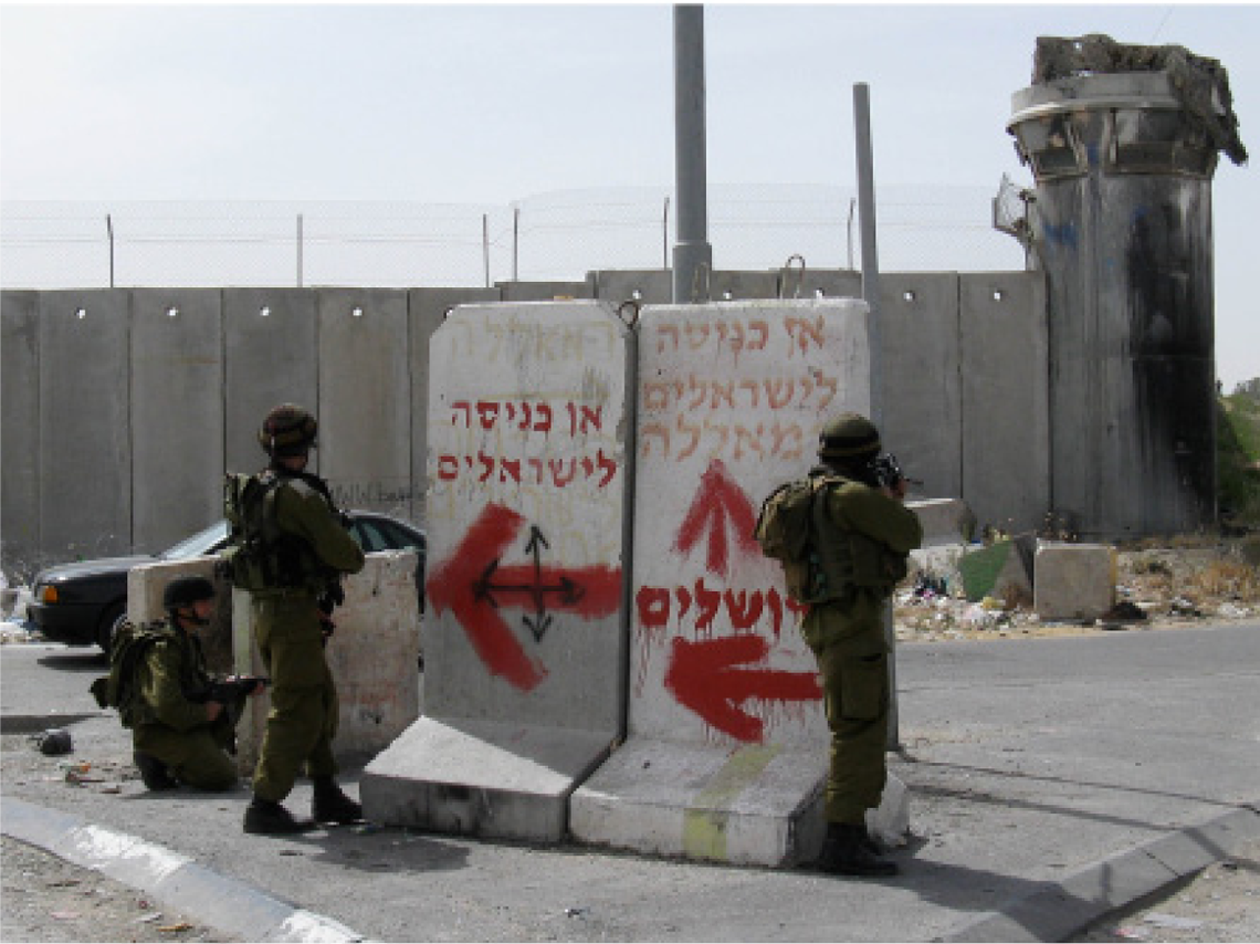
Qalandia checkpoint, May 2008.
Israeli army checkpoints are an integral part of the restricted movement for those living in the West Bank. Hence passing through or seeking to pass through at least one checkpoint, if not more – given they separate all towns and many villages – is necessary in order to seek hospital care. It is not unusual for ambulances of the Red Crescent 2 to be held up, or even refused passage to villages or towns as they negotiate their way across more than 500 barriers to movement (including checkpoints, road gates, earth mounds and ditches) across the West Bank and East Jerusalem (UN OCHA, 2010, 2011). Once having reached the patient, and in the process of ferrying him or her to a critically needed medical service, it is usual for the delays noted above to be repeated and intensified. There are many recorded instances where patients, including women in labour and their newborn infants, die during the hours they are held at a checkpoint. 3 For cases requiring advanced medical services only available beyond the Wall and via the Qalandia checkpoint into East Jerusalem – due to the erosion of medicine within the OPT – a permit must first be obtained. This process is in itself time-consuming and difficult. In some cases the need for a permit is used by the Israeli Defense Force (IDF) as a bargaining device, agreeing to supply one only on condition that the patient becomes an informant on the whereabouts of a family member or friend (see extract of case study A., p. 12). Even with a permit, and no matter how ill, the patient must endure ‘back-to-back’ transfer, that is, he or she must be removed from the Palestinian ambulance in the open confines of the checkpoint to an Israeli ambulance (see for example, Figures 5 & 8). The process, again frequently involving excessive and inexplicable delay, has inscribed within it the potential to aggravate the medical situation. In some cases, a patient may be detained, refused entry and then returned – without explanation and despite clear evidence of medical need – without receiving medical aid to the West Bank (Weingarten, 2007: 4).
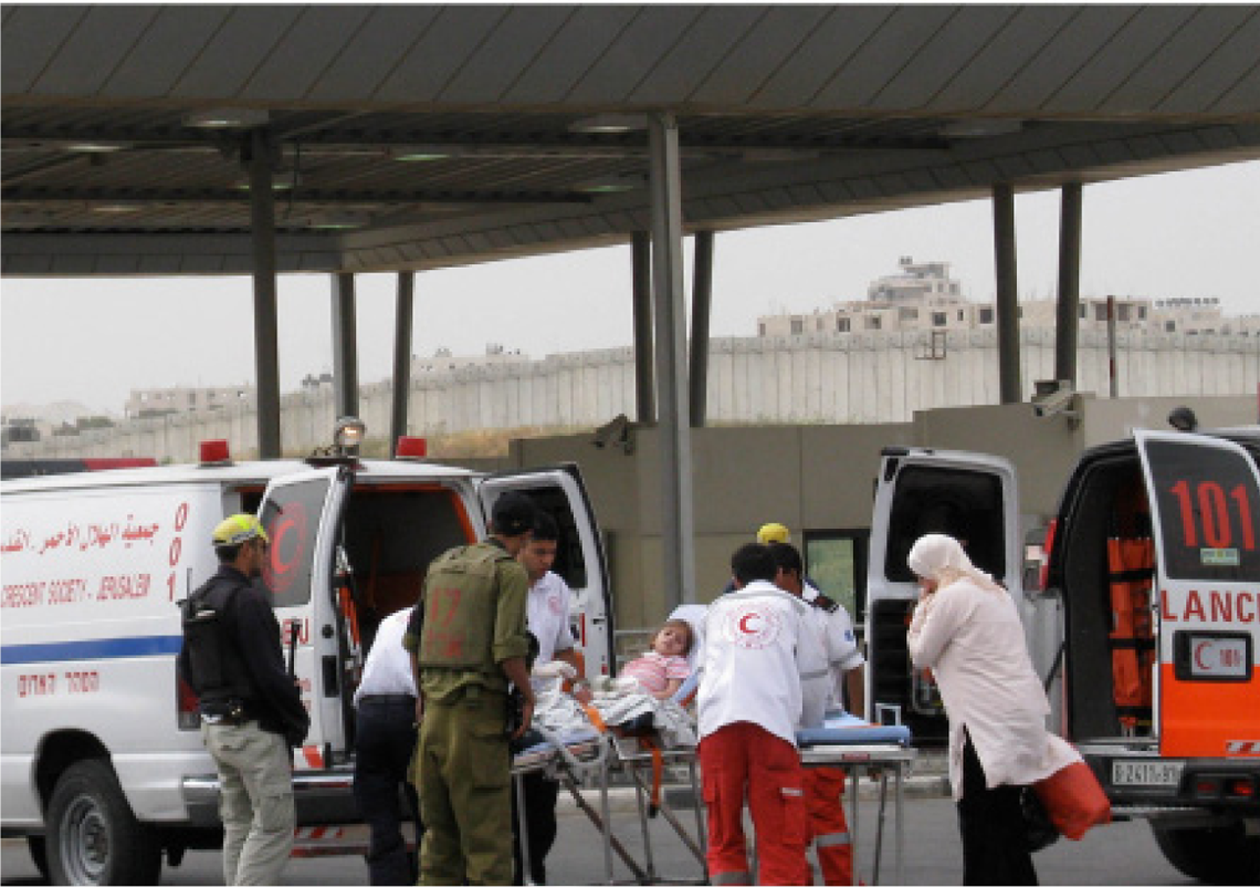
Qalandia checkpoint.
Many of the medical cases needing to be moved through checkpoints and past the Wall that divides the West Bank from medical facilities located within Jerusalem, as well as those in the Gaza Strip requiring entry to Israel or to Egypt, are not solely the result of the erosion of medical infrastructure under the Occupation but a direct result of military attack by the IDF. The special issue of the Lancet cited above and, in particular, the article by former President of the United States Jimmy Carter (2009), makes reference to a report by Batniji et al. (2009) which found that some 35,000 Palestinians were injured between 2000, the beginning of the al Aqsa Intifada – the second Palestinian uprising 4 – and the completion of the report in March 2009. The article specifically notes the high ratio of head and upper-body bullet injuries, which underscores how the practice of occupation and assault is directed to maximize injury. It includes a comprehensive account of how a multiplicity of interconnecting kinds of damage affect Palestinian health. Among these are the combined threat to homes and properties from aerial bombing and direct shelling, together with demolition and the threat of demolition, occupation and regulations denying building permits for Palestinian construction, land confiscation and the destruction of crops; military restrictions effecting limited access to fuel, electricity, sanitation as well as to water; together with degrading treatment at the checkpoint and barrier regime in the West Bank; and exposure to sonic booms across Gaza. All are said to have had and can be argued to continue to have severe direct impacts on the human security of Palestinians in the OPT. 5
While wanting to avoid making a distinction that reinforces the Israeli attempt to politically and spatially separate Palestinians and the Palestinian national movement, we do want to comment on the extreme humanitarian conditions that are specific to Gaza since 2005, the period Israel refers to as ‘disengagement’. By withdrawing from Gaza – in terms of removing Israeli settlements and withdrawing the Israeli presence on the ground – Israel presented itself as giving Gaza autonomy, even as Israel continued to maintain military control over the air, the land borders and the sea, and over the population register.
6
In practice, ‘disengagement’ meant that Israel absolved itself from responsibility for the population of Gaza, abrogating its obligations as an occupying power under international law to protect the population under its care (see Ben-Naftali et al., 2005). Through ‘disengagement’, Gaza has also been made more available to military assault and, in 2007, Israel designated Gaza an ‘enemy entity’ (al-Haq, 2007). The 22-day Israeli military offensive against the Gaza Strip in the winter of 2008/9, known as Operation Cast Lead, involved extensive attacks on civilians and civilian infrastructure. A report by al-Haq (2009) on Operation Cast Lead provides a detailed account of death and injury to Palestinians and to Palestinian and other nationals attempting to provide medical services.
A., 38, was a cancer patient with Hodgkin’s lymphoma, who had recently developed a new lump in the neck. In order to clarify the nature of the lump, he was referred urgently for a PET/CT scan – a test that is not available in Gaza – at Ichilov Hospital in Tel Aviv. Following a petition submitted by PHR-Israel to the High Court of Justice in November 2007 (HCJ 9522/07), the State announced that it would allow the patient to enter for treatment in Israel and that he was required to undergo GSS questioning at Erez Crossing [Israeli maintained point of exit for Gazans]. The patient received an appointment for Ichilov Hospital for the 2nd of December 2007 at 14: 00 p.m. The patient arrived at Erez Crossing early in the morning, and was made to wait there for a number of hours. When he finally went in for questioning, GSS interrogators demanded that he collaborate and threatened that unless he responded to their demand they would prevent his entry into Israel. One of his interrogators said: ‘You have cancer, and it will soon spread to your brain. As long as you don’t help us, you will wait to go across the Rafah Crossing.’ After the end of his interrogation, A. was forced to continue waiting at the crossing for hours until ten hours had passed in total since his arrival. He was then informed that his entry into Israel was approved. However, his entry permit was no longer of use. He had missed his appointment. (Weingarten, 2008) Al Quds Hospital following army bombardment.
The Shurrab family – a father and his two adult sons travelling to a safer locale away from the fighting and during a period of proclaimed truce – were shot at and then denied evacuation and medical care for 23 hours. Both sons died: one from direct injury sustained from an Israeli bullet, the other also wounded but not seriously, then bled to death while he, initially, and the father called to their assailants who were within speaking distance for help. The father and bleeding son also made telephone contact with PHR-I who were prevented from providing life-saving aid until it was too late. The hospital was 1 kilometre away. (PHR-I, 2009a: 37)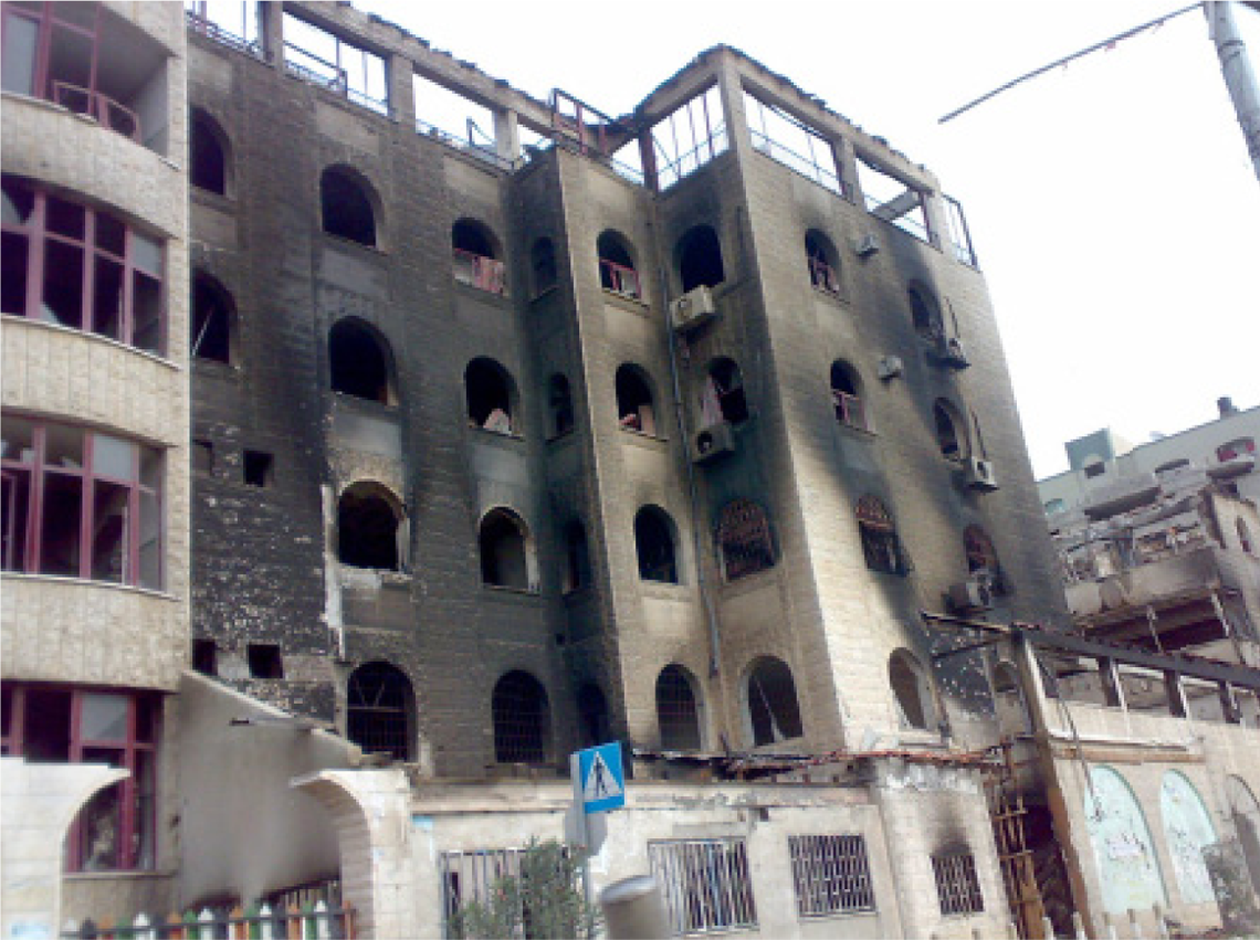

Union of Health Care Committees mobile clinics attacked 31 January 2009.
Precarity and the Claim of ‘Ethics’ as Justification
Although, so far, we have refrained from commentary on the political arguments put forward by Israel – notably, what it claims must be done in the name of security – it is important to note here that a notion of ethics is not absent in the Israeli approach to occupation. The website of the Israeli Medical Association (2011) includes the number of a hotline on human rights and ethical dilemmas. Physicians are invited to call to discuss difficulties arising as follows: 1. Physicians who are faced with ethical dilemmas because of their work; 2. Physicians who identify a conflict of interest between their obligation to their employers and their medical obligation to their patients; 3. Management problems at the place of employment which clash with the ethical obligations of a physician. A soldier will use his weapons and his might only to fulfill the task at hand, to the extent required, and will maintain his humanity even in combat. The soldier shall not use his power and his weaponry to harm those who are not combatants or who are taken prisoner, and will do all within his ability to prevent harm to their lives, bodies, honor and property. (extract from IDF Code of Ethics, quoted in PHR-1, 2009a: 4)
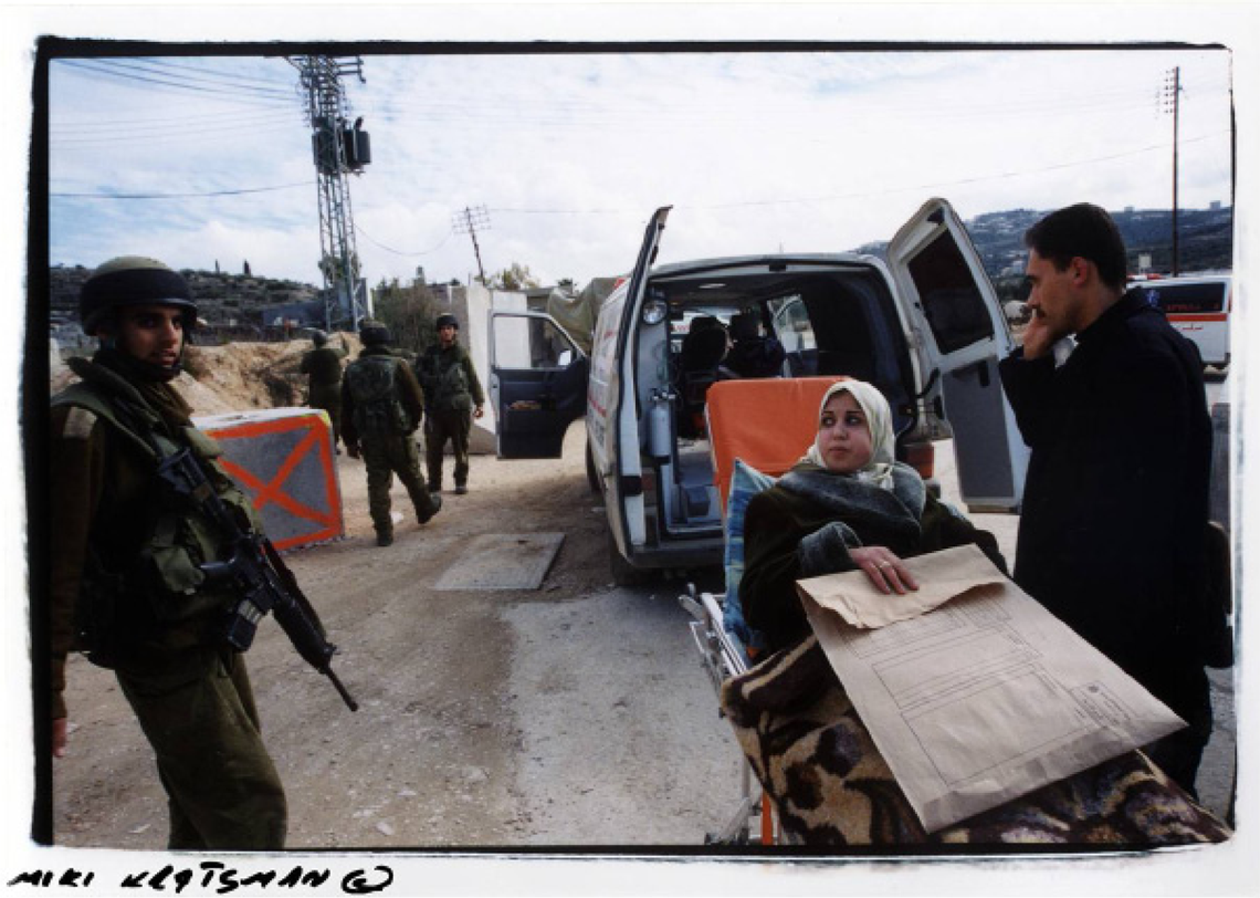
West Bank checkpoint.
Here we propose that the code serves as a cover, a protective device, to shield the army from criticism or, more aptly, condemnation and legitimate trial. The code is a specific feature of an active process of military warfare. And, going hand in hand with this, it is able to make ethical the acts of soldiers through the configuring of Palestinians as ‘combatants’. In the terms of Butler’s theory of performativity (2003, 2004), it is possible for the code to be contravened because it is rhetorically deployed in such a way that it does not apply to these particular Palestinians and, on this basis, we can deduce, in reality it effectively applies to none of them. Ethics, as it is appropriated at the level of rhetoric into the self-representational practices of the IDF, is part of the machinic assemblage of occupation – that is, the coming together of Israeli security claims with geo-technical arrangements that are part of the enactment of the state of Israel and the OPT – and, as such, an integral part of the maximizing of precarity. Indeed, at this point we might say that ethics appears to have lost the ground that we might assume it stands on in a process equivalent, in some respects, to what we suggest regarding medicine. It appears to have become un-anchored from the protection of life and, through a bizarre and extraordinarily tragic and cruel process, has entered into service against life.
But we hesitate in according to this process the transcendental terms that enable the metaphor ‘un-anchored’. By conceptualizing ethics as external to conduct, the ethical code can be called upon to give legitimacy to conduct that has already been rhetorically framed by the social and political forces responsible for maximizing precarity. In contrast, we draw on a conception of ethics as practice, ethics conceived as emergent in the relations of conduct. To put this another way, ethics should not be presumed to be an innocent guide that can be introduced to evaluate an activity – a morally derived position or code on how to act, an adjudicator on the rights and wrongs of action – but should be evaluated in terms of how it is already present or absent in the activity. The acceptance and enactment of a conception of ethics as a moral code or set of principles covers over the very processes that call this ‘ethics’ into practice (see for example, Fraser, 2006; Hawkins, 2006; Rosengarten and Michael, 2009). Hence we can say that a code of ethics is a performative device enabling unethicalacts not only to pass unhindered but also to acquire legitimacy in the process.
The Enactment of Violence, Ethics and the Obligation in the Photograph
The precarity and ethical obligation at the centre of Butler’s project is traced here through the everyday technological penetration of Palestinian life in an extraordinary relationship to medicine as both target and tactic of occupation. The technological is, as we have begun to suggest above, an integral part of the way medicine comes to take form in the militaristic project of maximizing precarity and, therefore, necessary fodder for a rethinking of ethics along with the new ontology of the body called for by Butler (2009: 3). By way of a slight detour, but one which will help to supplement her call, we draw on Hagar Kotef and Merav Amir’s incisive account of the ‘imaginary line’ within the checkpoint. In the permanent temporariness of each checkpoint a line is enforced behind which Palestinians must remain. This line is never made visible, except when Israeli soldiers determine to demonstrate that it has been transgressed. As Kotef and Amir (2011: 59, 60) explain: although this line is never publicly or visibly marked, its transgression carries penalties … such as detaining the ‘transgressors’ for hours, sending them back to the end of the line, or denying them passage; other times the disciplinary punishment is enforced on everybody waiting to cross the checkpoint by slowing down the security-check procedure or completely shutting down the checkpoint for periods of time; but every so often, the reaction of the soldiers is violent, sometimes with the result that whoever finds himself transgressing the non-existent demarcation is badly injured or even killed. Damage to Al Quds Hospital ambulance, 31 January 2009.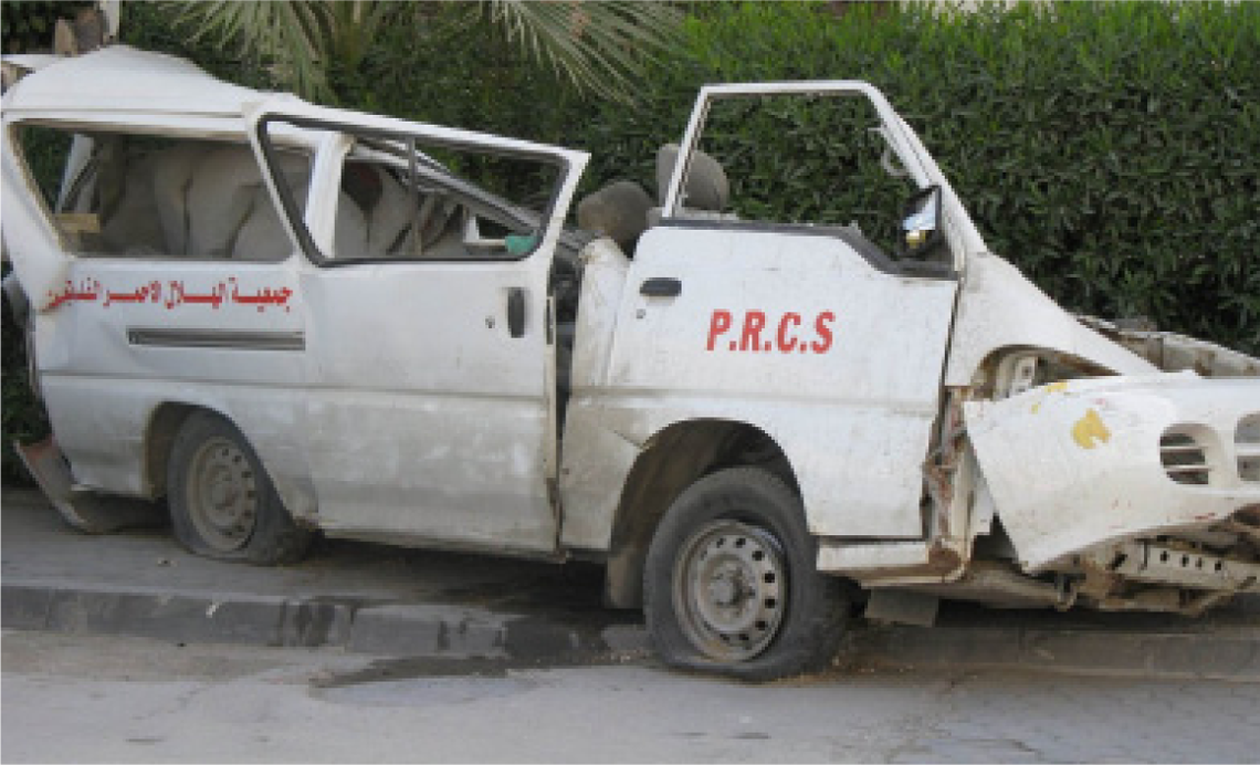
When Butler says ‘the precarity of life imposes an obligation on us’ (2008: 2), we are asked to consider the conditions that make it possible to apprehend precarity. Yet, despite its import, Butler’s approach does not engage with the technological associations that help to constitute the actions of the soldier – his or her being – in the encounter with another. The confrontation at checkpoints between medical personnel and soldiers that we may witness through the above photographs and case studies does not take place without the ambulance and the sick or injured person requiring urgent medical care. The encounter takes place because of the way in which the ambulance has been made into a technology of occupation. By recognizing the geo-technical arrangements in making the Occupation, we propose an extension to the ontological revision called for by Butler. This revision encompasses the material arrangements of occupation. By attending to such arrangements it becomes possible to consider how medicine can become a tactic of war and, moreover, how ethics emerges as part and parcel of the material arrangements.
On the twelfth of January 2009, at 4 in the afternoon, as a team of three ambulances attempted to evacuate a body from Al Zarqa Street in Jabalia, they were hit by a second artillery shell, killing Dr Issa Saleh aged 32 who was beheaded, and injuring the two paramedics Ahmad Abu AlFul, 25 (driver), and Abd ElMajed Abu ElAish. The three ambulances of the PMRS, Civil Defense and Ministry of Health had coordinated with ICRC for the evacuation. All were wearing clearly marked medical uniforms. The crew evacuated some of the injured to Kamal Adwan hospital, then returned, but shelling was renewed from aircraft and tanks, even as they were leaving the building with the injured people. (PHR-I, 2009b: 20) we [as observers] are placed on the threshold, on the very line that divides the outside and the inside, light and shadow, life and art, whose division is at that moment traced by something that makes us cross it without eliminating it and that this offers itself fully for what it is, a world. (cited in Bell, 2012)
Conclusion
While it may not be especially new to claim that medicine is enmeshed in the conditions in which it takes place, we hope our study of the extraordinary conditions of occupation and the extraordinary form of state violence that can be witnessed in our material, may contribute to the way we evaluate the relations of both medicine and ethics. We have used extracts and photographs in this piece to convey something of the appalling suffering of Palestinians through Israeli state prevention of medical care, along with a brief discussion of the conditions that have been cultivated to bring about the requirement for health care. Our intention, as we stated at the outset of this article, has been to provoke a mode of apprehension counter to that upon which the Occupation relies, that is, a complex web of seemingly temporary but permanent militaristic aims for ‘securing’ the state of Israel through maximizing the precarity of Palestinian life.
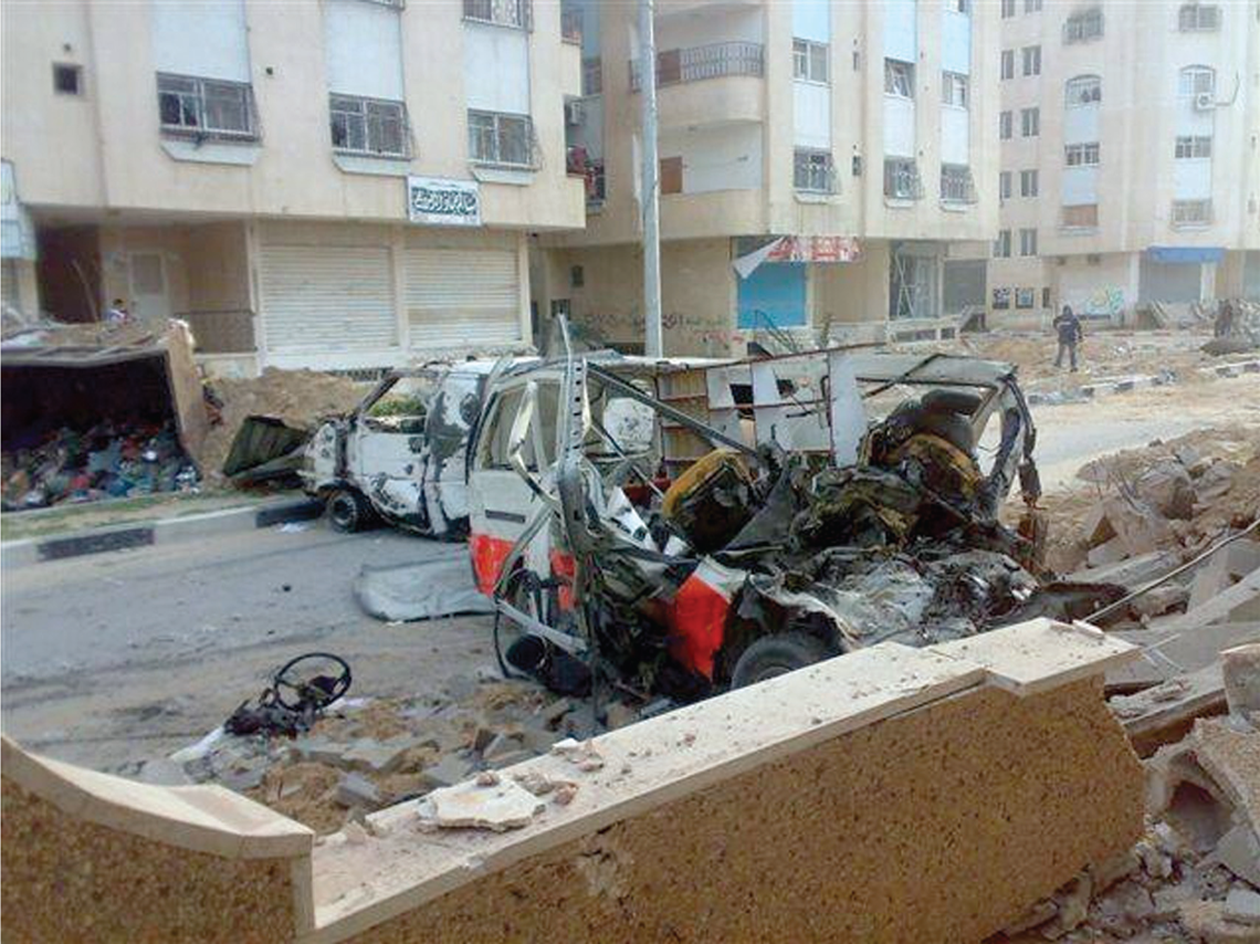
Bombed ambulance, Gaza 2009.
Obstruction of access to medical care, exacerbation of health problems and medical conditions through ‘back-to-back transfers’, delays and refusals for passage through checkpoints, invisible lines that cannot help but be overstepped, decimation of hospitals and ambulances – all are part of the performative process that makes medicine what those at risk require and are simultaneously denied. In other words, the particular experience of those constituted as Palestinian combatants – potential or given – is made possible through the geo-technical arrangements of Occupation that produce medical need in order to deny it or, at best, compromise it. The obligation to intervene – which can be understood as a matter of ethics – is not derived from a set of principles, as international bioethics or militaristic arguments would have it. Nor, we suggest, is it a matter of challenging rhetorical normative devices that have the capacity to lay claim to the validity of occupation. Rather the obligation resides in revealing the very arrangements that make Palestinian compliance with occupation impossible.
To phrase this in relation to the extracts and photographs that simultaneously make our text cohere and fragment it, the inability to gain access to cancer treatment only a matter of miles away is a most remarkable form of inhumanity but it is not just the denial of access that the cases of N., 44 and A., 38 draw attention to. It is the maximizing of this disease such that the sufferer is lured to seek access from the state that has already placed them in a position of dependency and ultimately death. It is the slow, drawn-out way in which, in the case of the Shurrab family, a father is forced to beg for the life of one son bleeding to death from a relatively minor bullet wound alongside another son already killed without the chance of defence, which reveals the manner in which medicine emerges through the arrangements of the OPT as the technical matter of war.
Precarity and the obligation that comes with it is, for Butler, an achievement of epistemic violence. In other words, it follows from a way of knowing or, to accept a more sensorial contribution, a way of apprehending. Here we have taken up her claim that we have an ethical obligation to rethink the ontology of the body in order that such violence be apprehended and propose that the very notion of ethics be reviewed as integral to the practice of such violence. By broadening the frame to encompass the enactment of a transcendent form of so-called ‘ethics’, we have sought to show how a moral ethical code can be used to re-invest an act of violence as justified and, in effect, not a matter of concern. To conclude, we propose that an ethical obligation that emerges in the use of medicine as a technique of combat is one that requires an interrogation of what is enacted as ethics. That is to say, the rhetorical devices embraced by the IDF oblige us to rethink an ethics that is conceived outside the context and, by being so conceived, is able to deliver legitimacy to the conditions for maximizing precarity. A combatant who stands as a military target is the effect of a complex process and it is in this process that ethics may be called to account. Elsewhere Isabelle Stengers (1997: 216–7) has argued that we need to take the time to pose a problem clearly, resisting the tendency to enact a separation of technique and ethics. We conclude by borrowing from this claim and propose that ethics involves reflexive consideration of where and how ethical and political problems are formulated: such that an ambulance comes to be a target for violence, that the need for medical treatment can be utilized as a strategy for turning the very ill into informants or that, in seeking refuge from attack, civilian family members are made to die within the visual and auditory range of a legitimized military formation.
Footnotes
Acknowledgements
We would like to express our thanks to Miri Weingarten for providing us with the documentary materials produced by PHR-I. We would also like to thank the anonymous reviewers and the editorial board of Body & Society for their comments on earlier drafts.