




Abstract
This article examines how the formation of markets in bottled water has relied on assembling a particular subject: the subject of hydration. The discourse of hydration is a conspicuous feature of efforts to market bottled water, allowing companies to appeal to scientifically framed principles and ideas of health in order to position the product as an essential component in self-health and healthy lifestyles. Alongside related principles, such as the ‘8 × 8 rule’, hydration has done much to establish new practices of water drinking and consumption in which the consumer appears to be always at risk of dehydration and must engage in practices of ‘frequent sipping’. This article traces the emergence of the concept of hydration from its origins in exercise science and explores its circulation, contemporary uses and purchase. I argue that the appeal to biomedical languages and concepts found in the discourse of hydration connects with much broader ways of conceiving and acting upon the self that have become prevalent in contemporary society – what Rose and Novas call ‘biological citizenship’ – indicating how the ensemble of hydration participates in wider-ranging transformations in forms of rule. The story of hydration reveals how biomedical techniques of the self can be made to double up as ‘market devices’ by offering specific procedures for assessing the self and calculating the body’s needs. In order to grasp these developments, I position the health sciences, and health and fitness in particular, as a potent site of popular culture in which bodies learn to be affected by the procedures of scientific experiment. A critical grasp of this context is best enabled, I argue, by situating the producers and consumers of scientific principles and commercial products as embodied and looking at their interconnection in processes of emergence. Through these means, we can begin to develop a fully materialized account of the question: how have we become so thirsty?
Keywords
As we look around us in our daily activities, we can observe how slavishly the exhortation is being followed. Everywhere, people are carrying bottles of water and taking frequent sips from them. (Valtin, 2002: R994)
This article examines an important element in the formation of markets in bottled water: the appeal to biomedical languages and in particular, scientifically framed concepts of hydration, which refer to the practice of drinking sufficient water. 1 Obviously, drinking water has long been a part of the practices enabling human being – some would say an essential part. But the ways in which this practice has been rationalized, understood and practised have been subject to change, as much as have techniques for making up personhood. Hydration has become a common theme in bottled water advertising. It allows companies to appeal to biomedically framed principles and ideas of health in order to position the product as an essential component in self-health and healthy lifestyles. Alongside related principles, such as the 8 × 8 rule (the idea that it is necessary to drink 8 × 8 ounce glasses of water a day), hydration has done much to establish new practices of water drinking, in which the consumer appears to be always at risk of dehydration, and must exercise constant low-level vigilance by adopting practices of frequent sipping. The translation of science into consumer information is of course a regular feature of food and beverage packaging (in the form of nutrition labelling for example). But the reference to scientific and medical discourse in the case of hydration is distinctive in that it is not a description of the product’s content but an appeal to a set of principles that are thought to have a life independent of the brand. Hydration describes a practice – like dieting or nutrition to be sure – which is both framed and instituted through biomedical vernacular. Moreover, the promotion of the principle would appear to be tantamount to promoting the product itself. There may be taps around, but you can’t exactly carry them with you.
Hydration’s appeal to biomedical languages and concepts connects with much broader ways of conceiving and acting upon the self which have become prevalent in contemporary society. Nikolas Rose and Carlos Novas (2005) have coined the term ‘biological citizenship’ to refer to the way in which biomedical languages are increasingly used to understand and describe aspects of the self and others in late 20th-century and early 21st-century life. In this context, authorities increasingly conceive individuals in biological and biomedical terms, indicating the emergence of a new paradigm for making up citizens. But what is also significant is how ‘biologically coloured languages’ enter into people’s descriptions of themselves, including their attempts to act upon themselves, their predicaments, their aspirations and their identity in processes which involve forging new relations with medical and scientific authorities – and, one might add, biomedical products. The overarching context for these developments is the wide-ranging and historic reorganization of the powers of the state in which many of the concerns that were once conceived as state responsibilities – the provision of welfare, health and security – are devolved to autonomous and semi-autonomous bodies (professional groups, the market, the family and – most emphatically – the individual) which in turn become responsible for managing their health, their welfare and their affairs. Here, health is no longer cast as something imposed on subjects through governmental strategies and disciplinary techniques. Rather, it becomes a goal that must be actively embraced by autonomous subjects in the new domain of consumption, ‘ensured through a combination of the market, expertise, and a regulated autonomy’ (Rose, 1998: 162). Just as significantly, health is reconstituted in the process. It is no longer limited to the goal of preventing disease or prolonging life, but now incorporates various attempts to reshape, enhance, improve and optimize the body, often involving investment in the promise of transformation inherent in new technologies and commodities. In this respect, the efforts of the beverage industry to promote hydration can be seen to connect with broader techniques of personhood that have a much wider currency within contemporary consumer society. But while Rose and Novas point to the ways in which biomedical rationalities are taken up by entrepreneurs and industry in order to build markets, the connection between biological citizens and market elaboration has yet to be worked through in any detail. The story of hydration helps to reveal how biomedically inspired technologies of the self can be made to double up as ‘market devices’ – a term which Michel Callon and colleagues use to understand the hybrid forms of agency that are key to the effective elaboration of markets (Callon, 1998; Callon et al., 2007).
The story of hydration is also a story about the diffusion and circulation of a ‘scientific’ principle – indeed, of public engagement with science. How has this relatively technical health-related concept acquired such widespread currency and become such a familiar part of everyday languages and practices of the self? While beverage industry efforts to promote the concept are clearly important here, they are only one part of the story. To gain traction, this principle has had to connect more intimately and extensively with the activities and meanings of bodies. On this count, I argue that inquiry into the making of scientific facts – not merely their consumption and communication – may provide clues about their salience or eventual capacity to engage publics. In particular, we need to situate the producers and consumers of scientific principles and products as embodied – that is, as already caught up in meaningful practices, activities and relations – and look at their interconnection in processes of emergence, rather than tracking the transmission of fully formed concepts between already fixed entities (whether science, consumers or industry) (see Michael, 2002, on embodiment and public understandings of science and Warner, 2002, on embodied publics).
In this respect, this article will approach the field of health, fitness and exercise science from which scientific principles of hydration first emerged as a dynamic zone of popular culture in which bodies have ‘learned to be affected’ by scientific concepts, practices and principles in the very process of their elaboration (Latour, 2004). This is not to debunk these scientific principles, but to situate them – that is, to approach their articulation as events. Events do not involve the application of human categories to the passive, natural world but the modification of all the components or circumstances of the event through a process of articulation, or what A.N. Whitehead would call ‘concrescence’ (1978 [1929]). From this perspective, we can discern how the emergence of new principles of hydration rests on a particular articulation of bodies, technologies of government, exercise science, professional sport, popular culture and the beverage industry, in which what gets proposed is that bodies will perform better by adopting new regimes of self-practice which in this instance involve more fluid intake than the professional guidelines that governed athletic events at the time allowed. Each of these elements makes something available to the other participants that would not otherwise have been available in some other arrangement or circumstance. And none of these participants leaves the scene unaltered. As Bruno Latour puts it, an event ‘has consequences for the historicity of all the ingredients that are the circumstances of that experiment’ (1999: 306). In this instance, this includes conceptions of health, the experience of thirst and even general expectations of self and government. Such an approach to scientific engagement enables a more active grasp on the ways in which contemporary subjects of hydration have been, and are being, assembled. We begin to develop a ‘fully materialized’ response (Hawkins and Race, 2011) to the question: How have we become so thirsty?
Hydration on the Go
To make sure you are well hydrated day and night, wherever you go and whatever you’re up to, evian® has a convenient PET bottle that’s right for you. At work or at home, opt for the larger formats. For sports, travel, or life on the go, the smaller sizes fit easily into your purse, pocket, briefcase or knapsack. (Evian advertisement, 2004)
The advertisement for Evian cited here (see Figure 1) distinguishes between the different uses of differently bottled water, and provides some preliminary insight into how the discourse of hydration articulates with PET plastic to produce and equip the mobile subject – the subject ‘on the go’. If the traditional glass bottle is proposed ‘for elegant occasions’ and ‘to enhance fine dining experiences’, the PET bottle, described as easy enough to fit in your ‘purse, pocket, briefcase or knapsack’, is said to befit ‘sports, travel or life on the go’.
2
Different materials intertwine with different meanings and occasions, allowing different forms of consumption to emerge. But alongside the discourse of convenience and mobility, another discourse is conspicuous here. The idea of being ‘well hydrated day and night’ gives this form of consumption its practical logic. It anticipates a particular manner of relating to water, to be enacted through specific practices, objects and techniques. Evian advertisement.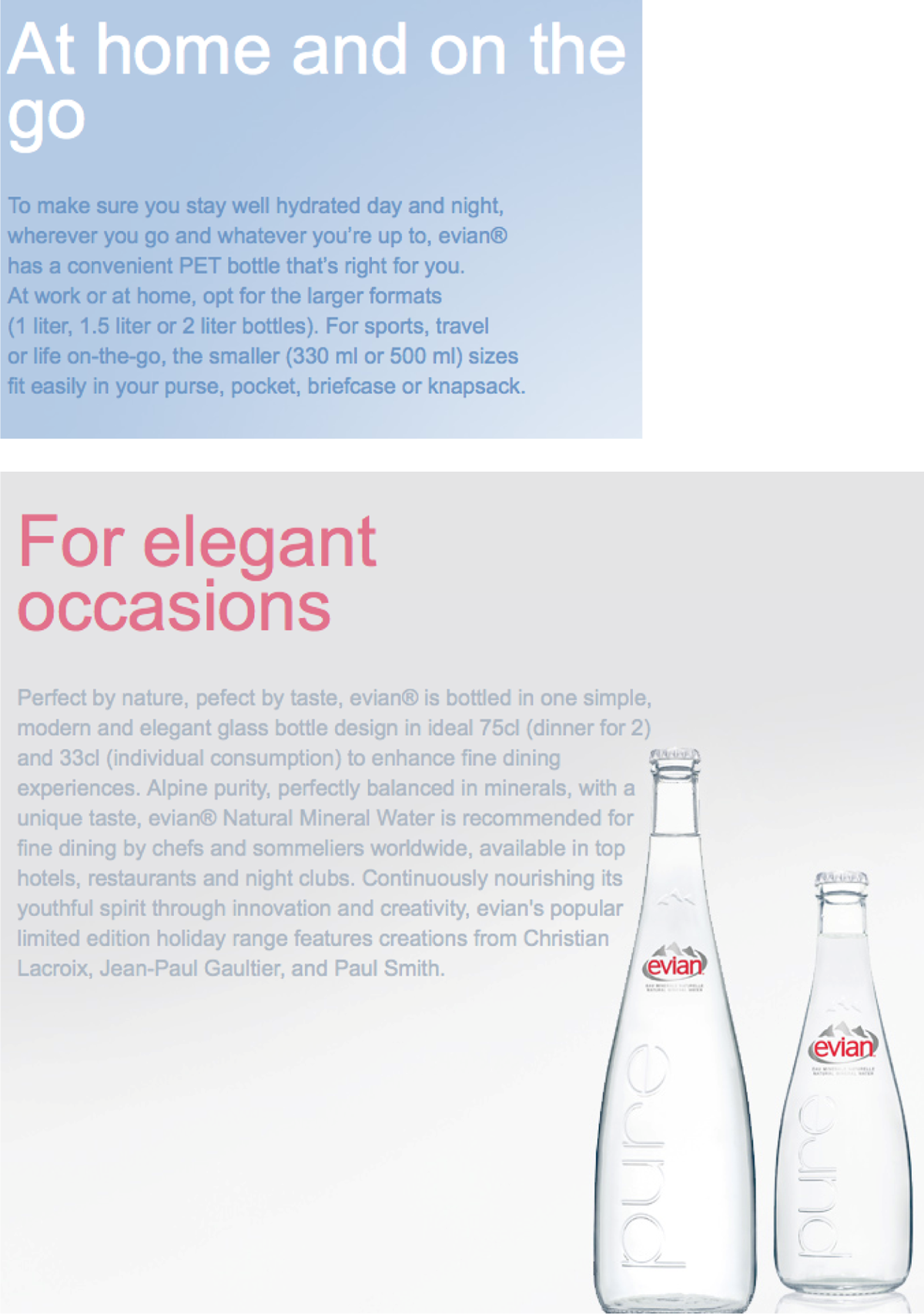
Here we can see how ideas of health combine with certain materials, such as PET plastic, to produce a distinctive cluster of meaning and practice – a specific rationale for consuming water (see Hawkins, 2011). But where does this discourse of hydration come from? What are its associations? And what does it do for bottled water? Hydration is notable for the way it conflates several disparate ideas about the relation of water and health. Initially emerging out of exercise science, where the dominant concern was the effects of fluid loss on athletic performance, the concept is now used much more promiscuously by the bottled water industry to evoke several quite distinct senses of health and the value of drinking water that have quite different medical genealogies. Alongside the discourse of replacing fluids that pertains primarily to the aerobic body, it is now common to encounter elements of a discourse of detoxification (concerned with ridding the body of toxins such as alcohol, tea and coffee); a discourse of weight loss and diabetes prevention (where water is positioned as the healthy alternative to soft drinks); a discourse of renal health, concerned with the health and functioning of the kidneys; and a discourse of heat stress, concerned with the effects of heat on the body. An appeal to dermatology involving the promise of clear skin is also apparent in some instances. Hydration is in this sense a truly heteroglossic concept, and this of course is its power: its ability to mobilize and attach itself to any number of (not necessarily commensurable) concerns and quasi-scientific ideas about the body’s optimal health, and render the consumption of the product a means of meeting the body’s requirements.
But it is also useful to distinguish hydration from some of the other health discourses that animate markets in bottled water. Hydration is different from the discourse of therapeutic minerals, for example, in which bottled water is valued for the special properties of the particular compounds it contains. This discourse, which has traditionally informed the use of table waters such as Perrier and Evian, draws on a longer history of hydrotherapy and ‘taking the waters’, which emphasizes the distinctive properties of minerals from particular springs and spas (see Van Tubergen and Van der Linden, 2002). 3 While this tradition is an important precursor to the mass markets in bottled water that emerged in the 1980s and 1990s, it appeals to quite different therapeutic logics and principles than the discourse of hydration. Bottled water products are indebted to this tradition, but the discourse of hydration adapts and transforms it in surprising ways, such that water’s very status as a generic and basic necessity becomes the attribute that is said to give rise to its therapeutic qualities.
Hydration is also different from the discourse of risk, which worries about the safety and quality of water, and bolsters the demand for bottled water from other directions. Compared to this discourse of risk, which is linked to anxieties around water contamination (and typically assuaged by appeals to – or mythical associations with – ‘purity’), hydration is less concerned with the source of water supply and evokes a much more active or positive sense of health promotion; something that you do for yourself, akin to taking minerals or vitamins. But, unlike the discourse of mineral water, this goodness does not consist in any special qualities of the contents themselves (beyond their generic identity as water), but rather in using the product on a regular basis, as an actively adopted practice. Thanks to hydration, we are no longer led to buy water on the basis of the special properties of the minerals or elements it exclusively contains, but because buying water is a prudent and healthy thing to do. In this sense, the concept of hydration can be situated as a key mechanism that has eased the passage of bottled water from a boutique to a mass product, all the while retaining its special (and especially active) association with health. The contents of the bottle may not be particularly special or distinctive, but the practice promises to make you so.
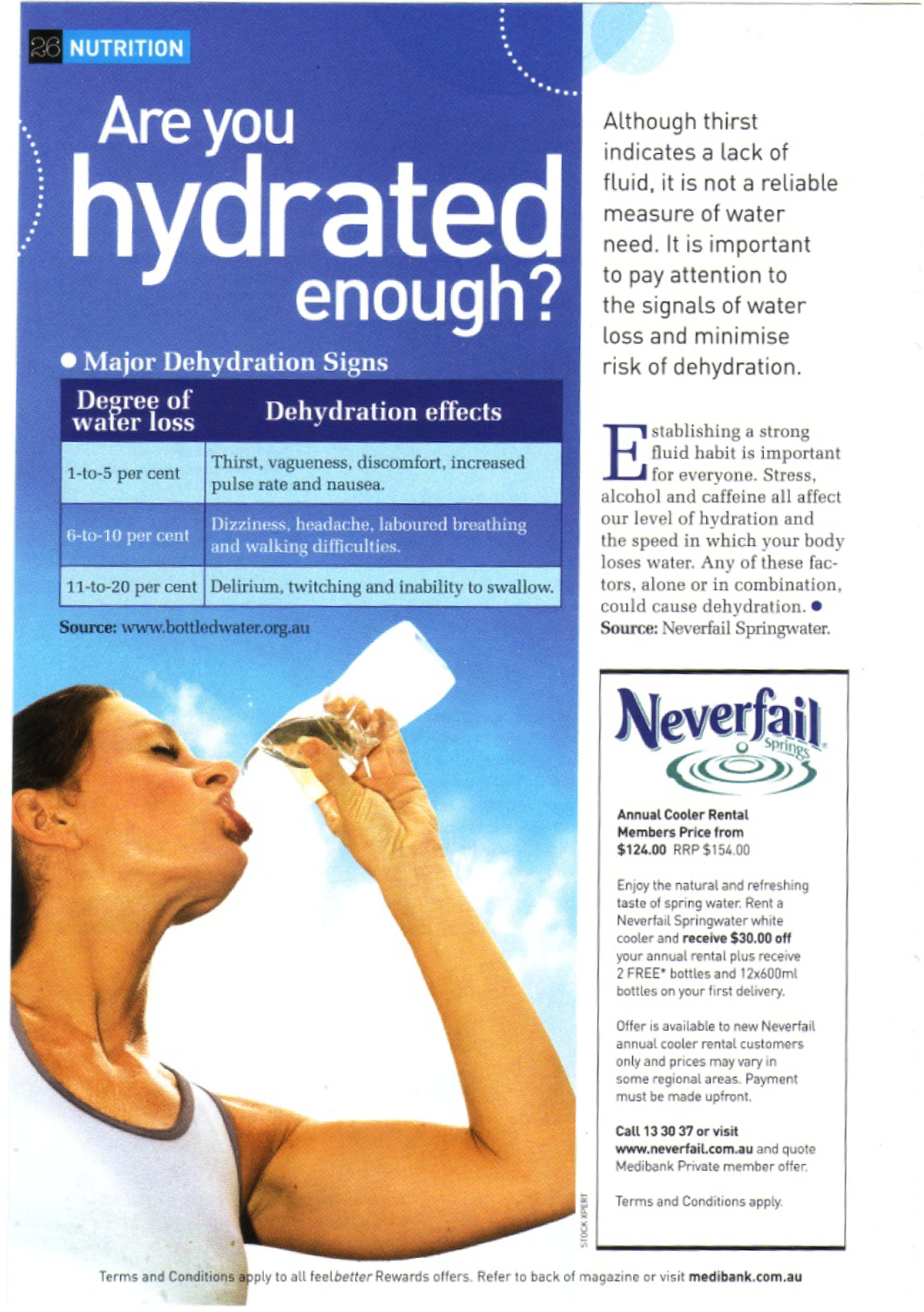
In this respect, hydration can be located at the junction where discourses of biomedicine and lifestyle-oriented consumption converge. Here, it is not simply the avoidance of sickness, but the optimization of health – its continual enhancement – that constitutes the broad focus of health practice. Joseph Dumit (2002) has coined the term ‘dependent normality’ to refer to an emerging paradigm of health, illness, treatment and normalcy, in which it has become common to believe that our normal state is one of deficit and that healthy functioning can only be achieved by the use of remedial products. Dumit is mainly concerned with contemporary pharmaceutical reasoning – a far cry, it would seem, from a product as benign and basic as water. But a quick look at the construction of hydration in health advertisement information reveals several analogous features. A picture of a sporty woman drinking from a bottle of water is captioned with the bold question ‘Are you hydrated enough?’ (Figure 2). This question is followed with a scientific table listing ‘Major Dehydration Signs’, in which ‘Degrees of Water Loss’ are matched with ‘Dehydration Effects’ – from thirst and nausea, to delirium and twitching. In a claim that has become a ubiquitous feature of hydration discourse, the ad states: ‘Although thirst indicates a lack of fluid, it is not a reliable measure of water need.’ The text enjoins the reader to:
pay attention to the signals of water loss and minimize risk of dehydration. Establishing a strong fluid habit is important for everyone. Stress, alcohol and caffeine all affect our level of hydration and the speed with which your body loses water. Any of these factors, alone or in combination, could cause dehydration.
Are you hydrated enough?
This text produces a reflexive subject concerned with the state of the body’s health. Significantly, she can’t trust her subjective experience of thirst, but must ‘pay attention to the signals of water loss and minimize risk of dehydration’. Oddly enough, the signals listed in the table include, first and foremost: thirst. But they also extend to a range of nebulous symptoms – vagueness, discomfort, nausea, increased pulse rate – which might otherwise be seen as familiar features of everyday life (delirium and twitching being the possible exceptions!). Meanwhile, dehydration is said to be caused by a range of familiar, everyday factors and circumstances, whether ‘alone or in combination’. In other words, health is a precarious achievement, and there is a constant risk of backsliding.
Joseph Dumit argues that a paradigm of ‘inherent illness’ has begun to replace the paradigm of ‘inherent health’ that once featured as the most common way of talking about health and illness. Where previously illness was seen as a temporary interruption to a default state of health, today the template of chronic illness has been extended to a wide range of conditions, such that ‘the normal state is one of vulnerability and precariousness, requiring a constant vigilance for further warning signs’ (2002: 125). In medical discourse, these warning signs are typically charted using algorithmic graphs which depict various symptoms as risk factors for the syndrome. On this model, one is always progressing towards the disorder, and the chart functions to dramatize the risk of discontinuing the remedial plan. For Dumit, this allows life to become fused with a pharmaceutical logic, in which drugs become the natural or obvious solution to a range of health problems, conceived as imminent or chronic. While this anxious iconography would seem to be a long way from the notion of lifestyle enhancement or optimization mentioned earlier, the construction of ‘dependent normality’ has been key to the naturalization of remedial products as essential components for extending and improving life, and the discourse of hydration can be seen here to depend on similar graphic and textual mechanisms. The circulation of these features in advertising, online media and popular discourse has become a factor in the making of thirsty biological citizens, as the appearance of this information in the promotional section of a private health insurance members’ magazine suggests. 4 Linked to this information, an advertisement offering members a discount for the rental of a Neverfail water cooler service appears. Drinking water is transformed in the process; from a public resource into a private good or service that promises not only to keep you well – but make you better. 5
Aerobic Bodies
Thus the transformation in the ontology of water involves a reorientation of medicine and health. The goal of ‘meeting the body’s needs’ is supplemented by a new emphasis on performance and self-enhancement. In this respect, the disciplinary context of the emerging science of hydration is especially interesting. For the construction of thirst as an unreliable guide to the body’s need for fluids can be traced to the findings of exercise science, rather than mainstream medicine. Prior to this moment, no one had found the issue of dehydration that interesting, except a team of research scientists who, on learning that American troops might be required to fight in the desert, were driven into the Colorado desert in the 1940s to study the physiological effects of water depletion during physical activity (Adolph, 1947). 6 It was not until 1970 that anyone paid the topic much more attention, when a number of factors converged to make the topic newly interesting. In particular, the professionalization of sports prompted researchers to begin to apply scientific methods to physical exercise and, in particular, to questions of athletic performance. David Costill, a researcher from Ball State University, is renowned for being one of the first researchers to apply scientific methods to the study of exercise and training in this context (Kolata, 2001). At the time, marathon rules forbade runners to take fluids before they ran 10 kilometres, and runners actually trained themselves into forgetting their thirst while training (Cantwell, 1980). But athletes were collapsing with body temperatures of up to 43 degrees and losing up to 5 kilograms on a single run. There was little money available to study sports at the time, so Costill approached the newly established beverage company Gatorade to ask for money to study the effects of dehydration on marathon runners. Not only did Gatorade agree; it provided enough funds for Costill to set up his Human Performance Laboratory at Ball State University, which still functions as a research and training hub today.
In his experiments on hydration, Costill can be viewed as articulating certain propositions about the relation between the athletic body and its intake of fluids. As Bruno Latour (1999, 2004) has explained, a proposition is not simply a claim or a statement. It involves articulating a body into a new set of arrangements or relations. Costill’s experiments found that taking fluids (not merely Gatorade) allowed runners to run further and faster. By documenting that distance runners were in dire need of fluids, Costill’s studies had the effect of prompting a major revision in marathon rules as well as changes in training practice. In other words, Costill was engaged not so much in the discovery of some essential or universal truth about the body, but in a quarrel or wrangle with existing habits of professional sports.
7
Despite the situated nature of these habits and relations, echoes of his findings are typically found in hydration discourse ubiquitously today. During the course of his initial experiments, Costill found that it was:
not unusual for the extremely dehydrated runner to experience very little or no desire for water. The athlete must be aware of his body’s demand for sodium chloride, water and glucose and realize that the thirst mechanism is an inadequate indicator of bodily needs. (1968)
Thus emerged some important precursors to the general discourse of hydration. But how did these principles travel and achieve the currency they have today? Costill’s experiments happened to coincide with an explosion of interest in running and aerobic activity in the western world. The televised win of the Olympic marathon by American long-distance runner Frank Shorter in 1972 inspired many Americans to take up the practice. (Some commentators attribute Shorter’s win to the new protocols of training and hydration instituted by Costill’s experiments, indicating the physiological components of this emerging assemblage.) Public marathons such as the New York City Marathon (held annually since 1970), the Chicago Marathon (since 1977) and the London Marathon (since 1980) created public venues for the practice which were at once spectacular, eventful, participatory and increasingly popular. People’s enthusiasm was catered to by magazines such as Runner’s World, which went monthly in 1973, and books such Kenneth Cooper’s Aerobics (1968) and James Fixx’s The Complete Book of Running (1977), which provided extensive practical information and advice for those interested in taking up these forms of exercise. Over this period, millions of people took up running, and this assemblage of media, popular practice and exercise science created new modes of engagement between consumers and scientific discourse around questions of bodily performance. Principles of fluid replacement were a case in point. They demonstrate how the practices and discourses of exercise provided new ways for fitness enthusiasts to ‘learn to be affected’ by scientific experiment (Latour, 2004). In his bestselling Complete Book of Running (1977), for example, James Fixx enthuses, almost lyrically:
Most of us don’t think a great deal about how much we drink or when we drink it. Runners however … know that physical efficiency drops substantially if they drink substantially less than they lose. Instead of drinking merely because they feel thirsty (or not drinking because they don’t feel thirsty), they drink consciously, deliberately, for the good of their bodies. They have learned how much their bodies need, and how often. What was once a mindless indulgence is elevated to an art. (1977: 31)
Here we can see the emergence and popularization of a new cluster of meaning, practice and identity. Fixx’s book did a great deal to popularize the practice of running for millions of Americans. But what is especially significant is the articulation of the body with certain prehensions from scientific discourse. In this moment, the question of fluid intake is disconnected from the body’s experience and rendered a matter of expert calculation and determination. Drinking is reconfigured in the process. No longer a simple response to how the body feels, it now takes the shape of a practice or a skill: an activity that is undertaken ‘consciously, deliberately, and for the good of the body’ (Fixx, 1977: 31). It can be learned and studied and optimized, moreover, to enhance the body’s efficiency and performance. Thirst is not what it used to be.
There are several features that are worth noticing about this event that may help us think about the popular engagement with hydration. First, these principles emerge from exercise science, not medical science or nutrition as might be expected. This is the study of the body in motion, the body’s performance, in quite specific – indeed, extreme – conditions. It does not pertain to the sedentary body, about which no reputable evidence justifying the 8 × 8 rule can be found, incidentally (McCartney, 2011; Valtin, 2002). Yet the disconnection of fluid needs from the experience of thirst goes on to become a ubiquitous feature of the emerging discourse.
Second, the articulation of these principles comes at a time when there is unprecedented interest in, and uptake of, activities that were previously the domain of a few. 8 The groundswell of interest in running and aerobic exercise propelled unprecedented popular engagement with new concepts of the body, including scientific explanations of performance, and especially differences in performance. The popular media that emerged to cater to this new movement eagerly reported and discussed these findings. In other words, this is not a case of unidirectional science communication, but something much more multi-linear and co-emergent. Costill was renowned for asking the same questions as athletes and people trying to get fit: the scientific interest in the aerobic body was a complement to widespread popular interest. In this sense, the exercise press can be situated as a key venue for the articulation of new ideas about sports performance, informed by an ethos that was at once experimental, popular, scientific, participatory and practical. These convergences allowed the principles to travel.
Third, health and fitness had begun to serve as a compelling source of identification and symbolism much more broadly at this time. This may help to explain the engagement with notions of performance and hydration beyond the specialized community of professional athletes. Robert Crawford (2006) has discussed how health and fitness became a key vehicle in this period for the expression of certain values with which the professional middle classes had long identified: personal responsibility, self-discipline, self-determination and willpower. As a form of work on the self, running and other forms of aerobic activity seemed to provide a visceral model of what hard work and discipline would differentially bestow. While competitive opportunities had always existed in sports, running fostered a new kind of competitiveness, in which individuals could compete against themselves. The notion of the ‘personal best’ – the idea that you could draw out your own potential through competing with yourself – provided a practical frame that could be used to make sense of the competitive nature of white-collar work, especially during the economic downturn of the mid-1970s. If the domain of the personal and the corporeal had been a primary beneficiary of the liberation movements of the post-war period, in conditions of world recession it was increasingly constructed as precisely the object upon which one must work to maintain security and control (Race, 2009). For many in the professional middle classes, exercise came to feature as a key site and medium through which the values that would later underwrite neoliberal philosophies of the self were both expressed and embodied, as a sort of ‘practical sense’ or habitus (Bourdieu, 1984). For others, an aspirational identification with this figure would suffice, as the active self expressed through the aerobic body came to substitute for the ideal of normative citizenship itself. In this respect, the popular identification with health and fitness that emerged at this time might be regarded as ‘an attachment to a cluster of promises’ that allowed people to imagine belonging to something or having a future (Berlant, 2011). 9 Whether this identification bore any strict or direct correspondence to the actual fitness activities of all those who came to invest in them is less significant and also less certain.
It is this aspirational attachment to health and fitness as a source of identity and belonging that contemporary bottled water advertisements rely on when they depict the sporting body as the absolutely generic body of the consumer public: A body that is at once normative and aspirational; presumed as general, yet slightly out of reach; what everyone is supposed to be in the regular, everyday, normative mode of being ‘yourself, only better’ (to take from the Fitness First logo) which has come to characterize healthy consumer citizenship today. The tendency of the bottled water industry to extrapolate and generalize this particular body to the body of the general public is evidenced, for example, in the self-assessment tools that urge you to calculate ‘how much water your body needs’ found on the International Bottled Water Association website (referenced in the advertisement for hydration discussed above). 10 The website features a Dehydration Calculator, in which you are asked to enter your weight, your ‘exercise minutes’ and your ‘exercise intensity’. Even if you enter a value of zero for the latter two categories, you are taken to a page featuring advice from the National Association of Athletic Trainers which states: ‘When exercising vigorously, you need to begin in a well hydrated state.’ This prescribed identification does much more than tell us about the identity of the idealized or presumed consumer. Calculation tools such as this also connect to – and attempt to engage – techniques of the self that have a much broader purchase in contemporary society, tapping into modes of self-assessment that have become a common feature of people’s everyday engagements with biomedicine and practices of healthy citizenship more generally.
Biovaluing Water
For Joseph Dumit (2002), the biomedical habit of visualizing and charting risk sets in motion a particular logic of illness that naturalizes the use of therapeutic products. What is conspicuous about the current context is the way these mechanisms for picturing and calculating illness and risk are actively embraced by consumer-citizens to make sense of their conditions. The internet has been central to these practices of patient self-education. People use online resources to develop quite specialized scientific and medical understandings of their being – a practice which Rose and Novas (2005) term ‘informational citizenship’. And they form themselves into communities linked electronically by email lists and websites around particular conditions – a development they call ‘digital biocitizenship’ (Rose and Novas, 2005). For Rose and Novas, these forms of engagement with biological explanations of the body are a distinctive development in the process of caring for, or caring about, health. ‘An active citizenship is increasingly enacted, in which individuals are taking a dynamic role in enhancing their own scientific – and especially biomedical – literacy’ (2005: 446).
Rose and Novas are also interested in the ways in which biotech, biomedical and pharmaceutical companies tap into these practices of patient self-education among active biological citizens. Thus, websites designed by pharmaceutical companies attempt to gear themselves to the practices of active health consumers, providing educational material, scientific explanations, self-assessment tools, practical tips and advice, in order to install ways for individuals to understand their condition and imagine how pharmaceutical agents will target it. Legal changes that allow pharmaceutical companies to engage in Direct-to-Consumer advertising in the United States provide the general context for these marketing initiatives. But in jurisdictions where Direct-to-Consumer advertising is not permitted, companies still use the internet for related purposes. Now, however, the information is not presented as an advertisement for a particular product, but as a resource for self-education about the condition itself. There is now both a marketing and a critical literature on ‘condition branding’, for example (Moynihan and Henry, 2006), in which ‘trust in brands appears capable of supplanting trust in neutral scientific expertise’ and ‘biovalue … is supplanting public value in the biological education of citizen-consumers’ (Rose and Novas, 2005: 448; see also Waldby, 2000: 33). 11
In this respect, the self-assessment tools found in this field of practice can be understood as ‘market devices’, in that they strive to promote particular calculative practices that become significant in the construction of markets. Michel Callon and colleagues use this term to refer to the material and discursive assemblages that participate in the shaping of markets. ‘From analytical techniques to pricing models, from purchase settings to merchandising tools, from trading protocols to aggregate indicators, the topic of market devices includes a wide array of objects’ (Callon et al., 2007: 2). Crucially, from this perspective, the ability to calculate is not concentrated on any individual actor, but is rather distributed among several actors, devices and material settings, such that the shaping of markets will inevitably involve the adjustment and articulation of diverse sites of agency and calculation. In other words, we are a long way from the human-centric theory of ‘false needs’ imagined by the Frankfurt School in its theorization of consumption, with its focus on ideological consciousness and inflated objects. We are also a long way from Birmingham School conceptions, where subjects enter the market with preformed identities and make consumption choices expressive of these identities. The shaping of markets involves the continual massaging and modification of diverse sites of agency – objects, humans and material practices – each of which is already implicated in emerging practices of self-formation that are already ‘on the go’, as it were. These efforts may involve putting in place, promoting or modifying particular calculative regimes, for example, which – while not determinative – nonetheless lend themselves to particular market choices.
The Hydration for Health website 12 provides a particularly vivid example of these market devices, and their connection to techniques of the self and modes of self-assessment that are already implicated in the making of biomedical knowledge and subjects. Sponsored by Danone (the company that produces Evian among other water products), the website is divided into two sections – one for ‘members of the general public’ and one for ‘healthcare professionals’. The first of these draws heavily on the above-mentioned genre of medical education. 13 It features an intricate Hydration Calculator, designed to ‘help you see whether you’re getting enough fluid in your daily diet’. After entering details of one’s weight, height, age, lifestyle, gender and country, the user is asked to enter detailed information about their daily beverage intake – an item which involves no less than 10 different categories of beverages, from soda to sports drinks. The results page puts forward a calculation of whether you have good or bad hydration, and conveys warnings about the fluid losses associated with different activities, including advice on what you need to do to compensate for them. A side-bar provides information on the intake of liquid calories from different beverages, stating ‘water is the only liquid necessary for proper hydration’. This feature illustrates how hydration discourse has come to incorporate contemporary concerns around obesity and diabetes. In the hands of the beverage industry, hydration becomes a hybrid form of health messaging capable of absorbing many different health concerns and medical aetiologies. By means of this device, the need for water is rendered calculable for consumers in a manner that bypasses traditional mechanisms that have been used to register the need for water, such as thirst. Consumers are invited to engage in particular forms of self-assessment, coming to enact a form of calculative agency, steeped in biomedical authority, the outcomes of which may in turn be factored into the equations of producers and marketers.
But wait, there’s more! A third section of the public website features a high-gloss documentary animation which presents information about ‘Water and Your Body’. After choosing a profile (the choices are Over-Indulgent, Pregnant, Senior, Active or Children) the user is presented with narrated scientific and medical information especially tailored to their personal profile. 14 Using scientific terminology, the narrator explains in extensive detail why hydration is a necessary concern for you. For each profile type, we receive detailed information about how different fluids and activities affect different organs of the body – the pancreas, kidneys, fat cells, heart, muscles, lungs and brain, respectively. These ‘health need’ profiles are used to constitute different market segments and match them with the different medical concerns which can apparently be resolved by taking water, further exploiting the heterogeneity of hydration discourse. For example, the Over-Indulgent category contrasts water with sugar-sweetened beverages, while the Active category features information on fluid loss during physical activity and thermoregulation. Another instance of heteroglossic opportunism.
Meanwhile, the website for Healthcare Professionals boasts an extensive range of features, from the Mission Statement (‘to establish healthy hydration as an integral part of public health nutritional guidelines and routine patient counseling so people can make informed choices’); to the delivery of scientific information about the health value of water; to the Hydration for Health Hub, ‘an interactive portal to the healthy hydration community worldwide… intended only for health professionals’. The site also offers a range of ‘Tools and Publications’ for the use of health professionals, including downloadable educational slide kits (presumably for use in professional and educational conferences), hydration charts, patient education materials and online patient advice; and a list of ‘Congresses and Events’, which include the Annual Scientific H4H Meeting, sponsored by Danone, held every year in Evian since 2009. 15 Long gone are the days of marketing initiatives targeting the consumer exclusively. Here were have the corporation’s participation in – and attempted shaping of – a whole field of knowledge, the payoffs of which may not be direct or immediate but are nonetheless treated as material.
Critics of commercial influence have documented the emergence of informal alliances between pharmaceutical corporations, public relations companies, journalists, doctors’ groups and patient advocates in the contemporary biomedical field. From the perspective of pharmaceutical corporations, these alliances are effective – not only in popularizing little-known conditions, but also in fostering the creation of entirely new medical disorders and dysfunctions and promoting these ideas to policy makers and the public (see, for example, Moynihan, 2003). One can see here the adoption of many of these practices by Danone – the sponsoring of scientific meetings, the enrolment of experts and the adoption of the language of health policy activism in its mission to influence public health guidelines. But this is not a straightforward process of product promotion; it entails seizing and negotiating moments of opportunity in an unfolding assemblage of biomedical, economic and bodily production. Also noteworthy here is the complete absence of any images of branded bottles on either website, including any mention of products such as Evian at all. Each page is visibly ‘Sponsored by Danone Waters’, but this is all that the company will venture in order to maintain legitimacy within the terms and conventions of health education discourse. All the images of drinking water on the website feature glasses or unmarked bottles. To recall Rose and Novas, the corporation is engaged here in a complex process to have the brand associated with biomedical principles and scientific legitimacy in a field where critical scrutiny of commercial influence is increasingly prominent (see Moynihan and Henry, 2006). The corporation does not determine or control this process, but anticipates and suggests connections between the self-constituting practices of subjects, authorities and technologies which are already under way.
What we have here is a stunning convergence of beverage advertising with the genres and practices of pharmaceutical marketing, which sees beverage producers taking up many of the practices pioneered by pharmaceutical corporations, not only in positioning their product, but also in the making of biomedical knowledge. It would be a mistake, though, to write off Danone’s efforts as bogus science, or distinguish them from legitimate science merely on the basis of commercial influence. As Moynihan and Henry’s work demonstrates, corporate sponsorship of research and development is a regular feature of the contemporary biomedical field. What is needed, rather, is ongoing attention to the historical and material co-construction of markets and biomedical facts, with particular attentiveness to how calculative devices are enacted by the bodies that participate and emerge in these encounters, as I have attempted to demonstrate here.
Conclusion
Brawndo’s got what plants crave. It’s got electrolytes. (Idiocracy, dir. M. Judge, 2006)
The film Idiocracy depicts a world where the hapless citizens kill their crops by irrigating them with a commercial sports drink because ‘it’s got electrolytes’. 16 The film caricatures a slavish relation to bioscientific language which some might be tempted to recognize in today’s consumer practices and cultures. But the film’s dystopian vision of the future is predicated on an idea of consumer stupidity that seriously underestimates the suggestiveness of contemporary market devices. As this article has shown, these devices are performative; they work by prompting and suggesting, rather than simply manipulating; by making connections, by tapping into much more widely invested techniques of making sense of, and acting upon, persons. A focus on markets, facts and subjects as mutually constitutive, processual and emergent might produce a more satisfactory relation to techno-scientific production – and a more satisfactory version of active citizenship – than a commitment to consumer stupidity would allow. This analysis of the discourses and practices of hydration thus has a number of implications for studies of embodiment, consumption and medicine. In order to grasp what is happening here, we need more than an analysis of meaning and representation, as advocated by cultural studies of consumption, and more than an analysis of commodity chains, as advocated by the anthropology and sociology of consumption. We need to be able to understand how the product becomes associated, both implicitly and explicitly, with already existing technologies of self, such as patient self-assessment tools and self-diagnosing practices; and particular ‘regimes of living’ (Collier and Lakoff, 2005), such as biological citizenship (Rose and Novas, 2005). And we need to understand how it forms connections with other meaningful practices, and techniques for making sense of those practices, such as exercise and exercise science, which have come to organize and invest the body and its performance in wide-ranging, popular ways. Finally, we need to consider how these meanings and self-practices participate in the emergence and transformation of forms of rule: the participation of seemingly mundane practices, associations and devices in changing technologies of government.
What is also apparent, in empirical terms, is the sense in which the construction of markets for bottled water involves participation in a complex assemblage of developments and practices that are characterizing and shaping the scene of biomedical knowledge production and education today. As this study demonstrates, the promotion of hydration reveals a striking convergence between beverage industry practices and the genres and practices of pharmaceutical marketing and biomedical knowledge construction, the implications of which are to invest water with a sort of ‘biovalue’ which may partially supplant previous conceptions of water’s value, including its appropriate modes of delivery and circulation: a matter of considerable biopolitical implication. My analysis of hydration also prompts a set of methodological suggestions for the study of embodiment in contemporary consumer cultures. If the body is an interface through which we ‘learn to be affected by hitherto unregistrable differences through the mediation of an artificially created set-up’, as Bruno Latour has suggested (2004: 209), there is also a history and a specificity to these ‘artificially created set-ups’ which it is possible to follow and trace. Science studies provide a rich set of conceptual tools for doing just that: for tracing the construction of scientific facts, previously cordoned off from cultural analysis. Given the increasing inter-implication of biomedical languages and practices with contemporary consumer cultures and forms of rule, it would seem then that the sociology of science and techniques provides increasingly indispensable tools for understanding what it is that we do with our bodies, and for grasping the assemblages of which they form a part.
Footnotes
Acknowledgements
The research for this article was undertaken with the support of a grant from the Australian Research Council Discovery Project scheme. I would like to thank Rebecca Brown for research assistance in relation to this piece; Gay Hawkins and Emily Potter, collaborators on the ARC Discovery Project ‘From the Tap to the Bottle’; and Marsha Rosengarten and Anne Pollock for reading and discussing earlier versions. Any errors are my own.