



Abstract
Cancer has long been a cultural touchstone: a metaphor of devastation and a spectre of social as well as bodily anomie and loss. Yet recent years have witnessed significant transformations in perceptions of cancer, particularly in perceptions of the cancer patient. This paper is concerned with the ‘struggles of subjectivity’ emergent in this transvalued cancer culture. Explored from the standpoint of the ‘bad patient’, and drawing on media and cultural methodologies, the paper will consider the convergence of medicine, morality and popular iconography as they are embedded in the imageries, imaginaries and representational economies of the cancer culture industry. Of particular concern in this context are the (re)composures of the patient, as liminal figure, caught between clinical imperative and cultural fantasy.
Keywords
Introduction
Angelina Jolie reveals she has had preventive mastectomy (guardian.co.uk, 14 May 2013) Will Angelina Jolie’s mastectomy inspire other women to follow her lead? (globeandmail.com, 2013) Jolie’s cancer risk shared by others with genetic flaw (usatoday.com, 2013) Angelina Jolie’s genetic self-ownership is the future of medicine (reason.com, 2013) After Jolie’s disclosure, cancer group urges caution (washingtonpost.com, 2013) A standing ovation for Angelina Jolie (Jezebel, 2013)
On 14 May 2013, the actress and celebrity Angelina Jolie published in the New York Times an article entitled ‘My medical choice’. In this article, she disclosed that she had undergone a prophylactic double mastectomy and breast reconstruction following diagnosis of a ‘faulty’ BRCA 1 gene. This was in the aftermath of the widely reported loss of her mother, who died of ovarian cancer in 2007 at the age of 57, and a maternal family history of breast and ovarian cancer. Jolie’s article elicited what might be described as a ‘measured torrent’ of international media commentary and reportage. The tone of this commentary generally tempered shock at the nature and extremity of her prophylaxis with homage (albeit in some cases uneasy homage) to Jolie herself. The escalating reportage also quickly coalesced around a number of emergent tendencies and motifs, all of which are relevant to the subject matter of this article.
First was the juxtaposition of the languages of genetic risk, fighting cancer and informed choice, which not only allowed but also rationalized and normalized the extremity (and for some, brutality) of Jolie’s decision. In this context, Jolie could be framed as a breast cancer patient though she did not have breast cancer and might never have gone on to have it. A zero-sum response to a far from certain science 1 (about a terrible disease that one could get) could seem, albeit with some unease, logical and proportionate. And ‘genetic self-ownership’ could be invested with both moral imperative and moral capital. Jolie’s case represents what both Lemke (2003, 2004) and Gibbon (2007) have argued is the wider genetification of risk both within and outside the context of cancer (see also Steinberg, 2013, 2015).
Second was the conjunction of cancer and gender, articulated on the mutually reinforcing terrains of female beauty culture and celebrity, the former with its particular fetishization of female breasts, and the latter amplifying the body reflexive imperatives of feminine capital. Jolie’s particular status as public body – ‘the most beautiful woman in the world’ – both jarred with and provided an additional interpretive frame for her perceived bravery to disclose, to acknowledge herself as genetically ‘flawed’, and to undergo a gruelling remedy. Perhaps the most prominent motif of the reportage of this event was the continual and disturbing juxtaposition of stock images of Jolie’s face, lips and breasts with sober, at times highly technical, explanations of genetics, breast cancer markers, citations of risk and graphic accounts of mastectomy and reconstruction surgeries (including Jolie’s own procedures).
Of particular relevance to this article was a third theme, the framing of Jolie (in part constituted by her framing of herself in her original article) as an edifying subject. As suggested in the selected headlines above, both the concern and the plaudits that greeted the news of Jolie’s decision were filtered through a permissive-imperative vernacular of ‘inspiration’. On one side of this was the construction of Jolie as a barrier-breaking and empowering figure for the ordinary woman; that is, if ‘the most beautiful woman in the world’ could come to this radical decision, this would ameliorate the stigma or desolation of mastectomy (and hold out the promise of restorative reconstruction). At the same time, Jolie’s personal wealth insulated her entirely from the gross inequities of health care that constrain the choices, availability and quality of care available to most Americans (and indeed, to most non-Americans – a point Jolie herself noted in her article). This, plus the particularities of her own medical history (and the realities that: (a) most cases of breast cancer are not correlated with BRCA gene mutations and (b) having a BRCA mutation does not determine that one will go on to develop breast cancer) means, however, that her situation cannot be globalized.
The dominant motifs surrounding Jolie’s story are not new. Rather, they represent an amplification of what this article will go on to argue are normative institutionalities and everyday non-remarkable sensibilities surrounding cancer. Jolie stepped into not only an established medico-commercial cancer industry (and a peculiarly American one at that), but also into a relatively recent mode of cultural discourse that has reconstituted the cultural status of cancer and of the medico-morality of patienthood.
As Susan Sontag (1990 [1978]) suggested, cancer has long been a cultural touchstone, a metaphor of devastation and a spectre of social as well as bodily anomie and loss. Yet recent years have witnessed significant transformations in perceptions of cancer, particularly in perceptions of the cancer patient. This article is interested in what might be termed the struggles of subjectivity emergent in this underlying and transvalued cancer culture. The analysis that follows takes cancer advertising as both a case study and peculiar slice of this larger transvalued culture. Focusing in particular on a long-running advertising campaign for Memorial Sloan-Kettering Hospital, this article pursues three interlinked arguments. The first is that contemporary cancer culture involves a potent articulation of popular, biocultural and medico-commercial discourse, of which medical advertising is a salient case in point. The second is that the cancer patient has become a primary object of transference, typically represented as an edifying subject and a figuration of moral entitlement and moral capital. The third, more specifically, is that the phantasmatic ‘good patient’ embodies distinctively neoliberal body-affective imperatives – imperatives of will, affect and action – that constitute cancer as an imperative field and in which an imperative of estrangement is a core dimension.
Signification and the Cancer Imaginary
In its examination of a distinctive trajectory within the signification field of cancer, this article deploys analytic resources drawn from critical discursive and cultural psychoanalytic traditions within media studies and is located centrally within a feminist social semiotic tradition (see for example Epstein and Steinberg, 2003, 2007, 2011; Steinberg, 2009). First, drawing from a long tradition of feminist semiotic studies of advertising (see for example Kilbourne, 1999; Mort, 1996; Nixon, 1996; Williamson, 1978), it focuses on a specific advertising campaign – that of the prominent USA cancer hospital Memorial Sloan-Kettering – as a case study of a larger significatory field. The campaign, on the one hand directed to a very particular and arguably narrow middle-class demographic, at the same time both draws from and reinforces tropes of cancer survivorship and patienthood that constitute a terrain of popular intelligibility beyond its own particularities and parameters. Advertising is not produced in a vacuum. Rather, it is a mode of utterance, deployed in and as narrative or discursive fragments, whose intelligibility presupposes a wider, shared meaning field, a realm of commonsense – in other words, that enables the viewer to fill in what is invoked without it having to be spelled out. This article is thus interested in what might be termed the field of intelligibility that constitutes (and reciprocally is constituted by) the distinctive features of the Memorial Sloan-Kettering advertising campaign as a point of reference for a larger constellation of public cancer discourse and popular cancer meanings. Second, in social semiotic terms, the article is also interested in the intersection of representation and social relations. This begins with a foundational understanding of signification as both materially constituted and materialising. I refer here to Butler’s (1993a) understanding of signification as embedded in and constitutive of material reality, rather than epiphenomenal to it. This is in part because representation is anchored in and both produced and consumed through material institutional contexts and processes. Media cultures, in other words, constitute and are constituted by not only circuits of meaning (Johnson, 1986–7) but also by circuits of material relations. In addition to filling in, a further dimension of the material-embodied anchoring of signification is affective – the modes of attachment (or repulsion) that engage viewers (and producers) in a project of meaning and that, in turn, sediment and fill out public discourse. The Memorial Sloan-Kettering ads thus constitute not only a mode of public understanding of cancer, but public feeling.
This article also engages (and engages with) several further framing resources. First is Sontag’s seminal critique of the (destructive) cultural dimensions of cancer, set out in Illness as Metaphor (1990 [1978]). Second, is Sander Gilman’s (1991) concept of transvaluation, which he used to describe instances of critical reversal of the negatory character of racial discourse (for example ‘black is beautiful’). Third is Frank Mort’s (1987) study of ‘medico-morality’, which explores the moral-discursive character of medicine and its triangulation with politics, popular commonsense and, in his case study, the historical regulation of gender and sexuality. The final resource is the growing cluster of studies specifically interested in the political, economic and cultural dimensions of cancer. These include critical assessments of corporatized dimensions of cancer and wider medical culture (Kasper and Ferguson, 2000), and particularly the pinkification of breast cancer (Ehrenreich, 2009; King, 2006; Sulik, 2011); critical evaluations of the turn to ‘evidence-based medicine’ (Goldenberg, 2012) and meditations on the ontological conflicts and biopolitical freighting that underpin cultural as well as clinical paradigms of cancer patienthood (Bell, 2012; Jain, 2007; Klawiter, 2008; Stacey, 1997). Of particular relevance here are Bell’s (2012) analysis of emergent discourses of cancer survivorship and Jain’s (2007) exploration of the temporal-ontological imperatives embedded in the public as well as clinical imaginary of cancer.
Cancer in Advertising: Medico-commercial Discourse
Memorandum: Date July 14, 2001. To: Cancer. From: Barbara. Your Occupation in my body has been officially terminated. Effective Immediately. Sincerely, Barbara (Memorial Sloan-Kettering Cancer Center, advert, 2009–13) Karen searched far and wide for the right breast cancer treatment. Then she moved 750 miles to get it. (Dana-Farber/Brigham and Women’s Cancer Center, advert, 2009) 18 MONTHS after cancer surgery, a young woman celebrated the one year anniversary of when other hospitals said she would die. (Mount Sinai, advert, 2010) At 14, Ryan Wenke faced losing a leg to bone cancer. At 15, her biggest problem was which boy to go to the dance with. (Mount Sinai, advert, 2009) ‘I’m here today because I never quit fighting my cancer’ (Novartis, advert, 2010) ‘Hail to the Victors Valiant’ (University of Michigan Health System, advert, 2009) ‘Hey Cancer Kiss My Butt’ (Cancer Research UK/Tesco, Race for Life, advert, 2013)
In 2009, following a year of cancer treatment, I began to systematically collect an archive of cancer-related advertising across both print and television formats. Owing to my circumstances, and not, I suspect, unlike other cancer patients, I became hyper-aware of public cancer discourse. Advertising struck me particularly, in part because it seemed to triangulate, to exactly encapsulate, and also to deny, the frequently irreconcilable and overwhelming cross-currents of clinical, intersubjective and cultural expectation on the one hand and, on the other, the material realities that colonize the day-to-day life of a cancer patient.
The archive’s print ads (the focus of this article) are predominantly from internationally circulated USA magazine sources, focusing in particular on The New Republic, The New Yorker, The Atlantic and The New York Times Magazine. The archive includes 23 separate print advertising campaigns, many of which ran over a number of years (some are still running) with multiple versions of the basic format. These campaigns include cancer hospitals, charities and charity events, health insurance, cancer research and cancer support services.
All of the campaigns I have examined share a number of features. First, as already mentioned, is the longevity of a number of their formats. For example, Memorial Sloan-Kettering cancer hospital has six versions of the same ad that have been running regularly (and interchangeably) in the New York Times Magazine for at least the past four years. Four other campaigns took this approach (Cancer Research UK: ‘Cancer we’re coming to get you’; Dana-Faber/Brigham and Women’s Cancer Center: ‘Amy’, ‘Karen’; MD Anderson: ‘Making Cancer History’; Mount Sinai: ‘Another day, Another breakthrough’).
Second is their character as advertising. Advertising is a distinctive media context and a point of convergence for multiple institutions, in this instance a nexus of clinical, pharmaceutical, charity-activist, research, and commercial interests. Indeed the questions of medical consumerism and marketization comprise a significant dimension of context for a semiotic analysis of cancer advertising, central as they are, for example, to the pinkified corporate-charity culture of breast cancer (King, 2006; Sulik, 2013; Sulik and Eich-Krohm, 2008). Advertising both represents and deploys discursive resources for wider public understandings, sensibilities and imaginaries articulating modalities of production and consumption, and standpoints of author and viewer. This is perhaps most powerfully articulated in the context of medical and pharmaceutical advertising (pervasive in the USA and Canada), where commercial, educational and public health idiomatics uncomfortably elide (see for example Mamo and Fosket, 2009).
A third aligning feature of my sample, particularly accruing to the magazine advertisements, is its consistent address to a middle-class preferred readership. This is constituted not only as an extension of the target demographic of the magazines, but also of its idiomatic location in discourses of consumer/rational choice and presumptions of capital, including of high degrees of literacy and educated entitlement. Perhaps the most powerful feature of the campaigns I followed, and exemplified across the tag lines quoted above, is their articulation of commercial, medical and moral-discursive meanings, presenting not only products (e.g. cancer services, cancer information, cancer insurance) in the marketized frame and middle-class idiom of consumer choice, but also a language of moral imperative, most prominently personified by and deployed through the first-person address of the cancer patient. As suggested in Mort’s (1987) foundational study, morality in this context does not simply refer to a set of particular moral ideological principles or propositions, but also to a modality of imperative – agentful, affective, intersubjective and mediated both materially and institutionally. It is this latter point with which this article is most concerned and that emerges most forcefully across the sample, in a number of common tropes, vernaculars and modes of address, and is potently elaborated in the Memorial Sloan-Kettering campaign. The classed assumptions built in to the contexts of its distribution, as I shall go on to argue, also articulate through the nuances of its address to and its reconstitution of this primary demographic in and through a preferred modality (and preferred morality) of survivorship.
Nearly all of the campaigns I examined used the trope of the first-person address, with their attendant, insistent, instructional summons to the reader. The testimonial forms of first-person ad campaigns have a number of effects. First, they draw subliminally on a peculiarly American version of confessional/testimonial, itself a discursive hybrid of social justice activism and self-help therapeutics (Epstein and Steinberg, 2003). They also, at least at first glance, appear to humanize the subject of cancer – in both senses. They suggest a locus of humanity – which counters cancer’s existential threat – and they offer a containment of cancer’s meaning to the individual and their world. They also offer an ordinary mode of discourse – from me to you – that both supersedes and offers a place of personal recognition and projective personal agency that, by right, will not be overwhelmed (either by being blinded with science or corralled by treatment regimes).
In the discussion that follows, I explore the Memorial Sloan-Kettering print-ad campaign, focusing on one particular exemplar from the series, ‘From Barbara’, to more closely examine this significant strand of the discursive, medico-commercial logics, languages and visual repertoires of the cancer culture. The Memorial Sloan-Kettering campaign, which at its core is a hospital touting for business, emblematizes a ubiquitous culture of medico-pharma advertising and is, itself, an artefact of the interlocking of medical and commercial interests, and of medical services, with a commercial industrial complex and a corporatized popular imaginary. 2
My discussion of this campaign is concerned with three overarching subjective tenses as they are elaborated through the visual, linguistic and compositional elements that constitute the Memorial Sloan-Kettering brand. These are what I have termed on the one hand, the edifying I – the ‘I’ asserted as exemplary subject; and on the other, and accruing to the exemplary subject, the exhortative you – the consequent requirements of you, the reader/addressee. Both are modes of address that imply a morally ordered imaginary and a hierarchy of relative standing vis-a-vis self and other. The third subjective tense, implied rather than addressed, is the I estranged, an outlier subject, neither edifying nor addressed.
‘From Barbara’: Cancer, Commerce and Cultural Affect
The ad, ‘From Barbara’ (Figure 1), is one of a long-running print-ad campaign by Memorial Sloan-Kettering 3 that includes six separate first-person images – of which five feature women and five present subjects who are white. 4
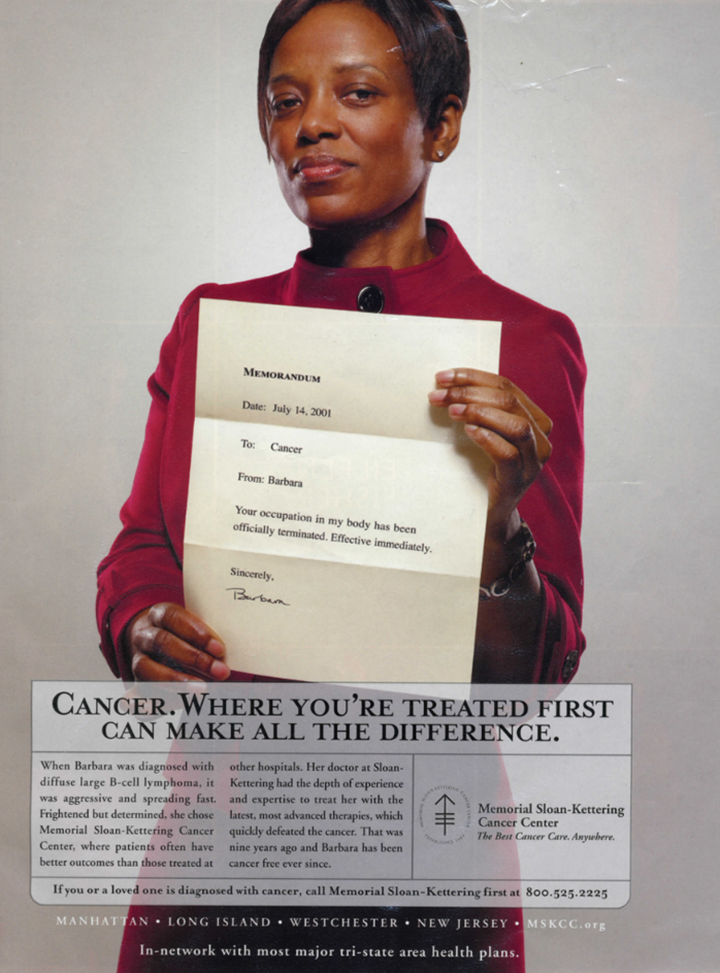
‘From Barbara’, in Memorial Sloan-Kettering Cancer Center advertising campaign ‘Where You’re Treated First Can Make All the Difference’ (collected between 2009–10 and 2013, NY Times Magazine).
All of the adverts share a compositionally parallel presentation, with comparable, defiant ‘I stood up to cancer’ messages addressed in writing to cancer itself (see Figure 2a–e): ‘Cancer, My hair has grown back. YOU haven’t’ Sarah ‘Cancer, You said I’d never have children. My daughter says you’re wrong’ Michelle and Maddie ‘To: Cancer From: Barbara Your occupation in my body has been officially terminated. Effective Immediately’ Sincerely, Barbara. ‘Cancer, NICE TRY’ Sincerely, Larry Rawson. ‘Hey Brain Tumor, We are so over’ Colleen ‘Hey Cancer – you messed with the wrong nurse’ Rebecca Granza RN

(a) Sarah, (b) Michelle and Maddie, (c) Larry, (d) Colleen, (e) Rebecca, in Memorial Sloan-Kettering Cancer Center ‘Where You’re Treated First Can Make All the Difference’, advertising campaign (collected between 2009–10 and 2013, NY Times Magazine).
In its framing of cancer as antagonist, the campaign recapitulates a long-standing trope of the cancer imaginary. However, there is a pointed shift in the ways in which that trope elides with the cancer patient as assertive protagonist. This is a transvalued cancer imaginary, 5 a survivorship discourse focused on (and transformed by), as Bell (2012) and others have argued, the ordinary person as cancer fighter. 6 In this transaction, cancer’s virulence is taken down a peg: a petty thief, a bad worker, a bad boyfriend. The framing referent is an aspirational return to normal, a twin fantasy that proposes that once you are done with cancer treatment, you are done with cancer; you are back to your proper life – not only the life that cancer interrupted, but indeed the life you were meant to have. At the same time, the visualized return is told in domestic normativities. In the stories of ‘Barbara’, ‘Rebecca’, ‘Larry’, ‘Sarah’, ‘Colleen’ and ‘Michelle’, there is an oscillation between the grand and the domesticated. Similarly, each tableau frames a quid pro quo, a social contract in which will (what one is prepared to do, intends or chooses to do) is the currency of exchange, rather than – and standing in for – what one is prepared to (or able to) pay. This contract is spelled out in the narrative arc of the biographies, by which we learn of the chosen journey from cancer to health, intermediated by Memorial Sloan-Kettering’s superordinate expertise, profoundly underscored, as emphasized in first-name references, by its investment in persons. There is also the tension of the compositional and the real that infuses this campaign (and the others like it) with a mode of moral standing that is at once a posture (we are accustomed to the actor-as-real-person in advertising) and yet at the same time unassailable because it is constituted as both a banner of, and a shield for, what might in fact be a real, and therefore vulnerable person; the staged ‘Colleen’, may actually be Colleen.
The Edifying I: Genre, Text and Trope
As we can see from Figure 1, the ad compositionally foregrounds ‘Barbara’,
7
framed as a cancer ‘survivor’, in a dual first-person address both ‘to cancer’ and to the reader, by means of a typed memorandum. Also in the foreground is the all caps primary tag line: ‘CANCER. WHERE YOU’RE TREATED FIRST CAN MAKE ALL THE DIFFERENCE’.
The name and logo of Memorial Sloan-Kettering Cancer Center appears below the tag line, in small font next to a brief biographical narrative that presents the ‘cancer free’ ‘Barbara’ as both fait accompli and authoritative referent (as well as referee) for Memorial Sloan-Kettering’s cancer services. More subtle is the framing of ‘Barbara’ as referent for a preferred cancer affect, a cancer cultural imperative defined by a stance of self-assertion, clinical certainty and ends-guaranteed-by-means.
On first impression of the ad, a number of buzz words and phrases, including a dominant trope of cancer survivorship stand out. These include ‘aggressive’ (cancer), ‘frightened but determined’ (‘Barbara’), ‘better outcomes’, ‘depth of experience and expertise…the latest, most advanced therapies’ (Memorial Sloan-Kettering cancer services) and ‘quickly defeated the cancer’.
The note displayed by ‘Barbara’, face front to camera, is a peremptory memorandum. It is addressed to cancer as a personification and is written in a familiar managerialist idiom of the office. It offers a callously brief termination notice. Underlying this visual pun (which operates at multiple levels) is a notion of deserved brutality that accrues as much to the (putatively failed) worker who deserves nothing better than to be sent packing as it does to (the malignancy of) cancer. The visual composure positions ‘Barbara’ as a point of identification in an alignment with managerialism itself – indeed with its most brutal and aggressive variant. In psychoanalytic terms, there is splitting 8 at a number of levels. The allusion to an inadequate co-worker or subordinate domesticates the existential crisis of cancer. Cancer treatment, framed as a firm directive, diffuses its gruelling rigours and dangers. This staging of ‘Barbara’s’ moral-professional rightness suggests an underlying proposition that even she does not (we do not) deserve to have cancer, that cancer is an injustice, and that a contract, in which ‘Barbara’/we should live cancer free, has been violated. Cancer staged as a wrong implies an entitlement (and power) to set right. Likewise, ‘beating cancer’ is a reciprocal metaphor of personal vindication and a corrective through which one might claim one’s ‘true’ standing.
The details of visual composure are also significant. By her dress and pose, ‘Barbara’ is styled as a professional, but one in a feminized occupation. She wears an attractive buttoned up blouse (but not a suit); she is groomed but not trendy, mature without being matronly, serious but without the graphic signifiers of upper (or perhaps even middle) management. Her costume evokes possibly a bank worker or mortgage adviser (rather than a hedge fund manager), a paralegal (rather than a lawyer or judge). She fits a trope of ‘working woman’: she presents as educated, she works in a professional (though not particularly well paid) sector, she may be single (she does not have a wedding ring); she bears the modest trappings of middle-class success without any suggestion of affluence. This is cemented by the memorandum – something that someone in a comparable position to ‘Barbara’ might imaginably receive or type up (the memorandum in and of itself strongly evokes the feminized occupational roles of secretary or office manager), but would not otherwise have the status to issue. The class inflections that frame ‘Barbara’ emerge from and are cemented through the narrative logic of the ad’s turn-the-tables dénouement – ‘Barbara’s’ memo signals a vindicating power reversal in which object and subject switch places – she who would receive a termination notice, will now issue it. The life-and-death terrain of cancer adds both freight and weight to the otherwise unsubtle double entendre of ‘termination’ and its simple reversal. In the period of its circulation, this imagery may have carried particular resonance as many people like ‘Barbara’, in the midst of recession, might have been receiving termination notices or lived in any case with the normative impermanence of such positions. By any interpretation, however, ‘Barbara’, like the other figures in this campaign, signifies an ‘ordinary’ working person. That she is presented as a normative (even ‘preferred’) patient for Memorial Sloan-Kettering carries an implication of egalitarianism: this, the ‘best of hospitals’, is not only or ideally for the affluent. This speaks directly to the anxieties of a culture in which extreme inequities of health care are the norm. The notion that someone like ‘Barbara’ could not only access a gold standard hospital like Memorial Sloan-Kettering, but represent their regular and indeed sought-after pool of patients, is a powerful draw.
The particular interlocking of gender, race and class in the imagery of ‘Barbara’ is complexly intertwined with the array of figurations in this series. She appears on the one hand as a lone black figure in an array of white figures. At the same time, she is presented as one of a diverse series of ‘ordinary patient’ tropes (older, younger, single, married, male, female, black, white). Together these images cross-cut gender and race (though less obviously class, since all are on a middle-class spectrum). This fills out an underlying implication in the array that suggests ‘cancer doesn’t discriminate; and neither do we’.
‘Barbara’s’ facial expression is complexly evocative. She is not, as the textual cliché in the ad describes, ‘frightened but determined’. She appears instead determined, fierce, superordinately entitled. On her face and in her pose is an unyielding determination. Her eyes, frontally direct to the reader, evoke a transitive adversarial transaction against that which – or who – would obstruct or impede or threaten. Her expression is firm, implacable. Juxtaposed with the text and particularly with the memo, there is an implication that ‘Barbara’ is the one who is in control, that we are witness to the results of her agency. There is a subtle air of triumphalism in her pose and expression, an implacability, a suggestion of unwillingness to compromise in any way with a powerful enemy whose power cannot be acknowledged – nothing but unconditional victory will suffice. Even though, in fact, cancer patients can and do ‘lose’, as the ad text itself back-handedly acknowledges in ‘Barbara’s’ bio: ‘she chose Sloan-Kettering Cancer Center where patients often [but not always] have better outcomes than those treated at other hospitals’ (author emphasis).
‘Barbara’s’ expression, along with the notion that ‘she chose’, also signifies a kind of transferred agency. The medical personnel who treated her and the regimens of her treatment are not mentioned. While the advert is for Memorial Sloan-Kettering cancer services, the imagery elides and transfers this agency to ‘Barbara’, the patient who chooses. It also posits a bargain for survival located primarily on the terrain of morality. There is here an implied quid pro quo that suggests that the unequivocal and insistent insertion of oneself into ‘the cutting edge of treatment’ (‘Barbara’s’choice) will pay off in a moral entitlement – as distinct from a probable outcome – to be ‘cancer free’.
Judith Butler (2004) has argued the representational currency of the face to convey (or repudiate) humanity and grievability. In the context of cancer, the focus on ‘Barbara’s’ face ostensibly does this. But it also does something else. In its pose of implacability, it also refuses humanity in a denial of the possibility of death and loss. It is in this sense the obverse of the Levinasian face (1985); it is all form. Its vulnerability is spectral, forgotten. Certainly it leaves estranged the grievable humanity of the cancer patient who is not ‘at war’ with cancer, who would not issue brutal memoranda of dismissal, who would not view cancer as a nefarious personification, separate from herself, or who cannot (or will not) fulfil the imperatives of action and affect that make up cancer’s requisite ‘bargain for survival’.
There are two elements of denial here: first, of the human condition, which cannot guarantee survival (whether from cancer or anything else) and cannot evade death, whether in the long or short run; and second, of an affirmative choice not to pursue heroic measures. Both, in this instantiation, are cast outside the imaginable moral hermeneutics of cancer. A corollary point is made by Bell (2012) with respect to the imperative neoliberal languages of ‘teachable moments’ and ‘post-traumatic growth’ in breast cancer discourse. 9 I would suggest that these too function as imperative languages that reconstitute the moral capital of the ‘survivor’ as against her (our) entitled exhortation to the ‘you’.
Exhortations (The ‘Exhortative You’)
As emblematized in the ‘From Barbara’ exemplar, the Memorial Sloan-Kettering campaign both forges and relies on a particular kind of bioethic that is constituted through exhortation to the reader – an issuing of imperatives of affect and action that constitute a social contract of witness (in this instance to ‘Barbara’s’ situation and choices).
There is, first, an imperative ‘will to live’. That is, we are presented with both a presumptive obligation and imperative to ‘choose to live’ and to be unwilling to compromise that; nothing else can possibly be accepted. There is no room for a choice to refuse treatment, or to doubt the efficacy or desirability of the ‘cutting edge’ of treatment. There is an implicit immorality and perhaps more than that, a morally infused unimaginability that one might not ‘choose life’ or want life.
Second, and accruing to this first imperative (to will to live), is a corollary imperative to invest and, indeed, to invest aggressively but at the same time without need for details or particular understanding, in the normotic phantasy 10 of expertise and control vis-a-vis ‘cutting edge’ therapies. In fact, the ‘latest’ and ‘most advanced’ therapies in the cancer field are frequently the most untested and most likely damaging to the patient, with neither their effectiveness nor safety having had time to be established. Even where this is not the case, cancer treatment is inescapably damaging, if not devastating to the body. 11 Rhetorically, however, ‘cutting edge treatment’ carries a very different set of connotations – a twin projective investment on the one hand in the power of medical science and, on the other, in subjective entitlement to a particular outcome as a (just) reward for one’s willing, even insistent, submission to it. Both are faith-based transactions built on a normative mode of believing in, as distinct from believing. Sam Harris (2004) discusses faith-based epistemic transactions in the context of terror and formal religious affiliation. I would suggest here that faith epistemology describes the imperative ‘feeling-knowledge’ standpoint of the ‘edifying’ or ‘exemplary’ patient. There is, in other words, a distinction to be made between believing something in the evidentiary sense and believing in something – a hauntological proposition which is always already in defiance of evidence. In this instance, faith in treatment is presented as a peculiar kind of wager. The willingness to undergo treatment’s ‘cutting edge’ takes on a talismanic power. What it promises to confer is not so much ‘freedom from cancer’, as it does moral standing, a certain brand of cultural entitlement and recognition as an edifying subject. Standing is the primary bargain. Symbolically it is – and also stands in for – the ‘better outcome’. The simple fact, however, is that nothing can guarantee a cancer-free life.
Rational Agency
The Memorial Sloan-Kettering campaign carries strong allusive references to rational agency. ‘Barbara’s’ story and her pose both invoke and disingenuously deny the question of choice, not only at a personal level (what one may choose for oneself) but also in terms of the larger social realities that dictate whether and to what extent one is in a position to choose. In the logic of the ad, ‘Barbara’ chooses. Her path and her outcome are presented as questions of (her) personal rational agency. The primary terrain of her choice is her own (responsible, strong, possibly informed) character. It is implied but not acknowledged that ‘Barbara’ has the means – the human, social and economic capital – to make such a choice. There is an assumption that it is only ‘Barbara’s’ intent (as opposed to the state of her health insurance, the terms of her employment contract, her geographical location, her personal means, her familial responsibilities or the decision of Sloan-Kettering itself to accept her as a patient or not, to name just a few) that determines whether or not she can be treated at her choice of hospital.
Competition and Medico-commerce
‘Where you’re treated first can make all the difference’
Kasper and Ferguson (2000) have argued that a distinctively corporate episteme frames the American political economy of breast cancer. The commercialized cancer discourse emblematized in the Sloan-Kettering campaign bespeaks this wider medical-corporate complex and, further, demonstrates its pervasive purchase across the cancer cultural imaginary. The notion that ‘where you are treated first can make all the difference’ cannot but have a disquieting (if probably unintended) subtext in a society and a health care context riven by extremes of inequality. It begs the question of why ‘you’ shouldn’t be able to count on quality health care wherever you are treated. The conceit that attaches to ‘Barbara’s’ choice is the fallacy of the ‘discerning’ patient in a context of corporatized medical care. It is a fallacy that operates at two levels. First, it reconstitutes the patient with ‘better outcomes’ in terms resembling connoisseurship. There is a connotation of class distinction that implicitly attaches to the discerning consumer. Thus while ‘Barbara’s’ persona evokes liberal egalitarianism, this is belied by her (ability to have) discriminating ‘taste’ in hospitals. The second fallacy is that personal choice not only can and always does trump social context and social position, but that that it ultimately trumps mortality.
Phantasmatics
The persuasive power of the Memorial Sloan-Kettering campaign is in part forged through powerful meta-level cultural fantasies, 12 all of which constitute phantasies of action (that is the phantasy of the restoration of self-agency against the threat of loss). 13
First is the fantasy of turn-the-tables justice and vindication in which the ‘little guy’ in a low-ranking and unappreciated job gets to (finally) call the shots (she who can terminate, rather than be terminated). This is elaborated through a further fantasy of capital – of having the means to make the choice of the gold standard, and of having human capital. Underlying both is a normotic phantasy constituted by a resolute and positivistic investment in the power of science and expertise and, in so doing, in the phantasy that all can be known and controlled. It is in this context that treatment takes on its totemic status – an object of faith, rather than a brutal reality with, at best, an equivocal and insecure relationship to survival.
Powerful in this context too is a narcissistic phantasy of having elevated moral capital and standing; to be the edifying I, she who can exhort rather than be exhorted, who can be the subject of phantasmatic identification, admiration and aspiration – here it is both cancer and one’s particular pose in the face of cancer, combined – that produce the self as not only important, but of elevated importance. It is a romantic fantasy, the imprimatur of noble battle, that adduces consolation in heroism and pathos. This is a potent appeal, a promise of redemption and of rescue from personal or social marginality, of spiritual compensation for the radical uncertainties and brutal physical exigencies that can attend the experience of cancer. This transvalued cancer patient would seem to be the antithesis of the repudiated subject described by Sontag in Illness as Metaphor (1978). This is a construction of the cancer patient not as a figure of pathos or cultural revulsion, but as edifying ideal: indefatigable, and with an implacably affirmative investment in the normative relations and exigencies of medico-commercial institutionalities. 14 As a female figuration, moreover, the self-assertion modelled in ‘Barbara’ has an additional seductive and connotative capital – as a figure of justice, a ‘feminist’ idealization of self-agency, admiration and vindication.
I Estranged
The Memorial Sloan-Kettering campaign elucidates some of the most powerful phantasmatic projections in the current popular culture of cancer, one in which the popular and clinical imperatives of cancer patienthood collide and which are suggestive of the underlying social contract of late neoliberalism. The repertoires at play in the Memorial Sloan-Kettering example suggest deeper values at stake: values of self-assertion, repudiation and distantiation lived out simultaneously as preferred moralities. Perhaps most poignant of these is the imperative estrangement that underlies all three.
This imperative estrangement is perhaps most powerfully articulated as the denial of loss. Drawing on Johnson’s (1999) understanding of mourning and loss, 15 I would suggest that the Memorial Sloan-Kettering campaign articulates a standpoint of melancholia – a refusal to mourn, a repudiation of loss and death, an insistence that we can choose to live, that life can be willed. It is in this context that the often extreme rigours of cancer treatment can be reconstrued as a sacrificial bargain through which one earns (back) life. Affective awareness of the tentativity of this promise is pointedly refused – in ‘Barbara’s’ figuration, a termination notice that brooks no ambiguity or wasted words. Embedded in this denial of loss is the repudiation of the body – the impossibility of seeing one’s cancer as oneself, and the necessity of understanding the exercise of self-destruction (cancer treatment involves some of the most destructive things that one can do to a human body) as a signifier only of self-recuperation.
A second imperative estrangement lies in the phantasmatics of transferred agency. The exemplary patient presents on the one hand in the first person – a self asserting ‘I’, and yet at the same time cathects this agency (in which there is no imagined dissent, discomfort, resistance, refusal) in a resolute turning over of herself to clinical protocols and expertise. There is no requirement or expectation for her to research or understand these protocols. In this cultural imaginary, the exemplary patient – like the exemplary citizen – asserts, chooses and desires, but only within the bounds of normotic governmentality; this is a citizenship defined solely by the will to consent.
A third imperative of estrangement is temporal. Jain (2007) has described one aspect of this in her discussion of ‘living in prognosis’ as the radical and requisite displacement of oneself from one’s own life. Life in prognosis is, Jain argues, contingent life, a limbo in which one must wait for an ‘all clear’ from without, to return to one’s self, to return to living. I would suggest there is a corollary order of temporal estrangement, what I would term the requirement of deferral, in which one repudiates the now in exchange for later, exchanges the habitation in one’s present life for a phantasmatic futurity. In this deferred space, the brutality of a now-in-treatment is transmogrified by a promise of future life. Indeed, phantasmatic futurity provides the rationale for present brutality. We see this in the framed standpoint of ‘Barbara’ – who issues brutalities as a moral entitlement that accrues precisely from her standing as a survivor, and who stands in for survival itself, where survival is what is later. In its transvalued variant, cancer is understood to obviate life now, to set in motion an imperative of dissociation in order to buy time. What is lost in this transaction is a fundamental reality of life – life is only now. Futurity is always notional.
Imperative estrangement in the wake of cancer also disallows consideration of the quality of now. There is no place in this imaginary, for example, for the choice of a treatment-free now which will be short – as distinct from a treatment-bound now which may be unbearable, done for the sake of more time, and which may be (and in some cases will almost certainly be) short anyway. There is no room for the acknowledgement that life in prognosis is also a form of now.
Conclusion
I am writing about it now because I hope that other women can benefit from my experience. Cancer is still a word that strikes fear into people’s hearts, producing a deep sense of powerlessness. But today it is possible to find out through a blood test whether you are highly susceptible to breast and ovarian cancer, and then take action. (Jolie, 2013)
I would like to conclude this article with three emergent themes that constitute the imperative field of cancer – of which the Memorial Sloan-Kettering campaign is particularly evocative and which also link it – powerfully, subliminally – to the Jolie exemplar that began this article. First is the strikingly neoliberal body-reflexive 16 ethic that infuses the representational field of cancer. This is constituted through repertoires of body-affective imperatives that are ruthlessly estranging and in which self-assertion is phantasmatically secured through its obverse – subjection, transferred agency, denial, distantiation. As Bell (2012) and others (Ehrenreich, 2009; Klawiter, 2008; Stacey, 1997) have suggested, it is powerfully evident that the cancer patient is no longer a metaphor of hopelessness, or corruption, or tragedy or shame. And yet, the terms of her transvalued capital seem no less disturbing: the cancer patient as indefatigable. She works, she asserts, she chooses, she speaks in the declarative. The social conditions of her life, even the biological conditions of her life, are not consequential, or not as consequential, as her personal determination and will. Her life models ours. And ours, as a logical corollary, are obliged to model hers. This is the quintessential neoliberal subject. And it is also the logic, and moral closure, and occasional unease that greeted Angelina Jolie’s aggressive mode of action, juxtaposed with the softly measured tone of her disclosure, as she presented at one and the same time as powerful public figure and also a vulnerable person. In this context, both constituted a particular kind of moral capital, a moral capital that made it crass and insensitive to introduce doubt or uncertainty about her understanding of genetics, or the extremity of her decision, or even the terms of her reception as ‘brave’. Much as it might seem crass to critique the framing of the staged ‘Barbara’; because ‘she’ might actually be – Barbara.
Arising from this is a second theme, the idealized subject position of the exemplary patient. She is foremost a public body, subject of and subject to the imperative expectations of the wider culture. As potently evinced in the tropes of popular culture, hers is a subject life interpellated 17 into particular duties of affect and action: duties of self-care, defined primarily or only by the exigencies of treatment and duties of feeling that are implacably affirmative and ruthlessly oriented to the future. In this context, the social contract that offers moral standing as a stand in for, and a talisman of, survival, becomes an inspirational example and a transferable public duty. The assertion of this subject doubly crowds out her obverse – the bad patient, she who might not be interested in marching forward (or be able to do so), who might not be invested in life at any cost, or perhaps even at all, she who is ‘not brave’ – and indeed, what does a ‘not brave’ cancer patient look like? One might suggest, in this context, that ‘Barbara’ and Jolie constitute mutually reinforcing brave faces. The medical choices of Jolie, and the terms of her disclosure as well as its public reception, play out on (even as they are overdetermined by) ‘Barbara’s’ terrain. Jolie’s capital both leverages and is leveraged by the twin bargain for standing as survival emblematized and embodied in the example of ‘Barbara’. Both ‘Barbara’ and Jolie are cast as elevated figures, ego ideals of ‘bravery’, points of transference and transcendence. The powerful, phantasmatic resonance of this trope their survivorship in turn makes plausible the pervasive interpretation of Jolie as one who has famously and pre-eminently battled (and survived) cancer, even though Jolie did not have cancer. It has constituted the terms of plausibility that extend cancer’s discursive reach into the pre-diagnostic, transposing its imperatives of survival into ‘pre-vival’. Aronowitz (2009) has noted a progressive convergence of risk of disease with disease itself. Jolie’s case both exemplifies and also significantly leverages the persuasion of this convergence. One of the effects of this leverage is both cultural persuasion and a widening intepretive field not only of risk and immanent patienthood, but also of its terms of estrangement. And it is this context, as Jain (2007) has suggested, that ‘living in prognosis’ can become universalized – a default, a litmus test, an expectation, a normative status.
This is the critical place of phantasmatic projection. It is, in part, in and through such projections that the representational relations of the cancer culture become reciprocally anchored into its material relations. The melancholic interstices of ‘bravery’, the hushed allusions to who has ‘failed’ (see for example Bach, 2014), the modes of experience or affective stance (suffering, anger, resistance) that have no place in cancer’s popular imaginary constitute an imperative-interpretive field infusing the terms of ‘survivorship’ and ‘better outcomes’ such that they can be so ambiguous, so painfully equivocal, and yet in the end, so definitively invoked.