



Abstract
In this article, I analyse line-rendering techniques in drawing and choreography, based on a Deleuzian framework. This pragmatic approach for understanding affect emerges in three distinct formulations. The first engages the coincidence of drawing and choreography at the limit of reach; the second investigates how trace and movement generate different yet mutually resonant versions of semblance. The third framework considers the potential for improvisation in the irreconcilability of contour and surface in the weighted line. These three framings generate an experimental milieu in which I articulate the co-emergence of thought and feeling in relation to relevant concepts of the body and affect. In activating affective intensity in different line-rendering operations, this analysis traces the way that affects help to modulate tendencies of moving, feeling and thinking over a series of operations.
The flat surface meets the drawing line. The felt pull of the arm, the taut pivots and extensions of shoulder, elbow, wrist, extend over the surface – movement becomes planar. The torso stiffens and the centre of gravity lowers, bending the knees to feel the heavy stability of the body as it supports the delicate path of the line. Movement is guided outwards in the practised tautness of pulling from the shoulder, while the soft padding of fingertips’ cushioned grip on the drawing utensil dampens the vibrations and increases the precision of the movement trajectory. In the midst of trajectory, the movement of vision is always in front of the contouring trace, luring it forward but never pinning it down. Any visual hesitation and the muscles quiver, faltering in jitters and kinks and the forward force loses focus. But when the force is sure enough, and fast enough, it presses in on breathing and cuts through a multitude of minor tremors, giving rise to a trajectory, which converges the surface with the indistinct bodies of the inhabited past. Then the line slips away, snapping body and line back into form.
In this article I generate an analytic of line rendering towards inhabiting choreographic, drawing and everyday processes with increased intensity, attention and variation. The process of line-rendering entangles the renderer kinaesthetically and affectively in the technical and media milieu and lures inhabited tendencies into new routes and operational potentials. 1 As line-rendering operations allow for connections to be made between a diverse array of gestures and spaces, subjective haptic and visceral tendencies evolve, modulating the way that one moves, knows, and sees. Analysis of the mutual activation of inhabited tendencies and the relations within the situated dynamics of line-rendering practice then develops what Blackman and Venn call an ‘analytics of attention’ (2010: 9). This ‘analytics of attention’ emerges with subjectivity in ways that are only partially voluntary since they inscribe a modulation of the subject that is not localized or bounded to a singular body. Instead, this analytic generates a shared ‘kinaesthetic modality’ between the rendering line and the inhabited body where one forgets the difference between them (Blackman and Venn, 2010: 9; Game, 2001: 1). In particular, the difference between contour and surface, gesture and trace, body and movement cease to be distinguishable. Thomas Lamarre explains that rendering a calligraphic line ‘cuts continuities and traces over discontinuities; it inscribes a body and a subject (but not an individual or interior)’ where the difference between touching and grasping is no longer recognized (De Brabandere, 2014: 236; Lamarre, 2002: 161–2). Experimenting with affects through line-rendering operations, then, cannot begin with pre-defined categories or representations but must feel for differences as they emerge. Valéry calls this space before the subject and the object of study are recognized a space of informing (De Brabandere, 2015: np; Valéry, 1938: 77).
My background in drawing practice provides a way to understand how the rendering line smooths the complex entanglements of the inhabited body into linear continuity while generating potentials for variation within it. As line-rendering operations funnel a diverse array of tendencies from the inhabited past into new focus, movements of skirting along the linear edges and planes of everyday spaces begin to inform the evolution of a line in drawing space. Meanwhile, affective and operational variations also emerge with the viscosities, porosities and fluidities of materials and tools in the line-rendering milieu, which inform inhabited movements off the page. In this process of mutual informing, the inhabited past and the situated present compose something new that transforms both. Kathleen Stewart calls the affects that coalesce into alignment the ‘lines of potential that a something coming together calls to mind and sets in motion’ (2007: 2).
This article comprises three frameworks where variations of line-rendering operations generate different emergent relations and affective intensities. These frameworks can be called ‘diagrams’ since they generate operations with the fixed form of the line that are always ‘doubled by an evolution force’ (Deleuze, 1983: 43). 2 Francis Bacon states that the ‘diagram’ emerges in the irreconcilability between given forms and ‘accidental’, ‘unrecognizable’ and ‘random’ marks, which ‘unlock…areas of sensation’ and become ‘germs’ for further operations (quoted in Deleuze, 2003: 102–3). The double analytic of the ‘diagram’ between the fixed and the irreconcilable, is sustained through the ‘proposition’. 3 To briefly elaborate, the proposition frames line rendering as an operation that activates an evolution of affective forces by maintaining a relation between ‘fixity’ and ‘openness’ in the milieu of practice itself. In Whitehead’s terms, this contrast between ‘fixity’ and ‘openness’ ensures that the proposition remains relevant as ‘a lure for feeling’ (Whitehead, 1978). These affective ‘lures’ decentre the ‘fixity’ of the line so that affects can co-compose with it, generating improvisatory movement potentials. José Gil affirms that a ‘certain form’ such as a rendering line, can help model the affects that emerge in the movement across discontinuous spaces (Gil, 1998: 126–7; see also Featherstone, 2010: 209). In this article, the proposition to activate line-rendering operations is a technique to analyse affects as they emerge across the discontinuous spaces of drawing, choreography and writing.
This experimental approach to affective modelling is relevant in a number of areas, including art history, criticism and body studies. A particularly important discussion in body studies revolves around rethinking the role of affect and the body in analyses that are centred on fixed representations or ‘body-image’ (Blackman and Venn, 2010: 9). One way to reconsider the centrality of body-image in analytic practice is to activate the ‘body-without-an-image’, where the subject–object symmetry of ‘body-image’ is decentred into visceral or haptic tensions in bodily movement (Featherstone, 2010: 209; Massumi, 2002: 61). The problem of treating body-image as a contained object of analysis shares ontological traits with dominant scientific models in the humanities where artifacts, artworks and even performances are considered to be isolated objects of study. While the insights gained in such paradigms remain important, they are limited in engaging the affective tensions in pragmatic technologies. Eduard Glissant emphasizes that these tensions are critical for developing emergent techniques of ‘being-in-the-world’ (2010: 78). In this article, generating emergent affects in line-rendering operations and in writing with them constitute an approach to developing techniques of ‘being-in-the-world’. The generative potential of this process clarifies the relevance of media and material practice for affect theory. Writing with the emergent affects in line-rendering operations helps to organize and differentiate affective lineages while also informing their conceptual and affective evolution. 4
This article will engage three distinct framings to diagram and dramatize the emergent affects in line-rendering operations. The first considers Gil’s concept, the ‘space-of-the-body’, to describe how even subtle operational variations in line rendering can generate affects that thin, swell, collapse, facet or erode. I then elaborate two examples to demonstrate how these affective textures intensify at the limit of reach, where the movement of the rendering line comes into tension with the fixity of the physical form of the body. The second framing engages with how affects become rerouted in inhabited textures by analysing contrasting examples of semblance. This part develops Suzanne Langer’s (1953) concept of semblance as the duality of ‘motion-in-permanence’ in an undulating line in image space in relation to the semblance of permanence-in-motion, which is visible in Elizabeth Streb’s choreography ‘Human Fountain’. In analysing these two versions of semblance together, the affects of the linear trace inform those felt when witnessing the falling trajectories in Streb’s choreography and vice versa. The third analytical framework considers ‘weighted’ line-rendering operations, where the forward movement of the rendering line in drawing space widens under an increase in weight, generating affective tension between surface and contour. This part develops in reference to Dana Reitz’s calligraphic choreographic notations as well as a series of weighted line iterations from my own practice. Reitz’s notations mobilize the differential weight and thickness of the calligraphic trace to fuel choreographic improvisation. Taking this technique as a cue for my own practice I develop a series of weighted line renderings, which allow for improvisation with the multiple potentials in the irreconcilability of contour and surface. It becomes clear that the affects that this process generates are never fully contained in either the instance of notation or the description of it but consistently lure emergent potentials between them.
Rendering Affective Space
In inhabited movement, including line rendering, there are no clear limits where one gestural lineage begins and another ends. 5 Gil (1998: 113) specifies that gestures are operations that are not reducible to a single discreet or contained form since they gather and link different sequences from different inhabited domains. As a case in point, activate the affective qualities of gathering threads in weaving can coincide with gathering mushrooms (Gil, 1998: 113). It is useful here to elaborate Gil’s ‘space-of-the-body’ in more detail to emphasize the way that the body is affectively composed and recomposed in movement, a process that is always simultaneous with the ‘spatialization of the body’ (Gil, 1998: 122–3). In the ‘space-of-the-body’ privileged spatial relations emerge that are at once objective and subjective, where the relation between them affectively defines space as near, far, resistant, thick, waxy or smooth (Gil, 1998: 29). Gil describes the emergence of these qualities as a process of affective modelling that designates the space of the metamorphoses of the body, where the felt difference between the subject and the multiple relations in inhabited space breaks down (Gil, 1998: 124). The abstraction of relation within this affective space allows ‘objects’ to become affectively ‘encoded’ across sensual spheres such that they ‘reverse’ or ‘coincide’ with a multiplicity of inhabited affective tendencies (Gil, 1998: 130). Gil relates that this abstraction is how vertical falling comes to be ‘encoded in the same manner of a sudden hoped for response’ as a loss of grip (Gil, 1998: 130).
The ‘space-of-the-body’ is a space that allows choreographic movement and everyday spaces to affectively coincide with line-rendering operations in ways that are ‘below the threshold’ of articulation. 6 The affective encodings that emerge from this vague space of recombination are not attributable to a specific act, trace, body or intention. Valéry affirms that: ‘drawing demands the collaboration with independent tools that constantly seek to resume their proper independence…[which is opposed to] a completely voluntary execution’ (1938: 64–5). 7 As tools seek ‘independence’ in the movement of a rendering line, so do the linear traces in image space. The advice of Klee to drawing students to experiment with different line-rendering instruments and line qualities in a single composition is thus not to be taken lightly – each mark activates different ‘spatial structures’ and ‘energy-charges’ within the composition (2013: n.p.). Tim Ingold’s elaborations of the ‘meandering’ line, which traces lyrical and gestural movements in space and ‘knows as it goes’ (2007: 74–8), also affirm how the dynamics of line rendering exceed subjective tendency or intention; a process that aligns new habitual ‘routes’. 8 The process of activating new affective encodings is then not concerned with the categorical status or meaning of form in the first instance but with the voluntary and involuntary dynamics with which affect, media and movement co-compose.
Take the mundane scenario of marking a line with a ballpoint pen on a smooth, industrially fabricated page. The mechanism of the ball tip ensures consistent flow relative to pressure, changes in direction and the speed of marking, making the rendering felt with control, consistency and precision. Any irregularities in pressure or pace in the movement of rendering are quickly forgotten in the smooth continuity of the line on the page. Meanwhile, the ink flow from brush bristles activates affects that are more precarious – subtle changes of pace render a line that bleeds an excess of fluid ink in bulging contours or a sparse irregular trace. As the rendering contour and the movement trajectory fall out of synchronization, both ink flow and attention dampen into the textures and absorbencies of the surface. Conversely, as the pace of movement and the flow of ink mutually enable the smooth continuity of the line, the momentum accelerates. Meanwhile, drawing with a thick and waxy crayon on a rough surface is felt with a gumminess that tenaciously resists graceful flow, inciting gestures of unsticking the rendering contour with multiple, lifting flicks of the wrist. The acceleration of each flicking gesture into reduced friction in air loosens the wax. As the flicking gesture repeatedly lifts off of the surface, it also activates the space above the rendering contour, dramatizing the potential for rendering movements off the page.
Many artists from the 1960s onwards have developed techniques to link drawing and choreographic practice by making subtle interventions into the movements, techniques and dimensions of drawing space, often generating dramatic gestural, material and affective potentials. 9 One example includes Ram Samocha’s drawing performances (2009–11), 10 where the rendering contour registers the span of reach when standing, facing a wall. Powdery charcoal lines curve spherically as the arms press onto the surface and outwards from the shoulder’s pivotal socket. The accumulating marks generate powdery charcoal volumes that are most dense where the marking is pressed hardest and most often. Eventually the powder no longer seems to be pressed onto the surface at all but instead appears to emerge from beneath it, or from the jumbling undersides of the multi-sided charcoal particles. As the movement of pressing contours onto the wall aligns with the movement of the material accumulation of charcoal powder, the wall begins to affectively loosen from architectural solidity into the stirring energies of eroding, all-enveloping, particulate dispersion.
In 2014, I developed a choreographic line-rendering operation as part of a series of performance vignettes called ‘Sharing Duets’. 11 The operation relays a line rendered with chalk on the floor between two people as they outline their physical contact with the floor. The moving outline passes between hands, guiding the chalk, chalking the surface while lifting feet forward, collapsing knees downward, and stretching precariously at the limits of reach. In this line-rendering operation the fast, forward pace of the moving contour seems to sprawl physical movements across the floor – participants must clumsily negotiate lifting, rolling and stretching their bodies to preserve the continuity of the linear trajectory. The contrast in ease and finesse between the forward force of the line and the physical movements required to sustain its pace make the body feel blunt, heavy and inert. Then focus shifts to the way the thighs, toes and arms bulge flatly over the floor – and in lifting again, un-stick from the cool tack of the smooth surface. As the movement of the rendering line generates relations of lifting and flattening the skin, floor and skin seem to knead together to compose and recompose a churning mosaic of flesh and the surface of the concrete floor.
In both of these examples the rendering line is dramatized at the limit of reach, where the forward force of the line gives way to haptic and affective textures. In Samocha’s performance the unceasing, fast-paced action of line rendering seems to collapse the abstract movement and form of the line into the thick volumes of powdered charcoal that it generates. In the example from ‘Sharing Duets’, the movement of the line seems to accelerate beyond the heavy, unruliness of physical movement over the floor. In both instances the physical limit of reach feels insufficient to hold the continuously escaping rendering line, and the difference between the line and the physical form of the body is intensified. The felt heaviness and slowness of movement relative to the line begins to resonate with the felt permanence of architectural space, where the wall and floor seem to slowly churn or knead together with the body in thick textures where one forgets the difference between them. This affective encoding also activates inhabited affects that link the felt slowness of movement with the heavy plasticity of clay or of standing deep in a dusty, eroding landscape. In the following section the relational and affective dynamics with which the rendering line generates new affective textures is further elaborated by pairing the contrasting examples of the semblance of permanence-in-motion in choreography and motion-in-permanence in image space.
Rendering ‘Misrecognition’ / Rescuing Action ‘Heroes’ from Falling
Suzanne Langer’s writing on the semblance of movement in an undulating linear motif explains how movement and linear form co-evolve in inhabited tendencies of seeing. Langer distinguishes ‘actual’ motion, which is understood as an empirical, measurable change in space-time coordinates, from the semblance of motion. Langer states: ‘[w]hat we call “motion” in art is not necessarily change of place, but is change made perceivable, i.e. imaginable, in any way whatever’ (1953: 66).
The ‘duality of motion-in-permanence’ in the semblance of movement in an undulating linear motif affirms that the movement of the trace is not localizable to either the material trace or to the observer but to the fact that both ‘embody the abstract principle of direction’ (Langer, 1953: 65). This abstraction arises in everyday tendencies of vision, when actual motion and linearity ‘stand proxy for each other’ even though we are not aware of it (Langer, 1953: 65). In this affective space a concept of movement emerges as the relation between linear trace and the feeling of visual movement (Langer, 1953: 65–6). 12 These affects are sustained in the continuous variation generated in the co-composition of this abstraction with inhabited textures, such that the semblance of motion is inexhaustible: ‘unlike actual motion, it is not involved with change…[t]his duality of motion-in-permanence is, indeed, what effects the abstraction of pure dynamism and creates the semblance of life, or activity maintaining its form’ (Langer, 1953: 67).
The evolving linkages between permanence and motion in semblance generate what Harney and Moten call an ‘economy of misrecognition’, where information is only ‘irrevocably given in transit’ in an ‘open seriality of terminals in off transcription’(2013: 51). In the case of the undulating line, this economy consists of an evolution of affective forces, which makes linear movement seem to speed up or slow down (see Figure 1). This variation in the felt pace of the line emerges as the virtual movement forward of the line’s path converges with the directional variations of the contour, as if it were pressing up against its own edges. The affective linkage between the form and speed of motion also makes the time of the movement felt, encoding each visual bend or change in direction with a periodic or rhythmic pulse. These pulsing intensities inflate the line with breathing volumes of air or the elastic tensility that is felt when repeatedly landing into and then being propelled back into flight when jumping on a trampoline.

Example of an undulating line.
Elizabeth Streb’s choreography ‘Human Fountain’ 13 helps further elaborate how the duality of motion and permanence in semblance activates an ‘economy of misrecognition’ or sustains variations of affective linkages in the continuity of a rendering trajectory. In ‘Human Fountain’ the semblance of the ‘duality of motion-in-permanence’ is reversed, such that the choreography generates the affects of the semblance of the duality of permanence-in-motion. The linear trajectory renders over and over as dancers, or what Streb calls ‘action heroes’ repeatedly plummet to the ground from extreme heights off a multi-level platform. The trajectory is affectively tensed in the contrast between the finesse and fearlessness with which the dancers jump from the platform and into the fixity of their trajectory downward. In the interval of ‘flight’ dancers extend and arch the spine, neck and shoulders with taut precision, as if reaching to the horizon and oblivious to the impending impact. The poised strength of the dancers’ horizontal postures presses outwards and affectively thickens the surrounding space, slowing the downward trajectories. This affective tension is made more extreme as dancers must land in precisely choreographed coordinates on the floor mat so as to avoid collision with other action heroes who continuously jump from the platform. The action heroes quickly get up from the floor mat so that they can again climb the platform and jump into flight, preserving a sense of continuity in the collectivity of falling trajectories. The irregular patterns with which dancers jump from the platform activates a tension between free fall and affective swell that resonates with the heavy force of water crashing over a cliff and the light dispersion of spray. Meanwhile, the rhythmic, thumping of bodies impacting the floor mat audibly punctuates the space, generating a vibratory intensity that fissures weak points in the space of the choreography.
We can further unpack the dynamics of motion and permanence in the affects of semblance with reference to Bergson’s concept of grace. Bergson suggests that grace invites sympathy for oneself in the felt ‘pleasure of mastering the flow of time and of holding the future in the present’ (1910: 12). The falling ‘action heroes’ generate grace by appearing to defy gravity, if only temporarily. But the closer the ‘action heroes’ get to the floor mat, the more the feeling of grace comes into tension with the inevitability of impact. The tension eventually reaches a breaking point where the graceful affects of mastering the flow of time slips and the downward movement returns with an accelerated force, despite the fact that the ‘action heroes’ themselves never betray a flinch. Before the affective charge dissipates altogether in dead weight, attention disbands from the fall and springs back into alignment with the swell of another falling trajectory that still has a few moments of pause left in it.
In both the example of the undulating linear motif and Streb’s ‘action heroes’, semblance is preserved in the continuous variation of affective linkages, either in the misrecognition of movement in a fixed undulating motif or in the affective swell and collapse of a falling trajectory. By writing with the affects generated in each instance of semblance, ever more varied affects begin to emerge. In this intense space of recombination, the pulsing undulations of the linear motif begin to resonate with the ‘action heroes’ trajectories. Each pulsed alignment nearly collides a body with the floor mat before rescuing it from collision as the line changes direction. The continuous undulation of the line also affectively connects the discontinuous trajectories of each ‘action hero’ into a wavy continuity, such that the force and finality of each landing impact with the floor mat dissipates into a relatively benign, pulsing regularity. In the following section, the dynamism with which affective tensions are generated and encoded in the irreconcilable linkages between contour and surface, gesture and trace, are further developed in weighted line renderings.
Rendering Weight
In what is known as the weighted line in drawing terminology, the rendering line thickens and thins relative to the pressure with which it meets the surface. 14 The thickening and thinning of weighted lines generates a space where the abstract form of the line composes with the material volumes, textures and surface tensions of situated renderings, activating a multiplicity of potential affective linkages between them. For example, in the picture plane, the weighted line comes into tension with its own materiality as it thickens when outlining an object’s contour, generating the semblance of relief. The thickened areas of the contour and the outlined object swell forward with the page while the thinning outline recedes into depth. The affects of relief that are generated in seeing the weighted contour activate an infra-dimensional space where new tendencies of moving and seeing can emerge. 15
In the choreography ‘Quintet project’ (1981), Dana Reitz and company mobilize the affective tension of the weighted, calligraphic line to develop a notational system towards sustaining an associated milieu of improvisation. The affective dynamism of each weighted, ink trace allows Reitz to perform a movement without trying to copy a pre-given figural shape or position, as is so often the case in the history of choreographic notation (see Goodridge, 1999: 91). Instead, the notation holds open an improvisational milieu in which multiple affective linkages emerge to generate choreographic movement potentials. The notation becomes a kind of phrase that allows dancers to fragment, condense and recombine different movements in multiple different ways (Reitz, 1981). It is difficult to determine in what way and to what extent the weighted dynamism of the calligraphic line activates improvisation in Reitz’s choreography since there is currently no online video resource of it. The weighted dynamics of the contour might work as a crescendo, slowing movement down as it thickens or making it dense or sparse as it thins. But whatever the specific activations, it is clear that the calligraphic notational technique allows Reitz’s company to improvise movements that resonate beyond figurative positions and the path of the line. Reitz states: ‘[d]rawing is a way to get at the energy that motivates movement, the direct line of intent and attention, the underlying current of form’ (quoted in Buckwalter, 2010: 85). In these underlying or excessive affective currents, choreographic movement becomes audible or generates intense silence (Reitz, 1981).
I develop a series of weighted line renderings where each iteration renders a variation of weightedness by improvising with the relation between surface and contour, as well as between image space and choreography. Figure 2 shows some examples of these weighted line renderings. The descriptions of the felt affective intensities associated with these renderings are as follows (from top):
A brittle charcoal stick presses hard over a surface, where a staccato of impact with the surface explodes, fracturing and dispersing chunks of charcoal. The cracking movement charges the rendering with the anticipation of listening for the sound of a lit fuse as it runs out of earshot before an explosion. Ink-drenched brush bristles glide over and then press deeply onto a porous paper surface, spreading parched skid marks. The irregular texture reroutes the smooth, linear flow of ink into absorbent textures that leave a distinctly dry taste in the mouth. Spray paint blurs and sharpens a linear contour as it hovers a rendering movement of varying distance over a stencil slit opening. In pulling the stencil upwards, hard edges give way to a volume of diffuse coverage that disperses the contour into a felt density of airborne particles. A blade pulled through yogurt generates an empty path – its sides join back together once the movement passes, forming a softly tucked, breathless crease amid an overall swell of energetic volume from below the surface. The paper surface holds evenly spaced ink traces and then scrunches into an angular topography under the pressure of closing fists. In the scrunching, the paper becomes a volume of irregular undercuts that break up the contours into jagged fragments that then forge new alignments across discontinuous planes. As the paper bends and folds, it modulates the weight of contours in a patchwork of thinning highlights and saturating shadows. Ink variably bleeds from the trace relative to the speed with which the line is rendered. In fast movement the line holds tight continuity, in slow movement the ink absorbs through the discontinuous fractured pores of the paper surface, slowing the forward force of the line to the pace of fibrous absorption. An elastic cord frays into a thickening contour. The fraying threads generate a volume of entangled curls and kinks, unwinding the clear linear movement of the cord, resonating a crescendo of gentle static noise. The hard tip of a pencil presses into the soft surface of a pad of newsprint paper, raising a path of broken fibres as it moves forward. The impassable texture extending backwards from the moving tip nips closely from behind, making it seem to accelerate the pace going forward over the smooth paper surface. Drops of ink release from the tip of a brush. Each consecutive drop releases at a greater distance from the page while staggering forward along a linear path. The higher the distance of release, the greater the splat diameter and graphic dynamism that each drop leaves on the page surface. As I wait for the ink to swell into drops at the outer, outstretched tip of the ink-soaked brush, the precise position of my arm begins to waver with strain – affective tension shifts from the moment of landing to the swelling accumulation before the drop’s release. A charcoal line falls hard back onto the surface, simultaneously breaking and bouncing back upon impact, then landing more gently the second time into a rendering movement with a new charcoal tip that regains its solidity in the even trail it leaves behind. A single horizontal crease is pinched halfway down a smooth piece of paper. As spray paint hovers over the fold, the page sharpens the paint into a fine contour over the folded peak and a broadened contour where the fold relaxes.
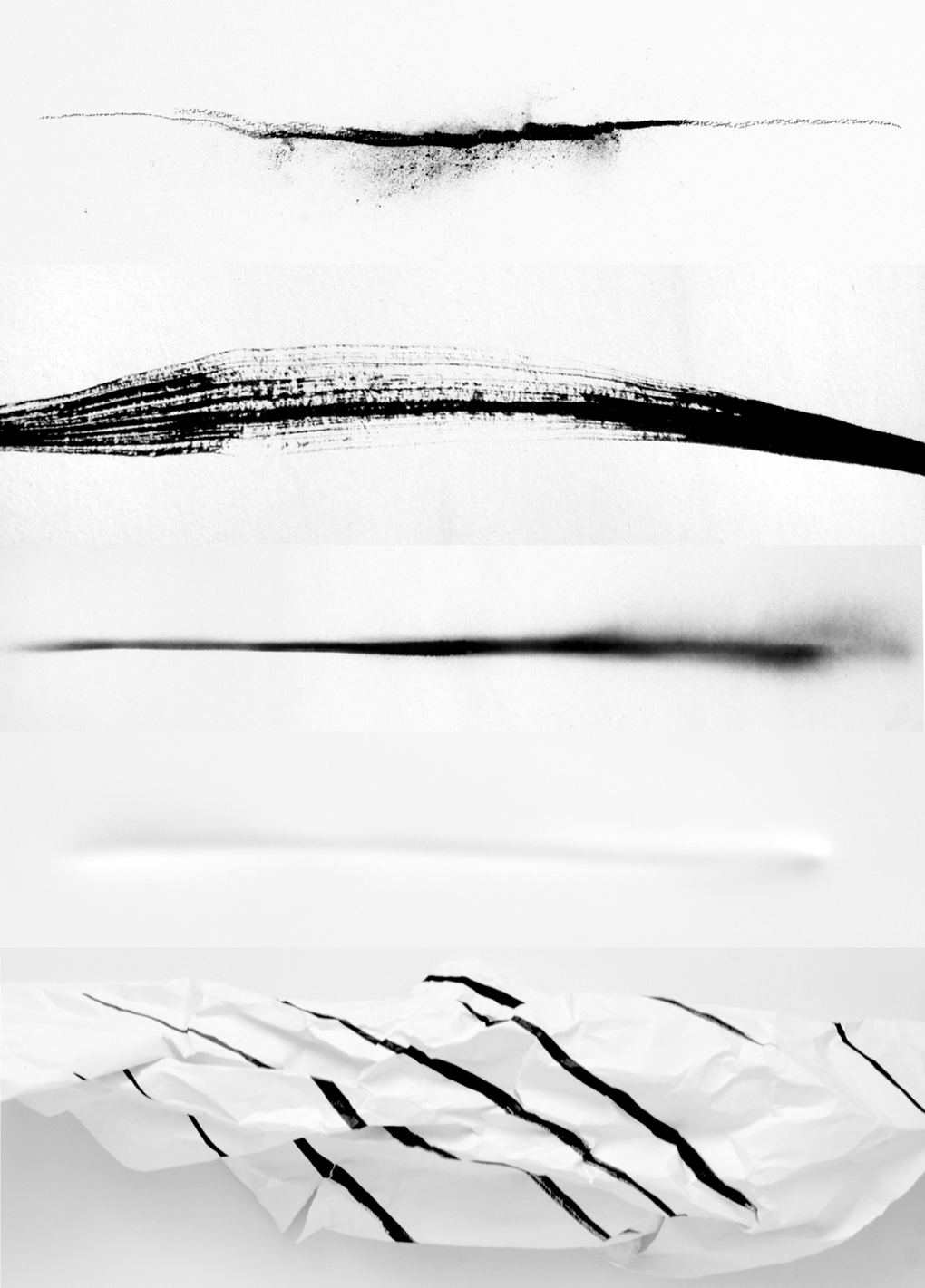
Weighted line renderings.
In this series of weighted line renderings (see Figure 2), one rendering emerged after the previous one, sometimes within minutes, and sometimes days. The potential to activate new renderings only became felt once the affects generated in previous iterations were sufficiently intense to invite further operations. This intensity gathers the force of invitation as it lures new relational potentials between the specificity of material qualities and inhabited movement, which recurs with each variation of the line-rendering ecology. Since the specific relations generated in practice are inhabited as much as they are situated, they also activate affective movement potentials off the page.
Each weighted line also activates improvisational potential by drawing force from the entire series of operations. The affects of each specific rendering encode and resonate across the entire series of iterations, clarifying the fact that each weighted notation does not fix or contain the affects it generates but increases its potential to lure and inform new operations that transform them. The multiple affective encodings in the series are recognizable in the resemblances and variations in the multiple visual patterns they generate. The process of describing the series of weighted lines resonates with the memory of the initial rendering, but also generates emergent thought and feeling through the process of seeing and writing with the traces after the fact. Since writing and seeing are rendering processes in their own right, they intensify the original renderings, without ever containing them. The passage below is a discursive analysis of the relation between renderings in the series, a process that generates new content while only partially activating its multiple discursive and affective potentials: The powdery dispersion of charcoal generates infinite particulate undersides that intensify the volume of the rendering line in excess of the path of the line and the two-dimensional space of the rendering surface.
16
The particulate texture lingers and resonates with the inhabited memory of spray paint that by now is almost volatile in air. The rendering returns as a felt pressure against the spray can nozzle, where a contour composes between lifting a stencil edge with one arm and holding the rendering line steady over it in the other. The weighted contour is no longer a variation in pressure against the rendering surface, but a variation of proximity with it, intensifying the space above the surface. When ink returns to the rendering pathway it releases drops from the outstretched tip of the brush held still. Then the swell of liquid weight in the formation of each drop renders the space before release with thick anticipation. Then charcoal returns through this thick space of anticipation by forcefully pressing downwards from outstretched heights, where the felt consistency of the space above the page is negotiated against the brittle ricochet of charcoal in a series of uncontrollable bounce backs.
Concluding Comments
This article develops three different frameworks to experiment with emergent affects in line-rendering operations, which affectively align the discontinuous spaces of drawing and choreography. The first demonstrates how affective intensity is generated when the movement of line rendering coincides with the physical limit of reach. In the second framework, specific examples from image space (an undulating line) and choreography (Streb’s ‘Human Fountain’) are contrasted to demonstrate how the affects of one dramatize the other, while also infusing both with mutually informing affects. In the last framework, the weighted line is activated to generate the potential for improvisation between the dimensions of contour and surface. This process develops a series of iterations where encoded affects become recognizable in the multiple resemblances and variations of the rendered trace. The irreconcilable dimensionality between contour and surface also lures new choreographic tendencies and movements off the page.
Massumi suggests that affective ‘capture’ is a process of ‘self-perception’ that ‘allows affect to be effectively analyzed as long as a vocabulary can be found for that which is imperceptible’ (1995: 97). Whatever vocabulary (including the emergent relations of words, word order and meaning) is developed to recognize or analyse affects, it will always fall short since it also always intensifies and modulates them. The process of writing generates an affective space as much as an analytical one, where a diversity of discursive and material practices coincide. I hope that by writing with emergent affects in line-rendering operations I have made the affective dynamism of this process felt. I also hope that by engaging this process I have demonstrated how the difference between seeing a trace, witnessing a performed trajectory and enacting one is not as clear as it often seems. When affect informs analysis the distinction between subject and object loosen into haptic and visceral affects. In turn, affective analysis exceeds any single formula, media or format but also moves with and across specific media traits and relations. In conclusion, to model affect, is to develop techniques of inhabiting an experimental space that always generates new ways to enter.
Footnotes
Acknowledgements
I would like to acknowledge Giaco Schiesser and Erin Manning for fruitful discussions and comments on the manuscript.