



Abstract
Marshall McLuhan understood television (TV) as a tactile medium. This understanding implied what Bruno Latour might call a ‘symmetrical’ conception of tactility. According to McLuhan, not only human actors are endowed with the sense of touch. In addition, TV, digital computers and other ‘electric media’ use light beams and similar scanning techniques for ceaselessly ‘caressing the contours’ of their surroundings. This notion of tactility was crucially shaped by the holistic aesthetics of the early Bauhaus. To get at the specific features of the TV image, McLuhan relied on the writings of László Moholy-Nagy and Sigfried Giedion, in particular their use of photography for capturing and highlighting the ‘texture’ of surfaces. However, he hardly reflected the social and political factors that, in the age of electric media, contribute to the ‘symmetricization’ of touch.
Marshall McLuhan conceived of television (TV) as a cool medium. According to McLuhan, hot media are extensions of single senses in ‘high definition’, in particular the sense of sight (McLuhan, 1994: 22). Alphabetic writing and photography define the messages they transmit in rather clear and crisp ways, requiring the focused gaze and sharp attention of their users. In contrast, cool media manifest their messages in rather cloudy and blurred ways. Following McLuhan, the reason is simple. TV, for example, is not just an extension of vision but also of hearing and touch. It thus requires ‘participation in depth’, that is, an ‘integral’ and ‘organic’ attitude of its user when she or he is wanting to decode and decipher its messages (McLuhan, 1994: 22–32).
McLuhan has become famous for considering TV not as an optical but as a haptic medium. In his principal work on media theory, Understanding Media of 1964, he noted: ‘With television came the extension of the sense of touch or of sense interplay that even more intimately involves the entire sensorium’ (McLuhan, 1994: 265). Two years earlier, he had already remarked that ‘TV is two-dimensional and sculptural in its tactile contours’. Unlike cinema, ‘TV is not a narrative medium, is not so much visual as audile-tactile’, he writes in The Gutenberg Galaxy (McLuhan, 2011: 45–46).
The provocation of McLuhan’s media theory here is twofold. It is not solely concerned to define TV, against all intuition, as a tactile and not as a visual medium. At the same time and no less counterintuitively, it aims at dissociating the concept of the sense of touch from the notion of physical contact or connection. Instead, it defines the tactile as a function of inserting gaps, of taking a distance, that is, paradoxically, as an agent of distancing. In a 1969 interview, he puts his conception of the sense of touch in succinct terms: ‘Touch is actually not connection but interval. When you touch an object there is a little space between you and the object, a space which resonates’ (McLuhan, 2003: 280). In 1971, in the preface to The Interior Landscape, he reiterates his notion of TV as a tactile mode of perception and adds: ‘Touch is the space of the interval, not of visual connection’ (McLuhan, 1971: xiv).
But that is not all. McLuhan’s doubly contradicting theory of TV also comes with a ‘symmetricization’ of the sense of touch, as one might put it alluding to Bruno Latour’s (1993) anthropology of science and technology. Despite his counterintuitive conception of the sense of touch, McLuhan actually is interested in the human experience of bodily touch, from phenomena such as the handshake or the ‘propensity to pat’ (McLuhan, 1994: 112), which he, citing a travel guide for Greece, considers to be a particularity of southern and old Europe, to the surface experiences of ‘the skin-diver, the water-skier, and the dinghy sailor’ (McLuhan, 1994: 327). What has been called ‘tactile modernity’ (Parisi, 2011) is thus an important theme for McLuhan.
In addition, however, he conceives of media as actual agencies of touch. In the 1930s, Walter Benjamin had described Dada artworks as ‘projectiles’ fired at the viewer (Benjamin, 2012: 243). 1 Similarly, McLuhan depicts TV viewers being ‘bombarded with light impulses’ and explicitly draws a parallel between the ‘TV tube’ and ‘firearms’ (McLuhan, 1994: 11, 313). According to him, TV acts like a projectile: ‘Light comes through the image at the viewer; the viewer is not a camera, but a screen’ (McLuhan, 1968: 266). In the same breath, McLuhan quotes James Joyce, who in Finnegans Wake speaks of ‘the “Charge of the Light Brigade” that imbues his “soulskin with sobconscious inklings”’ (McLuhan, 1994: 313). 2
In what follows, I reconsider McLuhan’s complex media theory of touch. My motivation is rather straightforward. In our highly networked and digitized societies, the interaction with media devices is increasingly marked by the sense of touch – from smartphones to tablet computers and activity trackers. But while we touch and handle such devices, holding them, fastening or in some way bringing them close to our bodies, these devices also scan us and our surroundings, tracking and tracing our movements through real and virtual spaces (see Chamayou, 2016; Koopman, 2019; Schmidgen, 2018).
Stimulated by such contexts, recent contributions to the field of media studies have highlighted the importance of tactility, for example, by reconstructing the history of haptic interfaces from electricity to computing (Parisi, 2018), by shedding light on the ‘instrumental intimacy’ created by means of electroencephalography (EEG) wearables and similar devices (Littlefield, 2018) and, more broadly, by investigating the emergence of the ‘push-button culture’ in technology, art and politics (Plotnick, 2018). In addition, there is a growing interest in re-considering critical relations between body, technology and affect by focusing on the sense of touch, ranging from Mark Andrejevic and Mark Burdon’s (2015) attempt at defining the ‘sensor society’ to Karin Harasser’s (2016) reconstruction of prosthetic cultures and Donna Haraway’s (2016: 30–57) exploration of ‘tentacular thinking’.
Against this background, the present article aims at critically investigating and historically studying one of the axiomatic contributions to the media theory of touch. Whereas McLuhan’s understanding of electric media as genuinely tactile media has remained evocative and attractive (see e.g. Heilmann, 2010, as well as Sprenger, 2012), it has also become evident that it does not facilitate addressing the social and economic contexts in which such media are used (for a similar point, see Theall, 1971: 204). The reason for this, my article argues, lies in the fact that McLuhan’s theory of tactility was crucially inspired by artistic practices cut off from their cultural and societal situatedness.
More concretely, I will show that important preconditions for McLuhan’s media theory of touch can be found in the avant-garde aesthetics of the tactile that came to prominence in the German context around 1920. To specify the tactile characteristics of the TV image, McLuhan repeatedly cites the Bauhaus, founded by Walter Gropius in 1919. Essential elements of Bauhaus instruction, famously, were touching exercises and studies of materials in the Vorkurs or preliminary course (see e.g. Franciscono, 1971). It is certainly true that since the late 19th century, the sense of touch has been explored by artists such as Adolf von Hildebrand and art historians such as Heinrich Wölfflin and Alois Riegl, and McLuhan occasionally refers to these earlier discussions (e.g. McLuhan, 1994: 249). 3 But his prime example for the tactile values of modernity is provided by the Bauhaus.
It is important to understand that, in McLuhan, ‘Bauhaus’ is not a label of functionality, standardization or industrial design. Rather, it is synonymous with holism and synaesthesia. As the author of Understanding Media explains, this art and architecture school is to be conceived of as an institution whose ‘effort tend[ed] toward inclusive human awareness’ (McLuhan, 1994: 250) and sought to promote ‘the nonliterate and even antiliterate values of tribal man’ (McLuhan, 1994: 109). 4 Schematically, one might say that what McLuhan had in mind was not the now-classic modernism of the Dessau Bauhaus but the early, expressionist form of the Bauhaus in Weimar (on the Bauhaus in Weimar, see Hüter, 1976; Vitale, 1989).
It is certainly true that McLuhan’s notion of tactility as ‘sense interplay’ is largely informed by Thomist philosophy and psychology. Drawing on authors such as Pierre Teilhard de Chardin and Edmund Joseph Ryan, McLuhan turns the sense of touch into something more than a mere synonym for the contact between skin and matter, ultimately, to make it synonymous with ‘the very life of things in the mind’ (McLuhan, 1994: 108). 5 At the same time, however, he draws on prominent representatives of the Bauhaus tradition, in particular László Moholy-Nagy and Sigfried Giedion, a former student of Wölfflin. In 1949, McLuhan reviewed Vision in Motion and Mechanization Takes Command, the main works of these two authors closely associated with the Bauhaus (McLuhan, 1949; see also Cavell, 2002: 113–114; Gruber, 2016; Theall, 1971: 200, 204).
Since 1943, moreover, McLuhan had been exchanging letters with Giedion, and he subsequently met him in person on several occasions. 6 Whereas he repeatedly and approvingly cites this theorist of architecture and technics in The Gutenberg Galaxy and Understanding Media, he mentions Moholy only occasionally. The engagement with Bauhaus aesthetics, however, permeates both the publications of the Explorations group in Toronto, which was of major importance for McLuhan, and the development of his own theory of media.
This applies also and perhaps especially to his theory of TV, as an article published in the early 1960s shows. In ‘Inside the Five Sense Sensorium’, McLuhan makes the following suggestion: ‘Let us consider the hypothesis that TV offers a massive Bauhaus program of re-education for North American sense life. That is to query whether the TV image is, in effect, a haptic, tactile, or synesthetic mode of interplay among the senses’ (McLuhan, 1961: 50). With the publication of The Gutenberg Galaxy and Understanding Media, the hypothesis has become a certainty and the query has been answered in the affirmative. TV technology and Bauhaus art are thus being closely associated.
As I will show in the following, the connection between McLuhan, Moholy and Giedion exists not only on the level of content. 7 It also, and at least just as importantly, has a formal or, if you like, medial component. McLuhan’s reference to the two authors associated with the Bauhaus leads him to view the medium of TV not as such but through the lens of another, older medium. It appears, to use one of McLuhan’s own succinct formulas, in the ‘rear-view mirror’ (McLuhan and Fiore, 1967: 100) of photography, more precisely, of photographed paintings and sculptures.
As a matter of fact, the photographs of works of art contained in books such as Moholy’s Vision in Motion and Giedion’s Eternal Present play an important, perhaps even decisive, role in McLuhan’s reading of these authors. While he does not mention these photos explicitly (though one issue of Explorations reproduces a photograph taken from Vision in Motion), 8 the relevance of the tactile aspects of visual phenomena and processes was clearly presented to him by the extremely crisp black-and-white photographs featured in both Moholy’s and Giedion’s book publications. Especially, the photomicrographs of the surface structures of paintings by Seurat and Cézanne, whose tactile qualities Moholy extensively comments on, led McLuhan to study the tactile ‘texture’ of the TV image. The painstakingly prepared and carefully staged photos Giedion published of prehistoric cave paintings and reliefs further stimulated these studies. 9
The result is a media theory that conceives of all electric media – TV, but also computers – as tactile media ‘caressing’ the contours of things, human and non-human. Thus, McLuhan’s theory remains interesting for discussing the growing presence of scanning devices in what is aptly called today’s ‘sensor society’ (Andrejevic and Burdon, 2015). 10 At the same time, his theory outlines a conception of history in which, thanks to the mediation of Bauhaus-inspired photography, the curved screen of the TV stands right next to the curved surface of a primeval relief showing the Woman with the Horn. Light and matter fuse with one another so that every gaze, human or non-human, becomes a touching experience – while the social contexts and developments of this experience largely fade into the background.
Touched by the Bauhaus
In the early days of the Bauhaus, the touching exercises and the study of materials were primarily explorative and aimed at shaping individual artistic personalities. Given the increasing use made of new kinds of construction materials in the second half of the 19th century (steel, concrete, etc.), the attention of the architects, sculptors and painters active at the Bauhaus had shifted to the material in itself.
At the same time, their reform-pedagogical claim was that education at the Weimar institution was to consist not only in appropriating theoretical knowledge but also to comprise the concrete experience of different materials. Accordingly, Johannes Itten’s exercises, for example, by representing the characteristic properties of a material such as wood in drawings, were to train the development of the eye as a receptive sense and of the sense of touch as a productive sense. Other exercises were to make use of combinations of the simplest of materials (wood, wire, cardboard, wicker, etc.) for observing one’s subjective feeling for materials (Wick, 2000: 92–130, 131–163).
When in 1923, Moholy became responsible for the Vorkurs, the character of these introductory studies changed. The touching exercises now served instead to make the education of aspiring artists, designers and architects more scientific, a goal pursued in the Soviet Union in the 1920s as well (see Vöhringer, 2007, which also discusses the role of later Bauhaus master Kandinsky). With custom-made ‘tactile tables’ (Figure 1), Moholy in fact combined the touching exercises with an effort to develop and employ aptitude assessment procedures of the kind that contemporary applied psychology (Psychotechnik) used to explore and document the tactile capacities of job candidates with greater precision. In other words, touching (tasten) functioned here as testing (testen).

Two lined, rotatable touch table with contrasted, juxtaposed tactile values from soft to hard and smooth to coarse (W. Kaminski). Exercise from Moholy’s Vorkurs (ca. 1927). Reproduced from László Moholy-Nagy (1929: 27).
Moholy nonetheless maintained the explorative touching exercises in the curriculum. Like his predecessor Itten, he considered study of the ‘tactile values’ of different materials and surfaces a pedagogical device ‘to arouse and enrich the desire for sensation and expression’ (Moholy-Nagy, 1929: 24, 2005: 27). Invoking Marinetti’s futurist tactilism manifesto, however, Moholy no longer sought to exclude the possibility that a new form of art might emerge from the touching exercises.
Yet paradoxically, the explorations students undertook under Moholy were not limited to directly touching and concretely dealing with wood, metal, paper and other materials. Photography, too, was considered a contribution to the culture of touch (on this point, see also Smith, 2006). 11 Thus, Moholy declares in his 1929 treatise von material zu architektur, partially translated as The New Vision in 1932: ‘the documentarily exact photos of material (touch) values, their magnified, previously hardly perceived forms of appearance motivate almost everyone…to test and train their touch function’ (Moholy-Nagy, 1968: 24n) – an observation echoed by Benjamin when he writes in his artwork essay that photographic close-ups ‘make completely new structural formations of matter appear’ (Benjamin, 2012: 240).
Photography thus functions as a propaedeutic for developing a new culture of materials ‘since its concentration of emphasis offers a quick, though an indirect, approach to actual experience with the material’ (Moholy-Nagy, 1968: 39, 2005: 39). Other illustrations in Moholy’s book, which show, among other things, surfaces of water, sand and asphalt, are also meant to foster such a visual experience of materiality. Stimulated by the theory and practice of Russian constructivism, he then distinguishes the ‘structure’ of a material from its ‘texture’ and ‘facture’ and further supplements this triad with the property of ‘massing’ (Moholy-Nagy, 2005: 26). 12 Although not always clear-cut, these categories, as we will see, are an important starting point for McLuhan’s analysis of the TV image.
Of key importance in this connection is the fact that surfaces of art also enter into Moholy’s photographic view. One of the illustrations in the German original of The New Vision, for example, exemplifies the phenomenon of texture via ‘various silk linings’. Arranged one on top of the others like the individual images of a strip of film, the fabric samples’ different weaving patterns almost become graspable (Figure 2).

László Moholy-Nagy, ‘Texture of various silk linings’. Reproduced from László Moholy-Nagy (1929: 42).
Later in the book, painted surfaces are presented photographically in a similar way. Possibly inspired by Aleksandr Rodchenko’s Black on Black series of facturist paintings, Moholy in three circular cut-out photographs presents ‘different surface treatments of the same oil paint on the same background’ (Moholy-Nagy, 1929: 42). Light coming in from the side highlights the facture of these painting samples. According to Moholy, ‘[t]he three examples are a proof of the statement that the manner of applying the paint, the motion of the brush gives different light effects therefore different color values’ (Moholy-Nagy, 1929: 80).
Published in 1947, Moholy’s major work, Vision in Motion, takes up and elaborates on these observations concerning the connection between texture, or ‘facture’, and light. In reading this book at the end of the 1940s, McLuhan thus receives not just a well-informed ‘resume of the Bauhaus program with its superb methods for training the senses’ (McLuhan, 1961: 601–602) but also, at the same time, a comprehensive introduction to an aesthetics of materials and surfaces. Moholy’s book, in fact, opens up a broad perspective on the ‘visual “tactilism”’ of the arts and of media (Moholy-Nagy, 1965: 134), and it is this perspective, precisely, that McLuhan will adopt in his theory of TV.
Vision in Motion presents a wealth of new illustrations aiming to demonstrate how nourishing the ‘visual food…photography provides’ is in engaging with the arts (Moholy-Nagy, 1965: 181). Besides ‘tactile charts’, dramatically staged by lateral lighting, we encounter sharply drawn photographs of shiny ‘hand-sculptures’ in precious wood, on which every pore seems to be visible. Aerial photographs of different landscapes appear as abstract patterns of traces while close-ups of sculptures, also lit from the side to great effect, display the texture of their surfaces almost too clearly (Moholy-Nagy, 1965: 59, 69, 75, 220–221).
It is against this background that Moholy revisits the texture of oil paintings. With comparative black-and-white photographs of van Gogh’s, Cézanne’s and Seurat’s brushwork, he draws attention to the different qualities of the painting surfaces (Figure 3). The arrangement of these photographs, incidentally, takes up the strip-like montage Moholy had used already in his Bauhaus days to present the different surfaces of silk fabrics and tactile materials (Moholy-Nagy, 1929: 42, 29).

Close-ups of brush textures by (1) van Gogh, (2) Seurat and (3) Cézanne. Reproduced from László Moholy-Nagy (1965: 158).
The accompanying text describes the different ‘brush textures’ in van Gogh, Cézanne and Seurat so vividly that the surfaces of the paintings seem to become sculptures in their own right. Thus, Moholy writes about the way van Gogh applied paint to the canvas: ‘The pigment appeared as relief casting a shadow, while the edges were touched by light’ (Moholy-Nagy, 1965: 158). This view of paintings as reliefs or sculptures goes back to the Bauhaus Vorkurs just as much as it announces McLuhan’s theory of TV.
TV Pointillism
Understanding Media discusses the particular properties of the TV image at length. In doing so, McLuhan focuses on two aspects with tactile connotations. They concern, first – and entirely in keeping with Moholy – the texture of the TV image. According to McLuhan, the TV image consists of small pictorial dots; it is ‘a mosaic mesh of light and dark spots’ (McLuhan, 1994: 313). The tactile aspect, briefly put, consists in that the emergence of this mosaic is traced back to the electronic scanning procedure of the TV camera.
The second particularity of the TV image for McLuhan is that it is a tube or ray image. It is an image projected from behind onto a coated glass surface. Referring to the example of gothic cathedrals and to symbolist as well as catholic painters such as Georges Rouault and André Girard, McLuhan underscores the fact that the TV image ‘appears by light through, not light on’ (McLuhan, 1994: 313). Here the tactile aspect is that the TV image does not simply confront viewers but includes them in a kind of radiant envelope. It functions, as McLuhan puts it, as a ‘housing-without-walls’ (McLuhan, 1994: 130). 13 In this sense, though, TV is not so much an extension of the sense of touch but, like clothing, an extension of the skin.
Just how much these analyses of the TV image are indebted to the vocabulary and illustrations in Moholy’s book is apparent, first, in McLuhan’s interest in the qualities of surfaces in general. In referring to written records before the age of print, for example, McLuhan mentions the ‘diffuse texture’ of medieval manuscripts; with regard to current fashion, he speaks of a contemporary ‘preference for coarse heavy textures and sculptural shapes in dress’ and in discussing Cubist paintings and collages, he describes a ‘dramatic conflict of patterns, lights, textures’ (McLuhan, 1994: 317, 122, 13).
Then he turns in a similar way to the surface character of the TV image. For him, the particularity of this image shows itself first of all in the medium’s predilection for motifs that appeal to the sense of touch. Given the low resolution of TV images in the 1960s, these are, according to McLuhan, primarily rough textures, which is also why TV is a cool not a hot medium. The consequences are not limited to structural or formal aspects. They also concern the medium’s choice of motifs, contents and topics. According to McLuhan, TV ‘takes kindly to the varied and rough textures of Western saddles, clothes, hides, and shoddy match-wood bars and hotel lobbies’, whereas high-resolution cinematic film ‘is at home in the slick chrome world of the night club and the luxury spots of the metropolis’ (McLuhan, 1994: 320). He even uses this approach to try and explain the outcome of the presidential debate between Nixon and Kennedy. On TV, he says, ‘Nixon’s sharp intense image’ had no chance against the ‘blurry shaggy texture of Kennedy’ (McLuhan, 1994: 329).
But McLuhan does not remain on the level of motifs. Relying on Moholy, he subsequently inscribes the tactile aspect in the material constitution of this kind of image. Insisting, in Understanding Media, on the TV image being a mosaic of light and dark spots, he time and again refers to Seurat’s pointillist paintings, whose texture is intensively analysed in Vision in Motion.
Moholy already had given this analysis a turn very much of interest to a media theory. According to him, the pointillists following Seurat juxtapose ‘small color dots’ to provoke in viewers the illusion of a wide vibrant field of colourful lights. For Moholy, the kind of image thus produced is to be understood in analogy with another, a technical procedure of image production: ‘At the end of the last century, Signac, Gross and especially Seurat preconceived the method of color photography as a new medium of expression by working with light effects’ (Moholy-Nagy, 1965: 158).
McLuhan takes up this argument but adapts it to his object and his purposes. In Understanding Media, he thus declares, at first in general terms, that ‘Cézanne or Seurat, or Rouault…provide…an indispensable approach to understanding TV’ (McLuhan, 1994: 334). Elsewhere he goes so far as to call Seurat a ‘prophet of TV’ (McLuhan and Parker, 1968: 181). He then takes up the connection established by Moholy between pointillism and photography: ‘In the daguerreotype process there was the same stippling or pitting with minute dots that was echoed later in Seurat’s pointillisme, and is still continued in the newspaper mesh of dots that is called “wire-photo”’ (McLuhan, 1994: 190). And then he includes TV in this description: ‘The stipple of points of Seurat is close to the present technique of sending pictures by telegraph, and close to the form of the TV image or mosaic made by the scanning finger’ (McLuhan, 1994: 249).
As soon as the aspect of pointillist texture has come to the fore, it no longer matters to McLuhan whether the dots of the image are produced by hand (as in painting) or by a camera (as in photography or TV). In other words, his analysis is ‘symmetrical’ in Latour’s (1993) sense of the term. Independently of whether it has come about artificially or naturally, that is, in a human or a non-human way, the primary focus is on the qualities of images’ respective ‘epidermis’ (Moholy-Nagy, 1929: 33, 2005: 42 [amended]). It is on this condition, precisely, that movements of the brush on the canvas can be set in analogy with the scanning process in the TV camera. In both cases, accordingly, we are dealing with tactilely produced images (Figure 4).
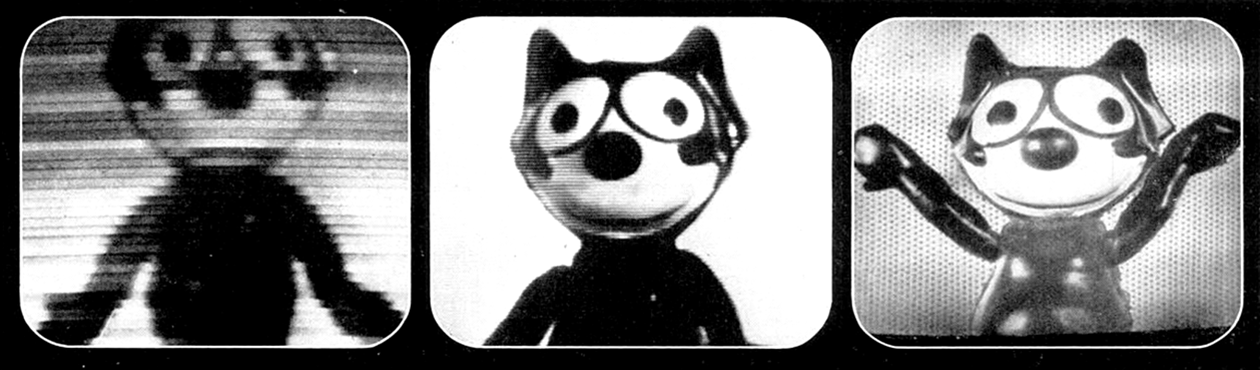
The changing quality of US television images. Left: a mechanically produced image with 60 scan lines of 1929; middle: an electronically produced image of 1936 with 343 lines; right: an electronically produced image of 1937 with 441 lines. Reproduced from Anonymous (1944: 90).
At this point, however, it also becomes clear just how much the black-and-white photographs from Moholy’s books intervene in McLuhan’s theorizing. The description of the TV image as a mesh of light and dark spots rather summarily suppresses the difference between Seurat’s colour paintings and 1960s black-and-white TV images. 14 As a result, the TV image in McLuhan appears to be remarkably static. It is not a movement image and does not draw viewers into the temporal structure of its broadcasting. Instead, it is the snapshot of a network, or a mosaic, covering and coating the spectator.
The Electric Cave
McLuhan expands and generalizes his analysis of the TV image as a surface composed of individual points penetrated by light from behind in a series of further observations on the tactile aspects of electric media. Here, too, art historical contextualizations and the Bauhaus tradition play an important role.
In Understanding Media, the assessment that electricity is primarily tactile and only incidentally visual and auditive, for example, is followed by the statement that ‘[t]he electric form of pervasive impression is profoundly tactile and organic, endowing each object with a kind of unified sensibility, as the cave painting had done’ (McLuhan, 1994: 249). And The Gutenberg Galaxy, too, makes a connection between tactile-electric media and prehistoric art: ‘It is necessary to understand the close interrelation between the world and art of the cave man, and the intensely organic interdependence of men in the electric age’ (McLuhan, 2011: 74). 15
Such match cuts, which – as in Kubrick’s 2001: A Space Odyssey – seamlessly join prehistory and future, seem to play in a different register than the photography-based comparisons between Seurat paintings and TV images. Ultimately, however, they, too, remain with the referential framework of Bauhaus aesthetics, only that now the anchor is not Moholy but Giedion.
As stark as the contrast might seem between the subject matter of Giedion’s previous treatise, Mechanization Takes Command (1948), and his study on the origin of art, the topic of the first volume of The Eternal Present (1962) was neither completely new for Giedion nor did it constitute a break with earlier interests of his. For, at least in the Weimar phase of the Bauhaus, the endeavour to discover the foundations of creative design and use them as a starting point for a new aesthetics was by no means limited to the practical tactile exercises in the preliminary course.
It also included an exploration of the ‘Art of Primitive Peoples and of Prehistory’. 16 Besides Eckart von Sydow’s eponymous book, in any case, Gropius had the Bauhaus library stocked with works such as Carl Einstein’s Afrikanische Plastik [African Sculpture], Herbert Kühn’s study on Malerei der Eiszeit [Ice Age Painting] and Adolf Stiegelmann’s presentation of the Altamira cave as a Kunsttempel des Urmenschen [Art Temple of Prehistoric Man] (Siebenbrodt and Simon-Ritz, 2009).
Yet once again, the first programmatic articulation of an interest in the aspects of art thus invoked is Moholy’s. As early as 1929, in Von Material zu Architektur, he explains the second stage of the development of sculpture, which according to him is characterized by the ‘modeled (hollowed-out) block’, with the help of illustrations he takes, without commentary, from Sydow’s book on prehistoric art. He presents the Venus of Menton as a stone ‘modeled according to a previous plan – not in the sense of a representation true to life, but in the sense of the tool, the material, and the abstract idea’ (Moholy-Nagy, 1968: 101). 17
The shaping of the stone thus does not intervene profoundly but stops at the tactile surface of the stone. According to Moholy, there are analogous procedures to be found in contemporary sculpture. Immediately following the photograph of the Venus of Menton are similarly ‘modelled’ sculptures by Archipenko and Brâncuşi.
Such combinations of the archaic and the modern take up and develop a photographic rhetoric that avant-garde art journals like Der blaue Reiter and Der Querschnitt experimented with in the 1910s and that can be found, in the 1920s and 1930s, in books by Le Corbusier and Amédée Ozenfant, for example, or in the journal Documents edited by Carl Einstein and Georges Bataille (see Fleckner, 2005).
Via Moholy, this visual rhetoric also finds its way into the treatise on modern sculpture that Giedion’s wife, Carola Giedion-Welcker, published in 1937. In this book, which McLuhan cites in The Gutenberg Galaxy, prehistoric Venus figures stand side by side with plastic works by Jean Arp and bronze age megalith formations are juxtaposed with sculptures by Giacometti (Giedion-Welcker, 1961: 108–111, 96–96; on this point, see also Geiser, 2010: 151–152).
Yet it was Giedion’s studies on prehistoric art and architecture that subordinated the photographic juxtaposition of prehistory and modernity to a clearly defined argumentative purpose. After the end of the Second World War, Giedion set out and ‘search[ed] for the unchanging elements of human nature’ (Giedion, 1962: xix) and found a ‘real inner affinity…between the longings of the man of today and the longings of primeval man, crystallized in signs and symbols on the cavern walls’ (Giedion, 1962: xx; Figure 5).
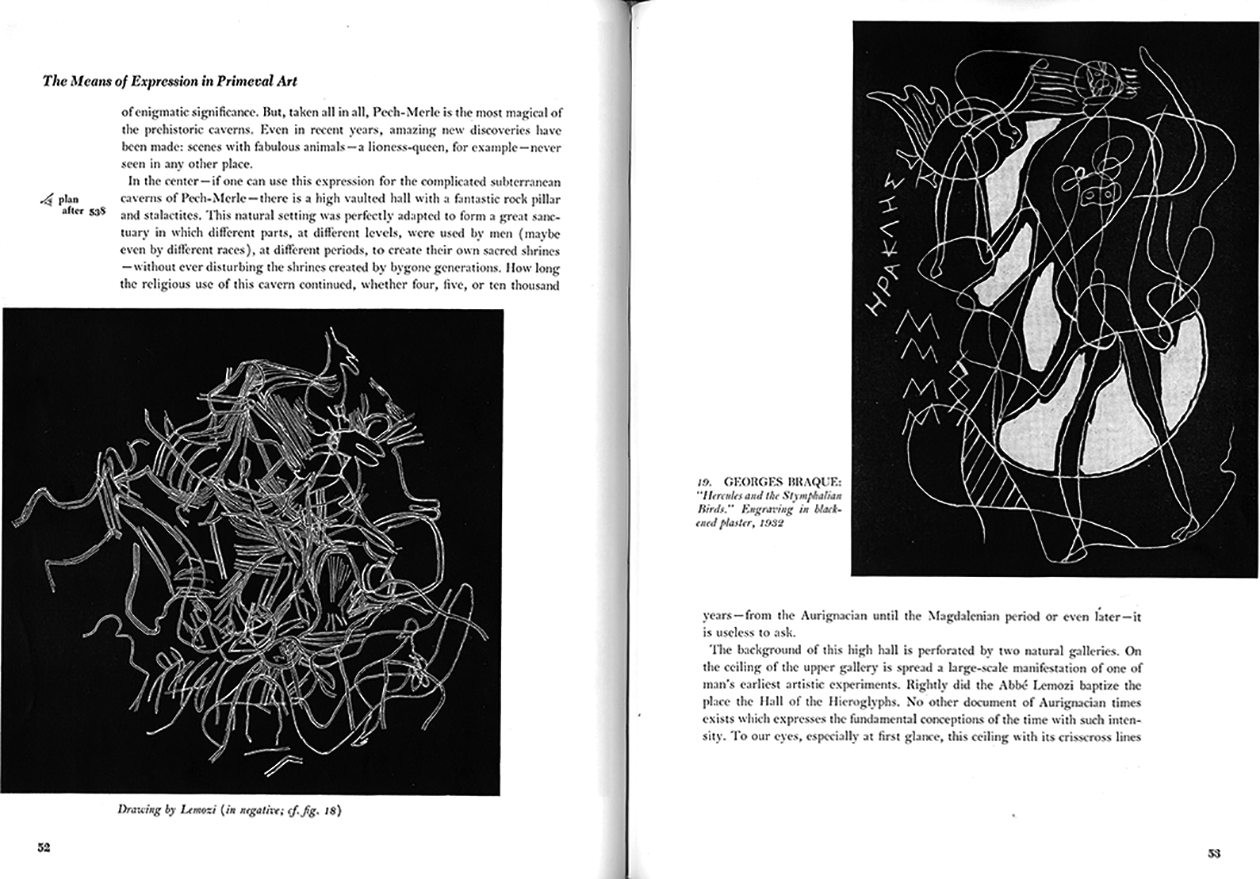
Juxtaposition of prehistoric and modern art. Left: negative copy of finger drawings in the cave at Pech-Merle; right: Georges Braque, Heraklès. Reproduced from Sigfried Giedion (1962: 52–53).
In The Beginnings of Art, Giedion successfully stages the ‘eternal present’ that became visible from this perspective by using photographs to juxtapose prehistoric finger drawings in clay found in the cave at Pech-Merle with an engraving by Georges Braque or the animal reliefs, also prehistoric, from the Abri Murat cave with a drawing by Paul Klee (Giedion, 1962: 51–53, 74–75). McLuhan picks up on such pictorial montages when he puts the art of cave dwellers in parallel with forms of experience of the electric age – not without reminding readers, incidentally, that the TV image is really ‘an abstract work of art on the pattern of a Seurat or Rouault’ (McLuhan, 1994: 313).
Giedion himself points out just how important photography is for his form of historiography. Right at the beginning of his essay on ‘Space Conception in Prehistoric Art’, which thanks to McLuhan appeared in Explorations (and was later included, in revised form, in The Beginnings of Art), he highlights the contributions of the photographs by Hugo P. Herdeg, ‘one of the best Swiss photographers’, and his colleague Achille Weider to the reconstruction of this conception of space (Giedion, 1956: 38). For if, as Giedion explains, ‘the root of primeval art’ is that it has ‘no relation to the horizontal or vertical’ (Giedion, 1956: 50), then photography facilitates capturing this decisive feature with precision because it makes possible a permanent detachment of the gaze from the usual standpoint and habitual stance of human viewers. It allows, as the later version of the essay included in the book puts it, for ‘seeing things without “relation to myself”’ (Giedion, 1962: 524).
Besides contributing to the discovery of what McLuhan would later call ‘multidirectional space orientation’ in audile-tactile environments (McLuhan, 1994: 76) – and what Gilles Deleuze and Félix Guattari (1987: 494, 557n56), going back to the context of Explorations, would refer to as the visual tactility of ‘smooth space’ – the photographs taken under Giedion’s direction served above all to capture and display the particular structures and textures of prehistoric art. As a matter of fact, McLuhan’s comparison between the tactility of electric media and cave paintings becomes concretely plausible only once the aspect of the (photographic) surface is taken into account.
Giedion, too, was convinced that photography played an important if not decisive role here. Like Moholy, he supposed that such photographic records would be able to aid in developing a new culture of touch and materiality; for that reason, they could also aid in fostering a new, haptically-oriented conception of prehistoric art (see also Geiser, 2010: 147; Papapetros, 2013: 178).
This is why, in the Explorations article, Giedion complains about the poor quality of the photos of cave art in circulation: ‘Nothing is more destructive of the true values of primeval art than the glare of electric light in this realm of eternal night.…The engraved lines, and even the coloured surfaces, lose their intensity under a strong direct light, and sometimes disappear altogether’ (Giedion, 1956: 47). What he is calling for, in particular, is visualizing the specific qualities of surfaces: ‘Only a soft side-lighting—lumière frisée—can awaken their [the lines’ and images’] original strength. Only by this means can the fine veining of the drawings be seen unsmothered by their rough background’ (Giedion, 1956: 47).
Giedion knew exactly what he was talking about. As part of the preparations for his cave expeditions in the early 1950s, he had visited the electrical engineer and experimental photographer Harold E. Edgerton at the Massachusetts Institute of Technology (MIT), seeking advice on the best lighting equipment for Herdeg and Weider to use. He tells his friend, the Harvard archaeologist Hallam L. Movius, Jr., about the result in a letter from August 1952. It concerned the lightning that should be used when photographing the interior of caves: ‘The Carpenter master light [spotlight] is by far the best apparatus to examine prehistoric pictures “à la lumière frisante” [in oblique light]’ (Giedion, 1952: 1).
The Woman with the Horn
Gideon discusses photography’s potential for bringing out the complex structures and textures of prehistoric art at length, using a prominent example, the so-called Venus of Laussel. This relief was discovered in a rock shelter near Marquay in the Dordogne département in the 1910s. It shows a female figure who with her right hand holds up a horn as her left hand rests on her bulging belly. While Giedion had long been familiar with this relief thanks to art historical publications such as von Sydow’s Art of Primitive Peoples and of Prehistory, he returned time and again to the Woman with the Horn in the course of working on the texts and images for The Beginnings of Art.
In fact, he visited the ‘small museum’ near Bordeaux that then housed the relief twice: first in October 1950, when under Herdeg’s direction a first set of photos was taken, then in September 1953, after it had turned out that these pictures, ‘though good’, were ‘not satisfactory’ for the purposes of the book publication (Figure 6). In a letter to the director of the museum, Giedion explains his special interest in the Woman with the Horn: ‘I intend to place the Venus of Laussel at the center of my book about the continuity of human nature, for historical but also for artistic reasons’ (Giedion, 1953: 1).

Hugo P. Herdeg, trial shots of the Venus of Laussel with Giedion’s comments (ca. 1950). ‘Photographs of original/Dr. Charon. Bordeaux/horn with incisions/blurred/figure too much in profile/& inclined backward.//? Copy./a very conventional/point of view’. Reproduced from ETH Zürich, Institut für Geschichte und Theorie der Architektur, gta Archiv, Giedion Papers, 43-T-10, Box ‘Notizen Prähistorie’.
When almost 10 years later, in 1962, the first American edition of The Beginnings of Art came out, the relief did not stand at the centre but rather served as the vanishing point, as it were, of the entire presentation. According to Giedion, it is ‘the most vigorously sculptured representation of the human body in the whole of primeval art’ (Giedion, 1962: 469). That is, this work of art fully depicts, for the first time, what constitutes the real point of reference of Giedion’s history of continuity: the human in its eternal present.
Giedion painstakingly prepared the prominent placement of the Venus of Laussel in the first volume of The Eternal Present. As early as 1957, when, giving the A. W. Mellon Lectures in the Fine Arts, he provided a first overview of his research, he talked about the Woman with the Horn right from the beginning. As the manuscript of the first lecture shows, he specifically inserted a passage to illustrate the transition from engraved lines and paintings to sculpture with this example. In a manner recalling Moholy, he, at this point and in other notes, traced the particular form of the relief back to a particular conception of the material: ‘The rock is treated like an elastic material’ (Giedion, 1957: 7). At the same time, Giedion criticized the pictures of the work of art in circulation: ‘The usual photographs of the Venus of L[aussel] do not express its artistic spirit. The Venus appears their [sic] like flattened in a plane’ (Giedion, 1957: 7). 18
To obtain an appropriate depiction of the Woman with the Horn, Giedion in preparing the book publication proceeded very carefully. In detailed layout sketches, he prescribed the reproduction of no less than five different views of the relief on a total of four print pages (Figure 7). In addition to a frontal detail view of the head and the horn, in which strong side-lighting makes the outlines of the sculpture stand out, these include two total views from a side angle. One of them, which is looking onto the relief from above, shows, according to Gideon, how the backward-leaning head ‘seems to be reclining as though on a cushion’; another, a side-view from below, is meant to convey how the relief would have been seen in its ‘original position’ on the rock (Giedion, 1962: 470, 473 [caption for figure 318]).
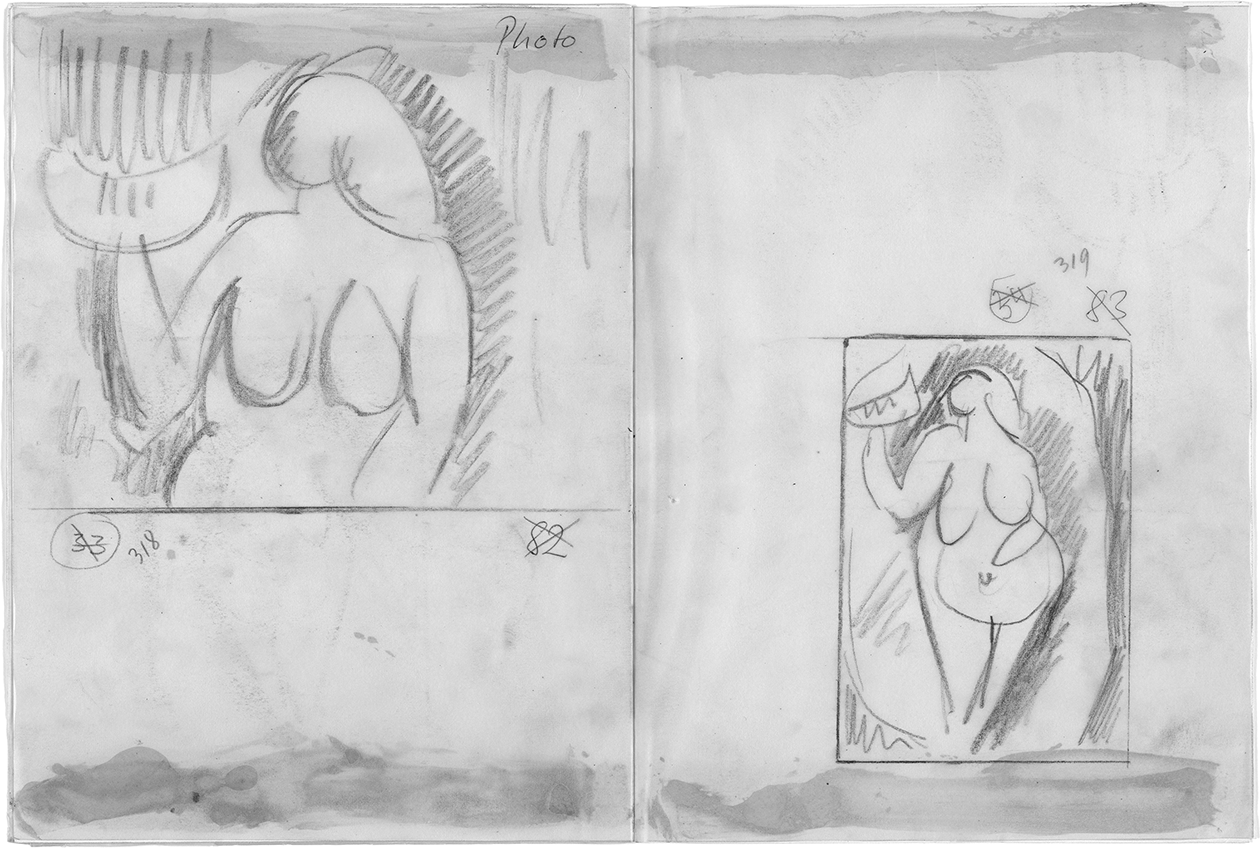
Sigfried Giedion, layout sketch for a double page on the Venus of Laussel (ca. 1960). Reproduced from ETH Zürich, Institut für Geschichte und Theorie der Architektur, gta Archiv, Giedion Papers, 43-T-10, Box 3.
Giedion seemed to have been happy with the second photograph in particular (Figure 8). In the American edition of The Beginnings of Art, it is reproduced in black and white in the text and once more in colour on a separate plate. In the German-language and other European editions, this colour photograph even serves as cover image.
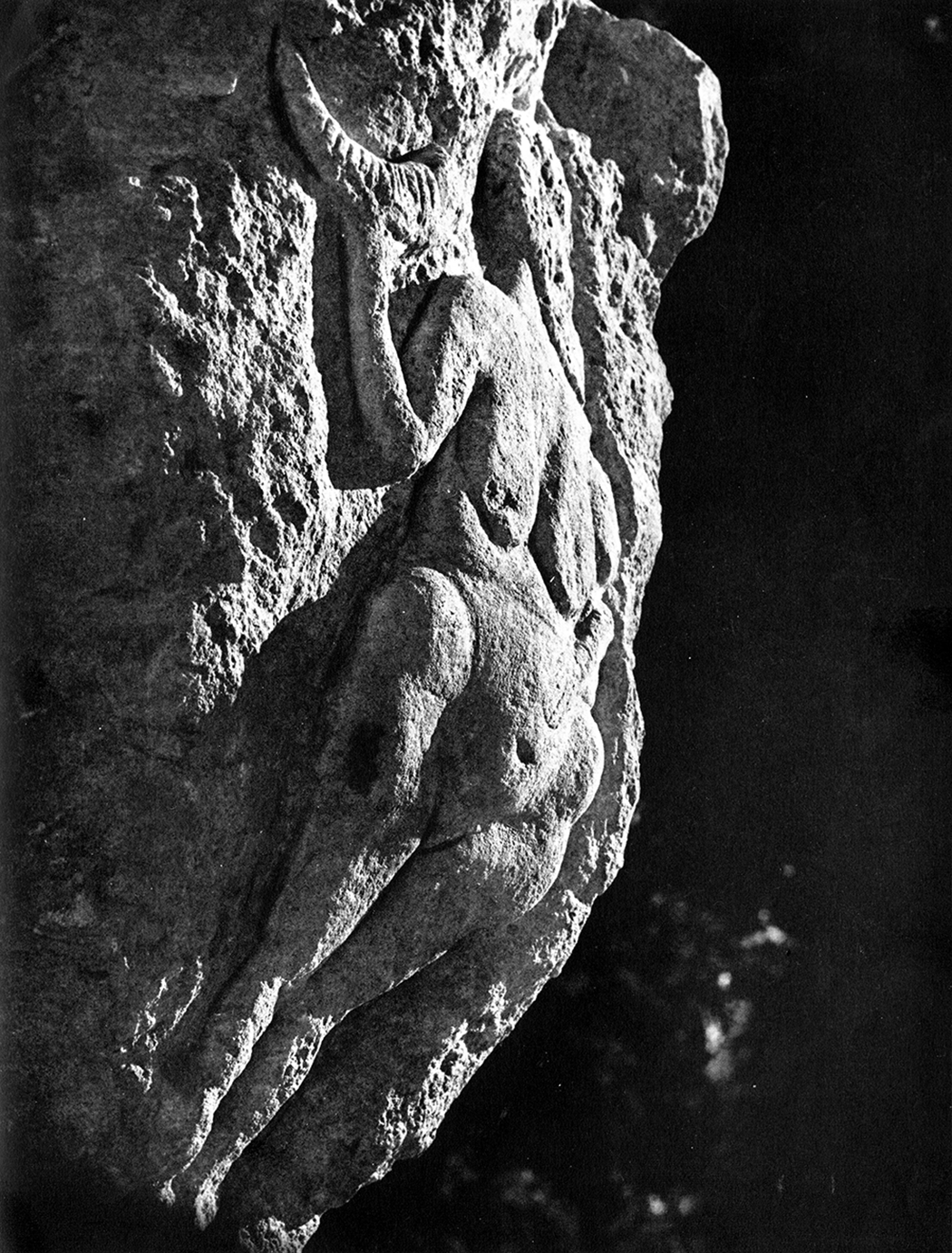
Achille Weider, definitive photograph of the Venus of Laussel. Reproduced from Sigfried Giedion (1962: 473).
Having established this photographic evidence, Giedion boldly argued that prehistoric art is essentially founded on a ‘freedom of approach to all surfaces’ (Giedion, 1956: 48, 1962: 529). According to him, it is based on a constant change of surfaces that become the starting point and frame of reference of creative design in the most varied of ways and on the most varied of occasions: ‘Whether the structure or shape of the surface be smooth, curved, or puckered, one can always recognize paleolithic man’s ability to use it to the full’. With the Vorkurs in the back of his mind, Giedion describes this procedure as an artful hugging or embracing of contours and explains that in French, such a use of rocks’ natural shape is indeed called ‘épouser les contours’ (Giedion, 1956: 51, 1962: 402).
McLuhan seems to have paid particular attention to this description. Fascinated with tactility as the main mode of perception of the non-literate, he immediately saw the connections with his observations of the texture of clothes, paintings and TV images. The Gutenberg Galaxy even quotes Giedion’s formula, épouser les contours, and follows up with a statement aimed at the present day: ‘Our rediscovery of a passion for contours is inseparable from the recognition of precise interdependence and function, and of all forms as organic’ (McLuhan, 2011: 76).
In speaking of ‘the recognition…of all forms as organic’, McLuhan describes the position of a fictitious morphologist interested in art and media, a position assumed equally by the humans of the electric age and the cave artists. This position, in Giedion’s terms, is the result of a creative reaction of prehistoric humans to their natural surroundings. For McLuhan, who also discerns a creative moment there, it ‘is thrust upon us by the electro-magnetic wave technology’ (McLuhan, 2011: 76). This is the real basis for putting electric media and cave art in parallel. It consists in supposing that electric media follow the principle of épouser les contours.
In Understanding Media, too, McLuhan draws on Giedion’s suggestive formula. Reasserting the notion that electricity is primarily tactile, he expands the statement about the TV camera constantly scanning its surroundings to virtually all electric media. Be it the wirephoto or TV, all electric media ‘caress the contours of every kind of being by…multiple touches’. From McLuhan’s point of view, this is true even of the ‘digital computer’ he usually pays little attention to, since the computer, too, ‘with its multiple yes–no dots and dashes’, scans all human and non-human beings in its surroundings (McLuhan, 1994: 249).
Electric media – to summarize McLuhan’s once again symmetrical observations – thus work in the same way as the authors of prehistoric cave art. They do not engage in incisive fashioning but in a careful modelling, an embracing of contours. Electric media, and TV chief among them, are surface media par excellence.
Conclusion
The Venus of Laussel holds a horn in her hand. Like the discoverer of the relief, Jean-Gaston Lalanne, Gideon, too, assumed that the carvings discernible on the horn are ‘hunting notches’ (Giedion, 1962: 470). We do not know what McLuhan thought about them. With the exception of a comparison between today’s radio and age-old ‘tribal horns’, the horn for him was not a medium that warranted any closer attention (McLuhan, 1994: 299).
More recent research on the Venus of Laussel conceives of the notches on the horn differently than Giedion and earlier authors. It sees them as temporal markers. Thirteen lines are visible, which is said to be a reference to the lunar months or the menstrual cycle. Some authors even go so far as to see a half moon in the horn the Venus of Laussel is holding in her hand (Cohen, 2003: 74; Marshack, 1991: 335).
The connection between horn and time thus evoked leads us back to the question of historiography. McLuhan’s media theory, I have argued, shows the tactility of TV in the rear-view mirror of photography. The black-and-white photographs of differently structured surfaces of bodies and things, paintings and sculptures, walls and reliefs he encountered in reading Moholy and Giedion prompted him to carefully explore the texture of the TV image.
The paradoxical result was, on the one hand, a further amplification of the spiritualization of the sense of touch already prepared in the Thomist and Jesuit references of McLuhan’s writings. Although he does bring in Bauhaus pedagogy to counterbalance the Catholic psychologization of the sense of touch, his recourse to Moholy’s and Giedion’s photographs leads him to conceive of tactility not as bodily touch but as a visual phenomenon, as the result of a ‘touching seeing’ in the sense of von Hildebrand, Wölfflin and other art historians. This tactile seeing can be done with the eye but, according to McLuhan, also with the TV camera.
That, however, is only one consequence. For, on the other hand, the dominance of photography in McLuhan leads to a far-reaching withdrawal of time. Because his investigation is oriented by photographically captured and reproduced textures of surfaces, the TV image appears less as a dynamic entity than as a static construct. To be sure, McLuhan stresses that the TV camera, unlike the photo camera, does not aim at the isolated moment but performs a ‘continuous scanning action’ (McLuhan, 1994: 188). Nonetheless, from the viewpoint of texture, the TV image loses many attributes of a movement- or time-image. Instead, it becomes a space-image that is at the same time an image-space, a visual envelope that leads, not least because it is first assembled from dots, to a certain form of architecture, not unlike the way in which stones are assembled to form a house.
Yet more or less the same can be said about McLuhan’s notion of history as a whole. What he is offering is not so much a historiography of media, which would in fact investigate the tactile changes brought about by media and their respective contexts, as it is a survey of historical snapshots. Prompted by the photographs he found in the publications by Moholy and Giedion, the author of Understanding Media in this synopsis ultimately assumes a simultaneity of all epochs – and accordingly, like Giedion, a substantial constancy of human experience. In this survey, TV can join the Bauhaus but also Gothic architecture and cave painting. Prehistory meets the present just as much as early modernity meets late modernism.
The productivity of this approach is immense. McLuhan’s media theory assembles a previously unheard-of wealth of examples to have them shed light on each other. One might say that this endows his presentation of media effects with pointillist traits of its own. It consists of a multitude of dots that are barely graspable in their details. Only in the synoptic view do they yield a picture.
This picture, however, is rather uninterested in the social and political factors that, in the age of electric media, contribute to the symmetricization of touch. Here lies the crucial difference between McLuhan’s explorations of tactile media and recent contributions to the media archaeology and media history of touch that highlight the importance of cultural and societal contexts (see e.g. Andrejevic and Burdon, 2015; Parisi, 2018; Plotnick, 2018).
To put it differently, one might say about Understanding Media what McLuhan, with a critical intention, noted about Moholy’s magnum opus, Vision in Motion: ‘The book swarms with brilliant insights into parallel effects and intentions between the most diverse activities of contemporary science, photography, engineering, art and literature’ (McLuhan, 1949: 601; see also Moholy-Nagy, 1965: 132–133, 343–346). According to McLuhan, this ‘vortex of interfused interests and activities’ can be mastered only by the intervention of a ‘serious teacher’ whose thinking – like that of Joyce or Giedion – is securely anchored in traditional knowledge (McLuhan, 1949: 602).
As author of Understanding Media, however, he himself proceeds differently. To link his diverse and varied examples, he relies on the fundamental assumption that there is no essential difference between light and matter. Yet this assumption, too, points back to photography. Although the conception of photography as an indexical sign based on physical contact with the signified would have to wait for later theorists (see e.g. Krauss, 1990), McLuhan already supposes that the reflection and recording of rays of light is, at bottom, a phenomenon of touch. That is why for him ‘scanning’ (abtasten) always also means ‘touching’ (berühren), independently of whether this scanning is done by the human eye or camera technology and independently of whether it is directed towards human and/or non-human beings. The ungraspable thus encounters the palpable, one transitions to the other. Not unlike medieval metaphysics or modern physics, McLuhan’s presentation has light appear as a form of matter, and the sense of touch, accordingly, dissolves in the life of the mind. Under Catholic auspices, McLuhan’s understanding of tactile agency results in a metaphysics of touch as interval.
Ultimately, in McLuhan, even history turns into light. ‘All ages are contemporaneous’ is the quotation from Ezra Pound, whom McLuhan much admired, that Giedion places at the beginning of the first volume of The Eternal Present (Giedion, 1962: vii). Giedion thus sums up his own conception of history, which is indebted to a largely detached view on the archive of photography.
This detached view is also at the basis of McLuhan’s media theory. And this is precisely why many of his observations and claims – for example, his understanding of information as ‘environment’, his notion of the ‘city as classroom’ as well as his famous thesis about the ‘global village’ – remain interesting and stimulating with regard to today’s mobile and connected media devices (McLuhan, 1994: 93; McLuhan et al., 1977).
Given the ever-increasing presence of the most varied of scanning devices (body scanners, book scanners, barcode scanners, etc.), his discussion of how TV images envelop and penetrate their viewers continues to be evocative and attractive – even if this media theory hardly captures the historical, social and economic specificities of our tactile present.
Footnotes
Acknowledgements
I would like to thank the VolkswagenStiftung, Hannover, for supporting this project within its funding initiative, ‘Original – isn’t it?’ New Options for the Humanities and Cultural Studies. I would also like to thank Simon Frisch for numerous ideas and comments during our joint seminar ‘Revisiting the Bauhaus I/II’ in the fall of 2016. I thank Johannes Hess for his help in coming to grips with the Giedion papers in Zurich, as well as Andrew McLuhan and Ellen Fernandez-Sacco for their valuable help with respect to André Girard. I thank the director of the library at Bauhaus-Universität Weimar, Frank Simon-Ritz, and the director of the Archiv der Moderne, Christiane Wolf, for their assistance. And finally, I would like to thank Nils F. Schott for his great translation of this piece.
