



Abstract
We evaluated an epilepsy education programme based on text messaging (SMS). Epilepsy outpatients from three hospitals in Malaysia were randomised into two groups: intervention and control. Patients in the control group were supplied with printed epilepsy educational material while those in the intervention group also received text messages from the Mobile Epilepsy Educational System (MEES). A total of 136 patients completed the study (mean age 31 years; 91% Malay; 51% with an illness duration of more than 5 years). A between-group analysis showed that the awareness, knowledge and attitudes (AKA) about epilepsy did not significantly differ between the groups at baseline (P > 0.05). The intervention patients reported better AKA levels during follow-up compared to the control patients (P < 0.05). A within-group analysis showed that in intervention patients, there were significant improvements in all AKA domains with larger effect sizes (P < 0.01) while control patients also exhibited significant improvement in most domains except for Awareness but with smaller effect sizes. After controlling for possible confounding variables (age, gender, educational qualification, monthly income and baseline mean for each domain), the intervention group still reported significantly higher AKA than the control group particularly in Awareness (P < 0.001) and Total AKA (P = 0.003). There was also significantly better medication adherence and clinic attendance in the intervention group (P < 0.05). The results suggest that the addition of the MEES to conventional epilepsy education is effective in improving AKA.
Introduction
Epilepsy is a disorder associated with a high degree of stigma and prejudice, and the success of its treatment depends very much on the patients’ treatment compliance and their understanding of the disorder. 1 Although information is easily available through member organisations, brochures and the Internet, information-seeking is a less preferred coping strategy than religion and emotional support among people with epilepsy (PWE) in Malaysia. 2 Therefore, it would probably be more effective if healthcare providers could deliver the information via a tool such as the mobile telephone.
Text messaging (short message service, SMS) allows messages to be delivered almost immediately to the recipient's telephone once it is switched on, and the messages can be read whenever convenient. However, this technique has not been used in Malaysia to deliver epilepsy education. We therefore developed a mobile epilepsy educational system (MEES) to deliver individualised health education via SMS, with the aim of improving awareness, knowledge and attitudes (AKA), medication adherence and clinic attendance rate among PWE.
Mobile Epilepsy Education System
The Mobile Epilepsy Education System (MEES) was based on the Modular Service Package for Epilepsy (MOSES),3,4 which has nine sub-modules covering the following topics; 1) Living with epilepsy, 2) Epidemiology, 3) Basic knowledge, 4) Diagnostics, 5) Therapy, 6) Self-control, 7) Prognosis, 8) Psychosocial aspects and 9) Network epilepsy. MEES can be run on a computer and send text messages to patients’ mobile telephones. The system was designed to assist healthcare providers by delivering brief, concise and continuous information to patients automatically and persistently.
The MEES allowed patients to send queries and comments regarding the healthcare services or their illness via SMS. Simple comments and queries were immediately replied to by the research assistants. If the queries needed expert opinions, patients were advised to seek medical consultation from the clinicians at their respective clinics.
The system was divided into three parts:
The epilepsy education module comprised approximately 70% of the entire system and was designed to enforce knowledge among PWE. Essentially the previous epilepsy education module was converted into text messages. The gist of each sub-module was compressed into simple text messages and programmed into the MEES. Besides the introductory and closing text messages, two simple text messages generated from each sub-module were automatically delivered to patients within four days. The text messages were scheduled to be delivered at 10:00 each time for the patients’ convenience.
The second module dealt with drug-taking reminders. Patient medication details containing drug name, dosage, frequency, time and duration were recorded in the system. The system then generated a drug-taking reminder according to the patients’ prescribed medication. They were reminded once every month about their medication. Within a 3-month period, three SMS messages were delivered to each patient.
The third module dealt with clinic appointment reminders. The patients’ next clinic appointment details were obtained during recruitment and recorded in the system. A reminder was then sent to patients one day before the clinic appointment date.
Methods
A randomised controlled trial was conducted in the neurology clinics of three public hospitals located in the states of Terengganu, Pahang and Kelantan in Malaysia. The study was approved by the appropriate ethics committee. Patients had to be 18 years old and above, to be on regular treatment, able to either write, read or understand and communicate in Malay or English, capable of completing questionnaires (either written or verbal), and be owners and active users of mobile telephones. Patients were excluded if they were younger than 18 years old, not on regular treatment, unable to write, read, understand or communicate in Malay or English language, incapable of completing questionnaires (neither written nor verbal), did not own a mobile telephone, were non-active users or failed to provide written consent for participation.
The sample size calculation was based on a level of significance of 0.01 with 90% power. The required sample size per group was 54. For two groups, the sample size needed was 108. After estimating a 20% drop-out, the final sample size required for the study was 130, i.e. 65 patients per group.
Recruitment began in December 2010 and ended in December 2011. A hospital coordinator was trained to help with patient identification and medical record management. Information was collected on the epilepsy clinic day to facilitate patient convenience. On the agreed meeting day, potential patients who met all the inclusion criteria were approached and invited to participate in the study.
Once agreed, participants were randomly assigned to either control or intervention group via an Interactive Voice Response System (IVRS). At the baseline, all patients completed the Personal Information Form, Malay Awareness, Knowledge, Attitudes Epilepsy 5 and Malay Modified Morisky Medication Adherence Scale (MMMMAS).6–8 Patients in the control group (CG) received an 11-part printed epilepsy educational module plus a user manual. A total of 12 weeks were needed to complete the entire module (one part per week). Besides receiving the printed module, patients in the intervention group (IG) were supplied with additional text messages from the MEES for a 3-month period. An introductory text message marking the beginning of the MEES services was sent to patients a day after recruitment. With 4 days between each SMS, patients were continuously supplied with snippets of epilepsy education information. At the end of the 3-month period, a text message was sent to patients thanking them for participating in the study.
After three months, all patients were re-contacted via telephone by the research assistants for follow-up. During the follow-up session, patients completed the same set of forms as during baseline, except for the Personal Information Form, see Figure 1.
The data collection procedure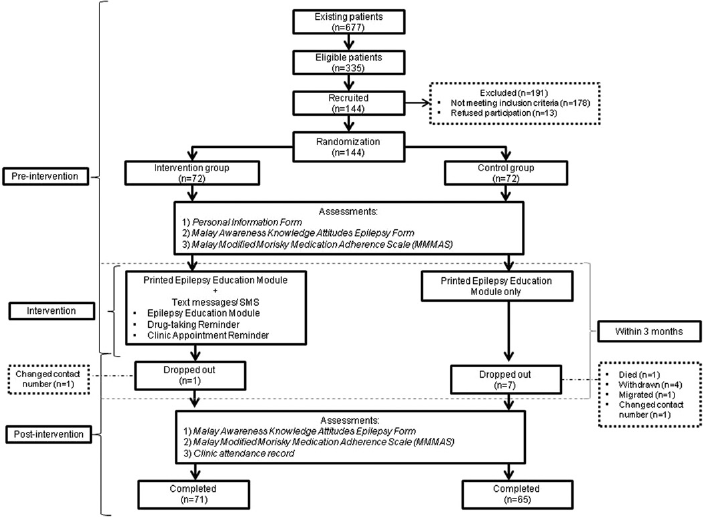
Outcome measures
The Malay Awareness, Knowledge and Attitude Epilepsy Form 5 contained three domains: Awareness, Knowledge and Attitudes. Each response score ranged from 0 to 10. The first domain was the Awareness level which contained 5 items with a total score ranging from 0 to 50. The scores were interpreted as: 0–10 = very low; 11–20 = low; 21–30 = moderate; 31–40 = high; 41–50 = very high. The second domain was the Knowledge level which contained 8 items with total possible scores from 0 to 80 and interpreted as: 0–16 = very low; 17–32 = low; 33–48 = moderate; 49–65 = high; 66–80 = very high. The last domain measured Attitude level which was sampled by 4 items (total score range 0 to 40) and its interpretation was: 0–7 = very low; 8–15 = low; 16–23 = moderate; 24–31 = high; 32–40 = very high. Finally the Total AKA Score was generated by summing the three domain scores. This score ranged from 0 to 170 with 0–33 considered as very low; 34–67 = low; 68–101 = moderate; 102–135 = high; 136–170 = very high. Three other items were included to assess patients’ (1) perception towards the best treatment for epilepsy, (2) preference for epilepsy information delivery and (3) preference for the mode of transportation to seek medical treatment during seizure attacks.
The Malay Modified Morisky Adherence Scale6–8 was a simple 4-item questionnaire which asked closed questions on medication use with binary response options (Yes = 0; No = 1). It was designed to gauge adherence level. Only item 2 was reworded and its corresponding response reversed due to concerns among patients with regard to the word “careless”. 8 The mean of the response scores was calculated for overall, between-group and within-group analyses. The mean scores ranged from 0 to 1.
Patients’ attendance for clinic appointment was recorded by the research assistants during follow-up sessions only because the baseline record was not kept as a routine in the clinic. The record was taken to determine the overall attendance percentage and to compare the attendance percentage between the two groups.
Statistical analysis
Statistical analyses were carried out with a standard package (SPSS Inc., Chicago IL, USA). Data were analysed based on the intention to treat principle. Analysis of covariance (ANCOVA) was used to examine the changes in AKA and medication adherence scores from baseline to follow-up in the two groups with potentially confounding factors (age, gender, educational qualification, monthly income and baseline mean for each variable) included as covariates. Adjusted effect sizes using Cohen's interpretation were also added. The values of adjusted effect sizes between 0.20–0.49 were considered as a small effect, 0.50 to 0.79 as a medium and values were greater than 0.80 were a large effect. 9
Results
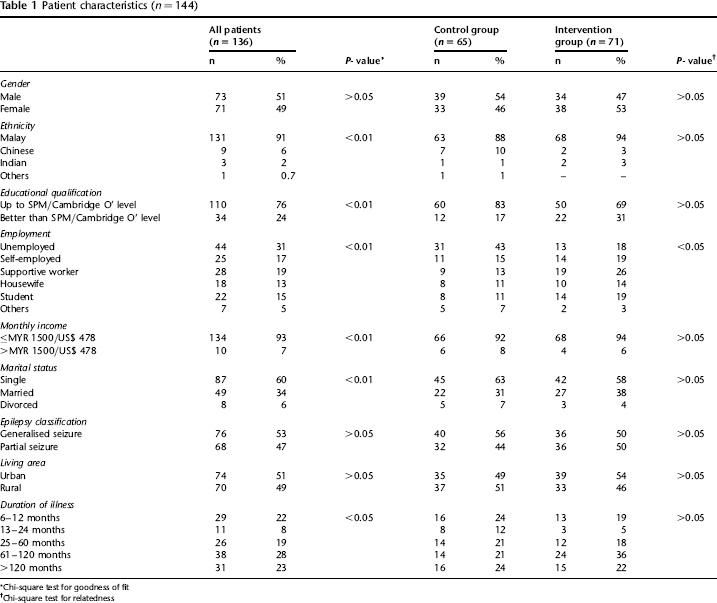
Of 677 epilepsy outpatients in the three public hospitals, only 335 were eligible for the study. Further screening resulted in 191 being excluded (178 did not meet the inclusion criteria while 13 refused participation). A total of 144 PWE were subsequently recruited at baseline but only 136 PWE managed to complete both the baseline and follow-up phases in the study. The average age of the patients was 31 years (SD 12). Most of them were Malays (91%), suffering from generalized seizure (53%), unmarried (60%), possessed an educational qualification not more than SPM/Cambridge O-level (76%), were unemployed (31%) and earned a monthly income not more than MYR 1500 (approx US$ 478) (93%) and had suffered from the illness for more than five years (51%), see Table 1.
Patient characteristics (n = 144)
Chi-square test for goodness of fit
Chi-square test for relatedness
Of 26 patient queries, eight required further expert advice from either doctors or neurologists. These queries were mostly about basic knowledge (n = 5), history and statistics (n = 2), living with epilepsy (n = 7), myth and facts (n = 2), self-control (n = 3), prognosis (n = 3), treatment/therapy (n = 8), psychosocial aspects (n = 1), laws and acts (n = 1), resources (n = 1) and other trivial issues (n = 3).
Between-group comparisons
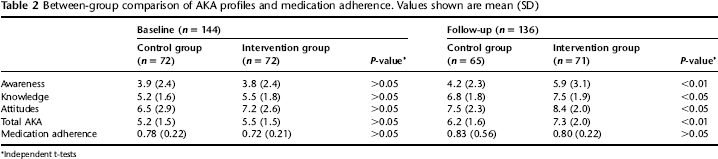
There was no significant difference between the groups at baseline for all AKA domains (P ≥ 0.05), see Table 2. However, during follow-up, intervention patients exhibited significantly better Awareness, Knowledge, Attitudes and Total AKA than the control patients (P < 0.05). Among all AKA domains, for both groups Attitudes exhibited the highest score while Awareness emerged as the lowest. In addition, there were no significant differences in medication adherence for both groups at baseline and follow-up (P ≥ 0.05).
Between-group comparison of AKA profiles and medication adherence. Values shown are mean (SD)
Independent t-tests
Within-group comparisons
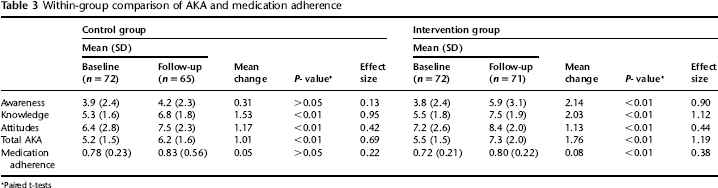
After intervention, there were significant improvements in Knowledge, Attitudes and Total AKA (P < 0.05) in control patients with Knowledge exhibiting large effect sizes (Cohen's d = 0.95). There were significant improvements in the intervention patients in all domains during follow-up (P < 0.01) with large effect sizes in Awareness, Knowledge and Total AKA (Cohen's d = 0.90–1.19). Compared to the control group, medication adherence was significantly better in the intervention group after intervention (P < 0.01), see Table 3.
Within-group comparison of AKA and medication adherence
Paired t-tests
Analysis of covariance
The results of ANCOVA for AKA scores and medication adherence from baseline to follow-up in the two groups are summarised in Table 4. There was significantly higher AKA in the intervention group compared to the control group, particularly in Awareness (P < 0.001) and Total AKA (P = 0.003) after controlling for potential confounding variables. Awareness had the largest adjusted effect size (Cohen's d = 0.87).
ANCOVA analysis between groups after controlling for potential confounding variables
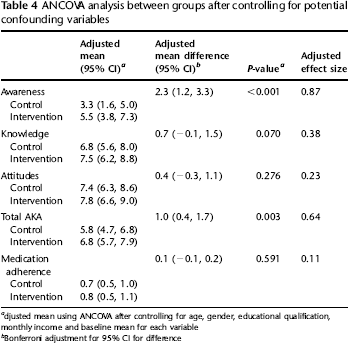
djusted mean using ANCOVA after controlling for age, gender, educational qualification, monthly income and baseline mean for each variable
Bonferroni adjustment for 95% CI for difference
Clinic attendance
Clinic attendance was not examined at baseline but during follow-up, the intervention patients had significantly better attendance at 90% in comparison to control patients who had 63% (P < 0.05), see Table 5.
Clinic attendance at follow-up (n = 136)

Chi-squared tests for relatedness
Discussion
Hanlon and collegues 10 found that after receiving health education, more than half of the participants changed one or more of their behaviours according to the advice given. Patients in their study also mentioned that the provision of information about their personal risk caused mild anxiety, and that advice and support could act as a motivating factor for behavioural change. Other studies have indicated that those who join a health promotion programme tend to be more health conscious, physically active, exposed to less health risk, adherent to prescribed medical regimens and demonstrate less absenteeism during clinic appointment than individuals who choose not to participate. 11 Thus both the printed epilepsy education module and the MEES could play a role in improving the psychosocial functioning of PWE and bringing about behavioural changes to cope better with the disease.
In comparing these two education interventions, even after controlling for potential confounders, the combination of SMS-based MEES and printed modules was clearly more effective than the conventional printed modules alone in improving AKA, especially Awareness. Continuous supplies of SMS containing epilepsy-related information reinforced the knowledge already obtained from the printed module and probably caused the PWE to be more aware and alert about their illness. After being delivered to patients’ mobile phones, the SMS messages could be read at their convenience. Being fast, simple, and flexible were some of the attractive features of the MEES. Another advantage of this system was the possibility of delivering large batches of text messages almost instantly, reducing labour cost. 12 SMS also do not require the mobile phone to be switched on and can be held for a number of days until the phone becomes active again. 13 Furthermore, SMS maintains some level of privacy, which was very reassuring for the patients.
Medication adherence among PWE remains a significant challenge, even for patients prescribed with newer antiepileptic drugs (AEDs), because non-adherence can result in increased risk of seizures, hospitalisation and higher treatment costs. 14 Because of the drug-taking reminders, the intervention patients reported better medication adherence than the control patients. We also found that SMS reminders were effective in improving attendance in primary care compared to the control group with no reminders, and were cost-effective 15 .
The present study had certain drawbacks. Because there was no clinic attendance record for epilepsy outpatients during the baseline period, within-group analyses for clinic attendance at baseline were not possible. In Malaysia, most of the primary care clinics do not have an appointment system and therefore the participants in our study may not have been familiar with keeping to appointments.
In conclusion, the present study suggests that the addition of the MEES to conventional epilepsy education is effective in improving AKA (especially Awareness), medication adherence and clinic attendance among PWE. This may alleviate the negative perceptions associated with epilepsy while simultaneously improving health outcomes.
Footnotes
Acknowledgements
We thank the Director General of Health, Malaysia for permission to publish this paper and the hospital directors, heads of Neurology Department (Zariah Abd Aziz, Sapari Satwi and Mahiran Mustafa) and staff of Hospital Sultanah Nur Zahirah (Hasmah Sabur and Rohani Mohammad), Hospital Tuanku Ampuan Afzan (Masnah Meon and Mazilah Abdullah) and Hospital Raja Perempuan Zainab II (Norhayati Yusoff) for their cooperation. We also thank the Faculty of Medicine and Health Sciences, UniSZA, the participants and their families for supporting the study. The Centre of Research Management and Innovation of UniSZA provided financial support (grant no: UDM/10/BR 029).