



Abstract
We compared the costs associated with three different methods of administering antibiotics to paediatric oncology patients. In scenario A, medicine was prepared in the home, checked in the home using a video link to a second nurse, and administered in the home. In scenario B, medicine was prepared by outsourcing the work to a commercial organisation, checked by pharmacists off-site and administered in the home. In scenario C, medicine was prepared in the hospital, checked by a second nurse and administered in the outpatient department. The staff time required for home administration was calculated from actual home visits. The cost of tablet computers and mobile Internet charges for double-checks in the home was based on an assumed useful life of 3 years for the equipment. The cost of outsourcing the preparation of medications was calculated from the actual cost of doing so during a four month period. Patient outcome was assumed to be the same in all three scenarios. The mean costs of a medication episode (i.e. one occasion of medication administration) was $129.91 in scenario A, $312.00 in scenario B and $355.91 in scenario C. Nurse preparation and administration in the home would save the oncology health service $124,899 per annum compared to outsourcing medication preparation. Nurse preparation and administration in the home would save the oncology health service $155,329 per annum compared to nurse preparation and administration in the outpatient department. Use of Internet-based video appears to produce savings compared to other methods of administering antibiotics and the technique may have wider application in supporting complex interventions in the home.
Introduction
Home care is an increasingly attractive option for health services to deliver interventions and services outside a hospital environment. There are advantages to the patient and perhaps cost savings to the health system. Hospital in the Home (HITH) services have been the subject of several economic evaluations. 1 – 3 A meta-analysis of five studies 2 established that similar outcomes were achieved for care at home with a similar, or lower, cost when compared to costs associated with inpatient care.
Prior to the commencement of the HITH programme at the Royal Children’s Hospital (RCH) in Brisbane, children with cancer receiving treatment for febrile neutropenia (a common complication of cancer treatment) would return daily to the oncology outpatients department to receive their intravenous antibiotics, once their condition had stabilised. In the oncology outpatients department, the nurse would undertake a check with a second nurse before administering the required medication. In the HITH programme, children are able to receive these intravenous antibiotics in their homes. However, with only one nurse in attendance in the home, it was not possible to perform the required double check. This led to the preparation of the prescribed antibiotics being outsourced to a pharmaceutical company, to eliminate the risk of incorrect dosage or antibiotic being administered.
We have previously established that it is safe and feasible for a nurse to prepare medications in the home and perform a double check using Internet-based video and a mobile tablet computer with a second nurse in a different location.4,5 However, the economics of this approach are not known. We have therefore compared the costs associated with three scenarios: (A) HITH care with nurse-prepared medications supported by Internet video double checks; (B) HITH care with outsourced preparation of medications; (C) usual care as an oncology outpatient with nurse-prepared medications.
Methods
The evaluation was conducted from the perspective of the health care system and assumed that no difference in patient outcome would have occurred, i.e. the patient would receive the intravenous medication as prescribed in all three scenarios. Because patient outcome was assumed to be equivalent, a cost minimisation approach was undertaken. The model included both fixed costs independent of the number of medications prepared (e.g. the purchase of tablet computers to enable a double check to be carried out) and the variable costs. The latter included the charges to outsource the preparation of medications, the extra nurse time required to prepare and check medications in the home, and outpatient appointment costs. Other costs that would have occurred in all three scenarios, such as pharmacy staff time, time spent coordinating care and the raw cost of the medications, were not included because they were the same for all three scenarios.
Equipment was valued according to its purchase price in 2012. The cost of the extra nursing time required to prepare and double check medication in the home was calculated based on the hourly rate for a registered nurse attending a home visit of $100 per hour. 6 All costs were calculated in 2012 Australian dollars.
A. Home prepared medication
The staff time considered for scenario A comprised the nurse time for the home visit (travel time and administration of medication), the nurse time for preparation of the medicine and the time of a second nurse for a double check.
The nurse time for a home visit was obtained from HITH records of the charges to the RCH during a four month period (July-October 2012). The time required for the nurse to prepare medication in the patient's home was estimated by timing nurse preparation of medications in the oncology day care unit; a time was obtained for each medication on five occasions. The time for the second nurse to double check medication via Internet video was also included. This was based on observing nurses actually doing double-checking in a previous study. 5
In addition to staff time, certain consumable items were required for nurse preparation, such as syringes, needles and water for injection. These costs were obtained from consumables price lists for clinical supplies. 7
B. Outsourced medication preparation
The staff time considered for scenario B comprised the nurse time for the home visit (travel time and administration of medication). The nurse time for a home visit was obtained from HITH records of the charges to the RCH during a four month period (July-October 2012).
The cost of outsourcing the preparation of medications was calculated from the actual cost of doing so during a four month period (July-October 2012). Information was obtained from the RCH pharmacy department about the costs incurred in outsourcing the preparation of medication items for paediatric oncology patients.
C. Hospital prepared medication
The staff time considered for scenario C included nurse preparation and administration of the medication as part of the routine delivery of care in the outpatient department. The costs of a paediatric outpatient appointment were used to value this option for medication administration. This cost was obtained from National Efficient Price data. 8 It excluded the raw cost of the medication itself.
Results
A time horizon of 3 years was used, based on an assumed useful life of 3 years for the computers.
Equipment
For scenario A, three tablet computers were required, which cost $569 each. The mobile Internet charges were $20 each per month.
Outsourced medication preparation
Medication costs over a 4-month period.

The mean cost of outsourcing medication preparation was calculated by taking the total of the charges to outsource medication preparation (column D, $52,841) and dividing by the number of medication episodes (n = 231), giving a mean cost of $229 per episode. This value takes into account the different medications and the variation in charges by the pharmaceutical company.
Nurse administration of outsourced medication in the home
The total cost for nurse home visits to administer pre-prepared medication for the 231 episodes was $19,250. Thus the mean cost of a nurse home visit (travel and medication administration) was $83.33 per episode.
Nurse prepared medication in the home
The time required to prepare medication varied for individual medications. Some medications took much longer to prepare than others (for example, tiecoplanin required 16 min to dissolve). The mean time to prepare the medications was 7 min (range 2–16). Thus the mean cost of the nurse time required was $12.
The time required for two nurses to perform a double check via Internet video was measured over 65 episodes in a previous study. 5 The mean duration was 9 min (range 4–30). This range reflects the differing levels of complexity involved in medication preparation and also included one occasion (30 min) where the Internet video communication was substandard and medication checking took longer than anticipated because of poor visual connection. The mean cost of the two nurses' time required was therefore $30 per double check.
The extra consumables that would be required to administer the medications during the 231 occasions in the home equated to a mean cost of $4.91 per medication item.
Nurse prepared medication in the outpatient department
A paediatric medical outpatient consultation was valued at $351 according to the National Efficiency Price. 8
Summary of costs
The mean variable costs for a medication episode (Table 2) were:
Medicine prepared in the home, checked in the home using video, and administered in the home, $129.91 Medicine prepared offsite, checked by pharmacists offsite and administered in the home, $312.00 Medicine prepared in the hospital, checked by a second nurse and administered in the outpatient department, $355.91 Fixed and variable costs. 1Outpatient costs were based on the National Efficient Price of $351 per consultation. 2Consumables included syringes, needles, water for injection and administration sets. 3Raw cost of medication ($1235) was not included, as it was the same for each scenario.

The total costs for administering medications in the three scenarios over a 3-year period (Table 3) were:
$273,949.89 $648,648.00 $739,936.89 Costs of medication in the three scenarios over a 3-year period.
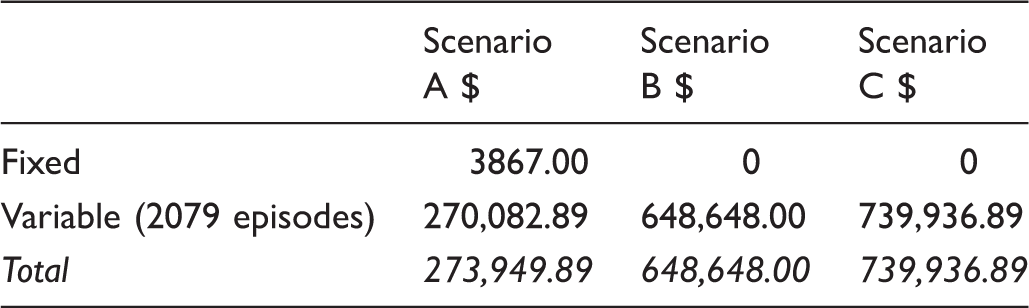
That is, nurse preparation and administration in the home would save the oncology health service $124,899 per annum compared to outsourcing medication preparation. Nurse preparation and administration in the home would save the oncology health service $155,329 per annum compared to nurse preparation and administration in the outpatient department.
Discussion
The economic analysis confirmed that significant savings could be made if nurses prepared medication in the home, rather than outsourcing the preparation of medications to a pharmaceutical company. While outsourcing of medication to pharmaceutical companies was slightly cheaper than preparation and administration in an outpatient department (variable costs of $312 versus $356 per episode), nurse preparation in the home was much cheaper (variable cost $130 per episode). All the costs associated with nurse preparation in the home (extra time, need for another nurse to double check, extra consumables, and equipment to undertake a double check via Internet video) were considered in the analysis.
The present evaluation considered only one type of patient, children with an oncological condition receiving treatment for febrile neutropenia. There is also potential to utilise home telehealth for other patients who are managed by HITH services, such as children being treated for cystic fibrosis, home ventilated children and other chronic complex conditions.
The evaluation had certain limitations. First we assumed that equivalent outcomes would occur in all three scenarios. It is conceivable that medication outsourced to a pharmaceutical company might have extra benefits, such as being stable for longer periods of time, than those prepared on site. This might be desirable in some circumstances. Second, relying on Internet video to perform a double check was demonstrated to work for 97% of the time in a previous study. 5 An alternative process for checking medications is required should Internet video fail, but these processes were not included in the analysis. Finally, the cost of outsourcing the drug preparation was dominated by one expensive drug. If this expensive drug is outsourced, but the others are prepared in the home, then the conclusions may alter.
Conclusion
The process of outsourcing medication items to a pharmaceutical company eliminates the need for a nurse to undertake a double check of the reconstituted medication. However it comes at a substantial cost. An economic evaluation of using Internet-based video to undertake a double check of medication preparation and administration in the home instead of outsourcing confirmed that substantial savings could be made without compromising patient safety. Indeed, enhanced patient safety with the maintenance of equivalent standards of care to that in hospital can be achieved by using Internet-based video to support complex interventions in the home. This technique therefore appears to have a useful role to play in ensuring the safe use of medications and facilitating other clinical interventions in home care. The future use of Internet video-calls within processes and systems may therefore improve patient safety while reducing costs.
Footnotes
Acknowledgements
We thank the Sporting Chance Cancer Foundation for financial support.