




Abstract
We developed, implemented and evaluated a web-based continuing professional development (CPD) programme on medical genetics. Development of the CPD programme followed the ADDIE model, i.e. Analysis, Design, Develop, Implement and Evaluation. An invitation to participate in a needs analysis survey was sent to all doctors on the email list of the Sri Lanka Medical Association. A total of 129 completed surveys was received (57% of the 228 who accessed the online survey). The average age of respondents was 42 years (range 27-81). The male: female ratio was approximately 2 : 1. Almost all respondents (96%) selected web-based CPD programmes, or web-based and conventional lectures, as their preferred method of learning. The programme was piloted on a group of 10 doctors. The average pre-knowledge score was 40.3 and the post-knowledge score was 62.1 marks out of 100 (P = 0.002). We conclude that a web-based CPD programme on medical genetics is feasible in Sri Lanka.
Introduction
Continuing professional development (CPD) in medicine refers to the education of physicians after their formal training period has been completed. The aim is to provide better quality health care by keeping the physicians’ practice up to-date. Studies have demonstrated that there is no single correct way of doing CPD. 1 There is a subtle difference between CPD and Continuing Medical Education (CME). The latter involves updating only clinical knowledge, whereas the CPD aims to develop and improve a broad range of skills necessary for medical practice. 2 Thus, CPD incorporates the concept of CME as well as clinical professional and managerial aspects. 3
Historically, physicians have maintained their competence, and probably practised medicine better at the end of their careers than at the start, through an innate process of reflective learning and self directed learning. 4 However, the amount of biomedical knowledge doubles every 20 years, 3 and a doctor's practice could become rapidly outdated without activities that allow knowledge and skills to be updated. Thus there is a global trend to introduce CPD in medicine.
In Sri Lanka, the Sri Lanka Medical Association (SLMA) is the national professional medical association and has approximately 3000 members. The SLMA has taken steps to introduce CPD courses/programmes to Sri Lankan doctors, such as setting up the National Centre for CPD in Medicine. 5
CPD programmes
The standard format of CPD for many years has been formal study courses, conferences, symposiums or workshops. Due to difficulties such as finances, time, job demands and work-life balance, CPD programmes are not accessible to those who live away from the main cities. 1 The introduction of e-learning has made CPD programmes easily accessible, even to doctors from rural areas.
The first online CPD course in the world was offered in 1996. 6 In the past few years, CPD on the Internet has grown steadily. 1 Some studies report that web-based learning is an attractive methodology for medical education and that it offers certain advantages over traditional methods. 7 Specifically, online CPD courses represent a cost effective, convenient option and one that affords physicians much flexibility when fulfilling educational requirements. 8 Research has shown that professionals are satisfied with the flexibility and convenience offered in web-based distant education and it is an effective and efficient mode of CPD delivery, especially for technologically competent professionals. 9
Genetics
Knowledge of genetics is essential for health professionals. At least 1 in 10 patients in primary care have a genetic component to their complaint. 10 It has long been recognised that health professionals’ knowledge of genetics is limited. 11 Moreover, lack of knowledge and skills on genetics had lowered the confidence of doctors in handling patient queries on genetic information. 10
Research has shown that more than 95% of physicians are interested in accessing medical genetic programmes via the Internet, especially if available free of charge. 12 The Internet has been identified as a promising medium for providing genetics education. 13 The objective of the present study was to develop, implement and evaluate a web-based CPD programme on medical genetics.
Methods
The ADDIE model14,15 represents a systematic approach to instructional systems development. It encompasses five phases: analysis, design, development, implementation and evaluation. Development of the CPD programme followed the ADDIE model:
Analysis. The process of needs analysis for CPD in medical genetics was done using a self administered, anonymous online questionnaire delivered through open source software (Lime Survey). Emails were sent to all SLMA members inviting them to respond to the survey and giving a link to the online questionnaire. Design. Design and development of content, and identifying teaching/learning and assessment methods to evaluate the respondents at the end of the course was done using a blueprinting mechanism. The blueprint is a table that highlights exit outcomes and course content. It ensures the alignment between outcome, content and assessment. Development. Content from genetic educational material was converted to the online mode of delivery using a theoretical model based on the Kolb and Lewin learning cycle
16
with the help of a content specialist and a medical educational specialist. The e-learning management system, mLearning, developed by Sri Lanka Telecom was used. It was customized according to the blue print. Implementation. The CPD programme was implemented for a group of doctors. An invitation email was sent to some of the postgraduate trainees on the SLMA email list inviting them to participate in the pilot programme. Evaluation. The programme was evaluated after implementation at level I (reaction) and level II (learning) of Kirkpatrick’s evaluation hierarchy.
17
The first level evaluation was done using quantitative and qualitative feedback and the second level knowledge assessment was done using a set of 20 multiple-choice questions on pre-/post-knowledge assessment.
Results
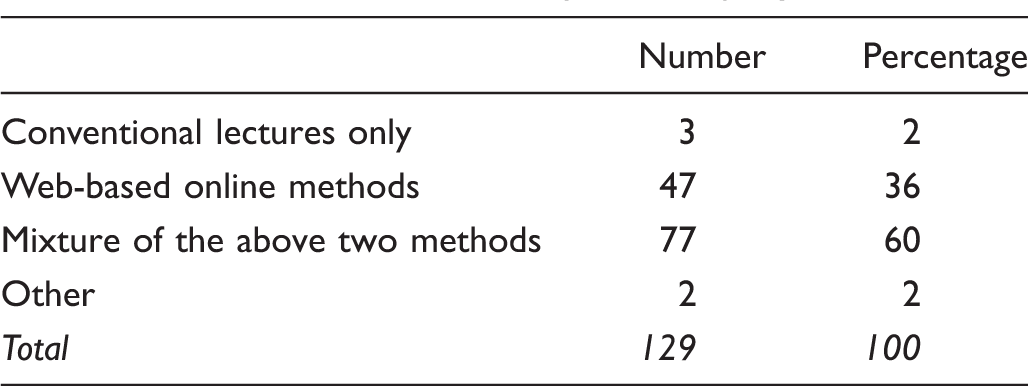
The online survey form was accessed 228 times. A total of 129 completed surveys was received, i.e. if each access was by a different person, then the response rate was 57%. The average age of the respondents was 42 years (range 27–81), see Figure 1. The majority (66%) were males. The majority (96%) preferred some kind of web-based form of CPD delivery (Table 1).
Age distribution of respondents (n = 129). Preferred mode of delivery of CPD programmes.
Distance from respondents’ workplace to the SLMA.

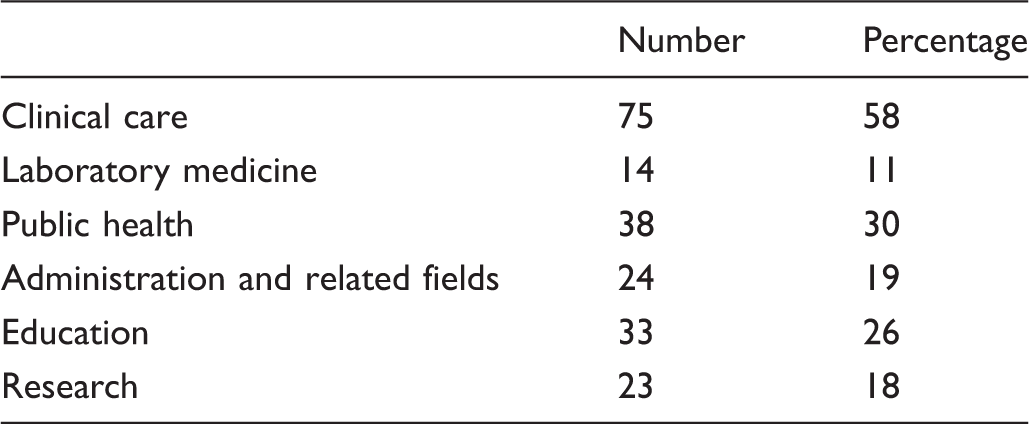
Main areas of responsibility (n = 129). Responders could have more than one area of responsibility.
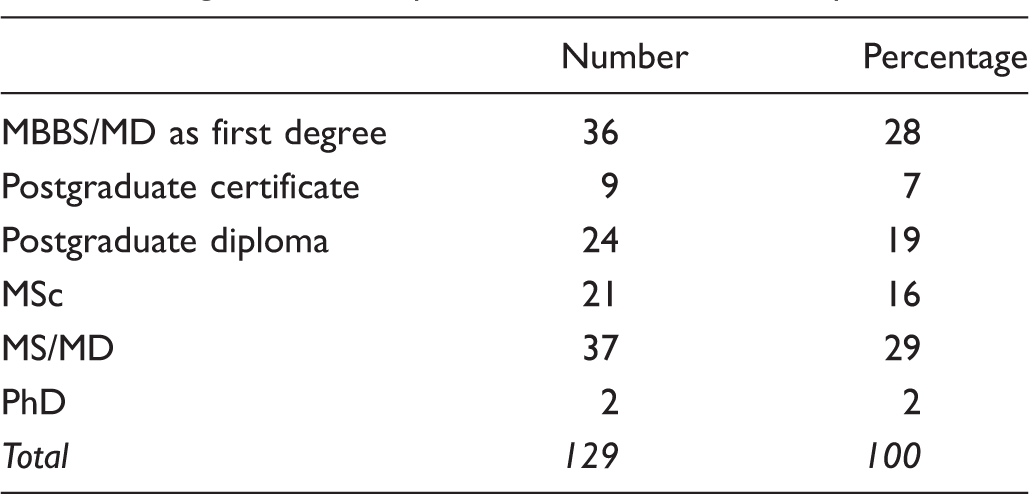
Highest level of professional education completed.
Preferred modes of accessing a web-based CPD programme (129 respondents). Responders could state a preference for more than one mode to access.

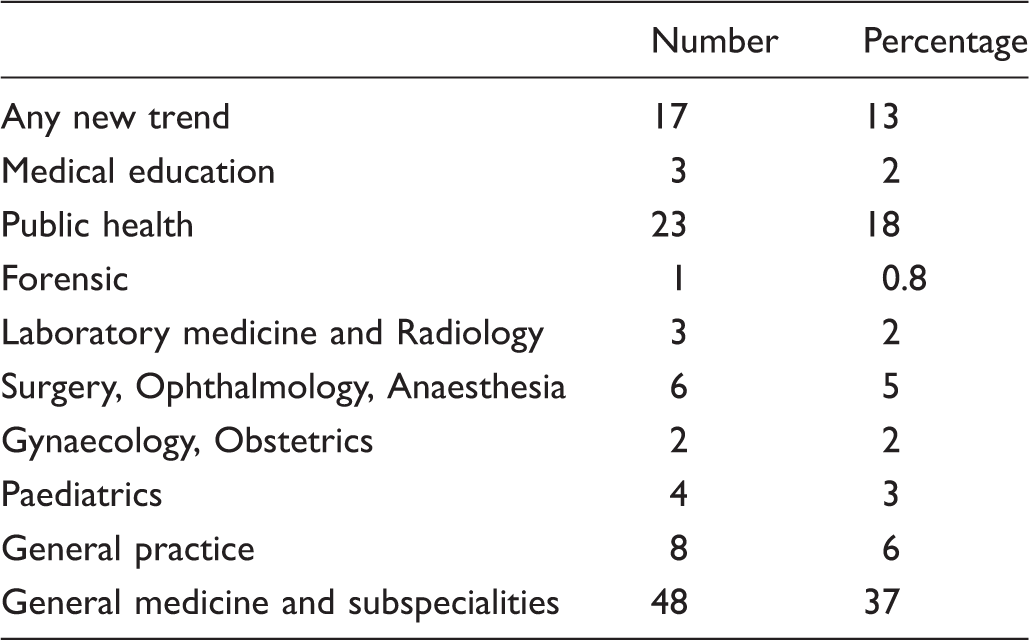
Preferred subjects for CPD programmes (n = 129). Responders could prefer more than one subject area.
Evaluation of the CPD programme
Feedback from the respondents about the course satisfaction and efficacy (n = 9).

The second level of evaluation was knowledge assessment, which was done by using multiple choice questions (MCQs). The average pre-knowledge score was 40.3 and the post-knowledge score was 62.1 marks out of 100 (Figure 2). A paired samples t-test indicated a significant increase in pre- to post-knowledge (P = 0.002).
Pre and post test scores.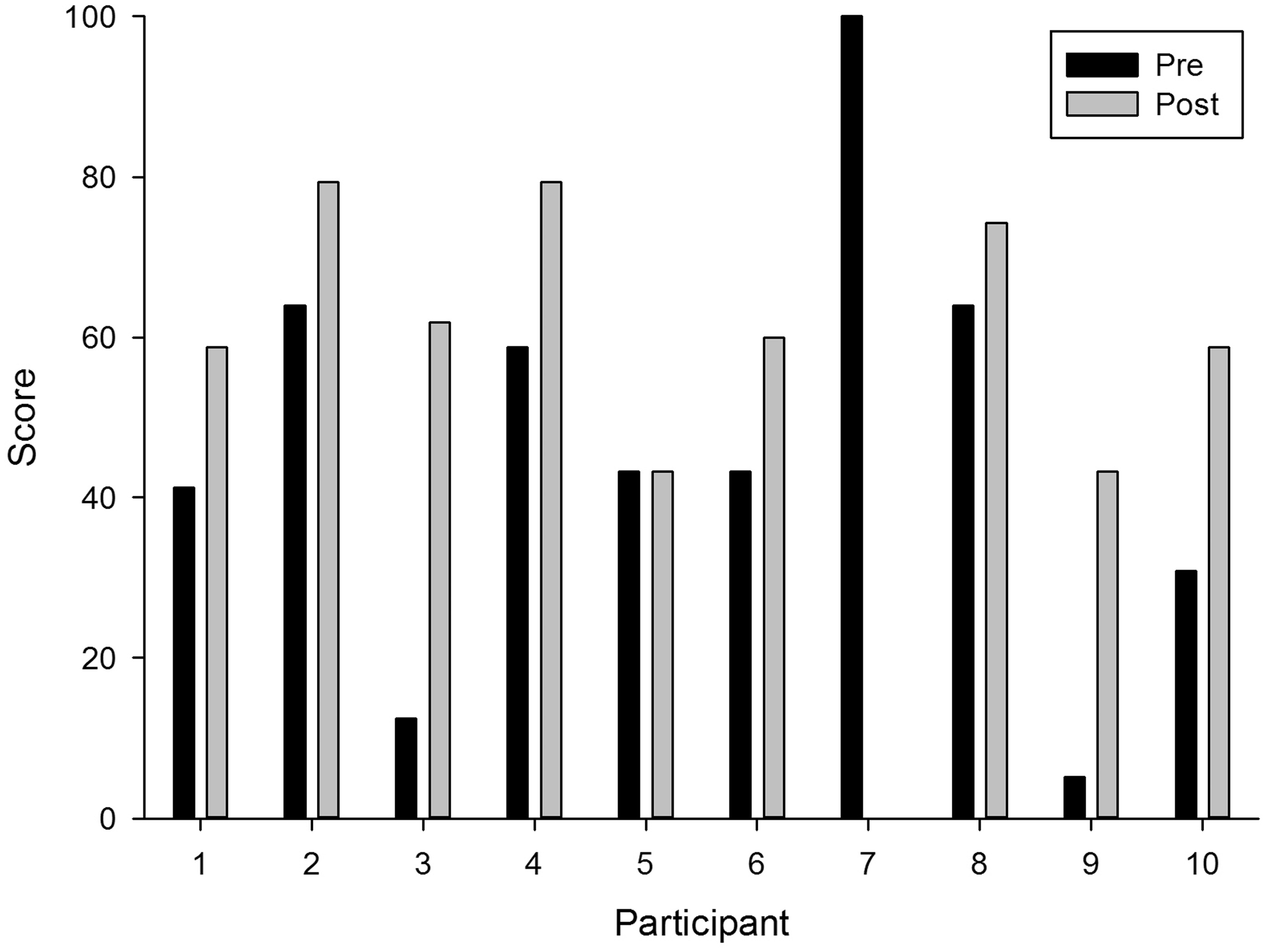
Discussion
The response rate in the initial needs assessment survey was 57%. This rate was higher than in a previous survey (41%) on satisfaction with web-based CPD. 7 However, the number of returns was low in comparison to those (n = 902) in an online survey on effectiveness of CPD. 1
The respondents in our survey were middle aged. In comparison, a previous study reported an average age of 46 years. 7 Previous research has shown that the level of education is an important predictor of success in distance learning. 7 In our study, 72% of respondents had postgraduate medical qualifications. Web-based or hybrid (conventional combined with online) professional development was perceived by 94% of the course respondents as the most suitable platform for learning. These results are similar to research demonstrating that 97% of respondents were satisfied with web-based courses 7 and not in agreement with other research which suggests that college conferences, medical society conferences and speciality association sessions were the most valuable contributors to CPD. 2
The preference for web-based CPD found in our survey may be partly attributed to the high level of professional education of most respondents, their high interest in professional development despite their busy schedules and the fact that they were experienced Internet users. Most respondents (58%) were responsible for clinical care. Past studies report improved clinical practice as a result of e-learning and improved clinical decision making through the use of online group casework. 18 Therefore these respondents constitute a group that could benefit from e-learning. In the present study, the majority of respondents (60%) liked hybrid CPD programmes, which agrees with previous research demonstrating healthcare professionals' preference for a hybrid basic genetics course combining web-based learning with conventional face-to-face instructional techniques. 19
About 50% of the respondents responded positively about the importance of an online CPD programme in genetics. In a previous study, a higher percentage of physicians (95%) were interested in accessing a genomic medical curriculum via the web. 12
Limitations of the study
The present study had several limitations, including the fact that sampling of doctors was non random and relied on self-reported, qualitative data. This does not allow generalization of the results to all health care professionals. Only ten doctors volunteered to participate in the pilot programme in response to an invitation email, which may be due to the busy schedule of doctors generally.
In conclusion, the results of this pilot study show that implementing a web-based CPD programme in medical genetics is feasible in Sri Lanka.
Footnotes
Acknowledgements
We thank Dr Roshan Hewapathirana for advice and the doctors who participated in the study. We are grateful to Sri Lanka Telecom Mobitel (Pvt) Ltd for technical support with their learning platform and SLMA for providing access to their membership and support with the project. mLearning is a registered trade mark.