



Abstract
Summary
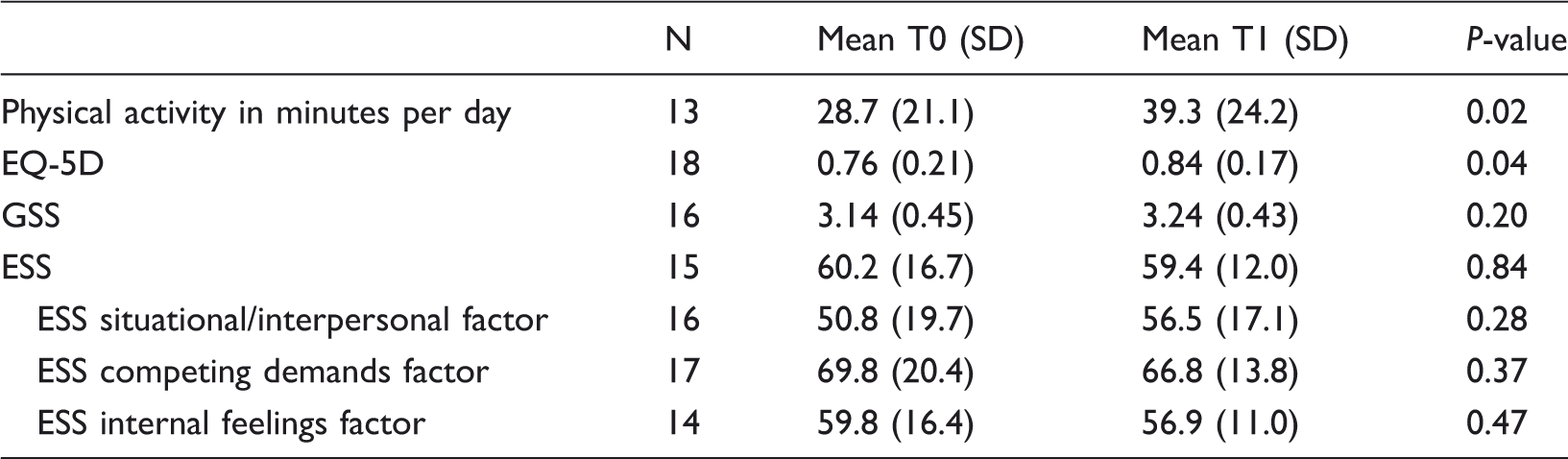
We tested the performance, acceptance and user satisfaction of a tool to stimulate physical activity. The tool consisted of an accelerometer, a smartphone app and a server/web application. Patients received feedback concerning their physical activity relative to a goal, which was set in dialogue with their practice nurse. Nurses could monitor their patients’ physical activity via a website. Twenty patients with COPD or type 2 diabetes used the tool for three months, combined with behaviour change counselling. Physical activity data were collected at the server and a log file was used to record technical problems. We interviewed patients and nurses after every consultation. At baseline, and after the intervention, patients completed questionnaires. Participants were positive about the tool, although motivation dropped when technical problems occurred caused by log-in and connectivity errors. On average, physical activity increased from 29 (SD 21) min per day in the first two weeks to 39 (SD 24) min per day in the last two weeks (P = 0.02), and quality of life scores increased from 0.76 (SD 0.21) to 0.84 (SD 0.17) (P = 0.04). Provided that no connectivity problems occur, the tool is a feasible intervention when embedded in primary care, and has a positive effect on physical activity levels.
Introduction
Patients with chronic obstructive pulmonary disease (COPD) or type 2 diabetes usually know that they must improve their lifestyle in terms of physical activity (PA). 1 However, adhering to guidelines for healthy exercise is difficult. 2 By integrating PA counselling into routine practice, primary care providers can support patients in meeting this challenge.3–5 Therefore, assessment of PA should be part of routine consultations for these patients and activity levels should be considered as a vital sign. 6
Primary care may be a suitable context for PA promotion, since changing behaviour demands regular contact between patient and healthcare professional. In the Netherlands, people with COPD or type 2 diabetes visit the family practice at least once a year and it is the task of the practice nurse to monitor treatment outcomes, provide education and support for behaviour change, and offer follow-up contact. 7 Practice nurses perform lifestyle counselling according to generally acknowledged criteria. However, there is room for improvement in the tailoring of information and advice about lifestyle behaviour. 8
Activity interventions have a moderate effect on self-reported PA, especially when the interventions include some professional guidance and on-going professional support. 9 Self-monitoring of behaviour, risk communication and the use of social support are effective elements in interventions to promote exercise, but providing knowledge, materials and professional support is not sufficient for patients to accomplish change. 10 In a recent literature review on promoting PA, 20 out of 29 studies showed significant differences in favour of computer-tailored interventions. 11 However, the circumstances of use with respect to the target group and its integration into the care process have to be clarified during the development process.
In the project “It’s LiFe!”, a monitoring and feedback tool aimed at supporting patients in achieving an active lifestyle was developed and tested, 12 along with a counselling protocol. We conducted a pilot study to test the technical performance of the tool in daily life, to test the acceptance and satisfaction with the tool and the counselling protocol, and to obtain information to design a subsequent randomised controlled trial.
Methods
The study took place from April until July 2012 in two general practices in the Netherlands. We asked the practice nurses to include 10 patients aged over 40 years, five of whom had type 2 diabetes with a body-mass index > 25 kg/m2 and five of whom had COPD according to the GOLD-criteria stage 2 or 3, who could benefit from more PA. Patients with complex co-existing medical conditions, insufficient mastery of the Dutch language, or without an Internet connection were excluded.
The tool consisted of an accelerometer, a smartphone app and a web application (Figure 1). Patients received personalized feedback on the smartphone concerning their activity in relation to an activity goal, which was set in dialogue with their practice nurse. Nurses could monitor patient activity via the website.
13
Smartphone and accelerometer.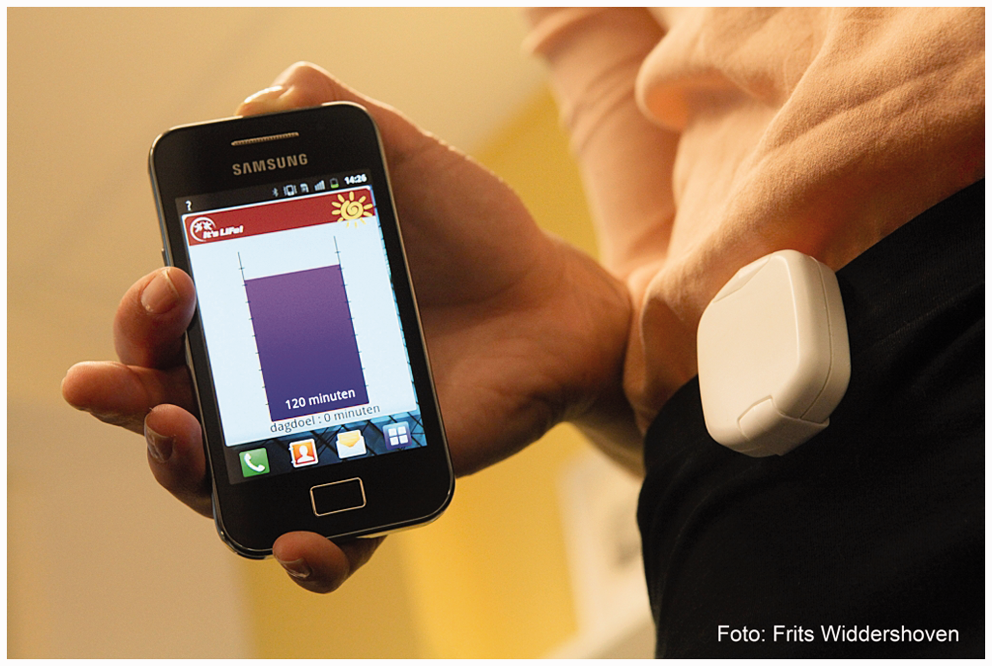
Patients were provided with the accelerometer (MOX Activity Monitor, Maastricht Instruments, The Netherlands) and a smartphone (Galaxy Ace, Samsung) with a data subscription, and equipped with the web application. The use of the tool started when the patient was registered on the server by the practice nurse. The login name and password were sent to the patient by email. At home, the patient had to complete a short questionnaire online concerning activity preferences. There was a pre-measurement period of 14 days. Patients could enter comments about being ill or having forgotten to wear the accelerometer. In the second week, patients were asked to keep an activity diary. They also received two sessions via the server concerning goals and activity planning based on the Physician-based Assessment and Counselling for Exercise intervention, 14 with the aim of modifying factors known to influence PA, such as social support and self-efficacy.
After two weeks, the patient and nurse together set a goal for the number of minutes of activity per day. Patients then received feedback based on their performance against this target.
At the end of the study, there was a focus group interview with the participating nurses and GPs to discuss the results.
Treatment protocol
The intervention consisted of the use of the tool in daily living, intertwined with consultations with the practice nurse – the Self-Management Support Programme. The programme was based on the Five A’s model, a counselling protocol to support self-management in a primary care setting.
15
The main elements of the intervention are shown in Figure 2.
Main elements of the intervention.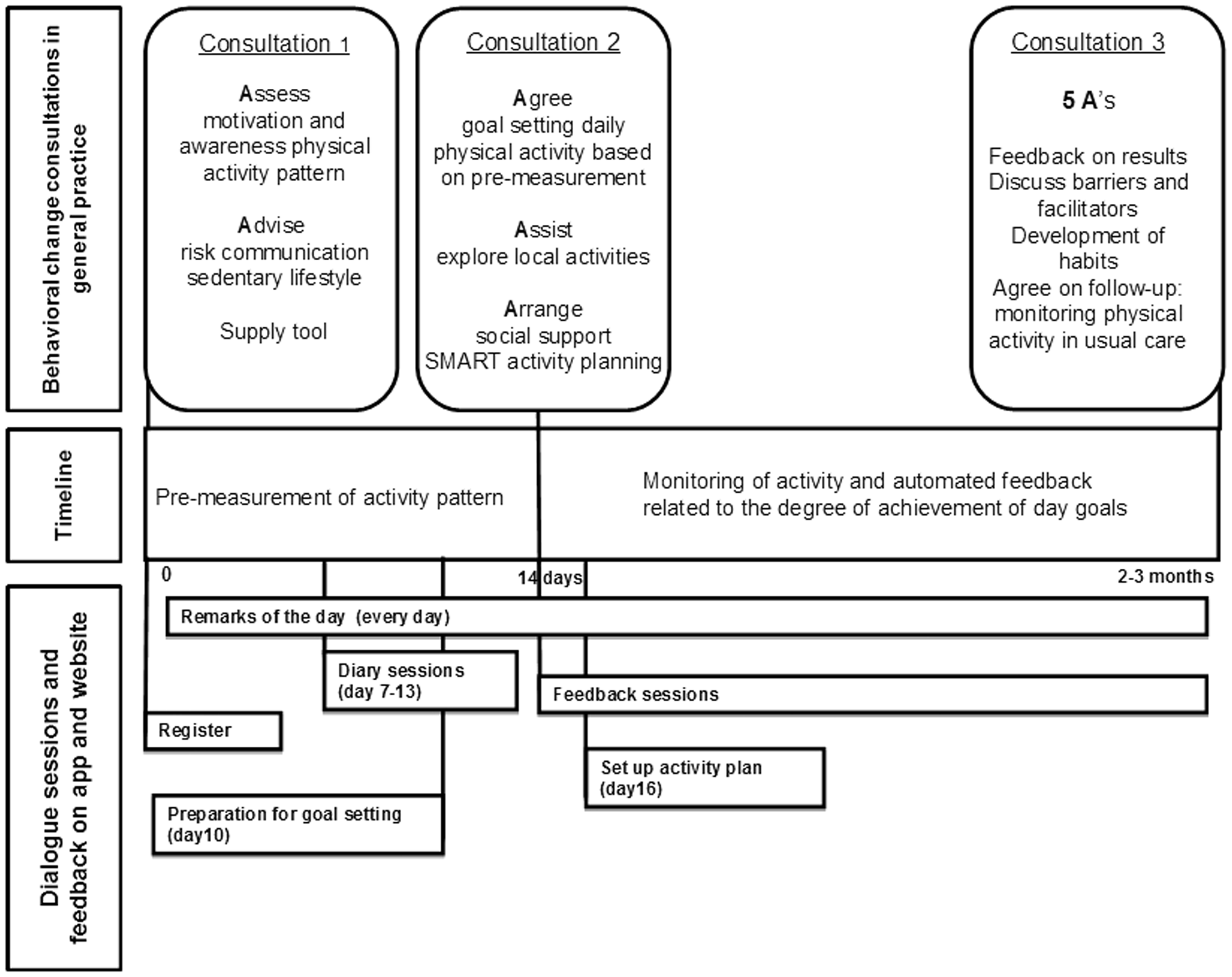
Before the start of the study, the nurses were provided with instruction charts for the course of the consultations with information about the intended counselling techniques, 16 namely motivational interviewing, 17 risk communication 18 and goal-setting. 19 They received instruction in how to use the system and were advised to try out the tool for themselves.
The patients visited the practice three times: in the first week, after two weeks, and after 8–12 weeks. The consultations (20 min) could be extra or an extension of a routine consultation (10 min).
During the first consultation the nurse performed an assessment of the patient’s activity pattern using an online self-assessment questionnaire, 20 provided information about the risks of a sedentary lifestyle and the benefits of PA on disease prognosis using an information card, and gave the patient a leaflet containing details of locally organized physical activities. The nurse supplied the tool, registered the patient in the system and instructed the patient how to use the tool. During the second consultation, the daily activity goal was set and the nurse stimulated the patient to think about which types of activities would suit the patient best in reaching this goal. During the third consultation the patient received feedback from the nurse, based on the results of the PA performance.
The study was approved by the appropriate ethics committee.
Measurements
We used qualitative and quantitative measurements. All patients and nurses were interviewed (30–60 min), shortly after every consultation. We asked questions about the technical functioning, acceptability, and user satisfaction with the tool and the consultations.
At baseline (T0) and a few days after the last consultation (T1), patients completed questionnaires. We used the EQ-5D for measuring quality of life and self-rated health. Self-efficacy has been shown to be a mediator of PA behaviour. This was measured with the 10-item General Self-efficacy Scale (GSS), designed to assess optimistic self-beliefs to cope with a variety of difficult demands in life, 21 and with the Exercise Self-efficacy Scale (ESS) which describes 18 situations during which it could be difficult to adhere to an exercise routine. Patients rated their degree of confidence to continue with regular exercise in the listed situations.
We collected the PA data (minutes spent per day of moderate-intense walking, i.e. at > 3.5 km per hour) which was measured by the accelerometer and the responses given by the patients on the sessions from the server. We recorded technical problems in a log file. Patients could contact the researchers during working hours if there were technical problems.
Analysis
We recorded and summarized all interviews. We followed a directed content analysis method by coding and organizing the data into categories that reflected the emerging feasibility themes for each aspect of the intervention. 22
We analysed the PA data from the first two weeks and from the last two weeks, and the questionnaires, with paired t-tests using a standard package (SPSS version 18). We used a non-parametric test (Wilcoxon Signed-rank test) to analyse the PA data.
Results
Characteristics of the participants.

Patients’ overall experiences of the intervention
Most patients (12 out of 17) were positive about the intervention. They felt encouraged to be more active and mentioned three aspects: the awareness of their PA performance, the stimulating effect of the daily target goal and the positive effect on self-efficacy.
Most participants who were enthusiastic in the first interview confirmed this opinion in the third, i.e. their ideas about the usefulness of the intervention did not change over time. There were four participants who indicated that they regretted having to return the tool at the end of the study. A total of 12 patients were positive about the effect of the intervention on their PA performance and five patients were neutral about it; the latter were patients who were already sufficiently active.
During the final interview, all patients were asked to characterize the intervention in one word. The following words were chosen: stimulating (n = 4), good (n = 4), fun (n = 3), positive, meaningful, could be effective, a boost, a helping hand, a big stick.
Effects on activity levels
Physical Activity, Quality of Life, General and Exercise Self-Efficacy.
Tool
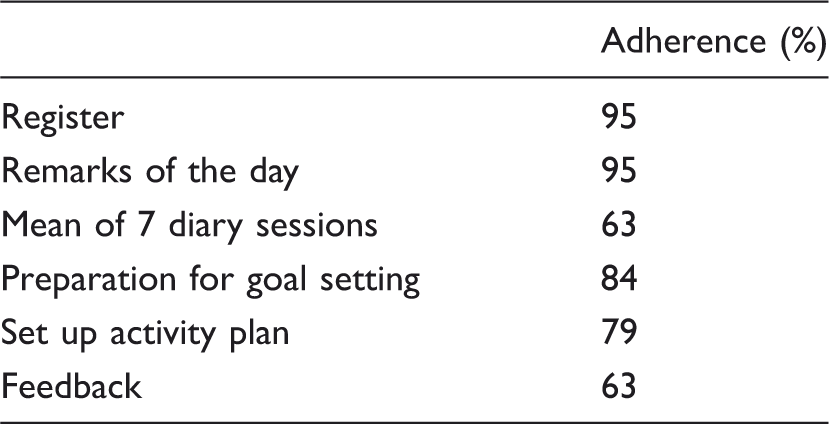
Adherence to the sessions (n = 19).
Although most of the patients were positive about the tool, the motivation of some patients dropped when technical problems occurred. Those problems occurred frequently (18 out of 20 participants) and had to do with log-in difficulties (small keyboard) and connectivity errors (not recognizing if Bluetooth was off or flight mode was on). A total of six patients needed some extra advice about how to log in, which was given to them during the first interview and during consultations with the nurse. The connectivity problems were twofold: between the accelerometer and the smartphone, as a result of which the app indicated the activity some time later, and between the smartphone and the server. This was not a major problem for the patients, because the results were also stored on the smartphone. However, they did not receive feedback sessions, and the nurses were unable to see the results on the website.
Most comments were given about the fact that some activities (cycling or gardening) did not account for many minutes of activity. Another comment on the recorded number of minutes was given by a patient with severe breathing problems and a patient with an orthopaedic shoe. When active, neither reached a speed of more than 3.5 km/h. Their impression was that they had really tried very hard, but the tool had not given them enough minutes as a reward.
Consultations
More than 50% of the patients mentioned the added value of the consultations and the involvement of the nurse. During the first consultation, attention to the tool dominated the consultation, and less attention was paid to the counselling protocol. The majority of the patients indicated that the nurse did not talk about the benefits of being more active because this was a topic which had already been frequently discussed before. Overall patients were satisfied with the course of the first consultation: they felt there was a good atmosphere and it was informative and clear.
The second consultation was partly executed as planned, with the main focus-setting goals in collaboration with the patient. Patients were satisfied about goal-setting. In some cases the nurse had to temper patients’ overly ambitious goals. There was less attention to setting up the plan and to the leaflet containing locally organized physical activities. Most patients simply intended to increase their walking and cycling activities.
In the final consultation the use of the tool was evaluated and patients talked about how to maintain their PA performance at a higher level. Positive feedback was given on PA performance and patients appreciated this.
Questionnaires
In the EQ-5D and the GSS patients scored higher after the intervention, but this was only significant for the EQ-5D, see Table 2. Quality of life scores increased from 0.76 (SD 0.21) to 0.84 (SD 0.17) (P = 0.04). At baseline the mean Quality of Life scores of the diabetes patients were 0.2 higher than the mean scores of the COPD patients.
Nurses’ opinions of the intervention
All nurses agreed on the usefulness of obtaining objective PA data via the tool, indicating that it was difficult to assess otherwise. They saw that patients reacted positively to reaching their target goals. The most critical remarks were made about receiving a lot of queries from patients because of the technical problems. The nurses spent more time explaining the tool than on activity counselling. All nurses indicated that when looking at the data together with the patient, it was much easier to talk about barriers and facilitators for becoming more active. However, this often resulted in a longer consultation time.
The activity meter started counting if the average speed was approximately 3.5 km/h. During the focus group, the possibility of lowering the threshold was discussed. The participants agreed that the stimulus of “earning minutes” was more important than recording the intensity. Therefore the option to adapt the threshold if the pre-measurement period revealed that the patient did not reach 3.5 km/h was implemented. Furthermore, the dialogue sessions were not flexible in time, whereas the study revealed that this was important. In a lot of cases, the second consultation was not scheduled exactly two weeks after the first consultation.
Discussion
In a pilot study, the intervention stimulated patients to become more physically active and supported nurses in performing activity counselling. Although the average gain in duration was modest, the relative increase in activity was quite high. Because the tool itself and its technical problems dominated the consultations, the counselling protocol was only partly executed as planned. But all participants valued the attention to PA and collaborative goal-setting during the consultations.
There was a positive trend in the level of PA during the study, which increased by more than 10 min per day, and patients reported a higher quality of life. Although the sample size of 20 was sufficient to evaluate the feasibility of the intervention, 23 conclusions about the effects should be made with great caution. There may have been selection bias towards patients known by the nurse to be highly cooperative, there was no control group and the accelerometer had not been validated. However, the results of the PA levels were consistent with the self-reported levels obtained during the interviews with the patients and nurses. Besides the positive effects of the tool and the consultations on the level of PA, the interviews themselves could have functioned as an extra motivator. It is not known if the positive results will be sustained in the longer term, when there is less human support.
On the basis of the pilot study, the tool and the counselling protocol were improved, with attention paid to the connectivity problems and the time required by the nurses. The results are promising with respect to increasing PA and reported quality of life, and encourage a large-scale effectiveness study. In conclusion, once the connectivity problems are solved and the nurses have gained some experience, the “It’s LiFe!” tool appears to be a feasible intervention in primary care.
Footnotes
Acknowledgements
We thank the participating patients, practice nurses and GPs of the family practices in Wijlre and in Ulestraten. The companies involved in the development of the tool were: IDEE Maastricht UMC+, Maastricht Instruments Ltd and Sananet Care Ltd. The work was supported by ZonMw (The Netherlands Organization for Health Research and Development).