



Abstract
Summary
We analysed the most highly cited articles in two specialist telemedicine journals, the Journal of Telemedicine and Telecare (JTT) and Telemedicine Journal and E-health (TJEH). Articles were extracted from the Science Citation Index Expanded in September 2012. A total of 1810 articles were listed for the JTT and 1550 for TJEH. In the JTT, the mean number of citations was 43 (SD 13); in TJEH the mean number of citations was 30 (SD 11). The average number of citations for the JTT was significantly higher than for TJEH (P < 0.001). In each journal, the 60 articles which had the most citations were identified as highly cited publications (HCPs). The 60 HCPs in the JTT originated from 16 countries; the 60 HCPs in TJEH originated from 10 countries. Considering both journals together, the majority of HCPs came from the US, UK, Australia and Canada. In the JTT, the mean number of authors for each HCP was 4.6 (SD = 3.1); in TJEH, the mean number of authors for each HCP was 4.5 (SD = 2.3). There was no difference between the two journals (P = 0.84) and the characteristics of the HCPs published in the JTT and TJEH were broadly similar. Although HCPs are not a direct method of measuring quality, they are an indicator of the scientific impact of the articles.
Introduction
There have been major advances in telemedicine and a growth in the number of studies carried out in this field. Thus there is a need for measures of scientific quality in the resulting publications. One index of quality is the number of citations to published articles. A citation occurs when one scientific article (the citing article) uses another (the cited article) as a reference. 1 The number of citations received by an article is an indicator of its scientific impact 2 and provides a reliable approach for ranking articles. 3 The more times a paper is cited, the more valuable is that paper.
Highly cited papers (HCPs) have been evaluated in different fields, such as ophthalmology, 4 anaesthesia, 5 emergency medicine, 6 orthopaedics, 7 urology, 8 rehabilitation, 9 obstetrics and gynaecology. 10 The aims of an analysis of HCPs are: (1) identifying what research has been done in the field and where it is developing, (2) demonstrating the progress of the literature over time, (3) identifying which areas are recognized as having greater impact, (4) assisting researchers and PhD students to identify new areas of work, (5) identifying authors who have made substantial contributions to the field, (6) determining frequently cited institutions.11–14 It would be useful to know about the characteristics of HCPs in the telemedicine field.
The aim of the present study was to analyse some characteristics of the 60 most cited papers published in the Journal of Telemedicine and Telecare (JTT) and Telemedicine Journal and E-health (TJEH). The JTT and TJEH are the only two specialist telemedicine journals which are indexed in the Web of Knowledge.
Methods
Articles were extracted from the Science Citation Index Expanded (Institute for Scientific Information Web of Knowledge) on 15 September 2012. The two journal names were searched separately in the Web of Science under “Publication Name” and the results were sorted in order of “Times Cited”. In each journal, the 60 articles which had the most citations were identified as HCPs.
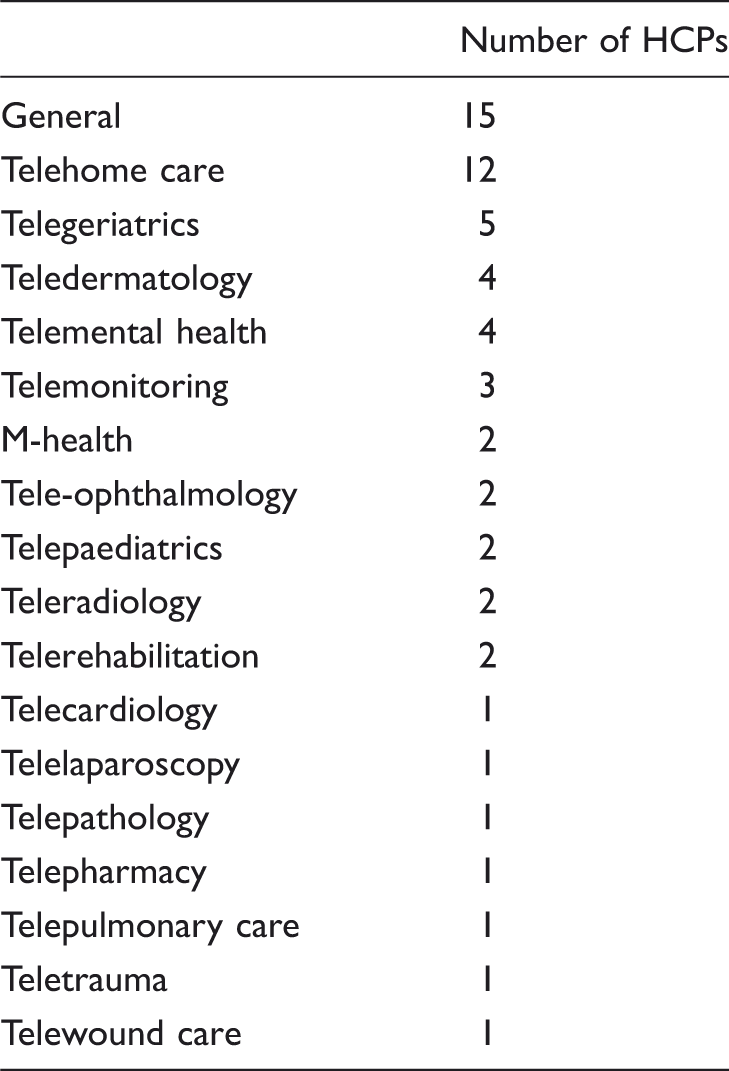
Categories of the highly-cited articles in the two journals.
We examined the trend in citations per year by calculating a regression coefficient for each journal for the period 1998–2008, i.e. the dependent variable was the total number of citations in a year.
Results
The 60 most cited articles published in the Journal of Telemedicine and Telecare.

no of citations/years in print until 2012.
The 60 most cited articles published in Telemedicine Journal and E-health.

no of citations/years in print until 2012.
In the JTT, the total number of citations for the 60 HCPs was 2584. In TJEH, the total number of citations for the 60 HCPs was 1790. Approximately 18% of the 60 HCPs published in the JTT had more than 50 citations, while 6% of the HCPs in TJEH had more than 50 citations.
The mean citation rate in the JTT was 42 per year (SD 6), range 35–52. The mean citation rate for TJEH was 33 per year (SD 11), range 25–62.
The HCPs in the JTT were from the period 1998–2009. The years with the most HCPs were 1998 and 2000 (23% for each year), see Figure 1. The maximum number of mean citations was in 2003 (mean = 52 per article), see Figure 2. The HCPs in TJEH were from the period 2000–2009. The year with the most HCPs was 2003 (22%), see Figure 1. The maximum number of mean citations was in 2009 (mean = 61 per article), see Figure 2.
The number of highly cited papers listed in the two journals. The mean number of citations for the highly cited papers in the two journals.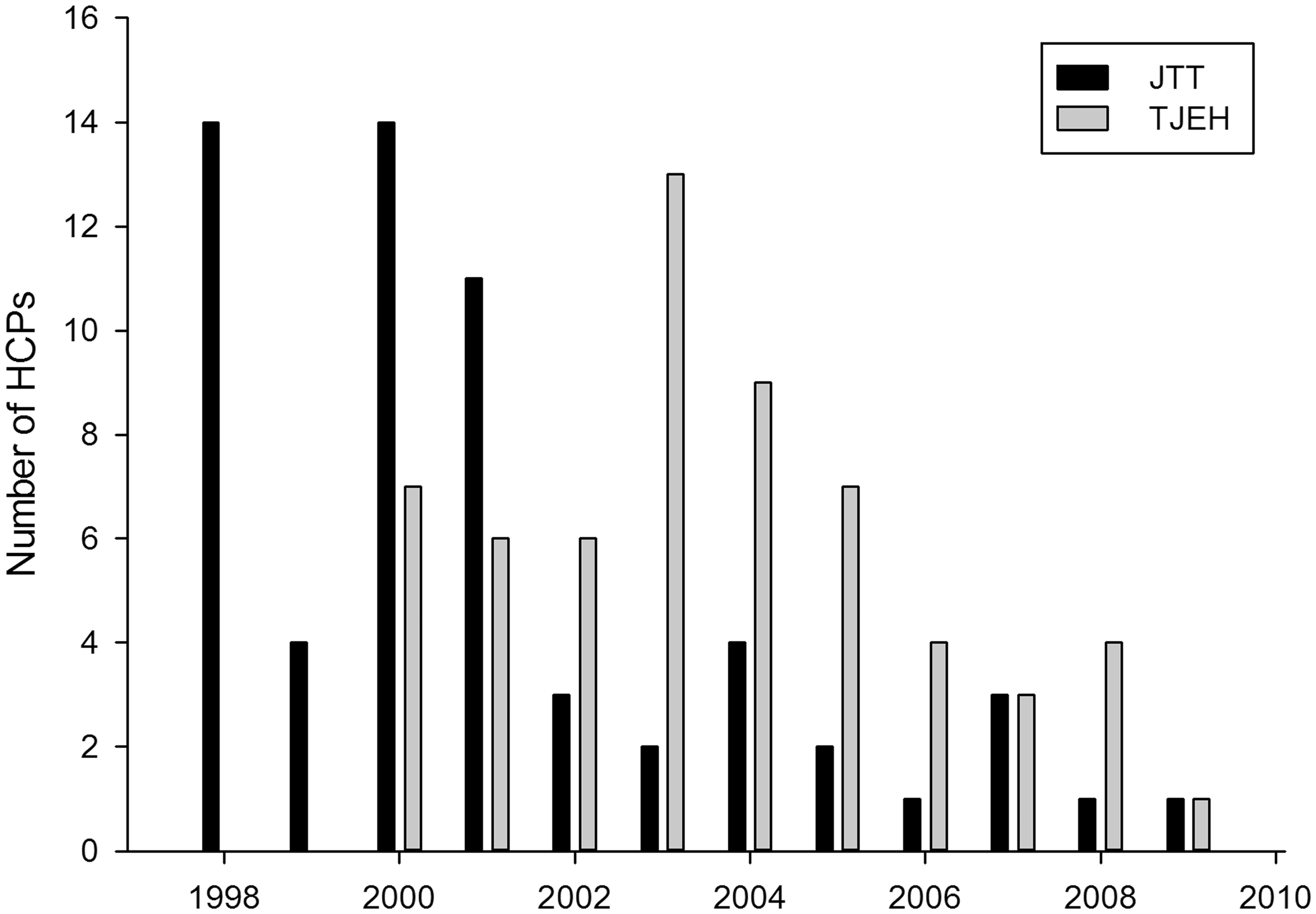
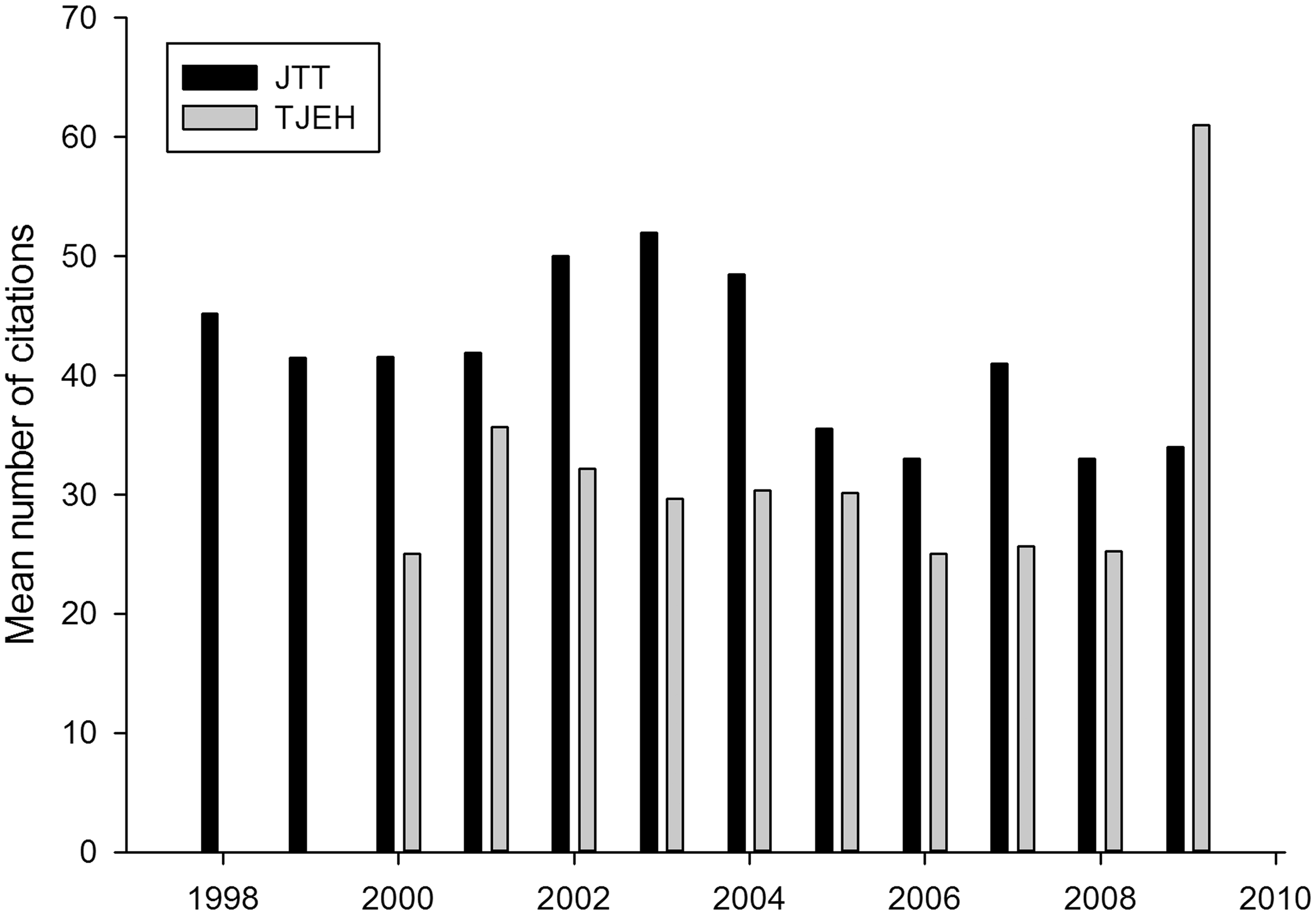
In the regression models, the coefficient for citations per year was not significant in either journal. In addition, the interaction terms between the name of the journal and year was not significant, which means that the trend of citations in both journals was similar (P = 0.094).
Country of origin of HCPs in the JTT.
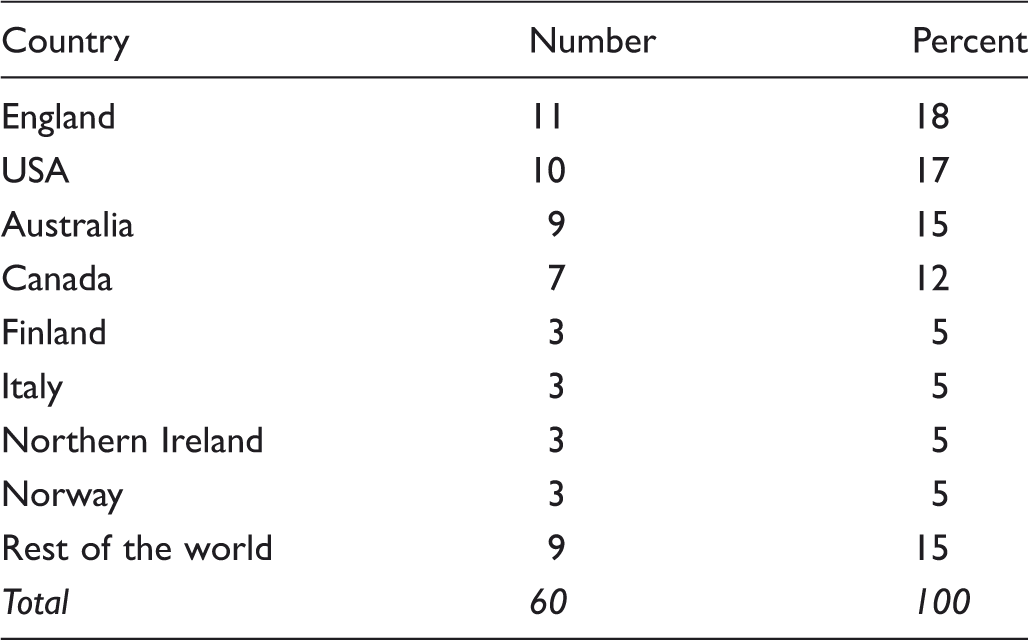
Country of origin of HCPs in TJEH.

In the JTT, the mean number of authors for each HCP was 4.6 (SD 3.1), range 1–18. In TJEH, the mean number of authors for each HCP was 4.5 (SD 2.3), range 1–12. There was no difference between the two journals (P = 0.84). In both journals approximately 58% of the HCPs had 1–4 authors.
The three most common categories of the 60 HCPs in the JTT and TJEH.

Discussion
The present study identified the 60 most highly cited articles published in the two specialist, peer-reviewed telemedicine journals. The characteristics of the HCPs published in the JTT and TJEH were broadly similar. For example, there was no significant difference in terms of the number of authors. Also in both journals, the majority of HCPs came from the US, UK and Canada. Furthermore, the most frequent category in both journals was the same (General). The number of citations per year did not exhibit any obvious trend. In most years the mean number of citation per year in the JTT was slightly higher than in TJEH (P < 0.001).
The present study had certain limitations. First, citations in textbooks and lectures were not considered. Furthermore, the citation count recorded by the Science Citation Index included self-citations; we do not know whether this is a source of bias. Second, the list of HCPs is not static, and will change with time. Third, we did not consider HCPs published in non-specialist journals. In future, a similar analysis could be carried out more widely to produce further data about highly cited articles in the field of telemedicine.
In summary, although analysis of citations is not a direct method of measuring the quality of published articles, it can identify – for authors and editors of journals, and others – the most highly cited papers in the two journals.8,135