



Abstract
We conducted a meta-analysis of randomized controlled trials (RCTs) up to January 2014 which evaluated the effects of electronic reminders on patient adherence to medication in chronic disease care. A random-effects model was used to pool the outcome data. Subgroup analyses were performed to examine a set of moderators. Data from 20 studies, representing 22 RCTs, were synthesized. Thirteen trials utilized short message service (SMS) reminders, three used pager reminders and six employed electronic alarm device-triggered reminders. The meta-analysis showed that the use of electronic reminders was associated with a significant, yet small, improvement in patient adherence to medication (pooled Cohen’s d=0.29, 95% confidence interval 0.18, 0.41). The effect was sensitive to sample size, type of disease and intervention duration. The frequency and type of electronic reminders appeared to have no moderating effect on medication adherence. The use of electronic reminders seems to be a simple and potentially effective way of improving patient adherence to chronic medication. Future research should concern the optimum strategies for the design and implementation of electronic reminders, with which the effectiveness of the reminders is likely to be augmented.
Introduction
Adherence to long-term treatment regimens is a prerequisite for effective chronic disease care. However, many patients, especially the chronically ill, encounter difficulties in adhering to recommended treatment regimens. 1 Poor adherence and non-adherence to treatment regimens have long been a widely reported problem in various health conditions.2–6 Evidence shows that a quarter of patients in general do not adhere to their treatment regimens. 5 Treatment regimens, even if effective, are poorly implemented at the practical level, resulting in undertreated patients. In addition, low adherence is likely to compromise the effectiveness of medication treatment and consequently leads to poor health outcomes and waste of health care resources.4,7,8
Although there is a substantial literature on the development of psychological, behavioural or educational adherence-enhancing interventions, these interventions are less effective than expected,9,10 and are largely constrained by their heavy demands on time and labour, and by their limited coverage of patients. Another response to patients’ poor adherence is the introduction of electronic reminders, which are automatically sent reminders without personal caregiver-patient contact in the delivery process. 11 The principles behind reminders can be explained by the behavioural learning theory, 12 which suggests that patients’ non-adherent behaviours can be converted into adherent ones if the patients are sufficiently exposed to repeated external stimuli (e.g. reminders). In clinical practice, electronic reminders, such as short message service (SMS) reminders and electronic alarm device-triggered reminders, are used to prompt patients to follow medication recommendations due to their advantages of saving time and labour, and of being easily delivered to a wide range of patients.13,14
While promising, results from previous reviews regarding the efficacy of electronic reminders are mixed.11,13,15,16 Moreover, these reviews either failed to provide quantitative evidence regarding the effectiveness of electronic reminders;11,13,15 or included a diverse range of health conditions (e.g. both chronic and non-chronic); 16 or based their results on a number of low quality studies. 15 The objective of the present study was to conduct a meta-analysis of randomized controlled trials (RCTs) that assessed electronic reminders in chronic disease care and to determine their effects on patient adherence to medication.
Methods
After a review of the literature on definitions of medication adherence in the health care domain,6,17 patient adherence to medication was defined for the purposes of the present study as the extent to which patients take their medications as prescribed.
We conducted a systematic literature search of CINAHL Plus, MEDLINE, Cochrane Central Register of Controlled Trials and Web of Science for relevant articles up to January 2014 with the following search terms: (adheren* or complian* or persisten* or concordan*) AND (remind* or alarm* or messag*) AND (random*). The titles and abstracts of the initial search citations were read and assessed to determine their relevance based on our inclusion and exclusion criteria. Articles considered as relevant were kept for full-text review. Reference lists of selected articles were searched manually for additional potential articles. We also examined studies included in previous reviews11,15,16 to catch possibly missing articles.
Inclusion and exclusion criteria
Studies were included if they: (1) were RCTs; (2) examined effects of electronic reminders on medication adherence outcomes; (3) delivered reminders directly to patients with any type of chronic disease; and (4) were written in English and peer-reviewed. Studies were excluded if the electronic reminders were used for disease screening, appointment attendance or non-chronic conditions, were delivered to physicians or were not the main component of the interventions evaluated.
Data extraction
The information extracted included study and intervention characteristics (i.e. author and year, country where the study was conducted, mean age, sex ratio, type of disease, sample size, intervention duration, description of intervention, attrition rate, primary outcome measure and its statistical significance, and outcome assessing method) and data on outcome measures. Two adherence measures were reported in the trials and were coded for the meta-analysis: the proportion of medication taken as prescribed and the proportion of adherent patients. We adopted original definitions of adherent patients for trials that reported this measure. For multiple-arm studies, we extracted all eligible comparison trials (i.e. use of reminders versus non-use of such reminders) and considered them as separate trials based on recent guidelines. 18
Two authors independently conducted the article selection, data extraction and study quality assessment. Any discrepancy was resolved through discussion between them, or by third-party adjudication.
Statistical methods
Although the adherence measures varied across studies, the outcome difference between intervention and control groups can be measured and pooled using appropriate meta-analysis methods. 19 In our study, Cohen’s d was calculated as the effect size to determine the magnitude of the difference in medication adherence between the intervention and control groups. 19 A Cohen’s d value of 0.2, 0.5 and 0.8 can be considered as small, medium and large effect size, respectively. 20 A random-effects model was used to aggregate individual effect sizes, as large between-study heterogeneity was expected. 21 The I2 statistic, which describes the percentage of total variation across studies, was calculated to examine the between-study heterogeneity. 22 The possibility of publication bias was assessed using a visual inspection of a funnel plot, 23 and using Egger’s regression test, with P < 0.1 considered to indicate the presence of publication bias. 24
Because including several effect sizes from one trial violated the independence assumption in meta-analysis, 19 we chose only one effect size for each of the trials in our analysis. For trials reporting multiple adherence measures, we chose the one more likely to be objective and reliable (e.g. assessed by electronic monitoring over pill count and self-report; continuous scale over dichotomized scale). This approach has been widely adopted in previous meta-analyses on patient adherence to medication.9,25 We also calculated an average effect size for each of these trials and used the average effect size in sensitivity analysis to test the robustness of our effect size calculation method. The average effect size approach was also a widely accepted solution to guarantee the independence assumption in meta-analysis.8,19
Subgroup analyses
In response to substantial variability across studies (based on the I2 test for heterogeneity), subgroup analyses were performed to explore potential factors that would moderate the overall effect size. The following moderators were examined: age (age ≤ 37.4 or >37.4 years); sample size (n ≤97 or n >97); type of disease (diabetes, asthma, AIDS, cardiovascular diseases or other type of diseases); intervention duration (short-term (six months or less) or long-term (more than six months)); type of reminder (SMS, pager or electronic alarm device); frequency of reminder (daily, i.e. one or more reminders per day or weekly, i.e. less than one reminder per day); type of outcome measure (proportion of medication taken as prescribed or proportion of adherent patients); and type of outcome assessing method (electronic monitoring, self-report, pill count or pharmacy dispensing records). The cut-off points for age group and sample size were based on the median values among trials with available information.
Study quality
The study quality was assessed by the nine-item Delphi list for RCT quality assessment, using answers of yes, no or don’t know, where yes indicated that a criterion was met. 26 The study quality was rated as high if five or more of the nine criteria were met; otherwise it was rated as low. 26
Sensitivity analyses
We conducted three sensitivity analyses to test the robustness of the meta-analysis result. The first sensitivity analysis used average effect size for trials reporting multiple outcome measures; the second excluded trials with high sample attrition rate (20% or more); and the third excluded low quality trials.
Results
Twenty studies were included in the review.27–46 We extracted two separate comparison trials (daily SMS versus usual care; weekly SMS versus usual care) from the study of Pop-Eleches et al.,
41
and another two trials (pager versus usual care; pager and peer support versus peer support) from the study of Simoni et al.
43
Therefore, a total of 22 comparison trials were examined in the meta-analysis, Figure 1.
Study search and selection procedures.
Study characteristics
Study characteristics of the 22 included trials.

The type, frequency and content of reminders varied substantially across the 22 trials. Thirteen trials sent SMS reminders,31,32,35–41,44–46 three used pager reminders42,43 and the remaining six employed electronic alarm device-triggered reminders.27–30,33,34 The frequency of reminders ranged from daily27–30,32–34,36,39–46 to weekly.31,35,37,38,41 The content and format of the reminders depended largely on the type of reminders. For example, electronic alarm devices emitted alarms and displayed coloured lights at a predetermined time to remind patients to take medication. 28 SMS reminders delivered information-rich messages to patients, aiming to inform them of medication intake and to reinforce their medication-taking behaviours (e.g. Márquez Contreras et al. 37 ).
Quality assessment
Quality assessment of the 20 included studies by the Delphi list.
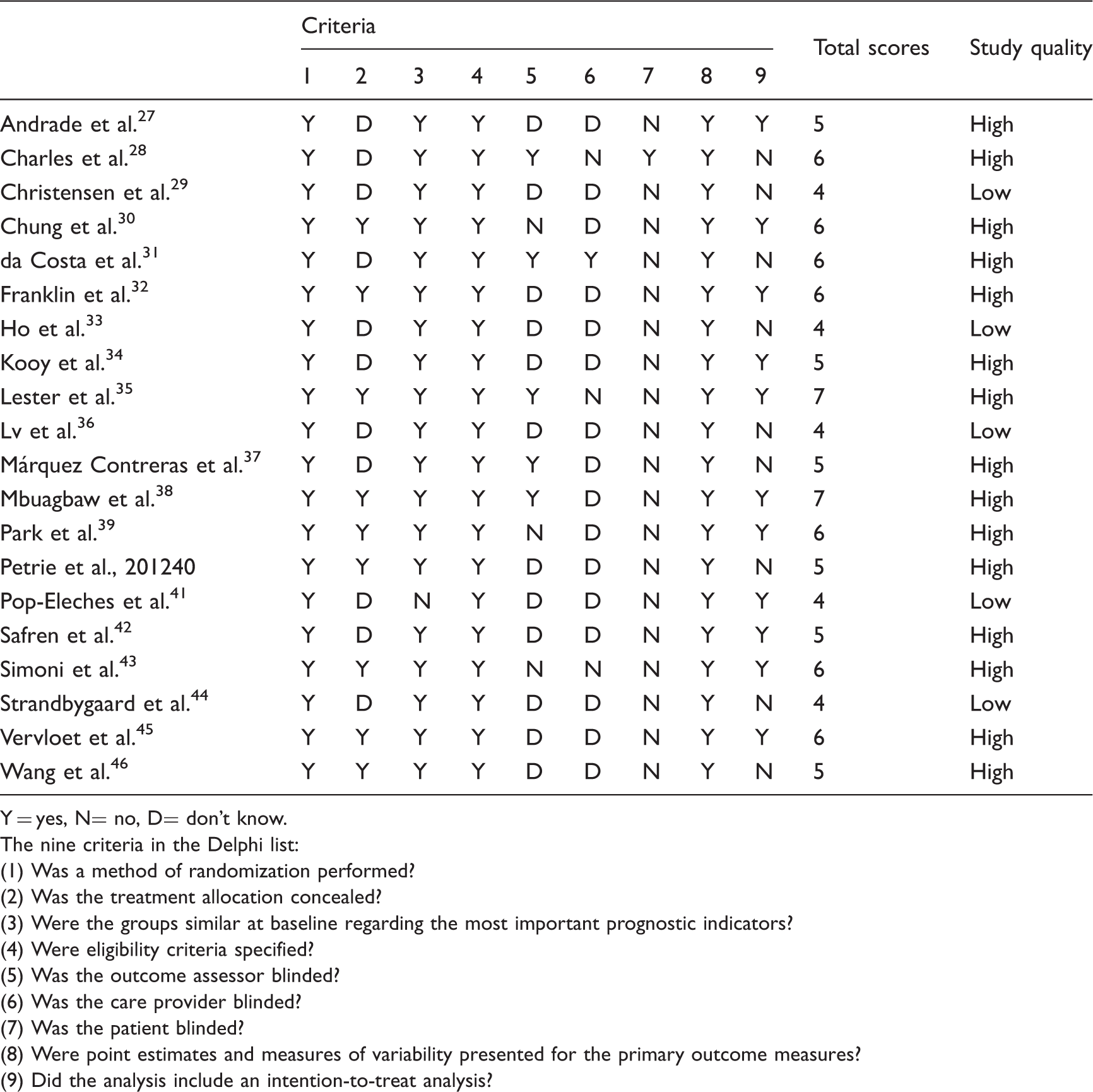
Y=yes, N= no, D= don’t know.
The nine criteria in the Delphi list:
(1) Was a method of randomization performed?
(2) Was the treatment allocation concealed?
(3) Were the groups similar at baseline regarding the most important prognostic indicators?
(4) Were eligibility criteria specified?
(5) Was the outcome assessor blinded?
(6) Was the care provider blinded?
(7) Was the patient blinded?
(8) Were point estimates and measures of variability presented for the primary outcome measures?
(9) Did the analysis include an intention-to-treat analysis?
Meta-analysis
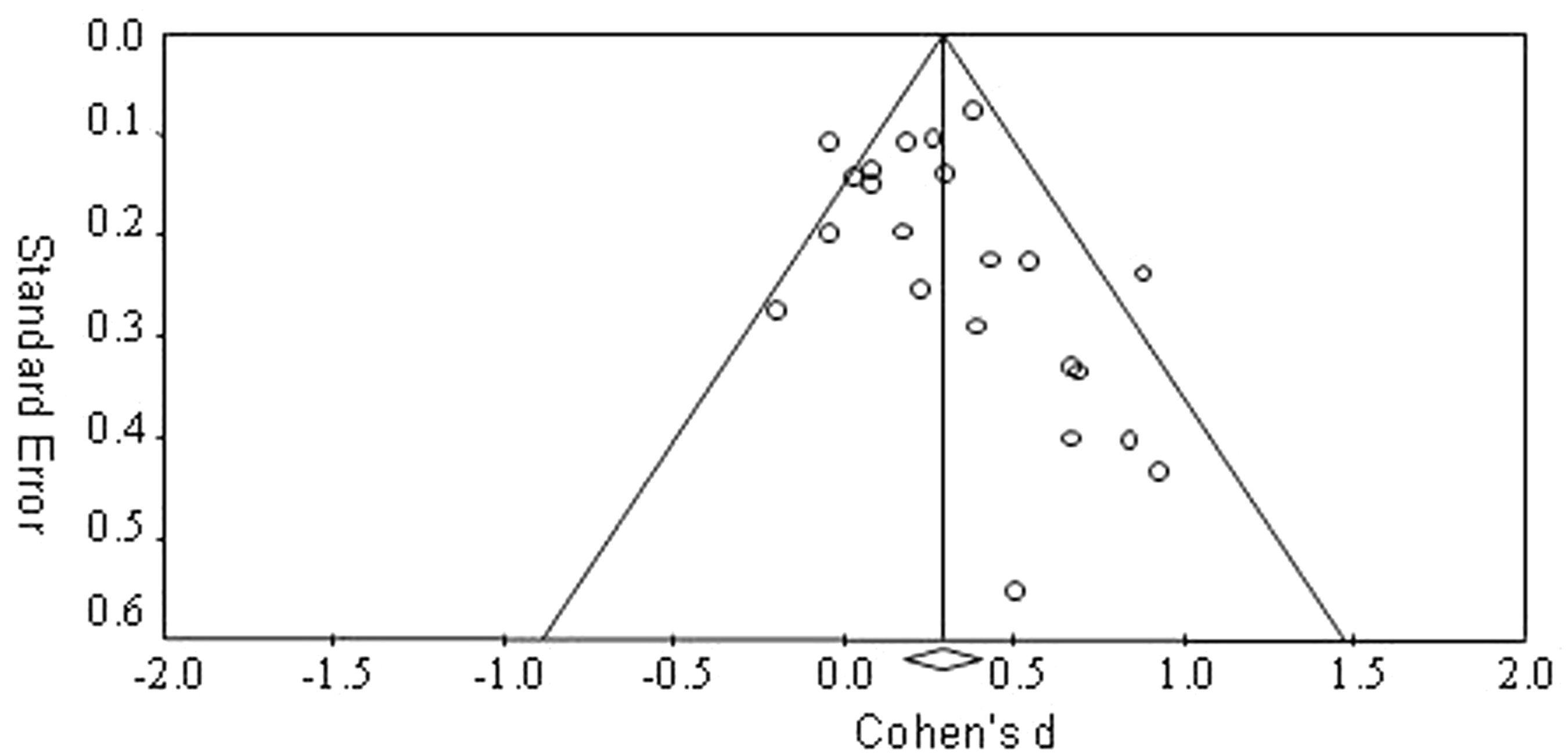
The pooled estimate based on data from 3152 patients showed that the use of electronic reminders was associated with a significant improvement in patient adherence to treatment (d=0.29, 95% confidence interval, CI=0.18, 0.41), see Figure 2. This weighted mean effect size was small. The funnel plot analysis (Figure 3) and Egger’s regression test (P=0.10) did not detect the presence of publication bias. Heterogeneity was high (I2 = 55%), indicating the existence of variability across the trials. We therefore performed subgroup analyses to investigate the impact of moderators on the overall effect size.
The effect of electronic reminders on patient adherence to medication. Funnel plot of standard error and Cohen’s d of patient adherence to medication between intervention and control groups.
Subgroup analyses
Subgroup analyses of the effect of electronic reminders on patient adherence to medication.

Note: Δd, The difference of pooled effect sizes between two subgroups within a given moderator, with the first subgroup under each moderator as the reference group.
*P < 0.05; **P < 0.01; ***P < 0.001.
Effect sizes regarding the type of disease varied, and ranged from medium to large magnitude for asthma (d=0.78, 95% CI=0.52, 1.04), small to medium for diabetes (d=0.39, 95% CI=0.26, 0.52), and small for cardiovascular diseases (d=0.13, 95% CI=−0.02, 0.27) and HIV (d=0.17, 95% CI=0.07, 0.26). Patient adherence to medication was significantly higher for asthma, compared with that for cardiovascular diseases (Δd=−0.65, P < 0.001), diabetes (Δd=−0.39, P=0.008) and HIV (Δd=−0.61, P < 0.001). The heterogeneity substantially decreased in subgroups by type of disease.
There was a trend towards diluted effects of electronic reminders over time (Δd=−0.26, P=0.017). Effect sizes fell in the small to medium range for short-term interventions (d=0.43, 95% CI=0.28, 0.59), while they were small for long-term interventions (d=0.17, 95% CI=0.02, 0.32).
The effect sizes were more pronounced when the reminders were delivered by SMS (d=0.32, 95% CI=0.17, 0.47) and alarm device (d=0.30, 95% CI=0.09, 0.50) compared with that by pager (d=0.21, 95% CI=−0.12, 0.53). The effect sizes were similar, whether the reminders were delivered daily (d=0.32, 95% CI=0.19, 0.45) or weekly (d=0.23, 95% CI=0.01, 0.46). There was no interaction effect between the type and frequency of the reminders.
The effect sizes did not differ much in subgroups defined by age, type of outcome measure or type of outcome assessing method.
Sensitivity analyses
The primary meta-analysis result was robust in the three sensitivity analyses. The effect of electronic reminders on patient adherence to medication did not change when we used average effect sizes for nine trials (eight studies)11,30,31,34,37,39,40,43 with multiple outcome measures (d=0.28, 95% CI=0.16, 0.39); when we excluded seven trials29,30,36,37,40,42,46 with sample attrition rates of 20% or more (d=0.28, 95% CI=0.15, 0.41; and when we excluded six trials (five studies)29,33,36,41,44 with low study quality (d=0.29, 95% CI=0.15, 0.43).
Discussion
The present study identified three types of electronic reminders (i.e. SMS, alarm device and pager) that have been widely used in clinical practice to enhance medication adherence for chronically ill patients. Despite the technological diversity of these reminders, we pooled and compared their effects on medication adherence, because we believe that their conceptual and functional similarity allow us to do so. We found that electronic reminders, regardless of their types, were associated with a significant, yet small, improvement in patient adherence to medication, compared to non-use of reminders, with a pooled effect size of 0.29 (95% CI=0.18, 0.41).
The meta-analysis result was consistent with findings of previous reviews,11,16 which showed favourable effects of electronic reminders.11,16 For example, Fenerty et al. found that technology-based reminder systems yielded a significantly higher treatment adherence rate compared with usual care (67% in reminder group versus 55% in control group) in various health conditions. 16 Vervloet et al. found that the use of electronic reminders appeared to lead to short-term effectiveness in increasing adherence to chronic medication. 11 The effect of electronic reminders in our study was also similar to previously reported effect sizes in meta-analyses of psychological, behavioural or educational adherence-enhancing interventions, e.g. the study by Kahana et al. 10 (d=0.34, 95% CI=0.30, 0.38) and by Conn et al. 9 (d=0.33, 95% CI=0.22, 0.45).
However, the small effect detected in our study, although significant, fell below the threshold of a clinically satisfactory improvement in medication adherence for the majority of the trials analysed. This may be because, as noted by Haynes et al., 47 many chronically ill patients tend to consider their conditions incurable, thus being less motivated to persist in taking long-term medication. Therefore, further work is required to reinforce patients’ belief in the efficacy of taking medication and to augment the effectiveness of the reminders in improving patient adherence to medication.
Moderators on the use of electronic reminders
Subgroup analysis showed that the effect of electronic reminders was sensitive to sample size, type of disease and intervention duration, while the effect did not change with respect to age, type of outcome measure and type of outcome assessing method. However, these findings should be interpreted cautiously, because of the small number of included studies, the associations among the moderators and the substantial heterogeneity within subgroups.
The trend towards a larger effect in small sample trials appeared to show a possible pattern of small sample trial effect, which suggests that small sample trials are more likely to detect larger intervention effects and are therefore more likely to be published. 48 In addition, this finding may confound the effect sizes in relation to other moderators. We noted that small sample trials contributed to a disproportionate number of trials examining patients with asthma (3 out of 4, 75%), and of trials with a short-term intervention duration (10 out of 14, 71%). Therefore, future studies should consider the interrelationship among the moderators when disentangling the moderating effects. Large sample size studies are also preferable in future evaluations of electronic reminders.
Our analysis indicated a higher medication adherence for patients with asthma compared to patients with other types of diseases. However, it is not clear whether this effect was truly disease specific or due to other reasons, such as small sample trial effect. In addition, we noted that a larger proportion of trials on asthma delivered enhanced reminders, containing not only prompt tips for medication intake, but also educational messages about disease management and advice on behavioural change, compared with trials on other conditions (75% for asthma,36,40,44 50% for cardiovascular diseases37,39 and diabetes, 32 and 20% for HIV 41 ). The enhanced reminders might also have contributed to the larger effect for patients with asthma. This suggests the possibility of combining electronic reminders with educational and behavioural interventions in order to produce greater benefit.
The finding that the effect of electronic reminders appeared to diminish over time echoed the conclusion of a previous review, which found only short-term effectiveness of the use of electronic reminders. 11 This has important clinical implications, since it is premature for any statement to be made about the long-term effectiveness of electronic reminders. However, this finding runs counter to our expectations. The primary purpose of reminders is to help patients take prescribed medication at the right time and to reinforce their adherent behaviours so that adherence to medication, in the long-term, can be a routine, or even a habituation in chronic disease care. Therefore, a long-term effect on medication adherence is probably an essential prerequisite for such behavioural changes, although it awaits confirmation in future studies.
Design and implementation strategies, such as the content, type, frequency and delivery time of electronic reminders, have been less investigated in previous reviews11,13,15,16 despite their potential importance in determining the efficacy of electronic reminders. In contrast, our study examined the type and frequency of reminders, but found no significant difference in medication adherence in relation to the two moderators. More research should be carried out to examine the under-investigated moderators so that electronic reminders can be better developed for and tailored to specific circumstances. However, it should be noted that reminders by SMS and alarm devices did show a trend towards better medication adherence compared to pagers. The use of pagers seems to have decreased, while SMS has become ubiquitous, and alarm devices are designed to be more user-friendly in home care environments. We speculate that SMS reminders are likely to confer more benefits to active mobile phone users, and alarm devices are probably preferable for house-bound patients.
Our analysis did not find any discernible effect on medication adherence in relation to the type of outcome measure and type of outcome assessment method. Regarding the type of outcome measure, the proportion of adherent patients seems to be a more clinically meaningful measure in illustrating reminder effect compared with the proportion of medication taken as prescribed. This measure, however, is likely to underestimate the effect. For example, a patient could be labelled as non-adherent, because the improved adherence may still fail to attain the threshold of being defined as an adherent patient. For outcome assessing methods, previous studies have argued that self-reporting is likely to overestimate adherence compared with methods such as electronic monitoring and pharmacy dispensing records.49,50 However, this argument cannot be confirmed by our findings. Possible explanations may be that the number of trials in the subgroups was too small to detect a significant difference; and that the lack of sufficient data in the trials did not allow us to compare the outcome assessing methods within the trials. While the evidence regarding these moderating effects is unclear, future studies are recommended to incorporate the two outcome measures and multiple outcome assessing methods for adherence measurement when possible, to produce more data for further examination.
Electronic reminders have advantages in timeliness and salience. They can be delivered or triggered at a specified time when patients need to act on medication regimens and in a way that the patients’ attention can be attracted by them (e.g. by ringtones or alarms). However, electronic reminders in any form as adherence-enhancing strategies work only for unintentionally non-adherent patients, rather than for patients who ignore them. None of the trials reported that they had specifically examined unintentionally non-adherent patients. Therefore, the effect of electronic reminders detected in our study may have been underestimated due to the possible inclusion of both intentionally and unintentionally non-adherent patients.
Strengths and limitations
The present study has several strengths. To the best of our knowledge, this study was the first to employ a meta-analysis to assess the effect of electronic reminders on medication adherence in chronic disease care. Second, we performed subgroup analyses in response to the between-study heterogeneity, and examined a set of moderators that have been little investigated previously but are critical to the design and implementation of the reminders. Finally, we tested the robustness of our results in sensitivity analyses with factors (i.e. study quality, attrition rate and effect size calculation method) that are likely to bias the results.
However, the study also has a number of limitations. First, the small number of trials included placed limitations on the subgroup analyses, which means that the findings cannot be considered conclusive. Second, pooling different adherence measures may represent a methodological drawback, although we calculated Cohen’s d to standardize these measures and pooled the effect sizes using an appropriate meta-analysis method. Third, several moderators examined in the subgroup analyses may be confounded with each other, so that their effects should be interpreted with full recognition of their interrelationship.
Conclusion
The use of electronic reminders appears to be a simple and potentially effective method of improving patient adherence to chronic medication. Future research should concern the optimum strategies for the design and implementation of electronic reminders, with which the effectiveness of the reminders is likely to be augmented.