



Abstract
We conducted a literature review of telerehabilitation interventions on cardiac patients. We searched for studies evaluating some form of telerehabilitation in cardiac patients. A total of 116 publications were screened initially, of which 37 publications were eligible for further review. We assessed study strength, based on the level of evidence and the quality of the intervention. The majority of the articles (70%) represented the highest level of evidence. Most interventions were of good (46%) or fair (51%) quality. Most studies evaluated the efficacy of the telerehabilitation interventions (84%), while 38% reported on feasibility and acceptance. Most studies did not include safety and/or cost-benefit analyses. Most telerehabilitation interventions (90%) employed only one or two core components of cardiac rehabilitation (CR). Of the CR core components, physical activity was most frequently evaluated. Telerehabilitation appears to be a feasible and effective additional and/or alternative form of rehabilitation, compared to conventional in-hospital CR. Evaluations of telerehabilitation programmes taking into account patient safety and health economics are now required.
Introduction
Cardiovascular disease (CVD) is the world’s leading killer, which accounted for 30% of all deaths in 2010. 1 Secondary prevention of CVD by means of cardiac rehabilitation (CR) is recommended. 2 An holistic management strategy, including exercise training, is recommended in heart failure patients to improve functional capacity and symptoms. 3 CR comprises different core components such as physical activity, behavioural change, risk factor modification, nutritional counselling and psychosocial wellbeing.4,5 The medical benefits of daily physical activity have been proven. 6 Unfortunately, despite the clinical effectiveness of hospital-based CR, the long-term clinical effectiveness of this intervention is often poor, due to the lack of attendance at rehabilitation sessions and non-adherence to recommendations. 7
In Belgium, one-third of the patients do not follow any rehabilitation session after percutaneous coronary intervention or surgical procedure and more than half of the outpatients (55%) do not attend any rehabilitation session after hospital discharge. 8 A variety of factors contribute to these poor uptake rates. Patients regularly choose not to attend rehabilitation sessions in hospital due to a lack of transport, ill-health, time and scheduling commitments associated with returning to work or reimbursement problems. Hansen et al. concluded that only 27% of patients with coronary artery disease adhered to the recommended physical activity level of CR at 18 months follow-up. Conrads et al. concluded that heart failure patients showed low adherence, even when they were enrolled in a supervised exercise training or multidisciplinary CR programme. 9 However non-compliance with lifestyle and risk factor recommendations in CR is associated with adverse outcomes. It is thus important to implement new strategies and interventions with the primary goal of motivating patients with heart disease to sustain a healthy lifestyle after completion of hospital-based CR.
Telerehabilitation may be an effective strategy to increase both attendance rates at CR sessions and long-term adherence to recommendations. In telerehabilitation, patients are not restricted to the hospital environment for CR, and can implement the rehabilitation programme in their daily routine at home. Telerehabilitation can support or even partially replace conventional in-clinic rehabilitation. Although the first publications on simple forms of telerehabilitation date from the 1990s, general interest has only occurred recently, illustrated by the rapid increase in papers describing some form of telerehabilitation. However, these studies are very heterogeneous with respect to patient population, telerehabilitation intervention used, primary and secondary outcome measures. We have therefore conducted a literature review of telerehabilitation interventions on cardiac patients.
Methods
We searched the following databases: PubMed/Medline, Embase, Cochrane Library, EuroPubMed. Articles were selected when they reported some form of telerehabilitation in cardiac patients. To search for these articles different combinations of Medical Subject Headings (MeSH) terms relating to some component of telerehabilitation were used. MeSH terms such as telemedicine, telecoaching, telecare, telerehabilitation, telecardiology, telemonitoring, remote monitoring, cardiac rehabilitation, transtelephonic monitoring, internet-based rehabilitation, cardiac patient, heart disease, internet-based rehabilitation, telephone-based rehabilitation, motion sensor were used in the different databases. We also performed manual searching of relevant conference proceedings.
Initial selection of eligible manuscripts was based on the information in their abstracts. During the second step, relevant articles were obtained for thorough review. To be included in the review, publications needed to have a publication date of 1999 or later, they needed to be written in English and they had to evaluate some form of telerehabilitation in cardiac patients. Articles that described alternative forms of CR that did not include some form of telerehabilitation, that were only available in abstract form or that were duplicates of articles already selected for inclusion in the literature study, were excluded.
Two reviewers independently screened the abstracts. Studies selected by either or both reviewers were subject to full text assessment against the inclusion and exclusion criteria. In cases of disagreement, a third reviewer independently examined the full-text-reports.
Study strength
The study strength of the reviewed articles was based on a combination of the level of evidence and the quality of the intervention used in the study. The level of evidence was classified as:
1A when the article described a meta-analysis of multiple well-designed controlled studies; for well-designed randomized controlled trials; for well-designed non-randomized controlled trials (quasi-experiments), for observational studies with controls (retrospective studies, interrupted time-series studies, case-control studies, cohort studies with controls); for observational studies without controls (cohort studies without controls and case series).
The quality of the used intervention was classified as: good, for clinically relevant well-described interventions making the intervention reproducible by external readers. fair, for those interventions that did not qualify as good or poor poor, for interventions with substantial limitations regarding relevance, rehabilitation method used and/or reproducibility.
Study patients
Three groups of cardiac patients were defined. The first group was coronary artery disease patients, who had suffered from an acute coronary syndrome for which a percutaneous coronary intervention or coronary artery bypass graft was performed. The second group was heart failure patients, with reduced or preserved ejection fraction. The third group were patients who had undergone surgery for valve replacement, for valve repair or for congenital heart disease.
Intervention
The concept of telerehabilitation is that the patient rehabilitates remotely from the hospital. Several different monitoring devices (e.g. accelerometers, pedometers) can be used. Information from the patient/sensor needs to be transmitted to the caregiver. We divided the telerehabilitation interventions into four categories, based on the medium for data transfer from the patient to the caregiver and vice versa. The papers dedicated to telerehabilitation are summarised in Table 1, and the papers dedicated to telemonitoring are summarised in Table 2 (see online archive).
For the telephone-based interventions, transtelephonically guided CR was used. The Internet was the medium for data transfer in the Internet-based interventions. For the videoconferencing interventions, communication between patient and caregiver was delivered by videoconferencing. Finally combined telerehabilitation interventions used more than one of the aforementioned media for data transfer.
Outcome assessment
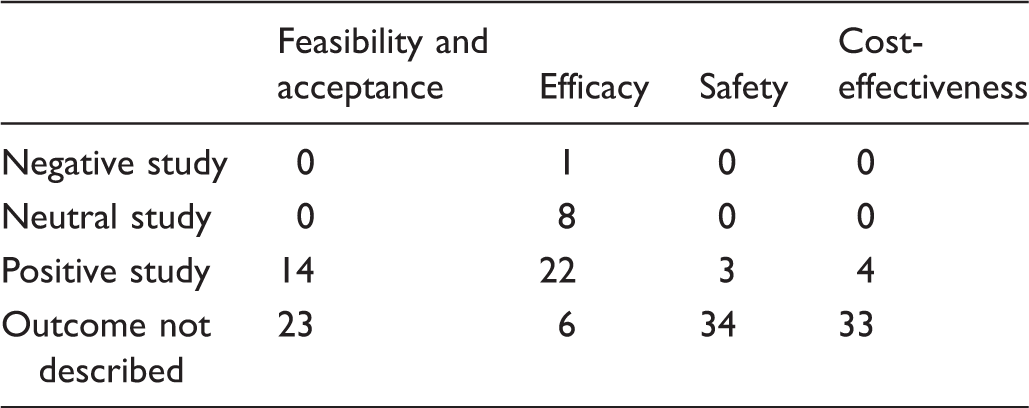
All eligible publications were assessed regarding four broad categories of outcome measures for the telerehabilitation intervention(s). The first outcome measure was feasibility and acceptance, based on the patient’s satisfaction with the technology used and their compliance with the telerehabilitation intervention. The second outcome measure was the efficacy of the intervention, based on the different core components of CR. The third outcome measure was safety, based on on intervention-related adverse events and mortality. The fourth outcome measure was cost; the costs associated with conventional and telerehabilitation were included, and also the costs due to re-hospitalisations for both cardiovascular and non-cardiovascular adverse events.
In each article, we searched for significant results favouring or not favouring telerehabilitation. A positive study favoured telerehabilitation, a neutral study found no significant difference in the results between the groups anda negative study concluded in favour of the conventional intervention (i.e. the control group).
Two forest plots were created. The first assessed the effect of the interventions on adverse events and re-hospitalisations. Adverse events were defined as cardiovascular events prompting the patients to visit their general practitioner, the emergency department or their cardiologist and possibly leading to re-hospitalisation. Mortality due to cardiovascular events was defined as a serious adverse event and hence included in this calculation.
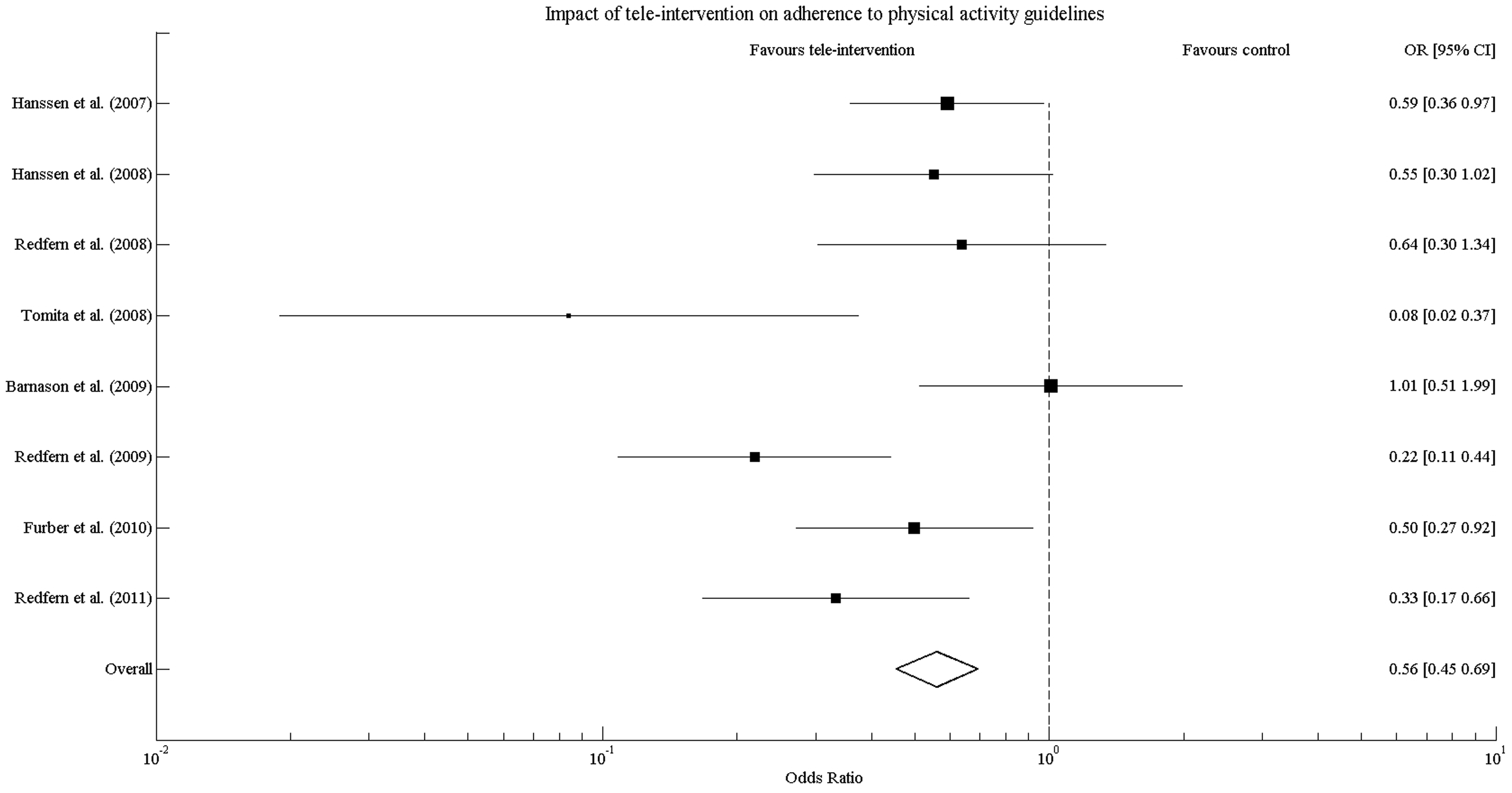
The second forest plot assessed the effect of the interventions on adherence to physical activity guidelines. In accordance with the guidelines for cardiovascular disease prevention, 10 a protocol of aerobic exercise training of moderate to vigorous intensity of 3–5 sessions/week, 30 min per session was recommended as secondary prevention for patients with a previous acute myocardial infarction, coronary artery bypass grafting (CABG), percutaneous coronary intervention or chronic heart failure. Physical activity data were extracted from the papers to calculate the number of patients adhering/not adhering to this recommendation. Based on these numbers, the Odds Ratios were calculated.
Cardiac rehabilitation core components
CR comprises different core components such as physical activity, behavioural change, risk factor modification, nutritional counselling and psychosocial wellbeing (Heart Related Quality of Life). CR includes a combination of these core components. However, physical activity is the most important core component of CR. 8 We assessed whether the studies reviewed evaluated only one, or a combination of several core components of CR in the telerehabilitation programme.
Focus areas
The main focus areas of a comprehensive telerehabilitation programme were defined as telemonitoring, e-learning, telecoaching and social networking. For each reviewed publication we evaluated whether the telerehabilitation intervention included one or more of these main focus areas. Telemonitoring was defined as sensor data collection and analysis to obtain a precise and complete image of the patient. Telecoaching included techniques to motivate the patient. In studies including social networking, the patient had access to different social networks including one for peers and one that contained caregivers and cardiologists. E-learning meant that the evaluated tele-intervention taught patients using medically and scientifically sound questionnaires/challenges and interactive didactic material, with the aim of enabling the patients to gain a better understanding of the aetiology, pathophysiology and clinical presentation of their condition and ways of preventing recurrences and deteriorations.
Results
The initial screening produced a total of 116 publications (Figure 1). One article was only available in German, one publication was a duplicate, one publication was not available in full-text and 76 publications evaluated some form of CR but did not include telerehabilitation. Most of the 37 publications for final review assessed telephone-based telerehabilitation interventions (65%).
Search flowchart.
Study strength
Strength of the studies reviewed (n = 37).

Outcomes
Outcome measures. A positive study favoured telerehabilitation, a neutral study found no significant difference between the groups and a negative study concluded in favour of the conventional intervention (i.e. the control group).
Pooling the available studies in forest plots (Figures 2 and 3) showed that tele-interventions were favoured regarding the risk for adverse events and re-hospitalisations for cardiovascular reasons; and adherence to physical activity guidelines.
Forest plot depicting the effect of the interventions on adverse events and re-hospitalisations for cardiovascular reasons. OR: Odds Ratio; CI: Confidence Interval. Forest plot depicting the effect of the interventions on adherence to physical activity guidelines. OR: Odds Ratio; CI: Confidence Interval.
Cardiac rehabilitation core components
Most telerehabilitation interventions (90%) employed only one or two core components of CR (Figure 4). None of the published trials included all core components in the telerehabilitation intervention. Of the CR core components, physical activity was most frequently evaluated.
Studies that evaluated one, two or three core components of CR. The darkest grey represents the studies reporting on a single core component (PA: physical activity; RF: risk factor modification; PS: psychosocial wellbeing; OTH: other). The intermediate grey represents the studies reporting on two core components (Double + PA: studies reporting on two core components, with PA including one of them; Double-PA: studies reporting on two core components, without PA). The lightest grey represents studies reporting on three core components.
Focus areas
Most studies focused on telemonitoring or telecoaching. Only 16% of publications had a combined focus and only 5% focused on more than two focus areas (Figure 5).
Focus areas in comprehensive rehabilitation programmes. Combined (2) means that two focus areas were included. Combined (>2) means that more than two focus areas were included in the rehabilitation programme.
Discussion
In the majority of the articles reviewed, the comparison of telerehabilitation with conventional hospital rehabilitation yielded positive results for telerehabilitation. However, most studies only reported feasibility, acceptance and/or efficacy. Studies of safety and cost-effectiveness were lacking. Since some ICT familiarity, patient education and interest were required for cardiac patients to be included in the Internet-based and videoconferencing telerehabilitation programmes, patient selection bias could have influenced the results for feasibility and acceptance. Only 10% of the telerehabilitation trials assessed included a multi core component approach. Therefore the possible value of this method of remote rehabilitation may have been underestimated. Telemonitoring and telecoaching were the preferred focus areas of telerehabilitation, and the use of combined approaches was limited.
An analysis of study strength showed that more studies with lower levels of evidence had a good intervention quality, compared to studies with the highest level of evidence. This somewhat contradictory finding was due to the higher level of evidence articles reporting relatively more on study results.
As with the introduction of a new drug, safety assessment of telerehabilitation is essential. In telerehabilitation, the patients rehabilitate at a distance from the hospital, in contrast to conventional rehabilitation where the patients rehabilitate near to their cardiologist. Thus the safety of the intervention must be demonstrated. However, little has been published on this matter. Piotrowicz et al. 37 assessed the safety of a home-based CR programme in heart failure patients. Patients in the intervention group exercised at home, and sent ECG-recordings transtelephonically to their cardiologist at predefined moments (coordinated with the training sessions) or whenever they felt worrying symptoms. Piotrowicz et al. concluded that heart failure patients undergoing home-based telemonitored CR did not develop any arrhythmia which required a change of the procedure, providing evidence that the intervention was safe. Although this study included high-risk patients (such as those waiting for elective orthotopic heart transplantation or with an implantable cardioverter-defibrillator and a history of cardiac arrest), further research is required.
Kortke et al. 35 were one of the first groups to report cost-effectiveness in a non-randomized controlled trial assessing a transtelephonic guide for ambulatory rehabilitation in cardiac surgery patients. They concluded that their intervention could reduce total rehabilitation costs. We have reported that the addition of an Internet-based telerehabilitation programme to conventional CR can reduce the costs associated with re-hospitalisation for cardiovascular diseases, compared to conventional rehabilitation alone. 48 The calculated mean cost for patients in the intervention group was lower than for patients in the control group, although not significant (P = 0.14). However thorough cost-effectiveness analyses comparing telerehabilitation with conventional CR are lacking. Because of the ageing population and the expected increase in elderly people suffering cardiac disease and needing chronic care and rehabilitation, and sometimes re-hospitalisation, insurance companies are very interested in the costs and potential savings of integrated telerehabilitation.
Although data are lacking on the possible added benefit of a multidisciplinary CR approach over physical activity alone, 8 CR should include a combination of the different core components. Most telerehabilitation interventions selected only physical activity and risk factor management. Further research on telerehabilitation that integrates all core components in one intervention thus seems highly desirable.
As well as monitoring and coaching, comprehensive programmes can encourage cardiac patients in their rehabilitation process using social networking and e-learning. 49 Peer pressure/support from social networks can motivate cardiac patients in their rehabilitation programme. 50 E-learning tools can provide patients with the best medical and scientific information, thereby improving the patient’s knowledge about their condition and possibly leading to greater compliance with therapy. 51 Comprehensive telerehabilitation programmes including all these focus areas are sparse, but are likely to be necessary to achieve a significant affect on the patients’ health condition.
Limitations
Some of the limitations of the present study were caused by the heterogeneity and lack of details provided in the articles analysed. Most studies were very heterogeneous regarding the study population, the intervention, study follow-up period and outcome measures, thereby making comparisons between studies difficult. Most telerehabilitation trials included only one specific cardiac patient subgroup (e.g. only heart failure patients, only coronary artery disease patients) limiting the generalizability of the results. Some trials were not transparent regarding the phase of rehabilitation. Since there are substantial differences between phase 2 (the subacute phase), phase 3 (the intensive outpatient CR phase) and phase 4 (the independent ongoing conditioning phase) of rehabilitation; this impeded the interpretation of study results. Finally, it was not always clearly stated whether the telerehabilitation intervention was a substitute for conventional CR, or an addition.
Conclusions
Based on the present review, telerehabilitation appears to be a feasible and effective additional and/or alternative form of rehabilitation, compared to conventional in-hospital CR. Multi-disciplinary evaluations of telerehabilitation programmes taking into account patient safety and health economics however are lacking. Most published articles studied telerehabilitation interventions focussing on only one or two CR core components, in only a single cardiac patient subgroup. Implementing physical activity, behavioural change, risk factor modification, nutritional counselling and psychosocial wellbeing in a telerehabilitation programme, and focusing on a broad cardiac patient population thus seems highly desirable. Telerehabilitation programmes might be further optimized by combining e-learning, social networking, telemonitoring and telecoaching.