



Abstract
We present a case of a newborn from a remote, underserved area in the inland of Paraíba, a state from Northeast Brazil. She presented with clinical cyanosis at birth. With the aid of telemedicine, a neonatologist under online cardiology supervision performed a screening echocardiogram. The session established the diagnosis of simple transposition of the great vessels in the baby’s first few hours of life. During the same telemedicine session, the necessary arrangements for transferal to a larger maternity center took place. The baby was maintained stable on prostaglandins and was subsequently transferred to a tertiary cardiac center in the neighboring State, Pernambuco. She underwent anatomical correction at day 10, presented no surgical or postoperative complications, and was discharged home at the age of 21 days. She is now over three years old and continues her follow-up care mostly at her hometown, with local pediatricians under online supervision by a cardiologist in a virtual outpatient clinic. The establishment of a Pediatric Cardiology Network, with the aid of telemedicine, can produce a major impact on the access to specialized health care for poor regions of developing countries.
Introduction
Congenital heart disease affects 8–10 per thousand live births 1 and is the main cause of neonatal mortality when infectious causes are excluded. 2 Some anatomical lesions, the so-called critical ones, depend on early diagnosis to avoid changes, such as duct closure, which lead to clinical deterioration and death. However, developing countries face major shortages of skilled pediatric cardiologists. 3 Besides, these professionals tend to gather in larger urban centers, with vast areas being left uncovered. The use of telemedicine can minimize diagnostic limitations and, in association with a pediatric cardiology program, can have a positive impact in the management of patients. 4
Case report
The patient was born in February 2012, at the city of Patos in inland Paraíba, a state in Northeast Brazil. The maternity center had just been enrolled in a Pediatric Cardiology Network (RCP-CirCor). It a was term, female, baby, weighting 3255 g and measuring 46 cm. Apgar scores were seven in the first minute and nine in the fifth. The baby presented with clinical cyanosis from birth which did not improve after delivery room maneuvers. She was admitted to the Neonatal intensive care unit (NICU) when the on-call neonatologist contacted RCP-CirCor and was advised to perform an echocardiogram under cardiology supervision, prior to using oxygen.
Of note, the on-call neonatologist had not yet undergone training but, with careful remote tutoring from the cardiologists, was able to obtain the four chamber and outflow images, which were considered satisfactory to demonstrate the parallel arrangement of the great vessels and establish the diagnosis of transposition of the great arteries. The examination was supervised online by using a tablet to film the echo screen within a teleconference environment using the software WebEx, from Cisco (http://www.webex.com/). The ductus arteriosus and foramen ovale were patent. No Ventricular septal defect (VSD) was seen. Figure 1 shows the telemedicine environment with images from the consulting cardiologist (a), the oxygen saturation monitor (b), the neonate (c) and the screening echo image (d).
Main aspects of the case. (a) the telemedicine session; (b) patient heart rate and oxygen saturation; (c) the patient; (d) the screening echocardiogram.
After diagnosis, transferal was immediately organized to the capital city, João Pessoa, for initial management. Upon arrival, a local cardiologist performed a full echocardiogram. The diagnosis of Transposition of great arteries (TGA) with Patent Ductus Arteriosus (PDA) and foramen ovale was confirmed and a small 3 mm muscular VSD was also documented.
Through a further teleconference with the CirCor team, prostaglandins were started to assure clinical stability while the paperwork for further transferal to surgery in Recife was organized. The baby underwent total anatomical correction at the referral center (Heart Circle, Royal Portuguese Hospital, Recife) at the age of 10 days, with no surgical or postoperative complications. Eleven days later, she was discharged and returned to her hometown. She has been followed up since in a combined virtual outpatient clinic set up between the Heart Circle cardiology team and the local pediatricians. In addition, Heart Circle cardiologists see her locally during the Heart Caravan visit, since there is a visit of over 40 Heart Circle professionals to all of the Network member cities in the interior of Paraíba. The patient is now aged three years and remains well and thriving.
Discussion
Telemedicine can be used to evaluate, diagnose, and supervise consultations for patients living far from specialized health centers. In developing countries, where there is a large deficit of experts in many areas, and often there are huge distances to be travelled, the impact of telemedicine can be much more significant.
In this context, in 2012, the Pernambuco-Paraíba Pediatric Cardiology Network was created.
4
It is based on the use of low-cost telemedicine tools, such as electronic stethoscopes, pulse oximeters, portable echo machines and tables, and it makes it possible to link centers located throughout the State of Paraíba, as seen in Figure 2, to a specialized center in its southern neighboring state. Nurses and neonatologists were trained to perform a focused clinical examination and pulse oximeter tests, and in some centers, neonatologists were trained to perform screening echocardiograms,
5
This was a pragmatic response to the lack of pediatric cardiologists in the countryside of Paraíba aimed to level up the screening and care provided to children with heart diseases from poor, remote areas in the State. This case exemplifies the impact of such approach.
Pernambuco-Paraíba Pediatric Cardiology Network in Paraíba. Light gray areas: level 1 centers; medium gray areas: level 2 centers; dark gray areas: João Pessoa (level 1, 2 and 3 centers); white areas: cities with screened neonates; black areas: cities without screened neonates.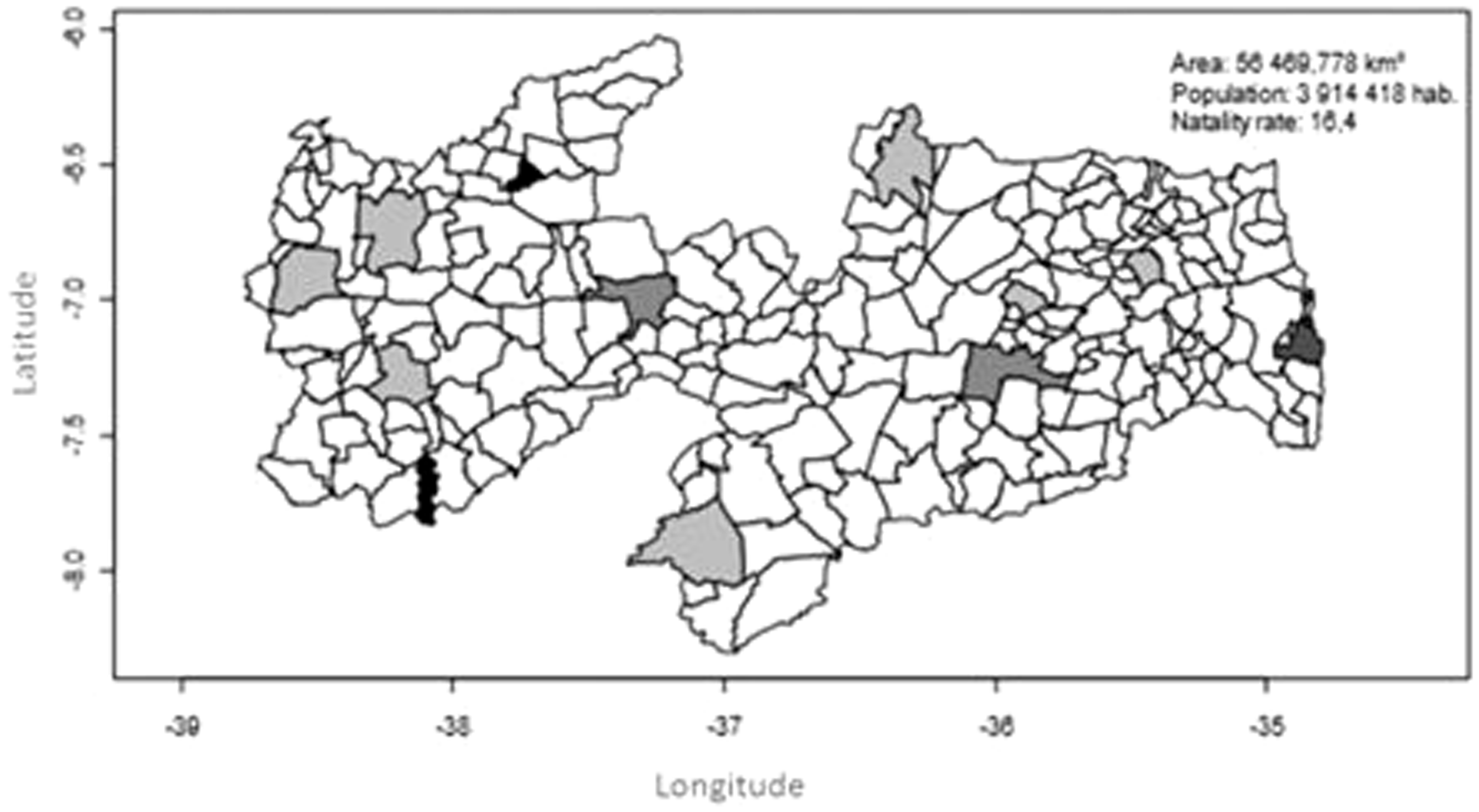
Hearts with atrioventricular concordance and ventricular arterial discordance, or simple transposition of the great arteries, represent 5–7% of all congenital heart disease, 6 corresponding to an incidence of 20–30 per 100,000 live births, with a male-to-female ratio of 1.5–3.2 to 1. 7 It often occurs in low-risk pregnancies, and association with non-cardiac malformations is only seen in 10% of cases. 8 Despite its severity, TGA does not affect fetal development and is often missed in fetal life. This happens because the parallel arrangement of the great arteries does not affect the four-chamber view, which is the only one view obtained routinely in most obstetric ultrasounds.
These babies thrive in-utero and are often born at term, with good weight and size. However, those with no sizeable intracardiac shunts will present with clinical cyanosis and become very ill. Without treatment nearly 30% of babies with simple TGA may die in the first week of life, 50% by the first month and nearly 90% by one year. 9 Besides, the postnatal progressive lowering of pulmonary arterial pressures may lead to a loss of left ventricular ability to sustain the systemic circulation after an anatomical correction, and this is the reason why corrective surgery is indicated in the first days of life. 10
It becomes clear that TGA is a critical congenital heart disease, which demands early diagnosis and treatment. Many babies in remote areas of developing countries do not have access to this. Some may die without even establishing the diagnosis. Others will reach the referral centers in such a critical stage often with infections, acidosis, and severe cyanosis. These are conditions that lead to prolonged hospitalization periods and post-operative complications.
The patient reported herein was born in a public maternity center in an area with no pediatric cardiologists, situated 300 km away from the State’s capital city and another 120 km from the specialized surgical facility at the neighboring State.
With the aid of a low-cost telemedicine facility, the local neonatologist was guided into performing a screening echocardiogram, which led to the establishment of the diagnosis. The Network further helped to set up the baby’s transferal to a larger maternity center, where prostaglandins were available. Therefore, it was possible to undergo all the necessary steps to ensure optimal timing for the operation, thus avoiding clinical complications that could have influenced surgical results. This timing is extremely important, not only to surgical success but also for the allocation of resources. 10
Monitoring these patients after surgery is another critical step to ensure adequate health care. Living in a remote town with no pediatric cardiologist close by would require journeys of the patient and family to larger cities, with consequent health, psychosocial, and financial effects for them and for the health care system.
To overcome this, the Network established virtual outreach clinics with local pediatricians in collaboration with cardiologists by telemedicine. And also, once a year the heart specialists, together with other health care professionals from the Heart Circle, pay a visit to every member town to check on all known patients and to screen older children for heart diseases. This approach not only reduced costs related to travelling but also promoted more frequent contact between patients and specialists, whilst simultaneously training pediatricians, nurses, and other health professionals in the management of these children.
This case highlights the advantages of the establishment of this innovative work system to improve the quality of health care delivered to populations in remote areas. Many other babies have benefitted from the new system as the Network approaches the mark of 100,000 neonatal screens.
Footnotes
Declaration of Conflicting Interests
The author(s) declared no potential conflicts of interest with respect to the research, authorship, and/or publication of this article.
Funding
This research received no specific grant from any funding agency in the public, commercial, or not-for-profit sectors.