



Abstract
Introduction
Telemedicine is a disruptive innovation within health care settings as consultations take place via audio-visual technology rather than traditional face-to-face. Specialist perceptions and experiences of providing audio-visual consultations in emergency situations, however, are not well understood. The aim of this exploratory study was to describe the experience of medical specialists providing acute stroke decision-making support via telemedicine.
Methods
Data from the Victorian Stroke Telemedicine (VST) programme were used. The experiences of specialists providing an acute clinical telemedicine service to rural emergency departments were explored, drawing on disruptive innovation theory. Document analysis of programme consultation records, meeting minutes and in-depth individual interviews with three neurologists were analysed using triangulation.
Results
Since February 2014, 269 stroke telemedicine consultations with 12 neurologists have occurred. Retention on the roster has varied between 1 and >4 years. Overall, neurologists reported benefits of participation, as they were addressing health equity gaps for rural patients. Negative effects were the unpredictability of consultations impacting on their personal life, the mixed level of experience of colleagues initiating the consult and not knowing patient outcomes since follow-up communication was not routine.
Conclusions
Insights into workforce experience and satisfaction were identified to inform strategies to support specialists to adapt to the disruptive innovation of telemedicine.
Introduction
Telemedicine provides a range of benefits for those within rural health care settings, including reduced travel time for patients or specialist clinicians, fewer patient transfer costs, and improved patient outcomes through more rapid access to clinical specialists.1–3 Despite the recognised benefits of telemedicine, this model of care delivery has the challenges of technology-related issues; it may increase demands on the specialist medical workforce impacting on capacity and it changes the traditional patient–clinician and clinician–clinician relationships.4,5 For example, the delivery of care via a telemedicine service disrupts the traditional patient–clinician relationship as it is no longer face-to-face, and may involve external specialists working within an unfamiliar setting with new colleagues. In turn, this may influence their satisfaction or confidence. Conducting telemedicine consultations via audio-visual technology may not have been included with medical training, usual practitioner experience or as part of local health setting protocols.
Changing the business model or process for delivering a service and opening access to a new consumer group is considered a disruptive innovation.6,7 Importantly, telemedicine is a disruptive business model or process 8 rather than a disruptive technological or product innovation, as it is the traditional face-to-face patient–practitioner model that is disrupted, even though technology facilitates its delivery. This patient–practitioner disruption may be particularly pronounced within an emergency context where assessment, diagnosis and clinical-decision making must occur quickly. For example, emergency consultations cannot be scheduled, requiring specialists to be readily available with quick access to the technology at minimal, if any, notice.
To the best of our knowledge, it is unclear how medical consultations via audio-visual technology rather than face-to-face during emergency situations affect the specialists' experience of providing clinical care. Consequences for clinicians could be positive or negative and include aspects of satisfaction related to their clinical practice (e.g. assessment), professional role (e.g. interprofessional collaborations), patient relationships (e.g. outcomes) or personal life (e.g. providing advice offsite).
The aim of our study was to identify the effects on specialist medical practitioners of providing clinical expertise via telemedicine in the context of emergency care for stroke.
Methods
Qualitative and quantitative data obtained from the Victorian Stroke Telemedicine (VST) programme were used and the project was approved by Bendigo Health Human Research Ethics Committee, Victoria, Australia (HREC/10/BHCG/4).
Context and setting
The VST programme 9 (www.vst.org.au) was used as a case study as acute stroke telemedicine is conducted in the emergency setting, and rapid diagnosis and treatment are required to improve patient outcomes. 10 As such, these clinical consultations cannot be scheduled and immediate specialist input is required to accurately identify each patient's eligibility for time critical stroke therapies. The VST programme11,12 is currently operational in six rural hospitals with 12 neurologists on-call, all day, every day. Each rostered day is from 8 a.m. for 24 hours, with weekends usually covered by one neurologist. If the primary neurologist does not answer the initial phone call it is transferred to another neurologist as a backup.
Data sources
Details of data sources.

Analysis
Qualitative and quantitative analyses were undertaken. Thematic analysis using established procedures, 13 including an overall reading and line-by-line analysis review, was conducted (KB). Interview data from the neurologists and programme documents were scrutinised, coded and analysed inductively (data-driven). 14 The coded data were then analysed together as part of a triangulation process whereby the major themes and sub-themes were refined, summarised and reviewed by two authors (KB, KM). Facilitators and barriers for participating in the telemedicine service were identified and where there was overlap in themes, these are outlined in the most appropriate category. Quotes from individual neurologists that best represent the themes that emerged have been incorporated into the text. Descriptive statistics (e.g. median, percentage) were used to report the number and duration of consults, the number of consultants and any issues experienced. These were obtained from the programme management documents and database systems.
Results
Descriptive statistics for telemedicine consultations.
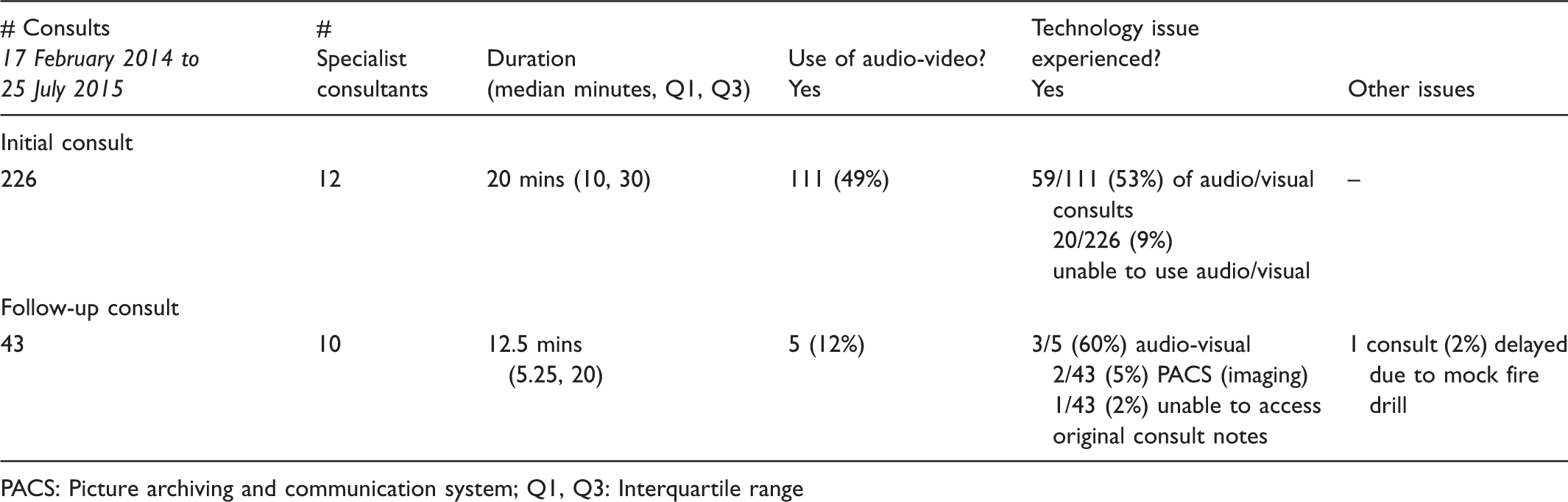
PACS: Picture archiving and communication system; Q1, Q3: Interquartile range
Expectations and experience of specialist providers
Variations in opinions were found across the three specialists as to what a telemedicine consultation involved, how the audio-visual technology could help and the minimum components required to conduct a consult. For example, one specialist indicated telemedicine was ‘two medical people … just [having] a discussion’ while another indicated telemedicine required seeing ‘the brain scans and … communicat[ing] with the patient’.
Disruptions to circle of influence
Specialists appeared to want to replicate what was available in metropolitan hospitals within regional hospitals. Benefits of specialist access included improvements in patient care (e.g. ‘speed up referral process’), provision of education to rural clinicians (including ambulance paramedics) and the discipline of neurology (‘encourage people into the speciality’). This also included how telemedicine could rapidly deploy new treatments to regional hospitals.
Disruptions to work environment
Internal processes or politics identified or presumed at the remote hospital that the staff at the remote hospital could not influence during the consultations were raised as challenges, along with site-specific protocols differing from the specialist's local hospital setting. Having to balance being respectful of the local setting (‘I think we just tread carefully’) while being able to deliver evidence-based practice to the patient were raised, including deriving sufficient information swiftly from clinicians unfamiliar to them who have varying levels of clinical experience in stroke. Participating specialists expected a lower level of skill and expertise related to the emergency management of stroke (‘very little comfort with recognising and assessing stroke’) and anticipated that this would affect their experience. However, specialists were also aware that meeting the expectations of the rural clinicians and providing a good ‘early’ experience were important to ensure further use of the telemedicine service.
Technical and physical aspects of the new workflow were reported as often being outside the control of the neurologists, including renovations at the regional setting or quality of internet access, and raised concerns for specialists (‘Was it my fault? Was it the fault of my machine? Did I push the wrong button?’). Access via multiple devices improved ease-of-use, making it a more flexible process for specialists.
Disruptions to clinical practice role and responsibility
For the most part, not knowing the outcome of care decisions made for patients (including patients’ recovery) following the telemedicine consultation, unlike in their own usual setting, was challenging for specialists (‘[I feel] disconnected with what's happening afterward’).
Conflicting opinions were revealed about whether regional sites should call only for specialist treatment recommendations (i.e. stroke thrombolysis). With some staff in rural emergency departments (EDs) having limited experience in diagnosing stroke, specialists were contacted to determine eligibility criteria for thrombolysis treatment. Often this was for non-eligible patients, but was accepted as part of the role to ‘ensure best care for patients’. While there was concern raised about taking calls related to aspects of patient management outside the primary scope of the telemedicine service (specialist workload), there was also awareness that by taking such calls, the service could provide additional benefits where neurological expertise was needed. However, once stricter criteria for calling specialists were implemented, there were then concerns about receiving fewer calls and suggestions that eligible patients may be missed.
Variation in prior experience of having to liaise with an unfamiliar clinician about a patient influenced confidence in this form of clinical care delivery. Some neurologists reported that it ‘added stress and worry’, while others felt that this was not a problem as they ‘can quickly quiz’ the other doctor to determine their level of experience in dealing with acute stroke. Participating specialists also identified social interactions with ED personnel and patients that could not occur remotely (‘[when working at my hospital] I push the patients myself into CT [computed tomography scan] and back’). Interviewees indicated that although the specialists are experienced and have credibility in the field, they still need to receive training on technical aspects of using the software and in undertaking remote consultation practices.
Disruption to personal life
Specialists stated that appropriate remuneration and a manageable workload (i.e. having sufficient specialists on the roster) were needed. Concerns were raised that the experience of being on-call was ‘demanding’, ‘onerous’ and interrupted ‘a consultant's lifestyle’. These concerns were also identified by some neurologists who had declined to participate in the service.
Disruption to current telemedicine delivery model
Over time, benefits of the telemedicine programme were identified for hospitals that could reduce consultations (‘once you’ve trained them up … consultations will be shorter … as people gain confidence’, ‘improve stroke care in your health centre’) or broaden services (‘flow-on … will be the upgrading of telemedicine services for your hospital’).
There was some concern that the telemedicine solution was a more complex, time consuming fix than required (‘must be a simple…[access to brain] imaging solution that we should work on more quickly’ (access to brain CT images is critical in the diagnosis and treatment of acute stroke)). Specialist providers were also considering the next iteration of the telemedicine service innovation, including a full neurology consultation service. Participants recognised that a different model would be needed to incorporate different case types, where specialists would need to be employed for a fixed session to conduct telemedicine, rather than being on the VST roster in addition to their current workload. Details of how this new model would be managed were raised, including balancing service demand with specialist remuneration.
Discussion
There are fewer medical specialists in rural settings15,16 and so access via telemedicine is emerging as an important solution to addressing problems of workforce capacity and equity of access issues in health care.17,18 This solution, however, negatively affects traditional face-to-face consultation practices by introducing audio-visual technology to allow remote consultations by specialists: a disruptive innovation.6,7 Although there is evidence of telemedicine's use to improve patient outcomes and influence health setting practices, there is no research available, to our knowledge, which examines the providers' experience within an emergency setting. This exploratory study provides preliminary insights into the experience of a specialist provider within a telemedicine service context for a complex condition such as acute stroke, with both positive and negative consequences reported.
Disruption to circle of influence
Specialists identified multiple benefits to patients and clinicians in rural settings by providing a critical service and addressing an important equity gap for rural patients and clinicians. Specific aspects included increased education and experience, resulting in building on expertise within the rural hospital setting as well as improved patient outcomes from their telemedicine service. Potential benefits included the retention of clinicians in rural settings interested in a speciality given the access to specialist consultants via telemedicine.
Disruptions to work environment
Specialists had to juggle patient clinical demands with respecting the rural setting systems, over which they would have limited experience, knowledge and influence, in contrast to their local work setting. Developing a sense of belonging and team orientation (psychological sense of community) 19 is important for job satisfaction 20 and loyalty. 19 For some, these changes and uncertainties would be challenging and generally positive (i.e. high on diffusion of innovation 21 ), while for others increased stress and frustration yield an undesirable experience of practising medicine and consequently low retention. Future work could explore whether optimal specialist providers are ‘innovators’ or ‘early adopters’ of new practices rather than ‘laggards’. 21 Clinical expertise alone is unlikely to be sufficient for retention; recruitment practices should identify those resilient to the work role variation and the unpredictable nature of this model of care.
Disruption to clinical practice role and responsibility
Further reduction in levels of control were reported within the specialists' role: scheduling specialist consultation times is not possible for medical conditions requiring urgent attention; technical issues are commonly experienced, adding a further complexity; changing the amount of information specialists would receive during a face-to-face consultation and working with unknown colleagues. We found that self-efficacy 22 for all aspects of the consultation was important to reduce work hindrances. 23 Support to understand and navigate the local setting's protocols and established working relationships is also required for job satisfaction.19,20 Strategies could include local champions 24 for telemedicine, tele-meet-and-greets and education sessions delivered by specialists. Such strategies are preferable to providing a broader service demonstrating the benefits of the telemedicine service with risks to workload demands for specialists 20 and offering an extensive clinical service too early (disruptive innovation theory posits commencing with basic service initially). 6 Informing specialists of patient outcomes was found to be important and would facilitate a sense of inclusivity and greater engagement or work satisfaction.
Disruption to personal life
Negative physical and psychological effects of being on-call, 25 fatigue from conducting telemedicine consultations 26 and dissatisfaction with the amount of leisure time have previously been reported by health care providers. 27 Technology is likely to continue to blur the boundaries of work and life spaces, exacerbated by the 24/7 nature of emergency medicine. Addressing such impacts will need to be considered for retention on acute service rosters. Ensuring appropriate remuneration for relevant telemedicine work content and manageable workload were identified as issues. To facilitate individual specialist retention over the longer term, frequent breaks in availability could be incorporated into rosters, or capacity could be built to support specialists with periods of time dedicated to telemedicine consults only.
As telemedicine services and demand for them grow, the number of specialists required to be involved becomes particularly important as workforce capacity issues arise. Different models (i.e. hub and spoke, virtual hub, dedicated neurologist, ‘follow-the-sun’) may be required and may be more appealing for specialists. 26
Limitations
Due to the preliminary nature of the study there are some limitations, which include the small sample of specialists that were interviewed, all of whom were involved with a single telemedicine service which had been operational for less than five years. However, consistent with methodological literature,28,29 the different viewpoints elicited between interviewees and the breadth of issues raised, combined with the triangulation of data with the rich and multiple sources of programme documentation, suggest that the purposes of this feasibility study were met.
Conclusion
Participating in an acute telemedicine service yields both positive and negative disruptive influences for specialist providers. Results from this preliminary exploration substantiate the need to further explore the issues for providers of emergency telemedicine consultations to ensure these models of care are sustainable. Programmes should provide ongoing support for providers in adapting to new work practices associated with acute clinical telemedicine consultations.
Footnotes
Acknowledgements
The authors would like to acknowledge and thank members of the VST Steering and Management committees, along with Working Group members, who provide oversight and direction in relation to this project. We also acknowledge former and current members of the VST programme team from The Florey Institute of Neuroscience and Mental Health for assistance with data management and project support, particularly Emma Tod and Sally Berger for extensive minute taking. Finally, we would like to thank Natasha Moloczij for conducting the interviews and each of the neurologists who were involved in this project.
Declaration of Conflicting Interests
The authors declared no potential conflicts of interest with respect to the research, authorship, and/or publication of this article.
Funding
The authors disclosed receipt of the following financial support for the research, authorship, and/or publication of this article: This project has been supported through funding from the Windermere Foundation, The State Government of Victoria: Department of Business and Innovation and Department of Health; and The Florey Institute of Neuroscience and Mental Health. The Florey Institute of Neuroscience and Mental Health acknowledges the strong support from the Victorian Government and in particular the funding from the Operational Infrastructure Support Grant. Dominique Cadilhac is the recipient of a National Health and Medical Research Council and the National Heart Foundation research fellowship (1063761). Professors Bladin and Cadilhac have received a restricted educational grant from Boehringer Ingelheim.