



Abstract
Introduction
Small hospitals in rural areas usually have an insufficient caseload of frail old people to justify the regular presence of a geriatrician. This study examined the costs of providing a telegeriatric service by videoconference in a rural hospital, compared to the costs of a visiting geriatrician that travels to undertake in-person consultations.
Methods
A cost analysis was undertaken to compare the costs of the telegeriatric service model with the costs of a visiting geriatrician service model. A recently established telegeriatric service at Warwick Hospital was used as a case study.
Results
In the base case model (assuming four patients per round and a round-trip travel distance of 312 kilometres), an estimated AUD$131 per patient consultation can be saved in favour of the telegeriatric service model. Key drivers of costs are the number of patients per round and the travel distance and time in the visiting geriatrician model. At a workload of four patients per round, it is less expensive to conduct a telegeriatric service than a visiting geriatrician service when the round-trip travel time exceeds 76 minutes.
Discussion
Even under quite conservative assumptions, a telegeriatric service offers an economically feasible approach to the delivery of specialist geriatric assessment in rural and remote settings.
Introduction
Comprehensive geriatric assessment is a ‘multidimensional interdisciplinary diagnostic process focused on determining a frail older person’s medical, psychological and functional capability in order to develop a coordinated and integrated plan for treatment and long term follow up’. 1 Geriatricians and specialist nurses are central to this process, with important contributions made by social and allied health workers. Reviews report beneficial outcomes for patients treated with Comprehensive Geriatric Assessment compared to usual care,2–5 with results being in favour of designated geriatric wards rather than visiting multidisciplinary teams.2,4
Small hospitals in rural areas often have an insufficiently large caseload of frail old people to justify the regular presence of a geriatrician in the town. For people in rural areas to benefit from quality geriatric care they either travel to larger city-based hospitals or the service needs to be brought to them. Given that travelling long distances is not beneficial to their health, a model of care that keeps an older person close to home and family is preferable. As a result, geriatricians travel to rural hospitals to enable in-person consultations. This limits consultations to long stay patients, and prevents the daily/weekly contribution to the multidisciplinary process that characterises geriatric and rehabilitation units in metropolitan and regional centres. In most jurisdictions geriatricians are in short supply and the likelihood of routine visits to small hospitals is low, 6 resulting in limited opportunity to receive geriatric specific care, or none in some rural areas.
The application of telemedicine in geriatrics is relatively new, and sound evidence of benefits and cost-effectiveness is still lacking. 7 Although no evidence is available for this particular service model in terms of patient outcomes, a pilot in a similar setting showed promising results; 8 however, assessing telemedicine applications and their required resources is a challenge. 9 A review of economic analyses of real-time video communication states that telemedicine can be cost-effective for rural health care, depending upon the specific setting and health service delivery model. 10
Previously, we developed a telehealth service model which incorporates a combination of asynchronous and videoconference (VC) strategies to support a geriatric and rehabilitation inpatient service in a large regional hospital which was unable to recruit a geriatrician. 11 This paper evaluates the deployment of a similar model to small rural hospitals where the challenge of lower numbers of older inpatients requiring geriatric consultation and subacute services could impact sustainability. This model is currently deployed in five small rural hospitals in southern Queensland, which range in distance from Brisbane from 150 kilometres to 500 kilometres, and service capacity of between 13 and 60 beds. In this study, we selected one of these sites – the first to be established and thus with the most stable operation – to conduct a cost analysis.
Methods
A cost analysis was undertaken to compare the costs of the telegeriatric service model to the costs of a visiting geriatrician service model. A health service perspective was taken. Human Research Ethics approval was granted for this project by Metro South Human Research Ethics Committee (HREC/12/QPAC/479, SSA/12/SPAH/481, HREC/12/QPAC/479/AMO1) and The University of Queensland Institutional Human Research Ethics Approval (2013001635).
The study site
Warwick is located in the Southern Downs of South East Queensland and has a population of around 13,000 people. 12 The Warwick Hospital is a 60-bed acute care facility, with an additional 40-bed high care residential aged care facility situated on the same campus. Older patients are admitted to a general ward. In the majority of cases, older patients without major medical and surgical problems are managed on location in Warwick. Geriatrician expertise is available at Princess Alexandra Hospital (PAH) in Brisbane (155 kilometres), but prior to the establishment of the telehealth service described here, there was no on-location geriatrician service.
Aggregated hospital data on Warwick Hospital were requested from the Queensland Hospital Admitted Patient Data Collection (QHAPDC) at the Health Statistics Unit. From 2011–2012, prior to the commencement of the geriatric telehealth service, over 4000 episodes and almost 15,000 patient days were recorded at Warwick Hospital. Persons aged 65 years and over accounted for 66.3% of patient days, with persons aged 85 years and over accounting for 22.3% of patient days.
Intervention
In August 2012, a telegeriatric service was established at Warwick Hospital by the PAH Telehealth Centre, and was in routine operation at the time of writing. The service is provided by a geriatrician through the PAH Telehealth Centre, where the telemedicine facilities are located and the clinical coordination, medical administration, technical and software support for the telegeriatric rounds are provided.
Telegeriatric rounds are organised routinely once per week. A geriatrician attends the rounds from a telemedicine studio, while at the Warwick end a mobile videoconference system is used to connect with the specialist. A nurse assessor at Warwick Hospital identifies eligible patients (those considered likely to require an extended hospital stay due to geriatric syndromes, recent functional decline or psychosocial issues). The nurse assessor prepares cases for consultation by conducting a structured assessment using an online comprehensive geriatric assessment (CeGA) clinical decision support system. 6 This information and the profiles generated by the system are available to the geriatrician prior to commencement of rounds.
The weekly rounds are organised into three components, which broadly emulate a conventional patient round: pre-discussion, in which each patient is discussed by the nurse assessor and the PAH geriatrician, sometimes accompanied by a house physician at the Warwick end; and a ward round, in which the geriatrician interacts with the patients at the bedside, hosted by the nurse assessor. During the ward rounds a physician at Warwick can be consulted to execute elements of the physical examination which cannot be performed by VC. The round ends with a multidisciplinary team meeting, which involves a Warwick-based physiotherapist, occupational therapist and social worker, along with the nurse assessor and PAH geriatrician.
The service is supported by the clinical decision support system ‘CeGA Online’, which is a web-based software application based on the interRAI Acute Assessment (AC) system.
6
The interRAI AC is a comprehensive assessment system developed for geriatric assessment in acute care hospitals.13,14 This system is based on clinical observations and a suite of derivative applications to support diagnostic and risk screening, care planning and monitoring of progress over time.
15
The geriatrician also has access to the imaging and pathology results, online. All information is available on the desktop in front of the geriatrician (see Figure 1).
Videoconferencing with a patient in hospital (remote site).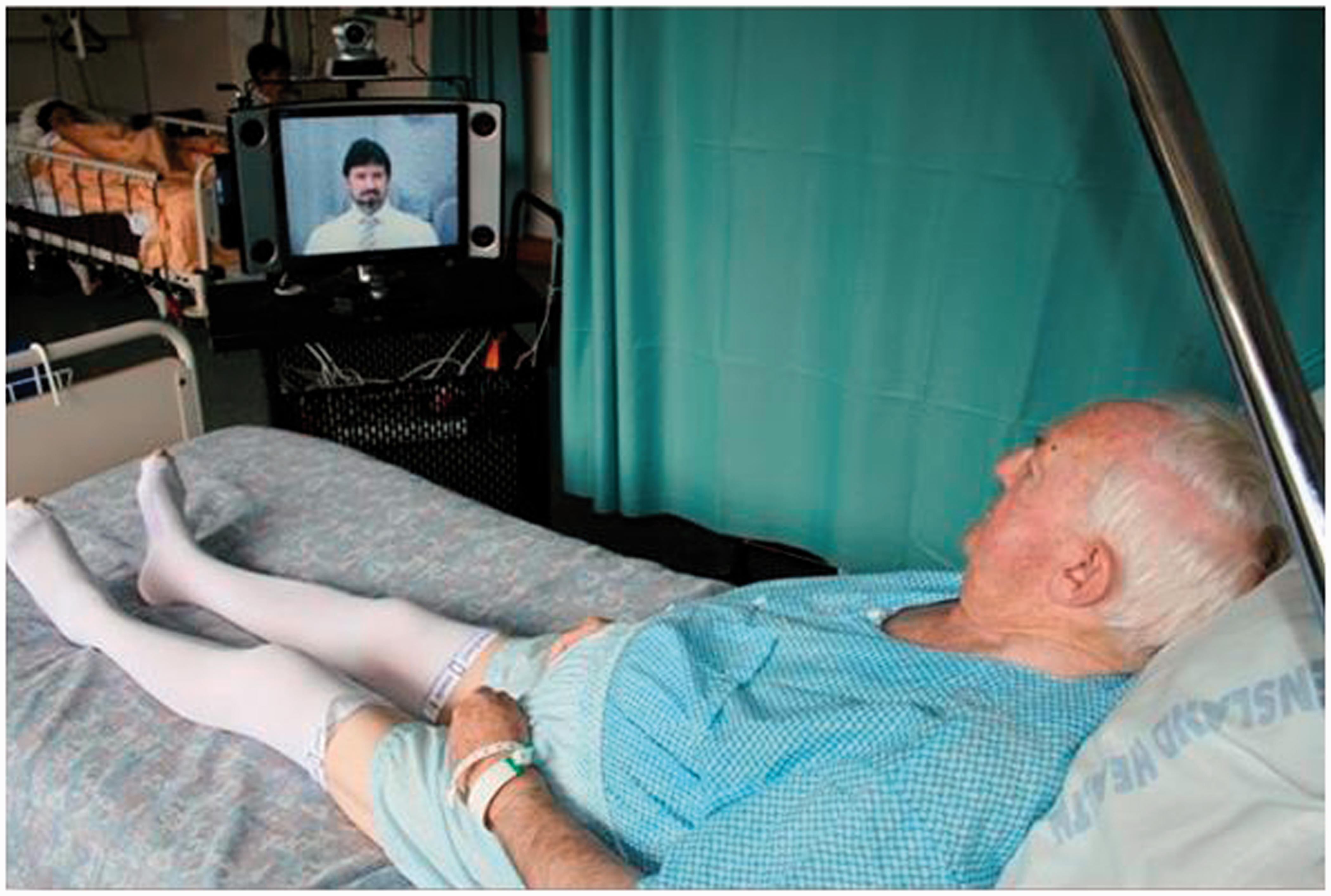
Comparator
The comparator was a theoretical visiting geriatrician service model. It was assumed that a geriatrician travelled weekly by car from the PAH to Warwick Hospital. The service models are similar in function, but different in regards to transport requirements and communication methods.
Outcome
The unit of evaluation was cost per patient per round, and this was compared for the two service models.
Resources and costs
The costs were divided into fixed costs, which did not vary with the number of patients, and variable costs, which increase as the number of patients increases. Fixed capital costs include the one-time initial investments required for establishing the telegeriatric service (which were annuitised assuming a three year equipment lifespan), and recurrent non-investment costs. Resources were divided into required resources for PAH (studio) and Warwick (remote) Hospitals. All costs are expressed in 2013 Australian dollars (AUD$) per annum. Costs were rounded to the nearest dollar value, unless otherwise specified. Common costs for both service models, e.g. medical supplies, room rental and hospital overhead costs, were not included. The maximum capacity for one round was set at 20 patients.
Telegeriatric service model
Information on required resources and estimated costs for the telegeriatric service model were obtained from The University of Queensland Centre for Online Health. At the studio end, the service is provided from a telemedicine studio at the PAH Telehealth Centre, for four hours per week. It was assumed that at other times, the videoconference room was in constant use, with a total operational time of 40 hours a week. At the remote end no studio is required as the service is facilitated by a mobile VC device. At the time of the study, the VC equipment at Warwick Hospital was used solely for the telegeriatric service (however, at the time of publication, this was no longer the case). In the current study fixed costs correspond to the portion of total operational time that the resources are used for the service (studio end: 10%; remote end: 100%).
Variable costs include: staff resources, including geriatrician, nurse assessor and allied health; and support resources, including round coordination, medical administration and technical and software support. Physician resources at the remote end were excluded as physicians are only consulted ‘on the spot’ occasionally for short periods of time, and this also occurs during conventional in-person visits. Timing sheets measured staff resources for the telegeriatric rounds. During three subsequent telegeriatric rounds per-patient-time was measured for the pre-discussion, time at the patient’s bed side (ward round) and the team meeting. Time required for geriatrician preparations and after-round report documentation was estimated based on a geriatrician’s experiences. A nurse assessor at Warwick Hospital recorded time needed for round preparations, including CeGA Online data collection and data entry, for a period of one week. Annual staff costs were calculated by multiplying mean time per patient by the total number of patients per annum and the hourly cost of the corresponding staff resource. Nurse assessor preparation time was only required (and thus included) for new patients.
Visiting geriatrician service model
Timing data for the theoretical visiting geriatrician model was modelled on data from a previous study on a similar service. 11 Travel resources were required for the geriatrician travelling from PAH to Warwick Hospital. Two types of travel resources were distinguished: travel distance and travel time. Travel distance costs were calculated by multiplying the number of kilometres for a round-trip by a rate per kilometre (AUD$0.60). Travel distance was obtained from Google maps16 and converted to travel time at 80 kilometres per hour. Travel time costs represent the forgone geriatrician employment costs associated with clinical time lost. These opportunity costs were calculated by multiplying the travel time for a round-trip by the hourly fee of the geriatrician.
Sensitivity analysis
One-way sensitivity analyses were undertaken to identify key drivers of costs. All parameters in the model were varied individually according to low and high input values, while holding all other aspects of the model constant. To determine low and high input values, base case values were decreased or increased by 66.67% of their base value. Subsequently, identified key drivers were investigated in two-way sensitivity analyses by varying two parameters over a plausible range.
Results
Required resources and assigned unit costs (in AUD$) for the telegeriatric and the visiting geriatrician service model, by studio and remote end (total costs).

n.a.: not applicable.
All capital costs are annuitised assuming an expected lifespan of three years, a depreciation rate of 25% and a resale value of 0.
Fixed device at studio end, mobile device at remote end.
No site visits needed at studio end.
No studio at remote end: mobile videoconferencing equipment.
Studio end: two hours at AUD$200/h (geriatrician hourly fee). Remote end: total price for a two-day training course.
Nurse preparation in CeGA Online only required in case of a new patient.
Source: Google maps.16
Travel distance is converted into travel time assuming a travel speed of 80 km/h.
Cost comparison of a telegeriatric and a visiting geriatrician service model (in AUD$), by studio and remote end.
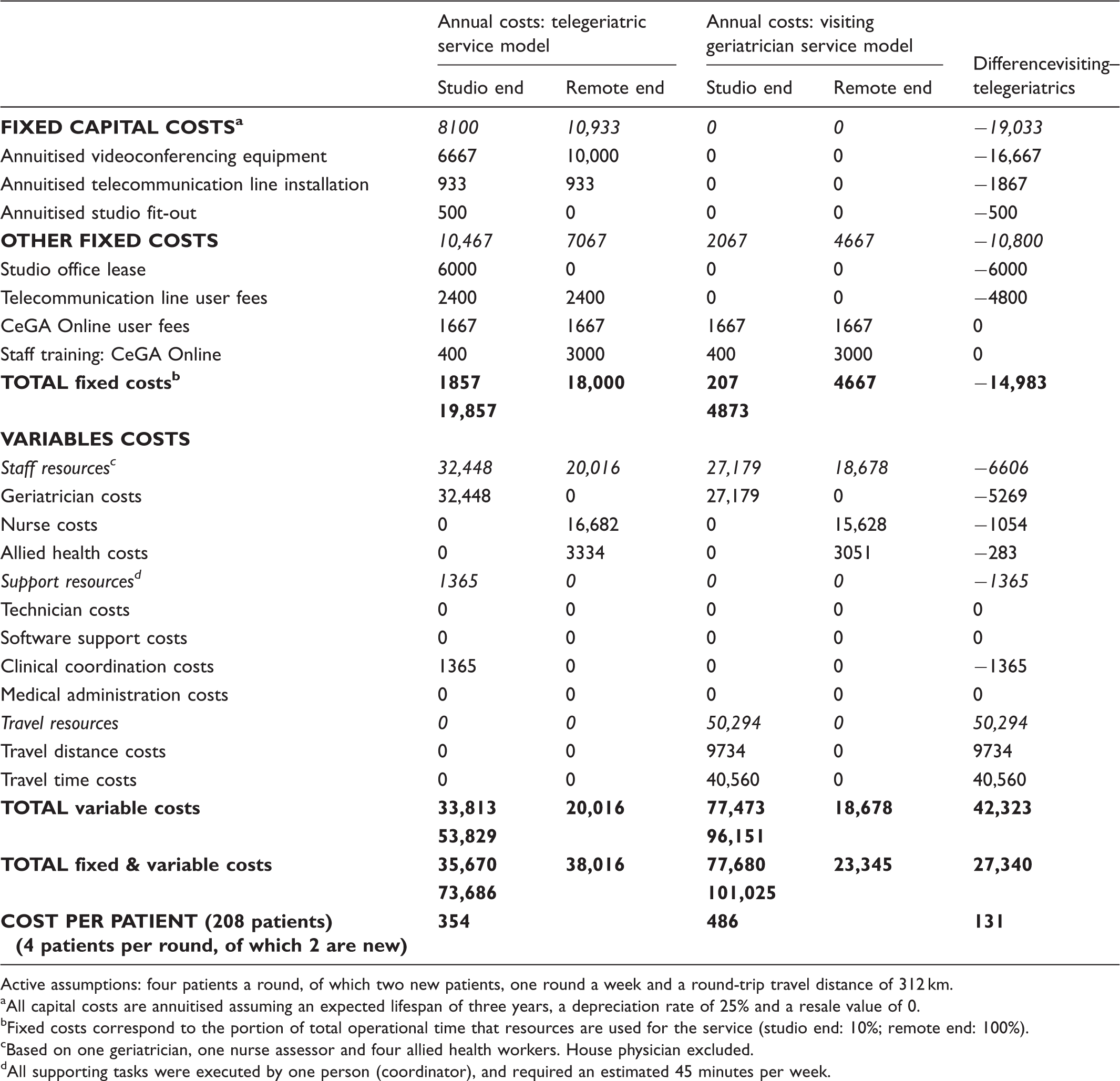
Active assumptions: four patients a round, of which two new patients, one round a week and a round-trip travel distance of 312 km.
All capital costs are annuitised assuming an expected lifespan of three years, a depreciation rate of 25% and a resale value of 0.
Fixed costs correspond to the portion of total operational time that resources are used for the service (studio end: 10%; remote end: 100%).
Based on one geriatrician, one nurse assessor and four allied health workers. House physician excluded.
All supporting tasks were executed by one person (coordinator), and required an estimated 45 minutes per week.
For the telegeriatric service, the mean time required per patient per round was 4.9 minutes (range 0.5–14.0, SD 4.2) for the pre-discussion, 15.2 minutes (range 4.4–45.6, SD 11.6) for the ward round, and 6.1 minutes (range 2.6–11.8, SD 3.0) for the team meeting. Total mean time per patient was 26.8 minutes (range 13.4–68.7, SD 16.1). A difference was observed in mean time per patient for new and review patients: 35.8 minutes (range 21.6–68.7, SD 22.1) and 20.8 minutes (range 13.4–31.8, SD 7.9) respectively. Based on a geriatrician’s experiences the estimated time needed for preparing the rounds is on average 15 minutes per patient. In addition, an estimated total time of 20 minutes is required for report documentation after the round. Assuming a typical round of four patients, the total time per round needed for geriatrician preparation and report documentation is 80 minutes. The nurse assessor at Warwick Hospital required on average 187 minutes (range 150–210, SD 28) per new patient for case preparation. Of this time, on average 67 minutes (range 60–90, SD 15) were spent on data collection and on average 120 minutes (range 90–150, SD 24) on data entry into CeGA online. Because of the small scale character of the round, all supporting tasks were executed by one person, and required an estimated 45 minutes per week. The estimated annual cost of the telegeriatric service is AUD$73,685, which equates to AUD$354 per patient per round.
The travel distance for the visiting geriatrician is 312 kilometres for the round trip, which takes approximately 234 minutes. Annual travel costs are AUD$50,294. Of these travel costs, AUD$40,560 are travel time costs and AUD$9734 are travel distance costs. The estimated annual cost of the visiting geriatrician service model is $101,025, which equates to AUD$486 per patient per round. Of these costs, approximately 40% are allocated for travel purposes.
Low and high input values for one-way sensitivity analyses.

(s): studio end; (r): remote end
Base case values were decreased and increased by 66.67%.
Low input: 1 new, 0 review patients. High input: 2 new, 5 review patients.
Number of Patients.
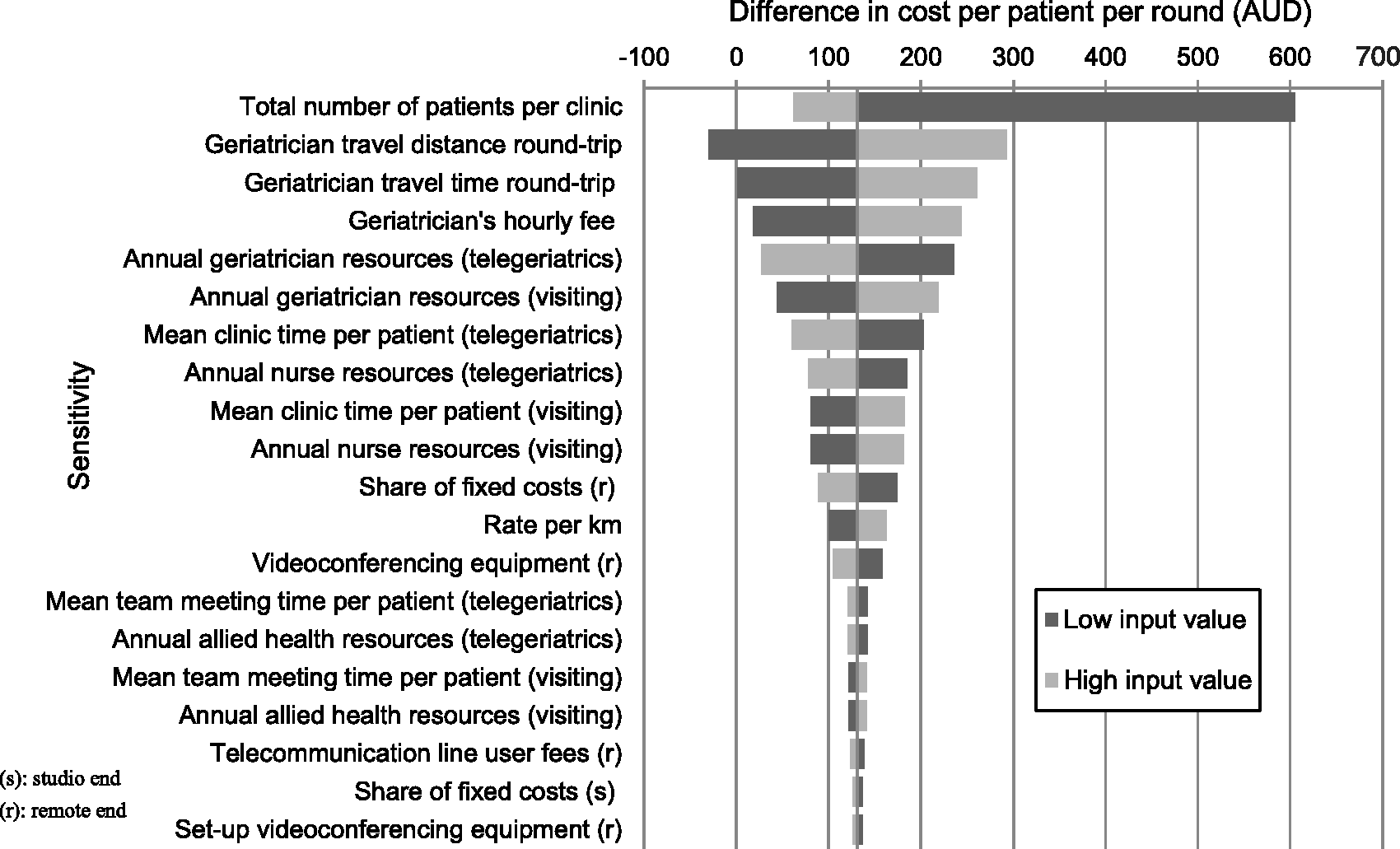
Cost-difference per patient per round between telegeriatric and visiting service model, for low and high input variables.
In the base case, assuming four patients per round, the telegeriatric service is cost-saving when travel time for a round-trip exceeds 76 minutes. Results of the two-way sensitivity analysis are displayed in Figure 3. When varying travel time and number of patients per round simultaneously while holding all other aspects of the model constant, at a low estimate of one patient per round the break-even travel time is 48 minutes. At a high estimate of seven patients per round the break-even travel time is 105 minutes.
Cost-difference per patient per round between telegeriatric and visiting service model: number of patients per round versus geriatrician travel time.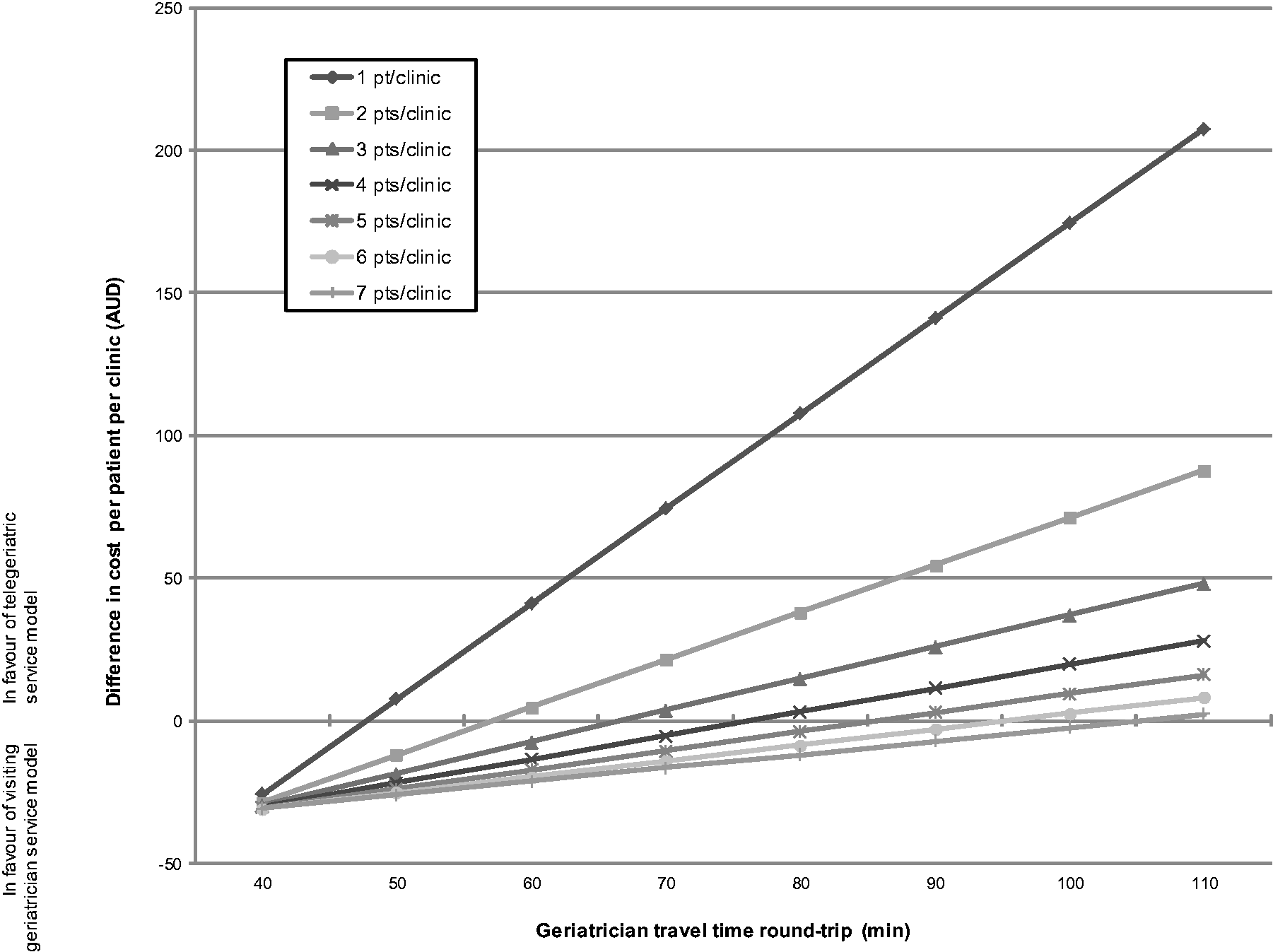
Discussion
This study demonstrates that a telegeriatric service is a feasible and cost-saving service in the rural health service setting, helping hospital administrators in decision-making to improve access to specialist geriatric services whilst using healthcare resources more efficiently. This study has global applicability. 17
The current study identified the number of patients per round as a key driver of costs. Decreasing the number of patients per round decreases the break-even travel time to justify a telegeriatric service. However, with the observed mean number of four patients assessed per telegeriatric round, the telegeriatric service remained cost-saving for round-trip travel times as low as 76 minutes.
At this time point, with substantial capital investment, in the base case model an estimated AUD$131 per patient per round can be saved by providing the geriatric service through VC. If the VC equipment were to be used by one additional specialty at the remote end, the break-even round-trip travel time is 38 minutes at four patients per round. With each additional speciality, the VC service model becomes more economically viable. In future, the decreasing cost of equipment will further enhance the financial viability of the model.
The current cost analysis compares the costs of providing the service; it does not compare health outcomes. Therefore, any benefit in health outcome attributable to either service is not considered in the assessment of value for money. This is a reasonable approach if patients are assumed to have access to a geriatrician in either model of care, and that both service models result in similar outcomes. It was not feasible to make any assumptions regarding outcomes because of the weak evidence base on this issue. Reviews on telemedicine identify a need for robust studies on costs linked to patient outcomes.9,10,18–22 It is possible (but unproven) that face to face models may offer better outcomes; however, it is also a reality that face to face service delivery is unattainable for some patients. In such a scenario, telegeriatric services may well provide preferable outcomes to the possibly more realistic scenario of a comparator of no specialist service at all.
Limitations
We acknowledge that while costs for staff have been calculated by the minute, staff are in fact employed on a contract basis which does not take into account such small variations in utilisation; therefore, the business case needs to take into account the full nurse assessor role, which involves other duties. The timing estimates may be over-estimated in this study because of the experience level of personnel involved (experienced geriatricians estimated preparation and report writing; inexperienced nurses completing nurse assessments and data entry), and the small number of cases used in the estimates for this study. Finally, the costs associated with the visiting geriatrician are assumptions which are as closely aligned to experience at the PAH as possible. Given that the telehealth model (the intervention) is based on actual data, this paper provides a useful guide for the reader to apply a cost comparison to an existing in-person service.
In this study, we have considered the costs directly connected to the delivery of a geriatric service in a rural hospital. It is important to consider the implications of delivering this service model on a larger scale, across all small rural hospitals in a geographic area and the implications for a health service from an economic perspective. While out of scope for this paper, it is recognised that there would be a significant implementation expense of equipment and human resources, but also a benefit in which rural clinical staff are upskilled to provide more complex care for their geriatric patient group. Where traditionally a group of frail older patients may have been forced to travel to the city to receive specialised geriatric care in times of emergencies, they would now be able to receive this care close to home and city based geriatric resources would be freed up to be directed to other areas of need.
Conclusion
The current study indicates that a telegeriatric service offers an economically feasible approach to the delivery of specialist geriatric assessment in a rural and remote setting. The outcomes of this study are especially of interest to rural and remote hospitals that cannot justify a designated geriatric unit or the full-time presence of a geriatrician because of an insufficient caseload of frail older people. The proposed innovative model of health service delivery provides access to geriatric expertise in settings where geriatric services would not be available otherwise.
Footnotes
Acknowledgements
We thank Chrissie Norton for her advice on the financial model and telehealth cost estimates.
We appreciate the support and efforts of the Metro South Hospital and Health Service and the Darling Downs Hospital and Health Service in Queensland, and thank the PAH Telehealth Centre for their role in coordinating the telegeriatric services. This research was conducted with the support of the Centre of Research Excellence (CRE) in Telehealth funded by NHMRC (grant ID: APP1061183). Dr MG Martin-Khan is supported with a CRE in Telehealth (Aged Care) post-doctoral fellowship.
Declaration of Conflicting Interests
The authors declared the following potential conflicts of interest with respect to the research, authorship, and/or publication of this article: CeGA Online software is owned and distributed by Uniquest, the commercialisation arm of The University of Queensland, Australia.
Funding
The authors received no financial support for the research, authorship, and/or publication of this article.