




Abstract
Introduction
The Champlain BASE (Building Access to Specialists through eConsultation) eConsultation service was designed to address the limited access to specialist care in Canada, which can lead to long waiting times and, subsequently, negative patient outcomes. Our primary objective was to perform an in-depth analysis of the use, content, and perceived value of haematology electronic consults (eConsults) submitted by primary care providers (PCPs) to the eConsult service.
Methods
We conducted a cross-sectional study using descriptive statistics to examine post-eConsult surveys for PCPs and other collected data including PCP designation, time for specialist to complete the eConsult, specialist response time, perceived value of the eConsult by the PCP, and the need for a face-to-face referral following the eConsult. A medically-trained author reviewed all haematology eConsults from April 2011 to January 2015, and categorized them by clinical topic and question type using validated taxonomies.
Results
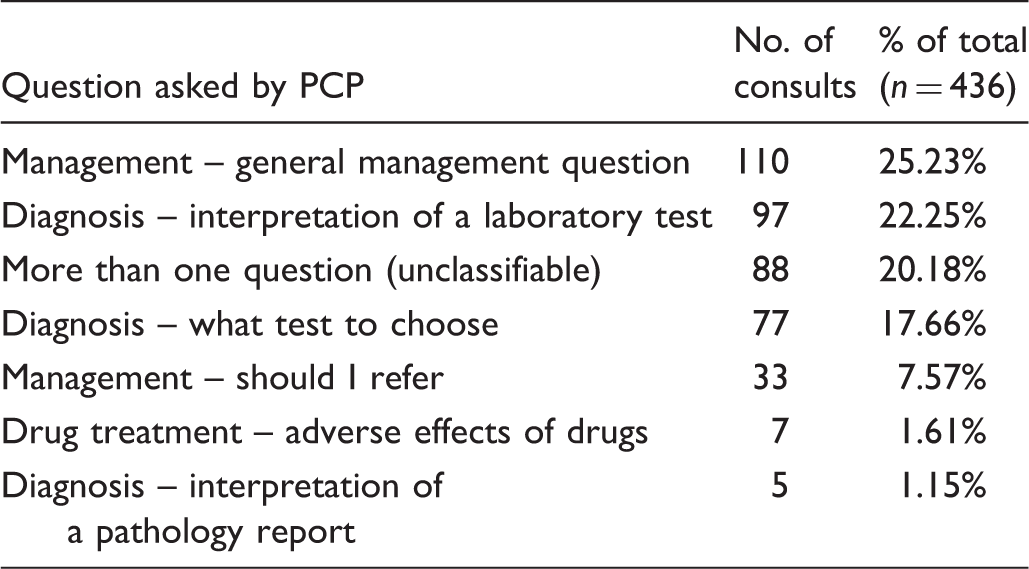
Haematology accounted for 436 out of 5601 (7.8%) total eConsults, making it the third most popular service utilized. In 66% of haematology eConsults, a face-to-face consultation was not needed. Anaemia, neutropenia, and hyperferritinemia were the most common clinical queries. Most eConsult question types concerned the management of haematological disorders or the interpretation of laboratory tests. Most eConsults were answered within three days, using less than 15 minutes of the specialists’ time. PCPs highly valued the service.
Discussion
This initiative increases access to haematology care and has the potential to reduce the long waiting times for non-urgent traditional consultation, along with the benefit of cost savings to the healthcare system.
Introduction
Electronic consultations (“eConsults”) are asynchronous, consultative, provider-to-provider communications within a shared electronic health record or web-based platform. 1 These systems allow healthcare providers to communicate asynchronously and could reduce the number of unnecessary referrals that clog wait lists, provide a record of the patient’s journey through the referral system, and lead to face-to-face visits that are more efficient. 2 eConsults are intended to improve access to specialty expertise for patients and providers without the need for a face-to-face visit. Access to specialist care is a point of concern for patients, primary care providers (PCPs), and specialists in Canada and the US.2–4 In Ontario alone, approximately 54,000 patients are referred to specialists for consultations each day. 5 This has dramatically extended the waiting time to see a specialist in Canada from 3.7 weeks in the year 1993 to 8.5 weeks by 2014. 6 The lengthy waiting times for a specialist appointment can have significant negative psychological and functional impacts on patients’ well-being. Impacts include worrying about serious undiagnosed diseases and experiencing symptoms that impact on daily functioning.7,8 The Fraser Institute demonstrated a direct correlation between waiting times and all-cause mortality in both males and females. 9
In an effort to improve access to care, alternatives to traditional consultation such as telephone consultation and email consultation have been explored. However, each alternative has its own limitations. Telephone consultations necessitate that providers synchronize their often busy schedules, while email consultations fail to meet privacy and security standards.10,11 Due to these limitations, eConsult services have been developed that allow PCPs to electronically submit a consult to a specialist who can provide advice without the need for a face-to-face consultation. This approach has been implemented successfully in several jurisdictions in other parts of the world.12–16 A recent systematic review examined 27 peer-reviewed articles from both single- and multi-specialty-based eConsult systems based in the US, Canada, Finland, North England, Ireland, and the Netherlands. The meta-analysis indicated the use of eConsults can result in an overall reduction in waiting times and improve access to specialist care. 1 To date, no specific analysis has been undertaken to further delineate the nature of haematology eConsults.
In this study, we describe the use and impact of an eConsultation service in the field of haematology. Further, we characterize each eConsult to determine the most common clinical topics and types of questions asked by PCPs, in order to better understand which clinical scenarios are most amenable to eConsultation.
Methods
Study design
We conducted a cross-sectional study of all the eConsult cases directed to haematology specialists using the Champlain BASE (Building Access to Specialists through eConsultation) eConsultation service between 1 April 2011 and 31 January 2015. Three haematologists who had been in independent practice for over five years (range 6–20 years) answered all haematology eConsults. The Ottawa Health Science Networks’ Research Ethics Board approved this research.
Setting
The majority of cases were from the Champlain Local Health Integration Network which is a large health region located in Eastern Ontario. This catchment area of 17,600 square miles serves 1.2 million people; health outcomes in this region are comparable to the rest of Canada. 17
Champlain BASE eConsult service
The Champlain BASE eConsult service uses a secure web-based platform that allows PCPs to consult various specialties asynchronously. The service is used for non-urgent consultations. As of December 2015, the service has completed over 11,400 eConsults across 84 specialty groups; this represents the largest multispecialty eConsultation service worldwide. Details of the design and integration specifics can be found in a previously publication. 11
A haematology eConsult is generated by a PCP logging onto a secure web portal, whereby they can submit the patient demographic information (age and gender), pertinent medical history, and the reason for consultation, with the option to attach laboratory test results, pictures, or videos. Once the eConsult is submitted, a central administrator assigns it to one of the three eConsultant haematologists, depending on availability. The haematologist receives a notification via email and then has up to seven days to respond in writing via the online portal with clinical advice, a request for more information, or advice for a face-to-face consultation. The PCP is able to see the specialist’s written response online via the eConsult portal. There is an opportunity for back-and-forth asynchronous dialogue between the specialist and PCP using the eConsult service, until the PCP decides to close the case/consultation. Once a case is closed, the PCP is presented with a mandatory brief close-out survey (Figure 1). The PCP is able to download a pdf version of the eConsult to incorporate into the patient chart.
Close-out survey administered upon completion of each eConsult.
eConsults from a medical legal perspective are considered along the same lines as a “curbside consult” in that the specialist provider does assume a duty of care once the case is reviewed.11,18 Patient privacy is ensured through a secure system which was created on a private network and meets all patient privacy policies in our jurisdiction. Payment for the specialists is CAD$200 per hour on a proportionately rated time basis in self-reported increments. Specialists are reimbursed CAD$200 per hour, paid according to self-reported time needed to complete each consult.
Data collection
The eConsult service uses real-time data collection. Information captured during the process comes from the PCP, the patient, and the consultation record. PCP and specialist data collected included their gender, clinic postal code, Rurality Index Ontario score of their practice, and provider type (physician or nurse practitioner). 19 Patient information collected included the patient’s date of birth and gender. Consultation-use data included PCP submission time, specialists’ response time, PCP close-out survey results, and specialists’ self-reported time for answering the consultation. The PCP close-out survey is mandatory and must be completed by all PCPs at the conclusion of each eConsult case. The survey has five questions: one which enquires about the outcome of the eConsult for the patient, another that enquires about the original need for referral and the final outcome of the eConsult, two that ask the PCP to rate the service in a Likert scale, and one open-field text box for additional feedback. The consultation record includes the communication log of exchanges between PCPs’ and specialists, and any attached documents or files. Data from all eConsult cases sent to haematology specialists between 1 April 2011 and 31 January 2015 were retrieved.
Analysis
We collected descriptive statistics on all of the haematology eConsults to characterize the use of the service. One medically trained author (AF) independently reviewed each communication log, along with the corresponding attachments, and classified each eConsult by: (1) clinical topic(s) (up to two per case) using a modification of the International Classification for Primary Care (ICPC-2); and (2) type of questions asked by the PCP based on a validated taxonomy.20,21 All data were de-identified and exported into Microsoft Excel 2013 for analysis.
Results
Use
Of the 5601 eConsults completed by Champlain BASE eConsultants between 1 April 2011 and 31 January 2015, 436 (7.8%) were directed to the haematology service. Haematology was the third largest specialty consulted after Dermatology and Endocrinology.
A total of 171 different PCPs consulted the haematology service during the study period. Physicians submitted 87.4% of the eConsults, while nurse practitioners submitted 12.6%. The majority of eConsults were generated by female (79.1%) PCPs who practiced in urban areas (70.4%) compared to rural areas (29.6%). The majority of patients were female (55.3%) and were an average age of 53.6 ± 0.91 years old.
Specialists’ median initial response time for haematology eConsults was three days (interquartile range 0.91–5.96). The specialists’ self-reported time spent to complete the eConsult was less than 10 minutes in 77% of cases, 10 to 15 minutes in 10% of cases, 15 to 20 minutes in 12% of cases, and greater than 20 minutes in 1% of cases.
Question types asked by PCPs to specialists for categories with five or more eConsults.
Impact of haematology eConsults
Impact of haematology eConsults on the need for face-to-face referral as indicated by PCPs on the close-out survey.

Conversely, 4% of the eConsults lead to a face-to-face consultation being initiated where one was not originally contemplated (Table 2). Further, PCPs indicated that they gained new or additional advice for a course of action in 58% of cases, while 39% were able to confirm their original course of action (Figure 2). The overall value of the service was very highly rated. On a scale from one (minimal) to five (excellent), PCPs rated the value of the eConsults for their patients and themselves as four or five in 93% and 95% of the cases, respectively. During the process, the PCPs submitted many positive comments in the optional open text field, including representative statements as follows:
“I will be able to provide more information to the consultant, for a more effective visit.” “In select cases this service definitely is a support to rural physicians.” “The eConsult process greatly increases my enjoyment of clinical practice as I am able to get immediate answers to questions and improve my knowledge daily.” Impact of haematology eConsults on the course of action indicated by the PCP on the close-out survey (n=436).

Discussion
To our knowledge, this is the first study evaluating a secure web-based electronic consultation service in haematology. Haematology is consistently among the top five specialties receiving these eConsults across systems. 1
This highly valued, efficient system improves upon the timeliness of access to specialist care face-to-face consultation in three ways: (1) rapid access to specialist care; (2) early detection of cases that should be referred; and (3) the future reduction in waiting times for face-to-face consultations due to the improved system efficiency. Based on our data, haematology eConsultants responded to an eConsult within a median of three days. For comparison, the median waiting time for a face-to-face internal medicine consultation (haematology being a subspecialty of internal medicine) in Canada is approximately 4.4 weeks. 6
A haematologic eConsult would not be appropriate in many scenarios (e.g. acute presentation of leukaemia). Yet for a number of low-acuity cases (e.g. incidental note of thrombocytopenia due to platelet clumping) an electronic exchange with a haematologist for further advice is quite appropriate and preferable for the patient, haematologist, and PCP alike.
Haematology eConsultants were able to complete 98.8% of eConsults within 15 minutes, while face-to-face consultations typically take up to 20–30 minutes. Finally, because eConsults pre-empted the need for face-to-face consultation in 46% of cases, it is likely that this substantial reduction in the number of face-to-face consultations will reduce waiting times for high-acuity haematology cases not amenable to eConsultation.
This reduction in face-to-face consultation has the potential to also reduce the financial burden of speciality consultation – in Ontario, a haematologist is paid CAD$157.00 for an initial consultation, while an eConsult specialist is currently paid CAD$50.00 for a 15-minute eConsult.11,22 Furthermore, this reduction in specialist waiting time will likely diminish anxiety for patients awaiting a specialist opinion. 23
There is a lack of literature in the area of patient safety and asynchronous eConsultations. 24 We demonstrated that in 4% of cases PCPs were not planning on sending the patient for a traditional face-to-face referral; however, the eConsultant recommended one due to the potential high-acuity nature or complexity of the problem. This means that in our study alone 17 people received a necessary face-to-face specialist consultation that would not have occurred if it were not for the eConsult process. We did not explore the outcomes of these cases as it was out of the scope of the research. However, other research has demonstrated the “safety-net” effect when employing eConsultation strategies. 25
Our study showed that PCPs highly valued the eConsult service. Factors contributing to high satisfaction rates include the speed of the eConsult process and the fact that PCPs were able to confirm their course of action with reassurance from a specialist. An additional factor includes the point-of-care educational value in which PCPs were able to gain new or additional knowledge when a new or additional course of action was suggested. 26 This was echoed by comments from many PCPs who noted that the eConsult service served as a valuable educational tool. 27
Our analysis of the clinical topic and questions that were directed to the haematology eConsultants can provide insight into the challenging clinical scenarios facing PCPs. This information could be used to inform the planning of continuing medical education (CME) and professional development events for PCPs. Specific areas of CME development in haematology based on our research could focus on the management of anaemia, neutropenia, and hyperferritinemia. Clinical guidelines and best practices could also be integrated as point-of-care CME for common clinical questions.
There were some limitations to this study. The data reflect a single site and may not be generalizable to other health systems. Furthermore, the 171 PCPs who submitted eConsult cases represent only a fraction of the PCPs in the Champlain region of Ontario – there are 1178 licensed family physicians in Ottawa alone per registration data from the College of Physicians and Surgeons of Ontario. 28 These 171 PCPs are likely “early adopters” and their patient population and clinical practice may not be representative of all patients in primary care. However, the gender proportion of PCPs registered for the eConsult system closely matches that of the overall PCP population. 27 Further, we were unable to track the clinical outcomes of the eConsults beyond the end of the eConsult exchange, nor do we have firm data on the probable specialist consultation waiting times. Future studies should measure the long-term impact of eConsultation in wait-time reduction, cost-effectiveness, and patient safety outcomes. In addition, further research should be carried out to understand how eConsults can further be implemented into the healthcare system to provide the best and most efficient patient services.
To conclude, the eConsult service for haematology has been successfully implemented in our region, and addresses a wide range of clinical topics. It has improved access to haematologist care, leading to reduced waiting times for specialist care, in addition to avoiding a large proportion of unnecessary face-to-face consultations. Classifying the content of each eConsult has the ability to inform CME, allowing PCPs to provide excellent care at the bedside without requiring the assistance of a specialist.
Footnotes
Acknowledgements
We would like to acknowledge Lesley Ananny for her contribution to this study.
Declaration of Conflicting Interests
The author(s) declared the following potential conflicts of interest with respect to the research, authorship, and/or publication of this article: AF, AA, CL, and EK declare no competing financial interests. KK received speaker’s fees and a travel honorarium from Novartis and Amgen Canada.
Funding
The author(s) disclosed receipt of the following financial support for the research, authorship, and/or publication of this article: Financial support for the Champlain BASE eConsult service was received from eHealth Ontario, the Ontario Ministry of Health and Long-Term Care, and the Champlain Local Health Integration Network. Grant support was received from the Canadian Institute of Health Research (grant number 297909), the Bruyère Research Institute and the Department of Medicine, University of Ottawa.