



Abstract
Introduction
Intensivist involvement for patients with sepsis is associated with decreased complications and mortality, and lower hospital resource utilization, but few studies have evaluated outcomes for patients exposed to electronic intensive care unit (eICU) telemedicine sepsis management in the emergency department (ED). In this study, we assess whether eICU cart exposure in the ED improved compliance with components of the 2010 Surviving Sepsis Campaign bundles, length of stay (LOS), disposition and hospital costs.
Methods
An institutional review board-approved, retrospective cohort study was completed on patients with confirmed sepsis who presented to our ED from July 2010 through February 2013.
Results
Of 711 patient ED encounters, 314 cases met criteria for analysis (95 exposed and 219 non-exposed). Patient cohorts had similar demographics and comorbid International Classification of Diseases, Ninth Edition (ICD-9) diagnoses. The exposed cohort received antibiotics more quickly (122.3 minutes ±83.3 versus 163.4 minutes ±204.4, p = 0.043) and were more likely to have lactic acid levels drawn within six hours (98.9% vs. 90%, p = 0.019). The exposed cohort had a shortened ED LOS (in days) 0.08 ± 0.28 versus 0.16 ± 0.37, p = 0.036. Hospital LOS, disposition and death were similar in both cohorts. Total hospital costs for the exposed cohort were lower and less variable (US$19,713 ± 16,550 vs. US$24,364 ± 25068), but this was not significant (p = 0.274).
Discussion
Our findings suggest that in individuals with confirmed sepsis, ED exposure to a telemedicine-based eICU cart impacted adherence to aspects of the Surviving Sepsis Campaign recommended bundle, but did not impact overall survival and medical costs.
Keywords
Introduction
Telemedicine programmes have been developed to assist with the management of complicated medical issues for patients admitted to hospitals in geographic areas that lack or have shortages of needed subspecialty expertise. 1 There is evidence that specialty involvement via telemedicine does improve care delivery for rural patients with high-risk conditions. 2 For example, improved delivery of tissue plasminogen factor in stroke has occurred with implementation of ‘telestroke services’ 3 as well as an improvement in treatment outcomes for patients with type 2 diabetes. 4 In these situations, telemedicine care allows bedside physicians to share patient data and obtain ‘real-time’ consultation with a subspecialist in order to promote and enhance decisional support and implementation of best practices. 1
Significant work has also evaluated the use of telemedicine to improve care in intensive care (ICU) settings in both small and larger hospitals. A decrease in both ICU and overall hospital mortality, as well as reduced length of ICU and hospital stay, have been reported when telemedicine is incorporated into ICU care as compared to standard care.5,6 Adherence to critical care best practices was higher and complications such as ventilator-associated pneumonia and catheter-related infections were lower with tele-ICU care. 6 Mortality rates improved with the incorporation of tele-ICU services into both closed (care assigned to an intensivist) and open model ICUs (patient admitted to primary physician with intensivist consultation available).
In particular, telemedicine services have been utilized in the ICU setting to assist with the screening and management of patients with severe sepsis. 7 Severe sepsis remains a major health problem, with significant morbidity and mortality rates approaching 50%. 8 In the United States, there are an estimated 750,000 to 1.2 million cases of sepsis with a mortality rate of 215,000 deaths annually. 9 In 2011, sepsis was the most expensive treated condition, with estimated costs at US$20.3 billion. 10 Prior studies suggest that intensivist care of critically ill patients with sepsis is associated with decreased complications and mortality rates, as well as lower hospital resource utilization. 11 However, there are projected future shortages of both critical care nursing staff and available intensivists by 2020.7,12
In 2011, Rincon and colleagues evaluated the implementation of telemedicine care across a large hospital system in Northern California. 7 A tele-ICU team of critical care doctors and nurses based at two separate remote sites utilized a ‘checklist to care’ for all patients admitted to the intensive care units (ICUs) at 10 different hospitals. These authors demonstrated earlier identification and improved compliance with evidence-based practice bundles for severe sepsis following the implementation of telemedicine sepsis care into the ICU setting. 7
At our institution, in an attempt to improve patient care and outcomes, telemedicine technology has been incorporated into sepsis management when patients first present to the emergency department (ED), prior to ICU admission. When a patient presents to the ED and is identified as meeting sepsis criteria, an ED sepsis alert is broadcasted. Responders include an ED physician, a pharmacist, nurse and an X-ray technician if available. The ED physician will assess the patient and place orders based on the sepsis protocol, adapted from the Surviving Sepsis Campaign (SSC) recommended sepsis bundles. 13 A wheeled electronic intensive medicine unit (eICU) cart that directly links the patient to an eICU intensivist (located elsewhere in the hospital) who reviews the care and makes changes or places additional orders as needed is also placed in the patient’s room. It was presumed that intensivist involvement in the care of patients with suspected sepsis on first presentation to the ED would assist with improved delivery of recommended care guidelines as recommended by the SSC 2010, and ultimately improve patient outcomes. 13
This study aims to evaluate whether the use of telemedicine eICU carts effectively identifies and assists in early management of septic patients in relation to the outlined 2010 SSC sepsis bundles 13 and if this translates to improvement in patient outcomes such as length of stay (LOS), disposition and hospital costs.
Methods
Study design and setting
This was an institutional review board-approved retrospective cohort study at OhioHealth Riverside Methodist hospital, a large community-based tertiary centre in Columbus, Ohio. This study included all patients between July 2010 and February 2013 admitted to our emergency department, with suspected sepsis at time of presentation, which was confirmed as a discharge diagnosis. Patients less than 18 years of age at time of admission, those who did not meet sepsis criteria, those with multiple visits (only first encounter during study time frame was used), those with treatment initiation prior to ED arrival and those with a lack of study data (incomplete charting of bundle time stamps) were excluded.
Data collection
Demographic data collected included: date of birth; date and 24-hour time of admission; emergency room (ER) diagnoses in the admission notes of suspected sepsis, severe sepsis or septic shock. Confirmation of sepsis was made based on hospital discharge International Classification of Diseases, Ninth Revision (ICD-9) diagnoses in the administrative billing record (995.90, 995.91, 995.92, 995.93 and 995.94). Cohorts were categorized based on eICU cart exposure (activation date and 24-hour time) or nonexposure.
Comorbidities were based on ICD-9 diagnoses in the administrative billing database. These included: chronic obstructive pulmonary disease (496); congestive heart failure (428.0); chronic kidney disease (585.3 to 585.5); acute renal failure (584.9); coronary artery disease (414.xx); ascites (789.5); acute respiratory failure (518.81); acute chronic respiratory failure (518.84); pneumonia (486); atrial fibrillation (427.31); obstructive chronic bronchitis (491.21); urinary tract infection (599.0) and diabetes (250.xx).
SSC bundle adherence evaluation
SSC bundle adherence data was extracted from the electronic medical record based on electronic time stamps (date and 24-hour time) and included: antibiotic administration within three hours; blood culture within three hours; lactic acid within six hours and normal saline within six hours. Date and 24-hour time stamp for the ED admission was used to establish time zero (T-zero). Date and 24-hour time stamps were used to calculate average time to meeting the four criteria. Raw time differences were also used to recode the data into a dichotomous measure (meeting the criteria within the specified time frame, yes or no) based on the 2010 SSC Bundle Guidelines. 13
Patient outcomes
Patient outcomes extracted via the administrative record for each patient encounter included: length of ED stay; length of hospital stay; readmission in 30 days; discharge disposition; mortality and hospital costs (total, fixed and variable).
Total hospital costs are the actual costs incurred by our institution and are calculated based on Relative Value Units (RVU), a standardized indicator of the value of services. 14 Fixed costs were based on overhead charges, fixed clinical salaries (i.e. the nurse manager salary on the floor providing care) and non-clinical hospital staff whose salaries are included in the care of every patient. Variable costs were based on calculations of the costs of staffing (attending, register nurses, patient support assistants) and required equipment/medical supplies.
Statistical analyses
Descriptive information on the study subjects was tabulated using means and standard deviations for numeric variables, and proportions for nominal variables. Univariate comparisons between the exposed patients (eICU cart) and the non-exposed patients were made using independent samples t-tests for continuous variables and chi-square tests for nominal or dichotomized data. Length of stay and in-hospital mortality outcomes were compared via independent samples t-tests and the chi-square test respectively. For skewed data, the non-parametric Wilcoxon rank sum test was used. Statistical significance was based on traditional two-sided tests with the alpha error set at 5%. Statistical analyses were conducted using IBM SPSS Statistics version 19.0 (Armonk, NY) and STATA version 12 (College Station, TX).
Results
There were 711 patients identified during the study period, see Figure 1. Of these, 84 were excluded for various reasons. This left 627 for retrospective chart review. Of these, 313 were excluded as they did not have confirmed sepsis diagnosis at both ED admission and discharge diagnosis. This left 314 patients in whom sepsis was suspected and confirmed (95 exposed and 219 non-exposed). In the exposed cohort, there was documentation of a sepsis alert in 80% versus only 20.2% in the non-exposed cohort. A physician was more likely to call the sepsis alert in the exposed cohort (77.9% versus 20.5%). Nurses activated the eICU cart in 88.4% of exposed patients.
Study flowchart.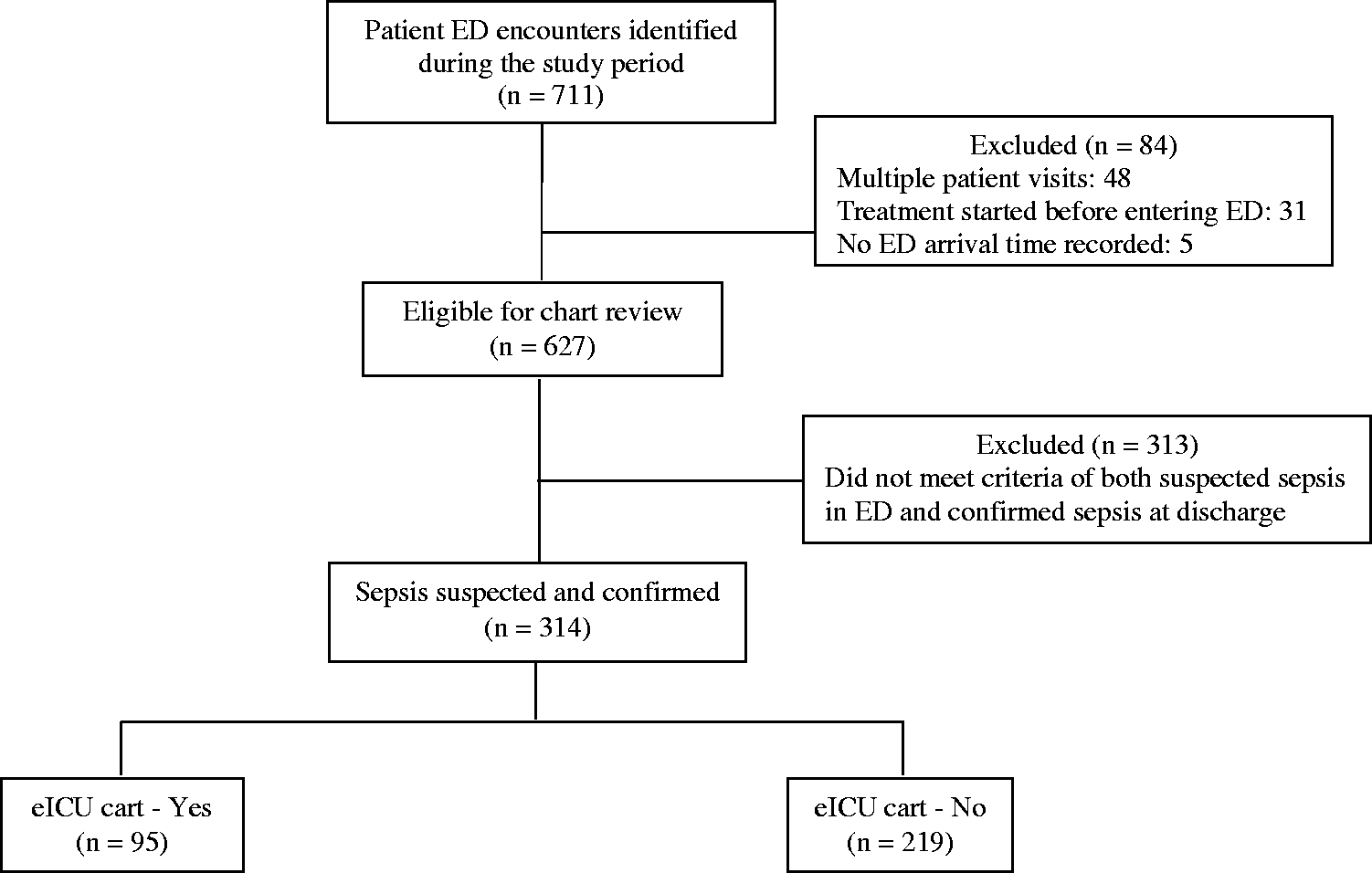
Patient characteristics.

COPD: chronic obstructive pulmonary disease; CHF: congestive heart failure; CKD: chronic kidney disease; CAD: coronary artery disease; UTI: urinary tract infection; DKA: diabetic ketoacidosis..
Adherence to Surviving Sepsis Campaign bundle guidelines.

Patient outcomes.

Discussion
Our findings suggest that for individuals with confirmed sepsis, ED exposure to a telemedicine-based eICU cart positively impacted adherence to some aspects of the 2010 Surviving Sepsis Campaign bundle, but did not improve overall mortality or reduce healthcare costs. Independently, we found improvements in several quality care measures with use of telemedicine eICU carts, including reduced length of ED stay as well as more timely administration of antibiotics and measurement of lactic acid levels.
In a global effort to improve the management, diagnosis and treatment of sepsis, the Society of Critical Care Medicine and European Society of Intensive Care Medicine joined together to form the Surviving Sepsis Campaign (SSC) in 2002. 15 Sepsis bundles were subsequently introduced in an effort to increase early delivery of specific goal-directed therapy (EGDT). In 2010, SSC bundles included: lactate level measurement; obtain blood cultures prior to antibiotics; administration of broad-spectrum antibiotics within three hours of ED presentation (and within one hour of non-ED admissions) and treatment for hypotension or lactate ≥4 mmol/L. These bundle objectives were to be completed within six hours for all patients presenting with severe sepsis or septic shock. 13
Literature on EGDT and sepsis bundles continues to evolve. SSC bundles have been updated to include: obtainment of blood cultures before antibiotic therapy and administration of broad-spectrum antimicrobials therapy within one hour of recognition of septic shock or severe sepsis without septic shock; reassessment of antimicrobial therapy daily for de-escalation, and when appropriate; initial fluid resuscitation with crystalloids. 16 Despite early reports of improved outcomes and decreased mortality, 17 more recent studies suggest that EGDT may not confer a survival benefit among patients with severe sepsis or septic shock.18,19 A recent meta-analysis found that EGDT was associated with higher red blood cell transfusions, greater inotropic use, and higher fluid administration in the first six hours following diagnosis of severe sepsis with and without shock. 20 Though changing definitions of sepsis and controversy over use of EGDT are raised, general agreement persists that early identification of lactic acidosis and antibiotic delivery remain important for the management of patients with severe sepsis. 8
It has been estimated that less than 30% of patients with severe sepsis receive antibiotic therapy within one hour, and that median time from presentation to antibiotic administration approaches two hours for the majority of patients. 8 In our ED, both telemedicine eICU cart-exposed and non-exposed groups met 2010 SSC guidelines for blood cultures and treatment with antibiotics, but the telemedicine carts did have a positive impact on the timing of both antibiotic administration and measurement of lactate levels. Time to treatment was shorter in the eICU cart-exposed group compared to those receiving standard treatment. Future work is needed to see if the eICU cart will impact compliance with antibiotic delivery within one hour.
Interestingly, we did not find that implementation of telemedicine eICU carts significantly impacted medical costs associated with sepsis diagnosis or overall survival. This may be because our study was performed at a well-funded tertiary care centre. Our institution is actively involved in quality improvement and research efforts to improve sepsis alerts and management. Resources that are easily accessible may allow ED physicians at our hospital to implement sepsis bundle guidelines without the assistance of a critical care physician or eICU nurse. However, telemedicine sepsis care may have a bigger impact on survival and overall costs if used in the EDs of smaller, rural hospitals where resources and staff may be limited. Badawi and Hassan suggest that telemedicine can provide ‘distinct advantages of expertise and standardization’ of care across hospital settings. 8
One interesting finding of our study was the reduction of patient time spent in the ED, a recognized quality of care measure for the Centers for Medicare & Medicaid Services and the National Quality Forum. 21 Overcrowding in the ED has been associated with negative consequences with regard to patient safety and treatment outcomes. 21 The ED physician must focus on delivery of care to multiple patients simultaneously, which could negatively impact adherence to strict timelines recommended by SSC bundled care. Utilization of telemedicine may allow the application of specific care within recommended time limits by physicians and nurses at remote sites, thus freeing the ED physician to continue needed bedside care, with resultant improvement in time management and workflow.
While our study findings suggest that exposure to the eICU cart was helpful in meeting SSC bundles guidelines, there may have been improvement just from the activation of the sepsis alert as part of eICU cart implementation. Previous reports found a sepsis workup and treatment protocol that involved an electronic health record-based triage sepsis alert, direct communication, mobilization of resources and standardized order sets improved fluid hydration and antibiotic administration in adult ED patients admitted with suspected sepsis, severe sepsis or septic shock. 22
Limitations
There are limitations to our study. Our data were collected retrospectively from nonrandom, observational cohorts at one institution. These factors limit generalizability to other populations. Upon chart review, a large number of patients did not meet our criteria of suspected sepsis on ED admission with sepsis confirmed at discharge. Patients met sepsis criteria in the ED and received sepsis appropriate therapy, but a sepsis diagnosis was not coded at discharge. Other patients did not have sepsis or suspected sepsis at ED admission, but sepsis was recorded as a discharge diagnosis, suggesting development of sepsis later in their hospital admission. Thus, it was important to exclude these groups in our evaluation of the eICU cart in the ED. However, this large number of excluded patients limited the power of our study. For example, based on our total hospital cost findings we would need 185 exposed patients and 426 non-exposed patients to detect a cost difference of US$4650 with the standard deviation of the difference of US$18,828. Thus, a larger sample would be needed in order to evaluate clinically meaningful hospital cost differences.
Conclusions
Our findings suggest that in individuals with confirmed sepsis, ED exposure to a telemedicine-based eICU cart impacted adherence to aspects of the Surviving Sepsis Campaign recommended bundle, but did not impact overall survival and medical costs. Smaller, rural, non-tertiary care centres may have improved outcomes with use of telemedicine in management of sepsis, but future investigations in the rural setting are needed.
Footnotes
Declaration of conflicting interests
The author(s) declared no potential conflicts of interest with respect to the research, authorship, and/or publication of this article.
Funding
The author(s) disclosed receipt of the following financial support for the research, authorship, and/or publication of this article: This research was supported by the OhioHealth Research Institute’s resident research fund.