



Abstract
Introduction
It is estimated that 70% of patients with posttraumatic stress disorder (PTSD) have chronic insomnia. A recent meta-analysis examined cognitive-behavioural therapy for insomnia (CBT-I) in veterans with and without PTSD, and suggested that most studies had questionable methodology, but generally supported its effectiveness in this population. Further, while CBT-I via telehealth (i.e. using telecommunication and information technology to deliver health services) has shown effectiveness for primary insomnia, it has not been applied to PTSD-related insomnia.
Methods
Veterans with insomnia who were diagnosed with PTSD (n = 12) or having significant subthreshold PTSD symptoms (n = 6) on the Clinician Administered PTSD Scale were randomly assigned to receive CBT-I in-person (n = 7) or by telephone (n = 11), to pilot test the potential effectiveness, acceptability, and feasibility of administering CBT-I in rural veterans. A six-week CBT-I protocol was delivered, and the veteran’s insomnia was assessed at post-treatment and follow-up.
Results
Given the small sample size, Cohen’s d was used to detect group differences, finding large effect sizes favouring the in-person delivery, until three-months post-treatment when this difference diminished. Most veterans found the treatment acceptable, regardless of mode of delivery. Based on the results, a larger project is feasible. Feasibility for a larger project is favourable.
Discussion
In summary, our findings uphold and extend previous research. Specifically, current pilot data suggest that telephone-delivered CBT-I may be able to reduce trauma-related insomnia symptoms. Future trials are needed to assess the effectiveness of CBT-I delivered to rural veterans with posttraumatic insomnia.
Introduction
Insomnia, defined as problems initiating or maintaining sleep or poor quality sleep, 1 is the most commonly reported symptom of posttraumatic stress disorder (PTSD). 2 Approximately 70% of patients with PTSD have insomnia, resulting in occupational, social, and physical health problems. 3 Insomnia is predictive of depression, suicidal ideation, and PTSD, 4 highlighting the need for treatments addressing sleep symptoms.
Insomnia responds well to cognitive-behavioural therapy for insomnia (CBT-I) both immediately and over time. 5 As such, the National Institute of Health has recommended CBT as a first-line treatment for insomnia. 6 Understanding the effectiveness of CBT-I in traumatized samples is especially important because individuals with posttraumatic- and primary insomnia may differ in that PTSD-driven symptoms (i.e. intrusive thoughts at bedtime, nightmares, and hypervigilance) leave patients simultaneously desirous and avoidant of sleep. 7
Research has shown that PTSD-related insomnia remains clinically significant after psychotherapeutic7,8 and psychopharmacologic 9 PTSD treatments have resolved other symptoms. For example, two studies examined insomnia following CBT for PTSD and found 48% and 70% had significant sleep problems following treatment.7,10 Further, a study of insomnia following evidence-based psychotherapies for PTSD found that insomnia symptoms decreased but did not remit. 11 Studies examining the effectiveness of CBT-I on PTSD-related sleep problems generally show that it is effective, 12 even when insomnia has not remitted during standard PTSD treatment. 13 However, more evidence is needed to confirm the use of CBT-I in veterans, 14 given that they have higher rates of PTSD, 15 and respond less well to PTSD treatments than non-veterans.16,17
Telehealth, defined as using telecommunication and information technology to deliver health services, 18 has been used to effectively deliver CBT for insomnia related to depression 19 and rural adults with primary insomnia. 20 However, the research on using telehealth to deliver CBT-I is limited to a few studies, and has not been applied to veterans or individuals with PTSD-related sleep problems. In addition, 5.2 million veterans reside in rural areas, making it difficult to access mental health care, and thus in need of telehealth services. 21 Therefore, the primary aim of this pilot project was to examine the feasibility, acceptability, and effectiveness of CBT-I delivered via telephone into the home among a small sample of rural veterans with PTSD symptoms.
Material and methods
Participants
Participants were recruited from a large, southeastern Veterans Affairs (VA) Mental Health Service, which contains five community-based outpatient clinics that lack PTSD speciality programmes. To be eligible for inclusion, veterans 1) had to meet PTSD criteria or report significant subclinical PTSD symptoms from a military-related trauma, as per the Diagnostic and Statistical Manual of Mental Disorders, Fourth Edition (DSM-IV) 1 ; 2) report impairing sleep problems within the last month, as per the Clinician Administered PTSD Scale (CAPS) 22 insomnia item (based on the 1-2 scoring rule); and 3) be deemed rural, as defined by living more than 30 miles23,24 from the PTSD clinic. Veterans with uncontrolled primary sleep disorders, determined by chart review (e.g. obstructive sleep apnoea), were excluded. Active psychosis and substance dependence, determined by the Structured Clinical Interview for DSM-IV (SCID) 25 sections, were also exclusions. Of note, no patients had a primary diagnosis of insomnia. Patients were not enrolled in other active psychotherapies. Participants could be on medication, including those prescribed for sleep, but were required to have a consistent regimen.
Assessments
Diagnostic interview
Self-report measures
Procedure
Veterans learned about the study from flyers, or from their treating clinician. Interested veterans contacted study staff to discuss the study and schedule screening appointments.
Data analytic plan
All analyses were conducted using SPSS (version 23). Initial assessments evaluated group differences on pre-treatment scores and other baseline characteristics using chi square test for independence and ANOVA. For the primary aim, examining whether reduction of insomnia is equivalent between groups, a hierarchical longitudinal linear regression analysis, with PSQI scores nested within patients, was conducted to account for the correlation within patients of their PSQI scores over time. Participants who did not complete all outcome measures were not included in the analysis for that time point. Effect size estimates were calculated based on means from immediate post-treatment and one- and three-month post-treatment PSQI global scores. Although the pilot study is inadequately powered to draw conclusions regarding equivalence, this will facilitate defining the clinically important difference.
For our second aim, regarding acceptability, we used chi square analyses to examine ratings by groups. For feasibility, recruitment and retention estimations were calculated as follows: percent eligible = 100*(# of eligible patients / # referred); percent recruited = 100*(# randomized / # of eligible patients) and percent retained = 100*(# completing assessment at three-months post-intervention / # randomized). The percent completing all sessions of treatment = 100*(# completing all six sessions / # randomized). Because attrition was unlikely to be random, we compared characteristics of persons who did and did not complete the therapy sessions.
Results
Eighteen veterans with full (n = 12; 67%) or subthreshold (n = 6; 33%) PTSD were recruited (see Figure 1 CONSORT diagram). There were no differences in full versus subthreshold PTSD by treatment group, X2(1, n = 18) = .486, p = .494. The mean age of the sample was 53.8 (SD = 12.0). As per the CONSORT recommendations for randomized controlled trials (RCTs), baseline demographic characteristics of the randomized groups were calculated (see Table 1). There was no difference in age, F(1, 16) = 0.28, p = .870, or in those who were taking psychotropic medications for sleep across groups, X2(2, n = 18) = 0.047, p = .829. To compare other demographic information, some groupings were collapsed to achieve an adequate cell size for chi-square analyses. There were no differences in race, X2(1, n = 17) = 1.893, p = .169; marital status, X2(2, n = 18) = 4.535, p = .104; educational achievement, X2(1, n = 18) = .267, p = .605; or employment status, X2(1, n = 18) = 1.169, p = .280.
Consort diagram detailing patient flow, assignment and dropout. Sample demographics (N = 18).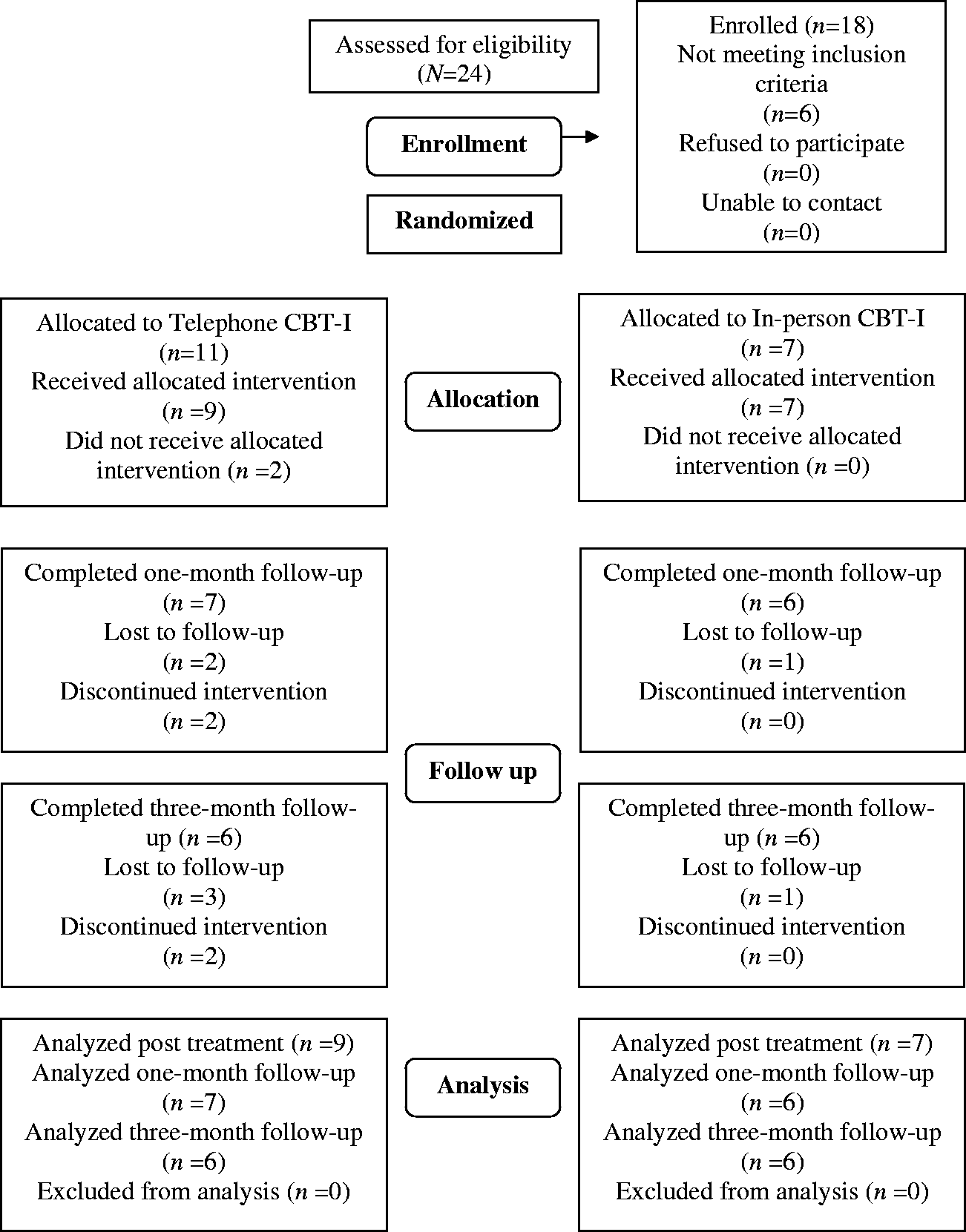

PSQI mean and SD by assessment point.

Therapists were not randomly assigned to treatment modality, so we examined differences in mode of delivery and PSQI scores by therapist. We found no differences in mode of delivery, X2(2, n = 18) = 1.169, p = .280, or in PSQI scores immediately post-treatment, F(1,12) = 1.048, p = .328, at one- F(1,12) = 1.814, p = .205, or three-months post-treatment, F(1,11) = 1.716, p = .219 by therapist.
There was no significant difference between the groups at baseline, F(1,16) = 0.00, p = .99, although there were significant changes over time in the PSQI scores of the two groups combined, F(3,16) = 7.58, p = .00. The term of most interest, the group-by-time interaction, was not significant, F(3,16) = 1.86, p = .18, indicating that the two groups did not differ over time in their PSQI scores.
Given the sample size, the current study was underpowered to detect group differences. As such, we evaluated the effectiveness of telephone-delivered CBT-I using between- and within-group effect sizes using Cohen’s d. Results revealed large between-group effect sizes favouring the in-person CBT-I group both immediately (d = 0.77) and one month post-intervention (d = 1.06), which diminished at three-months post-intervention (d = 0.10). When looking at within-group effect sizes, results revealed large effects for in-person CBT-I at all three time points (ds range from 1.00 to1.61) and medium to large effects for telephone-delivered CBT-I (ds range from .55 to 1.33).
Regarding acceptability, 83%, across both groups, found treatment moderately useful or more and would recommend it to other veterans. To analyse group differences in the small sample, chi square was used. For this, Likert ratings were collapsed into ‘moderately’ or less (ratings 1–4) versus ‘very’ or more (5 –7) to increase group membership, and no differences were found by group for usefulness, X2(1, n = 13) = 2.236, p = .135, or satisfaction, X2(1, n = 13) = 2.026, p = .155. However, it is notable, that no veterans fell into the moderately or less group on either variable in the in-person group, while 57.1% and 28.6% of the telephone group reported moderate or less ratings of usefulness and satisfaction, respectively.
Regarding feasibility, 24 veterans were referred to the study and six (25%) were found to be ineligible because they lacked PTSD/subthreshold PTSD (n = 2), CAPS-assessed insomnia (n = 1), or screened positive for psychosis (n = 1) or psychosis and substance dependence (n = 2) on the SCID. Thus, 50% (16/24) completed the three month follow up assessment of the 24 assessed for eligibility, 75% (18/24) were eligible, 100% of whom were enrolled; 67% (16/24) received the allocated treatment; and 50% (12/24) completed all assessments. Two patients dropped out after session one (see Figure 1). 30 Thus, we compared those who did and did not complete therapy, and found no differences on demographic variables, medication use, nor on CAPS or PSQI baseline scores.
Discussion
Our primary aim was to examine whether CBT-I can be delivered effectively via telephone. Preliminary data suggest that veterans will benefit from CBT-I regardless of mode of delivery. While in-person delivery reduced insomnia symptoms faster, there were no differences at month three post-treatment. Further, there were large effect sizes in both groups at one and three months, indicating effectiveness regardless of delivery modality. Thus, while more research is needed, this study suggests that using CBT-I to reach rural veterans, who might otherwise go without treatment, may be effective.
Importantly, only three veterans (one in telephone therapy) achieved good sleeper status (PSQI score lower than 5). Previous research using the PSQI to measure veterans’ insomnia has found that sleep problems are offset in this population, but less often when the veterans have PTSD. 31 Furthermore PSQI scores are generally higher in veterans than the general population, particularly those with mental health problems. 32 It could be that it is unrealistic to expect sleep problems to remit in this population without also addressing PTSD symptoms.
It is unclear why veterans responded faster in-person than in the telephone group. We required that six weeks of psychotherapy be completed in eight weeks, but did not track how many weeks participants took to complete the protocol. It is possible that those receiving telephone CBT-I did not complete as much homework or took longer to complete the therapy than those receiving in-person CBT-I. Indeed, this may be one reason why we continue to see improvement on the part of the telehealth group, as opposed to the in-person group, which appeared to regress back towards the post-treatment mean. This should be tracked in future protocols.
A secondary aim of this study was to determine the acceptability and feasibility of telephone-delivered CBT-I, as the telephone intervention may increase access and address concerns of veterans who do not want to seek treatment from a mental health clinic. We found that on average, veterans reported being satisfied with treatment, regardless of group assignment. While all veterans would recommend the treatment to others, regardless of condition, fewer individuals in the telephone group found it useful. Acceptability ratings were assessed immediately post-treatment, a time point when the telephone group had not seen treatment gains regarding symptom reduction. If we had questioned usefulness at three-months post-treatment, findings may have been more consistent across groups.
Feasibility for running a future, larger study was acceptable, with high recruitment and eligibility rates. Future studies should be aware that there was more attrition from therapy in the telephone therapy group. Additionally, more participants in the telephone group failed to complete the full assessments, even though these were done by telephone. Whereas only one veteran in the in-person group did not complete all assessments, six individuals did not in the telephone group. In PTSD samples, no differences have been found between CBT-I completers and non-completers. 33 However, in PTSD treatment, the most stable predictor of attrition is higher levels of PTSD symptoms pre-treatment.34,35 We did not find higher PTSD or insomnia scores across groups. Further, although depression has been found to be a predictor of dropout in non-trauma-related CBT-I studies, 36 we did not assess depression in this study.
Unfortunately, we did not ascertain veterans’ treatment preferences. Previous research has shown that treatment preferences affect treatment initiative, 37 attrition, 38 adherence 39 and outcome. 40 It may be that veteran preference for mode of delivery underlies the failure to complete the protocol. For example, it is possible that rural veterans with PTSD, who are socially isolated, prefer to report to a clinic for treatment. Public commitment 41 might also explain the differences in dropout, as veterans who met with their therapist in-person may have felt more commitment to the project than those who met over the phone. Lastly, it took more time for CBT-I to work with telephone delivery, and this delay in improvement may have contributed to attrition rates. Regardless, we found that for those veterans who completed treatment, CBT-I delivered via telephone worked as well as when delivered in-person.
The current study should be considered in light of its limitations and opportunities for subsequent research. First, the pilot sample size was small. Future research should seek to replicate these findings using larger outpatient samples of rural veterans. Second, the sample was entirely male. Although men comprise nearly 85% of our armed forces, the number of female personnel has increased in recent years. As such, future research should seek to replicate these findings using more diverse samples. Third, outcomes of interest were measured using self-report assessment. Despite using well-established and validated instruments for our sleep outcome, future research would benefit from incorporating other methods of assessment (e.g. actigraphy or polysomnography). Fourth, we did not investigate whether changes in sleep resulted in actual functional improvements, which would be important for future research. Finally, analyses were conducted using only those individuals with complete data. While it possible that our findings could differ were other methods used to assess treatment dropout including intent-to-treat, there were no differences in baseline variables for those who did and did not complete treatment.
In summary, previous research has consistently demonstrated the effectiveness of CBT-I, 5 and our findings uphold and extend these results. The current pilot data suggest that trauma-related insomnia symptoms can be reduced using telephone-delivered CBT-I at comparable rates to in-person delivery. Telehealth delivery of CBT-I was feasible, but was less acceptable and resulted in higher drop out rates than delivery in-person. Future RCTs are needed to further assess the feasibility, acceptability, and effectiveness of CBT-I delivered to rural veterans with posttraumatic insomnia.
Footnotes
Acknowledgements
The contents of this report do not represent the views of the Department of Veterans Affairs, the US government, or Baylor College of Medicine. The authors would like to acknowledge Marie C. Barrett, MA, for her help with editing this manuscript.
Declaration of Conflicting Interests
The author(s) declared the following potential conflicts of interest with respect to the research, authorship, and/or publication of this article: Drs Franklin and Thompson have received royalties from New Harbinger Publications for a book titled, The Posttraumatic Insomnia Workbook. All other authors declare no conflict of interest.
Funding
The author(s) disclosed receipt of the following financial support for the research, authorship, and/or publication of this article: This research was funded by the Veterans Affairs VISN 16 MIRECC Pilot Project Programme and with the use of resources and facilities of the Houston VA HSR&D Center for Innovations in Quality, Effectiveness and Safety (CIN13-413). There is no grant number associated with this funding.