



Abstract
Introduction
Palliative care (PC) services in the African region need to adapt to manage rising numbers of patients with cancer or other life-limiting conditions. Mobile phone use in healthcare delivery (mHealth) is at an early stage of development for PC, but may provide new approaches to supporting patients regionally, particularly those with non-communicable diseases.
Methods
We conducted an online survey of 51 PC providers across 21 countries in the African region to identify: (i) current mHealth use in PC service delivery; (ii) potential barriers to mHealth use; and (iii) provider priorities for research development.
Results
mHealth approaches were reported across 71.4% of services in which respondents were based. Barriers to mHealth research include patients not having access to phones, mobile network access, and limited access to expertise and hardware required for mHealth. Research priorities were identified which included exploring ways of incorporating mHealth into patient care and ensuring access and relevance of mHealth for patients and health professionals.
Discussion
mHealth approaches are present across PC services in the African region, but so too are barriers to their use. Further work is required to explore how existing mHealth activities might be further developed and aligned with priority areas for PC development. Crucially, user engagement that seeks to understand the preferences and priorities of patients with PC needs, their caregivers, and those involved in the provision of PC should remain central to these efforts.
Introduction
Palliative care (PC) – the prevention and relief of physical, emotional, social, or spiritual suffering associated with any chronic or life-threatening illness, beginning from the time of diagnosis – is a fundamental component of basic and essential health services. 1 Across the African region, PC development is at an early stage. 2 For example, in sub-Saharan Africa, PC is present in 24 of 48 countries, up from only five in 2004. 3 While provision of PC is increasing across the African region, still less than 5% of people who need it can access it. 4 Efforts to expand PC provision are underway, but coverage remains woefully inadequate. 5 Historically, PC in the African region has predominantly focused on HIV/AIDS, partly due to donor-driven funding priorities. 6 However, recent international and regional political declarations constitute a new global non-communicable disease (NCD) agenda. 6 This is in response to rising NCD rates; new cancer cases, for example, are projected to nearly double from 645,000 in 2012 to 1.28 million by 2030. 6 This epidemiological transition requires service delivery systems that are able to adapt to support patients under the chronic care service model. Currently, the need for PC services are at risk of outstripping capacity 7 unless effective strategies to promote their development are given the highest priority for implementation. 8
The use of information and communication technology (ICT) in PC provision is increasing across the United States and Europe. 9 Benefits of ICT use in these regions include supported pain management 10 and improved communication between patients and health professionals. 11 ICT approaches have also been shown to lead to improvements in the scale, efficiency and accuracy of data collection 12 and are acceptable to both patients 13 and health professionals 14 when used to improve cancer care coordination. In the African region, factors such as expanding penetration of mobile networks in rural communities and reduced costs of mobile handsets are driving the exploration of mHealth (i.e. the practice of medicine and public health supported by mobile devices) to support delivery of healthcare services.15,16 Mobile phones provide a means of communicating and augmenting existing services to engage with patients and their families, 6 enabling rapid access to clinical and social support networks. 17 Consequently, mHealth approaches are viewed as promising health investments in developing countries. 18 When used in this way, mHealth provides a means of communicating directly with a patient or family caregiver, independent of their location, to understand their needs and care preferences. Telecommunications can potentially bridge necessary health system structures from rigid pyramidal to plastic networks that improve access at all levels of care. 19 In the context of PC services in the African region, mHealth approaches could guide the exploration of new ways of communicating with, managing and coordinating patients and their caregivers. For example, mHealth could facilitate the capture of much-needed evidence on symptom prevalence and burden20–23 and patient-centred outcomes. 24 The ability to capture patient-level data, whether using mHealth or alternative approaches, is a precondition to understanding which PC components are currently effective and aligned with patient need. 25 These data can be used to evaluate the effectiveness of existing services, directing where adaptation to PC services is required and incorporating the voice of patients and their families in care. mHealth may also provide a means of supporting PC patients with NCDs requiring longer engagement periods, providing flexibility during their illness trajectory dependent on levels of assistance required. 6 For health professionals too, mHealth approaches could be explored for overcoming a key challenge of PC in the African region; a lack of PC education. 26
In the African region, the proliferation of mHealth approaches has demonstrated successes with chronic disease management, 27 patient behaviour change and health-systems strengthening, 28 reducing costs of patient monitoring, and improving adherence and communication. 29 However, the implementation of mHealth is threatened by factors such as dependency on funding, unclear healthcare system responsibilities, unreliable infrastructure and a lack of evidence on cost-effectiveness. 16 While this could be an opportune time to explore how evidence-based mHealth interventions might form part of the evolving PC services in the African region, 30 mHealth development needs to be planned, measured and evaluated. For example, existing mHealth activity and the capacity of PC services in the African region to develop mHealth approaches is not well understood. A recent literature review on mHealth use in PC services in sub-Saharan Africa identified early research activities 30 but highlighted that little is known about the extent of current mHealth use or the way in which it is viewed by service providers. Addressing this gap in knowledge is essential to guide further research activity. For this reason, this study aims to: (i) current mHealth use in PC service delivery in the African region; (ii) potential barriers to mHealth use; and (iii) provider priorities for research development.
Methods
We adopted a mixed methods descriptive design, using an online survey, in English and French, between May and August 2016. The survey sought to capture responses from the African region, encompassing both North Africa and sub-Saharan Africa. PC provision in North Africa, most developed in Morocco and Egypt, is still in the very early stages of service development, 31 mirroring PC development in most countries across sub-Saharan Africa. 32 Invitations to participate in the research and a link to the online survey (in the relevant language) were sent via email. Those approached to complete the survey were identified using membership lists of the African Palliative Care Association (APCA). APCA is a pan-African organisation that works collaboratively with both providers of PC services to help expand service provision and with governments and policymakers to ensure an optimum policy and regulatory framework for PC in the African region. Their contact lists contain PC providers established across the African region and national PC associations in 10 countries (i.e. Cameroon, Côte D’Ivoire, Democratic Republic of the Congo, Kenya, Malawi, Morocco, Senegal, South Africa, Tunisia and Uganda). APCA sent requests for national associations to distribute a link to the online questionnaire to providers that were members of their association. Where national associations were absent, direct contact was made, facilitated by APCA, with PC services or ministries of health where contact details were available.
Questionnaire
A questionnaire was developed specifically for this survey given no other instrument for assessing mobile device use in health services was found and was hosted by the Bristol Online Survey (www.onlinesurveys.ac.uk) service. Respondents were asked to indicate the country in which they work in PC, their professional role and length of PC experience. They were also asked to provide details on the service(s) in which they are based, including geographical region covered (i.e., urban, rural, peri-urban) and types of delivery (i.e., inpatient care, outpatient care, home visits, day care). Respondents were presented with the image shown in Figure 1, which was informed by the World Health Organization (WHO) visual framework for mHealth innovations as health system strengthening tools.
33
Four key stages of PC delivery models, typical in the Africa Region,
3
were added to the top of the figure. This enabled the charting of which uses of mHealth are occurring for PC provision across the advanced disease illness trajectory. A draft version of the adapted framework was shared with seven PC organisations in Rwanda, Kenya and Uganda for comment. Following two iterations, the framework was finalised by two authors (MA, EN). Respondents were asked, for each of the 13 applications of mobile devices outlined in Figure 1, whether they were currently using mobile devices in that way. If respondents answered ‘yes’, they were asked to define at which of the four stages of the PC pathway this was occurring, alongside providing a description of how mobile devices were being used in this way. Respondents were asked to describe any other uses of mobile devices with patients and health professionals not outlined in the figure. The final questions focused on respondents’ priorities for research on mobile device use in PC services. They were asked to state their key priority for mHealth research in PC, and to outline any barriers they anticipated to the development of mHealth approaches in services and to research on mHealth.
mHealth PC framework for the African region presented during the survey. The framework combines the WHO mHealth and ICT framework with a care pathway depicting PC provision in the African region.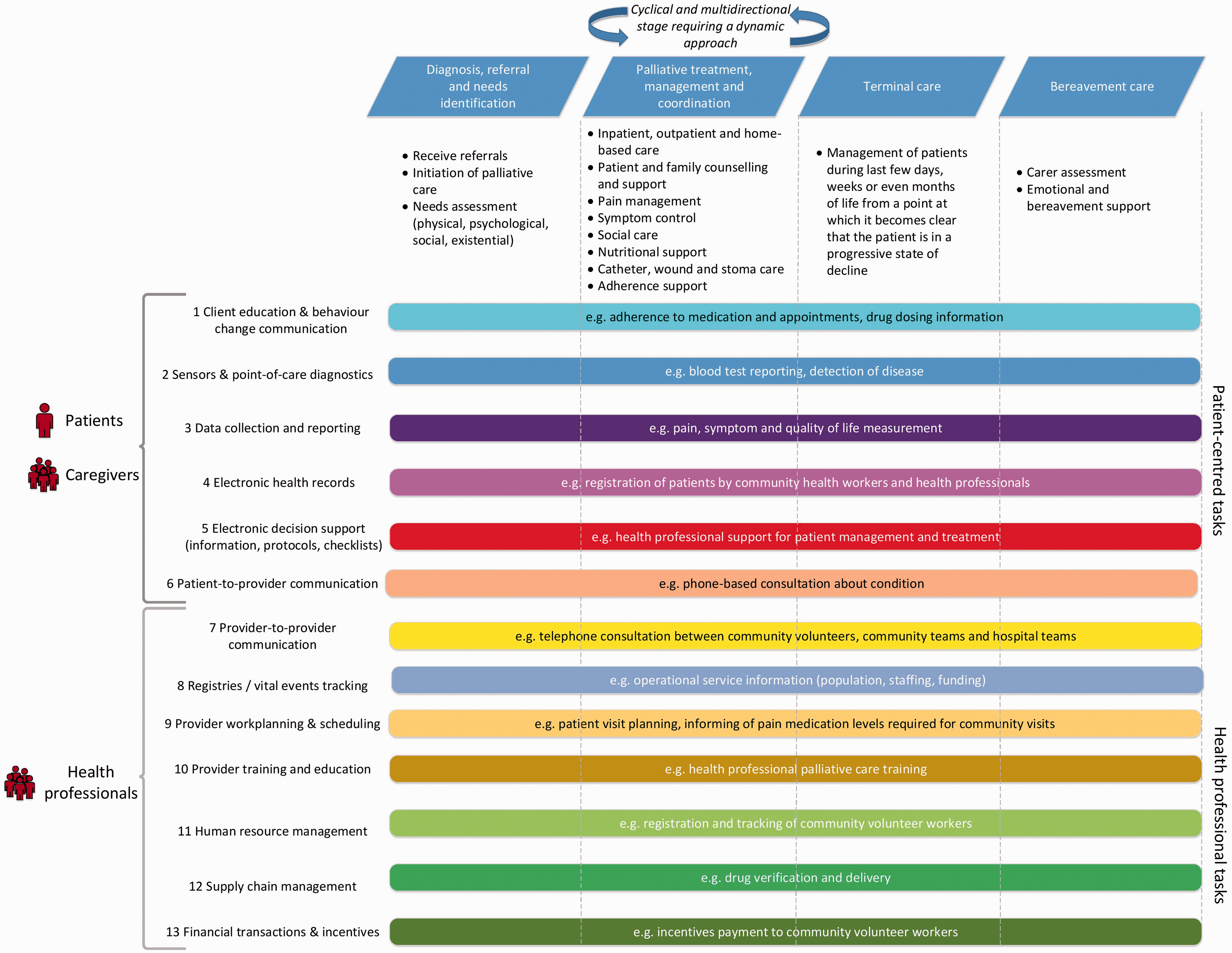
The questionnaire was piloted with four PC professionals across four countries in the African Region (Cameroon, Kenya, Malawi and Uganda) prior to being distributed to all providers.
Sample
The sample consisted of PC professionals fulfilling the following criteria: working within a country in the African region where PC provision is present; contact details of the PC organisation were held or could be obtained by APCA; could be contacted by email; and had internet access to complete the online questionnaire.
Analysis
Descriptive analysis was performed on responses, completed using SPSS (v.22). Findings were synthesised using geographical information system software (i.e. ArcGIS). Free text responses were analysed using content analysis conducted independently by two researchers (MA, EN), supported by NVivo software (v.10).
Results
In total, 101 PC organisations were contacted across 32 countries in the African region, including national associations in 10 countries. There were 51 responses to the questionnaire from 21 countries; a response rate of 50.5%. All responses were recorded via the online questionnaire system. Data were collected between May and August 2016. Respondents were from services that varied in staff composition, size, service provision and geographical region served. Respondents to the questionnaire had a number of different job roles across countries (Figure 2(a)). The most common respondents were nurses (n = 25; 49.0%), physicians (n = 7; 13.7%), administrators (n = 4; 7.8%) and clinical officers (n = 4; 7.8%).
(a) Job role and (b) experience of survey respondents.
Years’ experience of respondents varied (Figure 2(b)), with most respondents (n = 39; 76.5%) having between 1 and 8 years of experience in their current role. The team sizes varied from 2 to 100 (IQR = 8) staff members, with years of experience working in PC services ranging from 1 to 20 years (IQR = 5) (Figure 2(b)). Three services also reported that they had 400 (Malawi), 50 (Democratic Republic of the Congo) and 300 (Zimbabwe) volunteers involved with their services alongside clinical staff. Geographical coverage of PC services was reported as urban (n = 34; 66.6%), peri-urban (n = 10; 19.6%) and rural settings (n = 11; 21.6%), with seven services reporting coverage across more than one geographical setting. Clinical services were delivered through inpatient services (n = 29; 56.9%), outpatient services (n = 36; 70.6%), day care (n = 24; 47.1%) and home visits (n = 35; 68.6%).
Reported mHealth use
mHealth use was reported across 15 of the 21 (71.4%) countries from which responses were obtained (Figure 3). The most commonly reported mHealth uses were for patient education and behaviour change communication, data collection and reporting, and patient-to-provider communication (as detailed in Table 1). The mHealth use reported least across participants was to support sensors or point-of-care diagnostics; reported by providers in two (9.6%) countries.
Number of mHealth uses reported by respondents across participating countries. Overview of mHealth uses reported across participating countries. A: diagnosis, referral and needs identification; B: palliative treatment, management and coordination; C: terminal care; D: bereavement care.

Descriptions of mHealth use categories as reported by respondents.

Research priorities for mHealth in PC in the African Region
Priorities for research on mHealth
Priorities for research on mHealth in PC in the African region.

Barriers to mHealth use in PC services
Across respondents, six barriers to developing mHealth approaches in PC were identified: (i) patients not having access to phones (whether through lack of money or not owning their own phone); (ii) mobile network access, with unreliable networks and limited internet in some countries; (iii) limited access to expertise and hardware required for mHealth use (e.g. limited expertise to set up and use new mobile phone technology, lack of computer literacy in healthcare teams, need for electricity points to charge mobile devices); (iv) existing limits to the capacity of services (such as limited administrative support to take on additional tasks associated with mHealth approaches); (v) financial and cost constraints (e.g. airtime costs for voice and text communication on mobile phones), with cheaper methods of communicating, such as WhatsApp, not being available on cheaper phones; and (vi) governance constraints (such as those arising from resistance to adoption or buy-in from ministries of health, or institutional protocols to mHealth use).
Barriers to mHealth research in PC services across the African Region
A proportion of respondents (n = 15; 29.4%) suggested there were no barriers to mHealth research in their service, although barriers were identified. One participant noted there may be resistance from both health professionals and patients to mHealth research, fearing it will be used to replace human contact. There may also be a lack of commitment to research, with limited or no research personnel and capacity to conduct research in many services (n = 12; 23.5%). The lack of understanding and knowledge of how to conduct mHealth research was itself seen as a potential barrier to future mHealth research activities. Respondents highlighted that a further barrier to conducting mHealth research was a lack of necessary infrastructure, such as having hardware and the internet available at sites (n = 14; 27.5%). For patients, too, the need to have access to a mobile device and network were noted (n = 13; 25.5%). Lastly, patient literacy was referred to by respondents, alongside knowledge of how to use mobile devices (n = 4; 7.8%).
Discussion
This study presents the first survey of mHealth activity by PC service providers across the African region. Widespread use of mobile devices has been charted across a large proportion of countries in which respondents were based. Each of the common mHealth and ICT applications as identified by the WHO 33 were reported. Multiple, diverse uses of mobile devices are being integrated into PC provision in the African region. A lead priority for mHealth research is the exploration of mHealth to support patient care. However, future mHealth development for PC services in the region need to be mindful of barriers that have been identified. Development and implementation of mHealth approaches need to mitigate, for example, the lack of access to hardware and software to host mHealth approaches, alongside not having adequate expertise to support mHealth use as part of PC service delivery. These barriers may be associated with potential additional costs, at least during initial implementation.
A recent review of mHealth use in NCD care across low- and middle-income settings noted that studies currently lack comparator arms, clinical endpoints or are of short duration. 34 However it is promising that there has been an increase in the registration of clinical trial protocols of large-scale, multidimensional mHealth interventions being reported. 28 Important work to explore user perspectives is beginning as part of early piloting 35 and qualitative research. 36 Furthermore, initiatives led by the WHO Collaborating Centre on Research and Capacity Strengthening of Health Policy, Governance and Services, and the WHO Collaborating Centre for Palliative care, policy and rehabilitation, are beginning to explore the development and assessment of mHealth in in this region PC services in the African Region. To date, no research has explored how and why PC patients in this region might interact with mHealth approaches and where there could be value for them. For mHealth to support evaluation and adaptation of services to accommodate rising demands from NCDs, user engagement with patients (such as those with cancer) and their caregivers is an essential next step to inform its design and development. Capturing the needs of end-user perspectives (including those of health professionals) is crucial to health technology development 37 and to understanding contextual factors surrounding implementation. 38 Of equal importance is the need to explore issues related to the privacy, safety and security of data and its transfer. These are issues being faced by researchers and practitioners globally and are a key challenge for patient-centred approaches to mHealth, with calls for international cooperation to form codes of practice and amend regulatory conditions. 39
Varied and widespread use of mHealth activities were reported in the survey. To share information on current activities, facilitate collaboration and avoid duplication of mHealth efforts at this early stage, APCA has initiated a mHealth Research Network. The network provides updates on mHealth development in the region and enables PC services to disseminate information about their current mHealth activities with the opportunity to share their experiences. It also enables PC services to disseminate information about their current mHealth activities with the opportunity to share their experiences. There is a need to now expand the network, ensure representation of PC providers delivering services in a diverse range of settings across the African region and continue to develop mHealth evaluation research. The emerging health informatics environment across the African region may then facilitate the transfer and sharing of feasible and effective mHealth approaches. District and national health information systems (HIS) strengthening projects across the region suggest an environment conducive to technology development for healthcare delivery. 40 HIS are being built using similar software platforms, minimising issues around interoperability, such as how data gathered from mobile phones can be used to supply information. Recent recommendations for strengthening health-systems functions to expand access to PC and pain relief included incorporating PC and pain relief access, quality and financing indicators into health information systems. 41 Furthermore, supporting links between PC services and district and national HIS could help to build a clearer picture of the burden of advanced disease requiring PC across the region.
This study has some limitations. Participants were required to have internet access to participate in the survey. This approach may have precluded participation of rural services without internet access that may be utilising mHealth approaches. Additionally, identification of participants occurred through email-based mailing lists developed by APCA. This was crucial for contacting a wide range of PC providers across the region. However, providers and national associations working with APCA represent established PC services and those utilising electronic communication. Those working in services or countries where PC is being delivered less formally may not be represented, alongside providers who do not rely on electronic communication. Future approaches to surveying PC providers may need to explore alternative modes to support wider participation.
This early stage of mHealth development in PC services in the African Region could benefit from adopting structured and evidence-based approaches to mHealth development and piloting. 42 This should be accompanied by efforts to develop or scale-up technology-based approaches that align with the unmet needs of intended end users and priority areas for PC development in the African region. For example, the need to increase PC education in the African region has been well documented.5,26,43,44 Gathering a deeper understanding of the multiple mHealth approaches to training and education identified in this study could inform feasible options for expanding access through flexible teaching formats. For patients too, mHealth approaches present opportunities to explore, for example, integration of patient-reported data from PC services into electronic information systems. In the United States this has been shown to improve the scale, efficiency and accuracy of data collection. 12 Adopting mHealth approaches in the African region could help to determine the experience of patients in receipt of PC, such as those with cancer and other NCDs, and explore how best to adapt services to meet their needs. Alongside collection of data from patients, such work should also explore how mHealth approaches can deliver meaningful information and resources directly to patients and their caregivers. With mHealth activities reported across PC in the African region, and priorities for its development emerging, unified and collaborative working needs to be encouraged to determine how mHealth can best support the delivery of care for increasing numbers of patients and their caregivers requiring PC.
Footnotes
Authors’ Note
Eve Namisango is also affiliated to Department of Palliative Care, Policy & Rehabilitation, Cicely Saunders Institute, Kings College London, UK.
Acknowledgements
We would like to thank all respondents to the survey with special thanks to the national associations who supported distribution of the survey to palliative care providers in their country. We would also like to thank Rachel Oldroyd at the Consumer Data Research Centre, University of Leeds, for guidance with ArcGIS.
Author contributions
MA developed the survey approach and content, with support from EN and RP. MA led data collection, facilitated by EN. All authors were involved in drafting of the manuscript and have approved the final version for publication. All authors agree to be accountable for all aspects of the work in ensuring that questions related to the accuracy or integrity of any part of the work are appropriately investigated and resolved.
Availability of data and materials
The datasets used and analysed during the current study are available from the corresponding author on reasonable request.
Consent to publish
Consent to publish was obtained from all participants prior to completion of the online survey. Consent was obtained via a form presented online and was mandatory for all participants prior to participation in the study.
Declaration of Conflicting Interests
The author(s) declared no potential conflicts of interest with respect to the research, authorship and/or publication of this article.
Ethics approval
Ethical approval for the study was obtained from the University of Leeds Research Ethics Committee (reference MREC15-089).
Funding
The author(s) disclosed receipt of the following financial support for the research, authorship, and/or publication of this article: the University of Leeds Wellcome Trust Institutional Strategic Support Fund.