



Abstract
Introduction
The prevalence of diabetes is increasing around the world, especially in populations with limited health service resources. Diabetes is associated with increased mortality and cost. Therefore, we investigated the impact of increasing access to diabetes care through telemedicine.
Methods
Five rural communities were connected via videoconference. Patients received diabetes consultation (DC) or diabetes self-management education (DSME). DC was performed by an endocrinologist, while DSME was delivered by a certified diabetes educator. Haemoglobin A1c (HbA1c), blood pressure (BP) and lipid profile were evaluated as outcome measures.
Results
Sixty-nine subjects (70% females, 91% Caucasians) were studied, with 33 receiving DC and 36 receiving DSME. Patients were aged 56.7 ± 9.4 and 56.5 ± 6.7 years, respectively (p > 0.5), and had had diabetes for 11.4 ± 10.1 and 11.7 ± 9.2 years, respectively (p > 0.5). Both DC and DSME reduced HbA1c equally: DC at baseline 9.3 ± 1.3% compared to at 12 months 7.2 ± 0.9% (p = 0.0002), and DSME at baseline 9.8 ± 1.6% compared to at 12 months 8.3 ± 1.9% (p = 0.009). There was no difference in HbA1c between DC and DSME at baseline and at 12 months (p > 0.1). On the average, BP and lipids were equally controlled in DC and DSME at six months: total cholesterol 178.3 ± 50.5 mg/dL versus 185.9 ± 57.3 mg/dL, low-density lipoprotein cholesterol 91.4 ± 36.1 mg/dL versus 91.5 ± 50.2 mg/dL, high-density lipoprotein cholesterol 46.2 ± 11.0 mg/dL versus 43.5 ± 10.8 mg/dL, systolic BP 136.8 ± 23.6 mmHg versus 131.9 ± 22.3 mmHg, diastolic BP 72.0 ± 13.2 mmHg versus 77.7 ± 11.3 mmHg (p > 0.1). All subjects found DC and DSME cost effective, while 97% reported better diabetes control.
Discussion
In patients with long-standing uncontrolled diabetes who lived in rural communities with high diabetes-related mortality rates, DC or DSME delivered by videoconference improved glycemic control. No difference was found between the two interventions.
Introduction
The prevalence rate of diabetes has continued to increase across the world. Approximately 80% of people with diabetes live in low- and middle-income countries, many of which have rural populations. 1 In the USA, 34.2 million people (10.5% of the population) have diabetes, 2 but the prevalence rate may be 17% higher in rural communities compared to urban areas. 3 , 4 This disparity is compounded by the shortage of specialists, including endocrinologists especially in rural populations, thus leading to poor outcomes.5–7
In an earlier report, we demonstrated that a programme which provided diabetes self-management education (DSME) via telemedicine was beneficial in improving glycaemic control. 8 A systematic review of 16 studies with a pooled sample size of 2768 patients showed that glycated haemoglobin levels were significantly lower in patients allocated to telemedicine interventions than in controls at a median follow-up of nine months (mean difference –0.31, 95% confidence interval (CI) –0.37 to –0.24; p<0.00001). 9 However, an earlier review concluded that evidence for the efficacy of telemedicine in improving haemoglobin A1c (HbA1c) or other aspects of diabetes management was weak. 10 Only a few countries around the world utilised telemedicine in the care of patients with diabetes. 11 Given the projected increase in the prevalence of diabetes, especially in low- to middle-income countries with limited health-care resources, there is the need to investigate and employ the provision and expansion of care using telemedicine. The need to maintain physical distancing and to avoid large congregations imposed by the coronavirus disease 2019 (COVID-19) pandemic has made the application of remote health-care technology more imperative. Diabetic complications are significantly ameliorated by optimal glycaemic control. 12 , 13 Cardiovascular disease, including coronary artery disease, myocardial infarction, heart failure and stroke, is the leading cause of death in patients with diabetes. A meta-analysis of 13 prospective studies reported that for every one percentage point increase in HbA1c, the relative risk for a cardiovascular event was 1.18 (95% CI 1.10–1.26). 14 We hypothesised that bridging the gap in diabetes care in patients living in rural communities via telemedicine would improve diabetes control and cardiovascular risk. Therefore, we investigated the effect of diabetes consultation (DC) versus DMSE delivered through videoconference technology on glycaemic control and cardiovascular risk factors in patients living in rural communities with high diabetes-related mortality rates.
Methods
We conducted a prospective intervention study of patients with poorly controlled diabetes mellitus who were seen at the Telemedicine Unit of the University of Tennessee Health Science Center, Memphis, Tennessee, from September 2007 to August 2010. The patients were referred by their primary care providers for either DC or DSME. A meeting was held with the referring physicians in the community hospitals to discuss the study, and a research coordinator/nurse was appointed for each centre. In this study, we compared outcome measures between those who underwent DC and those who received DMSE.
Study population
The patients were recruited from five rural communities in Tennessee: Somerville, Parsons, Savannah, Trenton and Dyersburg. The diabetes-related mortality rates in these communities ranged from 41.5 to 84.7 per 100,000, which were higher than the state average of 31 per 100,000. 15 These communities were also health professional shortage areas, except for Trenton. 16 The inclusion criteria were patients aged ≥18 years with a known history of diabetes who had HbA1c ≥8.0%, gave informed consent and were referred to the telemedicine endocrine programme at the University of Tennessee Health Science Center by their primary care provider. The exclusion criteria were patients who did not have primary care providers (to coordinate care at the remote site), women who were pregnant or within six weeks after delivery, individuals who could not give informed consent and patients who might have difficulty adhering to instructions such as subjects with a history of active substance abuse or a psychiatric disorder.
Instrumentation
The telemedicine studio at the University of Tennessee and the remote sites were connected via videoconference using Polycom VSX 7000 video cameras (Pleasanton, CA). Television monitors and dedicated lines were used to transmit and display video and audio messages and data. Patients presented to the telemedicine units at their local community hospitals (remote sites).
DC
The patients and the endocrinologist were connected via videoconference, and were able to interact clearly by video and audio transmission to obtain the patient’s medical history. Clinical evaluation was done by the endocrinologist by visual inspection using the camera and television screen. A nurse at the remote site facilitated communication between the physician and the patient and also performed a basic physical examination, including assessing the sensation in the feet with a monofilament, under the watch of the endocrinologist (corresponding author).
Written recommendations regarding the management of the patients were sent from the endocrinologist to the referring primary care provider by fax. Laboratory evaluations were performed by the primary care provider as requested by the endocrinologist. The outcome measures collected included HbA1c, blood pressure and lipid profile. Data were collected during initial evaluation and subsequently as deemed necessary according to the standard of care stipulated by the American Diabetes Association (ADA). 17 A single endocrinologist conducted the DCs. Patients were seen for initial evaluation and returned for a follow-up visit after three months. Subsequent visits were scheduled by the primary care provider if it was deemed necessary by the primary care provider. On the average, the patients were seen two to three times during the study.
DSME
Patients in this arm of the study were recruited from the Addressing Diabetes in Tennessee (ADT) project cohort. 8 Briefly, ADT was a prospective interventional study in which DSME was delivered by a certified diabetes educator via videoconference to a group of about five patients in each class. The classes were supervised by the same endocrinologist (corresponding author), who also conducted a question-and-answer session at the end of each class to address any questions that the patients might have. The ADT curriculum were taught over four classes, which included the basic pathogenesis of diabetes, nutritional education, physical activity, self-blood glucose monitoring, effects of insulin and other diabetes medications, sick day management and complications of diabetes. The classes were taught every three months across a 12-month period, and each class lasted for about two hours. Laboratory data such as HbA1c and lipid profile were obtained from the patients’ primary care providers. Medication titration was not done in the DSME arm, and we did not provide individual consultation in the DSME arm, as the primary care providers requested diabetes education for these patients. Patients were seen for either DSME or DC.
Ethical consideration and statistical analysis
A questionnaire was administered at the end of each class or session to determine (a) if the patients were satisfied with the care they had received through telemedicine, (b) if the programme helped the patient to develop a plan to manage diabetes better and (c) if the programme saved the patient money.
Informed consent was obtained from each participant before recruitment into the study. The Institutional Review Board of the University of Tennessee Health Science Center approved the study (approval number: 07-08759-XP). Statistical analysis was performed by Student’s t-test or analysis of variance and chi-square test using the IBM SPSS Statistics for Windows v26 (IBM Corp., Armonk, NY).
Results
We recruited a total of 69 patients, of whom 70% were females and 91% were Caucasians. Thirty-three subjects were enrolled in the DC arm, while 36 were recruited into the DSME arm. The baseline characteristics of the subjects in both arms were statistically comparable (see Table 1). The mean ages were 56.7 ± 9.4 and 56.5 ± 6.7 years in the DC and the DSME arms, respectively (p > 0.5), while the mean durations of diabetes were 11.4 ± 10.1 and 11.7 ± 9.2 years, respectively (p > 0.5). The average HbA1c values were 9.3 ± 1.3% and 9.8 ± 1.6%, respectively (p > 0.5). The majority of patients had cardiovascular risk factors; 61% in the DC group compared to 55% in the DSME arm had concomitant hypertension and dyslipidaemia, which were being treated by their primary care providers.
Outcome measures
The effect of DC and DSME on the outcome measures is shown in Table 2. Both interventions reduced HbA1c significantly at 6 and 12 months. HbA1c at 12 months was 8.3 ± 1.9 for DSME compared to 7.2 ± 0.9 for DC (p = 0.172; Figure 1). Although the cardiovascular risk factor profile, including total cholesterol, low-density lipoprotein (LDL) cholesterol, high-density lipoprotein (HDL) cholesterol, triglycerides and systolic and diastolic blood pressure, did not differ statistically at baseline and six months after intervention in each arm, the means at six months were within acceptable limits of the goals recommended by the ADA, 18 except in the DSME arm, where the triglycerides level at six months was 274.6 mg/dL. The outcome measures, including glycated haemoglobin, lipid profile and blood pressure, were statistically similar in both groups at baseline and six months after intervention.
Effect of diabetes consultation and diabetes education on outcome measures.

TC: total cholesterol; LDL: low-density lipoprotein; HDL: high-density lipoprotein; TG: triglycerides; SBP: systolic blood pressure; DBP: diastolic blood pressure.
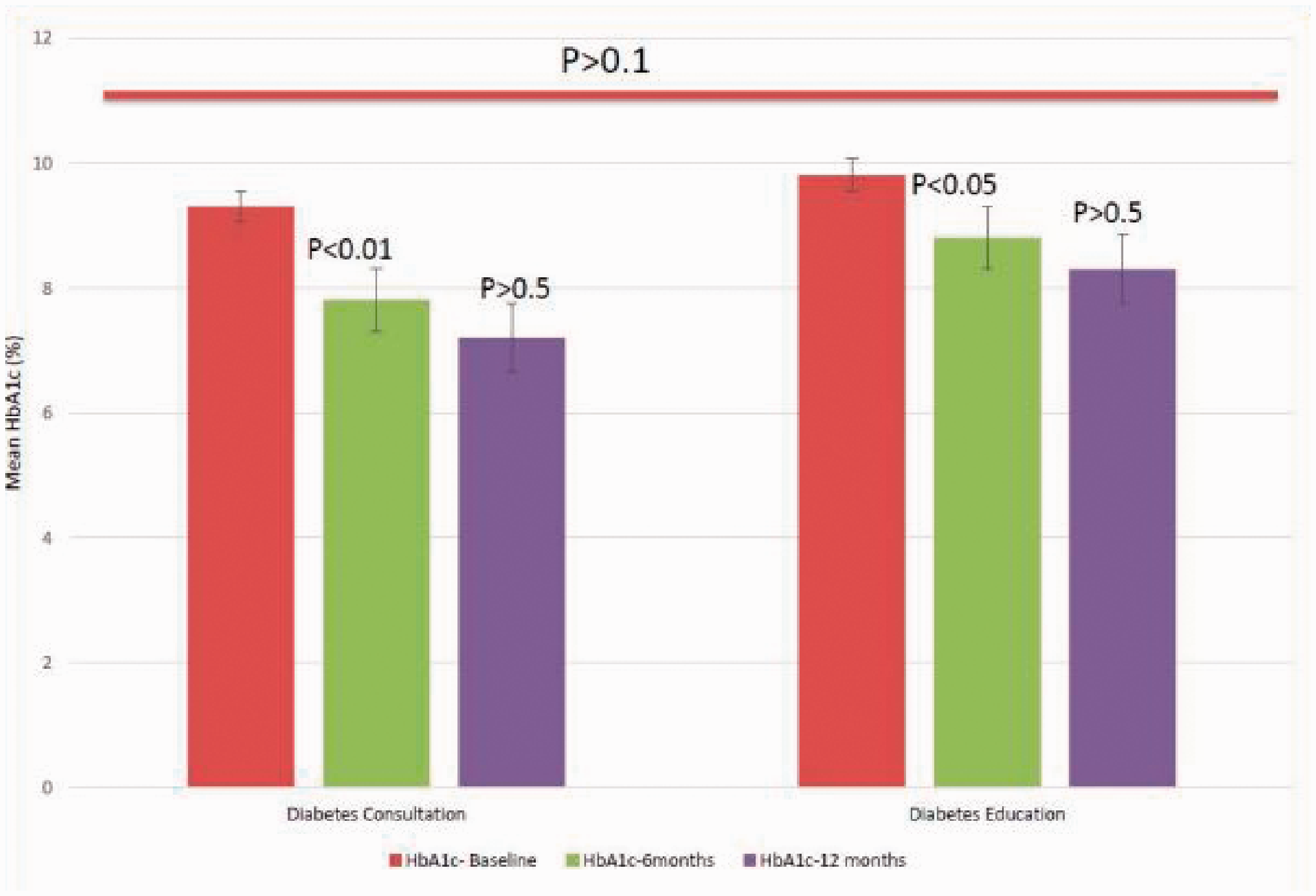
Effect of diabetes consultation and diabetes education of haemoglobin A1c at 6 and 12 months.
HbA1c at 12 months remained significantly lower than at baseline in both arms (DSME: 8.3 ± 1.9% vs. 9.8 ± 1.6%, p = 0.009; DC: 7.2 ± 0.9 vs. 9.3 ± 1.3, p = 0.0002), but there was no statistically significant difference between the two groups at 12 months (p = 0.172; Figure 1). The improvement in HbA1c was maintained over the 12 months of the study. Within each arm of the study, the HbA1c levels remained similar at 6 and 12 months (DSME, p = 0.560; DC, p = 0.503; Figure 1). In both arms of the study, total cholesterol, LDL cholesterol, HDL cholesterol and triglycerides at 12 months were statistically similar to the baseline values. In the DSME group, at 12 months, total cholesterol was 206.1 ± 48.2 mg/dL compared to 186.3 ± 41.8 mg/dL at baseline (p = 0.273); LDL cholesterol was 104.9 ± 36.7 mg/dL compared to 96.1 ± 43.9 mg/dL at baseline (p = 0.645); HDL cholesterol was 46.0 ± 11.9 mg/dL compared to 42.5 ± 14.0 mg/dL at baseline (p = 0.550); and triglycerides were 198.2 ± 140.1 mg/dL compared to 333.4 ± 273.8 mg/dL at baseline (p = 0.176). Among subjects who underwent DC, at 12 months, total cholesterol was 174.5 ± 40.8 mg/dL compared to 213.7 ± 79.4 mg/dL at baseline (p = 0.120); LDL cholesterol was 95.5 ± 34.2 mg/dL compared to 120.9 ± 62.7 mg/dL at baseline (p = 0.258); HDL cholesterol was 53.0 ± 13.0 mg/dL compared to 44.5 ± 16.0 mg/dL at baseline (p = 0.144); and triglycerides were 122.1 ± 108.2 mg/dL compared to 270.5 ± 265.4 mg/dL at baseline (p = 0.103). Despite a high level of HbA1c at baseline, this cohort of patients with poorly controlled diabetes had satisfactory blood pressure on average on presentation: systolic ∼130–136 mmHg and diastolic ∼72–77 mmHg.
All patients reported that the programme saved them money or was cost-effective (especially transportation costs), and 97% of patients acknowledged that the programme was useful in developing a treatment plan, which resulted in better diabetes control. However, not all patients attended all classes or visits, with approximately 40% (DC 36.4% vs. DSME 38.9%; p = 0.83) of the participants missing at least one appointment. Among subjects in the DSME arm, those who attended <50% of the classes were younger than those who attended > 50% of the classes (54.0 ± 7.5 years vs. 62.4 ± 8.4 years; p<0.01). Glycaemic control at six months was similar in those who missed appointments and those who did not (HbA1c 8.9 ± 2.6% vs. 8.7 ± 2.1%; p = 0.852).
Discussion
In this prospective telemedicine intervention study which delivered DC or DSME via videoconference, we have shown that in high-risk patients with poorly controlled diabetes living in rural underserved communities with high diabetes-related mortality, glycated haemoglobin was reduced by 1–1.5% at six months and 1.5–2.1% at 12 months. Both tele-consultation and tele-education were equally efficacious in reducing HbA1c. Although the cardiovascular risk profiles were statistically similar before and after the interventions, the mean values at six months were within acceptable limits of the goals recommended by the ADA. 18 All the participants acknowledged that the programme saved them money, and 97% of them reported that the intervention enabled them to develop an effective treatment plan. However, about 40% of the participants missed at least one class or appointment.
Considering the long-standing history of uncontrolled diabetes in our study population, the reduction in glycated haemoglobin recorded at six months, which was maintained over 12 months, demonstrates that a well-structured and delivered diabetes tele-consultation and tele-education service could be a useful alternative to the usual face-to-face care when the latter is not feasible or accessible. Our finding is consistent with the report of other studies, including two systematic reviews, one of which included nearly 3000 subjects from 16 studies 9 and the other that included 111 trials. Both reviews concluded that telemedicine interventions in diabetes resulted in significant reductions in HbA1c. 19 However, an earlier review reported that the evidence for the efficacy of telemedicine in improving HbA1c or other aspects of diabetes management was weak. 10 A more recent study that evaluated 53 systematic reviews also concluded that telehealth interventions were not superior to usual care. 20 The discordant results obtained from the different studies may be due to differing patient characteristics such as age, type of intervention and the duration of telemedicine intervention employed. One study found that telemedicine was more effective in patients > 40 years of age and in programmes that lasted more than six months, and that tele-consultation was more effective than remote patient monitoring. 21 These observations may explain the degree of glycated haemoglobin reduction seen in our study, especially in the tele-consultation arm. Our subjects were > 56 years of age on average and were followed up for 12 months. A telemedicine programme that targeted diabetes self-efficacy in older diabetes patients 22 or self-management in an underserved community, 23 also improved glycaemic control. Furthermore, in advanced-stage type 2 diabetes, a tele-medical lifestyle intervention programme improved diabetes control, demonstrating that lifestyle modification delivered through telemedicine could be an alternative to the intensification of pharmacological therapy. 24 Very few countries have employed telemedicine in the care of patients with diabetes. 11 Considering the rising prevalence of diabetes, particularly in countries with limited resources and the need for physical distancing imposed by the COVID-19 pandemic, it has become imperative to investigate the provision of care using telemedicine: how to increase or extend access to underserved populations. 25
The improvement in glycaemic control in our cohort of high-risk patients living in medically underserved rural communities with high diabetes-related mortality rate would translate to a better health outcome. Improved diabetes control would reduce the macrovascular 14 , 26 , 27 and microvascular28–30 complications of diabetes. In another study, <20% of the subjects reached the target HbA1c during intensive treatment compared to > 40% who achieved the target blood pressure and lipid profile. 30 This is consistent with our observation that lipid profile and blood pressure levels at six months were within the goals of the ADA, despite HbA1c remaining well above goal for a prolonged period. Generally, it is more challenging to attain the glycaemic target than to achieve lipid and blood pressure control. Hence, the favourable glycaemic response in our study should lead to improved health outcomes.
Although the telemedicine facility utilised in our study was located in the community hospital where the participants lived, about 40% of them missed their appointments. Since we conducted our study, Internet access via smartphones has become more widely available. Perhaps Internet-based meeting platforms such as Zoom and Cisco Webex Meeting could improve the adherence and efficacy of telemedicine-based interventions. We also observed that older patients were more likely to utilise the telemedicine services provided, which is in keeping with the finding of a prior report. 21 We have reported on a prospective intervention study that has demonstrated the remarkable benefit of telemedicine in a well-characterised cohort who lived in underserved rural communities. The interventions, which were well received by the patients, were cost-effective. However, our study was not randomised because the interventions rendered were based on referral by the primary care provider. The sample size, though comparable to other telemedicine interventions, was relatively small. Nevertheless, we have shown that a diabetes tele-consultation or tele-education programme delivered by videoconference technology improved glycaemic control in high-risk patients with poorly controlled diabetes who lived in rural communities with high diabetes-related mortality. We acknowledge that our study was conducted several years ago. We do not have more recent data because the telemedicine programme at our institution was discontinued. However, we provide data on the comparative effectiveness of two telemedicine interventions. The data presented here would be of value to primary care providers in resource-poor populations who have to make practical decisions on how to improve glycaemic control in patients with uncontrolled diabetes.
Footnotes
Declaration of conflicting interests
The authors declared no potential conflicts of interest with respect to the research, authorship and/or publication of this article
Funding
The authors disclosed receipt of the following financial support for the research, authorship and/or publication of this article: This work was supported by the Tennessee Department of Health (grant number ED-08-22875-00).
