



Abstract
Introduction
During the COVID-19 pandemic, children with neurodevelopmental disabilities could not attend their usual rehabilitation therapies, with a consequent reduced support of developmental process and risk of worsening of their clinical conditions.
Methods
We prospectively enrolled 14 children with developmental delay, who had already tried a personalised music therapy (Euterpe method). We included them in a 12-day programme of home-based music therapy. The children and their parents were investigated using the Sleep Disturbance Scale for Children and the Parent Stress Index-Short Form.
Results
Fourteen children started the intervention, while only 12 children completed all the planned home sessions and assessments. We observed a significant improvement in children’s sleep quality and a reduction of parental distress.
Discussion
The significant improvements in parental distress and sleep quality must be considered important achievements for the quality of life of a child and their family. Home-based music therapy can provide a feasible approach to improving sleep and parent’s stress for children with developmental disorders.
Keywords
Introduction
During the COVID-19 pandemic, most non-urgent procedures and activities of rehabilitation centres or school lessons have been interrupted, to avoid the spread of the virus. Most children with disabilities could not attend rehabilitation treatments, with the risk of a worsening developmental delay.
Some articles have discussed the impact of COVID-19 on the mental health of children.1–3 During the pandemic, children were out of school. Even where online substitutes for daily lessons have been adopted, not all children have access to technologies: approaches for ensuring continuity of learning and socialisation are needed. 1 Moreover, children are a vulnerable group as their nervous systems, endocrine systems and hypothalamic–pituitary–adrenal axes are not well developed. 2 In this situation, tele-mental health services (e.g. videoconferencing, online forums, smartphone apps, text-messaging and emails) may help patients maintain psychological well-being. 3
There is an increasing recognition of the potential of music therapy to improve psychological, motor and behavioural functions in children with developmental disorders. Some articles have analysed the effect of music therapy 4 and music training 5 in cerebral palsy. Only one systematic review analysed the impact of music therapy on children with a wide variety of disabilities. 6
Therefore, we offered a home-based music therapy programme to sustain children with developmental disorders secondary to neurological diseases and their worried parents.
Methods
Study design
The study was conducted at “Bambino Gesù” Children’s Hospital (Rome, Italy), which is a tertiary referral centre for children with neurological disorders who need intensive rehabilitation.
Study subjects were children with developmental disorders under the age of 12 years. Because of their developmental delay, they regularly attended rehabilitation. We used the Gross Motor Function Classification System (GMFCS) to assess their functional status.
All children included underwent personalised music therapy according to the Euterpe method before the pandemic. They were enrolled into a prospective monocentric, non-controlled pilot study, demonstrating feasibility of the method at home.
We obtained informed consent from the patient’s parents beforehand in order to report these findings.
Euterpe method’s music therapy
The “Euterpe” method is a type of music therapy that uses a personalised soundtrack for each child, but we also provide a multisensory stimulation while listening to sounds. This method is usually adopted at our department. Data on the Euterpe method music are still unpublished. The method uses sounds, together with multiple types of sensory stimulation. Each sense is involved: hearing by sound; vision by lights, placed in the therapy room; smell by aroma diffusers; and touch by the tuning fork and vibrating devices. The stimulations can be modified according to the different needs of the patients and to the specific therapeutic targets. During each session, the therapist chooses which senses must be excluded, reinforced or added.
The methodology differs from other music therapies, not only because it is supported by multisensory stimulation, but also because it uses an original algorithm, in order to compose a different sound path for each person (“sound history of life”).
The music is composed starting from the sound anamnesis of the child and their family environment. The maternal voice is recorded and combined with some familiar sounds to create a personalised musical composition and an audio archive. The compositions are improved and further customised through the audio and video recording of the child’s reactions during the sessions, arriving to a more attractive and effective sound composition. The musical proposals are also selected according to the therapeutic targets (interaction, relaxation, motor development, communication, etc.).
During “Euterpe” training, the child is placed at the centre of the activity, becomes the protagonist and, therefore, unconsciously “teaches” the therapist. The latter process within the Euterpe method is defined with the term “reverse-role”. During therapy, the interchangeability and reversal of roles determines the child’s disinhibition. The result is the creation of new inputs that are used by the therapist as a teaching tool.
The training sessions are performed in a multisensorial environment (“Synesthesy room”), which includes several devices: projectors and LED strips, audio stereo system, vibrating devices, aroma diffusers, audio mixer, audio-video recordings, postural instruments, tactile, visual and olfactory paths, interactions with image projections through sensors, touch monitors, instruments and musical objects.
The cardinal principle of the “Euterpe” method is that it must be tailored to the peculiarities of each patient and can be modified to obtain different therapeutic targets on the same child. In this way, this therapy can be applied to children with different disorders, such as autism, cerebral palsy or developmental delay.
Methodology of home-based music therapy and standardised assessment
During the COVID-19 outbreak, a personalised visual soundtrack (audio and mp4 video files) was realised using the composition created during the last hospitalisation of the child, before the pandemic, according to the “Euterpe” method.
The audio file (Figure 1) is composed using the audio archive of each child, acquired during their last hospitalisation, combining the most effective tracks administered previously. Each file lasts five minutes and is composed of four parts: the introduction (first part) lasts 40 seconds and it is the same for all the patients, with the aim to stimulate the child’s attention; the second part is composed of the maternal voice and of the patient’s vocal reaction, registered in the previous sessions and superimposed on an effective piece of music chosen from the patient’s audio storage; the third part adds the most effective tracks of the audio archive administered during the therapies; and the last part aims to relax the child using a “lullaby song” by the mother.

Audio file example.
All of the audio files have been created by a composer (TL) who has a bachelor’s degree in Music at the National Academy of Santa Cecilia in Rome (Italy), after which, he attended certified clinical training in music therapy and obtained a second bachelor’s degree in Education.
The mp4 video is composed of a sequence of images, taken from video recordings of the child’s previous training sessions. This allowed us to recreate at home the multisensorial environment (“Synesthesy room”) used in our method.
The audio and mp4 video files were then joined and synchronised in the personalised visual soundtrack (VS), in order to match the rhythmic pattern with the images of the child.
A sound check was made by our music therapist before the soundtrack was sent to the parents. We recommended not to use earphones, because of potential deterioration in sound quality. Two modes of delivery were chosen because not all of the parents had tablets or could reproduce the video file on their television.
The VS was sent to parents, asking them to show it to their child at home, using a television or a tablet, three times a day for 12 consecutive days.
Parents were tested before treatment (t0) and after treatment (t1) at home via telephone or email, by a paediatric neurologist during the COVID-19 outbreak (March–May 2020). The Sleep Disturbance Scale for Children (SDSC) 7 and the Parent Stress Index-Short Form (PSI-SF) 8 were administered to caregivers. SDSC and PSI-SF are parent-report questionnaires. We asked the parents to answer by referring at sleep and stress before treatment (at t0) and the end of the treatment (at t1). The SDSC total score and its sub-scores (DIMS: disorders of initiating and maintaining sleep; SBD: sleep breathing disorders; DA: disorders of arousal; SWTD: sleep wake transition disorders; DOES: disorders of excessive somnolence; SHY: sleep hyperhidrosis) were analysed.7 PSI-SF total score and its sub-scores (PD: parental distress; PDCI: Parent–Child Dysfunctional Interaction; DC: difficult child; DR: defensive responding) were examined. 8
Statistical analysis
Data were analysed with the MedCalc Software package for Windows, release 12.7 (MedCalc Software, Belgium).
Data are presented as numbers and percentages for categorical variables; continuous variables are expressed as median ± standard deviation if they are normally distributed (normality was assessed with the D’Agostino–Pearson test). Differences in PSI-SF and SDSC before and after treatment were analysed with the paired t-test. A two-tailed p-value <0.05 was considered as statistically significant.
Results
In total, 20 children with developmental delay underwent music therapy before the pandemic. Of these, 14 parents gave consent to participate in the study. Two parents were tested at t0 and received the personalised VS but never administered it at home. Twelve children completed all the planned home sessions and assessments both at t0 and t1 and, thus, were included in the data analysis.
Of the study subjects, six were male (50%). Seven children had a genetic syndrome: one had a deletion on chromosome 13 (13q22.2), one had a deletion on chromosome 6 (6q16.1q16.2), one had Rett syndrome, one had McKusick–Kaufman syndrome, one had a partial duplication of 21q and of 7p with a karyotype 47 XX, one had a mosaicism of chromosome 2 and one had a pluri-malformative syndrome but no genetic anomalies were still identified. The remaining five children had cerebral palsy related to a perinatal asphyxia. The median GMFCS of the whole group was 4. The mean age was seven years and five months.
Table 1 presents the details of the SDSC results. We observed significant changes in the SDSC (P = 0.010) total score and in the SBD (P = 0.012) and SWTD (P = 0.032) sub-scores, while the others sub-scores (DIMS, DA, DOES and SHY) did not show a significant improvement (P < 0.05).
Sleep Disturbance Scale for Children (SDSC) scores (results are reported as mean ± standard deviation).
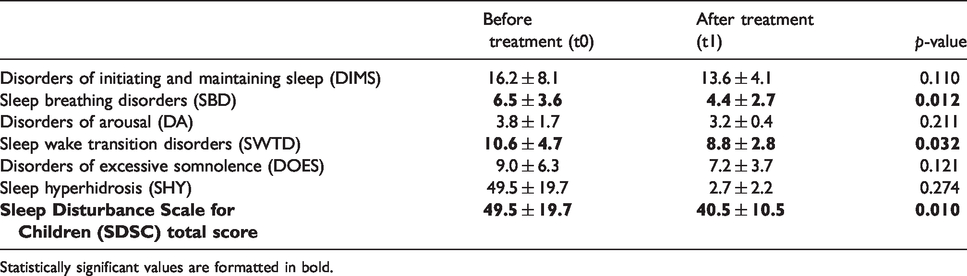
Statistically significant values are formatted in bold.
Table 2 presents the results of the PSI-SF total score and sub-scores. We detected a significant reduction in the PD and DR sub-scores. The PSI-SF total score and the other sub-scores decreased, but not significantly.
Parenting Stress Index-Short Form (PSI-SF) scores (results are reported as mean ± standard deviation).

Statistically significant values are formatted in bold.
Discussion
In this study, we aimed to evaluate the feasibility of home-based music therapy during the COVID-19 outbreak in Italy. We adjusted the Euterpe method, usually adopted at our department, to be administered at home by parents of children with developmental delay, to improve children’s sleep and to support parents during the pandemic. COVID-19 is having a great impact on health services and obviously attention is concentrated on emergency and acute care. Negrini et al. estimated that more than one million people per day are being denied rehabilitation care and, in Europe, there was a reduction of all rehabilitation activities in all settings: acute, post-acute and outpatients. 9 There is medical evidence that music has a positive influence on different functions of children with cerebral palsy (CP). 10 In an interesting commentary, Mastnak stresses the psychopathological problems related to the COVID-19 pandemic and their possible prevention with music therapy. 11
Firstly, it is well known that children with developmental disorders are already at risk for sleep disturbances. 12 Considering the current changes in their regular daytime activities, a serious risk of worsening of sleep quality in these infants should be considered. To analyse the impact of our home-based music therapy on the sleep quality of these infants, we used SDSC. 7 After the treatment, we observed not only an improvement in SDSC total score, but also in two sub-scores (SBD and SWTD).
SBD considers breathing problems, sleep apnoea and snoring; however, none of the children had a diagnosis of sleep apnoea. SWTD’s sub-score is defined by seven items related to sleep duration and latency, problems in falling asleep and night awakenings. Most likely, relaxing sounds such as a “lullaby song” contained in the soundtrack could help children in falling asleep and maintaining a longer sleep, but the personalised musical approach to the child, typical of our method, could have played a key role.
Furthermore, the simultaneous video probably evoked the emotional and relational sensations experienced during training in the hospital.
Secondly, parents of children with disabilities experienced greater amounts of stress, because they were concerned that their child's condition may worsen, after discontinuation of the neurorehabilitation.
Some studies analysed the effect of the COVID-19 outbreak on parents’ stress levels: parents have to deal not only with their children’s disabilities but also with quarantine, and with a higher risk of potential child maltreatment if not adequately supported.13,14
Furthermore, parental stress during the pandemic could also be related to the fear about contagion of their children and possible related effects. 15 Moreover, the impact on families and carers is especially heightened where the usual supports of residential schools, day services or respite care have been withdrawn because of the pandemic. Parental stress was assessed using PSI-SF. 8 The study demonstrated changes in two subscales of the PSI-SF: the PD subscale and the DR subscale. The PD subscale reflects parents’ personal adjustment to parenthood. Most likely, parents experienced less stress about the parent role. The DR subscale assesses whether a person tries to present a favourable impression of himself or herself or tries to minimise problems or stress in the parent–child relationship. During the second evaluation, mothers may have completed the PSI test more honestly.
Furthermore, the importance of listening to the maternal voice during child’s neurodevelopment has been already reported.16,17 Involving mothers in the composition of the soundtrack probably improved the relationship with their children.
The statistically significant improvement in these items must be considered important achievements for the quality of life of children and their families. However, we are aware of the main limitations of our study: the single-centre site and the lack of a control group, which could not be recruited during the pandemic. We chose to include all patients who previously underwent the Euterpe method to support as many children as possible, even if this limited the sample size and led to the analysis of a heterogeneous group. Despite these limitations, children and parents were positively engaged in an enjoyable activity: all the families asked us to continue the intervention.
To the best of our knowledge, this is the first report of a home-based music therapy approach in children with developmental disorders during the COVID-19 pandemic. In the future, a broader evaluation of the role of our method in sleep improvement could be performed using objective measures (such as polysomnography or actigraphy) in a well-designed prospective study.
At the time of writing, our results demonstrated the utility of a home-based music therapy approach to sleep quality in children. Moreover, changes like lockdown and rehabilitation centre closures can trigger acute stress reactions in the children’s parents, and alternative approaches need to be carefully designed to avoid this.
Footnotes
Acknowledgement
The authors thank the “Toffee for Charity” Foundation of Rome for its support.
Declaration of Conflicting Interests
The author(s) declared the following potential conflicts of interest with respect to the research, authorship, and/or publication of this article: T Liuzzi, F D’Arienzo and S Khosravi are members of the Euterpe Association. The Euterpe Association has many aims, from teaching music to children with learning disabilities and autism spectrum disorders to supporting children with neurodevelopmental delay, providing music therapy to them.
Funding
The author(s) received no financial support for the research, authorship, and/or publication of this article.
