



Abstract
Introduction
Rheumatoid arthritis (RA) disease is a systemic progressive inflammatory autoimmune disorder. Elderly-onset RA can be assumed as a benign form of RA. Until recently, face-to-face therapeutic sessions between health professionals and patients are usually the method of its treatment. However, during pandemics, including coronavirus disease 2019 (COVID-19), teletherapeutic sessions can extensively increase the patient safety especially in elderly patients who are more vulnerable to these infections. Thus, the aim of this randomized clinical trial was to evaluate a novel teletherapy approach for management of elderly patients suffering from RA by utilizing laser acupuncture.
Methods
A teletherapy system was used for management of elderly patients suffering from RA. Sixty participants were allocated randomly into two groups and the ratio was 1:1. Patients in the first group were treated with laser acupuncture and telerehabilitation sessions, which consisted of aerobic exercise and virtual reality training. Patients in the second group received telerehabilitation sessions, which consisted of aerobic exercise and virtual reality training. Evaluation of patients was done by using the Health Assessment questionnaire (HAQ), the Rheumatoid Arthritis Quality of Life (RAQoL) questionnaire, and the analysis of interleukin-6 (IL-6), serum C-reactive protein (CRP), plasma adenosine triphosphate (ATP) concentration and plasma malondialdehyde (MDA).
Results
A statistically significant difference was found in CRP, RAQoL, IL-6 and MDA between the pre- and post-treatments in the first group (p < 0.05) favouring the post-treatment group, while the HAQ showed a statistically significant difference between pre- and post-treatments (p < 0.05) in both groups. Statistically significant post-treatment differences were also observed between the two groups (p < 0.05) in RAQoL, CRP, ATP and MDA, favouring the first group.
Discussion
Laser acupuncture teletherapy could be suggested as a reliable treatment method for elderly patients suffering from RA, as it can provide a safe and effective therapeutic approach. Teletherapy provided safer access to health professionals and patients while giving a high patient satisfaction value with a relatively lower cost (ClinicalTrials.gov Identifier: NCT04684693).
Keywords
Introduction
Rheumatoid arthritis (RA) disease is considered to be among the most frequent autoimmune diseases. The disease onset can differ between early years and old age with its peak incidence in the 6th decade of life.
The World Health Organization reported that about 1 to 2% of the world population have RA, which can lead to functional limitations in about 30% of these patients. 1 Unfortunately, elderly-onset RA has been increasing significantly worldwide. Its prevalence is about 2% among patients aged more than 60 years. 2
Elderly-onset RA patients form a clinical subgroup of patients who differ in the manifestations, prognosis and management from young-onset RA patients. 3
Many authors believe that teletherapy of the elderly and digital transformation of their care has great potential for increasing quality of life, as well as optimizing care processes. Recently, there have been several implementations and developments in the digital gerontechnology world, a world that combines technology with the gerontology. From smart devices to ambient assistant living approaches, gerontechnologies have shown very promising outcomes. 4
The ageing process can disturb the adaptive as well as the innate immune systems. The adaptive immune system may develop functional defects and suffer phenotypical change with ageing which can result in a breakdown of the immunological tolerance contributing to an accelerated progression of autoimmune diseases. In addition, the innate immune system can become non-specifically active with ageing, and this may contribute to increasing comorbidities and chronic inflammation. 5
Elderly-onset RA patients suffer more from functional limitations and comorbidities in comparison with young-onset RA patients. In addition, elderly-onset RA exhibits more systemic involvements. 6
Laser acupuncture can reflect the benefits of photobiomodulation through the photonic stimulation of acupuncture points which initiate therapeutic effects. 7 The evidence for laser acupuncture mediated effects comes from several functional magnetic resonance imaging (fMRI) studies, which revealed cortex activation as a response to acupoint stimulation by laser. 8
Acupoint stimulation was found to have a positive influence on the autonomic nervous system through biochemical changes which occur by releasing neurochemical messengers that can affect the body’s homeostatic mechanism. Moreover, it was reported that it can positively influence brain areas that decrease pain sensitivity, inflammation and stress through promotion of release of immunomodulatory and vascular factors as well as improving biomechanical function. The traditional Chinese medicine models regard RA as a complex disorder in which body regions can be stimulated in a specific internal movement with autonomic activation taking place in different body organs starting in the liver, followed by heart and thorax, and progressing through the lungs and hypochondrium to the kidneys and lower abdomen. 1
The adverse effects of therapeutic approaches remain one of the major factors affecting the compliance of RA patients with treatment. However, controversy regarding the ideal treatment for elderly-onset RA still exists due to the limited number of randomized clinical trials. 9
A particular sector where the medical professions can greatly benefit from adopting the field of teletherapy is internet of things (IoT) technologies. The IoT was able to provide a tremendous technological change to medical and healthcare infrastructures; however, recent research showed that there are several areas in the healthcare field still in need of improvement, which can be done by enhancing service delivery during pandemics including coronavirus disease 2019 (COVID-19). 10
Therefore, the aim of this study is to evaluate a novel teletherapy approach for management of elderly-onset RA by utilizing laser acupuncture, which can be beneficial during pandemics including COVID-19, since the compliance of elderly patients to traditional treatment sessions in many hospitals and clinics has been decreased.
Subjects and methods
Recruitment of patients was realised by referral sampling, where the physicians act as intermediaries to identify persons who meet the inclusion criteria, gain their collaboration and then ask them to recruit more respondents having the same conditions.
Sixty patients of both sexes (31 females and 29 males) aged between 65 and 75 years were recruited, all of whom met the criteria of the American College of Rheumatology (ACR) and European League Against Rheumatism (EULAR) classifications for RA. 11 The patients had active elderly-onset RA and had not been on anti-rheumatic drugs for at least 3 months.
Patients with connective tissue disorders and malignancy and those who were smokers were excluded from the study. Patients who refused to fulfil the requirements of the study were also excluded. The approval from the Research Ethics committee at Cairo University was attained prior to study.
The 60 patients were randomly allocated into a study group and a control group in a 1 to 1 ratio. The intervention group was remotely treated by laser acupuncture and telerehabilitation sessions, which consisted of aerobic exercise and virtual reality training. The control group was treated by telerehabilitation sessions, which consisted of aerobic exercise and virtual reality training. Written consent was attained from all participants. All the treatments were given remotely via the teletherapy system while collection and evaluation of the outcomes were done by an independent coworker who was blinded to the groups of study.
Patient assignment and blinding
The patients were divided randomly into two groups of 30 by a computerized random number generator software (Statsdirect version 2.7.7, StatsDirect Ltd., Cheshire, UK). The preparation of this simple randomization procedure was independently established by a researcher who was not included in patients’ selection, eligibility determination or outcomes evaluation. The assessment of outcomes was done by a blinded assessor. As shown in Figure 1, the study was performed following CONSORT guidelines for conducting randomized trials.
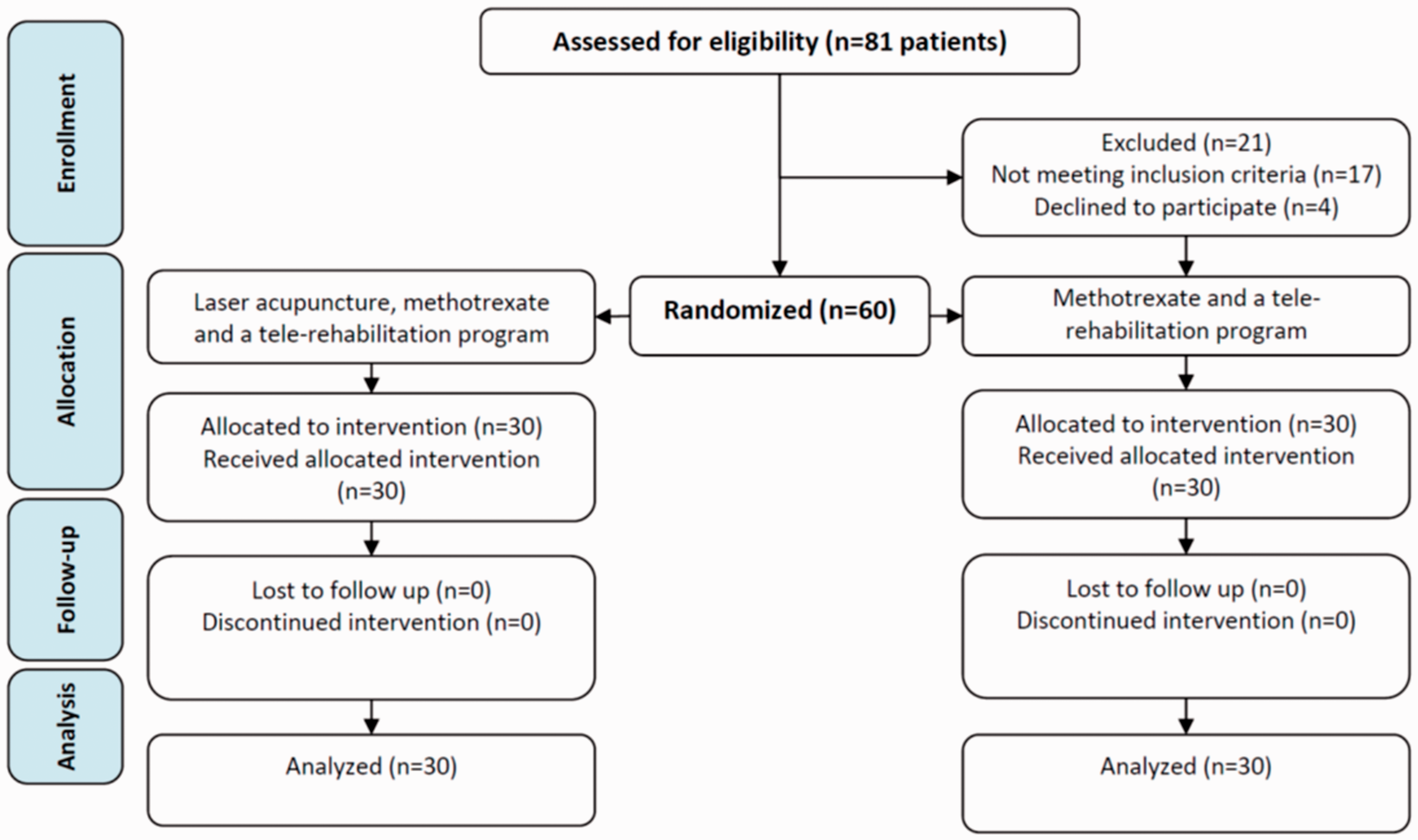
CONSORT flow diagram.
The evaluation procedures
Pre- and post-treatment assessment was done using the Health Assessment questionnaire (HAQ) scale, the Rheumatoid Arthritis Quality of Life (RAQoL) questionnaire, the analysis of C-reactive protein (CRP) and interleukin-6 (IL-6) inflammatory markers, plasma adenosine triphosphate (ATP) concentration anti-oxidant marker, and plasma malondialdehyde (MDA) oxidative marker.
After the end of therapy, patients were requested to fill in a survey form along with a score sheet to record their feedback on our proposed teletherapy programme and the potential benefits or drawbacks of this system. The questions involved were, ‘What are the advantages of having teletherapy performed in your home?’, ‘What are the problems that faced you when having teletherapy performed in your home?’ and ‘if there are any other comments to be written, please write it down’.
The clinical procedures
Laser acupuncture points stimulation was done by an infrared smart laser device system, at 808 nm, continuous wave, with a 100 mW/cm2 power density and a 7.5 Joule/cm2 energy density. Each point was irradiated for 60 seconds.
The system has the ability to connect and read data from the laser device in addition to initiation of the laser device settings and parameters. This allowed the clinicians to adjust the laser device settings and parameters remotely (Figure 2).

The laser acupuncture teletherapy system. (a) The health professional initiates and controls the smart laser settings and parameters remotely by the system. A videoconferencing screen allows the health professional to communicate with the patient and the care giver. (b) In the patient’s home in the absence of the health professional, the care giver uses the acupoints detector to determine the acupuncture points on the patient.
An acupoints detector was utilized for determining accurately the acupoints for each participant. The stimulated acupoints were Stomach-25 (ST 25), Liver-8 (LR8), Spleen-6 (SP6), Spleen-9 (SP9) and Pericardium-6 (PC6). The teletherapy sessions were taken during a period of 4 weeks with six sessions per week. The virtual reality service was utilized for provision of a pain-relieving environment through distraction of the patient during the treatment sessions. The aerobic exercise was done on a treadmill with walking speed of 3 miles per hour for 20 minutes without inclination.
Teletherapy and remote rehabilitation
Health professionals and patients in the groups interacted using the mobile application; in addition, a web-based software has been developed to be used for computers. The system was designed with capabilities for using smart devices and adopting IoT technologies. Double encryption protocol was used for maintaining hardware-based security. All patients were managed via the same healthcare professional all the way through follow-up periods.
Once enrolled, the patients were requested to install the application. They were then trained on how to use this application. Their devices have been checked and listed in the system database for security and accuracy purposes. The application images and videos indicate the locations of acupuncture points and demonstrate for the care giver the way of using the acupoints detector, the correct holding technique of the probe and the precautions that should be followed during the session. Every care giver has taken an online comprehensive education programme on laser safety and how to protect the patient and him- or herself from laser hazards.
After establishing the connection between the system and the laser device, the health professionals were capable of initiating and controlling the smart laser settings and parameters remotely via the system. When confirming the starting date by the patient, the date was verified at the background, with automatic integration of the treatment schedule. Once the schedule was activated, the patient was then automatically directed to the weekly sessions schedule list.
The application was able to send out periodic notifications to the patients, nurses and health professionals to remind them about each session. When consultations were required, the patient had the ability to open a chatting session via texting his or her questions or reporting his or her situation by voice or video message. In order for the health professional to be notified of the patient query, automated reminders and notifications were generated accordingly. By the same means, the health professional also had the ability to initiate consultations in accordance with the periodical reports. A decision tree method-based algorithm was embedded in the application for analysing the notification content and number of reminders.
Additionally, the application provided an educational functionality, which can promote self-learning for healthier habits as well as methods for self-care of RA patients. Before any session, the assigned nurse would review the patients' data via the system then acted according to each situation through contacting this patient for the assessments and then contacting the participating health professional to manage the patient remotely.
A virtual reality environment was provided by the application to help the patients overcome their pain, depression and their urges for travelling to different places. This was achieved via developing a scenario to enable patients to travel around their preferable places and enjoy the various beautiful sights of nature. This helped to distract them from pain and stimulated their relaxation. The sounds would change in accordance with the location and the patient preferences, which included different themes such as music or the sounds of nature.
Statistical analysis
The data from this study were statistically analysed by the Graph Pad Prism version 8 (Graph Pad Software, San Diego, CA, USA) with a level of significance of 0.05. Changes in RAQoL, HAQ, IL-6, CRP, MDA and ATP were evaluated using the independent t test between the intervention and the control group. Moreover, the dependent t test was used to evaluate changes within the groups. To compare pre-treatment with post-treatment for each group the paired t test was used.
Results
A total of 60 patients (29 males and 31 females) participated in the study. Their ages ranged from 65 to 75 years with a mean (±SD) age of 67.9 ± 2.8 years (Table 1).
Demographic information at baseline.

Therapeutic outcomes
Table 2 show that there was a statistically significant difference in the HAQ scale pre- and post-treatment in both groups, where p < 0.05. Additionally, there was a statistically significant difference in RAQoL pre- and post-treatment in group A (p < 0.05). Regarding the CRP and IL-6 and the MDA, a significant difference was found between pre- and post-treatment (p < 0.05) with group A showing an obvious reduction in these markers. Furthermore, a statistically significant improvement in the ATP levels in group A after the end of treatment was observed when compared to the pre-treatment results (p < 0.05). The comparisons between the two groups showed statistically significant post-treatment differences in RAQoL, CRP and MDA with lower recorded values in group A (p < 0.05) as well as statistically significant post-treatment differences in ATP with higher recorded values in group A (Figure 3).
The comparative analysis of Health Assessment questionnaire (HAQ), the Rheumatoid Arthritis Quality of Life (RAQoL) questionnaire, interleukin-6 (IL-6), C-reactive protein (CRP), adenosine triphosphate (ATP) and malondialdehyde (MDA) mean values between the two groups pre- and post-treatment.

Values are given as mean ± standard deviation.
S: significant (p<0.05); NS: non-significant.

Health Assessment questionnaire (HAQ), the Rheumatoid Arthritis Quality of Life (RAQoL) questionnaire, interleukin-6 (IL-6), C-reactive protein (CRP), adenosine triphosphate (ATP) and malondialdehyde (MDA) mean values between the two groups pre- and post-treatment.
Teletherapy outcomes
Fifty-two patients completed the feedback surveys, with a response rate of 86.6%. Four themes were identified from comments, which included the elimination of transferring costs, ease and accessibility for the rehabilitation programme, increased patient comfort and safety, in addition to time and effort saving. Only one main theme was found in the item of ‘problems that faced you’, which was related to some problems in dealing with the system.
On average, all the patients were satisfied (score 4.7), and the majority reported that the software was quite simple (score 4.5), convenient (score 4.8) and that they wanted to recommend it to others (score 4.9). Patients also did not demonstrate any privacy or security concerns (score 4.9). Their feedback demonstrated that this approach was preferable (score 4.6), made accessibility to the healthcare specialists easier (score 4.9) and that they were pleased with the virtual reality service (score 4.9). Most patients indicated that the equipment was relatively comfortable (score 4.1) and that the system response time was adequate (score 4.8) with the replies to their queries mostly being fast (score 4.4). In addition, their replies also illustrated that interacting remotely by videoconferencing allowed patient–clinician rapport, as the majority believed that the consultation quality was great (score 4.7). Regarding the technology, the patients did not report any major issues from the audio or the video clarity (scores 3.8 and 3.9, respectively). Their feedback about addressing their concerns and the overall quality of care was high (scores 4.6 and 4.9, respectively) (Figure 4).

Patient’s feedback (scores were from 0 to 5 where 0 is the worst and 5 is the best score).
Discussion
Traditionally, therapeutic sessions have always been done in clinics and hospitals through face-to-face management of the patient. The reason for this can be explained by the inherent belief by many clinicians that teletherapy cannot be relied on as ‘a stand-alone solution’ in treatment.
As confirmed by the findings of our study and many other studies in the field of teletherapy,12,13 using non-invasive and more safe approaches can enable clinicians to consider teletherapeutic approaches as being a reliable method for provision of professional healthcare especially in the elderly communities that usually suffer from restrictions in free movement and transfer.
Adaptation of home-based teletherapy in this study has enabled the older population who are suffering from RA to benefit from this system as a potential solution for addressing their therapeutic needs. Thus, more attention needs to be directed at the minority groups including characteristics and needs of geriatric persons to avoid discrimination and depersonalization while providing context-sensitive, reliable and relevant data.
The system has been found to be acceptable, feasible and safe. Acceptability was measured from the patients’ responses scores levels through evaluating the simplicity, preferability, convenience, accessibility and the overall satisfaction, with an average score equal to 4.7.
Feasibility was measured in this study from the patients’ compliance and adherence to their prescribed teletherapy programme as all the participants completed their sessions. The high compliance of patients in this study was found to be correlated directly with the automated reminders and recommendations. This was consistent with another study which indicated that the compliance of geriatric persons to therapeutic and exercise programmes could be realised via reminders, motivations and follow-ups. 14 Another study also underlined the benefits of using mobile applications for older adults in order to adhere to exercises and therapies. 15
It has also been reported that a specific programme for the elderly might have more success with patients who suffer from depression or pain. 16 This might add an advantage to the present study, as it was revealed that virtual reality training helped the patients in overcoming their pain and depression.
Lastly, no adverse effects, privacy disclosure or security concerns were reported throughout the study. Our results were consistent with another study, which reported that laser acupuncture is a safe therapeutic technique for old people. 17
The outcomes of this study revealed that laser acupuncture therapy produced significant anti-oxidative and anti-inflammatory effects. These results were in accordance with results of some clinical trials which also reported a remarkable improvement in the values of anti-inflammatory, oxidative and anti-oxidant markers.1,17
Inflammation is found to be the core mechanism of chronic nociceptive pain in RA. Inflammatory pain in RA is due to the recruitment of inflammatory mediators to the synovial fluid of the joint. The inflammatory mediators can directly activate the nerve terminals in the joint leading to neurotransmitter release and transmission of pain information.
The mechanisms for self-limiting the inflammatory response have been demonstrated through the inflammatory reflexes of the immune-regulatory vagal nerve circuit. A recent study has revealed that acupuncture therapy can regulate the immune function through stimulating the parasympathetic pathway. 18
Oxidative stress in RA can be caused by the imbalance between the antioxidants and the pro-oxidants, which is almost always associated with macromolecular damage or redox circuitry disturbance. Oxidative stress can also be a major cause of inflammation and multiple pathologies such as cardiac and vascular disorders. Therefore, it can be postulated that the anti-oxidative and systemic effects of the laser acupuncture therapy contributed significantly to the positive outcomes of the study. 19 Recent studies have also revealed that laser acupuncture therapy has the ability to reduce oxidative stress. It was found that laser acupuncture can modulate the redox homeostasis via regulation of the imbalance between antioxidants and pro-oxidants.17,20
The benefits of teletherapy were seen in the reliable provision of ‘in home’ healthcare services for geriatric patients to protect them from the danger of acquiring the COVID-19 infection in addition to maximizing safety for healthcare professionals. Studies have shown that the symptoms of COVID-19 can be masked especially in elderly patients who are taking anti-rheumatic drugs, which may pose a risk to the clinicians working face to face with them.21,22
Our proposed approach can reduce the burden on elderly patients to go outside for every medical visit, the counselling costs, the medical visit costs, transportation costs and required medical facility room space. In addition, it can encourage faster identification and responses to complications or situations that can be harder to manage if not discovered early.
When calculating the actual usage and each unit cost per patient over a short period of time, it was found that it would be more expensive to assign devices to be used by a single patient. However, when distributing this cost over long-term usage, it can be very worthwhile and feasible when compared with the traditional methods that involve visiting medical facilities. This suggests that our proposed approach is practical, even though maintaining a larger number of patients would require more generalizable solutions for any challenges that might arise. Although the present results are considered to be very promising, broader studies that have greater sample sizes are needed to further explore the effectiveness of laser acupuncture teletherapy for RA elderly patients.
Conclusion
Our findings showed that laser acupuncture can be effective in improving elderly-onset RA. Additionally, teletherapy has provided safer access to health professionals and patients while giving a high patient satisfaction with a relatively lower cost.
Footnotes
Declaration of conflicting interests
The authors declared no potential conflicts of interest with respect to the research, authorship and/or publication of this article.
Funding
The authors received no financial support for the research, authorship and/or publication of this article.
