



Abstract
Objectives
Sepsis is associated with significant mortality. Telehealth may improve the quality of early sepsis care, but the use and impact of telehealth applications for sepsis remain unclear. We aim to describe the telehealth interventions that have been used to facilitate sepsis care, and to summarize the reported effect of telehealth on sepsis outcomes.
Data Sources
We identified articles reporting telehealth use for sepsis using an English-language search of PubMed, CINAHL Plus (EBSCO), Academic Search Ultimate (EBSCO), APA PsycINFO (EBSCO), Public Health (ProQuest), and Web of Science databases with no restrictions on publication date.
Study Selection
Included studies described the use of telehealth as an intervention for treating sepsis. Only comparative effectiveness analyses were included.
Data Extraction and Synthesis
Following the Preferred Reporting Items for Systematic Reviews and Meta-Analyses extension for scoping reviews (PRISMA-ScR) guidelines, two investigators independently selected articles for inclusion and abstracted data. A random-effects subgroup analysis was conducted on patient survival treated with and without telehealth.
Results
A total of 15 studies were included, involving 188,418 patients with sepsis. Thirteen studies used observational study designs, and the most common telehealth applications were provider-to-provider telehealth consultation and intensive care unit telehealth. Clinical and methodological heterogeneity was significantly high. Telehealth use was associated with higher survival, especially in settings with low control group survival. The effect of telehealth on other care processes and outcomes were more varied and likely dependent on hospital-level factors.
Conclusions
Telehealth has been used in diverse applications for sepsis care, and it may improve patient outcomes in certain contexts. Additional interventional trials and cost-based analyses would clarify the causal role of telehealth in improving sepsis outcomes.
Summary
Telesepsis effectiveness depends on various hospital-level factors. Telesepsis may promote survival in hospitals with low baseline survival, but it has been evaluated mostly through observational studies; additional interventional trials and cost-based analyses would be valuable.
Key points
Introduction
Sepsis is a leading cause of critical illness and death worldwide, with estimates suggesting 31.5 million sepsis cases and 5.3 million deaths occur annually.1,2 Sepsis is also a leading cause of death in U.S. hospitals, 3 now comprising 30% to 50% of hospital deaths.4,5 Standardization of early sepsis care has been shown to improve survival and between 2009 and 2017 annual sepsis survival rate increased by 9%. 6
Early intervention and appropriate treatment are essential components of high-quality sepsis care.7,8 The Surviving Sepsis Campaign (SSC), a multidisciplinary collaborative, publishes recommendations for sepsis care consisting of early recognition, prompt administration of antibiotics, and early resuscitation.7,9–12 Adherence with SSC bundle guidelines has been associated with reduced intensive care unit (ICU) length-of-stay and improved hospital survival.13,14 Unfortunately, SSC bundle adherence remains low, especially amongst rural sepsis patients in low-volume hospitals, where prior work has shown that bundle adherence is significantly lower than in higher-volume hospitals.15–19
While management of sepsis patients requires no specialized equipment or procedural capabilities, low-volume emergency departments (EDs) have a 38% lower sepsis survival compared to high-volume EDs.20–22 A similar trend is observed outside of EDs: hospital wards and ICUs that treat more than 500 severe sepsis cases annually have survival rates that are 36% greater compared to those that treat fewer than 50 cases. 23 Furthermore, rural sepsis patients who are transferred between hospitals have 9% lower survival compared to those who are not transferred, and even those who bypass a rural hospital to seek care in a higher-volume facility have a 6% lower survival.22,24,25 Some theorize that low rates of guideline-adherent care may be attributable to delays in sepsis recognition, provider education, and access to sepsis specialty care.26–28
One promising strategy that has been proposed to improve the quality of emergency sepsis care is telehealth,29–32 which we defined as technology-enabled communication between telehealth providers and bedside providers and/or patients for care-related purposes. Since its inception in the early 1960s, 33 telehealth has been used in EDs, ICUs, and hospital wards. Telehealth can be used for remote monitoring, nursing care, or physician consultation. 34 Telehealth could potentially be used to improve sepsis care and patient outcomes, yet it is unclear how, where, and for whom it is used, and how its use may affect clinical outcomes. We therefore conducted this systematic review to evaluate the current landscape of studies that have applied “tele-sepsis” and to characterize the types of telehealth that have been used for sepsis care. The objectives of this systematic review were to (1) describe the global literature focused on the use of telehealth in sepsis patients, (2) summarize the effect of telehealth on processes of care and clinical outcomes, and (3) provide guidance for the direction of future studies.
Methods
We originally conducted a scoping review according to the guidelines in Munn et al.
35
the Joanna Briggs Institutes Reviewer's Manual,
36
and the Preferred Reporting Items for Systematic Reviews and Meta-Analyses extension for scoping reviews (PRISMA-ScR)
37
(Supplemental eTable 1). In the context of the scoping review, we sought to answer the following questions:
How has telehealth been used to impact care for sepsis patients? What are the characteristics, contexts, and key findings of studies (including patient outcomes) on the use of telehealth in the treatment of sepsis? What are the conceptual and methodological gaps in research concerning the use of telehealth in sepsis care?
Upon completing the scoping review, we determined that there were enough studies and overlap in study outcomes to conduct a systematic review, and that the diversity of telehealth use in sepsis was low. Thereafter, we also sought to answer the question, “How has telehealth affected processes of care and clinical outcomes in sepsis care?”. We followed PRISMA guidelines in conducting the systematic review.
38
We registered the protocol in the Open Science Framework on May 25, 2022.
39
Search strategy
The search strategy was developed by the research team in collaboration with a public health librarian (NT) experienced in systematic review methods, combining search terms of (1) sepsis and (2) telehealth (detailed search strategy available in Supplemental eTable 2). On May 27, 2022, we searched Academic Search Ultimate (EBSCO), APA PsycINFO (EBSCO), CINAHL Plus (EBSCO), Public Health (ProQuest), PubMed, and Web of Science for peer-reviewed studies published in English. We did not apply other limits. We included all comparative effectiveness study designs (e.g. cohort, case-control, interventional studies), but case reports, uncontrolled case series, editorials, and opinion pieces were excluded. We searched through gray literature (i.e. abstracts, pre-prints) using the TRIP database, BASE Search Engine, and MedRxiv. Google Scholar was also searched for studies using the same terms as the original search in order to identify studies that may have been missed. Additionally, we reviewed reference lists of the included studies by hand. We reviewed the meeting proceedings of the Society of Critical Care Medicine and the American Telemedicine Association from 2017 to 2022 for relevant abstracts. We excluded abstracts that were subsequently published as peer-reviewed manuscripts to avoid “double-counting” samples. We contacted authors if there was missing or unpublished referenced data.
Study selection
The analysis included studies that reported on the treatment of sepsis patients with the use of telehealth. Each title, abstract, and the full-text manuscript were independently screened by two reviewers (KJT and CW) using Rayyan (Rayyan Systems Inc, Cambridge, MA), a web-based application designed to facilitate the screening process for researchers working on systematic reviews.
40
We used the following inclusion criteria:
Use of telehealth as an intervention Sepsis was diagnosed and/or treated using telehealth Surveillance for the presence of sepsis was included if it is done using telehealth The study was original comparative effectiveness research (no case studies/series, reviews, protocols, editorials, or opinion pieces)
Disagreements were resolved through discussion with a third reviewer (NMM).
Data abstraction
We used a structured data abstraction form to characterize the features of the included studies. Two reviewers (KJT and CW) independently abstracted all data, and the risk of bias was assessed using the Newcastle-Ottawa scale for nonrandomized studies and the Cochrane Risk of Bias tool for randomized trials.41,42 We considered studies to be of low risk of bias if they received a score of six or greater on Newcastle-Ottawa's nine-point scale. 43 The following data were abstracted: publication information (i.e. title, authors, and year of publication), study characteristics (i.e. type of study and outcomes studied), study population characteristics (i.e. sample size, age, sex/gender, race/ethnicity, rurality, and control group survival), telehealth characteristics (i.e. synchronous vs. asynchronous, users, hospital unit), and key findings. Patient outcomes (survival and transfer) and care processes (antibiotic timeliness, bundle adherence, and lactate measurement) were also abstracted, and odds ratios (ORs) were calculated between patients treated without and with telemedicine if not reported in the paper. Each study's reported outcomes were classified into measurement domains as described by the Rural Telehealth and Healthcare System Readiness (RTHSRC) Committee (National Quality Forum) for telehealth measure development for: (1) access to care and technology, (2) costs, business models, and logistics, (3) experience, (4) effectiveness, and (5) equity. 44
Subgroup analysis and weighted regression
We determined after review that the clinical and methodological heterogeneity was too high to pool study outcomes in a formal meta-analysis. However, we reasoned that an explanatory analysis may explain the heterogeneity and still provide insights into the use of telehealth for sepsis care. We qualitatively evaluated patient survival data after separating the studies into three subgroups related to study methodology (randomized, cohort, and before–after). After conducting the analysis, we explored a hypothesis post hoc that the survival effect associated with telehealth was related to the severity of illness. To test that hypothesis, we performed a weighted regression with an explanatory variable of control group survival using OpenMetaAnalyst (Agency for Healthcare Research and Quality, Rockville, MD). 45 We modeled the treatment effect based on the β of the telehealth effect size from adjusted models, and pooling was performed using a random effect weighted regression.
Results
The original search yielded 365 unique studies, of which 15 studies met the inclusion criteria and were included in this systematic review.46–60 Figure 1 describes the search results, and Table 1 summarizes the characteristics of the included studies. Most of the studies used observational designs: cohort studies (n = 9) with concurrent controls, before–after quasi-experimental studies (n = 4), and randomized trials (n = 2), with a total enrollment across all studies of 188,418 participants (Table 1). Twelve (80%) of our studies had a low risk of bias, according to the Cochrane Risk of Bias Tool (Supplemental eFigure 1) and Newcastle-Ottawa Scale (Supplemental eTable 3).
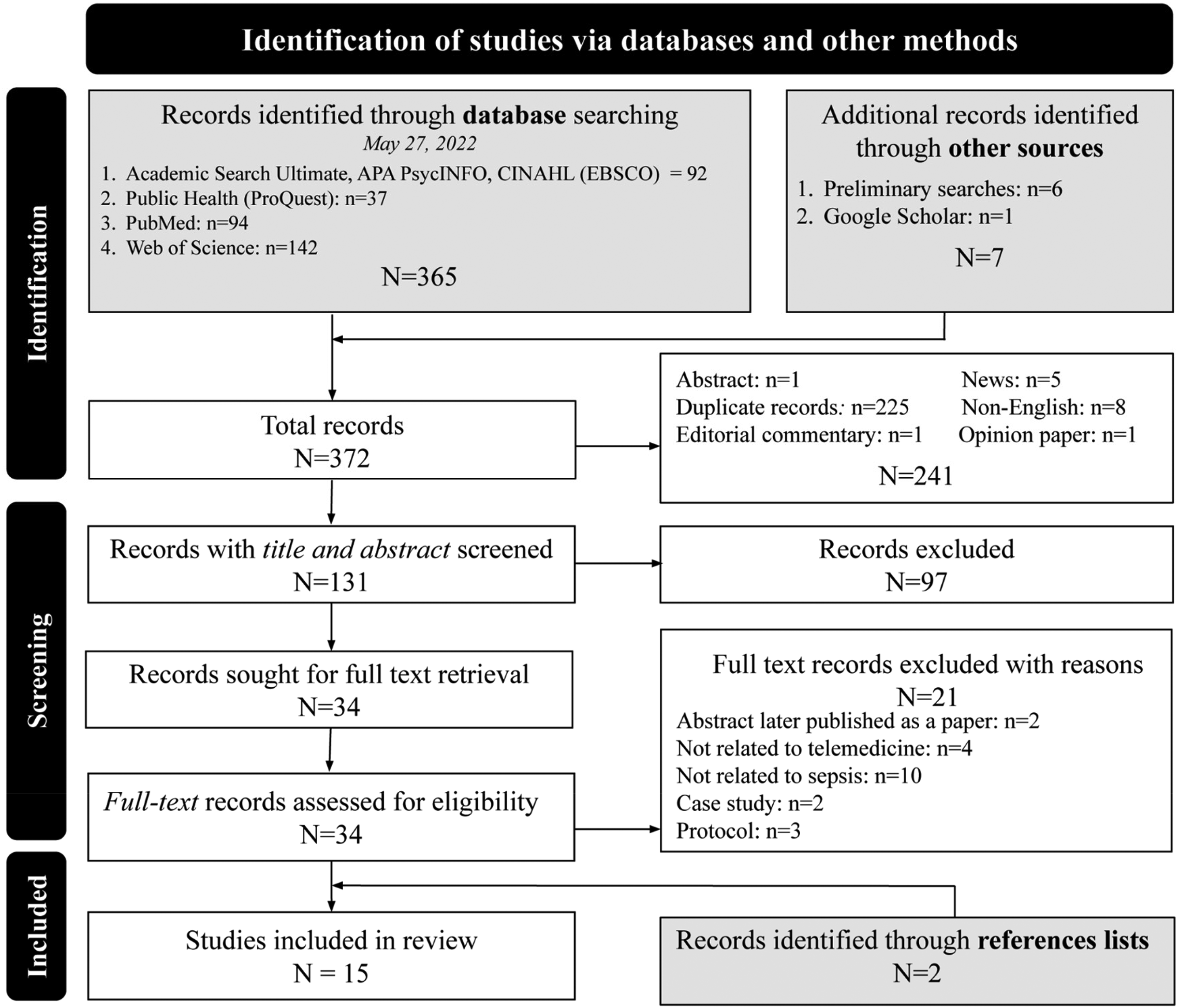
PRISMA study selection flow diagram. PRISMA: Preferred Reporting Items for Systematic Reviews and Meta-Analyses.
Characteristics of included studies.
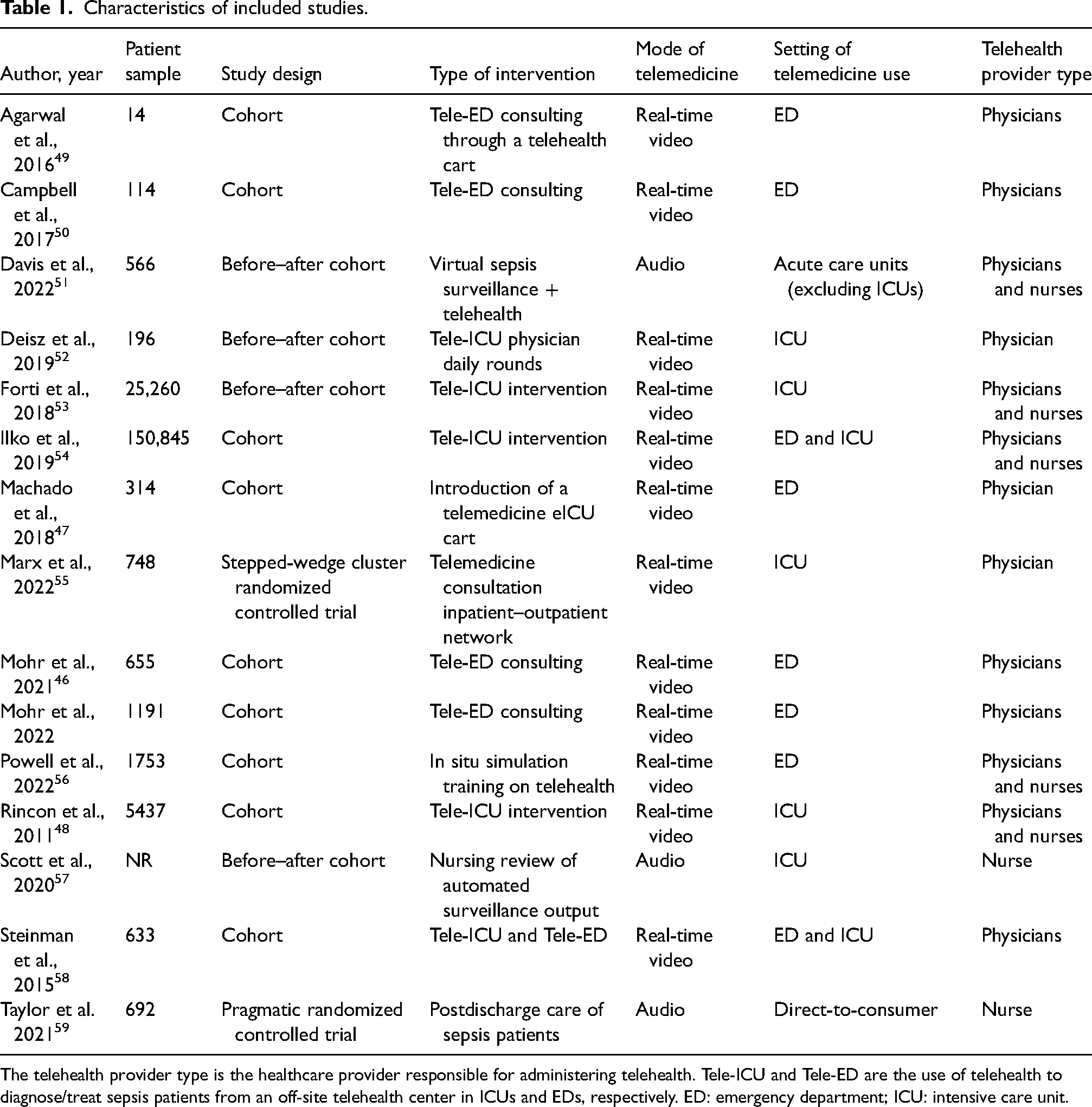
The telehealth provider type is the healthcare provider responsible for administering telehealth. Tele-ICU and Tele-ED are the use of telehealth to diagnose/treat sepsis patients from an off-site telehealth center in ICUs and EDs, respectively. ED: emergency department; ICU: intensive care unit.
aOR of study outcomes following telemedicine.
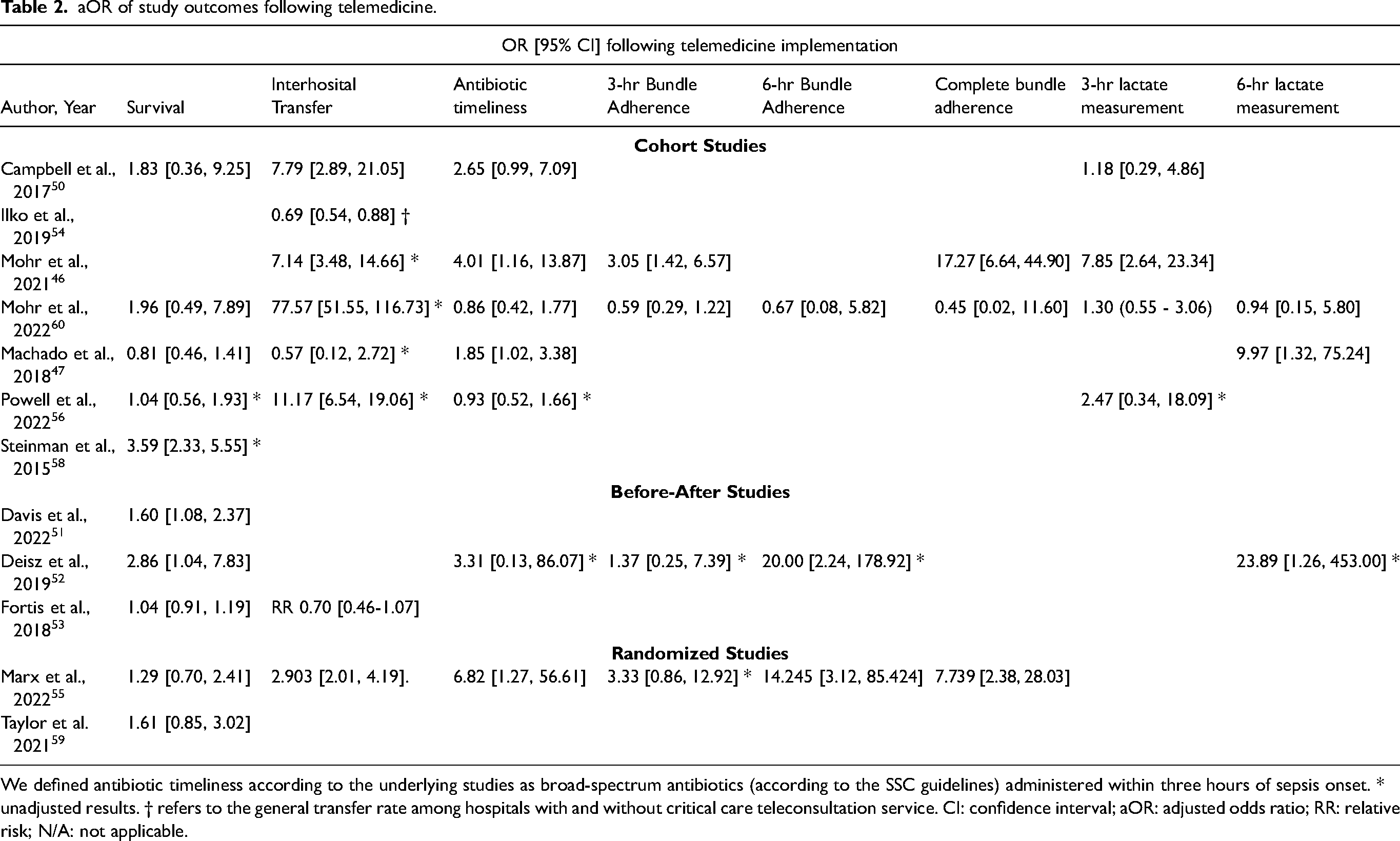
We defined antibiotic timeliness according to the underlying studies as broad-spectrum antibiotics (according to the SSC guidelines) administered within three hours of sepsis onset. * unadjusted results. † refers to the general transfer rate among hospitals with and without critical care teleconsultation service. CI: confidence interval; aOR: adjusted odds ratio; RR: relative risk; N/A: not applicable.
Telehealth characteristics
Telehealth applications were diverse, with care being provided to patients in EDs,46,47,49–51,54,56,58,60 ICUs,48,52–54,57,58 and in postdischarge recovery at home. 59 Most applications used high-definition audio–video real-time connections through either a portable cart or permanently installed telehealth hardware in hospitals.46–50,52–56,58,60 Most telehealth programs fell into two categories: (1) provider-to-provider on-demand telehealth consultations for patients with suspected sepsis and (2) real-time tele-ICU monitoring for patients on inpatient units (ICUs or wards) by nurses or physicians (Table 1). Many of the reports were small demonstration projects, with only a single originating site and a single telehealth provider site, but three studies reported on interventions that had been scaled using a hub-and-spoke model, many of which had spokes in rural facilities.46,50,60
Several studies reported results from provider-to-provider ED-based teleconsultations, with three coming from a single rural ED network.46,50,60 In these studies, staff in rural hospitals use an on-demand consultation service with a board-certified emergency physician and experienced ED nurse for advice on diagnosis, treatment, and help with interhospital transfer. This intervention was part of a mature network that also provided care for patients with cardiac emergencies, trauma, and stroke, but sepsis-specific pathways were used.
Powell et al. 56 combined a similar ED-based telehealth consultation service with an educational intervention to examine the role of in situ simulations in promoting telehealth use in sepsis patients. Although clinical outcomes were measured, the goal of the educational program was to increase network use.
The other major category of studies used tele-ICU technology, which allows for a physician or nurse-directed real-time telemonitoring of patients using high-definition video and telemetry in an inpatient setting. Three studies48,51,59 used this style of surveillance systems, often in conjunction with algorithms to identify clinical decompensation, trigger formal screening, and notify staff in suspected sepsis cases, and one had a healthcare provider that conducted a virtual consultation when indicated. 51 Another program used a tele-ICU nurse team to work collaboratively with bedside teams to verify the completion of bundle-adherent care by time targets for qualifying sepsis patients. 48
Taylor et al. 59 reported the use of direct-to-consumer telehealth postdischarge from a sepsis hospitalization. The study implemented a program called STAR (Sepsis Transition And Recovery), a nurse-led postdischarge sepsis telehealth program designed to identify and address treatable complications of recovery that commonly lead to readmissions and preventable postdischarge morbidity.
Outcome reporting
The most commonly studied outcomes, using the telehealth measure domains, were effectiveness outcomes, including survival and SSC bundle adherence (Figure 2). The summary of all measured outcomes is available in Supplemental eTable 5. The most frequently reported outcomes, including survival, SSC 3 h bundle adherence, and antibiotic timeliness, are described further below.

Telehealth outcome domain heatmap. A heatmap classifying study outcomes reported according to the RTHSRC telehealth domains. The percentage of studied outcomes within a study (number of outcomes in each domain evaluated by the study/total number of outcomes evaluated by the study) is correlated to the redness of the cell.
Three studies reported outcomes on patient and provider experiences, largely reporting that both providers and patients were comfortable with telehealth use.49,52,56 Other observations included providers’ views that offloading surveillance and documentation activities reduce alert fatigue, 57 and that telehealth led to cultural changes that improved the quality of sepsis care. 58
Only one study 47 reported on cost-effectiveness of their telehealth intervention, observing no difference in costs between telehealth and nontelehealth groups (US$19,713 vs. US$24,364, p = 0.274).
Care processes and patient outcomes
The ORs of care processes and patient outcomes following telehealth use are listed in Table 2. Generally, survival was increased among sepsis patients treated with telehealth, with ORs ranging from 0.81 [95% confidence interval (CI) 0.46, 1.41] to 3.59 [95% CI 2.33, 5.55]. Though survival OR point estimates were increased in 9 out of 10 studies, survival was only increased statistically significantly in 3 studies.51,52,58 The effect of telehealth on interhospital transfer was highly varied, likely in part due to hospital-level factors and the lack of adjustment among analyses. Interhospital transfer OR ranged from 0.57 [95% CI 0.12, 2.72] to 77.57 [95% CI 51.55, 116.73]. Telehealth increased antibiotic timeliness and appropriateness in 5 out of 7 studies with ORs ranging from 0.86 [CI 95% 0.42, 1.77] to 6.82 [CI 95% 1.27, 56.61]. Telehealth increased bundle adherence in a majority of studies, with 3 h, 6 h, and complete bundle adherence having ORs ranging from 0.59 [CI 95% 0.29, 1.22] to 3.33 [CI 95% 0.86, 12.92]; 0.67 [CI 95% 0.08, 5.82] to 20.00 [CI 95% 2.24, 178.92]; and 0.45 [CI 95% 0.02, 11.60] to 17.27 [CI 95% 6.64, 44.90], respectively. Only one study reported a significant increase in 3 h lactate measurement, all studies together having ORs ranging from 1.18 [CI 95% 0.29, 4.86] to 7.85 [CI 95% 2.64, 23.34]. Two out of three studies reported a significant increase in 6 h lactate measurement, all studies together having ORs ranging from 0.94 [95% CI 0.15, 5.80] to 23.89 [95% CI 1.26, 453.00].
We discovered significant clinical and methodological heterogeneity within our studies, which prevented us from pooling the data in a formal meta-analysis. Instead, we performed an explanatory analysis to uncover the reasons for this heterogeneity. We accounted for some heterogeneity in study methodology by focusing on studies that reported on provider-to-provider on-demand video consultations in EDs and ICUs as their telehealth intervention. We also focused on patient survival as an outcome (n = 28,708 pooled patients), as it was the most frequently reported outcome. Though the majority of the points were within the 95% CI of the funnel plot, we assessed there to be some risk of publication bias because the funnel plots were asymmetric (Supplemental eFigure 2). We compared cohort, randomized, and before–after studies. The cohort studies, which had a high risk of bias, seemed to demonstrate the highest, and most variable telehealth effect sizes (Supplemental eTable 6).
We also noticed that studies with lower baseline survival tended to demonstrate larger telehealth effect sizes for improving survival. We thus hypothesized that baseline illness severity may be an effect modifier. Focusing on studies that reported on provider-to-provider on-demand telehealth consultations as an intervention, we performed weighted meta-regression using control group survival as our sole predictor. We observed that those studies with the highest control group survival had the smallest association between telehealth use and survival (β 0.18 lower log-odds survival per 10% increase in control group survival, 95% CI −0.12 to −0.24) (Figure 3).

Weighted regression of effect of telehealth on survival, related to baseline sepsis survival. The horizontal axis reports the control group survival (percentage), and the vertical axis is the β, from the adjusted effect size of telehealth on survival, from each of the underlying studies. The size of each point is proportional to the sample size and weighting in our regression model, and the linear weighted regression line is represented on the graph.
Discussion
Telehealth has been used to augment sepsis care, especially in settings where sepsis specialty care may not be readily available. Of the studies included in this systematic review, most were published in the past 5 years, suggesting increased recent interest in this area. Our systematic review found that telehealth has been used in diverse settings for the management of patients in EDs and ICUs, surveillance of inpatient services, and postdischarge monitoring, and current comparative effectiveness research has primarily focused on clinical effectiveness for process and clinical outcomes. Telehealth use was typically associated with improved sepsis survival and care processes, but these effects were variable. Ultimately, the effectiveness of telemedicine is likely dependent on hospital-level factors.
Our results confirm broader findings from Totten et al. 61 that nonsepsis telehealth applications are diverse. Part of the reason for that diversity of application may be that telehealth is being used to solve very different clinical problems related to sepsis care. It also highlights that the heterogeneous treatment effects we observed may reflect the underlying resources and operations of the systems in which telehealth is deployed. Although we were unable to determine why some studies had poor control group outcomes, baseline survival is likely a surrogate for underlying health system performance, patient selection within health systems, training and experience of local care teams, or other factors that may make telehealth a more effective alternative. Similar results have been found in telestroke, where telehealth has previously been shown to have the greatest effect in rural areas with the fewest available local resources. 62 One of our included references observed that the effect of telehealth was greatest in the smallest rural EDs with the lowest sepsis volume most often staffed by advanced practice providers, which aligns closely with the findings of our weighted meta-regression analysis. 60
Telehealth has many potential mechanisms that could affect outcomes. Several studies highlighted that telehealth contributes to the education of local providers. 63 This has previously been cited as a secondary benefit of patient-focused teleconsultation, and it is one of the ways that care evolution can propagate through professional networks. Other studies focused on surveillance to improve early detection or expert consultation for treatment recommendations. 34 Early detection is a significant barrier to early treatment, and it may contribute to higher mortality for inpatients developing sepsis than those who present with sepsis on admission. The barriers of early diagnosis could have affected the observed effects in provider-to-provider teleconsultation in other studies because local sepsis recognition may be required prior to telehealth activation.
It was surprising that we observed highly variable improvement in guideline adherence or antibiotic timeliness, although the point estimates for both of these outcomes suggest that care may actually be different in patients whose care was supplemented with telehealth. 64 These two process outcomes were narrowly focused, however, and there may be other ways, such as through guidance on airway management, hemodynamic evaluation and optimization, interhospital transfer, and management of underlying comorbidities where telehealth recommendations may not be captured in SSC guideline measurement. Future work may explore the social relationship between telehealth and local providers to better define the ways in which telehealth recommendations reflect guidelines, are implemented, and contribute to changes in local care pathways. The highly variable bundle adherence and antibiotic timeliness rates also raise questions about the mechanism by which telehealth is associated with improved survival.
Our systematic review highlighted some key areas of opportunity for future investigation. Most published comparative effectiveness research is derived from observational cohort studies. Quasi-experimental or randomized studies are clearly needed to better elucidate the causal role of telehealth in improving patient outcomes within high-risk groups and to better understand the heterogeneity of treatment effects. The other theme we identified is that the outcomes included in sepsis telehealth studies are narrow. Few studies include long-term clinical or patient-centered outcomes (e.g. quality of functional recovery, the ability of a family to visit patients closer to home). Robust large-scale cost and cost-effectiveness studies have not been performed, even though these are often cited as benefits of telehealth use. A study is currently underway to evaluate the economic effect of telehealth in rural ED-based sepsis care. 65
Limitations
Our systematic review has several limitations. First, the number of published studies evaluating telehealth in sepsis care is limited and most are published by only a few research groups. This could mean that other groups have developed telehealth interventions that have not been reported in the scientific literature, but the certainty of our conclusions is limited by the underlying data. Clinical and statistical heterogeneity remains a limitation because the systems and interventions reported differ and are likely only partially explained by baseline survival. Due to the high variance in the studies’ findings, the certainty of our outcomes from the subgroup and regression analyses is low, which impacts the strength of our conclusions. Finally, our subgroup analyses and weighted regression are subject to the limitations of the underlying observational study designs, which risk being confounded by indication.
Conclusion
Telehealth has been used by a variety of groups in diverse ways to improve sepsis care. Telehealth use for sepsis care may be associated with improved survival in some settings, with the greatest effect in studies with the lowest baseline survival. Future work would benefit from interventional studies, long-term postdischarge and patient-centered outcomes, and cost-based analyses, because the causal effect of novel care delivery programs on clinical outcomes and resource utilization has policy relevance and is needed to optimize the ways in which these programs are used.
Supplemental Material
sj-docx-1-jtt-10.1177_1357633X231170038 - Supplemental material for The impact of telehealth in sepsis care: A systematic review
Supplemental material, sj-docx-1-jtt-10.1177_1357633X231170038 for The impact of telehealth in sepsis care: A systematic review by Kevin J Tu, Cole Wymore, Nedelina Tchangalova, Brian M Fuller and Nicholas M Mohr in Journal of Telemedicine and Telecare
Footnotes
Declaration of conflicting interests
The author(s) declared no potential conflicts of interest with respect to the research, authorship, and/or publication of this article.
Funding
The author(s) disclosed receipt of the following financial support for the research, authorship, and/or publication of this article: KJT was supported by a Daniel and Carly Rochkind research grant and a Banneker/Key scholarship, both provided by the University of Maryland Honor College. NMM was supported by a grant from the Agency for Healthcare Research and Quality (AHRQ, grant K08HS025753) and the Health Resources and Services Administration (HRSA, award U3GRH40003). The views expressed in this publication are solely those of the authors and do not reflect the official views of the funders or the U.S government.

Supplemental material
Supplemental material for this article is available online.
References
Supplementary Material
Please find the following supplemental material available below.
For Open Access articles published under a Creative Commons License, all supplemental material carries the same license as the article it is associated with.
For non-Open Access articles published, all supplemental material carries a non-exclusive license, and permission requests for re-use of supplemental material or any part of supplemental material shall be sent directly to the copyright owner as specified in the copyright notice associated with the article.
