



Abstract

The ongoing adoption of telehealth and associated research continues to strengthen through the COVID-19 pandemic, but in retrospect, the Journal of Telemedicine and Telecare (JTT) has maintained a key role in sharing knowledge and expertise in telehealth and digital healthcare for almost three decades. Established in 1994 by founding Editor Emeritus Professor Richard Wootton, the JTT continues to be a leading source of scientific evidence reports, formal reviews, perspectives, and instructional advice on telehealth. 1 The recent pandemic might have had a pivotal role in generating public awareness of telehealth (albeit in the form of telephone and video consultations), but the ongoing need for evidence to support ‘telehealth-enabled’ models of care remain just as important as ever before. 2 There is no doubt that telehealth is contributing to the transformation of our health system. The drivers for change remain: how do we make our health services more clinically and economically efficient, more accessible, and more patient centric?
From an editor's perspective, we can gauge telehealth advancement by the number, diversity and quality of manuscripts being submitted to the journal. Since the onset of the pandemic, the total number of manuscripts being submitted to the journal doubled, and this trend remains unchanged. In the last 12 months, a total of 1041 manuscripts were submitted to the JTT. Of these, about 25% were sent out for peer-review after editorial consultation, and about the same proportion were referred to alternative journals (such as discipline-specific publications).
Appraisal of manuscripts in a timely manner is always a challenge, although we still believe that the JTT turn-around time for the first decision (within a month) is exceptionally good compared to other Q1 scientific journals. We appreciate that there are perceived delays in handling manuscripts, but the timeframes do depend on workload, editorial review processes, reviewer availability and response times, and the return of author revisions. We appreciate that every submission made to the JTT is important, and we are doing our best to ensure a speedy response.
The Impact Factor of 6.344 is the highest ever score to date for the JTT. In terms of ranking, the JTT is the leading journal in its field and is in the top 15% of all journals in the category of Health Care Sciences and Services. These achievements reflect the efforts of the JTT editorial and production teams, authors, peer-reviewers, and our international readers.
Publication statistics
Publication statistics are of interest (for different reasons) to author, subscriber and publisher alike. They also allow the identification of long-term trends relating to the JTT. During 2022, the average length of time from submission to the first decision was 21 days. The average length of time between the submission of a manuscript and a final decision was 23 days. In 2022, the average days from acceptance to publication online are 26 days. The proportion of submitted papers accepted for publication in the JTT remains at around 10%.
Bibliometric statistics
Bibliometric statistics are compiled each year by Clarivate Analytics. The JTT is included in the ‘Health Care Sciences and Services’ category which covers 109 journals in the Journal Citation Reports. The ratio between the number of citations and the number of articles published gives the impact factor. The JTT published 221 citable articles and received 1402 citations. The JTT's impact factor was 6.344 and the journal ranked 12th out of 109 and is in the first quartile in this category.
Key facts
The JTT is a peer-reviewed specialist journal which:
Covers all aspects of telemedicine and telecare, including e-health and digital healthcare Is published 10 times per year Has an impact factor of 6.344 Has a five-year impact factor of 6.338
The JTT is an international publication and:
Over 270,000 copies of papers are downloaded from the online journal each year The majority of papers published are from Western Europe, North America or Australia.
During 2022:
The acceptance rate for papers was 9.6% The average time for refereeing research papers was 21 days The average time from submission to providing a final decision was 23 days The average time between acceptance and publication online was 26 days.
Electronic access
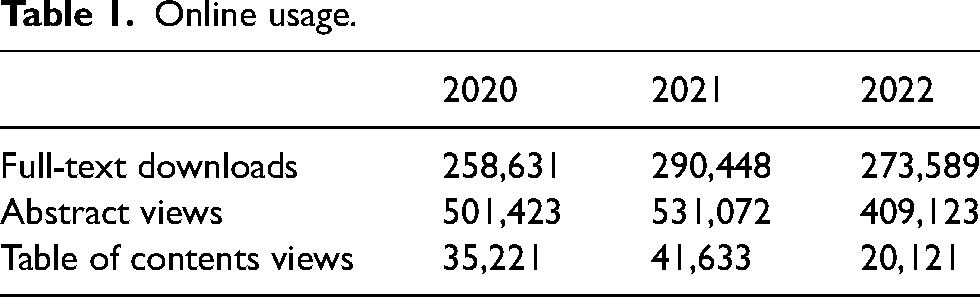
All subscribers are entitled to access the full-text electronic version of the Journal at no extra cost (see https://journals-sagepub-com-s.web.bisu.edu.cn/home/jtt). Online issues dating back to Volume 1 (1995) are available. Free online access for subscribers will continue in 2023. Online access is becoming increasingly popular with subscribers and access to abstracts and full-text downloading continues to grow. Usage figures for 2022 are summarised in Table 1.
Online usage.


Footnotes
Acknowledgements
Since the majority of the Journal's referees are overseas, it is our opinion that the very rapid refereeing time (usually less than four weeks) reflects great credit on them. As Editors, we are most grateful to the following reviewers, whether domestic or international, for their assistance with refereeing papers in 2022:
Sami Al Kasab
AH Alamoodi
Osamah Albahrey
Franchesca Arias
Nigel Armfield
Haleh Ayatollahi
Annie Banbury
Phoebe Barnett
Christian J Barton
Anna Barwick
Mohammad Behnammoghadam
Annabelle Belcher
Trine Strand Bergmo
Robert Berry
Christopher Bladin
Natale Daniele Brunetti
Irene Cabrera-Martos
Liam J Caffery
Grace Chao
Katherine Chike-Harris
Joseph Choi
Jane Clemensen
Patricia Commiskey
Michelle Cottrell
Mark G Coulthard
Kevin Cowart
Narelle S Cox
Snehil Dixit
Hung Doan
Megan Dwyer
Sisira Edirippulige
Robert H Eikelboom
Margit Endler
Christina Fang
Shira Fischer
Chris Freeman
Victor Gallegos-Rejas
Ryan Gillihan
Rui Guo
Hanadi Y Hamadi
Jens Peter Hansen
Rae-Anne Hardie
Helen M Haydon
Daniel Hinthorn
Genevieve Hofmann
Bree Holtz
David Hsiehchen
Thomas Hull
Anne Hunt
Sowmya Iyer
J'Aime Jennings
Jaimon Kelly
Nguyen Khoi Quan
Kristian Kidholm
Alena Kirzhner
Zeynep Koç
Elizabeth A Krupinski
Shaun Wen Huey Lee
Marcio Leyser
Sarah Liebherz
Louise Lillicrap
PK Loh
Mike Loper
Ana Maria Lopez
Parand Mansouri Rad
James Marcin
Craig McBride
Melissa McCarthy
Ryan McCool
Marisa P McGinley
Robyn Metcalfe
Patricia Mínguez-Clemente
Joel Mintz
Dinesh Mudaranthakam
Sorush Niknamian
John B North
Yongmiao Pan
Jordan Parsons
Andrew O Parsonson
Jennifer Pecina
Jill Peltzer
Daniel Perez-Troncoso
Robert P Pierce
Charlie Porter
Mandakini Pradhan
Zachary Pruitt
Rohit Ravi
Giovanna Ricci
Giacomo Rossettini
Sabe Sabesan
Gabrielle Saunders
Richard E Scott
John Scott
Paul Scuffham
Denton Shanks
Steven Simpson
Centaine L Snoswell
Chi Fuk So
H Peter Soyer
Ryan Spaulding
Rebecca Stovel
Naryan Subedi
Weijing Sun
Alan D Taylor
Monica Taylor
Luc Teot
Emma E Thomas
Ida Tornvall
Mary Ellen Vajravelu
Qingling Wang
Maxine Whelan
John Whited
Hsiu-Wen Yang
Peter M Yellowlees
Saijun Zhang
Declaration of conflicting interests
The author(s) declared no potential conflicts of interest with respect to the research, authorship, and/or publication of this article.
Funding
The author(s) received no financial support for the research, authorship, and/or publication of this article.