



Abstract
Background
Virtual care expanded rapidly during the COVID-19 pandemic, and how this shift affected healthcare disparities among subgroups of patients is of concern. Racial and ethnic minorities, older adults, individuals with less education, and lower-income households have lower rates of home broadband, smartphone ownership, and patient portal adoption, which may directly affect access to virtual care. Because primary care is a major access point to healthcare, perspectives of primary care providers are critical to inform the implementation of equitable virtual care.
Objective
The aim of this mixed methods study was to explore primary care physician experiences and perceptions of barriers and facilitators to equitable virtual care.
Design
We used an explanatory sequential mixed methods design, which consists of first collecting and analyzing quantitative survey data, then using those results to inform a qualitative follow-up phase to explain and expand on results.
Participants
Primary care physicians in a family medicine department at an academic medical center responded to surveys (n = 38) and participated in interviews (n = 16).
Approach
Participants completed a survey concerning frequency and preferences about video visits, pros and cons of video visits, communication aspects, and sufficiency of the technology. A purposeful sample of participants completed semi-structured interviews about their virtual care experiences with a focus on equity for subpopulations.
Key Results
The results indicated that physicians have observed equity issues for unique patient populations. The results add to the understanding of nuanced ways in which virtual care can increase and decrease healthcare access for unique populations. Patients with limited English proficiency were particularly affected by inequity in virtual care access.
Conclusion
Additional research and interventions are needed to improve portal access for those with limited English proficiency. Improvements should focus on health system interventions that expand access without requiring increased patient burden.
Introduction
The COVID-19 pandemic disrupted US healthcare, with organizations transitioning rapidly to virtual care after Medicare/Medicaid changes in reimbursement rules. Yet, socioeconomically disadvantaged patients are less likely to adopt healthcare technologies like patient portals.1–4 Despite evidence of the clinical effectiveness of telehealth,5,6 lack of portal access will severely limit the ability to receive virtual care, such as video visits, which are typically scheduled through a patient portal. Given the disproportionate burden of COVID-19 in disadvantaged (e.g. low socioeconomic status, Hispanic, and Black) groups, 7 and their lower access to broadband Internet and newer devices, 8 it is critical to understand and address healthcare disparities associated with virtual care.
Rapid, expanded use of virtual care might create new, or exacerbate existing, healthcare disparities.9,10 Patients who are from underrepresented groups, older, less formally educated, and have lower income already suffer from healthcare access disparities. 11 These same groups also have lower rates of home broadband access, 12 smartphone adoption, 12 and patient portal adoption, 13 which directly impact access to virtual care. Indeed, broadband access is increasingly seen as a social determinant of health in its own right. 14 Previous health informatics interventions have produced intervention-generated inequalities, 15 as socioeconomically advantaged groups tend to have increased access, uptake, and adherence to technology-based interventions relative to those who are more disadvantaged. For example, technologies like computers, smartphones, and health tracking devices that deliver informatics interventions are less likely to be available to those with less education and lower income levels. 15 This inequality has partly led to differential benefits with more advantaged groups benefiting more from health informatics interventions than underrepresented minorities or lower-income individuals. Patient portals, for instance, are used to deliver virtual care and for patient communication, yet clinicians enroll underrepresented minorities at lower rates leading to less access to care and disproportionately less benefit from interventions. 16 Video visits are less likely to be completed by those with lower income, who are older, or who have limited English proficiency 17 than their higher-income, younger, and English-speaking counterparts. Additionally, a recent survey found that 28% of Americans with home broadband and 30% of those with smartphones were concerned about their ability to continue to pay for those services; this was especially true for Black, Hispanic, and low-income respondents. 18 We adopted a comprehensive view of virtual care, looking beyond video visits to include other types of virtual care, all of which have played an important role during the COVID-19 pandemic. We define virtual care as including video visits, phone visits, eVisits, portal messages, or eConsults.
The aim of this mixed methods study was to explore physician experiences and perceptions of barriers and facilitators to equitable virtual care during the COVID-19 pandemic. Physicians have a unique perspective in delivering virtual care given that they see multiple patients and thus have the ability to discern patterns across numerous patients’ experiences with virtual care. However, little prior research has sought to understand how they think that virtual care may have influenced healthcare disparities among different subpopulations shown in other works to have disparate virtual care uptake.19–22 Subpopulations are patient groups characterized by race, socioeconomic status, ethnicity, language proficiency, age, and disability status. Physicians are in a unique position to explain barriers to and facilitators of equitable virtual care, given their interactions with patients, their understanding of needs, and their workflow. Virtual care has the potential to remove important barriers to healthcare access for some patients, which may improve equity; however, physician adoption may have a direct effect on virtual care access. If physicians do not want to implement virtual care, they will be less likely to offer it, which can exacerbate access inequities. Documenting physicians’ perspectives is critical to inform solutions and implementation strategies for equitable delivery of care that may further improve equity in health outcomes. A mixed methods design is ideal for understanding the ways in which virtual care may have affected disparities by examining trends along with gathering detailed experiences of virtual care from physicians. 23 Understanding how virtual care may have exacerbated disparities for different subpopulations is critical to illuminate gaps in care and inform strategies to reduce inequality.
Methods
We used an explanatory sequential mixed methods design, which consists of first collecting and analyzing quantitative survey data, then using those results to inform a qualitative follow-up phase to explain and expand on results. 24 We surveyed family medicine physicians to reflect on their experiences during the closure of clinics and subsequent re-opening. We then used those results to begin to purposefully sample physicians who indicated that they were willing to be interviewed. We followed COREQ guidelines for reporting qualitative aspects of this study. 25
Setting
This research was conducted within the Department of Family Medicine (DFM) at the University of Michigan. Eligibility for participation included physicians who completed video visits between March 16, 2020, and September 30, 2020, which corresponded to ambulatory clinics ramping down to favor virtual care and re-opening with continued focus on virtual care. The study was approved by the University of Michigan Institutional Review Board (HUM00199739).
Physician survey phase
The sampling frame was based on the electronic health record data, which detailed DFM physicians who conducted video visit encounters between the targeted dates. We contacted these physicians via email with an invitation to complete consent and a survey via Qualtrics. This survey included a question asking respondents whether they would be willing to participate in a follow-up interview. The survey covered the following domains: demographic characteristics, frequency and preferences about video visits, pros and cons of video visits, communication aspects, and sufficiency of the technology (Supplement 1). We calculated descriptive statistics for all survey items.
Physician interviews
We used survey results to develop semi-structured interview questions to ensure we were expanding on relevant concepts related to equity. For example, survey results about groups adversely affected by video visits relative to in-person visits informed the questions and prompts about equity on the interview guide. Based on early interviews that revealed specific equity concerns with patients with limited English proficiency, we purposively sampled additional physicians who work with these subpopulations and could speak to issues of equity.
We pilot tested the interview protocol with physicians not included in the sample, and the questions focused on the domains of access, uptake, adherence, and efficacy (Supplement 2). A primary care physician (OR) and a methodologist (TG) obtained verbal consent and conducted the interviews via Zoom, which lasted approximately 30 min. Interviews were audio-recorded and professionally transcribed.
We analyzed interview transcripts with a thematic analysis approach 26 assisted by MAXQDA software. Analysis began with line-by-line open coding interview transcripts and simultaneously developing a codebook to identify units of meaning in text segments. Through the coding process, we refined codes by adding new codes as needed and collapsing redundant codes. To identify themes, we used MAXQDA's retrieved segments to query text for each code. We further examined patterns among codes using the code relations browser for co-occurrence of codes in addition to the code matrix browser and quote matrices to compare codes and segments by document. Two individuals (OR and TG) completed the coding and met routinely for debriefing through a consensus process to ensure consistency. Themes were presented to the larger research team for discussion and further refinement. Validation strategies included search for disconfirming evidence and investigator triangulation.
Integrative analysis
Finally, we integrated through merging 27 qualitative and quantitative results on common domains and compared results through a joint display. 28
Results
Quantitative results
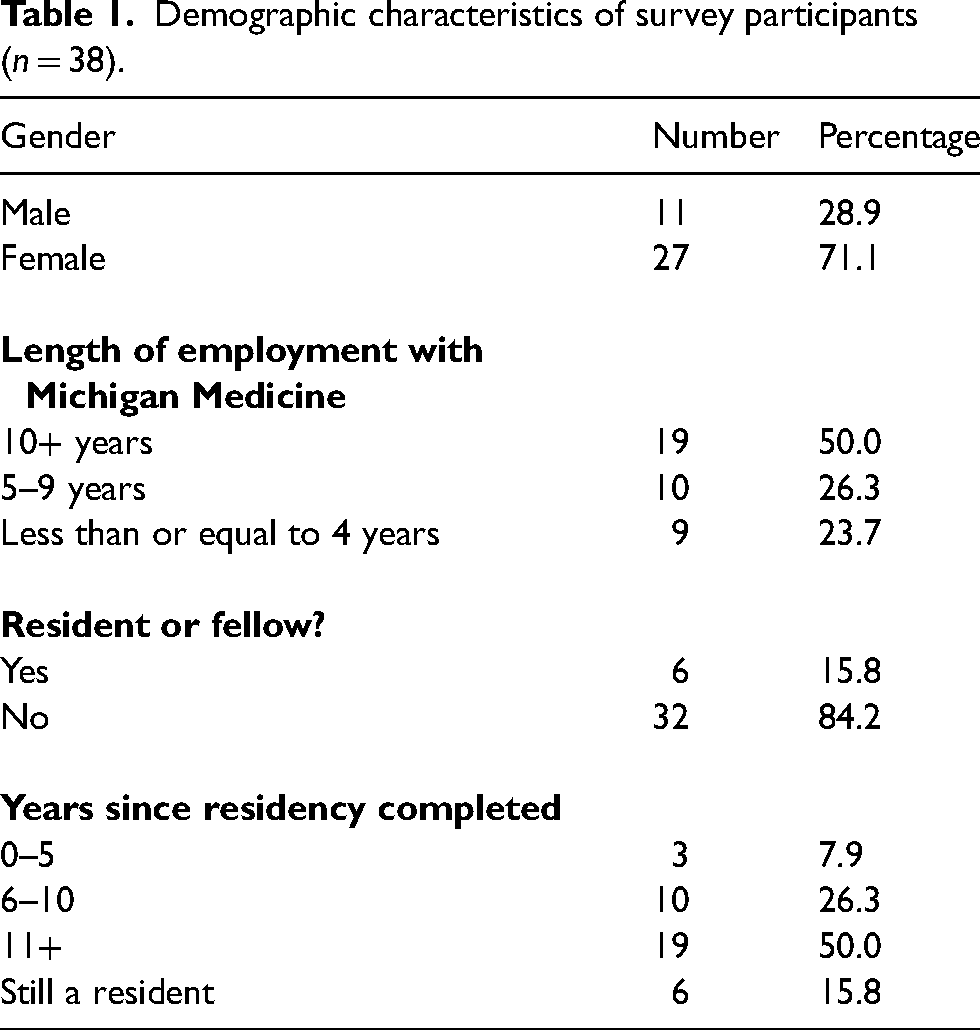
A total of 38 physicians responded to the survey, with a 31% response rate. See Table 1 for participant demographics.
Demographic characteristics of survey participants (n = 38).
Physicians evaluated the pros and cons of virtual video visits. Of those surveyed, 76.3% (n = 29/38) had never completed a virtual visit prior to March 2020. Physicians appreciated the increased flexibility (73.7%, n = 28/38) and convenience (84.2%, n = 32/38) of virtual visits. Video visits were reported to take less time compared to face-to-face visits (60.5%, n = 23/38), and 63.2% (n = 24/38) of physicians felt that they had sufficient time to complete a video visit. Physicians also appreciated the opportunity to see their patients’ home environment (81.6%, n = 31/38) and to protect patients from possible COVID-19 exposures in person (68.4%, n = 26/38). Cons included that 71.1% (n = 27/38) of physicians reported they arrived 15 min late to a video visit, and 86.6% (n = 32/38) reported that the patient was late to the video visit or not present at least once.
Communication during virtual visits was also evaluated on a scale of 1 = always and 5 = never. Physicians reported that communication with non-native speakers (M = 2.8, SD = 0.8), older adults (M = 2.7, SD = 0.7), and children/adolescents (M = 2.1, SD = 0.9) was most adversely affected during video visits compared to in person. The need for an interpreter was one of the most common reasons for completing a three-way video visit (44.7%, n = 17/38), and 65.8% (n = 25/38) of physicians reported completing a three-way video visit since March 2020. Communication with patients with physical disabilities (M = 4.0, SD = 0.9); pregnant women (M = 4.6, SD = 0.5); minority patients; lesbian, gay, and bisexual patients; and transgender patients was rated least likely to be compromised during video visits, and communication with patients with hearing-related disabilities (M = 2.8, SD = 1.0), cognitive disabilities (M = 2.76, SD = 1.0), and older adults (M = 2.67, SD = 0.7) was perceived as more adversely affected.
In terms of technology (1 = never and 5 = always), most physicians reported the video technology was sufficient (M = 4.1, SD = 0.6). Common technical issues included insufficient video detail (M = 3.3, SD = 1.1) and poor video (M = 3.7, SD = 0.6) and audio (M = 3.8, SD = 0.7) quality from the patient. Of physician respondents, 63.2% (n = 24/38) reported dissatisfaction related to technical issues, and 81.6% (n = 31/38) reported experiencing technical issues within the past month. The least common technical issues included echo or feedback (M = 4.6, SD = 0.6), sound and picture out of sync (M = 4.5, SD = 0.6), poor video (M = 4.5, SD = .6), and poor audio (M = 4.3, SD = 0.8) quality from the physician.
Overall, physicians were satisfied with using virtual video visit technology for clinical care (M = 1.7, SD = 0.9) (1 = extremely satisfied and 5 = extremely dissatisfied, reverse coded item to check for reading accuracy) and felt that video visits were clinically sufficient (M = 2.2, SD = 0.5) (1 = always and 5 = never) to adequately evaluate the patient's needs. The most common frustrations with virtual video visits included not being able to see (M = 2.8, SD = 0.6) or feel (M = 3.0, SD = 1.1) well enough to make good clinical judgments. In addition, 84.2% (n = 32/38) of physicians were frustrated with incomplete information available during virtual video visits, 60.5% (n = 23/38) indicated the patient brought up complaints that needed face-to-face examination, and 65.8% (n = 25/38) needed to examine the patient in person to observe nonverbal cues.
Qualitative results
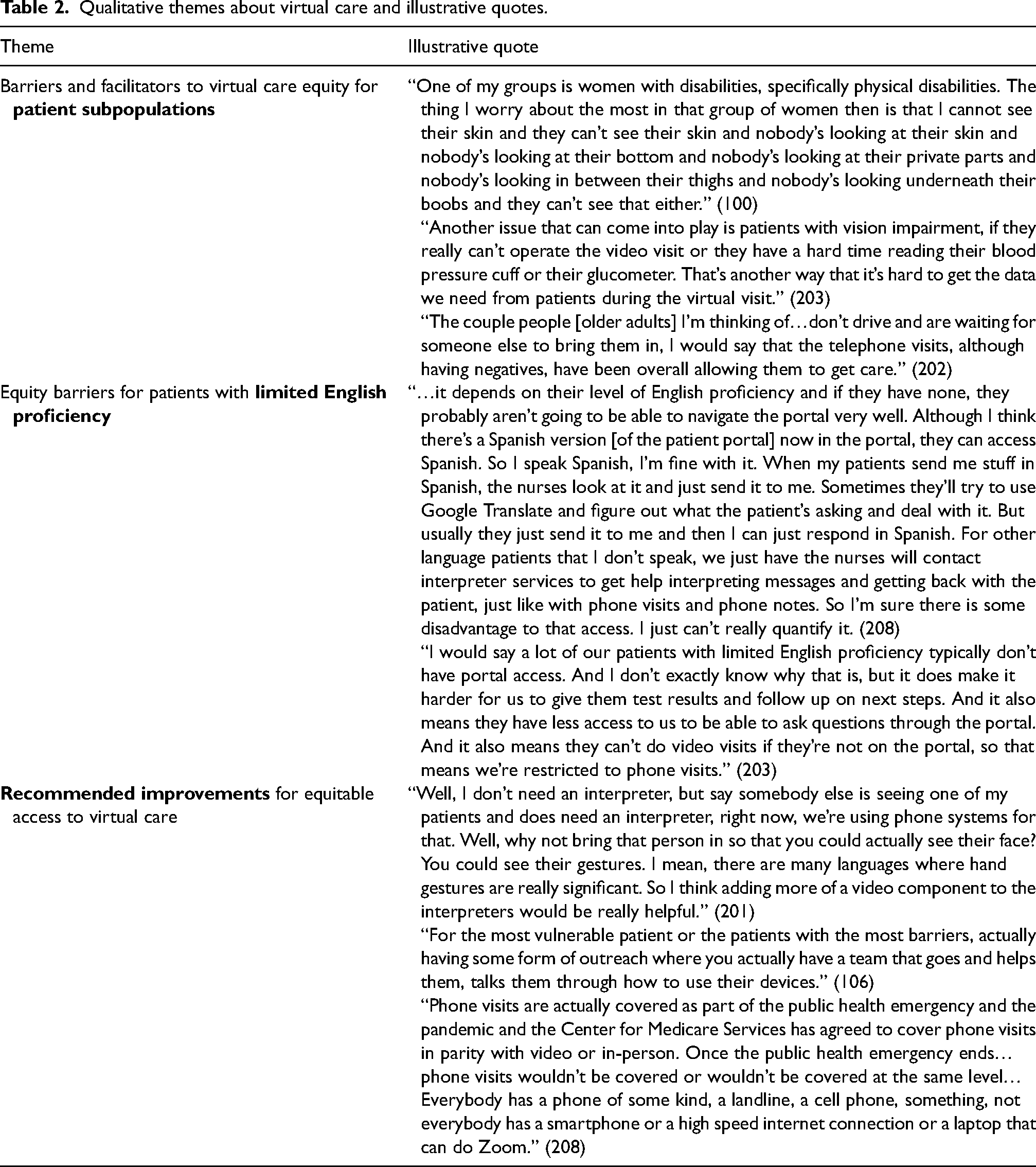
We conducted interviews with 16 family medicine physicians about their experiences and views on virtual care. We identified three major themes: virtual care presents both barriers and facilitators to equity for patient subpopulations, equity barriers for patients with limited English proficiency, and recommended improvements for equitable access (Table 2).
Qualitative themes about virtual care and illustrative quotes.
Virtual care presents both barriers and facilitators to equity for patient subpopulations
The support needed to participate in virtual care is amplified for patients with disabilities, patients with limited resources, and patients who do not speak English. For patients with physical disabilities, virtual care can facilitate access and concomitantly increase barriers to care. For patients with physical disabilities who have barriers to mobility or transportation, being able to receive care at home has improved their access. While there are still times when in-person visits are necessary, this allows patients to conserve their resources and energy. I think for some of my actual physical disability patients though,…like it's hard to move, they have to use assistive devices, those kinds of things, actually the virtual care's been a pro because some of them can have their conversations about medical management with me without…to get into the office. (206)
On the other hand, virtual care could be a barrier for some patients who do need physical assistance to complete the visit. For example, patients may have vision impairments, making a virtual visit difficult.
While virtual care can sometimes facilitate access to care, this is dependent on whether the patient has the sufficient resources for virtual care. Access and ability to use the phone, internet, and patient portal are limiting factors. A physician explained, They may not have a reliable address. Between not having a phone on file and not having an address on file, it makes it fairly hard to reach patients virtually, let alone follow up with them. (203)
A similar complexity was evident among virtual care for older adults, which has broken down some barriers for access by decreasing need for transportation and navigating clinic settings. However, providers have noted that this population can struggle with technology and often rely on external support, so virtual care has worsened access. Though not clinically optimal, having a phone visit, enabled by payer reimbursement changes, has facilitated their ability to receive care.
Equity barriers for patients with limited English proficiency
Providing equitable care to patients with limited English proficiency and cultural diversity was commonly identified as a barrier, but physicians perceive the health system has not adequately acknowledged the issue.
Equity for linguistically and culturally diverse patients is exacerbated by limited access to non-English portal platforms for patients to use, challenges with interpreters, and lack of understanding of cultural differences. Physicians explained that patients typically need access to an EHR portal to participate in a virtual care visit, yet lack of portal access or limited access in their preferred language can restrict patients to phone visits only. This results in loss of nonverbal cues and can limit follow-up options, such as accessing test results and follow-up instructions.
For patients who do have portal access, video visits are ideally with a provider proficient in their language or include an interpreter. Experiences with audio only interpreters were variable, depending on skills and sound quality. However, physicians described success in accessing interpreters when scheduled in advance and using video. I get the best [outcome] if they’re scheduled in advance and I get a third screen on my video screen, which is the interpreter sitting in a box as if they’re in a room with us. And I think that was actually the same as in-person care, because when I had to rely on a phone interpreter, it was hit or miss how good they were, how well you could communicate, what the quality of the connection was. (206)
Beyond communication, logistics, and technical issues, providers should consider the cultural beliefs and backgrounds of patients to improve virtual care equity. Even when there is a preference for in-person care, having access to a virtual visit facilitates care by allowing patients to communicate in their own language that may not otherwise be possible. A physician who practices in a language other than English explained that their clinic's patients often travel over an hour for a visit to communicate in their own language: We have patients routinely coming an hour or 90 minutes away, and the issue is that the language barrier's so significant for them, it's so difficult for them to communicate with a provider…And I think it's so underestimated by the medical establishment, how much being able to communicate with a doctor in your own language really means to someone. (201)
Recommended improvements for virtual care
Having staff and resources available to troubleshoot technical difficulties could be beneficial to bridge a gap. In addition, physicians advocated for providing internet access or devices to help all patients and enhance equity. One provider suggested working with community institutions that are available to patients to improve access to internet, computers, tablets, and phones. Things like local libraries having somebody there that is proficient…because often a library would be more accessible…we have patients that come to us for their primary care, but live four hours away. Whereas, I am sure they have a local library where they would probably be able to access reliable kind of WiFi. (206)
However, many communities will still lack resources to provide devices or internet access, which is a substantial barrier. A physician argued that continued phone visit access and payment coverage is needed for those without access to smartphones or high-speed internet.
Patients with limited English proficiency, however, will still have substantial disparities in access without specific improvements. Virtual care heavily relies on the patient portal to both connect and communicate with patients. A physician who practices in another language explained that a portal and patient material that is in a patient's preferred language would improve access and equity: Even though we have a quite substantive population of people that speak the language that I use, we don’t have any of that language and material available in our electronic medical record. And the electronic medical record doesn’t support the fonts for it…A lot of our materials that we could share with patients say about a certain topic, maybe sinusitis or something, would be available both in English and in Spanish.…But in this day and age, the technology needs to be leveraged to make better access to the languages that are spoken. (201)
Physicians also explained that the use of video relative to phone-only interpreters improves communication, which is true for languages that rely on gestures and languages such as American Sign Language. A physician also explained that it can also be harder to determine if an interpreter is misunderstanding something during a phone visit relative to a video visit. I find that with the interpreter [on the phone], the quality of the line is not as good. That is much easier if you are in the clinic, but it definitely adds another [issue], particularly over the phone when you cannot see. (106)
Mixed methods results
Table 3 provides a joint display that merges quantitative and linked qualitative results. Overall, the survey and interview results were congruent, yet the interviews illuminated greater potential for inequity in virtual care. One discrepancy was noted about patients with physical disabilities. While the quantitative results indicated communication was least likely to be compromised for patients with physical disabilities, the qualitative results included specific examples where the clinical exam was insufficient through video because patients with physical disabilities may be unable to inspect their skin and body. Because the qualitative sampling and interviews focused on equity, it may have better elicited equity concerns.
A mixed methods joint display merging quantitative and qualitative virtual care equity results for patient subpopulations.
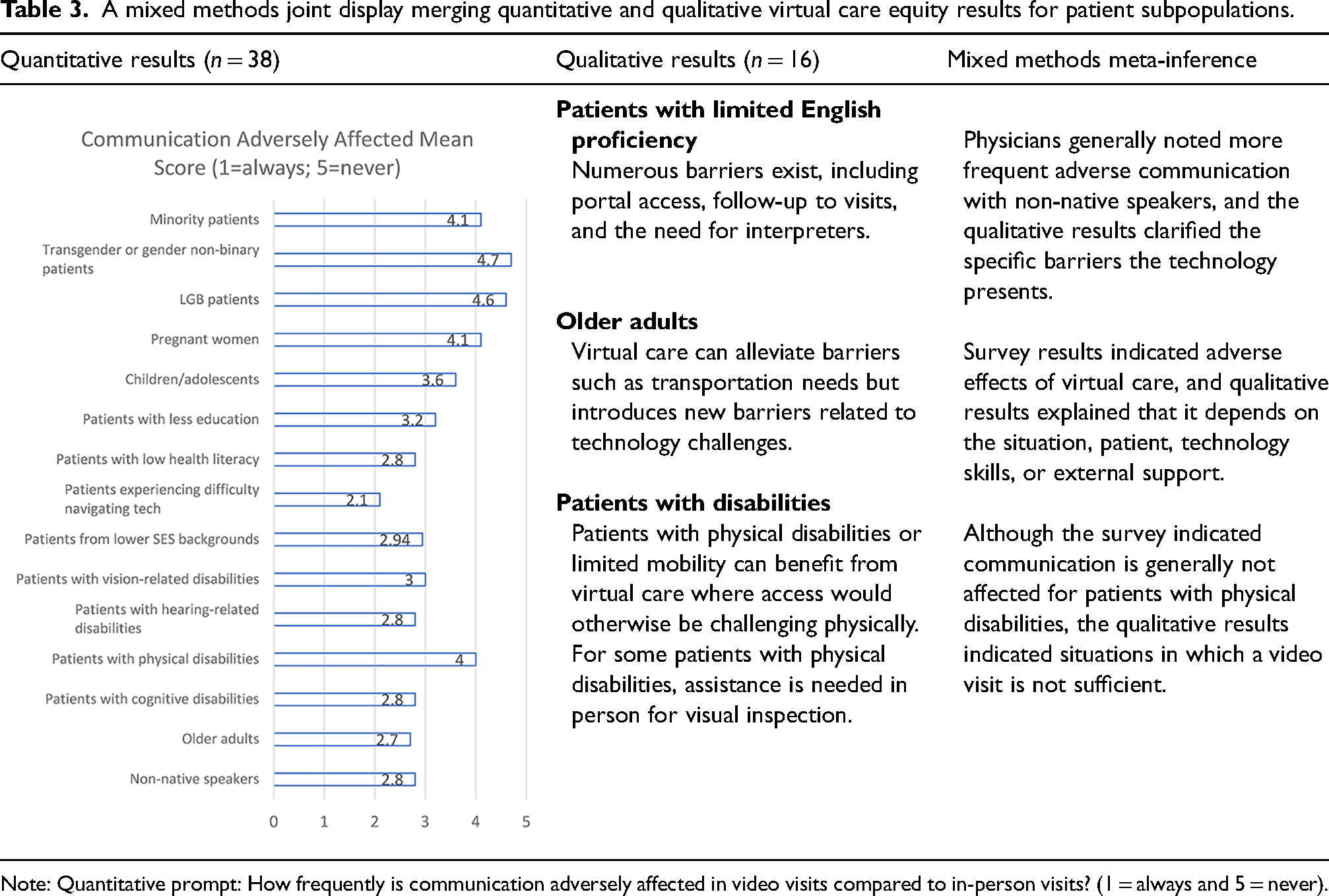
Note: Quantitative prompt: How frequently is communication adversely affected in video visits compared to in-person visits? (1 = always and 5 = never).
Discussion
Physicians reported numerous benefits of virtual care in terms of efficiency and convenience for patients, but access to this can be limited by needing a computer, tablet, or smartphone in addition to reliable internet. For patients with limited resources, such as transportation, virtual care could help, but it also requires internet and devices, which may also create barriers. To provide equitable care, patients need the option for phone and video visits, and healthcare systems need to understand barriers and implement strategies to increase access to video visits. 29 Moreover, policy changes may be needed to ensure continued coverage of virtual care, including video and phone visits when indicated.30–33
Despite potential advantages, drawbacks of virtual care appear more salient for certain patient subpopulations, including those with limited resources and those whose preferred language is not English. The results indicate that virtual care can exacerbate inequities for these patients. Perhaps, the most notable inequities were present among patients with limited English proficiency, which has been found to be a barrier to virtual care in other primarily English-speaking countries, consistent with our results. 34 Patient portal access is a gateway for access to virtual care, including accessing a video visit itself and follow-up information such as after-visit summaries, patient education material, and messages with the healthcare team. These results strongly suggest the need for further research and interventions to improve portal access for those with limited English proficiency.
Limitations of this research are related to its focus on a single healthcare system and the difficulty in capturing various specializations within primary care practice. Future research should examine virtual care from both provider and patient perspectives in diverse health systems in addition to smaller practices. Moreover, within family medicine at the academic medical center sampled, physicians often have specific specializations such as musculoskeletal or sports medicine, women's health, pregnancy care, geriatrics, and many others. More of these specific virtual care use cases need to be understood.
The demand for virtual care will likely remain, and permanent changes to reimbursement mechanisms are needed to sustain adoption.9,31 Findings indicated strong physician endorsement of the need for support for virtual care. Healthcare team members can act as supportive intermediaries by aiding new virtual care users and by helping individuals navigate technology and develop skills needed for virtual care.10,35,36 Partnerships with community health organizations, local resources, colleges/universities, 35 and government support could help by giving technology to patients to participate in virtual care. 9 These activities will require input from patients, communities experiencing inequity, and thoughtful investments by healthcare systems, payers, and governments. 29 To enhance equity, such investments should focus on “upstream” interventions that expand access without requiring increased patient effort to access care 37 where possible.
Supplemental Material
sj-docx-1-jtt-10.1177_1357633X231194382 - Supplemental material for Equity in virtual care: A mixed methods study of perspectives from physicians
Supplemental material, sj-docx-1-jtt-10.1177_1357633X231194382 for Equity in virtual care: A mixed methods study of perspectives from physicians by Timothy C Guetterman, Emily Koptyra, Olivia Ritchie, Liz B Marquis, Reema Kadri, Anna Laurie, VG Vinod Vydiswaran, Jiazhao Li, Lindsay K Brown, Tiffany C Veinot, and Lorraine R Buis in Journal of Telemedicine and Telecare
Supplemental Material
sj-docx-2-jtt-10.1177_1357633X231194382 - Supplemental material for Equity in virtual care: A mixed methods study of perspectives from physicians
Supplemental material, sj-docx-2-jtt-10.1177_1357633X231194382 for Equity in virtual care: A mixed methods study of perspectives from physicians by Timothy C Guetterman, Emily Koptyra, Olivia Ritchie, Liz B Marquis, Reema Kadri, Anna Laurie, VG Vinod Vydiswaran, Jiazhao Li, Lindsay K Brown, Tiffany C Veinot, and Lorraine R Buis in Journal of Telemedicine and Telecare
Footnotes
Declaration of conflicting interests
The author(s) declared no potential conflicts of interest with respect to the research, authorship, and/or publication of this article.
Funding
The author(s) disclosed receipt of the following financial support for the research, authorship, and/or publication of this article: This work was supported by the University of Michigan, Department of Family Medicine Building Block Grant, and Google Health.

Data availability statement
Because de-identification would be very difficult and participants did not consent to have data shared, data are not available for reuse.
Supplemental material
Supplemental material for this article is available online.
References
Supplementary Material
Please find the following supplemental material available below.
For Open Access articles published under a Creative Commons License, all supplemental material carries the same license as the article it is associated with.
For non-Open Access articles published, all supplemental material carries a non-exclusive license, and permission requests for re-use of supplemental material or any part of supplemental material shall be sent directly to the copyright owner as specified in the copyright notice associated with the article.
