



Abstract
The 2022 mpox outbreak in New York City posed challenges to rapidly scaling up treatment capacity. We describe a telehealth treatment model launched during this outbreak that facilitated healthcare provider treatment capacity, and was able to adhere to a Centers for Disease Control and Prevention (CDC)-sponsored expanded access investigational new drug (EA-IND) protocol for tecovirimat. Sixty-nine patients were evaluated and prescribed tecovirimat for mpox through telehealth visits at NYC Health + Hospitals/Bellevue and NYU Langone Health from June to August 2022. Thirty-two (46.4%) were previously diagnosed with HIV. Forty-four (63.8%) reported full recovery, with the remainder lost to follow-up. Most patients (n = 60, 87.0%) attended at least one follow-up visit (either in person or through telehealth) after starting treatment. We observed favorable treatment outcomes, with no serious adverse events, hospitalizations, or deaths related to mpox. While equitable access to telehealth remains a limitation that needs to be addressed, this telehealth model enabled a rapid scale-up of tecovirimat prescription during the mpox outbreak, and should be considered as an important tool used to respond to future infectious disease outbreaks.
Introduction
New York City (NYC) experienced its first case of human mpox (clade IIb) in May 2022, followed by a significant outbreak from July to August. 1 While the clade II virus has a low mortality rate, 2 infections can still lead to significant morbidity including bacterial superinfection or painful ophthalmological or anogenital lesions. 3 Mpox management guidelines from the Centers for Disease Control and Prevention (CDC) and NYC Department of Health and Mental Hygiene (DOHMH) recommend supportive care and treatment with tecovirimat, an antiviral with activity against orthopoxviruses, where indicated through an expanded access investigational new drug (EA-IND) protocol. Indications for treatment include severe disease (e.g. confluent lesions), risk for severe disease (e.g. immunocompromised state), or lesions involving anatomic areas that might result in serious complications (e.g. rectal).4,5 The EA-IND protocol initially had significant prescriber reporting and follow-up requirements which limited patient access due to prescriber care capacity.
As cases rapidly increased in NYC, our providers at NYC Health + Hospitals/Bellevue (Bellevue) and NYU Langone Health (NYULH) worked with NYC DOHMH to establish a telehealth visit model with telephone and/or video conference to provide an alternative option beyond in-person visits for treatment access. The goal was to increase provider capacity to evaluate patients and to eliminate the burden of travel for patients. Telehealth visits mitigate infectious exposure risk and allow clinicians to visually evaluate the progression of mpox skin lesions through video conferences or photo submissions. Herein, we describe the characteristics and outcomes of the initial cohort of patients prescribed tecovirimat through telehealth visits for mpox infection at Bellevue and NYULH.
Methods
Bellevue is the largest public hospital in NYC, and NYULH is a large urban non-profit academic medical center. After an in-person diagnostic visit where mpox testing was performed, patients with suspected or confirmed mpox infection were referred for treatment evaluation. Telehealth visits were offered, but in-person evaluation was also available for patients who needed it. Both Bellevue and NYULH electronic medical records (EMR) systems allowed patients to engage in telehealth visits (with audiovisual capabilities) and to transmit skin lesion photos and signed HIPAA-compliant consent forms required by the EA-IND protocol. NYC DOHMH contracted with a commercial pharmacy to provide same-day courier delivery of electronically prescribed tecovirimat. Follow-up with patients could be through telehealth or in-person visits.
We conducted a retrospective chart review of all patients ≥18 years who were evaluated for mpox infection where the initial clinical encounter to prescribe treatment was done through a telehealth visit from 19 June to 8 August 2022. Outcomes were captured for 30 days after treatment completion. Patients were excluded if they subsequently were determined to not have mpox infection or if they were not eligible to start tecovirimat.4,5 The NYU Langone institutional review board (IRB), which oversees NYULH and Bellevue, exempted this study from formal review.
Results
Of 83 patients evaluated for tecovirimat prescription, 69 (83.1%) had an initial telehealth treatment visit, with 54 encounters (78.2%) at Bellevue, and 15 (21.7%) at NYULH. Of the 14 patients excluded from the analysis, three patients were started on treatment in a clinic, two patients in the emergency department, seven while hospitalized, and two were not prescribed tecovirimat. The table describes our cohort characteristics. The median (IQR) age was 36 (32–42) years, and all were assigned male sex at birth. Most (82.6%) reported having sex with men and had exposure to mpox through sexual contact (71.0%). Thirty-two (46.4%) individuals were previously diagnosed with HIV, and all were reported to be on antiretroviral therapy.
The most common indication for tecovirimat treatment was mucosal membrane involvement (n = 59, 85.5%), most frequently in the oropharynx or rectal area. The median (IQR) days from symptom onset to treatment was 9 (7–12), and from specimen collection to treatment was 5 (3–7). Most patients (n = 60, 87.0%) attended at least one follow-up visit (either in person or through telehealth) after starting treatment, but fewer (n = 41, 59.4%) attended a visit after treatment completion (Table 1). Forty-four (63.8%) patients reported full recovery with or without sequelae, with the remainder (n = 25, 36.2%) lost to follow-up. Median (IQR) days to improvement while on treatment was 3 (2–4). Of the 18 who reported recovery with sequelae, 17 (94.4%) reported skin scarring or discoloration, and 1 (5.6%) reported fatigue. Three (4.3%) patients opted to stop tecovirimat early due to symptom improvement. Seven (10.1%) had follow-up visits in person for pain management or additional diagnostic testing. None required hospitalization and no patients died related to mpox.
Characteristics and outcomes of patients treated with tecovirimat for mpox infection through telehealth visits, New York City, June–August 2022 (N = 69).

PrEP: pre-exposure prophylaxis; STI: sexually transmitted infection.
Other mpox/smallpox vaccines included ACAM2000 and Dryvax.
All individuals with HIV reported being on antiretroviral therapy.
Fifteen patients had missing data on the date of exposure and/or symptom onset.
Eight patients had missing data on the date of symptom onset and/or specimen collection.
Eleven patients had missing data on the date of specimen collection.
Five patients had missing data on the date of symptom onset.
All complications involved secondary bacterial infections.
Discussion
During a large outbreak of mpox, our telehealth model facilitated the rapid establishment of a treatment program with timely and safe tecovirimat prescription. We demonstrate that this model of care was feasible even with the significant administrative and reporting requirements associated with the tecovirimat EA-IND protocol. We were able to obtain informed consent for treatment and retain a significant proportion of patients for follow-up. This program provided a large proportion of the earliest tecovirimat prescriptions in NYC, allowing rapid scale-up of treatment and reducing further infectious exposure to mpox (Figure 1). The median time of nine days from symptom onset to treatment was partly due to early delays in symptom recognition and linkage to testing. Our telehealth model allowed the prescription of tecovirimat within a median of five days from the time of specimen collection, reflecting the initial challenges of few trained prescribers and inefficient referral pathways. There were no reported serious adverse events associated with tecovirimat during the 30 days of follow-up. All patients with follow-up data reported full recovery from their infection.
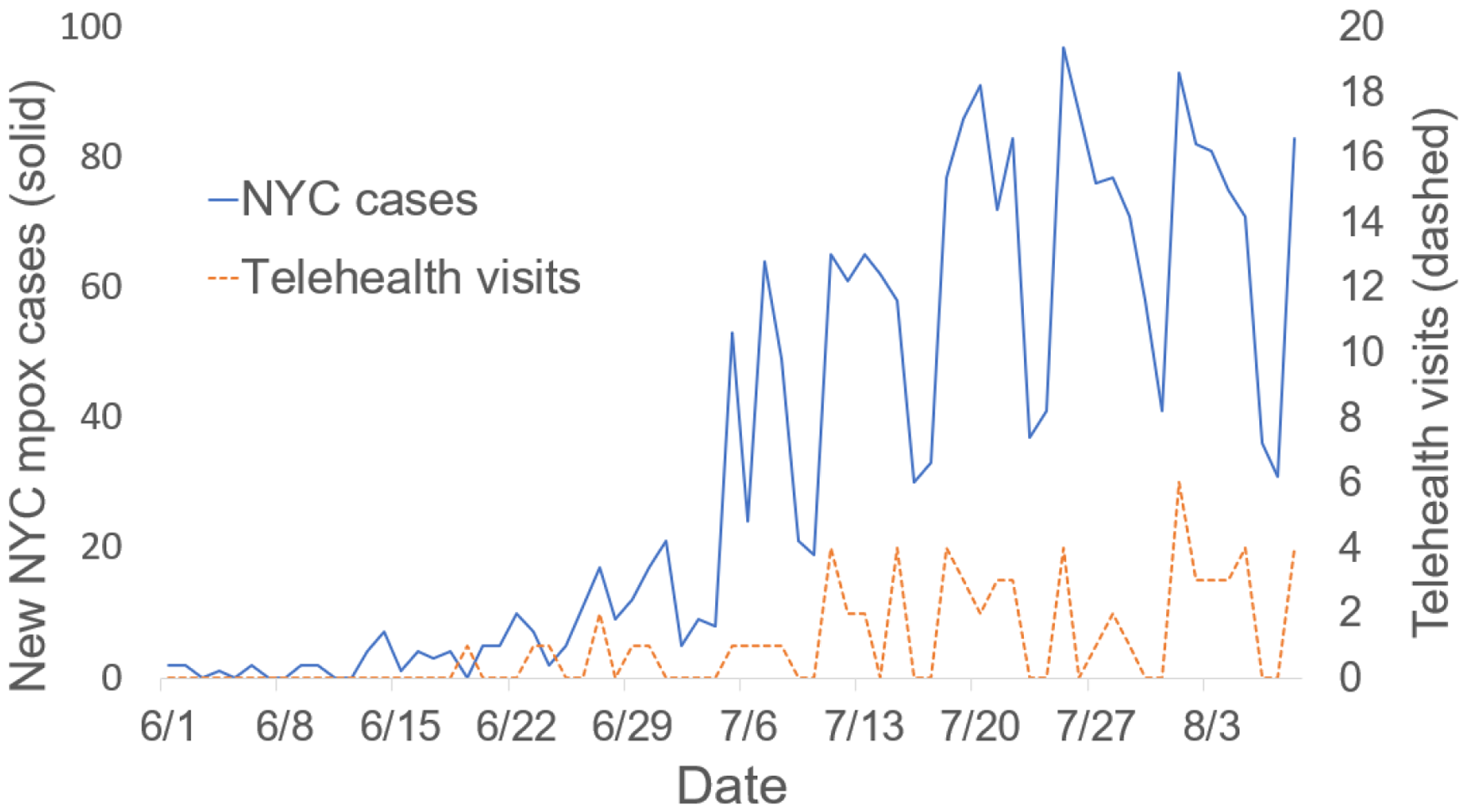
Telehealth visits at NYU Langone Health (NYULH) and NYC Health + Hospitals/Bellevue and incident mpox cases in NYC, 1 June – 8 August 2022.
The major challenges with our telehealth model of tecovirimat prescription included inequitable access to technology and the inability to perform additional diagnostic testing. While telehealth expanded our capacity to treat more patients early during the outbreak, our cohort who accessed telehealth was comprised of mostly non-Hispanic (65.2%) and White (52.2%) men who have sex with men (MSM), while the mpox outbreak in NYC disproportionately affected Hispanic and Black MSM who have lower vaccine access. 1 A comparison of the race/ethnicity breakdown of mpox cases reported nationally 6 compared to those treated with tecovirimat 7 also suggested racial and ethnic inequities in care and treatment access during the outbreak. Although this study did not specifically examine reasons for the lack of access to telehealth, we observed similar causes of inequitable access as identified during the COVID-19 pandemic, such as lack of access to working computers or smartphones, unreliable internet connectivity, and low technology literacy.8,9 Therefore, in addition to telehealth, our sites created in-person treatment options, paired non-English speaking patients with prescribers who spoke their language, and offered extended hours for appointments to improve equitable access to tecovirimat.
While an estimated 29% of patients with mpox are co-infected with STIs, 3 a telehealth follow-up visit model does not allow for further testing beyond the initial mpox testing encounter. In our cohort, 55% had STI testing done before their telehealth visit, and 42% received empiric STI treatment. Those asymptomatic with sexual exposure and not screened for STIs were counseled to have a follow-up in-person visit for STI testing after their isolation period.
The telehealth model may help facilitate patient follow-up. Our 87% rate of any follow-up visit during or after treatment exceeded that of a national cohort (n = 369), where 58% and 39% had documented assessments during and post-treatment, respectively. 7 The ability of our patients to communicate directly with prescribers electronically through our EMR to report treatment issues such as pain may have encouraged engagement and retention in care.
Our study was subject to limitations. Firstly, we did not have a robust comparison group of an alternative model of tecovirimat prescription to investigate differences in outcomes such as time intervals to treatment and proportion lost to follow-up. During the same period, only three individuals were prescribed tecovirimat through in-person clinic visits at our institutions. Secondly, the small size of our cohort did not allow for the analysis of factors associated with outcomes. Future studies with a larger cohort could investigate which patient factors predict successful mpox outcomes through telehealth versus in-person. Moreover, future qualitative research exploring patients’ experiences with telehealth services during the mpox outbreak will provide more context regarding the most important elements of an effective telehealth model.
Prescription of tecovirimat for mpox infection via telehealth provides an important option to increase capacity, expedite linkage to care and treatment, and minimize infection control risk. The robust partnership between an academic medical center (NYULH) along with its IRB, and a large community safety net hospital (Bellevue) allowed us to rapidly provide treatment to some of the earliest cases in the outbreak while adhering to requirements of the CDC's EA-IND protocol for tecovirimat. There are benefits to patients and health systems in leveraging telehealth to provide expedited care during an outbreak, but several issues need to be addressed to ensure equitable access, including ensuring access to technology (e.g. smartphones), technical literacy, and broadband internet connectivity. 10 Additionally, access to a private space to openly discuss their mpox diagnosis is critical to a successful telehealth model. Addressing these factors is essential to ensuring digital health equity, as seen in the COVID-19 and influenza responses.11,12 Telehealth should be one of several strategies, including clinic- and home-based care, developed to reach all those affected by the mpox outbreak in an equitable, efficient, and patient-centered fashion. Our study demonstrates that telehealth strategies can be implemented quickly and safely and should be leveraged as an important element in future infectious outbreak responses.
Footnotes
Acknowledgements
We thank Amanda Dontino, Hye-Youn Kim, Mark Mulligan, Samuel Nweke, Miguel Rodriguez, Julia Wagner, Heekoung (Allison) Youn, and Lisa Zhao from NYU Langone Health's Vaccine Center for administrative support and assistance with data retrieval. We also thank all the Bellevue and NYULH staff who were involved in the testing and treatment of mpox during the outbreak response.
Author contributions
JC, DM, and OM conceptualized the study. DD, PP, and DK conducted data collection. JC, DD, PP, DK, DM, and OM analyzed the data. JC and OM worked on writing the manuscript. All authors edited and approved the final manuscript.
Declaration of conflicting interests
The author(s) declared no potential conflicts of interest with respect to the research, authorship, and/or publication of this article.
Funding
The author(s) received no financial support for the research, authorship, and/or publication of this article.

Data availability statement
Data sharing do not apply to this article as no datasets were generated or analyzed during the current study.