



Abstract
The safety and effectiveness of remote guidance of percutaneous coronary interventions (PCI) have not been fully appraised in controlled studies. We hereby presented the results of a study on remote guidance (vs on-site guidance) of PCI to explore its feasibility, safety, and effectiveness. Patients were recruited from those who received PCI procedures from January 2018 to June 2019 in a secondary hospital (Jincheng, Shanxi, China), in collaboration with a tertiary medical center (Beijing, China) approximately 680 km away. According to the type of guidance during the procedure, the patients were assigned to two groups: the remote guidance group and the on-site guidance group. Remote guidance was assisted with an advanced commercial telemedicine system. Interventional strategies, procedural success rate, peri-procedural complications, procedural duration, radiation doses, and the amount of contrast medium were compared between the two groups. A total of 352 patients were included in this study, with a total of 411 PCI procedures and 446 target lesions. The baseline clinical characteristics, as well as the distribution and characteristics of coronary artery lesions, did not differ significantly between the two groups. No significant differences were noticed in procedural success rate, peri-procedural complications, procedural duration, radiation dose, and in-hospital major adverse cardiovascular events. However, the amount of contrast medium was slightly higher in the remote guidance group. The results of the present pilot study showed the feasibility of remotely guided PCI, with safety and effectiveness measures at acceptable levels comparable to the traditional on-site guidance. Randomized studies with long-term follow-up are warranted to further confirm our findings.
Introduction
The development of healthcare systems in different regions of the world is unbalanced. It was estimated that up to 5 billion people in the world did not have access to safe and affordable basic surgical care, and 143 million additional surgical procedures were needed annually in developing countries to provide life-saving treatment and prevent disability.1,2 This problem is also evident in China, where the healthcare resources are rather unbalanced in distribution. Over the past decades, the prevalence of coronary heart disease in China has been rising rapidly, 3 and percutaneous coronary intervention (PCI) has been recommended as one of the main strategies of revascularization in many current guidelines. However, there is a lack of experienced interventional cardiologists in underdeveloped regions. 4 While many local hospitals tended to invite experienced interventional cardiologists from tertiary medical centers in large cities to supervise or perform PCI for them, such on-site guidance was rather inefficient and untimely. Many patients in need cannot get timely high-quality interventional treatment in undeveloped regions. 3 Thus, they were either referred to tertiary hospitals or put on a waitlist for experienced doctors visiting the local hospital. These practices either increased the costs and risks of patients during waiting or referral or wasted considerable time of experienced doctors in traveling.
With the advancement of telecommunication, telemedicine is becoming an entirely new branch of medicine, whose history dates to the 1950s. 5 For the past several decades, applications of telemedicine continued to expand.6,7 As an advanced form of telemedicine, remote surgical guidance not only communicates medical information and provides consultation, but also provides a great opportunity for continued medical education at the same time. Although many clinical studies have shown the safety and feasibility of remote surgical guidance,8–12 we found only one preliminary report published in the field of interventional treatment of coronary artery disease. 13 To our knowledge, there were no controlled studies to confirm the safety and efficacy of remote guidance of PCI. We speculated that remote guidance of PCI may be an effective approach to provide not only high-quality health care for patients with coronary heart diseases but also advanced training experience for local junior interventional cardiologists. To this end, we designed this study with the aim to evaluate the feasibility, safety, and effectiveness of remote guidance of PCI versus traditional on-site guidance, and to discuss our preliminary experiences in this field.
Methods
Participants and study design
We enrolled patients who underwent elective PCI procedures in a secondary hospital (Jincheng, Shanxi, China) from January 2018 to June 2019, in collaboration with a tertiary medical center (Beijing, China), approximately 680 km away. Patients who were diagnosed with ST-segment elevation myocardial infarction (MI) and underwent primary PCI were excluded.
According to the study protocol, local junior interventional cardiologists from the secondary hospital performed all the procedures under either remote or on-site guidance of experienced interventional cardiologists from the tertiary hospital.
Local junior interventional cardiologists should master all basic interventional skills and be qualified for PCI with certification after a regular training period according to the Chinese Cardiovascular Intervention Training Program. However, they were less experienced in performing PCI procedures on their own. Experienced interventional cardiologists from the tertiary hospital took turns serving as remote mentors, on-site mentors, or standby experts. They should perform 250–300 PCI procedures annually to be qualified as a mentor. The study protocol was approved by the Institutional Committee on Human Research and conformed to the ethical guidelines of the 1975 Declaration of Helsinki. Written informed consent was obtained from each patient before the procedures of PCI. Patient names had been removed from all text/figures/tables/images. All the persons whose identifiable images had been showed in the figures of this article had provided informed consent for the publication of identifying information/images in an online open-access publication.
In a convenient design, there was no randomization or blinding in the protocol. The patients were assigned to either the remote or on-site guidance arm in a tandem manner according to the days of the week when receiving the procedure. Patients who received PCI on Mondays, Wednesdays, and Fridays were assigned to the remote guidance arm, while those who underwent PCI on Tuesdays and Thursdays were assigned to the on-site guidance arm.
In both treatment arms, the mentors and the local junior interventional cardiologist would have a detailed discussion on the clinical and angiographic characteristics of each patient before PCI. The mentors assisted the junior cardiologists to formulate an initial interventional strategy, selecting proper interventional materials (e.g. guiding catheters, guide wires, balloons, and/or stents), evaluating potential periprocedural risk, and preparing for possible strategic changes during the procedure.
In the remote treatment arm, another experienced interventional cardiologist from the tertiary center should be on standby (but not in the Cath lab) in the secondary hospital during the procedure to ensure safety of the procedure. Once the procedure was too tough for the junior cardiologist to complete, the standby cardiologist would be called to the Cath lab to assist in the procedure in person. The mode of remote guidance is illustrated in Supplementary Figure 1. In contrast, in the on-site guidance group, an experienced cardiologist would always be in the Cath lab to guide coronary angiography and PCI.
Telecommunication platform
The real-time transmission of coronary angiograms and online remote guidance of PCI procedures were implemented on an advanced high-speed telecommunication platform (Butel Medical System, Beijing RedCDN Technologies Co, Ltd, Beijing, China). The system directly collects signals from digital subtraction angiography, intravascular ultrasound and optical coherence tomography, and on-site cameras, and simultaneously transmits 10-way high-definition image signals in real-time between the hospitals. It also enables remote annotation and measurements of real-time images. These ancillary functions facilitated remote guidance and training. Communication with this system is completely based on the internet at a bandwidth of up to 10 MB per second. All-around quadruple encryption technology is used to ensure the safety of the transmitted data. In this study, the distance between the two hospitals is about 680 km, and the time delay ranges from 50 to 80 ms, which is acceptable for safe remote guidance of PCI.
Clinical outcomes and statistical analysis
The baseline clinical conditions of all participants were collected from the electronic medical records (medical history, physical examination, and final diagnosis) case by case. The major clinical conditions collected include admission age, sex category, body weight and height, prevalent hypertension, diabetes, stroke, smoking, as well as family history of coronary heart diseases. Key preprocedural medical therapy was also recorded, including usage and type of statins, and dual-antiplatelet therapies. The procedural success rate, procedural duration, radiation dose, the amount of contrast medium, interventional strategies, and periprocedural complications were compared between the two treatment arms. We defined in-hospital major adverse cardiovascular events (MACE) as a composite of death, symptomatic PCI-related MI, unplanned reintervention involving target lesions, and stroke.
Statistical analysis was performed with SPSS Version 20.0. Continuous variables were presented as means with standard deviations. Normally distributed variables were compared with the independent two-sample t-test, while nonnormally distributed variables with the Mann–Whitney U test. Categorical variables were presented in percentages and were compared with the Chi-square test or Fisher exact test. A two-tailed P value of < 0.05 was considered statistically significant.
Results
A total of 352 patients were enrolled in this study, including 189 patients (73.5% male) in the remote guidance group and 163 patients (71.2% male) in the on-site guidance group. Fifty-nine patients had a second elective PCI during the index hospitalization. There were 411 PCI procedures (225 in the remote guidance group) and 446 target lesions (240 in the remote guidance group) (Figure 1). Baseline patient characteristics (Table 1) and coronary angiographic characteristics (Table 2) were well balanced between the two groups. All patients were on dual-antiplatelet therapy (clopidogrel or ticagrelor, plus aspirin), with a higher percentage of ticagrelor in the remote guidance group (17.8%) versus the on-site guidance group (3.8%), and all patients were given statins (atorvastatin, rosuvastatin, or simvastatin). No anticoagulants or glycoprotein IIb/IIIa inhibitors were used before the procedure.
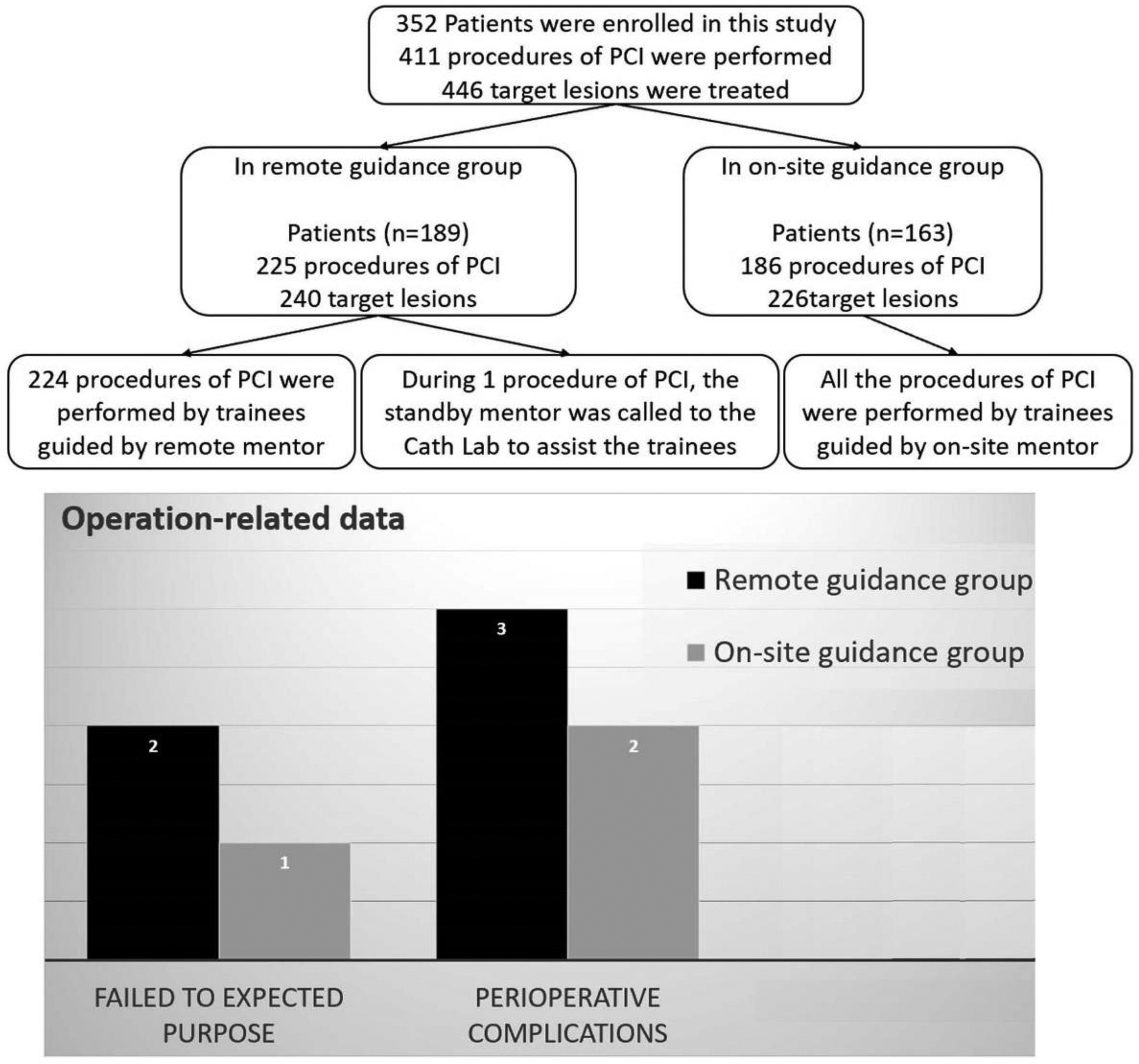
The information about patient allocation and key results associated with percutaneous coronary intervention (PCI).
Baseline clinical and angiographic characteristics.
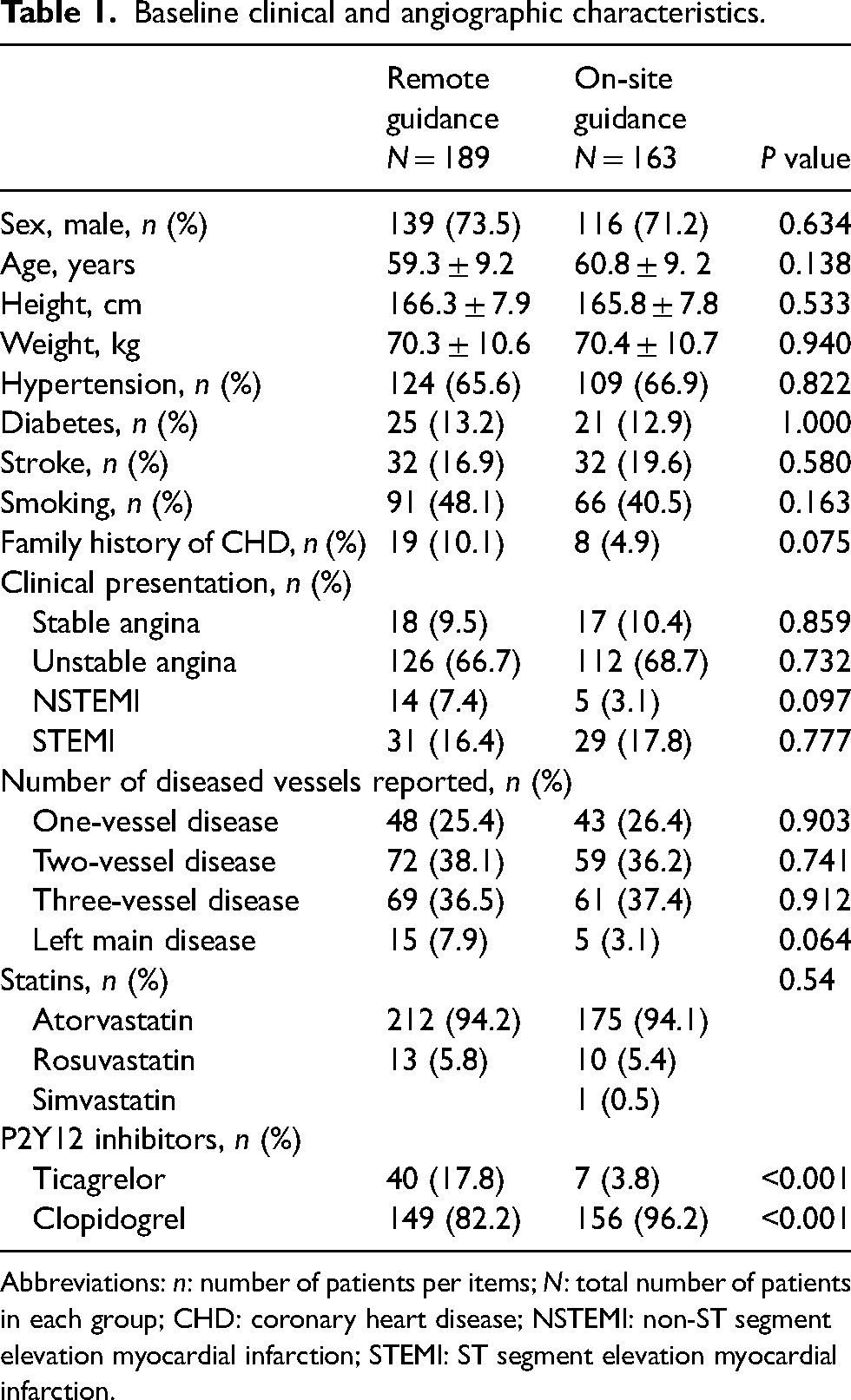
Abbreviations: n: number of patients per items; N: total number of patients in each group; CHD: coronary heart disease; NSTEMI: non-ST segment elevation myocardial infarction; STEMI: ST segment elevation myocardial infarction.
Lesion characteristics of coronary arteries.
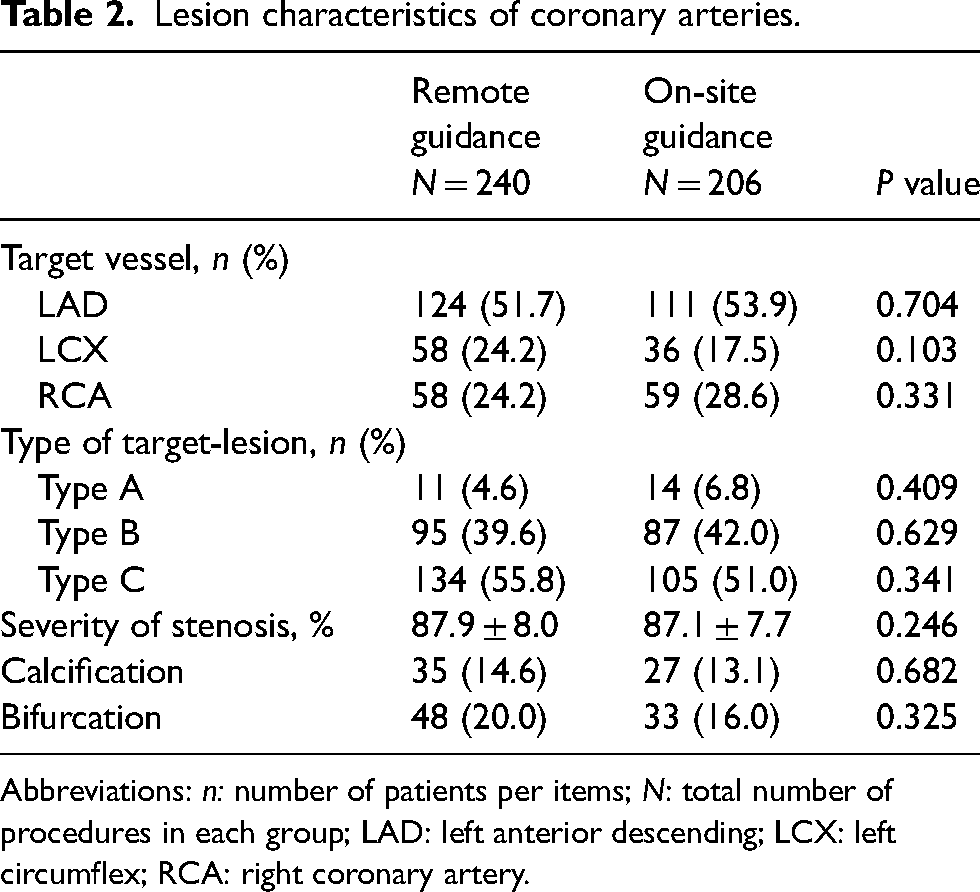
Abbreviations: n: number of patients per items; N: total number of procedures in each group; LAD: left anterior descending; LCX: left circumflex; RCA: right coronary artery.
There was no significant difference between the two groups in the number of stents, procedural duration, and radiation dose. However, the average amount of contrast medium was moderately higher in the remote guidance group compared with the on-site guidance group (124 ± 33 ml vs 114 ± 33 ml, P=0.002, Table 3). There were no overall differences in procedural strategies, although jailed wire and jailed balloon techniques were more frequently adopted in the remote guidance group.
Procedure-related characteristics.
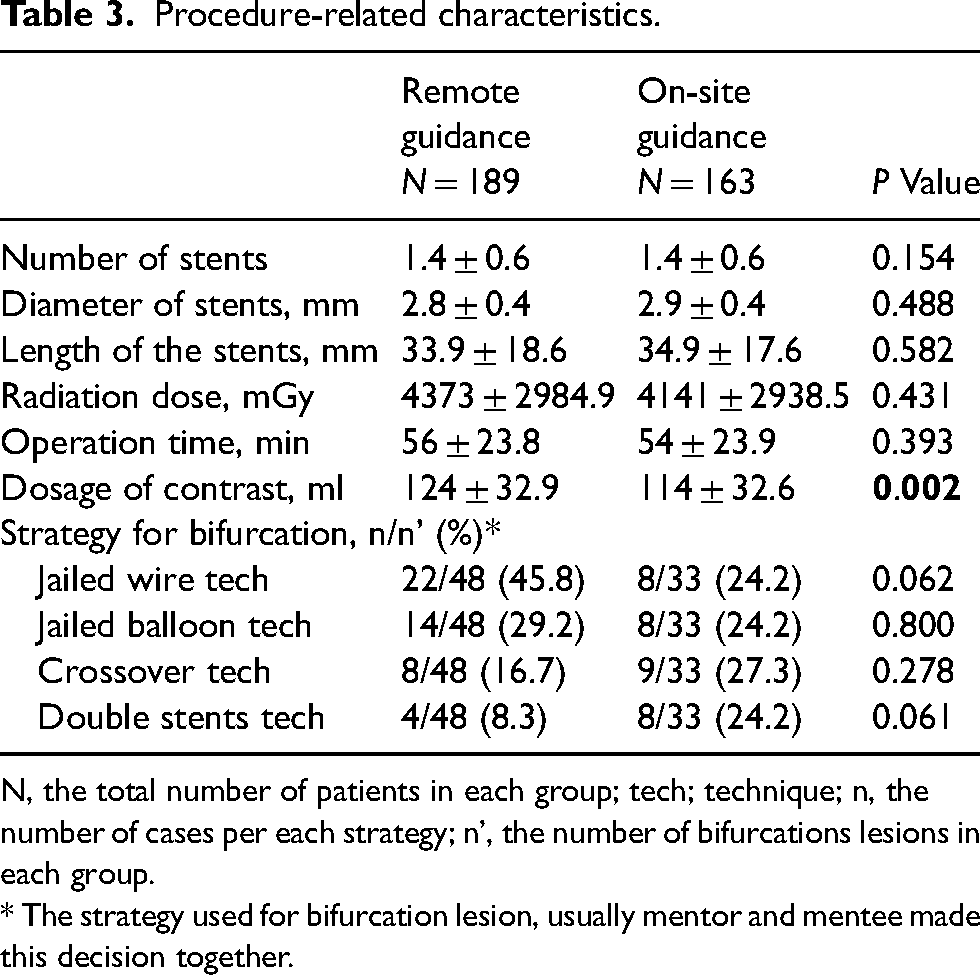
N, the total number of patients in each group; tech; technique; n, the number of cases per each strategy; n’, the number of bifurcations lesions in each group.
* The strategy used for bifurcation lesion, usually mentor and mentee made this decision together.
Two cases in the remote guidance group and one in the on-site guidance group failed to achieve planned procedural goals. In the remote guidance group, one case had inadequate balloon inflation, leading to failure of planned stent implantation, and the other had failed protective wiring of a diagonal branch, which occluded after stenting of the main vessel. The case in the on-site guidance group failed in the planned rewiring of a side branch after the stenting of the main vessel. In addition, the standby senior interventional cardiologist was called into the catheter lab to assist in the PCI procedure in only one case of the remote guidance group, due to the failure of the guide wire to pass total occlusion of the coronary artery.
Procedural complications occurred in three cases (1.2%) in the remote guidance group, including one distal hematoma and two dissections at the edge of the stent. In each case, an additional stent had to be implanted to cover the hematoma or dissection. There were two cases with complications (1%) in the on-site guidance group. One case presented slow flow after stenting, which was improved by intracoronary injection of tirofiban and nitroglycerin. The other case had plaque translocation after stenting, which was covered with an additional stent.
For in-hospital MACEs, there was one moderate but symptomatic PCI-related MI (after occlusion of the diagonal branch mentioned above) in the remote guidance group, which was confirmed by EKG changes and elevated Troponin measures. No other in-hospital MACE was observed in both treatment groups.
Discussion
In this prospective controlled study, we showed remote guidance of PCI procedures was feasible, with a safety and effectiveness profile numerically comparable to traditional on-site guidance. There were no significant differences in success rate, procedural time, radiation dose, and procedural complications. A moderate increase (10 ml) in the dosage of contrast medium was observed in the remote guidance group. Although the remote guidance group used relatively more ticagrelor compared with the on-site guidance group, major clinical profiles including lesion complexity have been shown to be comparable between the two groups. Moreover, it has been shown that ticagrelor versus clopidogrel pretreatment resulted in no difference in periprocedural MI and bleeding after elective PCI. 14 Therefore, it is unlikely that the difference in P2Y12 inhibitor selection would substantially bias the results of the present study.
Most studies on remote guidance were implemented in the field of surgical procedures. Remote guidance in the literature could be categorized into four forms: first, verbal guidance; second, guidance with telestration; third, guidance with tele-assist; and fourth, telesurgery.8–13,15 The type of remote guidance adopted by our study was comparable to the second form. In a preliminary pilot study, Toru Adachi et al. reported their initial experiences in this field of cardiovascular intervention assisted with an audiovisual tele-support system for 21 patients with coronary heart disease. 13 They gave a detailed description of the system and noted that the audiovisual tele-support system enabled cardiologists with limited experience to perform safe and high-quality cardiovascular interventions. The working principle of the advanced high-speed telecommunication platform implemented in our study resembles the audiovisual tele-support system described by Toru Adachi. Beyond feasibility, despite the limited sample size and statistical power, we observed an acceptable safety and effectiveness profile comparable to traditional on-site guidance.
Although there was no overall difference in the interventional strategies of bifurcated lesions between these two treatment arms, the double-stent technique was slightly less adopted in the remote guidance group. This finding indicated that implementation of complex procedures was still limited in the setting of remote guidance, possibly attributable to the concern of both senior and junior cardiologists on the accomplishment of more complex procedures. In the remote guidance group, the standby senior interventional cardiologist was called into the catheter lab to assist in the PCI procedure in only one case, which suggested that most procedures can be safely accomplished with remote guidance.
According to our experience, the following points are crucial to ensure the successful application of the remote PCI guidance. The first point is the availability of remote mentors. Remote mentors should be readily contacted and online in time. The second point is the acquaintance between remote mentors and local junior interventional cardiologists. The mentors should be aware of the competency of the local cardiologists to accurately assess which procedure can be safely performed under remote guidance. The local cardiologists should also be familiar with the mentors. Moreover, mutual adaptation in the early stage can make telecommunication in the following period easier and smoother. The third point is the safe and fast transmission of data. Real-time images should be transferred safely, timely, clearly, and robustly.
Based on the plausible safety and effectiveness observations from the present study, remote guidance of PCI has a promising future in medical practice and warrants further investigation. Remote guidance could greatly shorten the learning curve in becoming an experienced interventional cardiologist. It would also grant patients in underdeveloped regions access to high-quality PCI procedures, and avoid the risks during waiting periods for experienced cardiologists from tertiary centers, especially patients unsuitable to travel a long distance. Therefore, remotely guided PCI may be an efficient, cost-effective, and time-saving medical practice, especially in the postpandemic era. Randomized studies with a larger sample size are warranted to further verify the feasibility and safety of remote PCI guidance over longer periods.
This study has several limitations. First, it was not a randomized study. Although there were no significant differences in the available clinical data and angiographic characteristics between the two treatment arms, there could be unbalanced factors that were not recorded, which might bias the findings. Second, the clinical outcomes were only evaluated in the periprocedural and in-hospital period, and a longer follow-up is necessary to confirm the long-term effectiveness and safety. Finally, we should be cautious about potential problems related to remote PCI guidance, such as legal and ethical considerations, the issues of responsibility in the telemedicine process, and financial and economic considerations, just like other forms of telemedicine. 16
Conclusion
In conclusion, the present study indicated that remote guidance of interventional treatment for coronary heart disease with an advanced telemedicine system was feasible, with an acceptable safety and effectiveness profile comparable to on-site guidance.
Supplemental Material
sj-docx-1-jtt-10.1177_1357633X231213111 - Supplemental material for Remote guidance of percutaneous coronary intervention: A pilot study
Supplemental material, sj-docx-1-jtt-10.1177_1357633X231213111 for Remote guidance of percutaneous coronary intervention: A pilot study by Zhengming Xu, Li Zhao, Jing Cui, Jianyong Zheng, Zhichao Wang, Yi Cao, Yigang Qiu, Yixiong Huang, Jianhong Zhao, Lu Zhang, Dan Wang, and Yu Chen in Journal of Telemedicine and Telecare
Footnotes
Acknowledgments
The authors would like to thank Professor Tianchang Li, retired director of the Department of Cardiology, The Sixth Medical Center of PLA General Hospital, for his insightful ideas and hearted guidance during the study; as well as Mr Wenhui Zhou, who came from the Beijing Red CDN Technologies Co. Ltd, for the technical support of Butel Medical System.
Author contributions
Each author of the authorship has significantly contributed to this submitted work. Z.X. and Y.C. have prepared the design of this study and analysis and interpretation of data. Z.X. drafted the work. L.Z. and J.C. completed the analysis and interpretation of data and revision of this manuscript. J.Z., Z.W., Y.C., Y.C., Y.Q., Y.H., J.Z., L.Z., and D.W. have done the acquisition, analysis of data in this work. Y.C. is the corresponding author of this article, and final approval of the article submitted.
Declaration of conflicting interests
The authors declared no potential conflicts of interest with respect to the research, authorship, and/or publication of this article.
Funding
The authors disclosed receipt of the following financial support for the research, authorship, and/or publication of this article: This work was supported by the new clinical technology fund of the Sixth Medical Center, Chinese PLA General Hospital (HZXJS 2018-5).

Data availability statement
Supplemental material
Supplemental material for this article is available online.
References
Supplementary Material
Please find the following supplemental material available below.
For Open Access articles published under a Creative Commons License, all supplemental material carries the same license as the article it is associated with.
For non-Open Access articles published, all supplemental material carries a non-exclusive license, and permission requests for re-use of supplemental material or any part of supplemental material shall be sent directly to the copyright owner as specified in the copyright notice associated with the article.
