



Abstract
Introduction
The COVID-19 public health emergency led to an unprecedented rapid increase in telehealth use, but the role of telehealth in reducing disparities in access to care has been questioned. The objective of this study was to conduct a systematic review to summarize the available evidence on how telehealth during the COVID-19 pandemic was associated with telehealth utilization for minority groups and its role in health disparities.
Methods
We conducted a systematic review focused on health equity and access to care by searching for interventional and observational studies using the following four search domains: telehealth, COVID-19, health equity, and access to care. We searched PubMed, Embase, Cochrane CENTRAL, CINAHL, telehealth.hhs.gov, and the Rural Health Research Gateway, and included any study that reported quantitative results with a control group.
Results
Our initial search yielded 1970 studies, and we included 48 in our final review. The most common dimensions of health equity studied were race/ethnicity, rurality, insurance status, language, and socioeconomic status, and the telehealth applications studied were diverse. Included studies had a moderate risk of bias. In aggregate, most studies reported increased telehealth use during the pandemic, with the greatest increase in non-minority populations, including White, younger, English-speaking people from urban areas.
Discussion
We found that despite rapid adoption and increased telehealth use during the public health emergency, telehealth did not reduce existing disparities in access to care. We recommend that future work measuring the impact of telehealth focus on equity so that features of telehealth innovation can reduce disparities in health outcomes.
Keywords
Introduction
The COVID-19 public health emergency led to an unprecedented increase in telehealth use as a way to maintain healthcare access while limiting the spread of communicable diseases.1,2 In the US, both federal and commercial payors increased reimbursable telehealth services, and additional licensure and policy flexibilities, along with decreased in-person service volumes, making it easier for healthcare providers to provide telehealth.3–7 Over 53 million medical visits were provided to fee-for-service Medicare beneficiaries using telehealth in 2020, which represented a 60-fold increase from 2019, and telehealth use in 2021 remained above pre-pandemic levels.8,9 A systematic review from 2023 showed increased telehealth use, especially for those without complex clinical conditions and with good access to healthcare. 10 Despite efforts to maintain healthcare access, however, 41% of US adults avoided receiving healthcare because of concerns related to COVID-19. 11
COVID-19 highlighted the importance of minority status in health outcomes, and a systematic review and meta-analysis published in 2021 reported higher COVID-19 positivity and disease severity among racial and ethnic minority groups and those in regions with a high area deprivation index. 12 Telehealth has long been hypothesized to be a method of improving access to healthcare that may reduce disparities for minority groups, who have long been afflicted by worse health outcomes.13–15 Because telehealth reduces barriers of travel time, geographic constraints of healthcare access, and even language and cultural barriers, it may provide a more patient-centric way of providing healthcare. Minority groups are more represented in Medically Underserved Areas, highlighting the role that telehealth could play in leveling access between high-access and low-access regions—especially for specialty care. Medicare policy has enabled telehealth access for those in rural communities because of these recognized barriers, but rural disparities persist.16,17 These data in aggregate highlight the importance of understanding how a shift to telehealth-enabled healthcare could affect disparities in health access and outcomes.
Unfortunately, a national survey conducted in 2021 and subsequently repeated suggested that significant disparities persist in the use of telehealth.18,19 Prior work has highlighted the role of telehealth during the COVID-19 public health emergency in specific health conditions or care settings.20–27 Other systematic reviews have focused on health equity, but they have used a narrower definition of sociodemographic characteristics to define disparities or they did not include a non-telehealth comparator control group.28,29 The objective of this paper was to summarize the available evidence on how telehealth access and utilization changed for minority groups broadly across conditions and telehealth modalities during the COVID-19 public health emergency. We planned to complete this objective by conducting a systematic review, with a focus on health equity. Our secondary objective was to understand which dimensions of minority status were frequently measured in telehealth studies during the COVID-19 pandemic, and how variation in the experiences of these groups contributed to health equity.
Methods
We conducted a systematic review focused on how telehealth access and its use were associated with health equity during the COVID-19 public health emergency. We planned to conduct a meta-analysis if clinical and statistical heterogeneity was low, but we decided a priori to perform and report the systematic review alone if heterogeneity was high. Our review protocol was registered in PROSPERO (CRD42023392678), 30 and we reported our paper using the Preferred Reporting Items in Systematic Reviews and Meta-Analysis (PRISMA) guidelines. 31
Data sources, search strategy, and selection criteria
In conjunction with a health sciences librarian trained in systematic review methodology (HH), we developed our search strategy using four domains: telehealth, COVID-19, health equity, and access to care. Each of those domains was expanded using a combination of subject headings and keywords, and we searched PubMed, Embase (Elsevier), Cochrane Central Register of Controlled Trials (Wiley), and CINAHL (EBSCO) with no publication date or language limits. Duplicate references were removed through automated and manual methods. We additionally conducted a gray literature search at telehealth.hhs.gov and the Rural Health Research Gateway, looking for relevant research products published after the beginning of the COVID-19 pandemic (i.e. 2020–2022).32,33 All searches were conducted on 9 December 2022. The full search strategies are detailed in Supplemental Appendix A.
We included studies of interventional or observational designs that included an estimate of either telehealth access or utilization, stratified by socioeconomic, racial or ethnic, geographic, or other minority status. We included strata of insurance status as a minority status because of the myriad ways that insurance status affects healthcare use and availability, but we did not include disability status. We excluded case studies, editorials, narrative reviews, qualitative studies, or any study design that had no control group. The control group, however, could be a pre-pandemic control group or a concurrent control with different telehealth access, but studies estimating control group behavior without empirical, quantitative data were excluded. We included references in all languages, we included grey literature as it was identified in these databases, and we removed duplicate references using an automated algorithm.
For this review, we included telehealth studies in which the telehealth intervention included synchronous communication between a patient or care team and a telehealth provider to deliver healthcare. Those interventions could include video, audio-only, or real-time text communication for either inpatient or outpatient care, but they did not include store-and-forward, e-mail, or artificial intelligence-based interventions. Our outcomes included access to care and utilization, and we included papers with any specific measure of access or utilization (e.g. telehealth use, telehealth availability), as adjudicated by the independent reviewers. Our full search strategy is detailed in Supplemental Appendix A.
Study selection and data abstraction
After the database search was complete, two authors (LL and ST) performed title and abstract screening and independently determined whether the studies met our inclusion criteria. Then, all remaining references not excluded underwent a full-text review conducted independently by the same two authors, and final inclusion decisions were made. All disagreements were discussed and resolved either by consensus or by the determination of a third independent reviewer (JPV). After studies were selected, data from included references were manually abstracted by both independent reviewers (LL and ST) using a structured data collection form and disagreements were resolved by consensus.
Risk of bias assessment was performed by both reviewers using the Downs and Black assessment because that tool is applicable for both clinical trials and observational studies. This validated tool assessed the transparency, characteristics, and reporting of the study design, divided into sub-scores for reporting characteristics, external validity, and two separate internal validity domains. 34 Elements that were not present in a study design, including those that were not applicable, were scored as zero for being not present.
Meta-analysis
After the steering committee (NMM, JPV, and MMW) reviewed the results of the systematic review, they concluded that too much clinical heterogeneity (e.g. populations, settings, intervention, and context) existed and no statistical pooling or meta-analysis could be performed.
Results
Our search identified an initial yield of 1970 studies (Figure 1). The primary reasons for exclusion were the wrong study design or publication type, no clinical telehealth or underserved population, and the lack of an adequate comparator population. After applying the exclusion criteria, 48 studies were included in the systematic review.
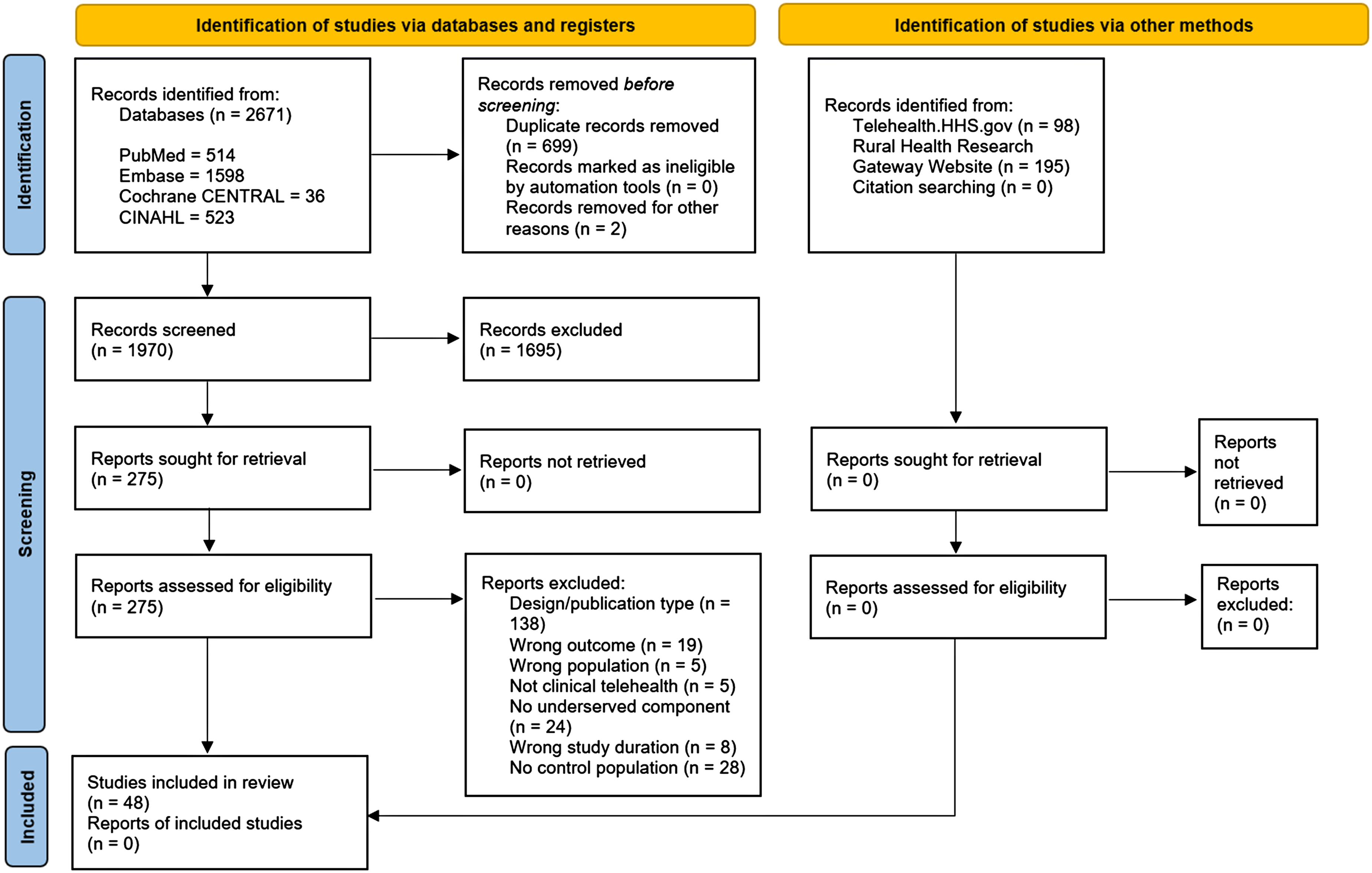
Preferred reporting items for systematic reviews and meta-analyses (PRISMA) 2020 flow diagram of included studies.
Overall study characteristics
All included papers were observational studies reporting the results from direct-to-consumer synchronous telehealth applications, and many (n = 16) considered audio-only and video telehealth separately. Clinical applications included cancer (n = 3), orthopedics (n = 2), gastroenterology (n = 4), surgical specialties (n = 2), ambulatory/outpatient conditions (n = 4), primary care (n = 3), mental health disorders (n = 4), HIV (n = 1), rheumatology (n = 2), headaches (n = 1), dermatology (n = 2), diabetes (n = 2), hypertensive pregnancy disorders (n = 1), pain (n = 1), infertility (n = 1), otolaryngology (n = 1), cardiology (n = 1), and hepatology (n = 2). Eleven studies did not specify a clinical condition of interest. All included studies reported on telehealth utilization, with other availability or clinical outcomes not frequently measured. All studies reported differential use by race/ethnicity, age, sex, language, insurance status, rurality, or socioeconomic status (Table 1).
Table of evidence.

Race/ethnicity
Forty studies (84%) included at least one stratified analysis of race and/or ethnicity. Among these studies, most (n = 27, 68%) reported lower telehealth utilization38,40,43–46,48–50,53,54,61–63,65,67–69,71,73–75,80–84 among Black/African American participants and other racial minorities compared to White participants, but six studies (15%) observed higher telehealth utilization in minority groups. Ten studies (25%) that screened for differences in telehealth modality, racial/ethnic minority groups were more likely to use audio-only telehealth, compared with White telehealth users.
Rurality/location
We included 22 studies (46%) that examined geographical factors in telehealth use. Most of these studies (n = 14, 64%) reported that rural participants were less likely to use telehealth than urban participants.39,41,44,49,51,52,59,62,64,71,77,83,85 Two studies looked at differences by geographic region, and both showed that participants living in the Northeast had higher telehealth utilization than those in the South and the West.47,52
Age
Twenty-one studies (44%) reported age-stratified analyses, of which 18 (86%) reported that older patients were less likely to use telehealth compared to younger patients.37,39,44–46,48–50,52,53,61,66,67,69,75,78,81,84 Among the two studies comparing audio-only to video telehealth, both showed that older patients were more likely to use audio-only instead of video telehealth.61,79
Insurance status
Twenty studies (42%) reported telehealth utilization outcomes stratified by insurance status during this time period, and one-third (n = 7, 35%) reported that telehealth usage was similar in different strata of insurance coverage.35,38,40,43,48,54,60 Five studies (25% of those that included insurance status) showed that participants with public insurance were less likely to utilize telehealth,53,61,65,68,84 and three studies (15%) showed that self-pay or other insurance was associated with less telehealth use than commercial insurance.46,75,76 Three studies (15%) indicated that participants with Medicare or Medicaid were less likely to utilize video telehealth compared to audio only.45,67,85
Language
We identified 15 studies (31%) that examined telehealth utilization by language preference. Of these studies, 10 (67%) showed that English speakers had higher utilization.37,38,46,54,65,69,75,76,84,86
Socioeconomic status, income, and social vulnerability
Of the included studies, 14 (29%) reported the association between social vulnerability and telehealth utilization, either by examining individual socioeconomic status (SES) or income (n = 11), the area deprivation index (n = 2), or county-level characteristics (n = 1). Most studies (n = 11, 79%) reported that telehealth use was the lowest in counties with high poverty levels, low income, low SES, or low education levels.41,44,49,54,57,62,65,67,71,80,83,84
Sex
Of the 12 studies (25%) that examined telehealth utilization by sex, seven (58%) reported increased utilization among females, but differences by sex were small.47,57,68,75,77,81,82
Risk of bias assessment
Total scores from the Downs and Black risk of bias assessment (Figure 2) ranged between 10 and 19 (out of 27), indicating a moderate risk of bias in the included studies (and no studies at low risk of bias). The mean score was 16.2, and sub-domain means were as follows: reporting bias (6.3 out of ten), external validity (2.7 out of three), internal validity—bias (3.7 out of seven), and internal validity—confounding (3.5 out of seven).
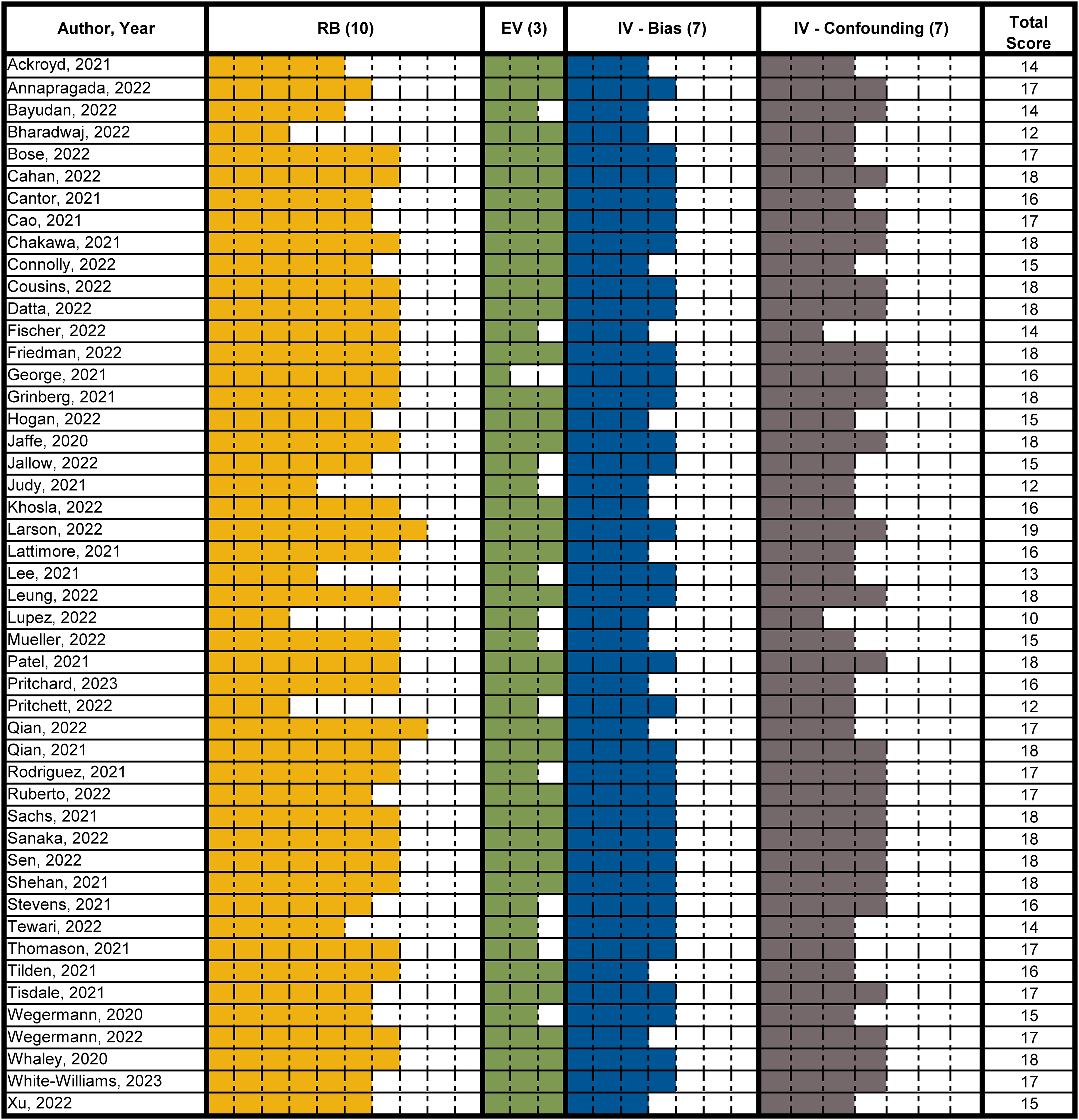
Summary of methodological quality of included studies using the Downs and Black risk of bias assessment.
Discussion
In this systematic review of studies examining health equity in telehealth access and use during the COVID-19 pandemic, we identified papers that reported the association between telehealth use and racial/ethnic minority status, rurality, native language, age, and other sociodemographic factors. In aggregate, most of these studies reported that although telehealth use increased during the pandemic, the increase was most pronounced in largely non-minority populations, including White, younger, English-speaking people from urban areas. This finding is relevant because it suggests that many telehealth applications were not effective in reducing health inequity during the pandemic, despite being a technology that was widely adopted across a number of social and demographic groups.
Some have highlighted the role that the digital divide plays in exacerbating health inequality related to telehealth use. In a survey of primary care practices in 2020, social vulnerability was a factor significantly associated with decreased use of telehealth. 87 Factors associated with social vulnerability are also associated with reduced availability of broadband internet, decreased access to communication technology, and lower technology literacy, and these factors may become even more consequential with the rapid adoption of new telehealth solutions. A working group of the International Medical Informatics Association highlighted that the COVID-19 experience uncovered concerns about telehealth exacerbating health inequity, with access to technology, financing, equipment, and governance capacity driving improved equitable use. 88 Shaw and colleagues extended this work to highlight three factors that could potentially improve equitable delivery of telehealth-enabled care: simplifying complex interfaces and workflows, using supportive intermediaries, and creating mechanisms through which marginalized community members can provide immediate input into the planning and delivery of virtual care. 87 These recommendations were an important contribution because they lean heavily on principles of active community and end-user engagement in designing new systems of care, attempting to address longstanding systematic structural attributes that contribute to unequal access, unequal care, and unequal outcomes. They also supplement other work suggesting that interventions to reduce the digital divide require a multi-stakeholder approach, appropriate use of interpreters, and a multifaceted policy approach to reducing disparities in access.89–91
However, ameliorating disparities in telehealth access and use is only one step on the pathway to improving health outcomes. Existing features of the health system perpetuate ongoing disparities in traditional healthcare. 92 Minority patients have been shown to experience poor healthcare communication, including information-giving, patient participation, and participatory decision-making. Disadvantaged populations are more likely to live in regions with inadequate access to physicians and other healthcare providers.93,94 Even access to healthy groceries, bike lanes, and high-speed internet are lower in communities with more racial/ethnic minority residents, which further contribute to underlying differences in health literacy, chronic health diagnoses,95–97 and ability to access healthcare. Telehealth policy changes allowing non-rural patients access to telehealth services from home—even in urban areas—may have further widened disparities. 5 For telehealth to reduce disparities in healthcare, it does not only need to be available and used equally—it needs to specifically benefit those least likely to have adequate existing pathways to care.
There is one bright spot in the pandemic's highlighting of care disparities, however. COVID-19 outcomes were so different in disadvantaged populations that researchers, educators, and policymakers have had renewed focus on ways to track and reduce disparities. For instance, inequalities in COVID-19 test availability may have contributed to differences in COVID-19 clinical outcomes by community racial/ethnic status, 98 but that inequality lessened through the course of the pandemic. Inpatient COVID-19 medical care may have been different for disadvantaged populations early in the pandemic. 99 For instance, it was only after recognizing discrepancies between blood gas results and pulse oximetry that researchers identified the role of skin color in contributing to inadequate oxygen supplementation in COVID-19 patients. 100 With telehealth availability specifically, telehealth interventions targeted to reduce disparities showed early evidence of effectiveness. 101 Many disparities reduced as the pandemic progressed, and highlighting differences in care and outcomes was one powerful tool to address underlying health system imbalances that lead to disparities in access and outcomes.
Our study has several limitations. First, the studies that comprised this analysis had significant clinical heterogeneity, precluding our statistical pooling of the findings. Second, many of these studies used data from programs that were implemented very quickly in the context of the COVID-19 pandemic. Those characteristics of included telehealth interventions may have evolved later in the pandemic as lessons learned from early implementation were used to improve later telehealth-facilitated care. Finally, in a study of health equity, pre-pandemic control groups used in some of the studies may not have fully incorporated the ways in which non-telehealth care changed during 2020 and 2021, which could lead to spurious conclusions in some of the included studies.
In conclusion, many telehealth studies reported measures of health equity during the early phase of the COVID-19 pandemic, and the dimensions of equity most commonly reported focused on differences in telehealth use based on race/ethnicity, rurality, language, and age. We recommend that future telehealth studies examine characteristics of program implementation that improve equity so that those features and lessons can be used to improve aggregate telehealth care across conditions and contexts.
Supplemental Material
sj-docx-1-jtt-10.1177_1357633X241245459 - Supplemental material for The role of increasing synchronous telehealth use during the COVID-19 pandemic on disparities in access to healthcare: A systematic review
Supplemental material, sj-docx-1-jtt-10.1177_1357633X241245459 for The role of increasing synchronous telehealth use during the COVID-19 pandemic on disparities in access to healthcare: A systematic review by Sara Ternes, Lauren Lavin, J Priyanka Vakkalanka, Heather S Healy, Kimberly AS Merchant, Marcia M Ward, and Nicholas M Mohr in Journal of Telemedicine and Telecare
Footnotes
Acknowledgements
The authors acknowledge Tera Shea, BS (University of Iowa Carver College of Medicine) for her editorial assistance in the preparation of this manuscript.
Declaration of conflicting interests
The author(s) declared no potential conflicts of interest with respect to the research, authorship, and/or publication of this article.
Funding
The author(s) disclosed receipt of the following financial support for the research, authorship, and/or publication of this article: This work was supported by funding from the Rural Telehealth Research Center, which is supported by the Office for the Advancement of Telehealth, Health Resources and Services Administration (HRSA, U3GRH40003). Dr Mohr is additionally supported by a grant from the Agency for Healthcare Research and Quality (AHRQ, K08 HS025753). The views expressed in this publication are solely those of the authors and do not reflect the official views of AHRQ, HRSA, or the U.S. Government.

Data availability statement
All data generated or analyzed during this study are included in this published article.
Supplemental material
Supplemental material for this article is available online.
References
Supplementary Material
Please find the following supplemental material available below.
For Open Access articles published under a Creative Commons License, all supplemental material carries the same license as the article it is associated with.
For non-Open Access articles published, all supplemental material carries a non-exclusive license, and permission requests for re-use of supplemental material or any part of supplemental material shall be sent directly to the copyright owner as specified in the copyright notice associated with the article.
