



Abstract
Introduction
Several barriers can preclude people with type 2 diabetes (T2D) from in-person exercise session participation. Telehealth may be an alternative mode of service delivery to increase uptake. We evaluated the feasibility, safety and preliminary efficacy of delivering group exercise via telehealth for people with T2D.
Methods
Sixteen people with T2D (age 59.9 ± 12.7 years, 63% male, duration of T2D 11.5 ± 11.1 years) underwent an 8-week telehealth-delivered group exercise intervention. Weekly supervised sessions incorporated whole-body aerobic and resistance exercises, followed by education. Feasibility was evaluated by recruitment, enrolment, attendance and attrition rates, the practicality of telehealth delivery, and participant feedback. Adverse events were monitored throughout (safety). Preliminary efficacy was determined from changes in glycaemic control, body composition, blood pressure, exercise capacity, neuromuscular strength/fitness, quality of life and physical activity levels. The agreement/reliability of in-person clinician-measured versus telehealth-supervised participant-self-measured assessments was also evaluated.
Results
Feasibility was supported by high attendance (97.1%) and low attrition (81%). All (100%) participants reported they would participate in telehealth-delivered exercise interventions in the future and would recommend them to other people with T2D. No serious adverse events were reported. There were improvements in hip circumference (Cohen's d −0.50), diastolic blood pressure (–0.75), exercise capacity (1.72), upper body strength (1.14), grip strength (0.58), health-related quality of life (0.76–0.81) and self-reported physical activity (1.14). Participant-self-measured assessment of body weight, 2-min step test and 30-sec sit-to-stand test were deemed acceptable.
Discussion
Telehealth-delivered group exercise appears feasible, safe and efficacious for people with T2D. These findings warrant further exploration in a powered trial.
Trial Registration
Australian New Zealand Clinical Trials Registry (ACTRN12622000379718).
Introduction
Almost 1 million Australian adults (5.3% of the population aged ≥ 18 years) have type 2 diabetes (T2D). 1 Exercise is a key component of T2D management, to be used as first-line therapy alongside diet modification. This is because exercise interventions are effective at improving glycaemic control, reducing body fat, reducing cholesterol and increasing cardiorespiratory fitness. 2 In Australia, Medicare (a publicly funded universal health care insurance scheme) subsidises eight group exercise physiology classes annually for people with T2D. However, barriers such as lack of access to transport and living in rural areas with few to no exercise physiology services can preclude people from in-person exercise session participation. 3
Telehealth may be an alternative approach to overcome these barriers. In response to COVID-19, Medicare is subsidising one-on-one videoconference services for allied health including exercise physiology; however, this funding has not been extended to group services. In people with T2D, social interaction can be an important enabler of exercise; specifically, the accountability, increased enjoyment and sense of community that accompanies group training improves adherence. 4 Studies in heart failure 5 and chronic nonspecific neck pain 6 have shown group exercise services delivered via telehealth to be an appropriate alternative to in-person exercise. However, it has not been evaluated in T2D.
In addition to delivering exercise sessions online, it is clinically necessary to assess patients to (a) establish their baseline clinical and functional status and develop an exercise program accordingly and (b) monitor progress towards goals and thus determine the efficacy of the intervention. However, requiring patients to attend in-person consults to complete these assessments contradicts the purpose and advantages of telehealth-delivered interventions. As such, it is also important to determine whether patients can accurately self-assess key clinical and functional measures when supervised by clinicians via telehealth. A previous study in liver transplant recipients showed good reliability, but large variability in accuracy and agreement, between clinician-measured and participant-self-measured assessments. However, the participants completed these measures unsupervised. 7 Clinician supervision enabled valid and reliable telehealth assessment of functional exercise capacity in people with heart failure, though the chosen assessments required specialised equipment (i.e. handgrip dynamometer) and/or space (i.e. a 30-m walking track for a 6-min walk test), which limits the real-world feasibility and applicability. 8
Therefore, in people with T2D, the aims of this study were to:
Establish the feasibility and safety of delivering a group exercise intervention via telehealth. Assess the preliminary efficacy of an 8-week group telehealth-delivered exercise intervention on glycaemic control, body composition, blood pressure, exercise capacity, neuromuscular strength and fitness, health-related quality of life and physical activity levels. Determine the agreement and reliability of in-person clinician-measured versus telehealth-supervised participant-self-measured assessments.
Methods
This single-arm pilot study was approved by the University of Newcastle Human Research Ethics Committee (approval number H-2021-0201) and was prospectively registered with the Australian New Zealand Clinical Trials Registry (ACTRN12622000379718). All participants provided written informed consent prior to enrolment in the study. The study was completed according to the Declaration of Helsinki. Recruitment occurred between March 2022 and October 2023.
Eligibility criteria
Participants required a diagnosis of T2D with a glycated haemoglobin (HbA1c) of ≥7.0% at baseline and access to a device with a camera (e.g. computer/laptop/tablet). Potential participants were screened using the Adult Pre-Exercise Screening System to ensure safety.
People were ineligible if they had: type 1 diabetes, any condition as per the absolute contraindications to exercise outlined by the American College of Sports Medicine, 9 were meeting the physical activity guidelines (150 min/week moderate intensity or 75 min/week vigorous intensity exercise or any equivalent combination), planned medical operations during the research period, a physical condition whereby exercise training would be inappropriate, pregnant or expecting to be pregnant during the study period, non-English speaking, and cognitive impairment that limited the ability to understand verbal instructions.
Group telehealth-delivered exercise intervention
The 8-week telehealth-delivered exercise intervention was conducted in groups of 3–5 by an accredited exercise physiologist using a two-way audio-visual communication platform (Zoom Video Communications Inc., California, USA). While there is a risk of cyber security breaches while using an online platform, Zoom has several security capabilities for ensuring participant privacy including (1) meeting encryption and password protection, (2) waiting rooms for attendees, which enables the host to allow only study participants to enter the session, (3) requiring the host to be present before the meeting starts and (4) breakout rooms for private discussions between participants and research team. This synchronous, videoconferencing approach enabled the accredited exercise physiologist to watch participants performing the exercises and provide real-time feedback, as well as facilitate peer support from other participants. To align with the standard format of Medicare-subsided T2D programs in Australia, each session was 1 h, with 45 min dedicated to exercise and 15 min to education.
The exercise component included both aerobic and resistance training, which aligns with the Exercise and Sports Science Australia guidelines for people with T2D. 10 The exercises were selected based on the availability of equipment and space, as well as individual participant needs within the group. An example session prescription, including variations, is provided in Table S1. Participants were given a resistance band to aid with exercise prescription. The sessions occurred once weekly, though participants were provided with additional resources for completing self-directed exercises external to the supervised sessions.
The sessions also included 15 min of education to help participants transition to self-management. These were delivered by electronic slide presentations at the end of each session. To enhance the likelihood of long-term behaviour change, the education sessions targeted key constructs from Bandura's Social Cognitive Theory.11,12 Key topics included goal setting, social support and challenging negative thoughts (cognitive behavioural therapy).
Outcomes
Feasibility
Several indicators were used to determine feasibility, including recruitment rate (number of participants recruited per month), enrolment rate (%), retention rate (%) and reasons for attrition, attendance rate (%) and the practicality of this mode of service delivery (number of technical issues; number excluded from the trial for telehealth-related reasons).
To assess the acceptability of the telehealth intervention, participants completed a brief, individual semi-structured interview at the conclusion of the intervention. The questions focussed on their experiences in the intervention, the advantages and disadvantages of telehealth-delivered exercise sessions (versus in-person sessions) and their willingness to participate in the future/recommend this mode of service delivery to others with T2D (Table S2). These were conducted individually, either in-person (in the same setting as the assessment sessions) or online via ZoomTM, by a member of the research team not known to them. Interviews were audio-recorded and scheduled within one week of completing the intervention.
Safety
Adverse events were monitored throughout the study. The type and severity of events were determined based on the Common Terminology Criteria for Adverse Events 5.0. Relation of the event to the intervention was determined by a physician external to the investigator team.
Preliminary efficacy
The preliminary efficacy outcomes assessed included glycaemic control (HbA1c, fasting glucose), body composition (body mass index, waist/hip circumferences), blood pressure, exercise capacity (2-min step test), neuromuscular strength and fitness (30-s sit-to-stand test, handgrip strength test, 30-s bicep curl test and floor rise-to-standing test), health-related quality of life (validated Short Form Health Survey, SF-36 13 ) and physical activity levels (device-measured via accelerometry [ActiGraph GT9X Link, Pensacola, USA]; and self-reported via interviewer-guided, long-form International Physical Activity Questionnaire, IPAQ 14 ). Additional detail on these measures is in Supplemental Material 1. These outcomes were chosen to be pragmatic for real-world clinical telehealth practice (i.e. suitable for both clinicians and participants to execute).
Participants were assessed at baseline and post-intervention (8 weeks). At baseline, the participants underwent in-person testing at the University of Newcastle. At a similar time of day, within 72 h, participants self-performed the same battery of tests (excluding bloods, height, handgrip strength, questionnaires and accelerometry) under the supervision of an accredited exercise physiologist via telehealth. This timeframe was designed to minimise the effects of time and diurnal variations on differences in repeat measures. The researchers supervising the participant-self-measured assessments were blinded to the in-person results. Post-intervention assessments only occurred in person at the University. For the assessment sessions, participants were asked to attend following an overnight fast (≥8 h) and having refrained from strenuous exercise in the 24 h prior.
Participants were advised not to change their diet during the study period to ensure changes to health were a result of the intervention. To monitor diet, participants completed a 24-h dietary recall at the baseline and post-intervention using the online Automated Self-Administered 24-Hour (ASA24) Dietary Assessment Tool (National Cancer Institute, Bethesda, USA).
Data analysis
A descriptive analysis was performed to establish the feasibility and safety of delivering group exercise interventions via telehealth in people with T2D. Additionally, interview audio recordings were manually transcribed verbatim by research staff who were not involved in the interviewing process. Data were coded and analysed for themes (ERC) using a deductive style of thematic analysis. 15 To validate interpretations, themes were tabulated and crosschecked with illustrative quotes via consensus discussions between the authorship team. The percentage of participants reporting each response was calculated.
To investigate the preliminary efficacy of the intervention, changes pre- to post-intervention were assessed per-protocol on those who completed the follow-up assessment, using a paired sample T-test. Cohen's d effect sizes were calculated and interpreted as small <0.50), medium (0.50–0.79) and large (≥0.80). As this is a pilot feasibility study, no a-priori sample size calculation was conducted.
Agreement between the in-person clinician-measured assessments and telehealth-supervised participant-self-measured assessments was determined using Bland-Altman plots. Data were verified for normal distribution via the Shapiro-Wilks test, the Kolmogorov-Smirnov test and visualization of the residual Q-Q plot. Limits of agreement were calculated as mean difference ± 1.96 standard deviation of mean difference. Differences were calculated as in-person–telehealth-supervised so that a negative mean difference indicated that the telehealth-supervised score was higher (i.e. overrated) and a positive mean difference indicated that the telehealth-supervised score was lower (i.e. underrated). Systematic (fixed) bias was assessed using (i) a one-sample t-test conducted to determine whether there were statistically significant differences between the two assessment approaches and (ii) by evaluating if the line of equality (y = 0) was outside the 95% CI of the mean difference. Proportional bias was assessed by linear regression to determine whether the average of the measures (independent variable) was significantly related to the difference between the in-person and telehealth-supervised measures (dependent variable). In addition to statistical approaches, minimally clinically important differences (MCIDs) were estimated a-priori based on previous approaches. 7 An outcome measure was considered acceptable if at least 80% of study participants were within the limits of clinically meaningful agreement (<MCID for that outcome). Using a two-way mixed effects model with absolute agreement, intra-class correlation coefficients (ICC) were also assessed. ICCs were interpreted as poor (<0.50), moderate (0.50–0.74), good (0.75–0.89) and excellent (≥0.90). 16 All analyses were performed using SPSS version 27 (SPSS Inc, Chicago, USA).
Results
Participants
Sixty-six potential participants were assessed for eligibility; reasons for exclusion included HbA1c < 7.0% (n = 20), meeting physical activity guidelines (n = 8), being unable to attend the in-person assessments (n = 8), not interested (n = 7), presence of comorbidities making telehealth-delivered exercise unsafe (n = 4), eligible but declined to participate (n = 2) and having type 1 diabetes (n = 1). Sixteen eligible participants completed baseline testing. The baseline characteristics of the participants are shown in Table 1. Thirteen participants completed the 8-week intervention.
Participant characteristics at the baseline.

Data are presented as mean ± standard deviation for continuous variables, and n (%) for categorical variables.
HbA1c: glycated haemoglobin; MVPA: moderate-to-vigorous physical activity.
#Measured using an accelerometer; ^Measured using the long-form International Physical Activity Questionnaire; $Polypharmacy is defined as the concomitant use of five or more prescribed medications for any condition.
Feasibility
Recruitment occurred over a 19-month period and yielded 18 people eligible (recruitment rate <1 participant/month); this sample size was lower than our target of 25. Two people were deemed eligible but declined to participate, leaving 16 participants enrolled in the trial (89% enrolment rate). No people who expressed interest in the study were excluded due to inadequate access to the technology required to participate. Four people (6%) were excluded due to the presence of comorbidities (i.e. severe cardiopulmonary disease) that made telehealth-delivered exercise potentially unsafe. Overall, 81% of eligible participants who completed baseline testing finished the intervention (retention rate). Reasons for attrition included work commitments (n = 1; prior to intervention start) and health problems (n = 2; development of long-COVID during the intervention; and full thickness tear of hip labrum following a fall prior to intervention start).
There was a high attendance rate, with participants attending 97.1% of prescribed sessions (101/104). All participants attended at least six (out of eight) telehealth-delivered exercise sessions.
During the intervention, audio/visual or internet connection errors occurred in 10% of the group sessions (4/40); three of these were experienced by participants and one by the supervising accredited exercise physiologist. Three were able to be resolved immediately and had no impact on the service delivery. The fourth resulted in the participant being unable to join the session (software issues).
The median [IQR] semi-structured interview duration was 10 min 25 s [6:42–13:14]. Several themes were identified; illustrative quotes are included in Table S3. Overall, 92% of participants reported a positive experience with the intervention. The most frequently reported advantages of telehealth-delivered exercise sessions, as opposed to in-person sessions, were the lack of requirement for travel to a clinic (reported by 62%), flexibility to schedule exercise around other commitments (54%) and the comfort of exercising in their own environment (54%). Other reported advantages included being able to clearly see other group members doing the exercises, which created a sense of camaraderie and mutual support, and using their own video to get feedback on their technique (like a mirror). The most frequently reported disadvantages of telehealth-delivered exercise sessions were technical issues such as requiring the assistance of a family member to use their device/the software and occasional lags in the video stream during the sessions (reported by 38%), suboptimal equipment and/or space availability in their own environment (23%) and less opportunity for interaction with other group members (23%). One third of participants (31%) reported no disadvantages of telehealth-delivered exercise sessions. Overall, 100% of participants would participate in telehealth-delivered exercise interventions in the future and 100% would recommend this mode of service delivery to other people with T2D.
Safety
No serious adverse events were reported. Five grade one adverse events were reported during the study period (mild, intervention not indicated), of which two were deemed related to the intervention; these were delayed onset muscle soreness in the shoulders in the 24 h following exercise, and an asymptomatic drop in systolic blood pressure of <20 mmHg at the end of a session.
Preliminary efficacy
After 8-weeks of telehealth-delivered exercise, there were medium to large effect sizes for reduction in hip circumference and diastolic blood pressure, and for an increase in exercise capacity (2-min step test score), neuromuscular strength and fitness (dominant hand grip strength, 30-s bicep curl score), health-related quality of life and self-reported (IPAQ) physical activity levels (Table 2). Daily energy intake did not change across the 8-weeks.
Preliminary efficacy based on clinician-measured assessments (n = 13
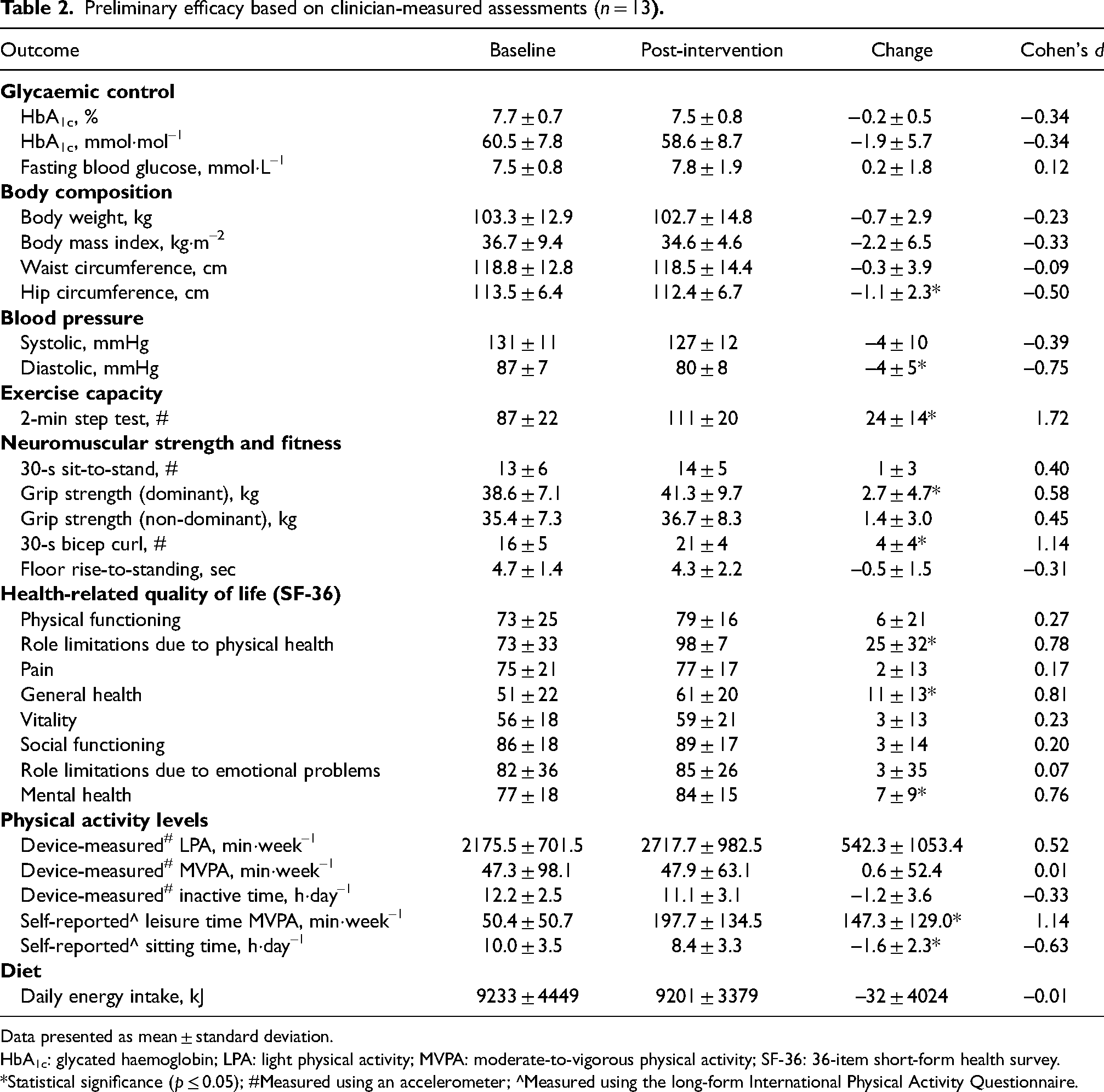
Data presented as mean ± standard deviation.
HbA1c: glycated haemoglobin; LPA: light physical activity; MVPA: moderate-to-vigorous physical activity; SF-36: 36-item short-form health survey.
*Statistical significance (p ≤ 0.05); #Measured using an accelerometer; ^Measured using the long-form International Physical Activity Questionnaire.
Agreement and reliability of in-person clinician-measured versus telehealth-supervised participant self-measured assessments
The agreement and reliability of in-person clinician-measured versus telehealth-supervised participant-self-measured assessments are presented in Table 3. Mean reliability for assessment between clinician (in-person) and participant (self-measured while supervised via telehealth) measurement was excellent (ICC ≥ 0.90) for body weight, waist and hip circumferences, and the 2-min step test; good for floor rise-to-standing (ICC = 0.821); and moderate for 30-s sit-to-stand (ICC = 0.640) and 30-s bicep curl (ICC = 0.585).
Agreement and reliability of in-person clinician-measured versus telehealth-supervised participant-self-measured assessments (n = 16).
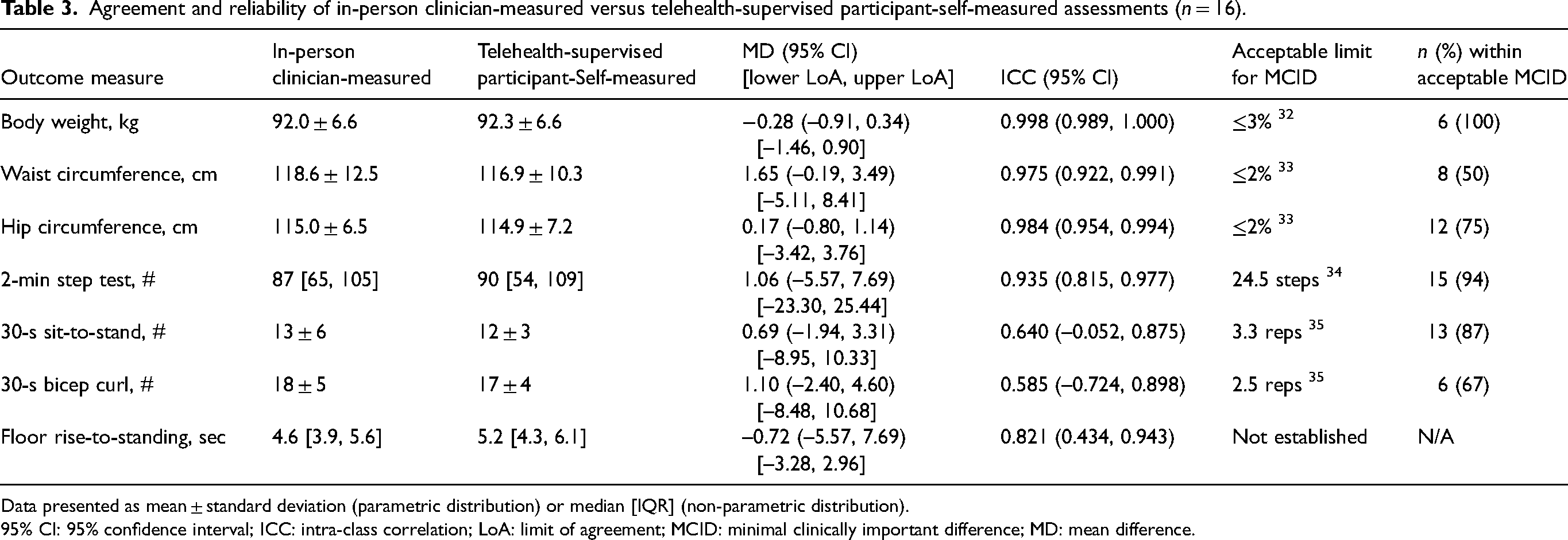
Data presented as mean ± standard deviation (parametric distribution) or median [IQR] (non-parametric distribution).
95% CI: 95% confidence interval; ICC: intra-class correlation; LoA: limit of agreement; MCID: minimal clinically important difference; MD: mean difference.
The variability in data can be seen in the Bland–Altman plots (Figure 1). No systematic bias was observed for any outcome. No proportional bias was observed for measures of body weight, hip circumference, or 30-s bicep curl. Proportional bias was observed for waist circumference, where there was more discordance in scores with a higher average waist circumference measure (r = 0.653 and p = 0.006); for 30-s sit-to-stand where there was more discordance in scores with a higher average sit-to-stand time (r = 0.548 and p = 0.0028); and for floor rise-to-standing where there was more discordance in scores with a higher average floor rise time (r = 0.759 and p = 0.002). All participants (100%) who completed self-measured body weight measures (n = 6) were within a-priori acceptable agreement limits. The 2-min step test and 30-s sit-to-stand test were also deemed acceptable with >80% of participants being within acceptable agreement (n = 15, 94% and n = 13, 87%, respectively).

Agreement between in-person clinician measures and telehealth-supervised participant measures for (A) body weight, n = 6; (B) waist circumference, n = 16; (C) hip circumference, n = 16; (D) 2-min step test, n = 16; (E) 30-s sit-to-stand, n = 16; (F) 30-s bicep curl, n = 9; and (G) floor rise-to-standing, n = 14. Solid line indicates the mean difference, dotted lines indicate the 95% confidence interval of the mean difference, and dashed lines are the upper and lower limits of agreement. Each solid circle represents an individual data point; each larger solid circle represents two participants with the same data for difference and average.
Discussion
In this pilot study, we demonstrated the feasibility, safety and preliminary efficacy of a telehealth-delivered group exercise intervention for people with T2D. These findings signal support for this mode of group exercise physiology service delivery and indicate that exploration of these findings in a fully powered trial is warranted.
Recruitment into the trial was difficult. This is likely attributed to our narrow inclusion criteria related to glycaemic control and physical activity participation, with 56% of people excluded for these reasons. While these criteria were chosen so we could investigate the use of telehealth-delivered group exercise in those who are most likely to benefit (i.e. those who have suboptimal blood glucose and are less active), they would not be present in clinical practice for Medicare-subsidised sessions. However, of the 18 people who were deemed eligible, only two people declined to participate (89% enrolment rate). Furthermore, our high session attendance rate of >97% is in line with, 5 or above, 17 rates seen in previous, similar telehealth-delivered exercise trials. Importantly, this rate is also in line with, 18 or above, 19 in-person group exercise trials. Finally, our retention rate was 81%. These findings signify high participant engagement with this mode of service delivery. Given high attendance and low attrition are likely to result in better participant outcomes, this speaks to the feasibility of telehealth-delivered exercise interventions for this population.
Technical issues are a common concern of telehealth-delivered exercise interventions. 20 Indeed, in the present study, these were reported by 38% of our participants. However, most technical issues were promptly resolved, and only one participant experienced software-related difficulties that prevented session participation. Addressing technical challenges is crucial for ensuring the scalability and effectiveness of telehealth-delivered exercise interventions. Our rate of technical issues (10%) was close to half of the rates reported in previous telehealth-delivered exercise interventions (17%). 21 This may be attributed to our provision of a ‘how-to’ guide on using the telehealth software, as well as the individual telehealth-delivered baseline assessment sessions, both of which allowed familiarisation with the platform and troubleshooting of issues prior to the intervention start.
During the semi-structured interviews, participants indicated the advantages of telehealth-delivered exercise included lack of travel requirements, flexibility in scheduling and the comfort of exercising in their own environment. These insights align with existing literature in other populations.8,20,22 Interestingly, multiple participants reported they felt a sense of camaraderie and mutual support during the intervention, despite the online nature of the program. This is a particularly important advantage in the context of low exercise self-efficacy, as is common in less active individuals with T2D. 23 While most participants reported positive experiences, some identified disadvantages including suboptimal home environment/equipment and reduced interaction with other group members. Strategies such as creative exercise selection (e.g. use of non-traditional equipment such as bags of rice) and incorporating social interactions into sessions may mitigate these drawbacks. Despite these concerns, the overwhelmingly positive response from participants (100% expressing willingness to participate in future interventions and recommending this mode of service delivery to others with T2D) is an endorsement of the use of telehealth-delivered exercise interventions for this population.
Compared with in-person exercise interventions, the capacity to assist during an adverse event is diminished, and clinicians cannot monitor vital signs as easily, via telehealth; this raises concern regarding the safety of telehealth-delivered exercise. However, in our trial, there were only two adverse events that were deemed related to the intervention (i.e. delayed onset muscle soreness and acute drop in blood pressure); both events were mild, resulting in no serious harm and not requiring intervention. Furthermore, neither event is unexpected for exercise interventions, nor was related specifically to the mode of service delivery. This finding supports the current literature indicating that telehealth-delivered exercise is not more unsafe than in-person exercise,21,24 and underscores the overall safety of the telehealth-delivered exercise approach.
Although this was predominantly a pilot feasibility study, we also investigated the effects of telehealth-delivered exercise on key clinical and functional outcomes. Following the 8-week intervention, there were meaningful improvements in body composition, blood pressure, exercise capacity, neuromuscular strength and fitness, health-related quality of life and self-reported physical activity levels, affirming the efficacy of telehealth-delivered exercise for individuals with T2D.25–27 These findings also align with the established benefits of in-person group exercise. 28 It is important to acknowledge there was no change in glycaemic control with the intervention, which is a primary outcome for this population; a greater dose of physical activity (both supervised and unsupervised) and a longer intervention period are likely required to achieve such changes. 29 However, the large increase in self-reported leisure time moderate-to-vigorous physical activity (MVPA) is promising, with continued participation post-intervention likely to positively impact glycaemic control. In saying this, this increase in MVPA was not reflected in the device-measured outcome, so should be interpreted with caution. There was, however, an increase in device-measured light physical activity, which may demonstrate a difference in participants’ conceptual understanding of activity intensities.
Being able to accurately and reliably assess participants remotely is crucial for the feasibility of telehealth-delivered interventions. We found participants were able to reliably self-assess body weight, 30-s sit-to-stand and 2-min step test while being supervised by a clinician via telehealth. This is an improvement from a previous study where liver transplant recipients could only assess body weight reliably and not functional outcomes. 7 Notably, the participants in that study were not supervised, which suggests that the specialised supervision via telehealth in the present study may be an important factor in increasing the accuracy of some self-assessments. Furthermore, the study by Keating and colleagues (2020) used the 6-min walk test to assess exercise capacity, which had broad limits of agreement; the 2-min step test used in the present study was completed with excellent reliability and is therefore a suitable alternative for assessing exercise capacity. In the present study we observed measurement differences for waist and hip circumferences and 30-s bicep curl that could be of a clinically meaningful magnitude, which would negatively impact the ability to accurately assess changes across an intervention. Being unable to confirm the anatomical points selected by participants during waist circumference was likely a primary driver for the poor reliability of this measure. We also observed greater discordance between measures in those who had a higher waist circumference (proportional bias). Given body composition is a crucial outcome for people with T2D, optimising the assessment of this is essential for the delivery of a completely remote telehealth service; a combination of outcomes (i.e. waist circumference and body mass index) is likely required, 30 particularly in those with a high waist circumference. For the 30-s bicep curl, all participants underwent the in-person clinician-measured assessment before completing the telehealth-supervised self-measured assessment, so there may have been a learning effect that could have biased this outcome.
This study has several strengths and limitations. First, this was a pilot, single-arm trial with a small sample size. Larger-scale studies are needed to validate these findings. However, this trial has provided comprehensive insights into the feasibility, safety and preliminary efficacy of group telehealth-delivered exercise for people with T2D that can be used to inform larger trials and enhance clinical practice. Future research should also explore the long-term effects of telehealth-delivered exercise, including self-directed exercise adherence beyond the supervised period, as well as the cost-effectiveness of these interventions compared with in-person delivery. 31 Second, we did not need to exclude any potential participants based on inadequate access to technology, which highlights the inclusivity of telehealth and aligns with the broader goals of equitable healthcare delivery. However, we did exclude individuals with comorbidities that made telehealth-delivered exercise unsafe. While this was a necessary measure to ensure participant safety, this has implications for the study's generalisability, highlighting that telehealth-delivered exercise may not be universally suitable for individuals with T2D.
In conclusion, our study elucidates the feasibility, acceptability, safety and preliminary efficacy of telehealth-delivered exercise interventions for individuals with T2D. While challenges such as recruitment, technical issues and difficulty with the telehealth-supervised participant-self-measured assessments were identified, the overwhelmingly positive participant experiences, high retention and adherence rates, and intervention benefits on various health parameters signal the potential of telehealth in this context. By addressing the limitations and building on these findings, future research can contribute to the optimisation of telehealth interventions, ultimately enhancing the exercise management of individuals living with T2D.
Supplemental Material
sj-docx-1-jtt-10.1177_1357633X241287966 - Supplemental material for Feasibility, safety and preliminary efficacy of telehealth-delivered group exercise for people with type 2 diabetes: A pilot trial
Supplemental material, sj-docx-1-jtt-10.1177_1357633X241287966 for Feasibility, safety and preliminary efficacy of telehealth-delivered group exercise for people with type 2 diabetes: A pilot trial by Emily R Cox, Myles D Young, Shelley E Keating, Ryan J Drew, Matthew Kolasinski and Ronald C Plotnikoff in Journal of Telemedicine and Telecare
Footnotes
Acknowledgements
The authors would like to acknowledge the trial participants for donating their time, and Diabetes Australia and the Hunter Medical Research Institute for their assistance with participant recruitment.
Author contributions
All authors were involved study concept and design, and the acquisition, analysis, and/or interpretation of data. ERC, SEK, and RCP drafted the manuscript, and all remaining authors provided critical feedback. All authors contributed to the final version of the manuscript. ERC is the guarantor of the work and accepts full responsibility for the work and/or conducting the study, has access to the data, and controls the decision to publish.
Declaration of conflicting interest
The authors declared no potential conflicts of interest with respect to the research, authorship, and/or publication of this article.
Ethical approval and informed consent
This single-arm pilot study was approved by the University of Newcastle Human Research Ethics Committee (approval number H-2021-0201) and was prospectively registered with the Australian New Zealand Clinical Trials Registry (ACTRN12622000379718). All participants provided written informed consent prior to enrolment in the study. The study was completed according to the Declaration of Helsinki. Recruitment occurred between March 2022 and October 2023.
Funding
The authors disclose receipt of the following financial support for the research, authorship, and/or publication of this article: This work was supported by a University of Newcastle College of Engineering, Science and Environment Excellence Strategic Investment Grant.

Data availability
The datasets generated during and/or analyzed during the current study are available from the corresponding author on reasonable request.
Supplemental material
Supplemental material for this article is available online.
References
Supplementary Material
Please find the following supplemental material available below.
For Open Access articles published under a Creative Commons License, all supplemental material carries the same license as the article it is associated with.
For non-Open Access articles published, all supplemental material carries a non-exclusive license, and permission requests for re-use of supplemental material or any part of supplemental material shall be sent directly to the copyright owner as specified in the copyright notice associated with the article.
