



Abstract
Introduction
Telemedicine has evolved into an integral component of neurosurgical care, especially in expanding access to specialized services in remote or resource-limited areas. This systematic review summarizes worldwide evidence on the implementation, outcomes, and barriers of tele-neurosurgery in emergency and outpatient settings.
Methods
Following PRISMA guidelines, a comprehensive PubMed/MEDLINE search (2000–2025) identified English-language studies on telemedicine applications in neurosurgery. Eligible studies included emergency cases (trauma, stroke, intracerebral hemorrhage) and outpatient settings. Data on design, interventions, outcomes, and limitations were extracted and analyzed qualitatively.
Results
Thirty-six studies met inclusion criteria, covering programs within high-, middle-, and low-income regions. Emergency networks using teleradiology and teleconsultation achieved significant reductions in time-to-specialist evaluation—from about 160 to 38 min—and prevented up to 44% of potential patient transfers, with low failure rates among locally managed cases. Outpatient programs reported patient satisfaction above 80%, surgical decision agreement comparable to in-person visits, and notable travel and cost savings, especially in pediatric teleclinics. Across various settings, telemedicine improved access, workflow efficiency, and cost-effectiveness, though challenges remained regarding connectivity, imaging interoperability, licensure differences, and digital inequality.
Conclusion
Tele-neurosurgery is a safe, effective, and cost-efficient addition to traditional neurosurgical care. It enhances response times, improves triage, and maintains high patient satisfaction across various health systems. Overcoming infrastructural and regulatory barriers through standardized digital networks and equitable access programs will be essential for consolidating telemedicine as a core element of global neurosurgical practice.
Keywords
Introduction
Telemedicine—the remote delivery of health services via information and communication technologies—has evolved from pilot projects to a widely adopted care modality that can expand access, reduce travel and time costs, and support continuity of care.1,2,3 Previous evidence reviews across specialties have shown benefits for patients and promising clinical and economic results, while considering methodological differences and the complexity of assessing digital, system-level interventions. 1 In surgical disciplines, telemedicine now includes pre- and postoperative virtual visits, image-enabled teleconsultation/triage, telementoring, and early experiences with telesurgery, each aimed at mitigating geographic disparities in expertise and improving equity for rural and underserved populations.2,3 Pediatric programs, in particular, demonstrate how telehealth can provide specialty input, maintain the medical home, and reduce family burden at scale. 4
The COVID-19 pandemic sped up the widespread adoption of telemedicine in neurology and neurosurgery, with significant rises in publications and clinical use beginning in 2020.5,6,7 Observational series and systematic reviews from the COVID-19 period show high patient (≈80%–95%) and provider satisfaction, satisfactory clinical outcomes in certain cases, and effective outpatient follow-up through phone/video visits.3,6,7 At the same time, emergency care networks used teleradiology and telestroke pathways to accelerate specialist input and improve transfers; professional and regulatory flexibilities further lowered barriers to adoption.3,7 New research also describes the merging of telemedicine with artificial intelligence-driven diagnostics and workflow improvements for neurosurgical practice. 8
Despite this growth, decision-makers still encounter fragmented evidence across various settings (emergency trauma and acute stroke versus outpatient cranial/spine and pediatric care), jurisdictions (high-income versus resource-limited systems), and implementation models (hub-and-spoke, smartphone-enabled referrals, smart-glasses supervision). Ongoing challenges include bandwidth and connectivity issues, imaging interoperability, limitations in remote neurologic examinations, variability in licensure and reimbursement, and digital access disparities.1,3,7 Still, a guide for service planning is necessary for remote communities, where timeliness (“time is brain/spine”) and subspecialty routing are lacking. This review systematically synthesizes recent implementations, outcomes, and barriers of tele-neurosurgery across emergency and outpatient settings, aligning the evidence base for practical adoption and equity-focused expansion.
Methods
This systematic review was conducted in accordance with the PRISMA 2020 guidelines. A comprehensive search of PubMed/MEDLINE was conducted through December 31, 2025, limited to English-language publications. The search strategy combined controlled vocabulary and free-text terms related to telemedicine and neurosurgery, refined with filters for access and healthcare delivery outcomes. The full search string was: ((“telemedicine”[MeSH Terms] OR “telemedicine”[tiab] OR “telehealth”[tiab] OR “teleconsultation”[tiab] OR “tele-neurosurgery” [tiab] OR “telesurgery”[tiab] OR “remote consultation”[tiab] OR “virtual consultation”[tiab]) AND (“neurosurgery”[MeSH Terms] OR “neurosurgical”[tiab] OR “neurosurgeon”[tiab] OR “neurosurgical procedures”[tiab] OR “neurosurgical care”[tiab]) AND (“rural”[tiab] OR “remote”[tiab] OR “underserved”[tiab] OR “low-resource”[tiab] OR “developing countries”[MeSH Terms] OR “global surgery”[tiab] OR “global neurosurgery”[tiab]) AND (“access”[tiab] OR “availability”[tiab] OR “outcome”[tiab] OR “delivery of health care”[MeSH Terms] OR “health services accessibility”[MeSH Terms])) AND (“2000/01/01”[Date - Publication] : “2025/12/31”[Date - Publication]) AND (English[lang])
Study selection and eligibility
Two reviewers independently screened titles, abstracts, and full texts using predefined inclusion criteria. Eligible studies evaluated telemedicine applications in neurosurgery across emergency settings (trauma, acute stroke, intracerebral hemorrhage) and outpatient contexts (pediatric and general neurosurgery). When available, relevant evidence-based guidelines were incorporated. Exclusion criteria included single case reports, conference abstracts without full texts, narrative commentaries, and studies unrelated to telemedicine in neurosurgical care. Disagreements during screening were resolved by consensus.
A total of 81 records were identified. After screening and full-text review, 36 studies met the inclusion criteria (Figure 1). Data extraction used a standardized form to capture study characteristics such as author, year, region, setting, design, tele-intervention, findings, and barriers. Due to the heterogeneity of study designs and outcomes, results were synthesized qualitatively without conducting a meta-analysis; where available, quantitative findings from high-quality studies were summarized descriptively.
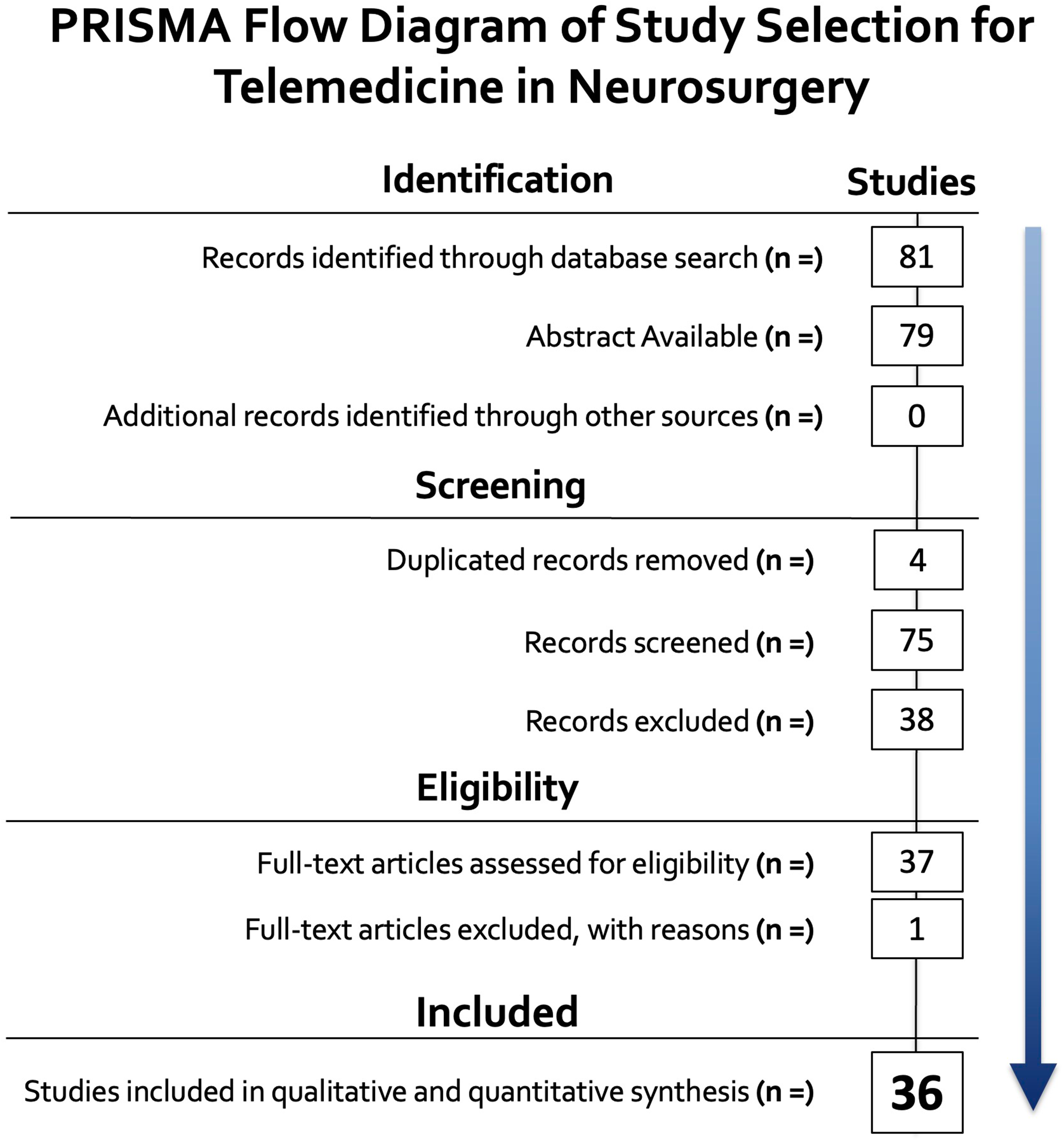
PRISMA flow diagram illustrating the study selection process for the systematic review on telemedicine in neurosurgery. A total of 81 records were identified through database searches; 36 studies met the inclusion criteria and were incorporated into the qualitative synthesis.
Quality assessment and synthesis
Methodological quality was independently assessed by two reviewers using design-appropriate appraisal tools: the Newcastle–Ottawa Scale (NOS) for observational cohort studies, the Joanna Briggs Institute (JBI) checklist for cross-sectional studies, CHEERS 2022 for economic evaluations, and AMSTAR 2 for systematic reviews. Descriptive program reports, perspectives, and narrative reviews that lacked primary outcome estimation were not formally appraisable and were treated as descriptive evidence. Given substantial heterogeneity, quantitative pooling was not feasible, and no meta-analysis or formal statistical assessment of publication bias (e.g., funnel plot asymmetry) was conducted. To mitigate selective reporting bias, predefined inclusion criteria, dual independent screening, and structured data extraction were used.
Results
Thirty-six studies met the inclusion criteria. The designs included retrospective cohorts and analyses, program descriptions, surveys, cost-effectiveness studies, and systematic or scoping reviews. These studies were conducted in both high-income and low- or middle-income settings, such as India, Israel, the USA, Europe, Africa, Australia, Malaysia, and Greenland–Denmark. They covered emergency care topics such as trauma and acute stroke/ICH, as well as outpatient neurosurgery for both general and pediatric patients. Data elements extracted from each study are summarized in Table 1.
Summary of studies on telemedicine in neurosurgery. Study quality and risk of bias were assessed using design-specific appraisal tools, including the Newcastle–Ottawa Scale (NOS) for observational cohort studies, the Joanna Briggs Institute (JBI) critical appraisal checklist for cross-sectional studies, the CHEERS 2022 reporting guidelines for economic evaluations, and AMSTAR 2 for systematic reviews. Descriptive program reports, policy analyses, and narrative reviews were classified as not formally appraisable and treated as descriptive evidence.
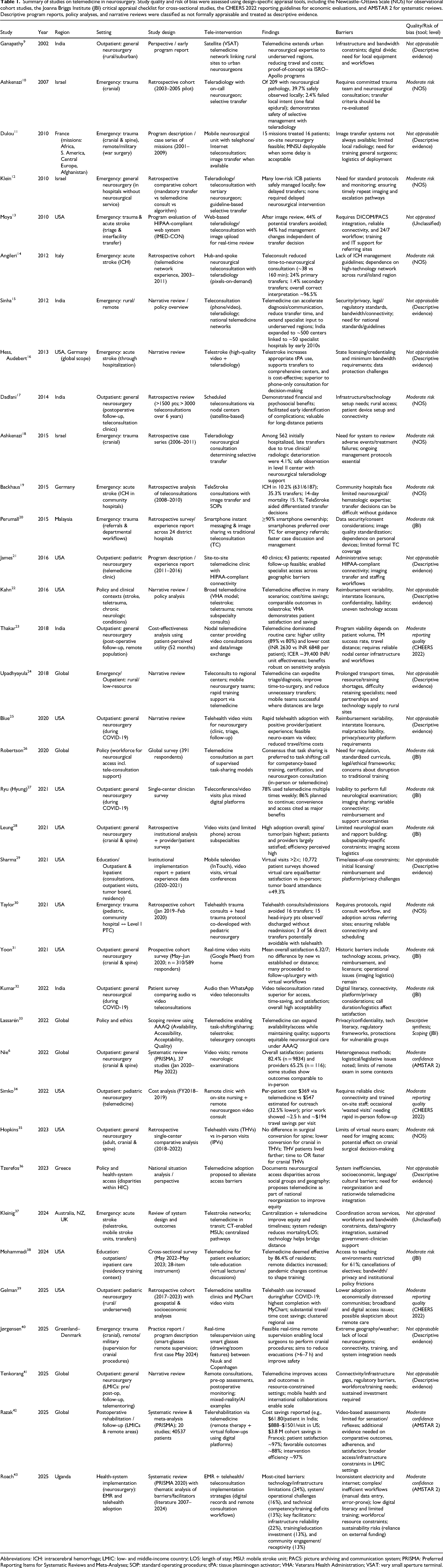
Abbreviations: ICH: intracerebral hemorrhage; LMIC: low- and middle-income country; LOS: length of stay; MSU: mobile stroke unit; PACS: picture archiving and communication system; PRISMA: Preferred Reporting Items for Systematic Reviews and Meta-Analyses; SOP: standard operating procedure; tPA: tissue plasminogen activator; VHA: Veterans Health Administration; VSAT: very small aperture terminal.
Publication volume increased over the review period, with a significant surge during and immediately after the COVID-19 era (2020–2022) and continued high output afterward (Figure 2). Early reports (2002–2010) demonstrated feasibility; the post-2020 acceleration indicates rapid clinical expansion and program evaluation.
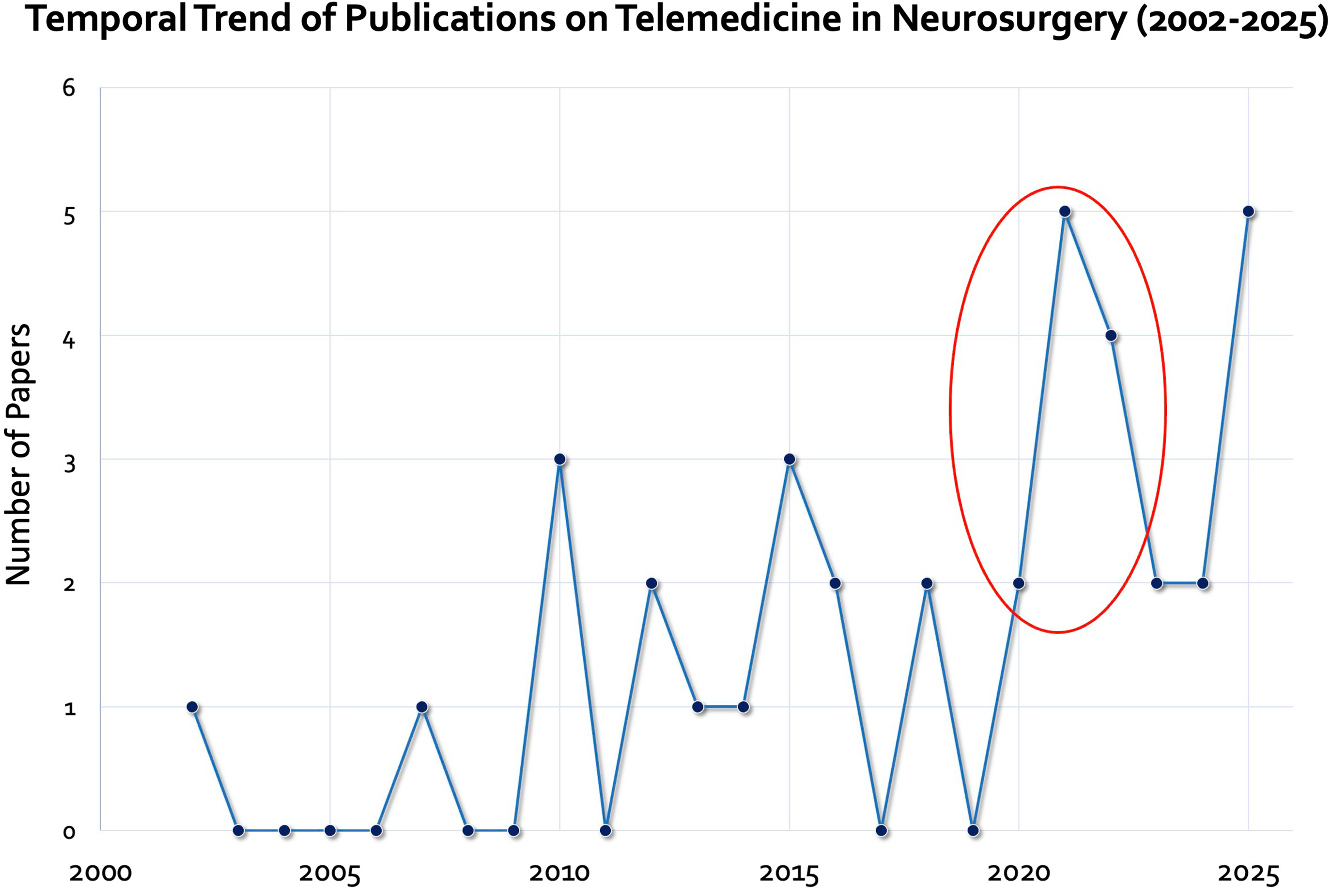
Temporal trend of publications on telemedicine in neurosurgery from 2002 to 2025, demonstrating a progressive increase in research output over the past two decades, with a marked surge following the COVID-19 pandemic (red circle). Data are derived from the 36 studies included in the qualitative synthesis and summarized in Table 1.
Emergency applications mainly focused on trauma and telestroke networks using teleradiology, teleconsultation, and hub-and-spoke models. Outpatient services included video visit clinics (both general and pediatric), telefollow-up, and satellite clinics. Novel modalities included smartphone-based referral systems, mobile neurosurgical units, and real-time remote procedural supervision with smart glasses.
Across heterogeneous designs, several consistent effects emerged, indicating effectiveness:
Reduced transfers and optimized triage. Real-time image review or teleconsultation prevented approximately 44% of potential transfers in one U.S. program evaluation
13
; selective transfer pathways safely managed 39.7% of head-injured patients locally in Israel, with only 2.4% failing local management.
10
Late transfers among initially observed patients remained low at 4.1%.
18
Pediatric trauma telehealth prevented unnecessary transfers with no readmissions among observed cases.
30
Faster specialist input. Teleconsultation for ICH reduced time-to-neurosurgical consultation from approximately 160 to about 38 min in an Italian network.
14
Access and utilization. During COVID-19, most clinicians reported frequent telemedicine use with intentions to continue; institutional series documented high adoption across subspecialties. Patient-reported outcomes and satisfaction. Prospective outpatient cohorts reported high satisfaction (e.g., mean 6.32/7)
31
; a systematic review found pooled patient satisfaction of around 82% and provider satisfaction of about 65%.
6
Cost and time savings. Economic evaluations demonstrated lower per-patient costs for telemedicine compared to outreach models (e.g., $369 vs $547) and showed it to be the most cost-effective option compared to routine care in LMIC contexts; multiple studies reported significant travel and time savings for families.
34
Clinical decision-making. In large outpatient datasets, surgical conversion rates for spine care were similar between telehealth and in-person visits. In contrast, cranial cases showed lower conversion rates, with a faster time to the operating room among those who proceeded to surgery.
35
Recurrent barriers included connectivity and bandwidth limitations; imaging access and interoperability (PACS/DICOM); constraints on remote neurological examinations; privacy, consent, and data security requirements; variability in licensure and reimbursement policies; and digital literacy and socioeconomic disparities impacting adoption—especially in underserved or remote communities.
Collectively, the included studies indicate that tele-neurosurgery implementations are feasible across diverse health systems, improve the timeliness of specialist input and triage efficiency, and are associated with high patient acceptability and favorable economic signals, while highlighting ongoing infrastructure and regulatory gaps (Table 1 and Figure 2).
Although the included studies were heterogeneous and therefore synthesized qualitatively, all 36 studies contributed to at least one of the prespecified domains summarized in Table 1: (1) emergency tele-neurosurgery models (telestroke/ICH and trauma triage with teleradiology), (2) outpatient tele-neurosurgery delivery (general and pediatric clinics and follow-up), (3) implementation strategies and health-system integration (including digital workflows, interoperability, and workforce/education models), (4) patient- and system-level outcomes (transfer avoidance, time-to-specialist input, satisfaction, utilization, and cost/time savings), and (5) barriers to adoption (connectivity, imaging access, examination constraints, regulatory/reimbursement factors, and digital inequity). Study-level findings supporting these domains are detailed in Table 1.
Discussion
Telemedicine has transitioned from a supplementary communication tool to a functional component of neurosurgical care in both emergency and outpatient settings. The evidence summarized in this review demonstrates that tele-neurosurgery provides measurable benefits in timeliness of specialist input, improving triage, and increasing patient access to care, all while ensuring safety and clinical effectiveness. The emerging pattern across the included studies indicates that the way it is used—whether in emergency trauma and stroke networks or for outpatient consultation and follow-up—determines the nature and extent of its impact.
In emergency settings, tele-neurosurgery consistently improved the speed of specialist evaluations and decreased unnecessary transfers between facilities. Research from Europe, Israel, and the United States documented significant reductions in the time to neurosurgical consultation, with one Italian intracerebral hemorrhage network shortening the interval from nearly 3 h to under 40 min. Selective transfer models, guided by real-time image review and structured remote triage, enabled almost 40% of patients with head injuries to be managed locally, with minimal late transfers or treatment failures. These results indicate that teleconsultation systems can safely decentralize initial management when combined with clear escalation guidelines and standardized follow-up imaging. The overall evidence supports the view that telemedicine transforms emergency neurosurgical care from a primarily centralized model to one of guided, criteria-based regional management—especially important for geographically spread or resource-limited systems where transfer delays can directly affect neurological outcomes.
In outpatient neurosurgery, telemedicine has matured into a reliable platform for evaluation, follow-up, and longitudinal management across both adult and pediatric populations. Multiple studies reported patient satisfaction reaching or exceeding 80%, with similar increases in provider acceptance. Spine consultations via virtual platforms resulted in surgical conversion rates comparable to in-person assessments, confirming that tele-assessment is sufficient for surgical decisions when supported by proper imaging. On the other hand, cranial consultations showed lower conversion rates but a quicker time-to-operation for those who ultimately had surgery, indicating that telemedicine facilitates efficient triage and prioritization. Pediatric teleclinics added value by cutting travel costs and maintaining continuity within the medical home, strengthening telemedicine's role in providing equitable access to specialized care for families in remote areas.
The heterogeneity of tele-intervention methods—covering teleradiology, real-time video consultations, structured telestroke protocols, smartphone-based referral platforms, and smart-glasses supervision—underscores the flexibility of digital tools to various local infrastructures. Despite differences in platforms and settings, common results emerged: enhanced workflow efficiency, increased patient satisfaction, and positive cost-effectiveness profiles. Economic analyses showed that telemedicine can provide outpatient neurosurgical care at lower per-patient costs compared to outreach models, especially benefiting low- and middle-income regions. Programs that used secure DICOM transfer and remote image viewing achieved quicker consults and fewer unnecessary transfers, demonstrating that technological interoperability directly impacts clinical performance.
However, structural and procedural barriers continue to hinder widespread adoption. Connectivity and bandwidth limitations are the most common problems, especially in rural and low-resource areas. Programs that achieve stable connectivity usually use standardized hardware, redundant network access, and dedicated technical support at spoke sites, indicating that infrastructure reliability is essential for sustainability. Imaging interoperability is another related challenge: the lack of seamless picture archiving communication systems (PACS) or secure cloud-based DICOM sharing can delay triage decisions and reduce confidence in remote review. Therefore, standardizing imaging protocols and establishing cross-institutional compatibility agreements should be key components of tele-neurosurgical planning.
Limitations inherent in remote neurological examinations persist, especially in cranial assessments that require fine motor or sensory evaluation. However, structured tele-examination protocols, local chaperones, and additional imaging can partially mitigate this gap. The effectiveness of tele-triage in spine consultations and the low failure rate among locally managed trauma patients indicate that, with proper imaging and clear escalation pathways, clinical accuracy is largely maintained.
Regulatory and reimbursement frameworks vary across jurisdictions, affecting adoption and continuity. Networks with unified credentialing and cross-site licensure agreements, such as statewide telestroke systems, experience fewer administrative disruptions and higher throughput. Achieving parity in reimbursement for teleconsultations and in-person visits would support long-term integration into standard neurosurgical workflows.
Digital inequity remains a significant concern. Patients in socioeconomically disadvantaged or broadband-poor regions exhibit lower participation rates and higher visit failure rates. Hybrid models that place teleconsultation equipment in community hospitals or public clinics have demonstrated improved uptake, especially when supported by local facilitators. Programs by institutions and governments that subsidize connectivity or device access can further reduce this disparity and promote equitable access to neurosurgical expertise.
Systems-level evidence from LMIC neurosurgery also reinforces the continuity-of-care rationale for telemedicine. A 2025 systematic review of Bolivian neurosurgery identified major system gaps, including fragmented infrastructure and substantial loss to follow-up. 44 Multiple included studies specifically recommended telemedicine and structured follow-up programs to address geographic isolation and discontinuity of care. These findings support prioritizing telemedicine not only for triage and access but also as a pragmatic tool to reduce follow-up attrition in geographically challenging settings.
The evolving intersection of telemedicine with telementoring, task sharing, and remote education presents an additional path for capacity building. Programs employing real-time remote supervision and smart-glasses-based assistance in resource-limited settings demonstrate the potential for geographically independent expert oversight, supporting safe local interventions when transfer is impractical. Incorporating structured tele-education and competency-based training into these networks could formalize quality assurance and expand the neurosurgical workforce effectively.
The evidence base confirms tele-neurosurgery as both practical and clinically effective across various healthcare systems. It shortens delays in specialist assessment, improves transfer procedures, maintains high patient satisfaction, and shows cost benefits while highlighting actionable solutions to ongoing infrastructural and regulatory issues. This review suggests that, with intentional system design focusing on network reliability, imaging interoperability, structured remote exams, and fair access, telemedicine can become a fundamental part of modern neurosurgical practice.
Limitations
Interpretation of these findings should be considered in light of methodological constraints inherent in the available evidence. The included studies were heterogeneous in design, intervention type, and reported outcomes, spanning retrospective cohorts, surveys, program descriptions, economic evaluations, and systematic reviews across emergency and outpatient settings. This variability limited direct comparability and precluded quantitative pooling or meta-analysis, making formal statistical assessment of publication bias inapplicable. In addition, many studies were observational or descriptive and relied on nonstandardized outcome measures, which may limit causal inference and cross-study consistency. The review may also be influenced by selective reporting and publication bias, as successful telemedicine implementations are more likely to be disseminated than neutral or unsuccessful programs. Although quality appraisal was conducted using design-appropriate tools, some implementation and policy reports were not formally appraisable and were treated as descriptive evidence.
Conclusion
Telemedicine has become a validated adjunct to neurosurgical care, demonstrating consistent improvements in the speed of specialist assessment, reducing unnecessary transfers, and preservation of clinical safety in both emergency and outpatient settings. The combined evidence indicates that real-time image sharing, structured teleconsultations, and remote follow-up can uphold diagnostic accuracy and patient satisfaction while providing clear cost savings and operational efficiencies. Although barriers such as connectivity limitations, imaging interoperability, and regulatory differences still exist, these can be overcome with standardized infrastructure, integrated digital networks, and equitable access policies. As technology progresses toward wider adoption of telementoring and remote procedural supervision, tele-neurosurgery is ready to shift from a backup option to a fundamental and ongoing part of global neurosurgical practice, especially in areas where geographic and resource limitations delay access to expert care.
Footnotes

Ethics approval
Not applicable. This study is a literature review based entirely on previously published data and does not involve new human participants, animals, or patient information.
Consent to publish
The authors are the owners of the illustrations and give consent for publication in this journal.
Consent to participate
Not applicable. This study was based exclusively on previously published studies and did not require informed consent from patients, as no new human or critical data were collected.
Author contributions
HOMP: conceptualization, writing—original draft, reviewing; EGF: writing—reviewing, supervision.
Funding
The authors received no financial support for the research, authorship, and/or publication of this article.
Declaration of conflicting interests
The authors declared no potential conflicts of interest with respect to the research, authorship, and/or publication of this article.
Data availability statement
Data sharing not applicable to this article as no datasets were generated or analyzed during the current study.