



Abstract
Although Botswana has recently been categorised as an upper middle income country, it is burdened by a scarcity of resources, both human and technological. There are barriers to patients’ access to specialized care and healthcare providers’ access to medical knowledge. Over the past three years, the Botswana-University of Pennsylvania Partnership (BUP) has piloted four mobile telemedicine projects in the specialties of women's health (cervical cancer screening utilizing visual inspection with acetic acid), radiology, oral medicine and dermatology. Mobile telemedicine has been used in 11 locations in Botswana, training a total of 24 clinicians and successfully contributing to the management of 643 cases. In addition to mobile telemedicine, BUP has initiated an m-learning programme with the University of Botswana School of Medicine. While successfully providing patients and providers with improved access to healthcare resources, the m-health projects have faced numerous technical and social challenges. These include malfunctioning mobile devices, unreliable IT infrastructure, accidental damage to mobile devices, and cultural misalignment between IT and healthcare providers. BUP has worked with its local partners to develop solutions to these problems. To ensure sustainability, m-health programmes must have strategic goals that are aligned with those of the national health and education system, and the initiatives must be owned and led by local stakeholders. Whenever possible, open source technology and local IT expertise and infrastructure should be employed.
Introduction
In a recent survey, over 70% of African countries reported having implemented at least one m-health application. 1 These applications address public health problems such as management of chronic disease; infectious disease epidemics and pandemics; psychosocial problems such as drug abuse, addiction and suicide; and social problems such as family planning and smoking cessation. However, fewer than 10% of these countries have evaluated their m-health projects. 1 The majority of the m-health projects are data collection applications and rely on one-way transmission of data. Few involve two-way data transmission, such as in mobile telemedicine, which requires the input of a medical expert in a distant location.
Mobile telemedicine aims to provide rural clinicians with specialist consultations, avoiding lengthy waiting lists and long distance travel. Use of mobile telemedicine provides physicians with a means of diagnosing, triaging and treating complex cases, and also serves as a method of collecting large quantities of data that can be analysed for research and evaluation. 2 An evaluation of two-way mobile telemedicine for dermatology in Egypt found it to be technically feasible and diagnostically reliable. 3 Overall, the biggest barriers to m-health implementation are the operating costs, knowledge, infrastructure and the absence of policy, which makes African nations highly dependent on external support for the development, implementation and expansion of m-health. 4
M-health in Botswana
Botswana has recently been categorised as an upper middle income country owing to its gross national income (GNI) per capita of $6890 in 2010.5,6 The diamond industry has been the major source of its rapid economic expansion, which has resulted in a transition from being one of the world's poorest countries at the time of its independence in 1966. 5 Despite being an upper middle income country, Botswana is also, according to the World Health Organization, considered a low-resource country, i.e. a country where the infrastructure and human resources are limited in quantity, quality and accessibility. Botswana's GINI index of 63 reflects the fact that the wealth is mainly concentrated in a small proportion of the country, and the living standards of the majority are similar to those of people living in a low income setting. 7 Although its wealth makes Botswana one of the fastest growing economies in Africa, a lack of competent human resources places it at a disadvantage compared to other upper middle income countries. For example, Botswana has a severe shortage of human resources for healthcare while faced with the second highest rate of HIV/AIDS infection in Africa. 8 This shortage has placed limitations on independent economic growth and has fostered dependence on foreign intervention.
Botswana has a national public health system made up of 343 health posts, 286 clinics, 18 district hospitals, 17 primary hospitals and 3 referral hospitals for a population of 2,030,000. 9 There are a total of 591 physicians and 5006 nurses, averaging about 3.4 physicians and 29 nurses per 10,000 people. Barriers to healthcare access include long waiting periods to be seen by specialists and long travel distances to and from health care facilities. 10 Access to physicians, especially specialist care, is particularly limited outside the major cities. Despite government efforts to mitigate barriers to healthcare access, primary care physicians face their own challenges, including lack of access to specialty referral systems, point-of-care clinical information and support for medical decision making related to complex cases.
In 2010, there were 137,400 land line phones and 2.4 million mobile phones in Botswana, making mobile phones over 95% of the telephones in use.7,11 Over the past few years the Botswana Telecommunications Corporation and private telecommunications providers have expanded mobile telecommunications services to rural underserved communities 12 and 95% of Botswana's population has access to GSM mobile phone networks. Mobile phones are used by 36% of rural households, 89% of urban villages, 93% of towns and 94% of cities.13,14
The partner institutions involved with m-health initiatives in Botswana span public, private, academic and non-profit sectors. Organizations driving m-health include the Botswana-University of Pennsylvania Partnership (BUP), the University of Botswana (UB), the Ministry of Health of Botswana (MoH), CDC-BOTUSA (Botswana-USA), the Orange Foundation, the Clinton Health Access Initiative, the Botswana-Harvard Partnership, the National Library of Medicine, Positive Innovation for the Next Generation (a youth led organization implementing health or youth-focused technology projects), Hewlett-Packard and Mascom Wireless. Of these, BUP, MoH, CDC-BOTUSA and Orange have partnered on mobile telemedicine, a branch of m-health that uses mobile phone technology to expand specialist care. Also, BUP, UB and Orange have partnered on mobile learning (m-learning) to support medical education.
BUP m-health projects
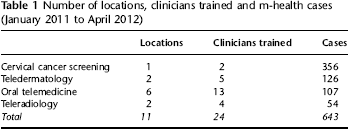
Over the past three years, BUP has piloted four mobile telemedicine projects in the specialties of women's health (cervical cancer screening utilizing visual inspection with acetic acid), radiology, oral medicine and dermatology. Mobile telemedicine has been used in 11 locations in Botswana, training a total of 24 clinicians and successfully contributing to the management of 643 cases (Table 1). Healthcare workers have been provided with smart phones equipped with a built-in camera and data-enabled subscriber identity module (SIM) cards donated by the Orange Foundation of Botswana. The organizational structure of each mobile telemedicine project includes an in-country medical specialist, an international specialist (the only position that is not held by a MoH employee), a national specialty manager, a referral site coordinator and the referring health care workers.
Number of locations, clinicians trained and m-health cases (january 2011 to april 2012)
All four mobile telemedicine projects share the same model in which the healthcare worker collects pertinent clinical history and associated images pertaining to a complex patient case. The collected history and images are then sent to an in-country remote specialist for consultation. The specialist uses the information to diagnose the illness and recommend an appropriate course of treatment. The in-country specialist also has the option of forwarding the case to an international specialist for further input and collaboration. The national specialty manager is the uniting force for each programme, working to train the health care workers on site, as well as coordinating all parties involved in the scaling up and sustainability of their programme.
In addition to mobile telemedicine, BUP has initiated an m-learning programme with several University of Botswana School of Medicine (UBSOM) residency programmes. 15 Resident physicians and faculty at UBSOM were provided with Android smart phones with medical and drug information applications (e.g. Dynamed, Archimedes, Medscape, ePocrates Rx and 5-Minute Clinical Consult). They were then trained by BUP and UBSOM librarians to access medical information via the phones at the point of care. An application is currently being developed to allow these residents to discuss and share cases with each other and their mentors. This project began with seven users in 2010, and was expanded to 33 users in 2011. In April 2012, BUP introduced 11 tablet computers with seven-inch screens (HTC Flyer) to replace the smart phones. The UBSOM will be supporting the expansion of the m-learning project to 151 new medical students, residents and faculty by 2013.
These m-health initiatives in Botswana have expanded the delivery of specialised care to rural areas in several medical specialties. Observed benefits include improved access to care, empowerment of clinicians, improved communication between point of care clinicians and remote specialists, collaboration among primary clinicians and students, and a reduction of referrals and associated costs. Despite the initial success of m-health in Botswana, the programmes have faced numerous challenges associated with their implementation and scaling up.
Challenges to m-health
Implementing and scaling up any new technology in a resource-limited setting presents several challenges. Other telemedicine programmes in resource-limited settings, such as the telemedicine project at the Aravind Eye Hospital in Tamil Nadu, India, have reported similar challenges to those faced by BUP, including equipment failure, power problems, remote management and training difficulties, theft of equipment, and transportation problems. 16 BUP's m-health programme has experienced technical and social challenges, both internal and external to the projects’ environments.
Internal technical challenges have included application software bugs, SIM card and mobile device malfunctions, battery power problems, lack of local hardware maintenance support and hackers attacking servers. Telemedicine software bugs have proven especially difficult to identify and solve, because the project's software developers are based outside the country and speak a different language from the users. For this reason, and for the benefit of local ownership and capacity building, all development, maintenance, and support for the scaling up of the telemedicine programme will come from local IT developers who utilize open source technologies. SIM card malfunctions, including Internet access and SMS interruption, have occurred on a number of occasions. BUP has been able to resolve these problems by collaborating with the customer support staff of the telecommunications provider.
Other mobile device usage challenges include battery overuse and difficulties in supporting the hardware in the field. In response to the battery problems, BUP has included battery-saving apps on devices and incorporated battery saving tips into the user training sessions. For scaling up both the telemedicine and m-learning projects, hardware is procured through local distribution channels, with extra user support in the form of support hotlines that users can call if the hardware is damaged or malfunctioning.
The BUP m-health programme also suffered a security breach when one of the servers was attacked by an anonymous hacker. Fortunately, none of the data were lost or stolen, but the incident did expose major security concerns. BUP has addressed this problem by utilizing the firewalls of local partners and setting standards for the encryption of m-health data that meet the technical security standards of America's Health Insurance Portability and Accountability Act.
Technical challenges external to the m-health programme have been due to nationwide IT infrastructure problems that are common to developing countries generally. Sporadic nationwide power outages have affected the projects’ servers, often halting operations. Malfunctioning medical technology has also affected m-health projects. For instance, the X-ray machine in one participating hospital was broken for nearly a year, limiting usage of the mobile devices there for teleradiology In addition, access to the Internet in most government facilities is unreliable. This poses a major challenge to in-country specialists who need Internet access to respond to consultations via telemedicine. To provide more reliable Internet access to local specialists, BUP and Orange have supplied Internet dongles and laptops to users. In the scaling up, the local specialists will be supplied with tablet computers with GPRS Internet access. Troubleshooting tips for these and other recurring technical problems have been included in the initial user training and the regular workshops that are held to assist users in solving problems by themselves.
Social challenges faced by m-health implementation can be similarly divided into those due to internal and external factors. A significant internal social challenge involves initial negative perceptions of the technology by new users. There is often some scepticism of new technology which disrupts established workflows. Although some professionals immediately embrace the technology, many require training and education. In our experience, this process is most effective when these negative perceptions are addressed by colleagues within the healthcare system. For this reason, training sessions are conducted by “specialty managers” who are project champions. These enthusiastic phone users conduct workshops to raise awareness and expand the m-health programmes. Other social challenges include physical or liquid damage and misplacement or theft of the devices. Policies have been developed to minimize these risks when introducing new devices to the healthcare setting. Carrying cases and protective covers are now included with every device distributed. Strict conditions have been established for the geographical usage of the devices, and security apps have been installed to locate and remotely erase their memories, if lost or stolen.
Social challenges external to BUP and specific to the governmental sector became evident during an 8-week public sector strike in 2011. Many healthcare workers participated in the strike, including those involved in the m-health projects. The strike resulted in the suspension of many m-health projects and had negative consequences for health care delivery across the country. Another major social challenge has been the high turnover rate of staff in the MoH and UB. The m-health projects are especially affected when key contributors and supporters leave partner institutions. In most cases, these employees have been transferred abruptly, without appropriate transfer of their responsibilities to the incoming worker. We found that managing these situations required constant communication between all stakeholders, especially senior managers and key policy decision makers, with frequent updates on the statuses of the projects.
Sustaining m-health
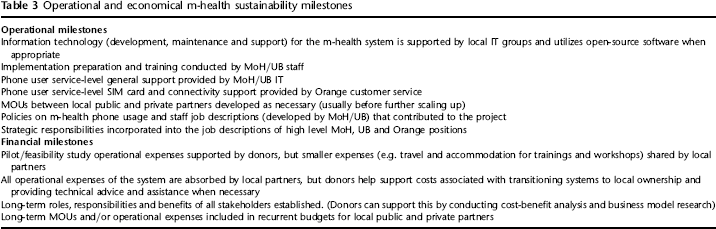
Sustainability is a major pillar of the BUP m-health programme. BUP works closely with local partners to sustain and scale up the programmes throughout the country. In doing so, numerous processes, documents and presentations have been developed to ensure that expansion of the projects is conducted responsibly and with a focus on local ownership and drive (Table 2). In order to achieve this goal, BUP and its partners have developed economical and operational milestones (Table 3). Efforts have been focused on four main components of sustainability: local customization, local ownership, public-private partnerships and the IT provider business model. These aspects of sustainability are similar to the principles for success of ICT programmes in resource-limited settings that have been outlined by Surana et al. and include optimization of an existing system, financial self-sufficiency and operational self-sufficiency 17
Engagement with the ministry of health on implementing the mobile telemedicine project

Operational and economical m-health sustainability milestones
BUP consistently encourages and empowers local ownership and drive. The greatest contributions to the BUP mobile telemedicine projects have come from the specialty managers and site coordinators who have embraced the projects and pursued initiatives to improve them. The specialty managers organize and run training workshops and sensitization programmes for local healthcare workers, allowing them to raise awareness of telemedicine and m-health. Specialty managers and site coordinators developed the idea of telemedicine awareness posters to hang in all the field sites. In another step towards local ownership, an official m-health help desk is currently being developed for all m-health phone users, which will feed into the existing MoH help desk system.
One of the ways that m-health can be sustained is through local ownership and support by local leaders in government and healthcare. In general, m-health projects are sustainable in cases where the project is institutionalized into existing government health programmes that can receive budget attention. 18 Recognizing this, the Botswana MoH has for the first time allocated funding for mobile telemedicine projects in its 2012 Recurring Clinical Services Budget and assigned key individuals in the MoH to support its development and implementation.
BUP therefore appears to have facilitated a sustainable local m-health system by adopting a public-private partnership model. BUP has worked with partners at the MoH, the UBSOM and Orange Foundation to help each stakeholder recognize and forecast its costs and benefits, and maintain a long-term vision for the mobile telemedicine and m-learning projects. These efforts have culminated in a three-year memorandum of understanding between Orange and the MoH to continue supporting the mobile telemedicine projects. Orange will be providing mobile devices for the next year of the project at a discounted rate, a 200 MByte/month data plan for the SIM cards for three years, which is 79% below the market rate. Overall, the MoH is financially supporting 84% of the operational budget for the first year of the new system, and the Orange Foundation is supporting 16% in the form of mobile devices and discounted data rates. Orange has committed to providing the discounted rates for three years, and the MoH has stated it will maintain at least the same support in its recurrent budget for the next three years, but will consider increasing it if there is interest and capacity to expand further.
BUP has also asked the Schools of Business at the University of Pennsylvania and at the University of Botswana to conduct cost-benefit analyses on each m-health project. This research collaboration also covers options for long-term sustainable business models with each stakeholder.
Throughout the three years of implementation and management of mobile telemedicine in Botswana, BUP has worked to identify the most effective and sustainable model for IT support for the m-health projects. In the early pilot studies, software was developed outside the country, which complicated debugging and maintenance. Based on this experience and the growing relationships with the local IT community in Botswana, all mobile telemedicine projects will soon be 100% coded in-country, utilizing open source software and tools. BUP guided and supported a local IT group to develop a prototype system using open source tools for oral medicine in 2011. The MoH has included a “coded in country” requirement in its national tender for the new mobile telemedicine system for all four specialties. The funds for the development, maintenance and support of the system will come from the MoH Clinical Services recurrent budget. The servers supporting the new system will be sited with all other government servers and will be owned by the MoH.
There are several factors that could threaten the continued sustainability of BUP's m-health programme. The MoH and Orange, despite committing funding for a period of three years, could end their agreement if either party is not satisfied with performance, or is faced by shifting priorities. An existing challenge and continuing risk is the high frequency of staff turnover, which would threaten programmes if key individuals were transferred or left public service.
The sustainability of the m-learning programme depends on integrating it into the UBSOM operating budget. Scaling up to 151 devices and users is supported by an international grant. If successful, however, UB may consider using funds earmarked for student laptops to purchase mobile devices instead. BUP and its local partners are aware of the risks to sustainability facing its programme, and are taking efforts to minimize them.
Future directions
In collaboration with Orange and the MoH, the mobile telemedicine programme is expanding to 25 new locations in tertiary and district hospitals around Botswana. In collaboration with UBSOM and Orange, m-learning is expanding to 151 students and faculty, both in and outside the capital city. During the scaling up, the funding and operational ownership is being transferred to the local partners.
Conclusion
BUP has successfully implemented Botswana's first mobile telemedicine and mobile learning programmes in collaboration with local partners. In so doing, the programmes have faced many challenges to their sustainability. M-health programmes must have strategic goals that are aligned with those of the national health and education system. Not only that, the initiatives must be owned and led by local stakeholders who recognize the benefits of mobile technology. Whenever possible, open source technology and local IT expertise and infrastructure should be utilized for a truly sustainable system.
Footnotes
Acknowledgements
Ryan Littman-Quinn and Chikoti Mibenge contributed equally to this work.