



Abstract
We investigated whether an expert's consultation provided via telemedicine could improve the quality of care for patients with dysphagia. A trained clinician completed videofluoroscopic swallowing studies (VFSS) of 17 consecutive patients in a Greek hospital. The videofluoroscopic images were then stored on a website for independent review by an expert Speech and Language Pathologist in the US. An extra Rater evaluated 20% of all data for additional reliability testing. Eight diagnostic indicators of swallowing impairment and an overall subjective severity index were recorded for each study. Clinicians were also asked to choose from ten common treatment options for patients with dysphagia. There was good inter-rater agreement for most of the diagnostic indicators examined (ranging from 78% to 90%; kappa = 0.52-0.71) between all three Raters. Agreement on overall severity ratings was exact for more than half of the patients and within one-point on the 4-point scale for all other patients except one. However, the quality of care would have been substandard for more than half of the patients if teleconsultation had not been employed. In settings where a swallowing expert is not available and real-time telemedicine is not feasible, the use of asynchronous teleconsultation can produce better quality of care for patients with dysphagia.
Introduction
Dysphagia or swallowing disorders can be defined as difficulties in receiving, maintaining and transferring food and liquids from the mouth to the oesophagus and the stomach. If left untreated, dysphagia may lead to serious complications, including social isolation, respiratory compromise, aspiration pneumonia, malnutrition or even death.1,2 The number of Speech and Language Pathology (SLP) clinicians adequately trained in dysphagia assessment and management is limited in the US 3 and other countries, including Greece. Telemedicine could allow evaluation and treatment for patients with swallowing disorders who live in underserved communities, such as Greece. A few research studies have been conducted and one clinical report published on the use of telepractice in the diagnosis and rehabilitation of swallowing disorders.4–7
Perlman and Witthawaskul tested real-time remote evaluation of oropharyngeal swallowing function using transmission of videofluoroscopic (real-time X-ray) images via the Internet. 6 This system, known as the Teledynamic Evaluation Software System (TESS), was recently tested from a remote hospital in Arkansas with the procedure being directed from the University of Illinois at Urbana-Champaign. 5 The researchers evaluated 32 patients with suspected dysphagia using the TESS. The patients received two separate fluoroscopic swallowing evaluations, one conventional on-site and one telefluoroscopic off-site. There was good agreement in the severity ratings and in penetration-aspiration scale rating scores. Agreement in treatment recommendations was moderate to high. 5
Ward and colleagues designed a specialized computer system that allowed them to perform clinical non-instrumental assessments of swallowing and speech in patients with laryngectomies. 7 The patients were simultaneously evaluated by an on-site and an off-site clinician. There was excellent agreement between the two.
Both these studies focused on reliability testing between on-site and off-site clinicians, with the aim of showing that swallowing evaluations are as effective via telemedicine as they are when conducted face-to-face.5,7 In both investigations, the on-site and off-site clinicians had similar levels of competency in evaluating swallowing function, since the main question of interest was the effectiveness of telepractice per se. A report in a non-peer reviewed journal described the potential value of telepractice in training inexperienced clinicians during swallowing evaluations. 4
The purpose of the present study was to investigate whether an expert's consultation provided via telemedicine could improve the quality of care for patients with dysphagia.
Methods
We conducted a prospective cohort study with no control group. Patients’ swallowing function was assessed by an on-site clinician and an off-site clinician (expert) independently. The treatment recommendations from the on-site assessment were compared to the expert recommendations from off-site to determine the quality of care that would have been provided if teleconsultation had not been employed.
The on-site assessments were completed at a university hospital in Athens, Greece, and the off-site assessments were completed at Columbia University in the US. The on-site clinician received 3 weeks of training before the study began. The training involved: (1) three 2-hour lectures, (2) approximately 20 hours of clinical observation and 20 hours of face-to-face supervised evaluation, and (3) training in scoring evaluation forms and protocols. The hospital does not have a speech language pathologist on staff, thus the trainees included an ICU specialist and a radiologist.
All videofluoroscopic swallowing studies (VFSS) were recorded at a rate of 14 frames/s on a Siemens Axiom R100 machine (Figure 1a). Imaging was completed in the lateral plane with the image intensifier focused on the lips anteriorly, the posterior pharyngeal wall posteriorly, the hard palate superiorly, and just below the upper oesophageal sphincter inferiorly The oral cavity and pharynx remained in view after each swallow for about 2 s to visualize post-swallow residue, late aspiration, and the subjects’ response to aspiration.

On-site videofluoroscopic evaluation of swallowing in greece. 1 (b) off-site evaluation in the US
A website was created to store patient information, case histories and VFSS recordings (Figure 1b). The stored material consisted of a high quality AVI video (with the same dimensions and frame rate as the original: 1024 The images were displayed on a digital monitor (Dome C3i Flat Panel Viewer with a maximum resolution of 2048 × 1536 pixels). One to three images demonstrating the intracranial pathology were photographed in a darkened room using a smart phone (iPhon 1024 pixels at 14 frames per second) using a compression codec WMV9 (95% quality; essentially lossless). Both Raters judged all swallows using the AVI files displayed on a computer (iMac) and 69 cm monitor with standard software (QuickTime Pro 7). The monitor resolution was 2560 The images were displayed on a digital monitor (Dome C3i Flat Panel Viewer with a maximum resolution of 2048 × 1536 pixels). One to three images demonstrating the intracranial pathology were photographed in a darkened room using a smart phone (iPhon 1440 pixels.
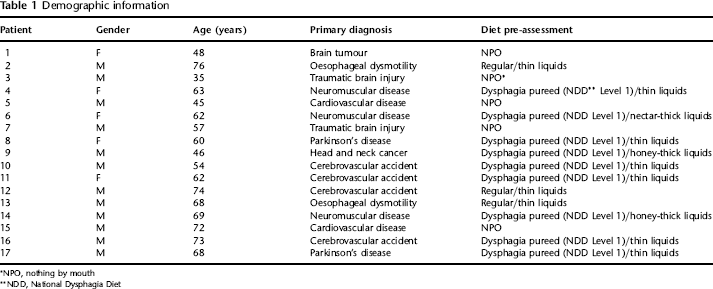
Over a period of 9 months, 17 patients were recruited (12 males and 5 females), see Table 1. The study was approved by the appropriate ethics committees.
Demographic information
NPO, nothing by mouth
NDD, National Dysphagia Diet
Raters
The Raters were two experienced SLPs, certified by the American Speech-Language-Hearing Association, and one ICU physician, newly trained in dysphagia. The on-site physician (Rater 1) directed and evaluated the videofluoroscopic assessment in the Greek hospital following a protocol (see below). The off-site expert was an experienced SLP (Rater 2) who independently evaluated all VFSS evaluations one-day later. A second off-site SLP (Rater 3) evaluated about 20% of all data in order to measure inter-rater reliability.
After their physician referred a patient for a swallowing evaluation, the on-site clinician (Rater 1) completed a detailed bedside clinical examination. When deemed necessary, a VFSS was performed. During the videofluoroscopic swallow evaluations, at least four bolus types were administered: 5 ml of thin liquid barium from a spoon, thin liquid barium from a cup (self-administered), 5 ml of a semisolid barium from a spoon and a 5 ml bite of bread with barium coating. The off-site expert (Rater 2) reviewed all the information and rated the VFSS evaluations independently. Rater 3 reviewed all data after the 17 VFSS evaluations had been completed.
Variables examined
Agreement was examined for eight diagnostic indicators of swallowing impairment and an overall subjective severity index. The diagnostic indicators were: (1) oral residue, (2) vallecular residue, (3) pyriform sinuses residue, (4) aspiration, (5) silent aspiration, (6) penetration, (7) silent penetration and (8) delayed pharyngeal response. Each was rated on a 3-point scale (1 = present; 2 = absent; 3 = cannot rate). The severity of swallowing difficulty for each patient was rated on a four point scale (1 = normal, 2 = mild, 3 = moderate, 4 = severe). 5 Agreement on the diagnostic indicators was assessed using total agreement (number of concordant pairs in the total sample) and the kappa coefficient. Agreement on the severity index was assessed using Kendall tau.
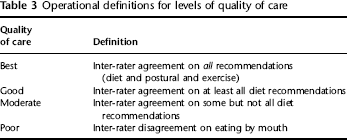
At the end of each assessment, clinicians were also asked to choose from ten common treatment options for patients with dysphagia (see Table 2). These recommendations were divided into dietary recommendations and posture/exercise recommendations. Clinicians were asked to choose as many recommendations as they considered appropriate for each patient. Treatment recommendations from the on-site assessment were compared to the expert recommendations from off-site to determine the quality of care that would have been provided if teleconsultation had not been employed, see Table 3 for definitions.
Categories of treatment recommendations

Operational definitions for levels of quality of care
Results
There were 17 patients and 17 evaluations (one for each patient). Each evaluation included at least 3 swallows, depending on the patient's abilities. A total of 87 swallows were analysed independently by Raters 1 and 2. A total of 18 swallows were rated by Rater 3.
Diagnostic indicators
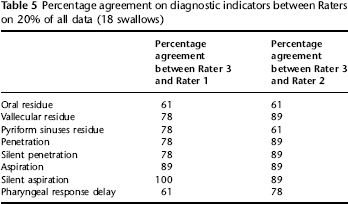
The agreement between Raters 1 and 2 was moderate to high (ranging from 78% to 90%; kappa = 0.52-0.71) for six of the eight diagnostic indicators, see Table 4. The agreement between Rater 1 and Rater 3 ranged from 61% to 100%, and was approximately the same as the agreement between Rater 2 and Rater 3 (ranging from 61% to 89%), see Table 5. For four of the eight diagnostic indicators there was a higher inter-rater agreement between Raters 2 and 3, while in two of the indicators there was a higher inter-rater agreement between Raters 1 and 3. This suggests that the good agreement between Raters 1 and 2 was not merely because of the trainer/trainee relationship between them.
Agreement on diagnostic indicators between rater 1 (on-site) and rater 2 (off-site expert)
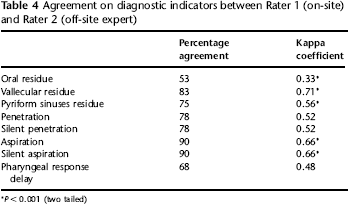
P< 0.001 (two tailed)
Percentage agreement on diagnostic indicators between raters on 20% of all data (18 swallows)
Overall severity
There was a significant correlation between Raters 1 and 2 for the overall severity index (Kendall's tau = 0.67, P = 0.003), see Figure 2. There was exact agreement on severity ratings in 10 of the 17 cases (weighted kappa = 0.55). For six patients disagreement was within 1 point in the 4-point scale. For one patient (Patient 6) disagreement was more than 2 points. In all ratings that showed disagreement the expert rater (Rater 2) consistently gave higher (i.e. more severe) scores than Rater 1.
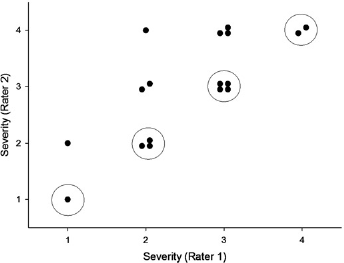
Severity ratings by rater 1 (on-site in greece) and rater 2 (off-site expert in the US). circled ratings represent exact agreement
Treatment recommendations
The number of agreements and disagreements on the two treatment categories (dietary and posture/exercise) for each patient and the level of quality of care designated are shown in Table 6. Good and best levels of quality of care would have been achieved without telemedicine in 8/17 cases, moderate level of care in 7/17 cases and poor quality of care in 2/17 cases (Table 7).
Numbers of agreements and disagreements in each recommendation category and resulting level of care without teleconsultation

Including disagreement on NPO status
Quality of care if teleconsultation had not been employed

Discussion
To our knowledge the present study is the first international pilot trial of the value of teleconsultation in providing care for patients with dysphagia. The results show that asynchronous teleconsultation can improve the quality of care for patients with dysphagia. Despite moderate agreement for most diagnostic indicators of swallowing impairment and severity ratings, the management decisions made by the on-site clinician were not always the same as those of the expert. Indeed, the quality of care would have been substandard for more than half of the patients if teleconsultation had not been employed. For two patients the care would have been poor, since Rater 1 would have allowed these two patients to continue eating orally, which was not deemed appropriate or safe by the expert.
Inter-rater agreement on most diagnostic indicators of swallowing impairment was moderate to high. Agreement was higher on diagnostic indicators such as the presence of aspiration, silent aspiration and pharyngeal residue (pyriform sinuses and vallecular residue), which is in agreement with previous studies showing the highest reliability scores for the presence of aspiration8–11 and pharyngeal residue.11,12
Agreement on oral residue and pharyngeal delay was poor. There are a few possible explanations for this finding. Regarding oral residue, several older patients had metal dental fillings, which partially obstructed the view of the oral cavity. Furthermore, few patients moved outside the full field of view for some of their swallows, and during these swallows accurate judgement of oral residue was difficult because the oral cavity was not in full view. Regarding pharyngeal delay, the main reason for the low agreement was the reduced frame rate of image acquisition, which was limited to 14 frames/s by the radiology equipment available.
Agreement on overall severity ratings was exact for more than half of the patients and within one-point on the 4-point scale for all other patients except one. For one patient the disagreement was more than two points apart. This patient had completed only three swallows during their videofluoroscopic swallowing study and it is possible that the two raters interpreted this limited study differently.
Limitations
A limitation of the present study was that at times, the remote expert (Rater 2) had difficulty in deciding on the best treatment recommendations based on the stored imaging sequences. Real-time telemedicine would permit a more comprehensive evaluation of the patients to be completed. Another technical limitation was the frame rate of image acquisition, which was limited to 14 frames/s. Higher frame rates would allow more detailed examinations to be performed.
The use of an on-site physician instead of an SLP was a consequence of the constraints of the hospital in Greece. This was an important limitation, especially considering the short time that was available for training and the immediate need to assess patients who had received no previous swallowing care. This limitation led to trainings, rating scales and recommendation categories being rather basic, and not nearly as detailed as is normal in a typical US hospital. This limited the amount and depth of our analysis and should be improved in future studies.
In conclusion, the present investigation showed that in settings where an expert is not available, the use of store-and-forward telemedicine for expert consultation will improve the quality of care for patients with dysphagia.
Footnotes
Acknowledgments
We thank Mr Hippocrates Sendoukas for setting up and maintaining the website, and Ms Loukia Psychogios for helping with data collection.