



Abstract
We examined the agreement between a videoconference-based evaluation and a bedside evaluation in the management of acute traumatic wounds in an emergency department. Adult and paediatric patients with acute wounds of various severities to the face, trunk and/or extremities presenting to the emergency department within 24 hours of injury were enrolled. Research assistants transmitted video images of the wound to an emergency physician using a laptop computer. The physician completed a standard wound assessment form before conducting a bedside evaluation and then completing a second assessment form. The primary outcome measure was wound length and depth. We also assessed management decision-making. A total of 173 wounds were evaluated. The correlation coefficient between video and bedside assessments was 0.96 for wound length. The mean difference between the lengths was 0.02 cm (SD 0.91). Management of the wound would have been the same in 94% of cases. The agreement on wound characteristics and wound management ranged from 84-100%. The highest correlation was 0.92 in suture material used and the lowest correlation was 0.64 in wound type. The ability of video images to distinguish between a minor and non-minor wound, and predicting the need for hospital management, had high degrees of sensitivity and specificity. The study showed that wound characteristics and management decisions appear to correlate well between video and bedside evaluations.
Introduction
The care of wounds may require simple irrigation and closure, or may require extensive imaging followed by a complicated surgical procedure. A clinician must be well versed in emergency medicine and trauma management to determine what level of care is required. Telemedicine has been used in the management of both acute and chronic wounds.1–3
There appear to have been no studies in which acute traumatic wounds have been evaluated with portable wireless telemedicine equipment and a bedside evaluation has been employed for comparison. The purpose of the present study was to determine the agreement between a videoconference-based evaluation and a bedside evaluation in the management of acute traumatic wounds in an emergency department setting.
Methods
The study involved an attending or resident physician evaluating a wound initially via videoconferencing with the ability to guide the examination; the physician then made a management plan. The same physician then performed a bedside evaluation and completed a second management plan. This allowed comparison of the evaluations and management plans, with the bedside evaluation acting as a gold standard.
The study was conducted in two sites of an urban, level 1 adult and paediatric trauma centre emergency department. At one site, there are approximately 70,000 adult patients per year and 58 acute care beds. At the other site, there are approximately 36,000 paediatric patients per year (<18 years) and 33 acute care beds.
The participants included adult and paediatric patients who had sustained trauma resulting in an open wound. Only patients who were initially seen by the resident staff were included. Patients were excluded from the study if their wound required urgent operative management, had a wound that would not allow the time required to be evaluated by both methods (video and bedside) before a treatment plan was initiated, or could not consent to the study. Patients were evaluated for enrollment by a third-year resident physician (i.e. postgraduate year 3). If the inclusion/exclusion criteria were met, the study was explained to the patient. Written informed consent was obtained from all patients, or patient's parents in case of minors, whose wound was being evaluated. The study was approved by the appropriate ethics committee.
The equipment consisted of two computers (MacBook Pro, Apple, Inc., Cupertino, CA), a digital video camera (JVC, Model No. GR-D750U, 34× optical zoom, 800× digital zoom), firewire 400 and i-chat via an 802.11 wireless network. One computer was set up in a room in the emergency department (ED) for the evaluator, a doctor who had not yet been in contact with the patient. The second computer was portable and could be taken to the patient's bedside. The patient's wound was then evaluated using the presentation protocol. The study investigator described the patient to the attending doctor. Video was transmitted through i-chat, including the history, multiple views of the wound and a neurovascular examination. Patients were allowed to interact at the direction of the evaluator, who then completed a standard collection form. The video assessment form included questions regarding wound characteristics, a treatment plan and video quality. Immediately following the video assessment, the evaluator performed a standard bedside evaluation and completed a bedside assessment form. The ED physician knew that he/she was evaluating the patient they had just seen by video. The data obtained on the bedside assessment form included the same information collected on the video assessment, except questions regarding video quality. The two forms were compared for concordance.
Analysis
The primary outcome measure was wound length and depth. We also assessed the wound location, shape, description and degree of contamination, and the management decision making (suture material and size, anaesthetic choice, irrigation choice, closure necessity, method and location). For each of these measures we determined how accurately emergency physicians could assess a wound via a web-based videoconference compared to bedside evaluation. We also compared the management of the wound by the two modalities.
The sample size required to determine whether observers would be within 20% agreement between video and bedside assessment of wound characteristics at a significance level of 0.05 was 132 patients.
Agreement was described using percentage agreement and correlation between groups (video and bedside) was performed using Spearman's Rank Correlation. A Bland and Altman plot was used to assess the level of agreement in length by comparing the differences in length measured at bedside versus by video.
Results
A total of 173 wounds was evaluated in 173 different patients (1 wound per patient); 57% of wounds were on the extremities, 27% on the face, 10% on the scalp and 7% on the trunk. The mean age of the patients was 42 years (SD 20), 84% were male and the mean time to presentation was 3.1 h (SD 3.4). Attending physicians completed 48% of the evaluations and the remainder were completed by senior (postgraduate year 3) residents. Twenty different attending physicians and 12 different senior residents completed the study evaluations. The mechanisms of injury were: 40% were cut by an object, 20% were falls, 15% were involved in a motor vehicle collision, 6% were pedestrians struck by a vehicle, 6% were assaults, 5% were direct blows, 4% were motorcycle crashes and 4% were gunshot wounds. The patient characteristics are summarized in Table 1.
Characteristics of the patients (n = 173)
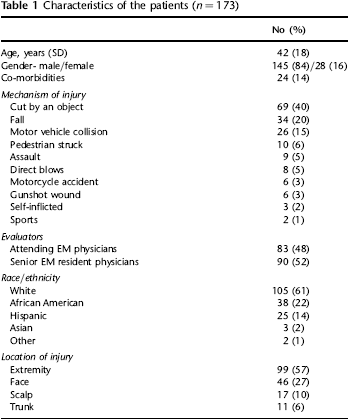
The correlation coefficient between video and bedside assessments was 0.96 for wound length. Management of the wound would have been the same in 94% of cases. The agreement on wound characteristics and wound management ranged from 84-100%, see Table 2. The highest correlation was 0.92 in suture material used and the lowest correlation was 0.64 in wound type (Table 3). The study evaluators’ rating of video image quality is summarised in Table 4. The ability of video images to distinguish between a minor and non-minor wound, and to predict the need for hospital management had high degrees of sensitivity and specificity (Table 5).
Percentage agreement between video-based and bedside evaluation

Wound characteristics and management details

Video image quality assessment

Sensitivity, specificity and predictive value of video for wound severity and the need for hospital management

The distribution of wound length data between video and bedside is shown in Figure 1. A comparison of length (in cm) measured at the bedside and by video is shown in Figure 2. The mean difference between the lengths was 0.02 cm (SD 0.91). Most of the differences in length fell within 1 SD (and within 1 cm) indicating that any differences were small. The close correlation between video and bedside depth measurements is shown in Figure 3.
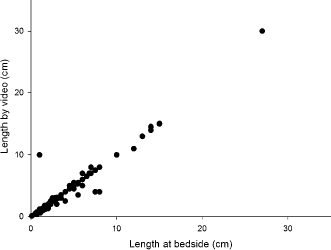
Wound length measured at bedside and by video

Bland-Altman plot of wound length measured at the bedside and by video
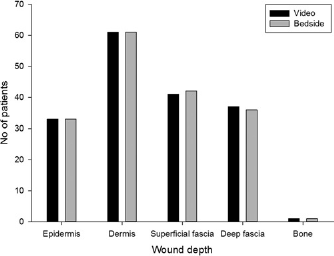
Wound depth evaluated by video and at the bedside
Discussion
Our study demonstrated a high degree of agreement, as well as a good correlation, between a telemedicine and bedside acute wound evaluation. Wound length, depth, assessment of degree of contamination and management interventions were all greater than 90% in agreement between the two modes of evaluation. The high sensitivity and specificity allow wound severity and the need for in-hospital management to be determined. This is important if an acute wound needs to be evaluated from a distance.
Various study designs have been used to assess telemedicine in wound management. One previous study compared physicians’ assessment of subacute wounds via still images with a bedside assessment, and found a high correlation. 2 A second study documented the successful use of telemedicine in prehospital care prior to physician evaluation, but did not make a direct before and after comparison by the same clinician. 4 Another study compared wound evaluation and management decisions made by technicians in the field to those made in the ED by physicians, and found a high correlation. 5
In our study, physicians completed telemedicine evaluations of acute traumatic wounds using mobile videoconferencing.
The present study demonstrates that off-the-shelf telemedicine might be useful in the rapid initiation of care. It would also provide emergency physicians with an opportunity to teach remote staff about wound management, and improve management decisions at the periphery.
The present study had certain limitations. For example, it was not a blinded study and the order of the presentation was not randomized. Also, the same physician evaluators completed both evaluations, which may have produced bias; future research might measure the between- and within-observer variance specifically. Finally, future studies might specify which parameters were being used to necessitate transfer, for example the need for specialty care, radiological imaging or observation, in order to avoid potential bias.
The present study demonstrates that wound characteristics and management decisions appear to correlate well between video and bedside evaluations. This may be useful in disaster management, and in assisting small peripheral EDs that may benefit from distant sub-specialist input.
Footnotes
Acknowledgements
We thank the residents and faculty from the Orlando Regional Medical Center emergency medicine residency programme for their participation. The research was supported in part by EMS Awards grant funding made available by the state of Florida and issued by the Orange County Government.